Skip to content
Seeking guardianship of a parent is a profound step, taken when you believe they can no longer safely manage their own medical care or finances. In Texas, you must prove to a court that your parent is legally incapacitated and that guardianship is the least restrictive way to protect them. The process involves filing a formal application, submitting a signed certificate from a physician, and attending a court hearing where a judge makes the final, critical decision.
When Is Guardianship for a Parent Actually Necessary?
Deciding to pursue guardianship for a parent is one of the most challenging choices an adult child can face. It's an emotional journey, often filled with concern about preserving your parent's dignity while ensuring their well-being. We understand the weight of this responsibility and are here to guide you with compassion.
Under Texas law, guardianship is a protective measure of last resort. It's designed to safeguard a vulnerable adult only when they can no longer protect themselves from harm.
This legal step becomes necessary when a parent is deemed legally incapacitated, a specific term defined in the Texas Estates Code (Title 3, Subtitle G). This isn't just about old age or occasional forgetfulness. Incapacity means that, due to a physical or mental condition, an adult is substantially unable to provide their own food, clothing, or shelter, care for their physical health, or manage their financial affairs.
Real-World Scenarios That Justify Guardianship
To understand when a Texas court might step in, it helps to look at practical situations where a parent's safety is clearly at risk.
Consider these common and heartbreaking examples:
- Financial Vulnerability: A parent with dementia begins making large, uncharacteristic withdrawals from their bank account, sending money to online strangers. Despite the family's pleas, the behavior continues, placing their life savings in jeopardy.
- Medical Decision-Making: A parent suffers a severe stroke and can no longer communicate their wishes for medical treatment. Without a Medical Power of Attorney, doctors are unable to proceed, and the family is legally powerless to authorize critical care.
- Physical Safety Concerns: A parent with advanced Alzheimer's frequently wanders from their home in a busy Dallas neighborhood. They forget to take vital medications and can no longer manage basic hygiene, creating a dangerous living environment.
In each of these scenarios, the parent has lost the capacity to make safe decisions. When less restrictive alternatives like a Power of Attorney aren't in place or are no longer sufficient, guardianship provides the legal authority needed to intervene. You can learn more about how and why Texas courts intervene in these delicate family matters in our detailed article.
At its core, guardianship is not about taking control—it’s about providing necessary protection. It is a legal tool designed by the state to ensure the health, safety, and financial security of its most vulnerable citizens when they cannot do so for themselves.
Pursuing guardianship is a responsible, loving step to ensure your parent receives the care they need. A Texas court, such as a Harris County Probate Court, will oversee the process with extreme care, always prioritizing your parent’s best interests. This legal framework ensures every action taken is transparent, justified, and focused solely on their welfare.
The Texas Guardianship Process Demystified
Navigating the legal path to becoming a guardian for your parent can feel overwhelming. The court system, with its specific rules and unfamiliar language, is naturally intimidating. However, the guardianship process in Texas is structured and logical, with every step designed to protect your parent’s rights and best interests.
This infographic breaks down some of the common triggers that lead families like yours to consider guardianship.

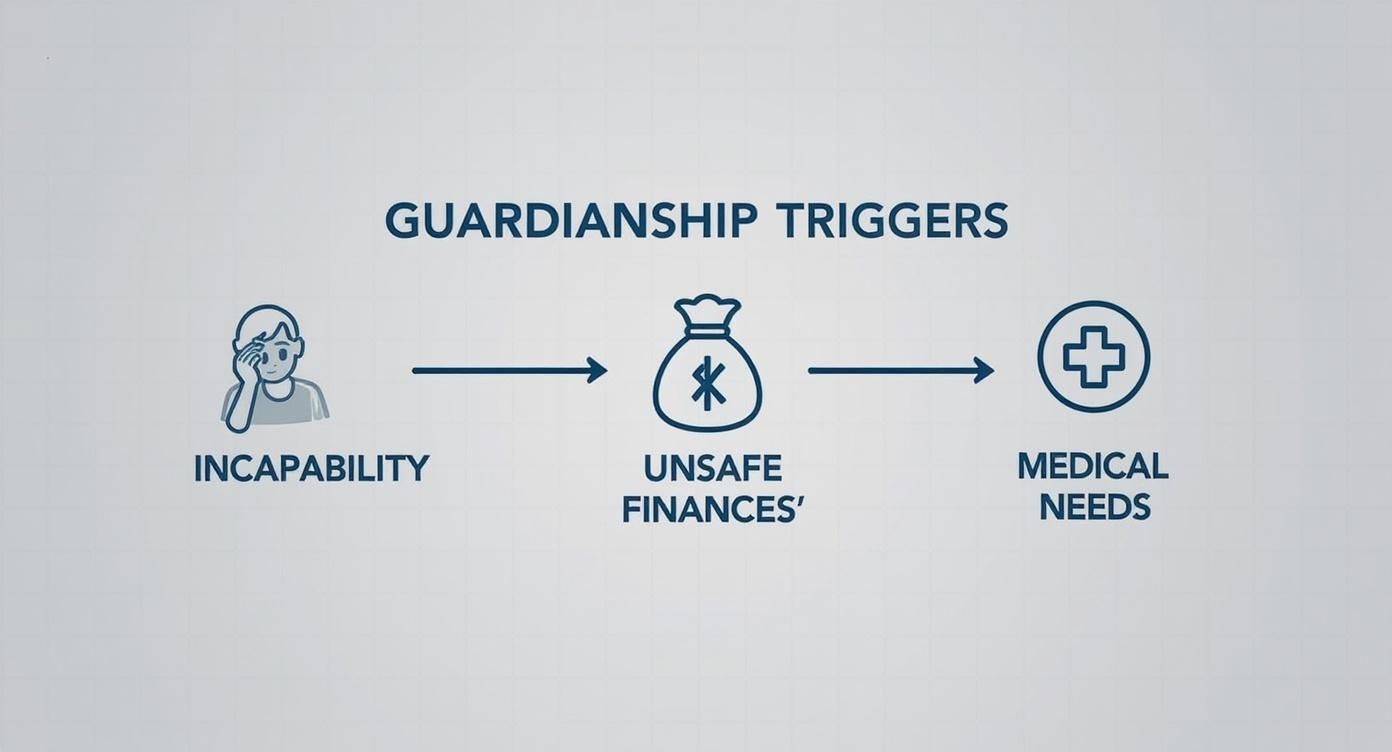
As you can see, the journey often begins when you notice a significant decline in a parent's cognitive ability, which in turn creates real risks to their financial stability and access to proper medical care.
Kicking Off the Legal Process
The journey officially begins when you, as the "applicant," file a document called the Application for Appointment of Permanent Guardian with the appropriate court. In Texas, this is typically a statutory probate court in the county where your parent resides.
This application is more than a simple form; it’s a sworn statement that presents the entire situation to the judge, including:
- Your parent's information (referred to as the "proposed ward").
- The specific reasons why you believe guardianship is necessary.
- The exact powers you are requesting (e.g., managing finances, making medical choices, or both).
- Details of close family members who must be notified.
Filing this document formally asks the court to step in and protect your parent, setting the entire legal process in motion.
The Crucial Medical Evidence
We cannot stress this enough: the single most critical piece of evidence in a guardianship case is the physician's certificate of medical examination. Under the Texas Estates Code, this is not optional—it is mandatory.
Within 120 days of filing the application, a doctor must examine your parent and complete a specific, standardized form. This document provides the court with a professional, unbiased medical opinion on your parent’s condition, evaluating their ability to handle daily tasks, manage finances, and make sound health decisions.
A judge simply cannot appoint a guardian without this medical proof. The certificate must clearly state, in the doctor's expert opinion, that your parent is incapacitated and requires the protection of a guardianship.
The Court's Independent Investigation
Once your application is filed, the court takes an active role by appointing two key individuals to ensure the process is fair and focused on your parent's well-being.
First is the court investigator. This person acts as the court's eyes and ears, visiting your parent, observing their living situation, and interviewing them, you, and other relevant parties. Their job is to provide an impartial report to the judge.
Second is the attorney ad litem. This is an independent lawyer appointed by the court for one reason: to represent your parent. The ad litem will meet with your parent, explain what’s happening in an understandable way, and advocate for their wishes. If your parent states, "I don't want a guardian," it is the ad litem's duty to fight for that outcome in court.
The Guardianship Hearing
Everything culminates at the court hearing, where the judge considers all the evidence to make a final decision. You, your attorney, the attorney ad litem, and sometimes your parent will be present.
During the hearing, the judge will review:
- The Application for Guardianship.
- The physician's certificate of medical examination.
- The court investigator's report.
- The recommendations from the attorney ad litem.
You will likely be asked to testify about why you believe your parent needs a guardian. The legal standard is high: you must prove by "clear and convincing evidence" that your parent is incapacitated and that guardianship is the least restrictive option available to keep them safe.
This is a significant journey, and you're not alone. According to the National Center for State Courts, approximately 1.3 million adults in the U.S. are under guardianship, with guardians managing assets worth about $50 billion. This highlights how vital this legal tool is in protecting our elders. You can read more about the national scope of guardianship from their report.
If the judge agrees that guardianship is necessary, they will sign an order appointing you. From there, you will have a few final administrative tasks, like taking an oath and possibly posting a bond, before you can officially assume your role. Navigating Texas probate law can be complex, but with our guidance, we can ensure your parent is protected with both compassion and legal precision.
Exploring Less Restrictive Alternatives


Before a Texas court will impose a guardianship—a process that removes a person's fundamental rights—it is legally required to determine that no less intrusive option will suffice.
This principle is known as exploring less restrictive alternatives, a vital safeguard within the Texas Estates Code. It ensures guardianship remains a last resort, used only when absolutely necessary to protect your parent.
Many families we work with are relieved to learn they can often achieve their protective goals without the time, expense, and emotional strain of a formal court proceeding. The key is that these alternative documents must be signed while your parent still has the mental capacity to understand them.
The Power of Proactive Planning
So, what are these alternatives? The most common and effective are powers of attorney. These are legal documents where your parent (the "principal") grants a trusted person (the "agent") the authority to make decisions on their behalf.
Let's walk through a practical scenario. Imagine your father, aware of his family's history of heart conditions, proactively met with an Estate Planning attorney years ago. He signed two key documents:
- Durable Power of Attorney: This gives his chosen agent the power to manage his finances—paying bills, handling bank accounts, filing taxes—if he becomes unable to do so himself.
- Medical Power of Attorney: This allows his agent to make healthcare decisions for him if he cannot communicate his wishes.
Years later, he suffers a major medical event and is incapacitated. Because these documents are in place, his child can immediately step in to authorize treatments and manage his finances without court intervention. This foresight saved the family from a stressful emergency guardianship hearing during an already overwhelming time.
Other Supportive Options in Texas
Powers of attorney are foundational to proactive planning, but they aren't the only tools available. Texas law offers several other ways to support a parent.
According to the Texas Estates Code §1001.001, before appointing a guardian, a court must find by clear and convincing evidence that less restrictive alternatives have been considered and determined to be infeasible.
This legal requirement mandates a thoughtful exploration of every available path. Other practical options include:
- Supported Decision-Making Agreements: A formal arrangement where your parent chooses trusted advisors—like you, other relatives, or friends—to help them process information and make their own choices, keeping their autonomy intact.
- Representative Payee: If your parent receives government benefits like Social Security, you can apply to become their representative payee to manage those specific funds on their behalf.
- Trusts: A living trust allows a designated trustee to manage a parent's assets for their benefit, offering a powerful way to protect their estate from mismanagement.
Each option provides a different level of support, allowing you to tailor a solution to your parent's unique needs.
Guardianship vs. Less Restrictive Alternatives
Choosing the right level of support can feel daunting. This table helps clarify the differences between full guardianship and common alternatives.
| Feature | Full Guardianship | Durable Power of Attorney | Medical Power of Attorney |
|---|---|---|---|
| Decision-Maker | Court-appointed guardian | Agent chosen by the individual | Agent chosen by the individual |
| When Effective | Upon court order of incapacity | Immediately or upon incapacity | Only upon incapacity |
| Scope of Power | Broad control over personal and/or financial life | Financial decisions only | Medical decisions only |
| Court Involvement | Extensive, ongoing court supervision | None, unless challenged | None, unless challenged |
| Cost & Complexity | High cost, complex legal process | Low cost, simple to create | Low cost, simple to create |
| Autonomy | Individual's rights are removed | Individual retains all rights | Individual retains all rights |
As you can see, alternatives like powers of attorney can provide essential support while preserving your parent's independence and dignity.
To help you weigh your options, our firm has created a detailed guide. You can learn more by reading our article on the different alternatives to guardianship available in Texas. Understanding these alternatives is a crucial first step in choosing the most compassionate path for your family.
Handling Urgent Cases with Temporary Guardianship

Sometimes, a crisis doesn't allow for the deliberate pace of the standard legal process. When your parent faces an immediate and substantial risk, waiting weeks for a permanent guardianship hearing is simply not an option.
This is where Texas law provides a powerful, fast-tracked solution: temporary guardianship.
Imagine your mother is hospitalized after a sudden accident and is unconscious, unable to consent to a critical surgery. Or perhaps you've discovered your father is being financially exploited, with thousands of dollars vanishing from his accounts weekly. These emergencies require immediate action.
Proving Imminent Danger to the Court
To secure a temporary guardianship, you must provide the court with substantial evidence that an imminent danger exists. Under the Texas Estates Code, Section 1251.051, this means proving the proposed ward is likely to suffer physical harm or significant financial loss if someone is not appointed to act immediately.
A judge in a Travis County or Bexar County probate court will look for concrete proof, such as:
- A sworn affidavit from a physician detailing an urgent medical need.
- Bank statements showing unusual and alarming transactions.
- Testimony from caregivers or family who have witnessed dangerous behavior or exploitation.
This process is built for true emergencies, creating a legal bridge to protect your parent while proceedings for a permanent solution get underway. For a deeper dive, read our comprehensive guide on what temporary guardianship is and how it works.
The Scope and Duration of a Temporary Order
If the court agrees an emergency exists, it will appoint a temporary guardian. This appointment is specific and strictly time-limited.
A temporary guardianship is a critical intervention that provides immediate, short-term authority. It typically lasts for no more than 60 days, giving the family and court time to establish a long-term protective plan.
The judge will clearly define the temporary guardian's powers, tailoring them to the specific crisis. For instance, if the emergency is medical, the order might only grant the power to make healthcare decisions. If it’s financial, the powers might be limited to freezing bank accounts and paying essential bills.
This reliance on family in crises is a global pattern. You can discover more insights about this global kinship care phenomenon from recent studies. This legal tool ensures that when a crisis hits, there is a clear, court-authorized path to protect your parent without delay.
Your Duties and Responsibilities as a Guardian
When a judge signs the order naming you as your parent's guardian, it is a significant moment. But this is not the finish line; it is the starting line for a new set of profound responsibilities.
Being a guardian is a serious legal and ethical role. You are now a fiduciary, legally bound to act only in your parent’s best interest. This duty extends far beyond the courtroom and involves ongoing obligations to both your parent and the Texas court that entrusted you with this role.
What to Do Immediately After Your Appointment
The moment the order is signed, the clock starts ticking. The Texas Estates Code outlines the initial tasks you must complete to officially "qualify" as a guardian.
Here’s what you’ll need to do right away:
- Take the Oath of Guardianship: You must appear before the court clerk and take a sworn oath, promising to faithfully carry out your duties.
- Post a Bond: In most cases, especially for a guardian of the estate, the court will require you to post a fiduciary bond. This is an insurance policy that protects your parent’s assets from potential mismanagement.
- Receive Your "Letters of Guardianship": Once the oath is taken and the bond is posted, the court issues this official document. The Letters of Guardianship are your proof of authority to show banks, doctors, and other institutions.
These are not mere administrative hoops; they are critical legal steps that activate your authority to act on your parent's behalf.
Juggling Your Parent's Well-Being and Finances
Once qualified, your day-to-day duties begin. Your role will generally fall into one or both of these categories.
As guardian of the person, your focus is on your parent’s personal and medical well-being. This includes:
- Deciding where your parent will live, ensuring it is a safe and supportive environment.
- Making healthcare decisions and consenting to medical treatments.
- Ensuring they receive proper nutrition, daily care, and social engagement.
As guardian of the estate, you become the manager of your parent's financial world. Your duties include:
- Locating, gathering, and securing all of their assets.
- Paying their bills, managing investments, and filing tax returns.
- Developing and adhering to a court-approved budget for their care.
This level of oversight is common in legal systems designed to protect vulnerable adults. You can discover more insights about international guardianship practices and their legal foundations.
Keeping Up with Court Reporting and Compliance
Your relationship with the court is ongoing. To ensure transparency and accountability, Texas law requires guardians to file regular, detailed reports.
Under Texas Estates Code, Title 3, Subtitle G, guardians have 90 days from their appointment to file a complete Inventory, Appraisement, and List of Claims. After that, annual reports are required. This is a non-negotiable legal deadline.
The key compliance documents include:
- Inventory, Appraisement, and List of Claims: A detailed list of every asset your parent owns, filed shortly after your appointment.
- Annual Report on the Well-Being of the Ward: A yearly update on your parent’s health, living situation, and overall condition.
- Annual Accounting: A yearly financial report detailing every dollar that came in and went out of your parent’s estate.
Missing these deadlines can have serious consequences, including removal as guardian. We can help you stay organized and meet every requirement, honoring the commitment you've made to your parent.
Your Top Questions About Parent Guardianship Answered
When you're first exploring how to get guardianship of a parent, a flood of questions is completely normal. It’s a path filled with legal complexities and emotional weight. Families often worry about the cost, how long it will take, and what happens if everyone isn't on the same page. Let's walk through the most common concerns we hear from Texas families to give you some clarity and confidence.
How Much Does It Cost to Get Guardianship of a Parent in Texas?
This is usually the first question people ask, and the honest answer is: it depends. There's no flat fee for guardianship in Texas because the total cost is tied directly to the complexity of your parent's situation. If the case is simple and the whole family is in agreement, you'll be on the lower end of the cost spectrum.
But if a sibling or another relative decides to fight the guardianship, the costs will climb. A contested case means more legal work, potential mediation, and a formal court hearing, all of which add to the final bill.
Here’s a breakdown of the typical costs you can expect:
- Court Filing Fees: Every county in Texas has its own fee just to get the application filed.
- Physician's Examination Fee: The doctor who provides the official medical report will charge for their time and expertise.
- Attorney Ad Litem Fees: The court appoints an independent lawyer to be your parent's advocate. Their fees are usually paid out of your parent’s assets, or "estate."
- Your Own Legal Fees: This covers the cost for your attorney to prepare the application, handle all the court filings, and represent you at the hearing.
Since every family's circumstances are different, the best way to get a realistic cost estimate is to discuss your specific case. We offer a free consultation for this exact reason—it lets us give you a much clearer picture of the potential expenses involved.
What Happens if Another Family Member Disputes the Guardianship?
Disagreements among family members can make a tough situation even harder, both emotionally and financially. When a sibling or other relative objects to the guardianship—maybe they don’t think it's needed, or they want to be the guardian instead—the case becomes “contested.”
When this happens, the judge sets the matter for a contested hearing, which is essentially a trial. Both sides get to present their evidence, bring in witnesses, and argue their case before the judge.
The court has one single focus in these disputes: the best interest of the proposed ward. A judge will hear everyone out, but the final decision will be based purely on what is safest and best for your parent.
This is a scenario where having an experienced guardianship attorney is non-negotiable. Your lawyer is crucial for building a strong case, presenting your evidence effectively, and making sure your parent's well-being remains the central focus, even in the middle of a family conflict.
Can My Parent Fight the Guardianship Petition?
Yes, they absolutely can. Texas law is fierce about protecting an individual's right to make their own decisions. Your parent has every legal right to object to having a guardian appointed for them.
To make sure their voice is heard, the court appoints an attorney ad litem. This lawyer's only job is to represent your parent's wishes. If your parent says, "I don't want a guardian," that attorney's duty is to fight for that position in court, regardless of what you or anyone else thinks is best.
The bar for proving someone is incapacitated is set high for a reason. You must show "clear and convincing evidence" that your parent can no longer manage their own affairs. Your parent's own testimony and expressed desires are a huge part of the judge's final decision.
How Long Does the Texas Guardianship Process Take?
The timeline can really vary. In a straightforward, uncontested case where the medical evidence is clear and everyone agrees, things can move pretty fast. You could be looking at as little as four to eight weeks from filing the application to the final court hearing.
But a few things can slow the process down:
- Contested Cases: Family disputes can easily add several months to the timeline.
- Administrative Delays: Sometimes, the courts are just busy. A packed docket in a place like the Harris County Probate Court can cause delays.
- Gathering Evidence: It might take a while to get the doctor’s exam scheduled or for the court's investigator to finish their report.
In a true crisis, however, you don't have to wait. If there's proof of immediate danger to your parent's health or finances, an emergency or temporary guardianship can often be put in place within just a few days.
Getting answers to these questions is the first step in protecting your parent. At The Law Office of Bryan Fagan, PLLC, we provide the compassionate guidance and legal expertise your family needs during this challenging time. For a clear path forward and answers to your specific questions, schedule a free, no-obligation consultation with our experienced Texas guardianship attorneys today. You can get started by visiting us at https://texasguardianshiplawyer.net.