Skip to content
Thinking about a last will and testament form for Texas can feel like a heavy topic, but it's genuinely one of the most powerful and caring steps you can take to protect the people you love. We understand this process involves facing difficult questions. Our goal is to guide you with clarity and care. This isn't just a legal document; it's your voice, ensuring your wishes are honored and your family is spared from unnecessary confusion and emotional hardship during an already difficult time.
Your Guide to Securing Your Family's Future in Texas
Creating a will isn’t just for the wealthy. It’s a foundational estate planning tool for every Texas family, regardless of the size of your estate. A properly prepared will brings clarity when it's needed most. It allows you to name an executor to handle your affairs, specify who receives your assets, and—most critically for parents—appoint a guardian to care for your minor children.
Why a Will is Non-Negotiable in Texas
If you pass away without a valid will, the State of Texas will make these deeply personal decisions for you. This process, known as "intestate succession," follows a rigid legal formula that rarely aligns with a family's unique dynamics or your personal wishes. Your property could be divided in ways you never intended, sparking disputes and emotional hardship for the people you leave behind.
Unfortunately, many people put this off. A recent survey revealed that only 24% of respondents reported having this vital document. You can discover more about these estate planning trends and their implications.
In Texas, the stakes are particularly high. Under the Texas Estates Code, if a valid will isn't filed with the court within four years of a person's death, the estate is automatically subject to the state's impersonal intestacy rules. At that point, any say you had in the matter is gone for good.
Key Elements of a Valid Texas Will at a Glance
To make sure your will is legally binding, it has to meet a few core requirements under Texas law. We've broken them down here to give you a clear picture of what a court, like the Harris County Probate Court, will look for.
| Requirement | Description | Why It Matters |
|---|---|---|
| In Writing | The will must be a physical document, not just spoken words. | This provides a clear, permanent record of your wishes, cutting down on any potential for arguments or misinterpretation later on. |
| Signed by Testator | You (the testator) must sign the will. Or, you can direct someone to sign it for you, but they have to do it in your presence. | Your signature is the legal confirmation that the document truly reflects your intentions and that you approve of its contents. |
| Attested by Witnesses | Two credible witnesses, who must be at least 14 years old, have to sign the will in your presence. | Witness signatures validate your identity and confirm you had the mental capacity to sign the document, adding a crucial layer of legal protection. |
Getting the details of a last will and testament form for Texas right can feel complex, but understanding these fundamental components is the first step toward taking control. This guide will continue to break down the process into simple, manageable actions, helping you create a plan that provides security and comfort for your family's future.
For personalized guidance on your unique situation, our team is here to help. The Law Office of Bryan Fagan is ready to assist you. Please call us at (281) 810-9760 to schedule a free consultation.
Getting the Legal Requirements Right for a Texas Will
For your last will and testament to hold up in court, it must follow specific rules laid out in the Texas Estates Code. Think of these as the non-negotiables that give your will its legal authority. A small mistake could give a probate court, whether in Harris County or elsewhere, a reason to invalidate the entire document.
It all starts with the person making the will—legally known as the testator. They must be legally qualified, which isn't just about age. It's about their mental clarity at the very moment they put pen to paper.
Who Can Legally Make a Will in Texas?
To create a valid will, Texas law says you must have testamentary capacity. In simple terms, this means you must be of "sound mind" when you sign the document. But what does that really look like?
It boils down to understanding a few key things:
- What you're doing: You know you're signing a will that will pass on your property after you die.
- What you own: You have a general sense of your assets—your house, bank accounts, car, and other major possessions.
- Who gets what: You know who your immediate family members are (like a spouse or children) and can identify the people you're choosing to inherit your property.
The standard isn't perfection. You don't need a flawless memory or to be a legal scholar. The law just wants to ensure the will reflects your true, clear intentions.
The Three Pillars of a Valid Texas Will
Beyond your capacity to create a will, the document itself has a strict format to follow. Texas law, specifically in the Estates Code, lays out three core requirements for a standard, formal will.
- It must be in writing. You can't just tell someone your wishes. An oral will is not valid in Texas; it has to be a physical document.
- It must be signed by you. As the testator, you need to sign the will. The only exception is if you have someone else sign for you, but they absolutely must do it in your presence and at your specific direction.
- It must be attested by two credible witnesses. This is a critical step. Two witnesses have to watch you sign (or watch you acknowledge your signature) and then sign the will themselves in your presence.
These witnesses are doing more than just scribbling their names. They are legally affirming that they saw you sign and that you appeared to be of sound mind and acting voluntarily.
The Rules for Witnesses
The requirements for witnesses are just as strict. In Texas, a credible witness must be at least 14 years old. Crucially, they also cannot be a beneficiary in the will. If someone set to inherit from you also acts as a witness, it can cause a legal nightmare that could void the very gift they were supposed to receive.
Hypothetical Scenario: Imagine Sarah asks her brother, Mark, to witness her will. Mark is also named as the beneficiary of her classic car. This well-intentioned error creates a conflict of interest that puts Mark's inheritance at risk and raises major red flags in probate court.
This is exactly why choosing neutral, disinterested witnesses is so vital to protecting your will's integrity. To be valid, a Texas will has several key requirements: the testator must be 18 or older (or married, or in the armed forces), be of sound mind, and the will must be written down. It needs the testator's signature and, for most wills, the signatures of two credible witnesses over age 14.
A Word of Warning on "Holographic" Wills
Now, Texas law does have one major exception to the witness rule: the holographic will. This is a will written entirely in your own handwriting. Because the whole thing is in your script, the law presumes it's authentic and doesn't require any witnesses.
But be careful here. Holographic wills are notorious for causing family fights and legal challenges. It can be surprisingly difficult to prove the handwriting is authentic, and because they're often written informally, the language can be vague or contradictory. While a holographic last will and testament form for Texas is legally an option, it's a risky path if you want to be sure your wishes are carried out without a hitch.
Taking these legal requirements seriously is the bedrock of a solid estate plan. If you want professional guidance to make sure every detail is correct, contact The Law Office of Bryan Fagan for a free consultation.
Putting Your Wishes on Paper: How to Draft Your Texas Will
This is where you formally document your wishes, giving you a clear voice in how your legacy is handled. Creating a last will and testament form for Texas is more than just listing assets; it's about providing your family with a clear, comforting roadmap during an emotional time.
Let's break down the key parts of a Texas will, using practical examples to demystify the legal terms so you can feel confident in your decisions.
Who Will Be in Charge? Naming Your Executor
Your Executor is the person you trust to manage your estate after you're gone. This individual or institution will guide your estate through the probate process, handle debts, and ensure your property is distributed to the right people, exactly as you specified. It's a role with significant responsibility.
When considering who to choose, look for someone who is:
- Honest and trustworthy: This is the most important quality. They'll have access to your finances and personal information.
- Organized and diligent: The role involves extensive paperwork and deadlines, from filing the will with the court to managing and distributing assets.
- Lives in Texas: While not a strict legal requirement, having an executor in-state can make court appearances and administrative tasks much more manageable.
You absolutely need to name an alternate executor. Life is unpredictable. If your first choice is unable or unwilling to serve, this backup ensures the process continues smoothly without the court needing to appoint someone for you. For instance, many people name their spouse as the primary executor and a trusted adult child or responsible sibling as the alternate.
Be Specific: Identifying Your Beneficiaries
Your beneficiaries are the people, charities, or organizations you want to inherit your property. The most important rule here is: be crystal clear. Vague language is the primary cause of arguments and legal battles during probate.
Don't just say, "I leave my property to my children." Instead, name each one specifically: "I leave my entire estate, in equal shares, to my son, John A. Smith, and my daughter, Jane M. Doe." This leaves no room for doubt, which is especially critical in blended families or where family relationships are complex.
You also need to plan for "what-ifs." What happens if a beneficiary passes away before you do? Your will can address this. You could add a clause like, "If my daughter, Jane M. Doe, does not survive me, her share shall be distributed to her children, in equal shares." This foresight prevents a judge from having to guess your intentions.
The Most Important Clause for Parents: Designating a Guardian
For any parent with minor children, this is the most critical part of a will. If both parents pass away without naming a guardian, a court will be forced to make this incredibly personal decision on your behalf. By designating a guardian in your will, you ensure your children are raised by someone you know, trust, and who shares your values. This is a core part of both Estate Planning and Guardianship law.
Before you name someone, have a heartfelt conversation with them. Make sure they are willing and able to take on such a profound responsibility. And just like with your executor, you must name an alternate guardian. Having a Plan B provides a vital layer of security for your children's future.
The Catch-All: Why You Need a Residuary Clause
What about assets you might forget to list? Or property you acquire after you sign your will? That’s where a residuary clause comes in. It’s a legal safety net that states who gets the "rest and residue" of your estate after all specific gifts are distributed and debts are paid.
A simple residuary clause looks like this: "I give all the rest, residue, and remainder of my estate, both real and personal, to my spouse, Michael Johnson."
Without this clause, any assets not specifically mentioned could be distributed based on Texas intestacy laws—the state's default plan, which may not align with your wishes at all.
Making Probate Faster with a Self-Proving Affidavit
Finally, let's talk about making things easier on your family. A self-proving affidavit is a separate statement attached to your will, signed by you and your two witnesses in front of a notary public. While not required for a will to be valid in Texas, it makes a huge difference during the probate process.
According to the Texas Estates Code, a will with this affidavit can be admitted to probate without requiring the witnesses to testify in court. This saves your executor significant time, money, and hassle. In busy courts like the Harris County Probate Court, this simple extra step can speed up the process considerably, allowing your estate to be settled much more quickly.
Taking the time to draft your will is a true act of care. By thinking through these key sections, you're leaving behind a clear, helpful roadmap for the people you love. If you have any questions about this process, please call The Law Office of Bryan Fagan at (281) 810-9760 for a free consultation.
Executing Your Will the Right Way
You’ve done the hard work of filling out your last will and testament form for Texas. Now comes the final, and most critical, part: making it legally binding. This isn't just about signing a piece of paper. It’s a formal legal event, often called a "signing ceremony," and getting this moment right is absolutely essential.
Texas law is very specific about how a will must be signed and witnessed. One small misstep could invalidate the entire document, unraveling all of your careful planning and leaving your loved ones in a difficult position.
The core rule, laid out in the Texas Estates Code (specifically Title 3, Subtitle G), is strict but straightforward: you (the testator) and your two credible witnesses must all be in the same room, at the same time. Everyone must watch each other sign. This requirement is designed to eliminate any doubt about the will's authenticity or your state of mind when you signed it.
The Signing Ceremony Checklist
A little preparation goes a long way in ensuring your signing ceremony is smooth and legally sound. Thinking through the logistics ahead of time can prevent major headaches for your family down the road.
- Pick a Neutral Spot: Find a quiet, private space free from interruptions. This could be an attorney’s office, a conference room, or even your kitchen table.
- Check Your Witnesses: Your witnesses must be at least 14 years old in Texas. Just as importantly, they cannot be beneficiaries in your will. Having someone who stands to inherit from you act as a witness creates a conflict of interest that can jeopardize their inheritance and complicate the probate process.
- Gather Everyone Together: You and both of your witnesses must be physically present for the entire signing. Nobody should step out of the room or sign at a different time. It all must happen in one continuous event.
This diagram illustrates the key roles you've designated in your will—all of which are protected by a proper signing ceremony.
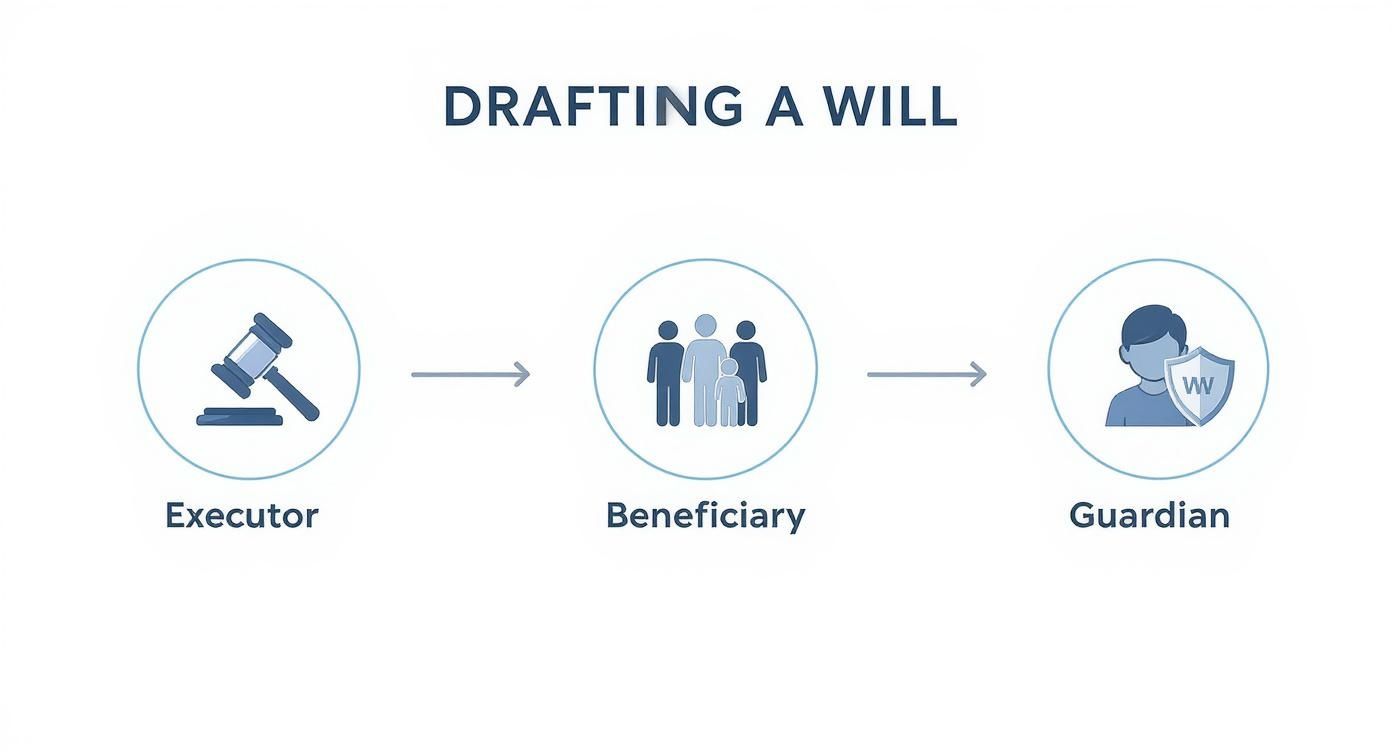
By clearly naming your executor, beneficiaries, and potential guardians, you have laid the groundwork for a secure future for your family. The signing ceremony is what locks it all in place and makes it legally binding.
A Step Worth Taking: The Self-Proving Affidavit
While signing your will in front of two witnesses makes it valid, there's one more step that can save your family a world of time and stress later on: the self-proving affidavit.
This is a separate statement, usually attached to the will itself, that you and your witnesses sign in the presence of a notary public.
Essentially, the affidavit pre-validates all the signatures. When your will eventually goes to a probate court, whether in Dallas County or Travis County, this document allows the court to accept the will as valid without having to track down your original witnesses to testify. It streamlines the entire process, making it much faster and less expensive for your executor. Understanding the full scope of their duties can help you appreciate why making their job easier is so important, and you can learn more about what an executor does in our detailed guide.
Picture this: It's ten years after you signed your will, and your executor needs to probate it. One of your witnesses has moved out of state, and the other has sadly passed away. Without a self-proving affidavit, your executor now faces a costly and difficult legal battle to prove the will's validity. With the affidavit, the process just moves forward smoothly.
This extra step isn't legally required to make your will valid, but it’s a powerful tool for simplifying the future for your loved ones. It turns what could be a major legal hurdle into a simple administrative step.
If you have questions about executing your will or want to ensure your entire estate plan is sound, our team is here to provide clarity. Schedule a free consultation with The Law Office of Bryan Fagan today by calling (281) 810-9760.
Storing and Updating Your Texas Will
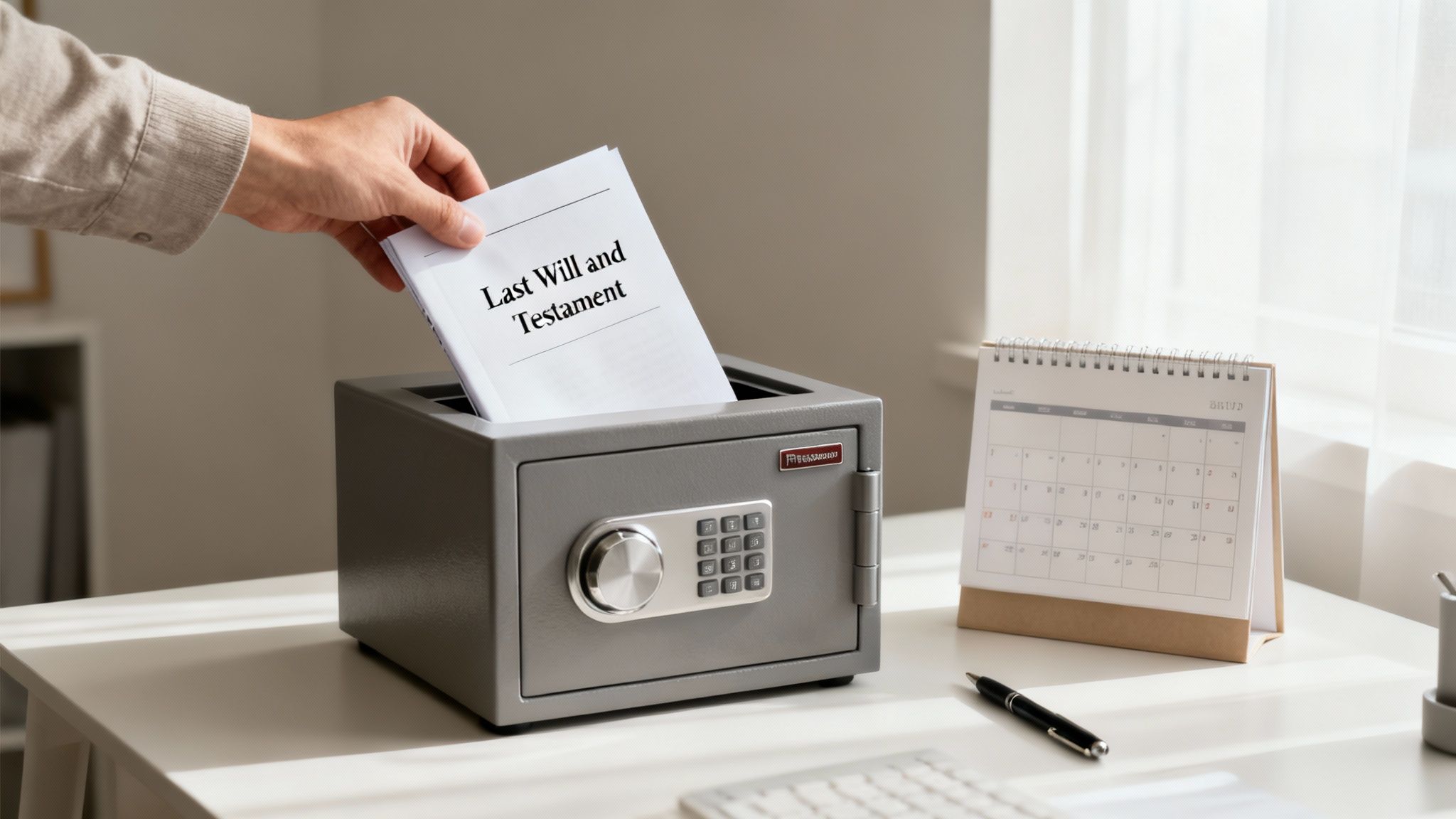
Congratulations—creating and signing your last will and testament form for Texas is a major milestone. But the work isn't quite done. A will that can't be found is as useless as one you never wrote. Knowing where to keep this critical document and when to review it for updates are the final, crucial steps in protecting your family's future.
Here’s the bottom line: your executor needs the original signed will, not a copy. Finding a storage spot that is both completely secure and readily accessible is a delicate balancing act.
Choosing a Safe Storage Location
You have a few solid options for storing your will, and each comes with its own set of pros and cons. The most important thing to consider is how easily your executor can access it when the time comes.
- A Fireproof Safe at Home: This keeps the document safe from disaster and gives you direct control. The catch? Your executor absolutely must know where the safe is and have the key or combination.
- Your Attorney's Office: Leaving the original with your estate planning lawyer is an excellent choice. It’s stored in a secure, professional setting, and the firm will have a clear record to help guide your executor through the next steps.
- A Safe Deposit Box: While this seems like the most secure option, it can backfire. If your executor isn't listed on the account, they may need a court order just to open the box, creating frustrating and costly delays.
Beyond the legalities, just figuring out a system for your important papers can be a headache. For some great tips on getting everything in order, it's worth learning how to organize important documents for good.
Knowing When to Update Your Will
Your will isn't a "set it and forget it" document. It should be a living reflection of your current life. Life changes, and your will should change with it. Plan on reviewing it every few years, or anytime a major life event occurs.
It’s time for a review if you experience:
- Changes in Marital Status: Getting married or divorced automatically has huge legal implications for your estate.
- Having a Child: You’ll need to add your new child as a beneficiary and, just as importantly, name a guardian for them.
- A Major Financial Shift: Coming into a large inheritance, starting a new business, or any other big change in your assets probably means your will needs tweaking.
- The Death of a Key Person: If your named executor, a guardian, or a main beneficiary passes away, you must update your will to appoint someone new.
Remember, the Texas Estates Code sets a four-year deadline to probate a will after a person's death. If your executor can't find the will, or if it's so outdated that it causes disputes, that window can slam shut. If that happens, the state’s intestate succession laws take over, and your wishes become irrelevant.
How to Make Changes Correctly
Need to make a small tweak, like swapping out an executor? You can use a legal document called a codicil. This is simply an amendment to your existing will, but it must be signed and witnessed with the exact same formalities as the original.
For anything more than a minor change, it's usually cleaner and safer to just create a brand-new will. A new will should always include specific language that clearly revokes all of your previous wills.
At the end of the day, keeping your will safe and current is the only way to guarantee your final wishes are honored. The decisions you make about your probate and non-probate assets are far too important to be left to chance.
If your life has changed or you need help creating a secure plan, contact The Law Office of Bryan Fagan at (281) 810-9760 for a free consultation.
When You Need an Estate Planning Attorney
While a basic last will and testament form for Texas can handle simple situations, many families discover that their circumstances are more complex than they thought. A DIY will can feel like a quick and easy solution, but we've seen how small mistakes or overlooked details can create massive legal and emotional headaches for loved ones down the road.
Think of legal advice not as an expense, but as a critical layer of protection for your family's future. An experienced estate planning attorney does more than just fill out forms. They act as your strategist, crafting a plan that fits your unique family dynamics and financial picture, often considering alternatives to guardianship or complex probate scenarios.
When a DIY Will Might Not Be Enough
Certain life events introduce complexities that a generic template just can't handle. If any of the following scenarios sound familiar, partnering with an attorney is the smartest move you can make to ensure your will is airtight and legally sound.
You should seriously consider professional guidance if you:
- Have a blended family. Second marriages with children from prior relationships can lead to will disputes. You need precise language to ensure everyone is provided for exactly as you intend, preventing accidental disinheritance or family conflict.
- Own a business. Your will must include a clear succession plan for your business. Without one, you risk operational chaos and diminishing the value of an asset you worked hard to build.
- Hold significant assets. If your estate is large enough to have tax implications, an attorney can structure your plan to legally minimize taxes, preserving more of your wealth for your beneficiaries.
- Plan to disinherit a direct heir. Excluding a spouse or child is a legally sensitive act that must be done with surgical precision to withstand an almost certain court challenge.
Exploring More Than Just a Will
Sometimes, a will isn't even the right tool for the job. For instance, if you have a child with special needs, leaving them a direct inheritance could be a catastrophic mistake. It could instantly disqualify them from receiving essential government benefits they rely on.
In that situation, an attorney would likely recommend setting up a special needs trust to hold the inheritance. This legal structure allows the money to be used for your child's benefit without counting as their personal asset, thereby protecting their access to care. This is a common alternative to guardianship that offers more flexibility.
Likewise, if your primary goal is to help your family avoid the probate process in a court like the Bexar County Probate Court, a revocable living trust might be a far better option. An attorney can walk you through these alternatives and help you decide which strategy truly meets your goals.
If your situation feels even a little complicated, a DIY approach is a huge gamble. The compassionate legal team at The Law Office of Bryan Fagan is here to bring you clarity and peace of mind. We invite you to schedule a free, no-obligation consultation to discuss your needs and ensure your family is protected, no matter what.
Common Questions About Texas Wills
Drafting a last will and testament form for Texas is a huge step, but it naturally brings up some important questions. Getting clear, straightforward answers is the best way to feel confident about your estate plan. Here are some of the most common things we hear from Texas families.
What Happens if I Die Without a Will in Texas?
If you pass away without a will, you are considered to have died "intestate," and you don't get a say in what happens to your property. Instead, the state’s “intestate succession” laws kick in. A probate court will divide everything you own according to a rigid legal formula based on family relationships.
This means your assets could go to relatives in a way you never would have wanted. And unfortunately, close friends or an unmarried partner will likely receive nothing at all.
Can I Use an Online Template for My Texas Will?
While you can find countless will templates online, they come with significant risks. Many are too generic and fail to meet the specific legal standards laid out in the Texas Estates Code.
A simple mistake—like using ambiguous language or not having the witnessing done correctly—can invalidate the entire document. This could easily lead to the very family disputes and legal battles you were trying to prevent in the first place.
Does My Will Need to Be Notarized in Texas?
Strictly speaking, a Texas will does not have to be notarized to be legally valid. However, we almost always recommend including what’s called a self-proving affidavit.
This is a separate statement that you and your witnesses sign in front of a notary. Taking this one extra step makes the probate process much faster and smoother down the road for your loved ones.
Navigating these details underscores just how important it is to get your will right. For personalized guidance to ensure your final wishes are protected, contact The Law Office of Bryan Fagan, PLLC. Schedule a free consultation with us and take the first step toward securing your family’s future.
You can learn more by visiting us at https://texasguardianshiplawyer.net.