Skip to content
When a family crisis hits, every second counts. Temporary guardianship is a legal rapid-response tool in Texas, designed for those heart-stopping moments when a child or an incapacitated adult is in immediate danger and needs protection right now. It's a way for a Texas court to quickly grant a trusted person the authority to make critical decisions, providing a legal shield to stop a bad situation from getting worse.
Facing this process can feel overwhelming. At The Law Office of Bryan Fagan, our mission is to guide Texas families through guardianship law with clarity and care. We understand the emotional and financial challenges you're facing, and this guide is here to provide the clear, compassionate answers you need.
Understanding Temporary Guardianship in an Emergency

Picture this: you get a call that your elderly mother, who has dementia, is being tricked by a new "friend" into draining her life savings. Or perhaps a child's single parent is suddenly hospitalized, leaving no one to authorize medical care if something happens. These are not problems that can wait weeks for a standard legal process. They require immediate action.
Think of temporary guardianship as a legal first-aid kit. It’s a short-term solution granted by a Texas probate court, like the Harris County Probate Court, to put a stop to an urgent problem. The primary goal is not to establish long-term control but to stabilize the crisis and protect your loved one.
The Core Purpose of This Legal Tool
The Texas Estates Code, specifically Title 3, Subtitle G, lays out the very strict rules for this emergency action. A judge will only grant a temporary guardianship if there's solid proof of an imminent danger to the person's physical health or their financial estate. It’s a powerful measure, but its use is carefully limited to true emergencies.
This legal step allows a responsible adult to step in and assume temporary authority, often because a parent or caregiver is suddenly unable to provide care due to illness, an accident, or another crisis. The arrangement is typically brief, with a specific end date set by the court. You can learn more about the fundamentals of these laws by exploring the basics of temporary child guardianship.
As stated in the Texas Estates Code § 1251.001, the court may appoint a temporary guardian with limited powers as the circumstances of the case require, if the court finds that there is substantial evidence that a person or the person's estate requires the immediate appointment of a guardian.
What Temporary Guardianship Is Not
It’s incredibly important to understand that temporary guardianship is not a shortcut to permanent Guardianship. It is not a way to bypass the proper legal channels for a long-term solution. It is a reactive measure designed for an unforeseen emergency.
A judge will only give a temporary guardian the specific powers needed to resolve the immediate problem. Nothing more.
This might include the authority to:
- Consent to an essential medical procedure.
- Block a fraudulent financial transaction.
- Move the person to a safe location.
Ultimately, the goal is to create a protective shield while a more permanent and stable solution can be determined.
Temporary vs. Permanent Guardianship at a Glance
This table breaks down the key distinctions to help families understand what each legal tool is designed for.
| Feature | Temporary Guardianship | Permanent Guardianship |
|---|---|---|
| Purpose | To address an immediate, urgent crisis or imminent danger. | To provide long-term care and decision-making for an incapacitated person. |
| Duration | Short-term, typically lasting no more than 60 days. | Long-term, often lasting for the ward's lifetime or until incapacity ends. |
| Powers Granted | Limited to only what is necessary to resolve the emergency. | Broad powers covering personal, financial, and medical decisions. |
| Legal Standard | Requires "substantial evidence" of imminent danger. | Requires "clear and convincing evidence" of long-term incapacity. |
| Process Speed | Very fast, often granted within days to address the urgency. | More thorough and lengthy, involving detailed investigations and reports. |
Understanding these differences is crucial. Temporary guardianship is the emergency room visit—it stabilizes the patient. Permanent guardianship is the long-term care plan that follows.
If you are facing a crisis and believe a loved one is in immediate danger, you cannot afford to wait. Taking swift, decisive action is vital. We encourage you to schedule a free consultation with our team to understand your options and protect your family.
When to Seek Emergency Guardianship in Texas
Let's be clear: Texas courts do not grant temporary guardianships lightly. This is a powerful legal step reserved for genuine, time-sensitive emergencies—not just for situations that are inconvenient or worrisome. The law sets a very high bar, requiring "substantial evidence" that a person is facing "imminent danger" to their physical health or their financial estate.
But what does “imminent danger” really look like for a family in crisis? It’s not a vague concern about what might happen down the road. It means something terrible is on the verge of happening right now if someone doesn't step in to stop it. A probate court, whether in Travis County or Harris County, will need to see undeniable proof of an urgent problem that simply can’t wait for the standard guardianship process to unfold.
Knowing what qualifies is the first practical step. This isn't about long-term planning; it's about immediate, decisive action to prevent a catastrophe.
Real-World Scenarios That Meet the Legal Standard
To turn that feeling of panic into a clear legal strategy, it helps to look at practical, real-life examples. Under Chapter 1251 of the Texas Estates Code, the court needs to see a direct link between the person's inability to make decisions and the harm that is about to occur.
Here are a few hypothetical scenarios that often meet the high standard for a temporary guardianship:
- Sudden Medical Crisis: An adult has a major stroke and is unconscious in the hospital. They cannot consent to a life-saving surgery, and there is no medical power of attorney in place. Doctors need legal authority from a guardian to act immediately.
- Financial Exploitation in Progress: An elderly parent with advanced dementia is being pressured by a "new friend" to sign over the deed to their house. You discover they are scheduled to go to the bank tomorrow to finalize the transaction.
- Abandonment of a Minor: A child's only parent is suddenly jailed or hospitalized with a life-threatening illness. The child is left with no legal guardian to enroll them in school, approve medical care, or provide a safe home.
- Immediate Physical Danger: A person experiencing a severe mental health crisis is refusing essential medical care. Their actions are putting them in direct harm's way, like wandering into traffic or neglecting basic needs like food and water to a life-threatening degree.
In every one of these cases, waiting would cause irreversible damage. That sense of urgency is precisely what a judge needs to see. For a deeper look into these situations, you can explore our detailed guide on what happens when decisions can’t wait in an emergency guardianship in Texas.
Building Your Case for the Court: Practical Steps
Proving imminent danger requires much more than just your word. You must present cold, hard facts to the court in a sworn affidavit.
An affidavit is a formal written statement you swear is true, and it serves as evidence in court. For a temporary guardianship, this document must paint a clear, convincing, and urgent picture of the threat.
Your application and affidavit need to be packed with specifics—facts, dates, and events. For instance, instead of saying, "My father is being taken advantage of," you need to provide bank statements showing suspicious withdrawals, name the individuals involved, and include a doctor's letter confirming his cognitive decline. This is a critical step before you even approach the courthouse.
We get it. These moments are incredibly stressful, both emotionally and financially. If you believe a loved one is in immediate danger, the time to act is now. Schedule a free consultation with our team, and we'll help you understand your legal options with the clarity and compassion your family deserves.
The Texas Temporary Guardianship Process Step by Step
When a crisis hits, you don't have time to wait. The temporary guardianship process in Texas is built for speed, designed to cut through the usual legal red tape and provide immediate protection when someone is facing imminent danger. It's an accelerated path that demands precision and swift, decisive action.
Understanding this process can feel overwhelming, but it's really a rapid series of practical steps where every document and piece of evidence counts. From the moment you identify the emergency to the judge's final order, the goal is always the same: fast, effective intervention.
This visual guide breaks down the core stages of seeking a temporary guardianship, from recognizing the crisis to making your case in court.
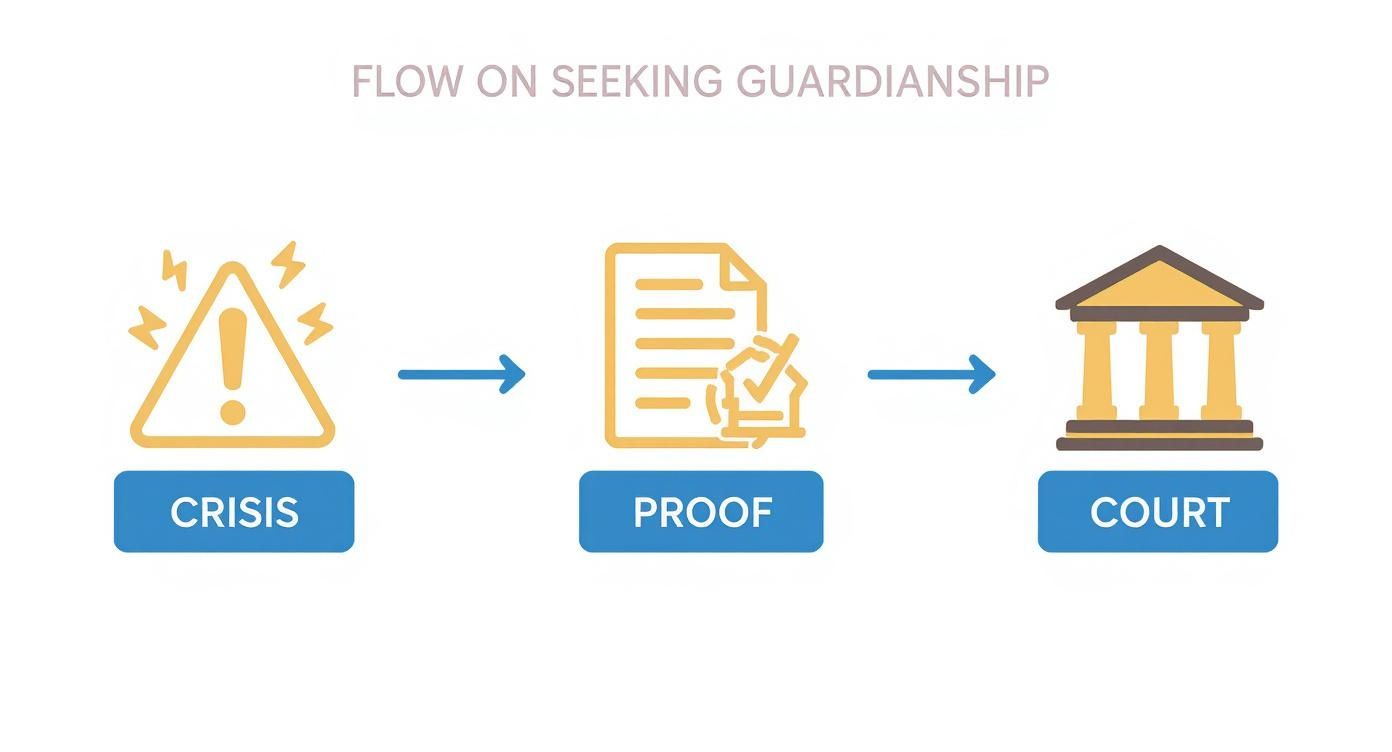
As you can see, the entire process hinges on having solid proof before you ever step foot in the courthouse. Your evidence is the bedrock of a successful emergency application.
Filing the Application and Affidavit
The journey officially begins the moment you file an Application for Appointment of Temporary Guardian with the proper probate court, whether that's in Harris County, Dallas County, or elsewhere in Texas. This isn't just filling out a form; it's a formal legal request that sets the wheels of justice in motion.
Attached to that application is your most critical piece of evidence: a sworn affidavit. Think of this document as your chance to tell the court exactly what's happening. It must clearly and convincingly lay out the imminent danger the proposed ward is in, packed with specific facts, dates, and examples that prove why the court needs to step in right now.
The Court's Immediate Actions
Once your application is on the judge's desk, things move quickly. The judge reviews your affidavit to see if there is "substantial evidence" of a true emergency. If they agree, a few things happen almost simultaneously:
- Appointment of an Attorney Ad Litem: The court immediately assigns an independent lawyer, called an "attorney ad litem," to represent the proposed ward. This attorney's only job is to protect the ward's best interests and report their findings back to the judge.
- Scheduling an Expedited Hearing: Forget waiting months for a court date. The hearing will be set within just a few days. This speed is what defines it as an emergency process.
- Personal Service: A court-appointed officer must personally deliver notice of the hearing to the proposed ward. This ensures they are fully aware that their rights are being discussed in court.
This rapid-fire sequence of events is a hallmark of temporary guardianship. The seriousness and formality of the process is why it is used for the most critical situations.
Preparing for the Hearing: Your Next Practical Steps
With a hearing date looming just days away, there's no time to waste. This is a crucial "during" phase for families. You and your attorney need to gather all crucial evidence, such as medical records, bank statements, or testimony from witnesses who can support your claims. Throughout this stage, it is often wise to seek guidance from legal and financial experts to ensure every angle is covered.
Meanwhile, the attorney ad litem will be conducting their own investigation. They will meet with the proposed ward, explain what's happening in plain English, and determine their wishes.
At the hearing, the judge will weigh all the evidence—yours, the ad litem's report, and any other testimony—before making a final decision. To get a feel for the entire process, you can check out our detailed resource on how to file for guardianship in Texas. If the judge is convinced that imminent danger exists, they will sign an order appointing a temporary guardian and grant them specific, limited powers to handle the crisis.
Trying to navigate this fast-paced process on your own is incredibly difficult and stressful. If you believe a loved one is in immediate danger, please schedule a free consultation with our team. We can give you the urgent, compassionate support you need to act quickly and effectively.
A Temporary Guardian's Powers and Responsibilities

When a Texas court names you a temporary guardian, you’re being handed a very specific, urgent job with serious rights and duties. Your authority isn’t a blank check; it's a carefully selected set of tools designed only to fix the immediate crisis at hand. This is a critical point to grasp as you step into this protective role.
A temporary guardian’s powers are laser-focused, which is a major difference from a permanent guardian who has much broader authority. The judge's order, issued under the Texas Estates Code, will spell out exactly what you can and cannot do. Think of your role as a shield, not a complete takeover of your loved one's life.
Specific Powers Granted by the Court
The judge will tailor your authority to match the emergency perfectly. For example, if your elderly mother is in the hospital and cannot consent to a necessary surgery, the court order will likely give you the specific power to make that one medical decision—and that's it.
Some of the most common powers granted in a temporary guardianship include the authority to:
- Authorize Emergency Medical Treatment: This could be consenting to a specific surgery, a course of medication, or another procedure that simply cannot wait.
- Prevent Financial Loss: Maybe you need to stop a fraudulent wire transfer, block access to a bank account being exploited, or prevent someone from selling a home under duress.
- Ensure Physical Safety: You might be given the power to move the ward from a dangerous living situation into a safe, licensed care facility.
- Access Confidential Records: This allows you to get the necessary medical or financial records to fully understand and address the immediate threat.
These powers are both temporary and precise. The whole point is to stabilize the situation. It gives your family the breathing room needed to figure out the next steps, which may or may not involve seeking a permanent Guardianship.
Your Fiduciary Duty and Legal Obligations
With these powers comes a profound legal and ethical responsibility known as a fiduciary duty. This is the highest standard of care recognized by the law. It means you must always act solely in the best interest of the ward—no exceptions. You cannot make decisions that benefit yourself or anyone else.
This fiduciary duty requires complete loyalty and good faith. Every action you take must be for the sole benefit and protection of the person you have been appointed to serve. Violating this duty can have serious legal consequences.
On top of that, a Texas court may require you to post a bond. This is essentially an insurance policy that protects the ward’s assets from any accidental mismanagement on your part. The bond ensures that if you were to make a mistake or act improperly, there’s a financial safety net to protect the ward’s estate.
We understand the weight of this responsibility can feel overwhelming, especially when you’re already in the middle of a family crisis. You don’t have to carry it alone. If you've been appointed as a temporary guardian or need this protection for a loved one, schedule a free consultation. Our team is here to give you the clear, compassionate guidance you need to fulfill your duties and protect your family member.
What Happens When a Temporary Guardianship Ends
Temporary guardianship is exactly what it sounds like—temporary. It’s a short-term legal fix designed for an urgent crisis, not a long-term solution.
Under the Texas Estates Code, this type of court order is strictly limited and usually lasts no more than 60 days. As that deadline approaches, families are often left wondering: what comes next? This is the "after" phase of the guardianship hearing, and it requires careful consideration.
The answer depends on your loved one's condition once the immediate danger has passed. There are two main paths forward, and each one leads to a very different outcome. Knowing what these possibilities are helps you prepare for the next phase with a clear head.
Two Paths Forward After the Order Expires
As the temporary order ends, you’ll find yourself at a fork in the road. The court's primary concern will be to determine if the ward still needs protection or if they are capable of safely managing their own affairs again. This often leads to one of two outcomes: guardianship termination or transition to a permanent arrangement.
The two most common outcomes are:
- The Guardianship Ends Completely: If the emergency has been resolved and the ward is now safe and capable, the temporary guardianship simply dissolves. For example, if the guardianship was granted because an adult child was incapacitated after surgery but has since made a full recovery, there’s no further need for court involvement. Their rights are fully restored.
- It Becomes a Permanent Guardianship: If the underlying issue that sparked the emergency is ongoing—like advanced dementia or a permanent disability—the temporary order can act as a bridge to a permanent guardianship. The evidence and experience from the temporary period often strengthen the case for long-term protection, ensuring there are no gaps in care.
Think of a temporary guardianship as a crucial pause button. It gives everyone a moment to stabilize a crisis. What happens next is about thoughtfully creating a sustainable plan, whether that means restoring independence or putting long-term support in place.
Preparing for the Next Phase
No matter which path you’re headed down, this transition requires careful planning.
If the guardianship is ending, the focus shifts to helping your loved one get back on their feet and regain control of their life. This might involve reconnecting them with their finances, helping them move back home, or just providing support as they adjust. For a deeper look at this process, check out our guide on how to terminate guardianship.
On the other hand, if a permanent solution is needed, now is the time to start the formal application process. This situation often highlights the value of proactive planning. Had alternatives to guardianship like a durable power of attorney been in place, a full guardianship might have been avoided altogether.
Navigating this transition is both a legal and emotional challenge. To get personalized guidance on your next steps, schedule a free consultation with our compassionate team today.
Frequently Asked Questions About Temporary Guardianship
When you're in the middle of a family crisis, the last thing you need is confusing legal jargon. You need straight answers. The idea of temporary guardianship can bring up a lot of questions, and getting clear, practical information is the only way to make good decisions under pressure. Here are some of the most common questions we hear from families navigating this urgent process in Texas.
How Much Does Temporary Guardianship Cost in Texas?
Let's be direct: the financial side of this is a major concern for most families. The truth is, the costs can swing pretty widely depending on how complex your situation is and which Texas county you're in.
You're generally looking at a few key expenses:
- Court Filing Fees: Every courthouse charges a fee just to get the case started.
- Attorney Ad Litem Fees: The court will appoint an independent lawyer for your loved one (the proposed ward), and you will most likely be responsible for their fees.
- Your Own Attorney's Fees: This is often the biggest piece. Hiring a skilled attorney is critical for a successful outcome.
- Bond Premium: The judge might require you to purchase a bond, which is like an insurance policy to protect your loved one's assets.
Because this is a serious financial commitment, we always offer a free consultation to give families a much clearer, personalized estimate based on their specific circumstances.
Can I Get Temporary Guardianship Without a Lawyer?
Legally, yes, you can file on your own. Realistically, it is incredibly difficult, and we strongly advise against it. The legal bar you have to clear to prove "imminent danger" is very high, and the court process moves at lightning speed.
One small mistake on the application or in your sworn statement can get your case denied. That doesn't just waste your money—it wastes precious time, leaving your loved one unprotected when they are at their most vulnerable. An experienced Guardianship attorney knows how to get it right from the very beginning.
What if My Loved One Objects to the Guardianship?
This is a fundamental point: the proposed ward has an absolute right to object. This can lead to a guardianship dispute. They have a right to be represented by a lawyer, and the attorney ad litem the court appoints is legally obligated to tell the judge exactly what the ward wants.
If the proposed ward objects, the case immediately becomes a contested matter. The judge has to listen to all the evidence and be convinced by a very high standard of proof that the guardianship is necessary even over the person's objection. This makes having skilled legal representation even more critical to build a compelling, fact-based argument.
An objection makes the whole situation more complex. The court has to carefully balance the need for protection against an individual's basic right to make their own choices.
How Is This Different from a Power of Attorney?
This is one of the most important things to understand when planning for the future. A power of attorney is a proactive tool—an alternative to guardianship. A person signs this legal document while they are still of sound mind, choosing a trusted agent to act on their behalf if they become unable to.
A temporary guardianship, on the other hand, is a reactive, court-ordered solution. It's what you use when someone has already lost the ability to make decisions, is in immediate danger, and has no other plans in place. Having a valid power of attorney can often prevent the need for a guardianship altogether, which is exactly why proactive Estate Planning is so important for every single family.
Navigating the complexities of temporary guardianship requires clear, compassionate, and experienced legal guidance. At the Law Office of Bryan Fagan, PLLC, we are dedicated to helping Texas families protect their loved ones during the most challenging times. If you are facing a crisis and need to explore your options, schedule a free, confidential consultation with our team today. We are here to provide the direction you need.