Skip to content
Making the choice to seek guardianship for the elderly is, without a doubt, one of the toughest crossroads a Texas family can face. It's a formal legal process, yes, but it’s really about protecting a loved one who can no longer make sound decisions about their health, safety, or finances. This isn’t about taking over; it’s about providing a court-supervised safety net when it’s needed most. We understand the emotional and financial challenges this journey entails, and our mission is to guide you with clarity and care.
What Guardianship for the Elderly Means in Texas


When an older adult in Texas starts to struggle with making safe decisions for themselves, their family is often thrown into a painful and confusing reality. Guardianship is a legal tool a Texas court can establish to protect these vulnerable individuals.
At its core, the process involves a judge appointing a responsible person—the guardian—to make critical decisions for an adult who has been legally determined to be "incapacitated." While the legal process can feel intimidating, its entire purpose is rooted in compassion and protection. It's the step you take when less restrictive measures, like a Power of Attorney, are no longer enough to keep your loved one safe.
The Legal Definition of Incapacity
Under Texas Estates Code, Title 3, Subtitle G, a judge can only appoint a guardian after finding that an adult is legally incapacitated. This isn’t a casual observation; it’s a specific legal finding that they lack the ability to:
- Provide their own food, clothing, or shelter.
- Care for their own physical health.
- Manage their financial affairs responsibly.
This is a high bar to clear, and courts don't take it lightly. It requires solid evidence, most critically a detailed medical evaluation from a physician. Courts in counties like Harris or Dallas will even appoint an independent attorney, known as an attorney ad litem, to represent the proposed ward and fiercely protect their rights throughout the process.
The Two Main Types of Guardianship
It's crucial to understand that guardianship isn't a one-size-fits-all solution. A court can grant a guardian very specific, limited powers or full authority, depending entirely on what the senior needs. The two primary types are:
- Guardian of the Person: This guardian focuses on personal well-being. They make decisions about healthcare, where the person lives, and other day-to-day welfare needs. For example, they might consent to a medical procedure or choose the right assisted living community for their loved one.
- Guardian of the Estate: This guardian is all about the finances. They are tasked with managing the ward's money and property, which includes paying bills, handling investments, and protecting their assets from scams or misuse.
A judge can appoint one person to handle both roles or split the duties between two different people. The goal is always the same: to create a solution that provides necessary protection while preserving as much of the senior's independence as possible.
We know the emotional weight of this decision. Our firm is here to help you explore your options with clarity and compassion. For personalized guidance on your family's unique situation, we invite you to schedule a free consultation.
Knowing When Guardianship May Be Necessary
The moment you start wondering if an elderly loved one needs a guardian is never easy. This isn't a decision that comes out of nowhere; it’s a slow burn, built from a series of small, unsettling observations that grow into a genuine fear for their safety and well-being.
It’s about more than just occasional forgetfulness. The real concern arises when you see a consistent pattern of them being unable to handle the basic tasks of life. Your role, born out of love, is to pay close attention, noting specific examples not to build a case against them, but to understand the full picture while treating them with the dignity they deserve.
Recognizing the Warning Signs
Pinpointing the need for guardianship is about spotting patterns that put your loved one's health, safety, or finances in jeopardy. While every family’s situation is different, there are some common red flags that should grab your attention.
Think about these hypothetical scenarios:
- Medical Management: Is your mom forgetting her heart medication or, worse, taking it twice? Maybe your dad can’t seem to explain his symptoms clearly to his doctor anymore, making proper care impossible.
- Financial Vulnerability: Are you finding stacks of unpaid bills and shut-off notices? Perhaps they've mentioned sending money to a "new friend" they met online, or you've noticed strange, large withdrawals from their bank account.
- Daily Living Struggles: Is their personal hygiene not what it used to be? Is their home becoming cluttered, unsafe, or unsanitary? Are they struggling to get to the grocery store or make themselves a simple meal?
These aren't just minor hiccups of old age. They are signals of a declining capacity that may require the protection of the court. A practical first step is keeping a simple log of these events with dates and details to share with an attorney.
The Role of Medical Evidence
Your observations are the starting point, but a Texas court needs more than that. The entire guardianship process hinges on solid medical evidence, specifically a document called the Certificate of Medical Examination. This isn't just any doctor's note; it's a specific legal form that a physician must complete within 120 days of filing your case.
A judge in a place like the Harris County Probate Court relies heavily on this report. The doctor must clearly state the nature, degree, and severity of the person's incapacity, as required by the Texas Estates Code. This expert opinion is what gives the court the grounds to decide if guardianship is truly necessary.
This underscores a critical truth: guardianship is a medical-legal process. It’s not granted because of age or because family members disagree. It’s based entirely on a professional, medical assessment of whether a person can still care for themselves.
Guardianship as a Last Resort
It's crucial to know that Texas courts view guardianship as the absolute last resort. Why? Because it involves taking away someone's fundamental rights to make their own decisions. Before ever appointing a guardian, a judge will always search for less restrictive alternatives.
With cognitive decline becoming more common, this is a challenge more families are facing. Statistics show that roughly 66% of adults aged 70 and older live with a cognitive issue like dementia, which is a major reason guardianship proceedings begin. You can find more data on how health impacts these decisions at JusticeinAging.org. Sometimes, exploring options like a well-structured Probate or a proactive Estate Planning strategy can put protections in place that avoid the need for court intervention altogether.
If you’re seeing these signs, it's natural to feel lost and overwhelmed. But you don't have to figure this out alone. Understanding all your options is the first step toward securing a safe future for the person you love.
The Texas Guardianship Process Step by Step
Filing for guardianship for the elderly in Texas can feel like you've been handed a complex legal puzzle without the instruction manual. We get it. You're likely feeling a mix of urgency and deep uncertainty. Think of this section as your clear, compassionate roadmap, breaking down the entire court process into manageable steps so you know exactly what to expect.
To make this journey easier to follow, let’s walk through a relatable example. Imagine Sarah, a Houston resident whose father, John, is in the advanced stages of Alzheimer's. John still lives alone, but he's started wandering off, and he recently fell for a phone scam that cost him a significant amount of money. Sarah knows she has to do something to protect him, so she begins the guardianship process in Harris County.
Step 1: Filing the Application and Initial Review
The journey officially begins when an Application for Appointment of Permanent Guardian is filed with the court. This isn't just a simple form; it's a formal legal document that has to be done just right. It must lay out specific information required by the Texas Estates Code, Title 3, Subtitle G, including details about the proposed ward (John), the applicant (Sarah), and a clear explanation of why a guardian is necessary.
This application is more than just paperwork—it’s the story you present to the judge, explaining exactly why your loved one needs this level of protection. It also has to be filed in the correct county, which is usually where the proposed ward lives. This initial filing is what sets the entire legal process in motion.
Step 2: The Court Appoints an Attorney Ad Litem
Once Sarah files her application, the court doesn’t just take her word for it. The judge’s number one priority is protecting John's rights. To make sure that happens, the court immediately appoints an attorney ad litem. This is an independent attorney whose only job is to represent John's best interests throughout the case.
The attorney ad litem essentially acts as the eyes and ears of the court. They will meet with John in person, explain what’s happening in a way he can understand, and then interview Sarah, doctors, and other family members to form their own unbiased recommendation for the judge.
This is a crucial step that ensures the process is fair and that John’s voice is heard, even if he can no longer effectively advocate for himself.
This infographic shows the kind of thinking that many families go through long before they ever file with the court.

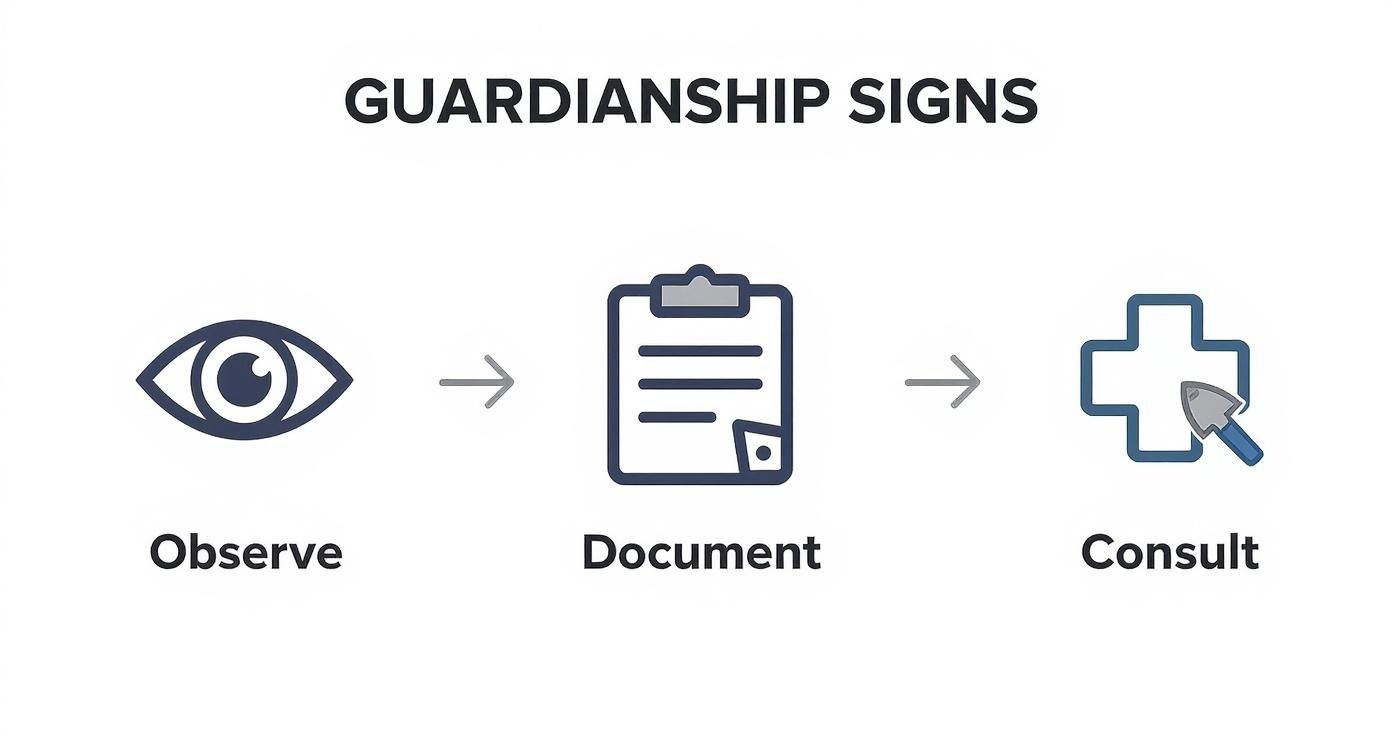
As you can see, the legal process is often the final step after a period of careful observation and information gathering to make sure guardianship is truly the right path.
Step 3: Formal Notices and Court Investigation
After the application is on file, Texas law is very specific about who needs to be formally notified about the hearing. This is legally called "service of citation." John himself must be personally served with a copy of the application by a constable or a private process server, ensuring he is officially aware of the case.
Other close relatives are also notified. This transparency gives family members a chance to show up in court if they either support or object to the guardianship. During this time, the court may also bring in a court investigator to conduct a separate, impartial review of the situation and file their own report with their findings.
Step 4: Understanding Guardian Responsibilities
As the case moves forward, it's vital to understand the different hats a guardian can wear. A judge can appoint a guardian for the "person," the "estate," or both, depending entirely on what the individual actually needs. Each role comes with its own distinct set of legal duties.
Here's a straightforward comparison to help clarify the two main roles.
Guardian of the Person vs Guardian of the Estate
| Responsibility Area | Guardian of the Person | Guardian of the Estate |
|---|---|---|
| Primary Focus | The ward's physical and emotional well-being. | The ward's financial assets and property. |
| Key Decisions | Healthcare, medical treatments, and living arrangements. | Paying bills, managing bank accounts, and filing taxes. |
| Court Reporting | Files an "Annual Report on the Condition and Well-Being." | Files a detailed "Annual Account" of all income and expenses. |
As you can see, one role is focused on the person's daily life and health, while the other is all about the money and property. It's common for one person to be appointed to both roles, but they are legally separate responsibilities.
Step 5: The Final Guardianship Hearing
The whole process leads up to a final hearing before the judge. This is where all the evidence comes together. Sarah will testify about John's condition and why she believes guardianship is needed. The doctor's medical report will be submitted as evidence, and the attorney ad litem will present their findings and make a recommendation to the court.
The judge will listen to everyone and must find by "clear and convincing evidence" that John is, in fact, incapacitated and that appointing Sarah as his guardian is in his best interest. If the judge agrees, an order is signed. From there, Sarah will need to take an oath and post a bond before she can officially begin her duties. For a deeper look into this critical final step, you can learn more about what to expect at a Texas guardianship hearing in our detailed guide.
The guardianship process is designed to be thorough to protect the vulnerable. If you are considering this path, remember you don’t have to walk it alone. Schedule a free consultation with our compassionate team to get the clear guidance you and your family deserve.
Exploring Powerful Alternatives to Guardianship
Guardianship is a profound legal step, and for good reason—it strips a person of their fundamental right to make their own decisions. Because of this, Texas courts are legally required to treat it as an absolute last resort. Before a judge will even consider appointing a guardian, they must be completely convinced that no less restrictive option can keep your loved one safe.
This approach is all about honoring a senior’s autonomy and empowering families to find solutions outside of a courtroom battle. The good news is that with a little proactive planning, you can often put the exact protections your loved one needs in place without the cost, time, and emotional toll of a formal guardianship.
These legal tools, created through thoughtful estate planning, allow your loved one to decide who they trust to make decisions for them long before a crisis ever hits. It’s the most compassionate way to ensure their wishes are always front and center.
This corner of the law is becoming more critical as our population ages. In fact, the global elder law service market, which covers services like guardianship and estate planning, was valued at around USD 3.6 billion in 2023. It’s projected to more than double by 2033. This highlights a worldwide trend of families turning to legal tools to protect vulnerable seniors. You can dig deeper into this growing field with insights from DataHorizzon Research.
Durable Power of Attorney for Finances
One of the most powerful and common alternatives is the Durable Power of Attorney. This is a legal document where your loved one (the "principal") appoints a trusted person (the "agent") to handle their financial life.
That word "durable" is the key. It means the document stays in effect even if the principal later becomes incapacitated and can't make decisions for themselves.
For example, if your father signs a durable power of attorney naming you as his agent, you suddenly have the authority to:
- Pay his mortgage and utility bills right from his bank account.
- Manage his investment portfolio.
- File his annual tax returns.
- Handle the sale of property on his behalf.
This lets you step in and manage things seamlessly without ever setting foot in a courtroom. It's a private agreement that keeps your family in control and avoids the public scrutiny that comes with guardianship.
Medical Power of Attorney and Healthcare Directives
Just as important is planning for healthcare decisions. A Medical Power of Attorney allows your mom or dad to name an agent to make medical choices for them if they can't communicate their own wishes. This person can talk to doctors, approve treatments, and access medical records.
This is often paired with a Directive to Physicians, which most people know as a Living Will. This document spells out your loved one's specific wishes about life-sustaining treatments in end-of-life situations. It lifts an unimaginable burden off the family's shoulders during an incredibly tough time.
These documents ensure that medical decisions are guided by your loved one’s personal values, not left to a court-appointed guardian who doesn’t know them.
Revocable Living Trusts and Other Tools
Another incredibly useful tool is a Revocable Living Trust. When your loved one places their assets into a trust, they can name a successor trustee who can take over management of those assets if they become incapacitated.
This strategy cleverly bypasses both guardianship for financial matters and the often slow and frustrating probate process after they pass away.
Figuring out the differences between these powerful documents is crucial. For a detailed breakdown, we strongly suggest reading our guide that compares guardianship vs. a power of attorney to see which path makes the most sense for your family. By exploring these alternatives now, you can build a strong safety net that protects your parent while preserving their dignity.
Your Duties as a Court-Appointed Guardian

Becoming a court-appointed guardian is more than just helping a loved one—it’s a profound legal commitment. When the judge signs that order, you’re not just a helper anymore. You are officially stepping into a formal role with serious responsibilities laid out by the Texas Estates Code, Title 3, Subtitle G.
At the heart of this role is what the law calls a fiduciary duty. This isn't just a fancy legal term; it's the highest standard of care the law recognizes. It means you must act with absolute loyalty and in good faith, always putting the best interests of your loved one (the "ward") ahead of your own. The court is placing immense trust in you, and you are legally bound to honor it.
The Initial Steps You Must Take
Right after you're appointed, the clock starts ticking on a few critical tasks. These aren't optional suggestions; they are mandatory steps the court requires to protect the ward and their assets from day one.
You'll have a specific amount of time to:
- File an Inventory, Appraisement, and Claim: This is a comprehensive list of everything the ward owns—from their house and car to bank accounts and personal belongings—along with an estimate of what it's all worth. This document creates a clear, official record of the estate you're now managing.
- Secure a Surety Bond: If you're named guardian of the estate, the court will almost certainly require you to get a surety bond. Think of it as an insurance policy for the ward's assets. If you were to mismanage or misappropriate funds, the bonding company would repay the estate, and you would then be on the hook to reimburse the company.
Completing these first steps sets the stage for total transparency and accountability for every decision you make moving forward.
Ongoing Responsibilities and Meticulous Record-Keeping
Your duties don’t end once the initial paperwork is filed. Managing a guardianship for the elderly is a continuous process that demands careful decision-making and even more careful bookkeeping. It's crucial to keep your own finances completely separate from the ward's and track every single penny that comes in or goes out of their accounts.
Think of yourself as the CEO of your loved one's life and finances. Every transaction, from buying groceries to paying a medical bill, must be documented. This level of detail is not just good practice—it’s a legal requirement.
This need for transparency and oversight isn't just a Texas issue. The Fourth National Guardianship Summit highlighted how complex guardianship systems can sometimes be misused. The summit stressed that strong court supervision is one of the best tools for preventing abuse and protecting the dignity of older adults. You can read more about these national reform efforts at USC's Elder Justice website.
All your diligent record-keeping leads to one of your most important ongoing duties: filing annual reports with the court. A Guardian of the Person files an Annual Report on the Condition of the Ward, while a Guardian of the Estate submits a detailed Annual Accounting. Failing to get these reports in on time or filling them out incorrectly can have serious repercussions, including being removed as guardian. This termination process is a serious matter and underscores the importance of compliance.
To make sure you get this critical step right, check out our guide on annual guardianship reports and how to avoid compliance issues.
Fulfilling these duties honorably is a true testament to your commitment. If you have any questions about your responsibilities or need some guidance, schedule a free consultation with our team. We're here to help you meet every legal expectation with confidence.
Handling Emergency and Temporary Guardianship
Sometimes, a crisis hits without warning, and you don't have the luxury of waiting weeks or months for a standard guardianship case to move through the courts. For these high-stakes situations, Texas law provides a powerful tool: Temporary Guardianship. It’s designed for true emergencies where an elderly loved one faces immediate and substantial harm.
Think of it as the legal system's emergency room. Its purpose isn't to create a long-term care plan but to stop the bleeding and stabilize a dangerous situation right now. Because it moves so quickly, the bar for proving it’s necessary is incredibly high.
Proving Imminent Danger
You can't get a temporary guardianship just by showing your parent needs some help. You have to bring substantial evidence to the court proving there is imminent danger to their physical health or their financial estate. The threat can't be something that might happen down the road—it has to be happening right now.
The Texas Estates Code, Title 3, Subtitle G, Chapter 1251, is very specific about this. A judge needs to see compelling proof that without immediate intervention, your loved one will suffer real, irreparable harm.
Here’s a heartbreaking scenario we see all too often:
Your elderly mother has a sudden stroke. She’s hospitalized, confused, and can't make medical decisions for herself, and she never signed a Medical Power of Attorney. Just as doctors are asking for consent for a critical procedure, a predatory "long-lost relative" suddenly shows up, trying to get access to her bank accounts.
This is the exact kind of crisis a temporary guardianship was created to solve.
How a Temporary Guardianship Works
If the judge agrees the situation is a genuine emergency, they can appoint a temporary guardian with very specific and limited powers—just enough to handle the crisis at hand. By its very nature, this appointment is short-lived.
- Limited Duration: A temporary guardianship is usually granted for no more than 60 days.
- Specific Powers: The court order will spell out exactly what the guardian is allowed to do. For example, it might grant the power to consent to a specific medical treatment and pay hospital bills, but not the authority to sell her house.
This 60-day window gives your family critical breathing room. It protects your loved one and stabilizes their situation while you take the necessary steps to pursue a permanent Guardianship, if one is still needed. The process moves at lightning speed and requires a precise and immediate legal response.
Navigating a family crisis is emotionally draining. You don't have to figure this out alone. If you believe your loved one is in immediate danger, schedule a free consultation with us right away to understand your options and how to act quickly.
Common Questions About Guardianship in Texas
Stepping into the world of guardianship for an elderly loved one is a huge decision, and it’s bound to come with a flood of questions. This is a major step, so it's completely normal to worry about the costs, the legal hoops you'll have to jump through, and what happens if family members don't see eye to eye.
We’ve pulled together some of the most frequent questions we hear from families across Texas to give you some clear, no-nonsense answers. The goal here is to cut through the confusion and give you the practical info you really need.
How Much Does Guardianship Cost in Texas?
Honestly, the cost of a guardianship can swing pretty wildly depending on how complicated your family’s situation is. At a minimum, you’ll need to budget for court filing fees, the cost of the attorney ad litem (the court-appointed lawyer for your loved one), and of course, your own attorney’s fees.
If another family member decides to fight the guardianship, that’s when the costs really start to climb. The whole thing shifts from a straightforward proceeding to something that looks a lot more like a lawsuit. Also, if you’re named guardian of the estate, the court will require you to get a surety bond to protect your loved one’s assets. It's a financial commitment, no doubt, but think of it as an investment in their safety.
Can I Get Guardianship if My Parent Has a Power of Attorney?
You can, but it’s an uphill battle. Texas courts are big fans of using less restrictive options whenever possible, and a Power of Attorney is usually their first choice. To get a guardianship approved, you have to prove two things to the judge: first, that your parent is incapacitated, and second, that the Power of Attorney just isn't working to protect them anymore.
You'll need to show solid evidence that the person named as the agent either can't do the job, is making bad decisions, or that the document itself just doesn't cover the problems your parent is facing now. The court's main focus is always on preserving as much of your loved one's independence as they can.
What Happens if a Family Member Contests the Guardianship?
When a family member objects, the process becomes what’s known as a "contested guardianship." This changes everything. It turns what could have been a cooperative effort into a full-blown legal fight, potentially with discovery, depositions, and even a trial. These guardianship disputes usually pop up over whether a guardian is needed at all, or who should be the one to serve.
Contested cases can be emotionally exhausting and a lot more expensive for everyone. This is where having an experienced attorney becomes non-negotiable. Your lawyer can help manage the conflict, fight for what’s best for your loved one, and push for a resolution—whether that's through smart negotiation or, if it comes to it, in a courtroom like the Bexar County Probate Court.
Navigating the complexities of guardianship requires a knowledgeable and compassionate guide. The attorneys at The Law Office of Bryan Fagan are dedicated to helping Texas families protect their vulnerable loved ones with clarity and care. For personalized guidance on your specific situation, schedule a free consultation with our team today.