Skip to content
For many Texas families, the idea of long-term care for a loved one brings a wave of stress. The emotional weight and the sheer financial cost of finding the right support can feel impossible. You’re likely worried about affording a nursing home, but you're also deeply concerned about your loved one losing their independence and quality of life.
This is exactly where the Medicaid waiver program in Texas steps in, offering a practical and compassionate solution. These programs are lifelines designed to provide essential care at home or in the community, preventing or delaying the need for institutional care.
What Exactly Are Texas Medicaid Waivers?
Think of it this way: traditional Medicaid is often set up to pay for care in a facility, like a nursing home. A "waiver" program essentially waives that rule. It allows Medicaid funds to be used for services that help a person stay in their own home or community instead.
Overseen by the Texas Health and Human Services Commission (HHSC), these programs are designed to provide a less restrictive alternative to institutionalization. It’s a lifeline that allows your loved one to remain in a familiar, supportive environment where they feel most comfortable.
A Bridge to Dignity and Independence
At its core, a Medicaid waiver is about empowering people to live with dignity and stay connected to their community. Instead of the isolation that can come with living in a facility, your loved one can get support tailored to their specific needs, right where they are.
For families in places like Harris County or Fort Bend County, this can mean the difference between constant worry and genuine peace of mind.
These programs are built on the simple truth that care provided at home is not only what most people prefer, but it’s often more effective. The kinds of support available are incredibly diverse and can include things like:
- Personal Care Assistance: Hands-on help with daily activities like bathing, dressing, and preparing meals.
- Respite Care: Gives primary caregivers a much-needed break to rest and recharge. This is crucial for avoiding burnout.
- Home Modifications: Funding for practical changes like wheelchair ramps, grab bars in the bathroom, or other modifications that make a home safer and more accessible.
- Specialized Therapies: Access to physical, occupational, or speech therapy without having to travel to a clinic.
Connecting Waivers to Guardianship and Long-Term Planning
Successfully applying for these vital services often intersects with legal planning. For instance, establishing a Guardianship can provide the legal authority needed to apply for a waiver on behalf of your loved one and manage their care. The Texas Estates Code, Title 3, Subtitle G, specifically empowers a guardian to make these critical healthcare and financial decisions.
At the same time, smart Estate Planning is essential to make sure your loved one’s assets don’t accidentally disqualify them from getting benefits. These waivers aren't just about healthcare—they're a key piece of a larger plan to protect your family’s future and financial stability.
Navigating the world of Texas Medicaid waivers can feel like a maze, but you don't have to figure it out alone. Understanding how these programs work is the first critical step toward securing the care and stability your loved one deserves.
If you’re feeling overwhelmed or just have questions about how a waiver could help your family, we're here for you. Schedule a free consultation with us today to talk through your situation and map out a clear path forward.
Exploring the Types of Texas Medicaid Waivers
Trying to figure out the different Texas Medicaid waiver programs can feel like navigating a maze, especially when you're already stressed about caring for a loved one. Each program is built for specific needs, and knowing which path to take is the first critical step.
Think of these waivers as different keys. Each one unlocks a unique set of services designed for a specific group of people, but you have to find the right key for your lock. These programs are definitely not one-size-fits-all. The Texas Health and Human Services Commission (HHSC) oversees several waivers, and each comes with its own eligibility rules, services, and—yes—its own waiting list.
Let's break down the most common options Texas families turn to.
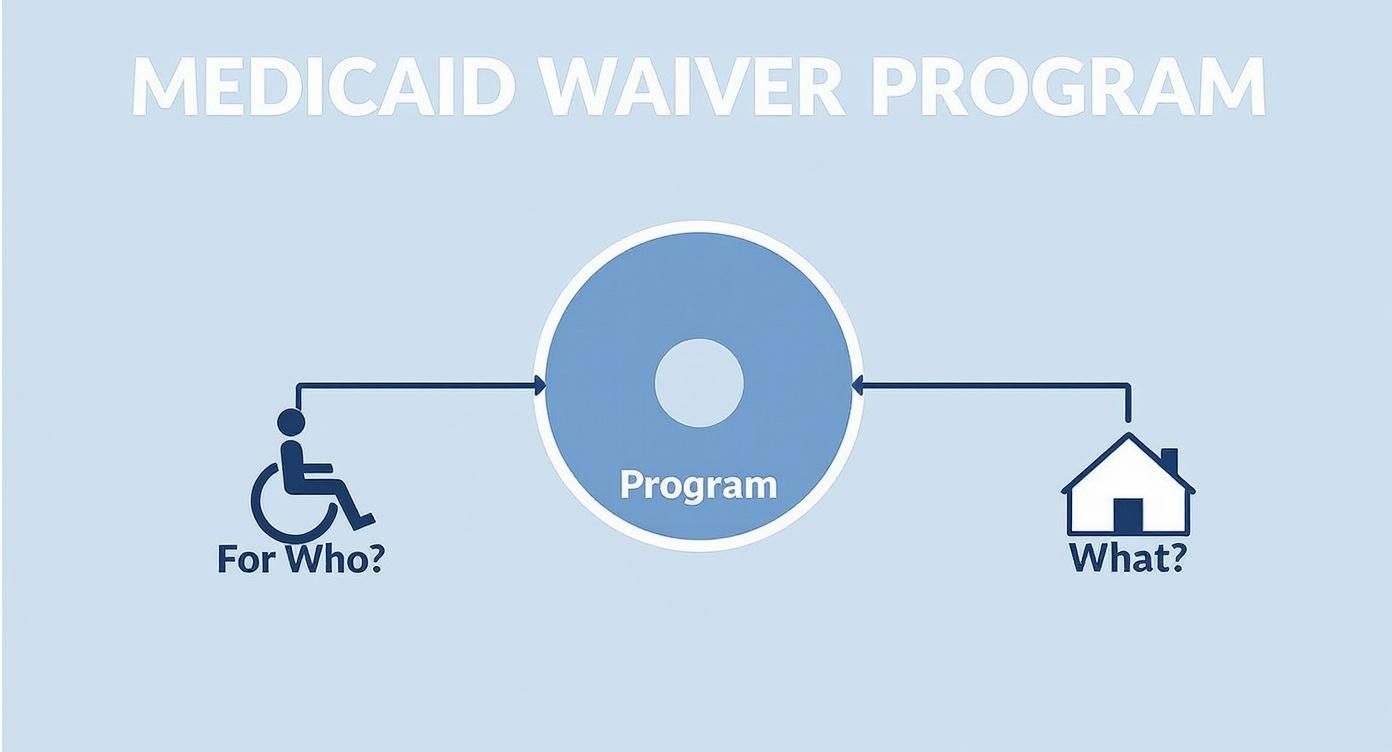
This diagram keeps it simple, connecting the program to who it helps and what it offers. It’s a great starting point for understanding how these waivers function at a high level.
STAR+PLUS Home and Community Based Services (HCBS)
The STAR+PLUS HCBS program is one of the most frequently used waivers in Texas. It's primarily for adults 65 or older and adults with disabilities who would otherwise need to be in a nursing home. This waiver is what allows them to get the long-term care they need right in their own homes or in an assisted living community.
Services available under STAR+PLUS HCBS often include:
- Personal Attendant Services: Help with daily essentials like bathing, getting dressed, and preparing meals.
- Respite Care: Gives family caregivers a much-needed break to prevent burnout.
- Home Modifications: Provides funding to make a home safer and more accessible, like installing wheelchair ramps or grab bars.
- Adaptive Aids and Medical Supplies: Covers items that help with daily living tasks.
Home and Community-based Services (HCS)
The HCS program is specifically for people with an intellectual disability (ID) or a related condition. It's a very comprehensive waiver that offers a wide array of services aimed at helping individuals live as independently as they can. For families who have gone through the process of getting Guardianship for an adult child with special needs, the HCS waiver is often the next logical and crucial step.
Key services under the HCS program include:
- Residential Support: Assistance in different living situations, from group homes to living with a host family.
- Day Habilitation: Offers chances to build skills and be part of the community during the daytime.
- Supported Employment: Helps individuals find and hold down a job.
- Specialized Therapies: Gives access to behavioral support, occupational therapy, and physical therapy.
Navigating these programs requires real patience and persistence. Because demand is so high, the interest lists for programs like HCS can be incredibly long—sometimes more than a decade. It is absolutely critical to get your loved one's name on the list as early as you possibly can.
Other Key Waiver Programs
Beyond STAR+PLUS and HCS, Texas has several other targeted programs that might be a better fit for your family’s unique situation. To help you quickly see the differences, here’s a table summarizing the main waivers.
Key Texas Medicaid Waiver Programs at a Glance
| Waiver Program Name | Primary Population Served | Example Services Covered |
|---|---|---|
| Texas Home Living (TxHmL) | Individuals with ID or related conditions living in their own or their family's home. | Community support, day habilitation, employment assistance. |
| Medically Dependent Children Program (MDCP) | Medically fragile children and young adults under 21 needing nursing facility care. | Respite care, adaptive aids, minor home modifications. |
| Youth Empowerment Services (YES) | Children and adolescents with serious emotional disturbances at risk of out-of-home placement. | Paraprofessional services, respite care, adaptive aids, family supports. |
Each of these programs offers a potential lifeline, but it’s vital to choose the correct one. A mistake here can lead to wasted time and delays in getting care for your loved one.
The Texas Home Living (TxHmL) waiver is a smaller program for individuals with ID who live at home. It provides essential services to help them stay in the community, but it's not as extensive as the HCS program.
The Medically Dependent Children Program (MDCP) serves children and young adults under 21 who are medically fragile. A huge advantage of MDCP is that it only considers the child's income and assets—not the parents'—which opens the door for many families who wouldn't qualify otherwise.
Finally, the Youth Empowerment Services (YES) Waiver provides community-based services for kids with serious emotional disturbances, aiming to keep families together. Despite saving the state an estimated $12,500 per child in 2023, the program is under strain. In 2023, there were 3,109 inquiries for the YES Waiver, but only 2,227 kids were served. This leaves hundreds waiting for help, a situation made worse by a statewide caregiver shortage.
Because the rules and services differ so much, it's often wise to get professional guidance. Understanding how these waivers fit in with other legal tools like Probate and Estate Planning is also key for long-term security. If you feel lost trying to determine which Medicaid waiver program in Texas is right for your loved one, please don't hesitate to reach out. Schedule a free consultation with our team to get clear, compassionate guidance.
How to Navigate the Waiver Application Process
Applying for a Medicaid waiver program in Texas can feel like trying to solve a puzzle with a thousand tiny pieces, especially when you're already juggling the stress of caregiving. But you don't have to figure it out alone. Once you understand the key steps, the path forward becomes much clearer.
At its heart, the application comes down to clearing two main hurdles: proving a medical need for services and meeting very strict financial limits. The Texas Health and Human Services Commission (HHSC) runs the show, and getting every detail right is critical to avoid frustrating delays.

Step 1: Get on the Interest List—Today
The very first move for most waiver programs is getting your loved one's name on an "interest list." Think of this not as the official application, but as securing your spot in a very, very long line. Because of overwhelming demand, these lists can stretch on for years—sometimes even a decade or more for certain programs.
You get started by contacting your local HHSC office or your Local Intellectual and Developmental Disability Authority (LIDDA). Do not put this off. Even if your loved one doesn't need services right this minute, getting on that list as early as you can is the single most important thing you can do.
Step 2: Prove Medical and Financial Need
When a slot finally opens up, HHSC will invite you to formally apply. This is the moment you have to back everything up with detailed documentation.
Proving Medical Need:
HHSC will conduct a comprehensive assessment to confirm your loved one requires a specific "level of care," usually equivalent to what they'd receive in a nursing home or intermediate care facility. This evaluation is built on medical records, doctor's statements, and functional assessments.
Meeting Financial Limits:
Texas Medicaid has incredibly tight rules for income and assets. For 2025, an individual applicant generally cannot have more than $2,000 in countable assets. For families whose finances are over these limits, legal planning isn't just helpful—it's essential.
A Real-World Example in Fort Bend County
Let's imagine a family in Fort Bend County whose elderly father has dementia. His Social Security and a small pension put his monthly income just over the Medicaid limit, and he has about $25,000 in savings. On paper, he doesn't qualify.
This is where smart legal guidance comes in. The family could set up a Qualified Income Trust (QIT), often called a Miller Trust. This legal tool allows his excess income to be deposited into the trust, which then makes him financially eligible. Those funds are used to pay his share of care costs. If he no longer has the capacity to manage his finances, a guardianship may be needed to establish the trust on his behalf.
The Hard Reality of Waiting Lists
Waiting is, without a doubt, the hardest part of this journey. While you're on the list, it is absolutely critical to keep your contact information updated with HHSC. If they can't reach you when a spot opens up, they will simply move on to the next person.
Use the waiting period to get your eventual application packet perfect. Start gathering all the necessary documents now, including:
- Birth certificates and Social Security cards
- Proof of all income (pension statements, Social Security award letters)
- Bank statements and records for all financial assets
- Powers of attorney or any guardianship court orders
Taking this proactive approach means that when your number is finally called, you'll be ready to go without any self-inflicted delays. While every state has different rules, the general structure is often similar; for example, you can see how this compares to Ohio's Assisted Living Waiver program.
Navigating this path requires patience and a solid strategy. From getting on an interest list to using legal tools like trusts, every step matters. If you need help creating a clear plan for your family’s situation, please schedule a free consultation with us.
Connecting Guardianship with Medicaid Waivers
For many Texas families, the path to securing life-changing Medicaid waiver benefits starts with a crucial first step: establishing a guardianship. The two processes are deeply connected, working together to make sure a vulnerable loved one gets the comprehensive care they need under the full protection of the law. Without a guardianship in place, you may find you don't have the legal standing to apply for and manage these benefits on their behalf.
This connection all comes down to legal authority. Once a court, like a Harris County Probate Court, appoints a guardian, that person is granted specific powers under Title 3 of the Texas Estates Code. This is what empowers the guardian to make firm decisions about the ward’s personal, financial, and medical life—including navigating and submitting a complex Medicaid waiver application.
The Guardian’s Role in the Waiver Process
Picture a parent in Travis County with an adult child who has a severe intellectual disability. That parent has been the primary caregiver their child’s entire life, but once the child becomes an adult, the parent no longer has the automatic legal authority to manage their affairs. By establishing a guardianship, that parent can confidently apply for the Home and Community-based Services (HCS) waiver, unlocking access to residential support, day programs, and specialized therapies.
A court-appointed guardian’s duties line up perfectly with what the Medicaid waiver system demands:
- Gathering Sensitive Information: Guardians have the legal right to access medical records, financial statements, and other personal documents that are mandatory for the application.
- Making Healthcare Decisions: A guardian of the person can consent to the medical assessments needed to prove a nursing facility level of care, which is a core requirement for most waivers.
- Managing Finances for Eligibility: A guardian of the estate can legally manage the ward’s income and assets to meet Medicaid's strict financial limits, often by establishing a required trust.
Aligning Financial Management with Medicaid Rules
One of the most critical jobs a guardian has is making sure the ward’s financial situation aligns perfectly with Medicaid’s tough eligibility rules. A guardian has a fiduciary duty to always act in the ward's best interest, and that absolutely includes preserving their eligibility for these vital public benefits. It's a delicate balancing act that requires both legal precision and a deep sense of compassion.
For instance, if a ward receives a small inheritance, it could easily push their assets over the $2,000 limit and put their waiver services in jeopardy. A guardian of the estate can take court-approved action to spend down these funds on permissible expenses or place them into a qualifying trust, protecting their eligibility. You can learn more about the ethical duties involved in our detailed guide on the management of public benefits within a guardianship context.
In Texas, the connection between public policy and healthcare access is clear. The Texas Medicaid 1115 Waiver, for instance, was instrumental from 2012 to 2022 in transforming healthcare delivery. This program served approximately 12 million Texans by providing federal funds to improve patient outcomes and sustain access for vulnerable populations. You can find more details on this impactful program from the Texas Comptroller.
This just goes to show how much the state relies on waiver systems to deliver care, which reinforces why having the proper legal authority through guardianship is so important for getting into these programs.
A properly established guardianship provides the legal framework to navigate the Medicaid waiver program in Texas effectively. It removes any ambiguity, empowers caregivers to act decisively, and ensures every decision is made to support the long-term well-being and security of your loved one. This intersection of Guardianship and Estate Planning is where families find true peace of mind.
If you are considering guardianship to help a loved one access Medicaid benefits, our team can provide the clear, compassionate guidance you need. Schedule a free consultation to discuss your family’s unique situation and create a plan.
Using Special Needs Trusts to Protect Eligibility
Finally securing a spot in a Texas Medicaid waiver program feels like a massive win for your family. But the work doesn't stop once the services start. Protecting that hard-won eligibility for the long haul is just as crucial.
A common pitfall we see is when a loved one on a waiver receives a sudden influx of cash—maybe from a personal injury settlement or a grandparent's inheritance. Anything that pushes their personal assets over Medicaid's strict $2,000 limit can trigger an immediate loss of benefits.
This is exactly where a Special Needs Trust (SNT) becomes your most powerful tool. An SNT is a highly specialized legal container designed to hold assets for a person with a disability. The key is that the money inside this trust doesn't count against them for needs-based government benefits like Medicaid or SSI.
Think of it as a protective financial bubble.

This structure allows the trust to pay for quality-of-life expenses that Medicaid waivers simply don't cover. The goal is always to supplement government benefits, never to replace them.
First-Party vs. Third-Party Trusts
In Texas, SNTs generally come in two flavors, and knowing the difference is vital for proper planning. It all boils down to one simple question: whose money is it?
First-Party Special Needs Trusts:
- Funding Source: This trust is funded with the beneficiary's own money. This could be from a personal injury settlement, a direct inheritance left to them, or even Social Security back payments.
- Key Rule: The beneficiary must be under 65 years old when the trust is created and funded.
- Medicaid Payback: This is the critical feature. When the beneficiary passes away, any funds left in the trust must first be used to reimburse the state for every dollar of Medicaid services they received in their lifetime.
Third-Party Special Needs Trusts:
- Funding Source: This trust is funded with money from someone else—parents, grandparents, or any other family member, usually as part of their estate plan.
- Key Rule: The beneficiary can't ever have owned or had legal rights to the money before it went into the trust. It has to come from a "third party."
- No Payback Provision: Because the money never belonged to the beneficiary, there is no requirement to pay back Medicaid. Any remaining funds can be passed on to other family members or charities, according to the trust's instructions.
A third-party SNT is one of the most powerful gifts a family can give. It allows you to leave a financial legacy for your loved one without jeopardizing the essential waiver services they rely on for daily care and support.
How a Special Needs Trust Works in Practice
Let’s walk through a common scenario. Imagine your adult son receives services through the HCS waiver program. His grandmother leaves him $50,000 in her will. If that money goes directly into his bank account, his assets will skyrocket past the $2,000 limit, and he will instantly lose his waiver eligibility and Medicaid coverage.
Now, let's rewind. What if his grandmother's will instead directed that $50,000 inheritance into a third-party SNT created for his benefit? The outcome is completely different. The money is held by a trustee, who can now use those funds for things that enrich your son's life. If you want to dig deeper into the mechanics, you can learn more about how to set up a Special Needs Trust in Texas in our detailed article.
The trustee could use the funds for things like:
- A much-needed vacation with a caregiver
- A new computer or tablet for entertainment and connection
- Specialized therapies not fully covered by his waiver
- Tickets to a concert or a Cowboys game
These purchases improve his quality of life immensely, all while his essential waiver services for housing, personal care, and medical needs remain fully intact.
Drafting an SNT is a highly technical legal task. A single misplaced word or incorrect clause can render the entire trust invalid, leading to a catastrophic loss of benefits. This is absolutely not a DIY project. Working with an attorney experienced in special needs planning and guardianship is non-negotiable to ensure the document complies with every federal and Texas state law.
Handling a Crisis with Emergency Waivers
Life can change in an instant. A sudden health crisis can throw a family into turmoil, leaving them scrambling for answers and immediate help. When you're in that situation, the idea of waiting years on an interest list for a standard Medicaid waiver program in Texas just isn't an option. Thankfully, the state has a way to respond to widespread emergencies, providing a critical lifeline when people need it most.
It's important to understand that an emergency waiver is a temporary tool the state uses to react to a major public health crisis or a natural disaster. These aren't waivers you can apply for because of a personal family crisis. Instead, they are broad, sweeping actions taken to get care to a large group of affected people—fast.
How Emergency Waivers Actually Work
Think of these waivers as a rapid-response system for catastrophic events. The state knows that during a crisis, the usual red tape and long application processes would be a roadblock, preventing vulnerable people from getting the medical help they desperately need.
A powerful real-world example of this was the "TexKat" waiver, which was rolled out after Hurricane Katrina hit in 2005. This emergency action gave temporary Medicaid coverage to nearly 60,000 evacuees who had relocated to Texas. It was a crucial piece of the disaster recovery puzzle, ensuring people had access to healthcare during an incredibly disruptive time. You can read more about the impact of the TexKat waiver to see how effective it was.
Proactive Planning for When Minutes Matter
While you can't apply for a large-scale emergency waiver for a personal crisis, you absolutely can prepare your family for one. The most powerful thing you can do is get the right legal documents in place before a crisis hits. If a loved one has a sudden medical event and loses the ability to make their own decisions, you’ll need legal authority to step in and act for them.
Here are the key documents to have ready:
- Durable Power of Attorney: This lets a person you choose make financial decisions.
- Medical Power of Attorney: This gives someone the authority to make healthcare choices.
- Guardianship Orders: If your loved one already lacks the capacity to make decisions, a court-ordered guardianship is essential.
When a crisis strikes, you might need to file for an emergency or temporary guardianship to get the authority to admit your loved one into a nursing home or consent to urgent medical care. At The Law Office of Bryan Fagan, we have extensive experience filing these expedited proceedings in courts across Texas, including Harris, Bexar, and Dallas counties. This allows you to act decisively when every single moment counts.
Don't wait until you're in the middle of an emergency to realize you don't have the legal authority to help. Schedule a free consultation with us to talk about your family's needs and build a proactive plan.
Common Questions About Texas Medicaid Waivers
When you start digging into the world of Medicaid waiver programs in Texas, a lot of specific questions pop up. It’s a complex system, and the details matter. We've put together answers to some of the most frequent concerns we hear from families, giving you clear, direct information you can use right away.
How Long Are the Waiting Lists?
This is the million-dollar question, and the answer can be tough to hear. The waiting lists, which are officially called "interest lists," can be incredibly long. For some of the most comprehensive programs, like the Home and Community-based Services (HCS) waiver, families can wait for years.
It is absolutely crucial to get your loved one on an interest list as soon as you think they might ever need services. Don't wait until it's a crisis. Once you're on the list, make sure HHSC always has your current contact information. You don’t want to miss your chance when a spot finally opens up after a decade-long wait.
Can My Child Get Waiver Services If We Earn Too Much?
Yes, this is a common and welcome surprise for many families. Several children's waiver programs, including the popular Medically Dependent Children Program (MDCP), only consider the child’s income and assets, not the parents'.
This is a game-changer. It means children with significant medical needs can get the support they require, regardless of their parents' financial situation. The rules here can get tricky, much like the regulations that govern Social Security benefits within a guardianship.
What Happens If Our Waiver Application Is Denied?
A denial letter is frustrating, but it’s not the end of the road. You have the right to appeal the decision. The denial letter itself will spell out why the application was rejected and explain the steps for requesting what's called a fair hearing.
Appeal deadlines are extremely strict, so you have to act fast. This is a moment where getting help from an attorney who specializes in Medicaid and administrative law can make a huge difference in your chances of success. They know how to build the strongest possible case for your appeal.
Trying to piece together the complexities of Texas Medicaid waivers and guardianship law can be overwhelming. It requires knowledgeable and compassionate guidance. At The Law Office of Bryan Fagan, PLLC, we are dedicated to helping families like yours secure the best possible future for your loved ones. Schedule your free consultation today by visiting us at https://texasguardianshiplawyer.net.