Skip to content
When a loved one starts to struggle with making their own decisions, Texas families often face the difficult choice between guardianship vs power of attorney. We understand this is an emotional and confusing time. A Power of Attorney (POA) is a document you create proactively, choosing a trusted person to make decisions for you if you become unable to. Guardianship, in contrast, is a court-supervised process for someone who is already incapacitated and can no longer grant that authority themselves.
The Core Difference: Who Decides?
At its heart, the main distinction between a Power of Attorney and guardianship comes down to personal choice. A POA is an act of foresight, where you decide your own future. A guardianship is a protective measure provided by the courts when that planning wasn't, or couldn't be, done. Understanding this fundamental difference is the first step toward making a clear-headed, compassionate, and legally sound decision for your family.
Here at The Law Office of Bryan Fagan, we guide families through these sensitive moments every day. It’s easy to feel overwhelmed by the legal system, but knowing which tools are available can empower you to protect your loved one.

Key Concepts Separating POA and Guardianship
Let's break down the practical differences in plain English:
- Proactive vs. Reactive: You create a Power of Attorney when you're thinking ahead, while you still have full mental capacity. Guardianship is a reactive measure, established only after a person has already become incapacitated.
- Voluntary vs. Court-Ordered: With a POA, you voluntarily choose your own agent. In a guardianship, a judge in a Texas probate court, like the Harris County Probate Court, appoints a guardian. The court's decision is based on evidence and what it determines is in the best interest of the incapacitated person, who is then legally known as the "ward."
- Privacy vs. Public Record: A POA is a private document between you and your agent. Guardianship proceedings, however, are public court records. This involves hearings, filings, and ongoing judicial oversight that are accessible to the public.
To make the distinction even clearer, let's put the two side-by-side.
Quick Comparison Guardianship vs Power of Attorney
This table provides a quick snapshot of the fundamental differences between a court-ordered guardianship and a voluntarily created Power of Attorney in Texas.
| Feature | Power of Attorney (POA) | Guardianship |
|---|---|---|
| Initiation | Voluntarily created by an individual (the "principal") while they have capacity. | Court-ordered process initiated when a person is already incapacitated. |
| Authority | The principal defines the scope of power granted to their chosen agent. | The court defines the guardian's powers, following the Texas Estates Code. |
| Timing | Created in advance as part of proactive Estate Planning. | Occurs only after incapacity has been legally determined. |
| Cost & Complexity | Less expensive, faster, and private. | More costly, time-consuming, and involves public court proceedings. |
Ultimately, this choice is about balancing personal freedom with necessary protection. If your loved one can still make their own decisions, exploring alternatives to Guardianship is essential.
For personalized guidance on your family's unique situation, we invite you to schedule a free consultation with our experienced team. We're here to help you understand your options.
How a Texas Power of Attorney Works
Life is unpredictable. A sudden illness or accident can leave you unable to manage your own affairs. In Texas, a Power of Attorney (POA) is a legal document that lets you appoint someone you trust to step in when you can’t.
Think of it as naming your personal advocate. You (the principal) create a private, voluntary document that gives an agent permission to act on your behalf. By doing this while you are fully capable, you can keep your personal matters out of the public eye and out of court.

Key Types Of Power Of Attorney In Texas
In Texas, POAs come in a few main types, each serving a specific purpose in your plan:
-
Durable Power of Attorney
This is for financial matters and remains effective even if you become incapacitated. It's ideal for managing bank accounts, investments, and paying bills when you no longer can. -
Medical Power of Attorney
This grants your agent the authority to make healthcare decisions for you, from consenting to treatments to accessing your medical records, if you are unable to communicate your wishes. -
General Power of Attorney
This covers a broad range of tasks but becomes void if you lose mental capacity. It's often used for short-term assignments, like handling a real estate closing while you’re out of the country.
A combination of a Durable and Medical POA forms the foundation of a solid plan for incapacity.
The Power Of Proactive Choice
When you create a POA, you are in control. You choose the agent, define their powers, and decide when those powers become active. This is a stark contrast to guardianship, where a judge decides who steps in and what they can do.
A Power of Attorney is your voice on paper. It spares your loved ones the emotional stress, guesswork, and expense of a probate court process.
Imagine an elderly parent in Tarrant County who drafts a Durable POA naming their responsible adult child as agent. If the parent later suffers a stroke, that child can immediately pay the mortgage, manage investments, and keep the household running smoothly. There are no court filings or waiting periods—just seamless continuity during a difficult time.
Flexibility And Limitations
A POA can be as broad or as limited as you need. You might grant sweeping authority over all financial matters or restrict your agent to a single task, like selling a specific property. The key is to lay out these powers clearly in the document, ensuring it complies with Texas law.
However, an agent's power is not unlimited. Your agent has a fiduciary duty to act in your best interest and can face legal consequences if they fail to do so. If an agent abuses their role, a court can override the POA and establish a guardianship if necessary to protect you.
For detailed guidance, it is wise to work with an experienced attorney. To see how a POA fits into your broader estate plan, explore The Role of a Power of Attorney in Texas.
Diving into the Texas Guardianship Process
When someone you love can no longer make sound decisions and no Power of Attorney is in place, Texas law provides a critical safety net: guardianship. This is not a path taken lightly. It is a formal, court-supervised legal proceeding designed to protect people who have been deemed "incapacitated" and are unable to care for themselves.
We recognize that considering guardianship is an emotional process, often marking a painful acceptance that a loved one can no longer manage their own life. The system, detailed in the Texas Estates Code, Title 3, Subtitle G, is deliberately thorough to safeguard the rights of the "proposed ward" while ensuring their needs are met.
The Court's Role in Protecting the Vulnerable
Unlike a private Power of Attorney, guardianship is a public legal matter decided in a Probate court. A judge must be presented with clear and convincing evidence that an individual lacks the capacity to manage their own affairs. This means proving they are unable to:
- Provide for their own food, clothing, or shelter.
- Care for their own physical health.
- Manage their own financial affairs.
This process transfers a person’s fundamental rights to a court-appointed guardian. It is a profound change, and Texas courts handle it with the gravity it deserves.
The Two Types of Guardianship in Texas
The Texas Estates Code recognizes that someone might need help with finances but not personal care, or vice versa. To avoid being overly restrictive, the law separates guardianship into two distinct roles. The same person can serve in both capacities, or they can be assigned to different individuals.
- Guardian of the Person: This guardian makes decisions about the ward’s personal and medical well-being. Responsibilities include choosing where the ward lives, consenting to medical treatments, and ensuring they receive proper daily care and are safe from harm.
- Guardian of the Estate: This guardian manages the ward's finances and property. They handle everything from paying bills and managing investments to protecting assets and filing tax returns, all under the strict supervision of the court.
Guardianship is about providing necessary support, not complete control. The court aims to create the least restrictive arrangement possible, tailored to the specific needs of the ward.
A Real-World Guardianship Scenario
Consider a family in Harris County. Their elderly mother has advanced dementia and never created a Power of Attorney. Recently, she began wandering from home and has fallen victim to financial scams. Her adult children, deeply concerned for her safety and financial stability, decide to seek guardianship.
Their journey through the Harris County Probate Court would typically involve these practical steps:
- Filing an Application: They would hire an attorney to file an "Application for Appointment of Guardian," explaining their mother's condition and why guardianship is necessary.
- Medical Evaluation: The court requires a recent letter from a physician confirming the mother's diagnosis and her inability to make decisions for herself.
- Court Appointments: The judge will appoint an "attorney ad litem" to act as the mother’s independent legal representative. An investigator known as a "court visitor" will also meet with the mother and report back to the court on her condition and wishes.
- The Hearing: During a formal hearing, the judge reviews all evidence, hears testimony, and determines if the mother is legally incapacitated. If so, the judge will appoint one of her children as guardian of her person and estate.
How often guardianship is used varies dramatically from state to state. A National Core Indicators survey revealed that the percentage of adults with intellectual disabilities under guardianship can be as low as 5.5% in some states and as high as a staggering 89.0% in others. This huge gap shows how differently legal systems approach this issue and suggests that less restrictive options like a Power of Attorney might be underused in many places. You can read the full report on guardianship statistics to see these variations for yourself.
Navigating this process alone can feel overwhelming. If your family is facing this difficult situation, you don’t have to do it by yourself. Schedule a free consultation with our compassionate legal team today to get the clear guidance you need.
Comparing Authority, Control, and the Legal Process
When you get right down to it, the difference between a guardianship and a power of attorney hangs on one simple, powerful question: who is in control? One path lets you proactively decide who will act for you, while the other requires a Texas court to reactively step in. Getting a handle on how authority is granted, managed, and supervised is absolutely essential for any family weighing these options.
The distinction between guardianship and power of attorney isn't just some legal fine print; it's a profound difference that impacts personal freedom and family dynamics. A Power of Attorney (POA) is a voluntary choice you make. A guardianship is a court-ordered transfer of your rights.
Initiation and Timing: Proactive vs. Reactive
Think of a Power of Attorney as a tool of foresight. It’s created by a person—the principal—while they are still mentally sharp and fully capable. This proactive step allows you to hand-pick a trusted agent and spell out the exact scope of their authority long before it might ever be needed.
Guardianship, on the other hand, is a reactive measure. It only comes into play after someone has already lost the capacity to make decisions for themselves, as defined by the Texas Estates Code. The legal process is kicked off when a family member or concerned party petitions a court, like the Fort Bend County Probate Court, to intervene because no plan was made ahead of time.
The single most significant differentiator is timing. A POA must be created before incapacity strikes. Guardianship is the legal solution for when it's already too late.
Scope of Authority: Defined by You vs. the Court
With a Power of Attorney, you are the architect. You call the shots. You can give your agent broad powers to handle all your financial and medical affairs, or you can limit their role to very specific tasks. This level of customization ensures your wishes are followed to the letter.
In a guardianship, the court dictates the guardian's powers. A judge hears evidence about the proposed ward’s limitations and grants only the authority necessary to protect them. This authority is strictly governed by Texas law and is meant to be the "least restrictive alternative"—meaning the court only removes the rights that the person can no longer safely exercise on their own.
Ongoing Oversight and Reporting
The lines of accountability also differ dramatically, highlighting the private nature of a POA versus the very public nature of a guardianship.
- Power of Attorney: An agent answers directly to the principal (the person who appointed them). While they have a fiduciary duty to act in the principal's best interests, there’s no formal court supervision unless someone comes forward with allegations of abuse or misconduct.
- Guardianship: A guardian is an officer of the court and answers directly to the judge. They are required to file detailed annual reports and financial accountings. They often need court permission for major decisions, like selling property or settling a lawsuit. This oversight is specifically designed to protect the ward from potential exploitation.
The team at the Mental Health & Addiction Law Firm of Texas has put together some great resources on this. You can discover more insights about these legal protections on mentalhealthaddictionlawfirm.com.
This decision tree gives you a good visual of the typical path that leads to a court-appointed guardianship.
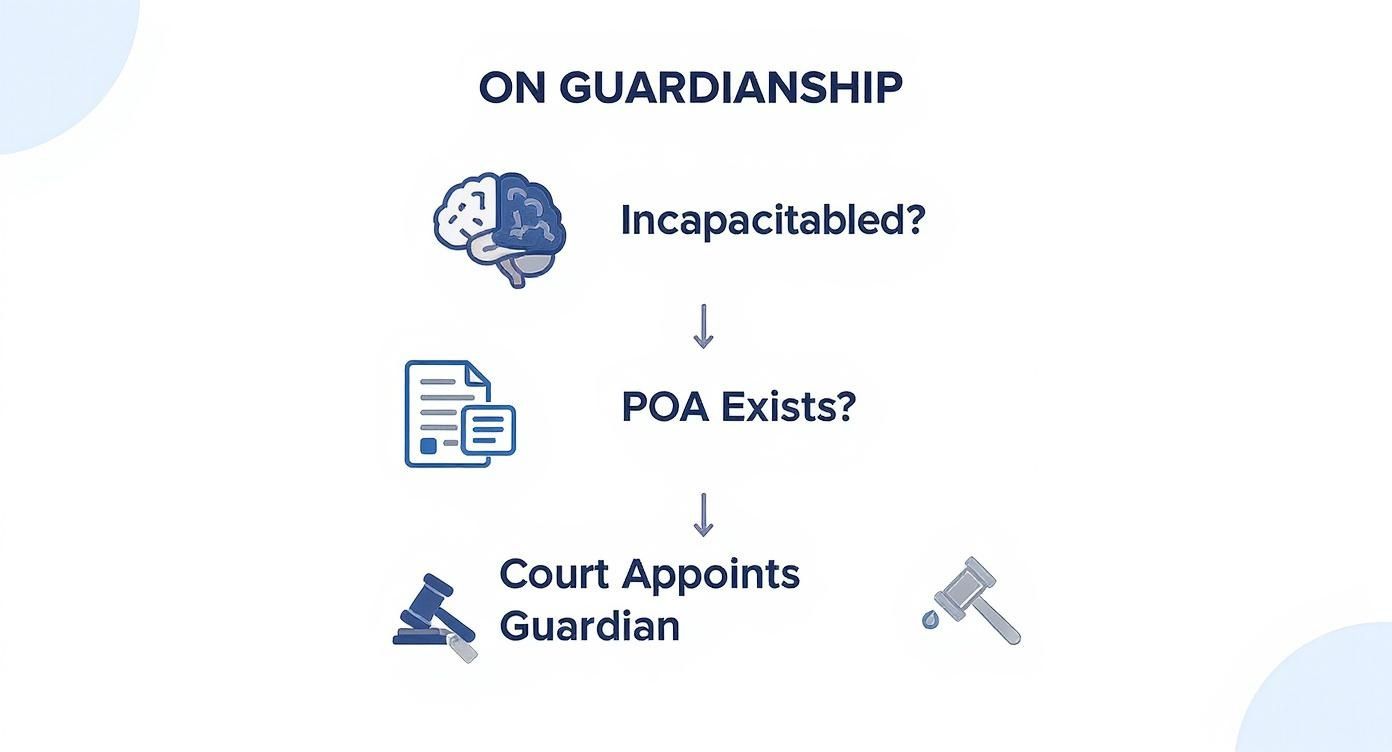
As the graphic shows, guardianship is often the final step, taken only when an individual is incapacitated and has no effective Power of Attorney already in place.
Let's take a closer look at the key differences side-by-side.
Detailed Feature Comparison: POA vs. Guardianship in Texas
This table breaks down the core distinctions between a Power of Attorney and a Guardianship, helping you see how they stack up in practical terms.
| Aspect | Power of Attorney | Guardianship |
|---|---|---|
| Initiation | Proactive & Voluntary. Created by the principal before incapacity occurs. | Reactive & Court-Ordered. Initiated by a third party after incapacity has occurred. |
| Authority Source | The Principal. You decide who gets power and how much they have. | The Court. A judge determines the guardian's powers based on evidence. |
| Legal Process | Simple document drafting and signing. No court involvement required. | Complex legal proceeding involving petitions, hearings, and evidence. |
| Timing | Must be created while the principal has full mental capacity. | Only available after an individual has become incapacitated. |
| Oversight | Private. The agent is accountable to the principal; no routine court supervision. | Public. The guardian is accountable to the court and must file annual reports. |
| Cost | Relatively low cost, typically just attorney's fees for drafting. | Can be very expensive, with court fees, attorney fees, and ongoing reporting costs. |
| Flexibility | Highly customizable. Powers can be broad or very specific. | Powers are determined by the court and limited by state law. |
| Revocability | Can be revoked by the principal at any time, as long as they are competent. | Can only be terminated by a court order. |
Ultimately, the choice hinges on your specific situation. A POA offers a streamlined, private, and cost-effective way to plan ahead, while guardianship provides a court-supervised safety net for those who can no longer protect themselves.
When Legal Paths Collide
It’s a common misconception that having a POA makes you immune to guardianship proceedings. That's not true. If a family member believes an agent is exploiting the principal or simply not acting in their best interests, they can petition the court.
A judge in a Texas probate court has the authority to investigate the agent's actions, suspend their powers, invalidate the POA, and establish a guardianship if it's necessary to protect a vulnerable person. This court intervention serves as a crucial check and balance, ensuring that even private arrangements are held to a high standard of care.
Understanding these detailed distinctions is essential. While both tools aim to protect a loved one, they operate in fundamentally different ways. For personalized advice on which path is right for your family's situation, we encourage you to schedule a free consultation with our experienced team.
When a Power of Attorney Is the Right Choice
Frankly, in almost every situation where you're comparing guardianship vs. power of attorney, putting a Power of Attorney (POA) in place beforehand isn't just a good choice—it's the best choice a Texas family can make. Think of a POA as a tool of empowerment. It lets you keep your dignity and control by choosing the exact person you trust to manage your affairs if you can no longer do it yourself.
This proactive approach is the polar opposite of guardianship. Instead of a public, often stressful court proceeding where a judge makes the final call, a POA keeps your personal business private, saves a significant amount of money, and leaves the decision-making firmly in your family's hands. It is truly the cornerstone of a well-thought-out estate plan.
Use Cases for a Power of Attorney
A POA is incredibly versatile and can be shaped to fit many common life situations. It's the perfect solution for:
- Planning for Future Incapacity: An aging parent can appoint an adult child to handle finances and healthcare, creating a smooth, seamless transition if dementia or another illness ever develops.
- Enabling Financial Assistance: You can give a trusted relative the authority to handle specific financial tasks, like paying your bills or managing investments, while you're traveling or recovering from surgery.
- Honoring Healthcare Wishes: A Medical Power of Attorney makes sure the person you trust most is empowered to make critical medical decisions for you, following your wishes without any court interference.
A Proactive Step to Preserve Autonomy
The strong preference for POAs isn't just a local trend; it's a global one. While both are legal tools for managing an adult's affairs, there's a significant worldwide shift toward the POA as the preferred, less restrictive option. Experts now recommend that continuing powers of attorney—which let you appoint an agent while keeping all your legal rights—should be the foundation of any adult protection system.
Guardianship, on the other hand, should be reserved only for those rare cases where nothing else will work. This reflects a worldwide understanding that guardianships involve far greater legal intervention and a higher risk of stripping away someone's autonomy compared to the forward-thinking planning a POA offers. You can learn more about these global perspectives on guardianship and see why self-determination is so highly valued.
The window to create a valid Power of Attorney is finite. Once mental capacity is lost, the opportunity closes forever, leaving guardianship as the only remaining path.
This makes the decision to create a POA both time-sensitive and incredibly important. Taking this step is an act of love for your family, saving them from the emotional and financial toll of a future court battle. By preparing now, you secure your own legacy of choice and independence. For more information, you can check out our guide on planning for incapacity with powers of attorney in Texas.
When Guardianship Becomes Necessary in Texas
Sometimes, no matter how much we plan, life throws a curveball. While a Power of Attorney (POA) is always the best first step, it isn't always an option. For many Texas families, guardianship becomes the only way forward.
This often happens when a loved one is already incapacitated and never signed a POA. Other times, family disagreements get in the way of deciding on care, or worse, someone is taking advantage of them financially and needs the court's immediate protection.
If you're facing the guardianship process, it can feel overwhelming. You're not alone. It’s a structured legal proceeding that acts as a safety net when nothing else will work. Understanding what’s involved will help you move forward with confidence, knowing you're getting your loved one the protection they deserve.

A Step-by-Step Overview of the Texas Guardianship Process
Getting a guardianship started means filing a formal application in a probate court, like those in Fort Bend or Montgomery County. This isn't just filling out forms; it's the official start of asking a judge to legally recognize that your loved one needs help. The entire process follows a clear path laid out in the Texas Estates Code.
Here’s a look at the practical steps you can expect:
- File an Application: Your attorney will file an "Application for Appointment of Permanent Guardian" with the correct county court. This document explains exactly why a guardian is needed.
- Get a Physician’s Certificate: The court needs a recent letter from a doctor. This letter must confirm the proposed ward's medical condition and state that they are unable to make their own decisions.
- The Court Appoints an Attorney: A judge will appoint an "attorney ad litem." This is an independent lawyer whose only job is to represent the best interests of the person who might need a guardian, ensuring their rights are protected.
- Attend the Court Hearing: You'll go before the judge, who will review all the evidence—from medical records to testimony—to determine if the person is legally incapacitated.
- The Guardian is Appointed: If the judge agrees there is clear and convincing evidence of incapacity, they will appoint a guardian. You'll then receive "Letters of Guardianship," the legal document that grants you the authority to act.
Preparing for the Emotional and Financial Realities
Let's be honest: this journey is tough, both emotionally and financially. Between court costs, attorney fees, and the strain of testifying about a family member's decline, the toll can be significant. A little preparation can go a long way in easing that burden.
Guardianship is a profound act of care, initiated to protect a vulnerable person when they can no longer protect themselves. It’s a legal last resort that prioritizes safety and well-being above all else.
Before you start, pull together all the relevant medical and financial documents you can find. It’s also incredibly helpful to write down specific examples of your loved one's confusion, poor decisions, or instances where they might have been exploited. This evidence will be vital for the court.
Facing the guardianship process is not something you should do by yourself. Compassionate legal guidance is essential. Schedule a free consultation with our experienced team to talk about your family's unique situation and map out a clear path forward.
Common Questions About Texas Guardianship and POAs
When Texas families start looking into ways to protect a loved one, the differences between a guardianship and a power of attorney can seem murky. Here are some of the most common questions we get at The Law Office of Bryan Fagan, along with straightforward answers.
Can a Durable Power of Attorney Avoid Guardianship in Texas?
Yes, absolutely. In fact, that's one of its primary purposes. A well-drafted Durable Power of Attorney, paired with a Medical Power of Attorney, can often make a court-ordered guardianship completely unnecessary.
By taking the initiative to appoint a trusted agent while you still have the capacity to do so, you create a seamless legal pathway for someone to manage your affairs if you ever can't. Think of guardianship as the legal safety net—it’s there for when no proactive plan exists, not as the first choice.
What Happens if a POA Agent Acts Improperly?
If an agent starts mismanaging money, abusing their authority, or simply not acting in the principal's best interest, family members have recourse. You can petition the court to step in. A judge in a Texas probate court, whether in Harris County, Dallas County, or elsewhere, has the power to investigate the agent's actions.
If misconduct is found, the court can revoke the Power of Attorney entirely. From there, it may start guardianship proceedings to appoint a responsible person to take over. This judicial oversight is a crucial protection and highlights why a court can override a POA when there's evidence of abuse.
An agent's fiduciary duty is a serious legal and ethical promise to act only in your best interest. When that trust is violated, the court system is designed to intervene and shield the vulnerable.
How Much Does Guardianship Cost Compared to a Power of Attorney?
There's no contest here—a power of attorney is dramatically less expensive. You're typically looking at a one-time fee for an experienced attorney to draft and execute the documents correctly.
Guardianship, on the other hand, is a full-blown court proceeding with costs that pile up quickly. You'll face court filing fees, fees for your attorney, fees for the ward's court-appointed attorney, and possibly annual bond premiums and reporting fees. It's not an exaggeration to say that guardianship can easily cost thousands of dollars more than setting up a POA.
Do I Need a Lawyer to Create a Power of Attorney in Texas?
While you can find templates online, trying to DIY a Power of Attorney is a risky gamble. We strongly recommend working with an experienced attorney. A lawyer will ensure your documents are fully compliant with the Texas Estates Code and, just as importantly, are tailored to your specific wishes and family dynamics.
An improperly drafted POA can be ruled invalid right when it's needed most. That single mistake could force your family into the very guardianship process you were trying so hard to avoid, undoing all your careful planning.
Choosing between a power of attorney and guardianship demands a careful look at your family's unique situation and future needs. The experienced attorneys at The Law Office of Bryan Fagan, PLLC are here to offer the clear, compassionate guidance you deserve. Schedule a free, no-obligation consultation with us today to figure out your next steps. https://texasguardianshiplawyer.net