Skip to content
Facing the possibility that a loved one can no longer make their own decisions is one of life's most difficult and emotional moments. The legal process of guardianship can feel overwhelming, but its purpose is compassionate: to protect a vulnerable person when they can no longer protect themselves. We understand the emotional and financial challenges your family is facing, and our goal is to guide you with clarity and care.
At its core, guardianship is a legal relationship created by a Texas probate court. It gives a qualified individual (the guardian) the authority to care for another person (the ward) who has become incapacitated. This isn't a step anyone takes lightly. Guardianship laws in Texas, outlined in the Texas Estates Code, Title 3, Subtitle G, set a very high bar, requiring clear and convincing evidence that a person truly lacks the capacity to manage their own life.
Understanding Incapacity Under Texas Law
So, what does “incapacitated” actually mean in a Texas courtroom like the Harris County Probate Court? It’s more than just making a few bad decisions or being forgetful.
Incapacity is the legal term for when a person, due to a physical or mental condition, is substantially unable to provide their own food, clothing, or shelter, care for their physical health, or manage their financial affairs.
Common situations that often lead families to explore guardianship include:
- Hypothetical Scenario: An elderly parent with advanced dementia or Alzheimer’s who is falling victim to financial scams or forgetting to pay essential bills.
- An adult child with a severe intellectual disability who cannot live independently without structured support.
- A loved one who has suffered a traumatic brain injury and can no longer communicate their needs or wishes.

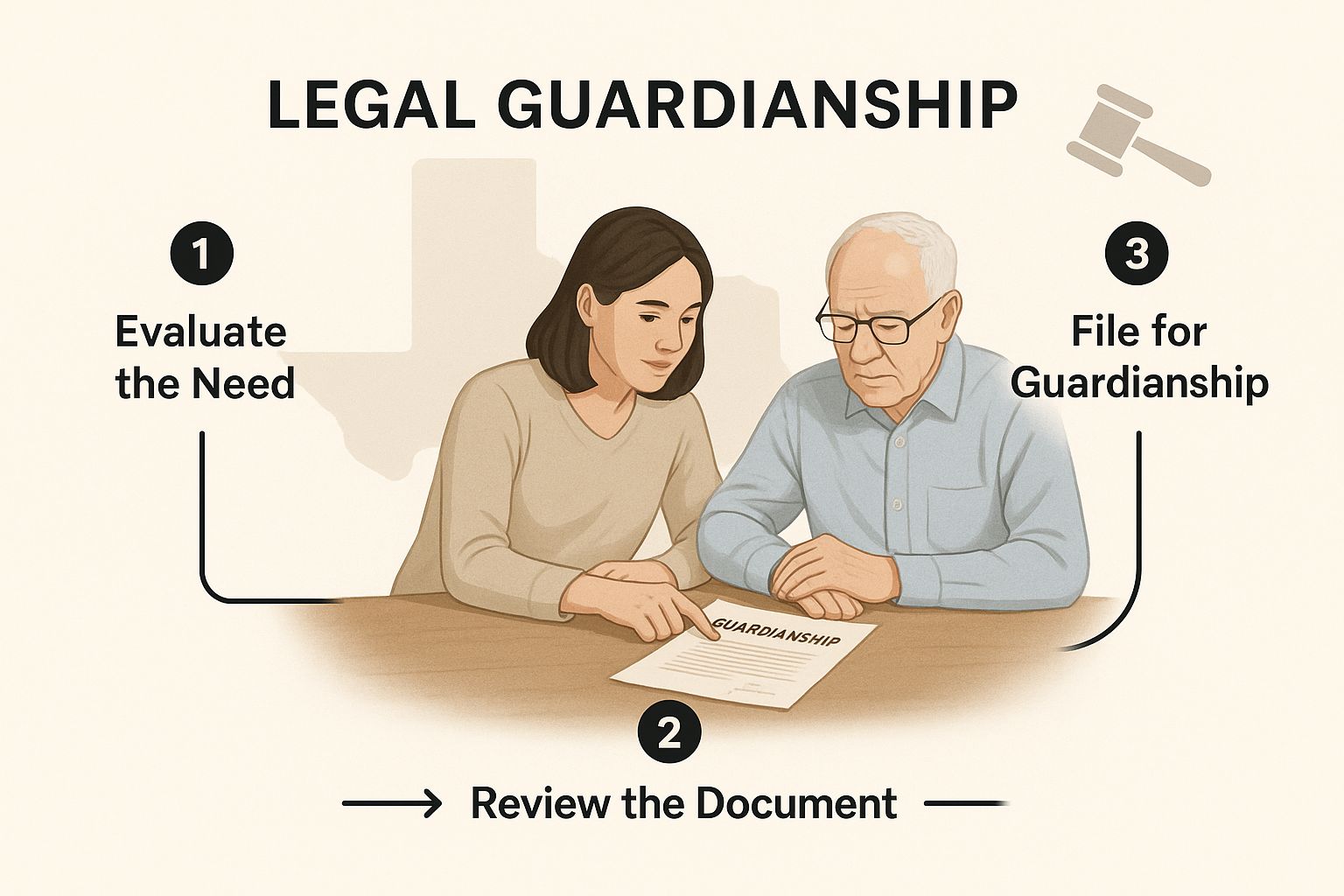
This process is about creating a protective legal shield, ensuring a loved one’s well-being is always the top priority.
A Protective Measure of Last Resort
Because guardianship involves removing a person’s fundamental right to make their own choices, Texas courts treat it as an absolute last resort. Whether you're in Harris County or Dallas County, a judge will only grant a guardianship if there are no less restrictive alternatives available.
Before starting down this path, it's a critical practical step to explore other options first, like a durable power of attorney, a medical power of attorney, or a supported decision-making agreement. For a deeper dive into the broader framework of care decisions, you can explore dedicated legal resources for care planning.
The evolution of guardianship laws in Texas highlights this protective principle. The system today includes robust safeguards to protect the rights and property of incapacitated individuals. For a more detailed look at the legal and ethical lines drawn in these cases, you can read our guide on when someone requires a guardian beyond parental care.
Is Guardianship the Right Path? Key Considerations
Deciding whether to pursue guardianship can be confusing. This table breaks down common scenarios to help you see how Texas law might view your situation.
| Situation or Concern | What Texas Law Considers | Potential Next Step |
|---|---|---|
| "Mom keeps forgetting to pay her bills." | Is this simple forgetfulness or a substantial inability to manage finances due to a medical condition? | Explore less restrictive options first, like a Power of Attorney or adding a trusted person to her bank accounts. |
| "My adult son with autism can't live alone safely." | Does his condition prevent him from providing for his own shelter, food, and basic safety? | A Guardianship of the Person might be appropriate to make decisions about his living situation and healthcare. |
| "Dad is giving all his money away to telemarketers." | Is he being exploited due to a condition like dementia that impairs his judgment? | A Guardianship of the Estate could be necessary to protect his assets from further depletion. |
| "My sister had a car accident and is in a coma." | She is clearly unable to make medical or financial decisions for herself. | An Emergency Guardianship may be needed immediately, followed by a permanent guardianship if necessary. |
While this table offers a starting point, every family's circumstances are unique. Making this decision is emotionally and financially taxing. At The Law Office of Bryan Fagan, we are here to guide you with the clarity and care your family deserves. To get personalized advice on whether guardianship is the right step for you, schedule a free consultation with our experienced attorneys today.
Navigating the Texas Guardianship Process Step by Step
The legal journey to establish guardianship can feel overwhelming, but breaking it down into clear, practical steps can bring a sense of control and clarity. This is a structured sequence of events designed to protect the proposed ward while giving the court everything it needs to make this life-altering decision.


This journey kicks off when you file a formal Application for Appointment of Guardian with the proper Texas probate court, whether that's in Harris County, Bexar County, or elsewhere. This detailed legal document officially gets the court involved.
The Initial Filing and Required Documentation
Think of the application as the foundation of your case. Governed by the Texas Estates Code, Title 3, Subtitle G, it must lay out specific information about the proposed ward, you as the applicant, and a clear explanation of why guardianship is necessary.
One of the most critical documents you'll file is a signed letter from a physician, often called a Certificate of Medical Examination (CME). This must be based on an examination of your loved one that happened within the last 120 days.
The CME must detail:
- The nature and degree of the proposed ward’s incapacity.
- The specific physical or mental conditions causing the decline.
- The doctor's professional opinion on whether guardianship is needed.
This medical evidence is non-negotiable. Without it, the court simply can't move forward, as it provides the objective medical basis required by Texas law. For a full breakdown of what you'll need to file, you can check out our step-by-step guide to filing for guardianship in Texas.
The Court's Investigation and Protections
Once the application is filed, the court immediately puts several safeguards in place. These aren't mere formalities—they are fundamental protections to ensure the rights of the person alleged to be incapacitated are front and center.
First, the court appoints an attorney ad litem. This is an independent attorney whose only job is to represent the proposed ward. They will meet with your loved one, explain what's happening in a way they can understand, and fight for their wishes in court—even if that means fighting against the guardianship itself.
The attorney ad litem acts as the eyes and ears of the court, ensuring the proposed ward's voice is heard and their legal rights are vigorously defended throughout the entire process.
Next, the judge will appoint a court investigator. This is a neutral third party who conducts their own investigation. They might visit the proposed ward’s home, interview family members, and talk to caregivers. The investigator then submits a confidential report to the judge, painting a comprehensive, unbiased picture of the situation.
The Final Hearing and Court's Decision
The whole process leads up to a final hearing. This is where you, the applicant, must present your case to the judge. This usually involves your own testimony and sometimes testimony from the physician who completed the medical certificate.
The attorney ad litem will also be there to present their findings and advocate for the proposed ward. Your loved one has the right to be at the hearing and can even testify. It’s up to you to prove with "clear and convincing evidence" that the person is incapacitated and that guardianship is the least restrictive way to protect them. This is a very high legal bar to clear.
If the judge agrees that guardianship is necessary, they will sign an order appointing the guardian. From there, the newly appointed guardian has to take an oath and post a bond, officially starting their legal duties. This final step is what transforms a loving family member into a court-supervised fiduciary, bound by the laws of Texas.
Understanding the Different Types of Guardianships
When it comes to protecting a loved one, Texas law understands that every family’s situation is unique. Guardianship isn't a one-size-fits-all legal tool. Instead, the law offers different options to match specific needs, ensuring the solution is both compassionate and effective.

The biggest distinction a Texas court makes is between managing someone’s personal life and managing their finances. This separation is key because it allows for a highly tailored approach, making sure a guardian only receives the authority that is absolutely necessary.
Guardian of the Person vs. Guardian of the Estate
The Texas Estates Code splits guardianship into two main roles. A court can appoint someone to handle just one, or in many cases, both.
- Guardian of the Person: This guardian makes decisions for the ward's personal and medical well-being—choosing where the ward lives, consenting to medical care, and making sure they have proper food, clothing, and a safe home.
- Guardian of the Estate: This guardian manages the ward’s financial world. Their job involves managing property and investments, paying bills, and protecting the ward’s assets from being wasted or falling prey to scams.
Example: Imagine an elderly parent with Alzheimer's. They might need a "Guardian of the Person" (like an adult child) to coordinate their care at an assisted living facility. At the same time, a separate "Guardian of the Estate" could manage their retirement accounts. It’s also very common for one capable, trustworthy person to be appointed to both roles. You can explore how these financial duties connect with the bigger picture in our articles on Probate and Estate Planning.
Full Guardianship vs. Limited Guardianship
Texas law has a strong preference for preserving as much of a person's independence as possible. This principle is so important that courts are required to consider a limited guardianship before they will even entertain the idea of a full one.
A limited guardianship is custom-fit to the ward’s specific limitations. It gives the guardian decision-making power only in the areas where the ward is truly incapacitated, leaving them in control of everything else. This approach respects their autonomy and dignity.
Example: A young adult with a developmental disability is perfectly capable of handling their daily budget but struggles with complex medical decisions. A limited guardianship would give a guardian authority only for those medical challenges, allowing the ward to keep managing their own day-to-day finances. A full guardianship, on the other hand, is a last resort, granted only when there’s clear evidence that a person is totally incapacitated.
Temporary or Emergency Guardianships
A sudden crisis—like a stroke or a serious accident—can leave a loved one instantly unable to care for themselves. For these urgent situations, the law provides for a temporary guardianship.
A court can move quickly to establish a temporary guardianship when there is an imminent danger to a person’s health or finances. These are short-term solutions, usually lasting no more than 60 days, designed to create a legal bridge. This allows a guardian to make critical decisions right away while the family has time to pursue a more permanent guardianship if needed. The legal bar for an emergency order is incredibly high; you must present substantial evidence that a true crisis is at hand.
Grasping these different types of Guardianship is the first critical step. If you're feeling overwhelmed, we are here to help. Schedule a free consultation with The Law Office of Bryan Fagan today for personalized guidance.
The Rights and Responsibilities of a Guardian
Taking on the role of a guardian is a profound commitment built on trust and accountability. It’s far more than a legal title; it’s a fiduciary duty. That’s a legal term meaning you are bound, both legally and ethically, to act only in the best interests of the person you’ve sworn to protect—the ward.
This is a responsibility the Texas courts take incredibly seriously. Because the role carries so much weight, the state has put clear requirements in place to make sure every guardian is up to the task. This isn't just red tape; it's a critical safety net for vulnerable Texans.
State-Mandated Training and Registration
In recent years, Texas has strengthened its laws to protect people under guardianship. Today, anyone hoping to become a guardian must first complete an online training course designed to educate them on their duties and the rights of the ward. You can discover more about the legislative efforts that brought about these vital changes.
Practical steps for a prospective guardian include:
- State-Mandated Online Training: This course covers the nuts and bolts of guardianship law in Texas.
- Criminal Background Check: A deep dive into your background is conducted to screen out anyone who might pose a risk to the ward.
- Statewide Registration: Guardians are entered into a statewide database, which boosts oversight and accountability.
Core Fiduciary Duties of a Guardian
Once appointed, you inherit a clear set of responsibilities spelled out in the Texas Estates Code, Title 3, Subtitle G. These duties are your roadmap for making legal and ethical decisions.
A guardian’s main jobs often include:
- Managing Finances Prudently: As a Guardian of the Estate, your job is to handle the ward's assets with care. This means paying bills, investing wisely, and protecting their property. For trickier financial waters, you might need to bring in a professional, a topic we touch on in our Estate Planning section.
- Making Healthcare Decisions: As a Guardian of the Person, you'll be the one consenting to medical treatments, choosing doctors, and making sure the ward gets the care they need.
- Filing Annual Reports: Every year, you must file a detailed report with the court. This report accounts for the ward’s well-being and, if it applies, their finances. It’s all about transparency and allowing the court to supervise your actions.
Your authority as a guardian is not absolute. It is a power granted by the court, and every decision you make must be justifiable as being in the ward's best interest.
The Ward’s Bill of Rights
This is incredibly important: guardianship laws in Texas are very clear that a ward does not lose all of their personal rights. The law goes out of its way to protect their dignity and autonomy as much as possible.
A guardian must always respect the ward’s Bill of Rights. This includes the right to be treated with respect, to have a say in personal matters when they are able, and to live in the least restrictive environment that’s safe for them. Juggling these duties can be a lot to handle. If you are considering becoming a guardian, we are here for you. Schedule a free consultation with The Law Office of Bryan Fagan for clear, compassionate advice.
Exploring Alternatives to Guardianship in Texas
Because it involves removing a person’s fundamental rights, Texas courts are required by law to consider guardianship only when all other options have been exhausted. This isn't just a legal hurdle; it's a way of honoring a person's dignity and preserving their independence.
Fortunately, Texas law offers several powerful tools that can achieve the same protective goals without a court-supervised guardianship. These alternatives are often part of a proactive planning strategy, empowering individuals to decide who will help them long before a crisis hits. Understanding these options is a critical first step.
Powers of Attorney: Financial and Medical
The most common and effective alternatives to guardianship are powers of attorney. These are legal documents where an individual (the "principal") grants a trusted person (the "agent") the authority to make decisions on their behalf.
- Durable Power of Attorney: This document lets your chosen agent manage your financial and property matters—things like paying bills or handling investments. The word "durable" is key; it means the document stays in effect even if you become incapacitated.
- Medical Power of Attorney: This tool empowers your agent to make healthcare decisions for you if you’re unable to.
For anyone looking to plan for the future, understanding tools like a durable power of attorney is essential. When created while a person has legal capacity, they can often eliminate the need for guardianship entirely.
Supported Decision-Making Agreements
Texas is a leader in promoting personal autonomy, and one of the most progressive tools available is the Supported Decision-Making Agreement. This legal document allows an individual with a disability to choose trusted advisors—like family or friends—to help them understand their options and make their own choices.
A Supported Decision-Making Agreement is not about giving away control. It’s about getting help to maintain it. The individual remains the sole decision-maker, preserving their legal rights and independence.
In 2015, Texas became the first state to formally write supported decision-making into law, a move specifically designed to reduce overly restrictive guardianships. This shift puts the rights of individuals with disabilities first.
Making the Right Choice for Your Family
Exploring these less restrictive options isn't just a good idea—it’s a requirement under Texas law. A judge in a Harris County Probate Court, for example, will specifically ask what alternatives have been considered and why they aren’t enough before granting a guardianship.
Guardianship vs. Alternatives in Texas
This table offers a side-by-side look at the primary legal tools available. The goal is always to find the least restrictive option that still provides the necessary support.
| Legal Tool | Who Makes Decisions? | Court Involvement | Best For… |
|---|---|---|---|
| Durable Power of Attorney | The chosen Agent, for financial matters. | None, if properly executed. | Individuals who want to plan for future incapacity. |
| Medical Power of Attorney | The chosen Agent, for healthcare decisions. | None, if properly executed. | Individuals planning ahead for medical decisions. |
| Supported Decision-Making | The individual, with help from trusted Supporters. | None. | Individuals with disabilities who can make their own choices with support. |
| Guardianship | The court-appointed Guardian. | Mandatory and ongoing. | Individuals who are fully incapacitated with no prior legal planning. |
These alternatives give you a way to protect your loved one while honoring their wishes. They are less expensive, less public, and far less emotionally draining than a formal court battle. To dive deeper, check out our guide on less restrictive options for decision-making.
Every family’s situation is unique. The compassionate attorneys at The Law Office of Bryan Fagan are here to help you understand your choices with clarity and care. Schedule a free consultation today to discuss the right solution for your family.
What Happens When Guardianship Gets Complicated?
Even with the best intentions, the emotional weight of a guardianship can spark family disagreements. These conflicts are tough, but guardianship laws in Texas offer a clear path for resolving disputes and making sure the ward’s best interests always stay front and center.
Whether a dispute is about who should serve as guardian or there are worries about how a guardian is handling their duties, the probate court system is there to step in.
Contesting a Guardianship (Guardianship Disputes)
Disputes often pop up at the beginning. A family member might argue that a guardianship isn't needed, or several relatives might each feel they're the best person for the job.
When someone formally contests a guardianship, the court must carefully look at all the evidence. Example: Imagine two adult children in a Travis County court both want to be the guardian for their aging mother. The judge will consider:
- Who is best equipped to manage the financial and medical responsibilities?
- Who has the closest relationship with their mother?
- Are there any conflicts of interest?
The court’s one goal is to appoint the person most capable of acting in the ward’s best interest, as required by the Texas Estates Code.
Changing or Ending a Guardianship (Termination and Compliance)
A guardianship isn’t always a lifelong commitment. A guardianship can be modified to either expand or shrink the guardian's powers. For example, if a ward's health declines, a limited guardianship might need to become a full guardianship.
A guardianship can be terminated entirely if the ward regains their capacity. This process, called a restoration, involves filing a motion with the court and providing fresh medical evidence that proves the ward can once again manage their own affairs. This ensures that guardianship is only used as a protective measure for as long as it's absolutely necessary.
When a Guardian Isn't Acting in the Ward’s Best Interest
One of the most serious issues arises when there are fears that a guardian is failing in their duties, mismanaging money, or even abusing their power. Texas law provides a direct way to address these problems.
Anyone with a legitimate concern can file a motion with the court to have a guardian removed. The court takes these allegations very seriously and will open an investigation. If the court finds the guardian has breached their fiduciary duty, it can act immediately to remove them and appoint someone new to protect the ward.
Navigating these disputes is both emotionally draining and legally intricate. The compassionate attorneys at The Law Office of Bryan Fagan are here to protect your loved one’s rights. Schedule a free consultation today for clear, caring advice on your specific situation.
Common Questions About Texas Guardianship Law
Stepping into the world of guardianship law in Texas naturally brings up practical questions. The process can feel overwhelming, but getting clear, straightforward answers is the first step toward making the best decisions for your family. Here are some of the most common concerns we hear.
How Much Does It Cost to Get a Guardianship in Texas?
There's no single price tag; the final cost depends on the complexity of the situation. You can generally expect to pay for court filing fees, the fee for the attorney ad litem (an attorney the court appoints to represent your loved one), and your own attorney's fees.
Keep in mind, if another family member contests the guardianship, the costs can climb quickly. Having a frank discussion about the potential financial commitment with an experienced attorney is a practical first step.
Can I Be a Guardian if I Live Out of State?
Yes, it's possible for an out-of-state resident to be appointed as a guardian in Texas, but it adds a layer of complexity. You'll have to prove you can effectively manage their life from a distance.
The Texas Estates Code often requires out-of-state guardians to name a resident agent in Texas who can be served with legal papers. Courts in counties like Harris or Dallas typically prefer a local guardian if a suitable one is available to ensure hands-on care.
What Happens if Someone Objects to Having a Guardian?
The proposed ward has an absolute right to object. Their court-appointed attorney ad litem is legally obligated to fight for their wishes in court. The proposed ward can attend the hearing, present their own evidence, and even demand a jury trial.
If they object, the burden of proof falls on the applicant. You must prove with “clear and convincing evidence” that the individual is incapacitated and needs a guardian. This is a high legal bar, showing how seriously the law protects a person's individual freedom.
How Long Does the Guardianship Process Take?
For an uncontested guardianship, the process in Texas usually takes several weeks to a few months after the application is filed. However, that timeline can stretch if the case gets complicated or if family members fight it. An emergency or temporary guardianship can be set up much more quickly, but it's only a temporary fix for immediate crises.
Getting a handle on the nuances of guardianship laws in Texas is the first step toward protecting your loved one with confidence and compassion. We know the legal and emotional hurdles can feel immense, but you don’t have to go through this alone. The experienced attorneys at the Law Office of Bryan Fagan, PLLC are here to offer the clear, steady guidance your family deserves.
Schedule a free, no-obligation consultation today to talk about your unique situation and find out how we can help you take the next step.