Skip to content
Thinking about the future can feel overwhelming, but creating the right estate planning documents is one of the most powerful and compassionate things you can do to protect the people you love. This isn't just about paperwork; it's about creating a clear roadmap for your family that prevents confusion and painful disputes when they're going through a tough time. At The Law Office of Bryan Fagan, our mission is to guide Texas families through this process with clarity and care.
Why Estate Planning Is an Act of Family Protection
Many Texas families believe estate planning is only for the wealthy or the elderly, but that couldn't be further from the truth. Creating an estate plan is a profound act of care. It’s your chance to leave clear, legally-binding instructions so your wishes are honored without any guesswork, offering your family stability during an emotional time.
A complete set of estate planning documents also protects you during your lifetime. It gives you control over your healthcare, lets you name trusted people to handle your finances if you become incapacitated, and most importantly, can help your family avoid stressful and costly court proceedings like guardianship.
The Cost of Having No Plan
If you don't have a plan, a judge in a Texas probate court, who doesn't know you or your family's unique situation, ends up making all the big decisions about your life and legacy. This can easily lead to outcomes you never would have wanted.
For instance, if you become incapacitated and don't have a durable power of attorney, your family might be forced into a guardianship proceeding just to get the authority to pay your bills or make medical decisions on your behalf. Under the Texas Estates Code, this means a public court process in a place like Harris County Probate Court to determine who should manage your affairs.
Dying without a will means Texas state law—not you—gets to decide who inherits your property. For parents with young children, the stakes are even higher. A judge will be the one to appoint a guardian to raise them, a deeply personal decision that should be yours alone.
By taking proactive steps now, you create a shield for your family, protecting them from the public, costly, and emotionally draining processes of guardianship and probate. It’s the ultimate peace of mind.
Despite how critical this is, so many people put it off. Surveys show that while 83% of Americans believe having a plan is important, a staggering 55% have no estate planning documents at all. You can get a better sense of how many Americans are unprepared by reviewing the 2025 will and estate planning report.
At The Law Office of Bryan Fagan, our entire mission is to guide Texas families through this process with clarity and compassion. We know these decisions carry a lot of emotional weight, and we're here to help you build a plan that secures your legacy and protects what matters most.
If you’re ready to take the first step, we invite you to schedule a free consultation with our experienced attorneys for personalized guidance.
Understanding Your Core Estate Planning Documents
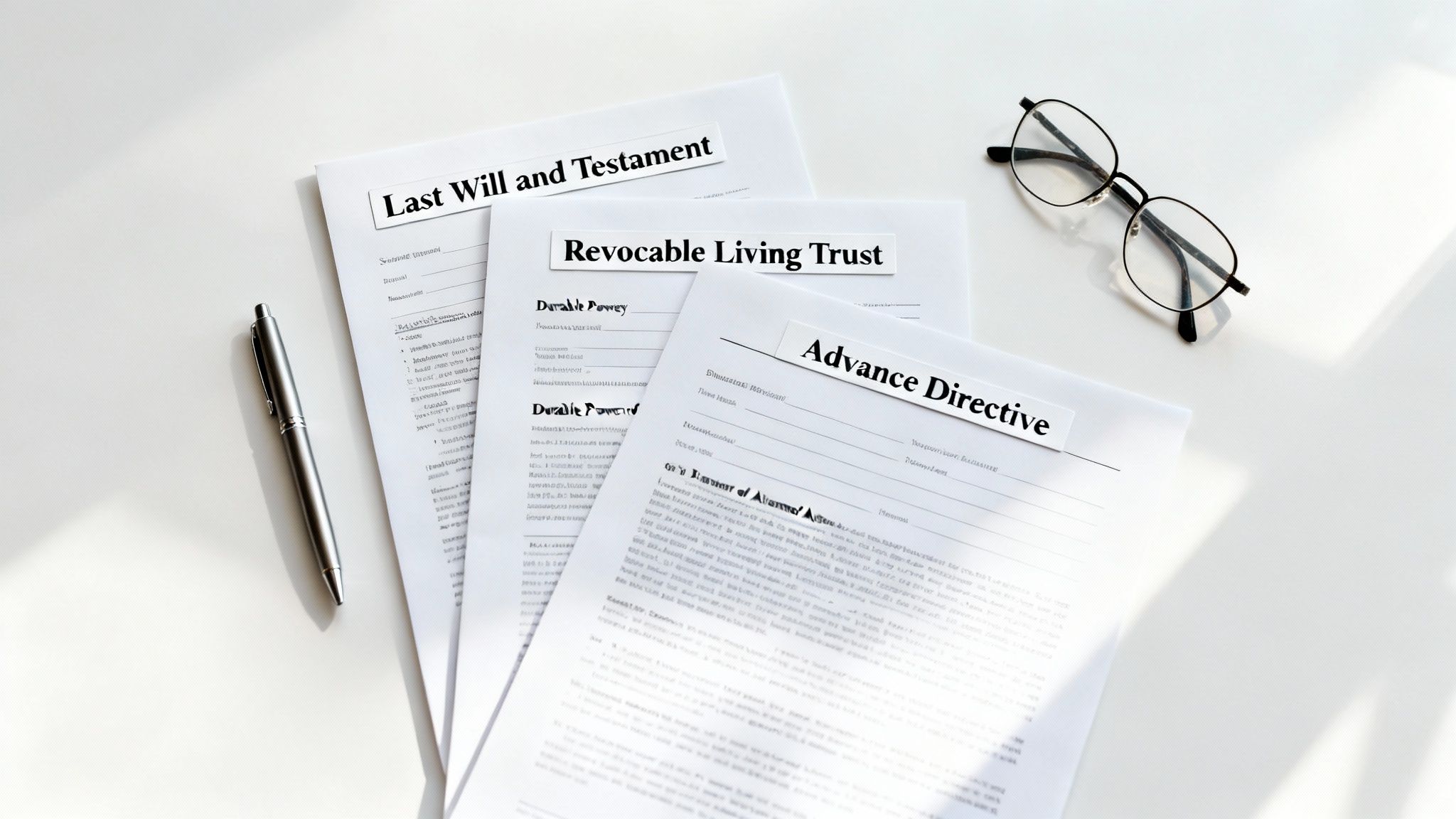
Stepping into the world of estate planning can feel like you're trying to learn a whole new language. Wills, trusts, powers of attorney—it’s a lot to take in. But each of these documents plays a unique and vital role in protecting you and the people you love.
Think of them as a team of specialists you’ve hand-picked, each with a specific job. Let's break down the core documents every Texan should know about in plain English. Once you understand what each one does, you'll feel much more confident making the right decisions for your family's future.
To give you a clearer picture, here’s a quick overview of the essential documents we'll be discussing.
Key Estate Planning Documents at a Glance
| Document | Primary Purpose | When It's Used | Key Texas Consideration |
|---|---|---|---|
| Will | To name guardians for minor kids and direct how your property is distributed | After your death | Must go through the probate court process to be validated and executed. |
| Trust | To hold and manage assets, often to avoid probate and maintain privacy | During your life and after death | Can be complex to set up but offers significant privacy and control. |
| Durable Power of Attorney | To appoint an agent to manage your financial and legal affairs | If you become incapacitated | Must be "durable" to remain in effect even if you are no longer able to make decisions. |
| Advance Directives | To state your wishes for medical treatment and end-of-life care | If you can't communicate them | Includes both a Medical Power of Attorney and a Directive to Physicians (Living Will). |
This table provides a snapshot, but the real power comes from understanding how these pieces fit together to form a protective shield for your family. Now, let’s dig into the details of each one.
The Last Will and Testament: Your Instruction Manual
A Last Will and Testament is the cornerstone of most estate plans. It's your official instruction manual for what should happen after you’re gone. For parents, its most critical job is naming a guardian for minor children—the person you trust to raise them if you can't.
Beyond that, a will spells out how your property—your house, your car, your heirlooms—should be passed on. It also names an executor, the person you’ve chosen to carry out those instructions and steer your estate through the probate process. Without a will, a Texas court has to make these deeply personal decisions for you.
Recent numbers show a worrying trend. A 2022 survey from Caring.com revealed that the percentage of American adults with a will dropped to just 24%, down from 33% the year before. The drop is even more pronounced among parents with young children, who need this protection the most.
The Revocable Living Trust: Your Private Container
A Revocable Living Trust is another powerful tool, but it functions very differently from a will. The best way to think of a trust is like a private container you create to hold your assets. While you're alive, you're in complete control. You can put things in or take things out whenever you want.
When you pass away, the person you named as your successor trustee steps in. They follow your private instructions to distribute the assets inside the container to your beneficiaries. The biggest advantage? Assets held in a trust almost always bypass the public, time-consuming, and often expensive probate process that wills require in counties like Harris or Dallas. This privacy and efficiency make trusts a popular choice.
The Durable Power of Attorney: Your Financial Safety Net
What if you become incapacitated and can't manage your own finances? That’s where a Durable Power of Attorney acts as your financial safety net. This document gives a person you trust—your "agent"—the legal authority to handle your financial life for you.
This is a serious responsibility. Your agent can be empowered to:
- Pay your bills and manage your bank accounts
- File your tax returns
- Oversee investments or real estate
- Handle insurance claims and government benefits
Without one, your family could be forced to go to court to establish a guardianship just to pay your mortgage. That’s an emotionally draining and costly process. A durable power of attorney keeps these decisions in your family’s hands and out of the courtroom. As you consider these core documents, it's also helpful to understand how technology is changing legal processes. You can learn more about the concept and benefits of e-signatures and their growing role.
Advance Directives: Your Voice in Healthcare Decisions
Advance directives are a group of documents that speak for you when you can't speak for yourself about medical care. They are literally your voice, ensuring doctors and loved ones know and respect your wishes. In Texas, this protection comes from two key documents.
1. Medical Power of Attorney
This document lets you name a trusted agent to make healthcare decisions for you if you become incapacitated. Your agent can consent to or refuse medical treatments based on what they know you would want or, if your wishes aren't known, what's in your best interest.
2. Directive to Physicians (Living Will)
More commonly known as a "living will," this document lays out your preferences for end-of-life care. It specifically addresses your wishes about life-sustaining treatments if you are diagnosed with a terminal or irreversible condition.
Key Takeaway: Together, these two documents give you complete control over your medical destiny. They provide crucial clarity for your family and doctors during an incredibly emotional time, lifting the burden of making agonizing decisions without your guidance.
These core estate planning documents are designed to work in concert, creating a comprehensive shield for you and your family. Each one answers a different "what if" question, making sure your wishes for your property, your finances, and your health are clearly defined and legally binding. Our team can help you understand how a Last Will and Testament form in Texas fits into this bigger picture.
If you have questions about which documents are right for your situation, we're here to help. Schedule a free consultation to get personalized guidance from our compassionate attorneys.
The Supporting Documents That Strengthen Your Plan
While the big players like wills and trusts form the foundation of your estate plan, a few key supporting documents provide a crucial extra layer of protection. Think of them as the specialized tools that ensure the main parts of your plan work without a hitch when you need them most.
These documents are often overlooked, but skipping them can lead to frustrating roadblocks and family conflict, especially when you're in the middle of a medical or financial crisis. Ignoring these can mean a perfectly good will or power of attorney gets tripped up by a simple administrative hurdle.
Let's walk through the three most important supporting documents that will make your Texas estate plan truly solid.
The HIPAA Release Form: Your Key to Communication
A Medical Power of Attorney is an absolute must-have, but it has a significant limitation on its own. It gives your chosen agent the authority to make decisions for you, but it doesn't automatically give them the right to see your private health information. That right is locked down by a federal law you've probably heard of: HIPAA (the Health Insurance Portability and Accountability Act).
This is where a HIPAA Release Form becomes so indispensable.
By signing a HIPAA Release, you are giving your doctors and other healthcare providers explicit permission to speak freely with the people you’ve designated. It’s the key that unlocks the door to communication, allowing your agent to get the information they need to make smart decisions that line up with your wishes.
Without this form, your agent could show up at a hospital in Houston or Austin, power of attorney in hand, only to be flatly denied access to your medical records. This can cause critical delays and incredible stress right in the middle of an emergency. You can learn more about how these documents work together in our guide on the differences between a durable vs. medical power of attorney.
Beneficiary Designations: The Fine Print That Can Override Your Will
So many people assume their will controls how all of their property gets divided up. The reality is that certain types of assets pass directly to individuals based on beneficiary designations, completely sidestepping both your will and the probate process.
These assets often include:
- Life insurance policies
- Retirement accounts like 401(k)s and IRAs
- Annuities
- Bank accounts set up with "Payable on Death" (POD) or "Transfer on Death" (TOD) instructions
It is critically important to review and update these designations regularly, especially after major life events. Forgetting to remove an ex-spouse from a life insurance policy after a divorce, for instance, could mean they get the entire payout, no matter what your new will says. Making sure your beneficiary designations match your overall estate plan isn't just a good idea—it's a non-negotiable step to ensure your assets end up with the right people.
Declaration of Guardian: A Proactive Voice in Court
Finally, Texas law gives you a powerful tool to influence a potential future guardianship proceeding before it ever happens. As laid out in Title 3, Subtitle G of the Texas Estates Code, you can file a Declaration of Guardian. This document serves two vital purposes.
First, it lets you state, in a legally binding document, who you would want to be appointed as your guardian if a court ever decides you need one. Second, and just as powerfully, you can also state who you absolutely do not want to serve as your guardian.
This document is literally your voice in a future court hearing. While a judge in a Bexar County or Travis County probate court makes the final call, they are required to give serious weight to your stated preferences. This declaration can head off ugly family disputes and ensure the person managing your affairs is someone you genuinely trust, giving you immense peace of mind.
How These Documents Help You Avoid Court
Think of your family's future as a fork in the road. One path, paved with a solid estate plan, leads to a smooth, private, and efficient process for your loved ones. The other path, left unplanned, goes straight to the public, costly, and emotionally draining Texas court system. These estate planning documents are the tools that let you choose the smoother, better path.
The main point of a comprehensive plan isn't just about who gets what. It's about preserving family harmony and keeping your personal decisions in your hands. When you create these legal safeguards ahead of time, you're taking a powerful step to keep deeply private family matters out of a courtroom. You're shielding the people you care about from the stress of public proceedings during an already difficult time.
Preventing a Guardianship Proceeding
A guardianship is a court proceeding where a judge appoints someone to make decisions for a person who has become incapacitated. While it’s sometimes necessary, it can be a long, expensive, and public ordeal that strips someone of their fundamental rights.
The good news is that it’s often entirely avoidable.
A Durable Power of Attorney and your Advance Directives are your first line of defense against a guardianship. By naming agents you trust to handle your financial and medical affairs if you can't, you remove the need for a court to step in. These documents give your chosen representatives the immediate legal authority they need, letting them bypass a court hearing in a place like the Harris County Probate Court.
A well-drafted set of incapacity documents is one of the most powerful gifts you can give your family. It replaces uncertainty and court filings with clarity and immediate action, allowing your loved ones to focus on your care, not on legal battles.
Bypassing the Probate Process
Probate is the court-supervised process of validating a will, paying off debts, and distributing what's left. Even if you have a will, the process can drag on for months—sometimes years—and the details of your estate become a matter of public record. A properly structured estate plan, however, can help your family sidestep this process almost entirely.
The key player here is the Revocable Living Trust. When you transfer your assets into the trust during your lifetime, they are no longer considered part of your probate estate. Upon your passing, the successor trustee you named can manage and distribute those assets privately and efficiently, just as you instructed, without needing a judge's permission. To get a better handle on what goes through this court process, you can explore our detailed guide on probate and non-probate assets.
This infographic shows how crucial supporting documents, like beneficiary designations and HIPAA releases, are to making sure your whole plan works seamlessly.
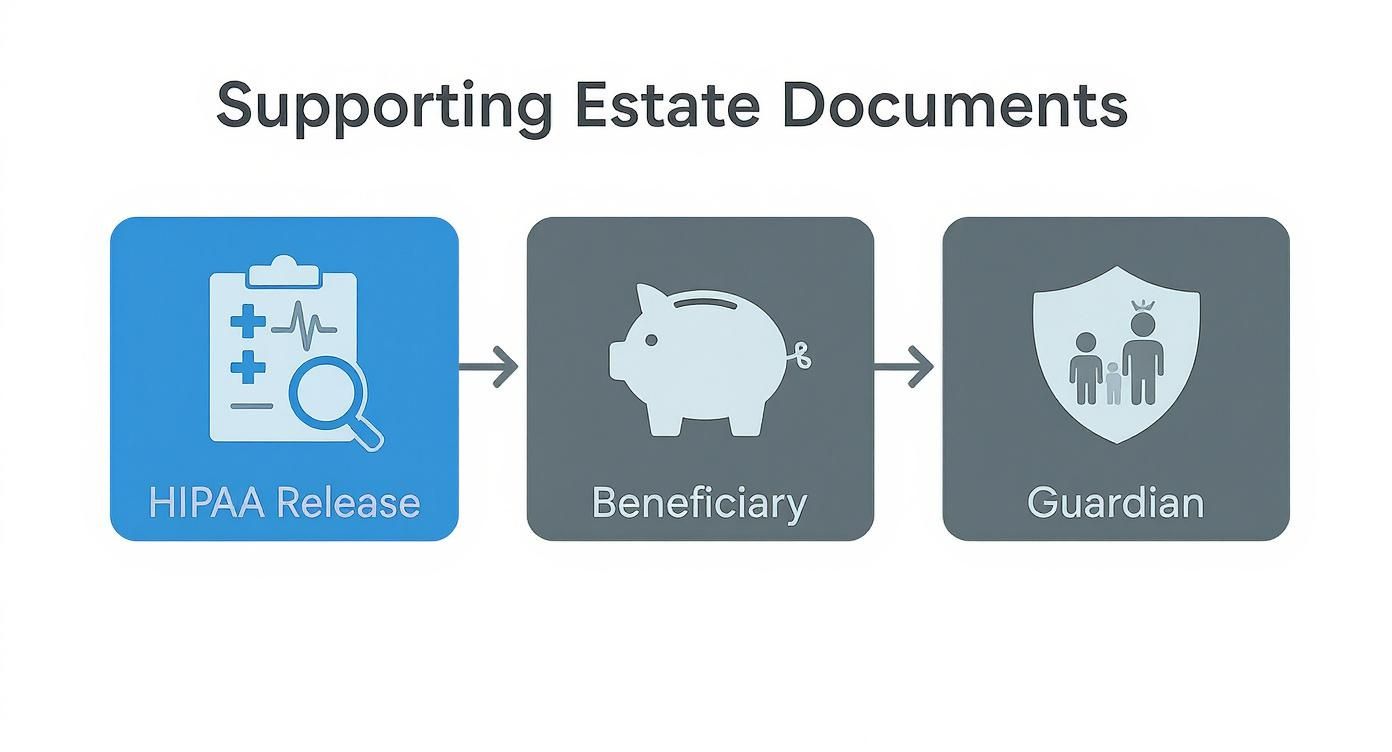
These documents all work together, giving your chosen agents the legal and practical authority they need to act on your behalf, which further cuts down the chances of ending up in court.
The Reality of Having No Plan
Without these documents in place, your family is stuck with the default plan Texas law provides, known as intestate succession. This means a judge who doesn't know you or your family will decide who gets your assets based on rigid legal formulas. Your long-term partner, stepchildren, or a favorite charity could end up with nothing.
With the massive transfer of wealth on the horizon, this is a critical issue. American retirees are projected to pass down over $124 trillion to beneficiaries by 2048. Without clear plans, a huge chunk of that wealth could get tied up in court fights. Federal law currently allows individuals to transfer up to $13.99 million without facing estate taxes, a number that highlights just how important smart planning is.
When you create your own plan, you take control away from the courts and put it firmly where it belongs: in the hands of the people you trust. It's a true act of foresight that protects your legacy and gives everyone invaluable peace of mind.
Your Practical Checklist for Getting Started

Moving from simply understanding these estate planning documents to actually creating them is the most critical part of the process. We get it—it can feel like a mountain of a task. But breaking it down into smaller, manageable pieces makes the entire journey far less intimidating.
Think of this checklist as your roadmap. Each step builds on the last, getting you closer to the profound peace of mind that a solid plan provides.
Step 1: Start the Conversation
Let's be honest, the most important conversations are often the hardest to start. But this one can't wait. Sit down with your spouse, partner, or other key family members and talk openly about your wishes.
Who should make financial and medical decisions if you can't? Who is the right person to be the guardian for your children? Getting everyone on the same page now prevents confusion and conflict later, ensuring your choices are both understood and respected.
Step 2: Gather Your Key Information
You can't create a plan without knowing what you're working with. It's time to start pulling together your important financial and legal paperwork. Don't worry about creating a perfect balance sheet; this is about gathering the raw materials your attorney will need.
Your information-gathering list should include:
- Property Deeds for any real estate you own.
- Account Statements from banks, investment firms, and retirement plans (like 401(k)s or IRAs).
- Life Insurance Policies, including policy numbers and coverage amounts.
- Vehicle Titles for cars, boats, or other registered vehicles.
- A List of Debts, such as mortgages, car loans, and credit card balances.
Having these documents organized from the get-go makes the planning process incredibly smooth and efficient for both you and your attorney.
Step 3: Choose Your Trusted People
Your entire estate plan hinges on appointing people you trust to carry out your wishes. These roles are incredibly important, so give this some real thought. Who is best suited for each responsibility?
You'll need to decide who will serve as your Executor (to manage your will), Trustee (to manage your trust), and Agents for your financial and medical powers of attorney. And for parents, the most crucial decision is choosing a Guardian for any minor children.
Look for individuals who are responsible, trustworthy, and capable of handling these duties with care. It's also smart to name an alternate for each role, just in case your first choice is unable to serve when the time comes.
Step 4: Clarify Your Wishes
Finally, take some time to reflect on your goals. What kind of legacy do you want to leave behind? Think about your specific wishes for medical care, your feelings on end-of-life decisions, and exactly how you want your assets distributed.
Are there specific heirlooms you want to go to certain people? Is there a charitable cause you’d like to support? Writing these thoughts down helps you prepare for a focused, productive meeting with an attorney. This isn't a legal document, but rather a personal guide that ensures your final estate planning documents truly reflect your values.
Taking these steps empowers you to walk into a legal consultation prepared and confident. If you're ready to turn your hard work into a legally sound plan, The Law Office of Bryan Fagan is here to help. Schedule your free consultation today to get personalized guidance from our compassionate team.
Got Questions About Texas Estate Plans? We've Got Answers.
When it comes to estate planning documents, it’s natural for questions to pop up. Getting clear, straightforward answers is the best way to feel confident moving forward. Let's tackle some of the most common concerns we hear from Texas families just like yours.
We know these topics can feel a bit heavy, but finding clarity is a powerful first step in protecting the people you love and cementing your legacy.
How Often Should I Update My Estate Plan?
Think of your estate plan less like a document you create once and more like a living roadmap that needs to adjust as your life’s journey changes. A good rule of thumb is to have an attorney review it every three to five years just to make sure it’s still in line with current Texas law.
But some life events should be an immediate trigger for a review. You’ll want to pull out your documents right away if you experience:
- A marriage or a divorce
- The birth or adoption of a child
- A major change in your financial picture (up or down)
- The death of a key person named in your plan, like an executor or a guardian
Keeping your plan current ensures it always reflects what you actually want to happen, which is the best way to prevent confusion and family disagreements later on.
What Happens if I Die Without a Will in Texas?
If you pass away in Texas without a will, you don't get a say in what happens next. The state makes those decisions for you through a rigid legal process called intestate succession. A probate judge, who has no idea about your family or your relationships, will divide up your property based on a strict formula laid out in the Texas Estates Code.
This means your assets could end up with relatives you barely know, while a lifelong partner you weren't married to or a close friend could get nothing. For parents, it's even more serious: a court will appoint a guardian for your minor children without any of your input.
This is exactly why having your own plan is so important—it keeps you in the driver's seat.
Are DIY Online Estate Planning Documents a Good Idea?
The low price tag on do-it-yourself online legal forms is definitely tempting, but they carry some serious risks. These cookie-cutter templates often miss the very specific details of Texas law, like the strict rules about how a will must be witnessed to be valid.
More importantly, a one-size-fits-all document can't possibly navigate complex family dynamics, like blended families or providing for a loved one with special needs. A simple error or oversight can make the whole document invalid, landing your family in the middle of the expensive court battles you were trying to avoid in the first place. Investing in professional advice is truly the safest way to know your plan is solid and will protect your family the way you intend.
If you have more questions, our team is here to help you find the answers. We invite you to schedule a free consultation for guidance that’s personalized to your situation.
It’s Time to Take That First Step and Protect Your Family
Putting together your estate plan isn't just about documents and legal jargon; it's a profound act of love that brings incredible peace of mind. When you put these key estate planning documents in place, you're not just organizing your assets. You're preserving family harmony, shielding your life's work from unnecessary court battles, and leaving a legacy of care and foresight.
We get it. Thinking about these topics can be tough, and it’s easy to put off. But the risks of waiting too long are very real. The unfortunate truth is that court proceedings, bitter family disputes, and immense stress are the common results when no plan is in place. The good news? All of it is entirely preventable.
The journey to security and clarity for your loved ones starts with one simple step. Taking action today builds a protective shield for your family tomorrow, giving them the space to focus on what truly matters during what will already be a difficult time.
Protecting your family's future is one of the most important things you will ever do. It’s about replacing uncertainty and what-ifs with a clear, legally sound roadmap that honors your wishes and safeguards your legacy for generations.
Let's start the conversation. We invite you to reach out to The Law Office of Bryan Fagan for a compassionate, no-pressure consultation. Our experienced Texas attorneys are here to help you build a personalized plan that protects everything you’ve worked so hard for and, most importantly, the people you love.
Contact The Law Office of Bryan Fagan, PLLC today to schedule a free consultation and start building your family's shield.