Skip to content
When you're navigating a Texas child custody case, the legal jargon can feel like a foreign language. One term you'll hear is sole managing conservatorship, a specific court-ordered arrangement where one parent is given the exclusive power to make most of the major decisions for a child. This parent becomes the final say on critical choices about school, healthcare, and where the child calls home. We understand that facing this possibility brings a mix of uncertainty and concern, and our goal is to provide clear, compassionate guidance.
Defining Sole Managing Conservatorship in Texas

In Texas family law, the term "custody" is replaced with "conservatorship," which defines the legal rights and responsibilities each parent has for their child. While the law presumes that parents should share these duties, sometimes a court determines it's in a child's best interest for one parent to take the lead. This is a decision made with immense care and only when specific circumstances warrant it.
Think of it this way: In most situations, Texas courts prefer both parents to act as co-captains in raising their child, an arrangement called Joint Managing Conservatorship. However, a sole managing conservatorship appoints one parent as the sole captain, trusting them to make the most critical decisions for the child's well-being.
This is not an arrangement that courts, such as the Harris County Probate Court or a Travis County family court, make lightly. A judge will only grant it when there is compelling evidence that it’s in the child's best interest, typically due to serious concerns about the other parent's stability, past behavior, or judgment.
The Exclusive Rights of a Sole Managing Conservator
A parent named the sole managing conservator holds a specific set of exclusive rights designed to create a stable and safe environment for the child, free from constant conflict over life's most essential decisions.
Here is a practical look at the exclusive authority this role typically includes:
- Deciding the child's primary residence, often without a geographic restriction unless specified by the court.
- Consenting to medical, dental, and surgical treatments that are invasive.
- Making all decisions about psychiatric and psychological care for the child.
- Directing the child's education and making all school-related choices.
This legal framework is established in the Texas Family Code, which reserves this status for situations where the other parent's involvement could be harmful to the child. The sole managing conservator also has the right to receive child support, represent the child in legal actions, and manage their earnings or passport applications.
The core principle guiding every Texas court is the "best interest of the child." A sole managing conservatorship is ordered only when a judge believes that giving one parent primary decision-making power provides the safest and most stable environment for the child to thrive.
It’s also important to note that while people sometimes use "conservator" and "guardian" interchangeably, they have distinct legal meanings in Texas. You can learn more about the specific differences between a conservator and a guardian in our detailed guide.
At The Law Office of Bryan Fagan, we understand the emotional weight these decisions carry. If you're facing a challenging custody battle, understanding your legal options is the first step toward protecting your child's future and your parental rights.
Understanding Joint vs Sole Managing Conservatorship

Texas courts begin with a core belief: a child's life is enriched when both parents are meaningfully involved. This is the bedrock principle that leads to a strong preference for Joint Managing Conservatorship (JMC), the most common arrangement for separated parents. But every family's situation is unique, and what works for one may not be what's best for another.
This is why it's essential to understand the real difference between joint and sole managing conservatorship. The distinction is not about who loves the child more or who spends more time with them. It boils down to legal authority—who has the final say on the major decisions that will shape your child's life? In a joint arrangement, both parents must work together. In a sole conservatorship, that decision-making power is consolidated with one parent to ensure stability and safety for the child.
Joint Managing Conservatorship: The Standard Approach
Under a JMC, parents are partners in decision-making. Imagine it as a partnership where the shared goal is raising a happy, healthy child. Both partners must have a say in major decisions.
Key features of a JMC usually include:
- Shared Decision-Making: Both parents are required to confer on significant issues like education, non-emergency medical treatment, and psychological care.
- Designated Primary Parent: Even with shared decision-making, one parent is typically given the exclusive right to decide where the child lives. This is often limited to a specific geographic area, like Harris County and its surrounding counties. This parent is also usually the one who receives child support.
- Cooperation is Crucial: This arrangement depends on the parents' ability to communicate effectively and prioritize their child's needs over their own disagreements.
Making this work can be challenging. Resources like co-parent counselling for separated couples can be incredibly helpful for building a functional co-parenting relationship focused on the child.
Sole Managing Conservatorship: The Exception for Protection
A judge in Dallas or Fort Worth will not deviate from the JMC model without a compelling reason. To obtain a sole managing conservatorship, you must present clear evidence showing it is in the child's best interest. It’s not a "win" for one parent; it's a protective measure the court puts in place for the child.
In this setup, one parent—the Sole Managing Conservator—gets the exclusive authority to make most major life decisions. The other parent is named the Possessory Conservator.
A Possessory Conservator still has important parental rights. They have the right to visitation (possession and access) and the right to be informed about the child's well-being. Their role is limited primarily in the decision-making process.
This structure creates a clear, single point of authority, which becomes critical in situations involving family violence, neglect, substance abuse, or extreme conflict where the turmoil could harm the child. The court's only goal is to create a stable, predictable environment.
Decision-Making Authority: Sole vs Joint Conservatorship
The differences become clear when you compare who holds specific rights. The table below breaks down how decision-making power is allocated in each arrangement.
| Parental Right | Sole Managing Conservator | Joint Managing Conservators |
|---|---|---|
| Determine Residence | Has the exclusive right to decide where the child lives. | One parent is typically designated with this exclusive right. |
| Medical Decisions | Has the exclusive right to consent to medical and dental care. | Both parents share this right and must consult one another. |
| Psychological Care | Has the exclusive right to consent to psychiatric care. | Both parents share this right and must consult one another. |
| Educational Choices | Has the exclusive right to make all decisions about schooling. | Both parents share this right and must consult one another. |
Ultimately, whether a court orders a joint or sole managing conservatorship, the final decision is driven by the powerful principle of the child's best interest. Understanding these legal structures is the first step toward advocating for a safe and nurturing future for your family. If you have questions about which path is right for your situation, we invite you to schedule a free consultation.
When Do Courts Grant Sole Managing Conservatorship?

Texas courts do not grant sole managing conservatorships casually. The law begins with a strong presumption that keeping both parents involved through a joint managing conservatorship is what’s best for a child. To persuade a judge to move away from this default, you must present compelling evidence that giving the other parent joint authority would actively harm your child’s physical or emotional well-being.
This is a high standard to meet. We are not talking about disagreements over bedtimes or screen time. A judge in Bexar County or Dallas County needs to see a clear and present danger—a pattern of behavior or a specific situation that makes a joint arrangement unsafe or unstable for the child. Every decision is guided by the child’s best interest standard. Your entire case must be built to prove that a sole managing conservatorship is the only way to guarantee your child’s safety and stability.
Grounds for Awarding Sole Managing Conservatorship
The Texas Family Code outlines specific, serious circumstances that can justify giving one parent sole authority. These are not mere suggestions; they are red flags that directly threaten a child's welfare. A court will carefully examine the evidence for any of these issues.
- A History of Family Violence or Abuse: Credible evidence of physical, emotional, or sexual abuse directed at the child or the other parent is one of the most powerful reasons for a judge to limit a parent's decision-making power.
- Child Neglect: This involves a failure to provide basic necessities—food, shelter, medical care, or supervision—to a degree that it puts the child's health and safety at risk.
- Parental Substance Abuse: A current or recent history of drug or alcohol abuse that impairs a parent's ability to provide a safe and consistent environment is a major concern.
- Extreme Parental Conflict: While disagreements are normal, when conflict is so toxic that parents cannot cooperate on even the simplest matters, it can be incredibly damaging for a child. If the conflict paralyzes joint decision-making, a judge might appoint a sole managing conservator to provide stability.
The court's primary duty is to create a safe harbor for the child. When evidence shows that one parent's actions create turmoil or danger, the court will act decisively to limit their legal authority and protect the child from further harm.
Proving Your Case in Court
Making an allegation is not enough; you must prove it with evidence. A Tarrant County family court judge will base their decision on facts, not on "he said, she said" arguments. The type of proof you need will depend on the specific reasons you are seeking sole managing conservatorship.
Types of Evidence Courts Consider:
- Police and Protective Services Reports: Official documents from law enforcement or Child Protective Services (CPS) detailing incidents of family violence or neglect are highly persuasive.
- Medical and Psychological Records: Reports from doctors, therapists, or counselors can provide professional validation for claims of abuse or document the emotional impact the conflict is having on your child.
- Testimony from Professionals: Neutral third parties like teachers, school counselors, or pediatricians can offer objective observations about your child's well-being.
- Drug and Alcohol Test Results: In cases involving substance abuse, court-ordered tests provide undeniable proof.
- Communications: A record of texts, emails, or social media messages can reveal a pattern of harassment, instability, or an inability to co-parent effectively.
Gathering this evidence can feel overwhelming, especially when you are already under emotional stress. At The Law Office of Bryan Fagan, we understand. Our experienced attorneys know how to build a strong case and can guide you in gathering the proof needed to protect your child.
Navigating the Texas Court process for Conservatorship
Stepping into the Texas legal system can be intimidating, but understanding the basic roadmap for a conservatorship case can provide a sense of control and clarity. The process, from filing the first document to receiving a final order, is structured to protect the child's best interests above all else. Knowing what to expect can ease the stress and help you prepare for the journey ahead.
The process officially begins when one parent files an Original Petition in Suit Affecting the Parent-Child Relationship. This formal legal document asks a Texas court to make decisions about conservatorship, possession, and financial support. Once filed with the appropriate court, like the Travis County District Court, the other parent must be formally notified through a procedure called "service of process."
The Initial Stages: Filing and Discovery
After the petition is filed and served, the case moves into the discovery phase. Think of discovery as the official fact-finding mission of your lawsuit. During this period, both sides gather the evidence needed to argue their case for why their proposed arrangement—whether sole or joint managing conservatorship—is in the child’s best interest.
During discovery, your attorney can use several legal tools to gather information:
- Requests for Production: A formal request for the other parent to provide relevant documents, such as bank statements, emails, or medical records.
- Interrogatories: Written questions sent to the other parent, which they must answer under oath.
- Depositions: Face-to-face interviews, under oath, with the other parent or other key witnesses.
This stage is absolutely crucial for building a case for sole managing conservatorship, as it is your opportunity to formally document evidence of family violence, substance abuse, or instability.
Mediation and Evaluations
Before a final trial, most Texas courts will require you and the other parent to attend mediation. A neutral, third-party mediator will help you work toward a mutually agreeable settlement. The process is confidential and gives you more control over the outcome than a trial. A surprising number of cases are resolved at this stage.
In high-conflict cases, especially where serious allegations are involved, a judge might order a custody evaluation. A mental health professional, often a psychologist, will conduct an in-depth investigation, interviewing you, the other parent, and the child. Their goal is to provide the court with an impartial, expert recommendation on what is in the child's best interest.
It's critical to understand that Texas courts are legally forbidden from making decisions based on gender. The law only considers evidence and what is in the child's best interest. A father has just as much of a right to be named a sole managing conservator as a mother does if the facts support it.
Family dynamics have shifted significantly over the decades. While mothers were historically the primary custodial parent, the number of single fathers with custody has risen from around 300,000 in the 1960s to over 2.5 million today. This shows that courts are focusing on who is the better parent, not their gender. You can discover more insights about custody statistics to see how much things have changed.
The Final Hearing and Court Orders
If an agreement cannot be reached in mediation, your case will proceed to a final hearing or trial. This is your day in court. Both sides will present evidence, question witnesses, and make closing arguments to the judge. This is a formal process where the rules of evidence are strictly followed, which is why having an experienced attorney is vital for telling your story effectively. To get a feel for the environment, it can be helpful to read about what to expect at a Texas guardianship hearing, as the courtroom dynamics are similar.
After hearing all the evidence, the judge will issue a Final Order. This legally binding document outlines all the rules, naming the sole managing conservator, detailing each parent's rights and duties, and specifying the visitation schedule and child support obligations. This order is the law governing your co-parenting relationship until your child turns 18 or a court modifies it.
Navigating this process requires patience, preparation, and the right legal guide. The Law Office of Bryan Fagan is here to walk with you every step of the way. For advice tailored to your specific situation, schedule a free consultation with our team.
Financial Responsibilities and Child Support
A conservatorship order does more than define decision-making rights and visitation; it also addresses the significant financial responsibilities of raising a child. When a judge names a sole managing conservator, the order will also establish child support obligations. Understanding these financial duties is fundamental to providing a stable future for your child.
Typically, the parent designated as the sole managing conservator receives child support payments. The other parent, the possessory conservator, has a legal duty to provide this financial support. This framework ensures both parents contribute to the costs of raising their child, even when they live apart.
How Texas Calculates and Orders Support
In Texas, child support is calculated using specific guidelines in the Texas Family Code, not arbitrary figures. The calculation is based primarily on a percentage of the non-custodial parent's net monthly income.
The standard guidelines are as follows:
- One Child: 20% of the paying parent’s net income
- Two Children: 25% of the paying parent’s net income
- Three Children: 30% of the paying parent’s net income
- Four Children: 35% of the paying parent’s net income
- Five or More Children: 40% of the paying parent’s net income
Beyond the monthly payment, the court order will also designate which parent must provide health and dental insurance for the child. The cost of these insurance premiums is often considered when finalizing the total support amount.
The Challenge of Child Support Enforcement
Unfortunately, getting a child support order is sometimes just the first step. For many families, ensuring those payments arrive consistently becomes a source of immense financial and emotional stress. The data reveals a difficult reality: while nearly half of custodial parents have a formal support agreement, only 45.9% receive the full amount they are owed. This shortfall can leave a family struggling to cover basic needs. For the 24.1% of custodial parents already living below the poverty line, a single missed payment can be devastating. You can learn more about these statistics and their impact on families.
This graphic illustrates the typical court process that establishes these important financial orders.
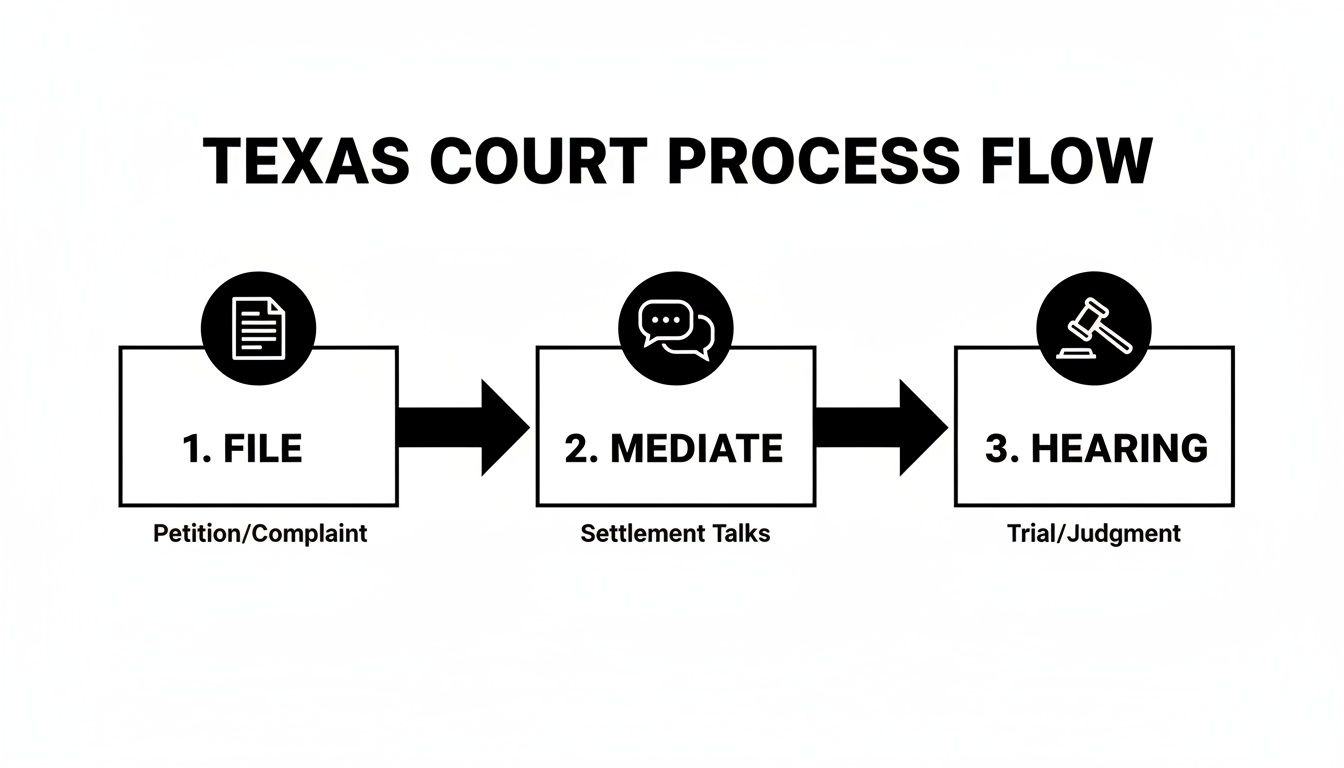
This entire process, from filing the initial petition to the final hearing, is where a judge solidifies each parent's financial duties to their child.
If the other parent falls behind on court-ordered child support, you are not powerless. The Texas Attorney General’s Office provides enforcement services, and you can also hire a private attorney to file an enforcement action in court.
A judge has powerful tools to enforce a child support order, including wage garnishment, driver's license suspension, and even jail time for contempt of court. You do not have to face this financial instability alone. The legal system provides clear pathways to hold the other parent accountable.
If you are struggling with child support issues related to a sole managing conservatorship order, our team at The Law Office of Bryan Fagan can help. Schedule a free consultation to discuss your options for enforcing your court order and protecting your family’s financial future.
How Our Firm Can Guide Your Family
Navigating a sole managing conservatorship case alone can be an isolating and overwhelming experience. The legal hurdles are complex, the emotional stress is immense, and the stakes for your child's future are incredibly high. You don’t have to walk this path by yourself. The Law Office of Bryan Fagan is a dedicated guide for Texas families facing these exact challenges, and we are here to provide the clarity and compassionate support you need.
Our attorneys are deeply immersed in Texas family law. We have spent years in courtrooms across Houston, Dallas, San Antonio, and beyond, advocating for parents and fighting to protect what matters most: the best interests of their children.
Our Approach to Your Case
Our process begins with listening. We understand that your family's situation is unique, so we provide straightforward, compassionate legal advice—no confusing jargon, just honest answers. From there, our team works to gather the critical evidence needed to build a strong case for you, whether that means documenting a history of instability or clearly demonstrating your unwavering commitment to your child’s well-being.
A child’s safety and stability are paramount. Our mission is to ensure the court sees a clear, evidence-based picture of what is truly in your child's best interest, as defined by the Texas Family Code.
We are prepared to stand by your family at every stage. From the initial filing and mediation to fiercely advocating for you in a final hearing, we handle the legal complexities so you can focus on your family.
Take the Next Step with Confidence
The decisions made in a conservatorship case will shape your child's life for years. The most empowering first step you can take is to gain a clear understanding of your rights and options.
We encourage you to schedule a free, no-obligation consultation with one of our experienced attorneys. It is a confidential meeting where we can discuss the specifics of your situation, answer your questions, and offer personalized guidance on the best path forward. Let our family help yours.
Frequently Asked Questions About Conservatorship
When facing something as personal as conservatorship, many practical questions arise. Families are naturally concerned about everything from visitation to what happens if someone moves. Here are clear, straightforward answers to some of the most common questions we hear about sole managing conservatorship in Texas.
Does Sole Managing Conservatorship Mean No Contact?
This is a common fear, and it is completely understandable. The short answer is no. Being named a sole managing conservator does not automatically mean the other parent is cut out of the child's life.
In the vast majority of cases, the other parent is named the possessory conservator. This role includes a court-ordered visitation schedule—often a Standard Possession Order—that details when they see the child. A judge's primary goal is to maintain the parent-child relationship, provided it is a safe and healthy environment for the child.
Of course, if the reasons for the sole managing conservatorship involved endangerment, a judge in Harris County might implement protective measures, such as ordering that all visits be supervised.
Can a Sole Managing Conservatorship Order Be Changed?
Yes, absolutely. Court orders for conservatorship are not set in stone; they can be changed through a legal process called a modification.
To modify an order, the parent requesting the change must prove two key things to the court:
- There has been a "material and substantial change" in the family's circumstances since the last order was signed.
- The requested change would be in the child's best interest.
For example, if a parent with a past substance abuse problem has completed treatment, demonstrated long-term sobriety, and established a stable home, they could petition the court. They could ask the judge to change the order from a sole to a joint managing conservatorship based on these new, positive circumstances.
What if the Conservator Wants to Move Out of State?
A sole managing conservator usually has the exclusive right to decide where the child lives. However, this right is not unlimited. Most court orders include a geographic restriction, which limits the child's primary residence to a specific area, such as a particular county and its surrounding counties.
If the conservator wants to move with the child outside of this restricted area, they cannot simply leave. They must either obtain written permission from the other parent or file a modification lawsuit to get a judge's permission. The judge will then evaluate all the facts to decide if allowing the move is truly in the child's best interest.
Navigating the details of a sole managing conservatorship case requires a guide who is both compassionate and deeply knowledgeable about Texas family law. At The Law Office of Bryan Fagan, PLLC, we are dedicated to protecting your child’s future while fiercely defending your parental rights. Schedule a free consultation today to discuss your case with an experienced attorney who understands what's at stake.