Skip to content
When people hear the term "estate planning," their minds often jump to sprawling mansions and complicated finances. But in Texas, estate planning is really just about creating a clear, legal roadmap for your assets, your healthcare, and—most importantly—your loved ones. We understand that this process can feel overwhelming, but it's a profound act of care.
It’s an act of foresight that puts your wishes in charge, rather than leaving those deeply personal decisions up to state law. A solid plan brings peace of mind, protects your family from conflict, and secures the legacy you’ve worked so hard to build.
What Estate Planning Really Means for Texas Families
Let's cut through the legal jargon. At its heart, estate planning is for every Texas family, not just the wealthy. Think of it as creating a personalized instruction manual for your life. This manual makes sure everyone knows your wishes for your property, finances, and loved ones if you're ever unable to speak for yourself. We've seen the relief this clarity brings to families during their most challenging times.
Without this manual, Texas law steps in to make these decisions for you through a rigid, one-size-fits-all process called intestacy. This can easily lead to family arguments, expensive court battles, and outcomes you never would have wanted. Since Texas is a community property state, the law might split your assets between your spouse and children in a way that creates unexpected financial hardship.
The Cost of Having No Plan
Putting off planning can have a staggering emotional and financial cost. The reality is that only about 24% of Americans have a will. This leaves the vast majority of families vulnerable to intestacy battles that can chew up 5-10% of an estate in fees and drag on for months, or even years. The emotional toll of these disputes is often even greater than the financial one.
For families with aging parents or adults with special needs, the stakes are even higher. Proactive planning with tools like powers of attorney or trusts can prevent intrusive court interventions, preserving both dignity and assets.
To give you a clearer picture, here’s a side-by-side look at how a simple plan can change everything for a typical Texas family.
Estate Plan vs. No Plan: A Texas Scenario
This table compares the outcomes for a family with and without a basic estate plan, showing how planning provides control and security.
| Situation | With an Estate Plan (Your Wishes) | Without an Estate Plan (Texas Intacy Law) |
|---|---|---|
| Who Gets Your Assets? | You decide exactly who inherits your property, heirlooms, and investments. You can leave specific gifts to family, friends, or charity. | The state's rigid formula dictates who gets what. Your spouse may have to share assets with children, even if it creates financial instability. Friends and unmarried partners receive nothing. |
| Who Manages Your Affairs? | You appoint a trusted person (Executor or Trustee) to manage your estate, pay bills, and distribute assets according to your instructions. | A court appoints an administrator, who may be a stranger or a family member you wouldn't have chosen. This process adds cost, delay, and potential for conflict. |
| If You're Incapacitated | You’ve chosen agents in your Durable Power of Attorney and Medical Power of Attorney to make financial and healthcare decisions for you. | Your family must go to court to establish a costly and public guardianship. A judge, not you, decides who is in control of your life and finances. |
| Caring for Minor Children | You name a guardian in your will, ensuring your children are raised by someone you know and trust. | A judge decides who will raise your children, a decision that can spark custody battles among relatives and may not reflect your wishes at all. |
| Overall Outcome | Your wishes are followed efficiently and privately. Your family has clarity and peace of mind during a difficult time. | The court process is public, expensive, and slow. Your family faces uncertainty and potential conflict, and the final outcome may be the opposite of what you intended. |
As you can see, the difference is night and day. A little bit of planning goes a long way in protecting the people you care about most.
Empowering Your Family with Clarity
A well-crafted estate plan does far more than just hand out assets. It gives your loved ones a clear path forward during an incredibly difficult time, lifting the burden of uncertainty off their shoulders. It empowers you to:
- Appoint your decision-makers: You get to choose who manages your finances (Durable Power of Attorney) and who makes healthcare choices for you (Medical Power of Attorney) if you can't.
- Protect your children: You can name a guardian for your minor kids, making sure they are cared for by someone you trust completely.
- Keep the peace: By clearly stating what you want, you shut down the potential for arguments and legal fights among your heirs.
A thoughtful estate plan is one of the greatest gifts you can give your family. It replaces confusion with direction, anxiety with security, and potential conflict with a clear path forward that honors your legacy.
Thinking holistically also means considering what happens after your assets are distributed. A good plan can set your beneficiaries up for success, especially when they are tasked with investing an inheritance wisely. Proper planning ensures the legacy you leave can continue to grow and support future generations, just as you intended.
Ultimately, estate planning in Texas is about taking control of your future to protect the people who matter most.
The Building Blocks of a Strong Texas Estate Plan
A solid estate plan is much more than just a will. Think of it as a custom-built toolkit, with each tool designed to protect you and your family in a specific way. These essential documents work together to make sure your wishes about your property, finances, and healthcare are crystal clear and legally binding. They are the pillars supporting your legacy.
Let’s unpack these building blocks, not with dry, legal definitions, but with a real-world look at how they help Texas families like yours. Understanding what each document does is the first step toward gaining genuine peace of mind.
This flowchart lays out the fundamental choice you have: either you direct your affairs with a plan, or you let Texas state law decide for you.
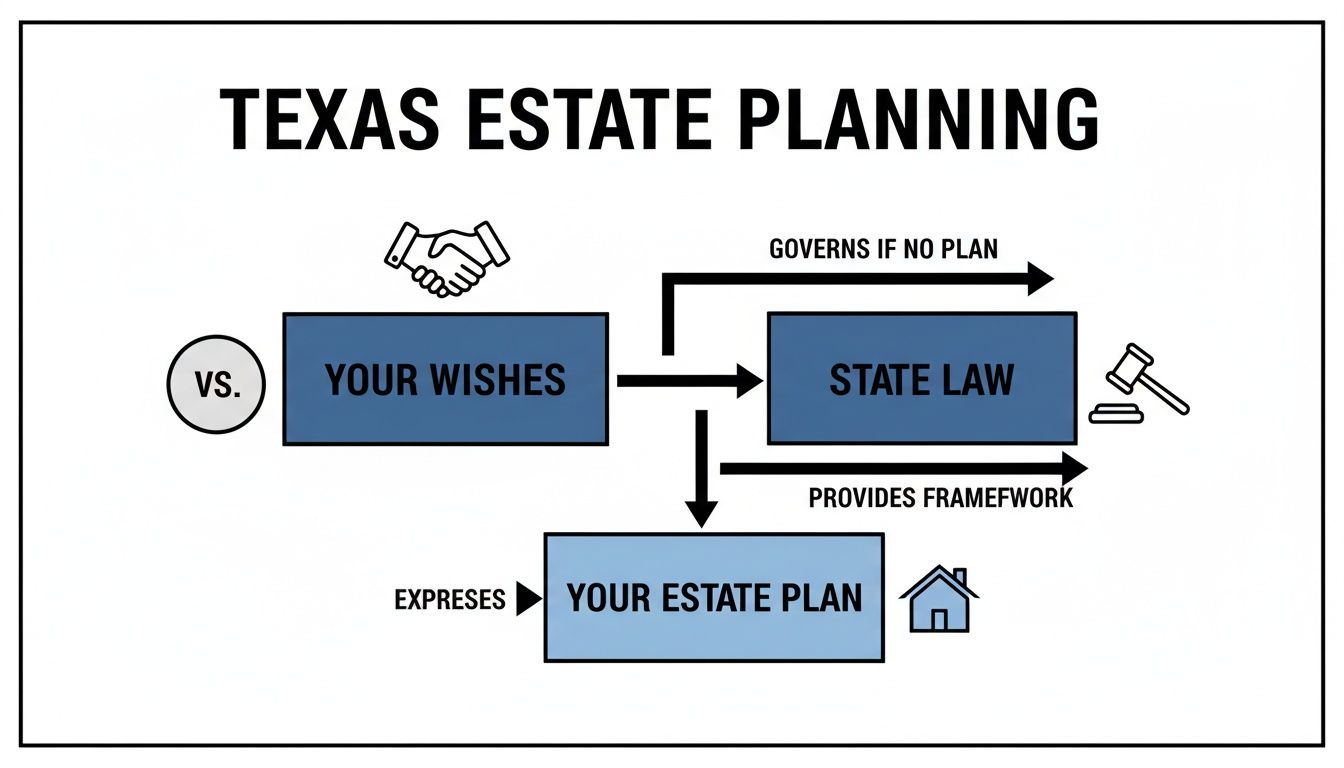
As the visual shows, a well-crafted plan puts you in the driver's seat. Without one, your family is stuck with an impersonal, one-size-fits-all legal process that likely won't reflect what you wanted.
Your Last Will and Testament
Most people have heard of a Last Will and Testament. It’s the cornerstone document that acts as your instruction manual for what happens after you're gone.
A will is where you get to:
- Name an Executor: This is the person or institution you trust to carry out your instructions, from paying off final bills to distributing your assets.
- Designate Beneficiaries: You can clearly state who gets what—whether it's your home in Fort Bend County or a cherished family heirloom.
- Appoint a Guardian for Minors: For parents, this is arguably the most critical part of a will. You name the person you want to raise your children if the unthinkable happens.
If you don't have a valid will, a Texas probate court judge will make these decisions for you based on state law. Their choices might be the last thing you would have wanted.
Trusts for Probate Avoidance and Control
While a will guides your assets through the probate process, a trust can help you skip it entirely. A Revocable Living Trust is like a protective container you create for your assets.
You simply transfer ownership of your property—your house, bank accounts, investments—into the trust while you're alive. You still control everything as the trustee. But when you pass away, the person you've named as your successor trustee can distribute the assets directly to your beneficiaries without court intervention. It's private, efficient, and can save your family a ton of time, money, and stress.
A trust gives you a level of control and privacy that a will simply can't match. It’s a powerful tool for families who want to make the inheritance process as smooth as possible for their loved ones.
Powers of Attorney for Lifetime Decisions
Estate planning isn't just about what happens after you die. It's also about protecting yourself while you're alive. Powers of Attorney are crucial documents that let you appoint trusted people to make decisions for you if you become incapacitated and can't make them yourself.
In Texas, there are two key types:
- Durable Power of Attorney: This document lets you name an "agent" to manage your financial life if you can't. This person can pay your bills, handle investments, and manage property on your behalf.
- Medical Power of Attorney: This appoints a healthcare agent to make medical decisions for you based on your wishes if you're unable to communicate them. This document works hand-in-hand with a Directive to Physicians (Living Will), where you spell out your preferences for end-of-life care.
A crucial part of creating a complete estate plan involves knowing the value of what you own. For some assets, like precious metals, you might need a guide to accurately calculate gold value. You can dive deeper into these and other essential Texas estate planning documents in our comprehensive guide.
Together, these foundational documents create a shield around you and your family, giving you a voice and providing clear direction during life’s most difficult moments.
Protecting Minors and Vulnerable Adults
An estate plan is about much more than just who gets your money and your house. It’s fundamentally about protecting the people you love. Two of the most critical parts of any solid Texas estate plan involve caring for those who can't care for themselves: minor children and adults who have become incapacitated.
This is where planning shifts from a financial task to a profound act of love and protection. We know these topics are tough to think about. Our goal is to walk you through the legal tools available, so you can feel confident that your most vulnerable family members will always have the care, security, and dignity they deserve, no matter what happens.

Understanding Texas Guardianship
What happens when someone can no longer make safe decisions for themselves and hasn't appointed anyone to help? In these cases, a court-supervised process called guardianship may be the only option. Governed by the Texas Estates Code, Title 3, Subtitle G, this legal process involves a judge appointing a responsible person (the guardian) to make decisions for another (the ward).
A guardianship can become necessary in several common scenarios:
- An aging parent in Dallas with dementia who can no longer handle their finances or healthcare.
- A minor child who inherits property or gets a settlement from a lawsuit.
- An adult with a lifelong intellectual disability who needs daily support.
Going to court for a guardianship is a serious and public affair. A judge, for example in a Harris County Probate Court, must be convinced that the person is truly incapacitated and that guardianship is the "least restrictive alternative" to protect them. The court has to explore every other option first because a guardianship involves removing some of a person's most basic rights. This process can be emotionally taxing, and our compassionate approach recognizes the difficulty families face.
Alternatives to Guardianship
Because guardianship is such a drastic measure, it should always be the last resort. The good news is that proactive estate planning provides powerful, less intrusive alternatives that keep your family in control and out of the courtroom.
These tools include:
- Durable and Medical Powers of Attorney: You appoint trusted agents to act for you if you become incapacitated.
- Revocable Living Trusts: You name a successor trustee to manage assets for you if you're unable to.
- Supported Decision-Making Agreements: A formal arrangement where a trusted team helps an adult with a disability make their own choices, preserving their autonomy.
Taking the time to put these documents in place now is an act of deep compassion. It respects an individual's independence while ensuring a safety net is ready, avoiding the emotional and financial drain of a court battle.
Planning for Loved Ones with Special Needs
For families with children or adults with disabilities, planning requires an extra layer of care and expertise. A direct inheritance might seem like a gift, but it could unintentionally disqualify your loved one from vital government benefits like Medicaid or Supplemental Security Income (SSI), which have strict asset limits.
This is where a Special Needs Trust (SNT) becomes an absolutely essential tool. An SNT is a specialized legal container designed to hold assets for the benefit of a person with a disability. A trustee manages the funds, using them for supplemental needs that improve their quality of life—like therapy, education, recreation, and transportation—without counting as a direct asset and jeopardizing benefits.
This kind of planning is critical for ensuring lifelong care. You can learn more about how this powerful tool works in our detailed guide on the Special Needs Trust in Texas. Proper planning means you can provide for them financially without risking the critical support they rely on. The need is real, as Texas reports over 50,000 active guardianship cases each year, many of which could have been avoided with the right plan.
How Texas Families Can Navigate the Probate Process
Many people hear the word ‘probate’ and immediately cringe. They picture a costly, drawn-out, and very public legal battle. While it can get complicated, it's important to understand what it really is at its core. We are here to demystify this process for you.
In Texas, probate is simply the official, court-supervised process for validating a will and settling an estate after someone passes away. Think of it as the formal procedure where a judge confirms the will is legitimate, gives the green light to the executor you named, and oversees the whole process of paying off debts and getting assets to your beneficiaries. While it’s a necessary step in many situations, a well-crafted estate plan can dramatically simplify—or even completely sidestep—this process for your family.
Why Avoiding Probate Is Often a Key Goal
The main reasons families want to bypass probate are pretty straightforward: time, cost, and privacy.
Even a relatively simple probate case in a court like Harris County can easily take several months to a year to wrap up. All the while, assets your family might need are locked up. On top of that, the court costs, attorney fees, and administrative expenses pile up, chipping away at the inheritance you intended to leave behind. We recognize the financial and emotional stress this can cause.
Perhaps most importantly for many, probate is a public record. This means your will, a list of your assets, and who got what becomes accessible to anyone who cares to look. For families who value keeping their financial matters private, this is a major concern.
Proactive estate planning in Texas isn't so much about dodging taxes as it is about dodging the courthouse. The right strategies allow your assets to pass directly to your loved ones privately and efficiently, preserving your legacy and saving your family from a world of unnecessary stress.
Powerful Strategies to Bypass the Probate System
Fortunately, Texas law offers several fantastic tools that allow assets to transfer automatically upon death, keeping them far away from the probate court's reach. Using these methods thoughtfully is a cornerstone of any modern estate plan.
Here are some key probate-avoidance tools:
- Revocable Living Trusts: As we touched on earlier, a trust is like a private container for your assets. Since the trust owns the property—not you personally—there’s nothing to probate when you pass away. Your successor trustee just follows your private instructions and distributes the assets. It’s that simple.
- Payable-on-Death (POD) Designations: You can add a POD designation to your bank accounts. This works just like a beneficiary designation, letting the funds pass directly to the person you named, no probate needed.
- Transfer-on-Death (TOD) Designations: This is similar to a POD but can be used for things like investment accounts, brokerage accounts, and even vehicles here in Texas.
- Joint Ownership with Right of Survivorship: When you own property (like a house or a joint bank account) with someone else "with right of survivorship," your share automatically goes to the surviving owner when you die. It’s an automatic transfer.
By strategically using these tools, you can ensure a huge portion—or even all—of your estate avoids the public, expensive, and time-consuming probate process. It’s crucial to understand the details of each option, and you can learn more by checking out our guide on probating a will in Texas and how to minimize its impact. Properly structuring your assets is truly an act of care, giving your family immediate access to the resources you wanted them to have.
Your Practical Estate Planning Checklist
Getting your head around the key documents and legal terms is the first big hurdle. Now, it's time to put that knowledge into action. This practical checklist breaks down the process of creating your Texas estate plan into simple, manageable steps.
It's completely normal to feel a bit overwhelmed by all of this. But if you approach it methodically, what seems like a mountain of a task becomes a series of achievable goals. Follow these steps, and you'll build a plan that gives your family true peace of mind.
Step 1: Gather Your Key Information
You can't plan for your future until you have a crystal-clear picture of your present. This first step is all about taking inventory, as it forms the foundation for every other decision you'll make.
Your inventory should include:
- A list of all your assets: This means everything from real estate (your home, any other properties) and bank accounts to retirement funds (401k, IRA), investment portfolios, life insurance policies, vehicles, and even significant personal items like family heirlooms or art.
- A list of all your debts: Make a note of any mortgages, car loans, student loans, credit card balances, and other liabilities. This gives your future executor a complete financial snapshot.
- Key personal documents: Collect birth certificates, marriage certificates, Social Security numbers, and the contact information for everyone you plan to include in your estate plan.
Having all this information neatly organized from the get-go makes the entire process incredibly smoother, whether you're just getting your thoughts in order or sitting down with an attorney.
Step 2: Define Your Goals and Beneficiaries
With your inventory complete, you can start thinking about the legacy you want to leave. Who should receive your property, and how should they receive it? This is where your personal wishes and values really come into play.
Ask yourself these critical questions:
- Who do you want to inherit your assets? Be specific with names and their relationship to you.
- Are there certain sentimental items you want to go to specific people?
- Do you want to leave a gift to a favorite charity or organization?
- If you have minor children, who do you trust to manage their inheritance until they are responsible enough to handle it themselves?
Writing down the answers to these questions forms the core instructions for your will or trust. That kind of clarity is absolutely essential for preventing confusion and heading off family disputes before they can start.
Step 3: Choose Your Fiduciaries
A fiduciary is simply a person you legally entrust to act on your behalf when you can't. These roles come with immense responsibility, so choosing the right people is one of the most important decisions you'll make in your estate planning in Texas.
You'll need to select people for several key roles:
- Executor: The person who will steer your estate through the probate process, following the instructions laid out in your will.
- Trustee (or Successor Trustee): The individual who will manage the assets held inside your trust for the benefit of your loved ones.
- Guardian for Minor Children: The person you choose to raise your children if you're no longer there to do it.
- Agents for Powers of Attorney: The people who will make financial and healthcare decisions for you if you become incapacitated and can't make them for yourself.
Always pick people who are responsible, trustworthy, and—this is key—willing to take on the job. It's also vital to name at least one alternate for each role, just in case your first choice is unable to serve when the time comes.
Step 4: Discuss Your Wishes with Your Family
While it's not a legal requirement, having an open conversation with your family about your plans can be an incredible gift. It helps prevent misunderstandings, hurt feelings, and unwelcome surprises after you're gone.
You don't need to get into every single financial detail, but explaining the basics of your plan can help manage expectations. At a minimum, let your chosen executor and agents know that you've selected them and tell them where they can find your important documents. This one conversation can promote harmony and ensure a much smoother transition during an already difficult time.
"A well-crafted estate plan is a final act of love, but a conversation about that plan is an act of compassion. It replaces future surprises with current understanding, giving your family the gift of clarity."
Step 5: Consult a Texas Attorney and Review Regularly
Finally, the most crucial step is to sit down with a qualified Texas estate planning attorney. DIY plans from the internet are notorious for containing errors or failing to account for Texas-specific laws, which can invalidate your documents and create the very mess you were trying to avoid. An attorney makes sure your plan is legally sound and actually does what you want it to do.
Once your plan is in place, it isn't set in stone. Life changes, and your plan needs to evolve with it. Make it a point to schedule a review with your attorney after any major life event:
- Marriage or divorce
- The birth or adoption of a child or grandchild
- A significant change in your financial situation
- The death of a beneficiary or someone you named as a fiduciary
Regular reviews ensure your plan remains a living document that protects your family through every stage of life. If you're ready to take these steps with confidence, our team at The Law Office of Bryan Fagan is here to help. Schedule a free consultation today for personalized guidance on securing your family's future.
We're Here to Help You Find Peace of Mind
Understanding the nuts and bolts of estate planning is one thing. Turning that knowledge into a solid, legally-sound plan that actually works for your family is another challenge entirely. That’s where The Law Office of Bryan Fagan comes in. We’ve seen firsthand the emotional and financial weight these decisions carry, and our entire mission is to lift that burden by giving you absolute clarity and confidence in your plan.
With deep roots across Texas—from the Harris County probate courts to communities in Dallas and Austin—our team is dedicated to creating plans that reflect your unique family and your values. We don’t do cookie-cutter solutions. We start by listening to your story and understanding your goals. From there, we build a plan from the ground up to protect what you’ve worked so hard for.
Your Guide Through a Complex Process
Let’s be honest: the legal system can feel intimidating. Our attorneys are here to be your advocates, breaking down complex procedures into plain English and making sure every single detail is handled with precision. We are committed to making this process as smooth and stress-free as possible for you and the people you love.
We focus on a few key areas to build your family’s fortress:
- Building the Foundation: We’ll help you create legally-sound wills, trusts, and powers of attorney that are built to comply with the Texas Estates Code and withstand any legal challenge.
- Navigating Guardianship: Whether you’re trying to establish a guardianship for a vulnerable adult or need to contest an existing one, we guide you through the requirements of the law with both compassion and skill.
- Creating Your Legacy: We help you put strategies in place to avoid the headaches of probate, protect your assets from creditors or predators, and build a lasting legacy for the generations that follow.
At our core, we believe that effective estate planning in Texas is about more than just documents—it's about building a fortress of security around your family. We provide the legal bricks and mortar to make that happen.
Your Partners in Planning for the Future
The peace of mind that comes from knowing you have a secure plan is priceless. It frees you from the "what-ifs" and lets you focus on what really matters: living your life and enjoying your family. We’re not just your lawyers; we’re your partners in building that secure future.
We invite you to see for yourself what a difference compassionate, experienced legal guidance can make. We offer a free, no-obligation consultation to talk about your family’s needs and show you how we can help. Let us help you take that final, crucial step in protecting your family’s future.
For tailored legal advice on Guardianship, Probate, or comprehensive Estate Planning, schedule your free consultation with The Law Office of Bryan Fagan today.
Frequently Asked Questions About Texas Estate Planning
Stepping into the world of estate planning naturally brings up a lot of questions. We get it. To help bring some clarity, here are straightforward answers to some of the most common concerns we hear from Texas families just like yours.
How Much Does an Estate Plan Cost in Texas?
This is probably the number one question we get, and the honest answer is: it depends. The cost of putting together an estate plan in Texas really hinges on how complex your situation is. A simple will might only be a few hundred dollars, while a more comprehensive plan involving trusts could run several thousand.
It's helpful to think of this not as an expense, but as a critical investment in your family's future security. The cost of thoughtful planning today is almost always a fraction of the legal fees, court costs, and emotional strain your family would face trying to sort things out in a lengthy probate process or a bitter family dispute.
What Happens if I Die Without a Will?
If you pass away in Texas without a will, you don't get a say in who gets your property. The state steps in and makes those decisions for you based on its intestacy laws. These are rigid, one-size-fits-all formulas that rarely match what someone would have actually wanted.
For instance, if you're married with children from that marriage, your spouse inherits all your shared community property. But things get tricky with your separate property—your spouse only gets one-third, and your children inherit the remaining two-thirds. For blended families, the rules get even more complicated and can easily leave a surviving spouse in a very tough financial spot.
When you don't have a will, you're handing over your decision-making power to the state of Texas. Its generic plan almost never aligns with a family's unique needs and wishes.
Can I Write My Own Will in Texas?
Legally, yes. Texas law does recognize holographic (entirely handwritten) wills. But just because you can do something doesn't mean you should. DIY wills and those cheap online templates are incredibly risky.
Why? Because they often fail to meet the strict legal requirements for how a will must be signed and witnessed in Texas. Or, they don't account for specific state laws, which can make the whole document invalid. An improperly drafted will can create far more legal headaches and family conflict than having no will at all, making a court battle much more likely.
When Should I Update My Estate Plan?
Your estate plan isn't something you create once and then file away forever. Life happens, and your plan needs to evolve right along with it. Think of it as a living document.
You should get in touch with your attorney for a review immediately after any major life event. These are the big ones:
- Getting married or divorced
- The birth or adoption of a child or grandchild
- A major change in your financial picture (like an inheritance or selling a business)
- The death of a beneficiary or someone you named as a fiduciary (like an executor)
- Moving to a different state
At The Law Office of Bryan Fagan, PLLC, we provide the clarity and expertise you need to protect your legacy. Schedule your free consultation today to build a plan that brings you and your family true peace of mind.