Skip to content
When you are faced with the profound responsibility of protecting a loved one who can no longer care for themselves, the legal system can feel overwhelming. A Letter of Guardianship is the official, court-issued document that grants you the legal authority to care for a minor or an incapacitated adult here in Texas.
In simple terms, it is the legal proof you need to act on their behalf, ensuring their health, safety, and financial well-being are protected.
What This Guide Will Cover for Texas Families

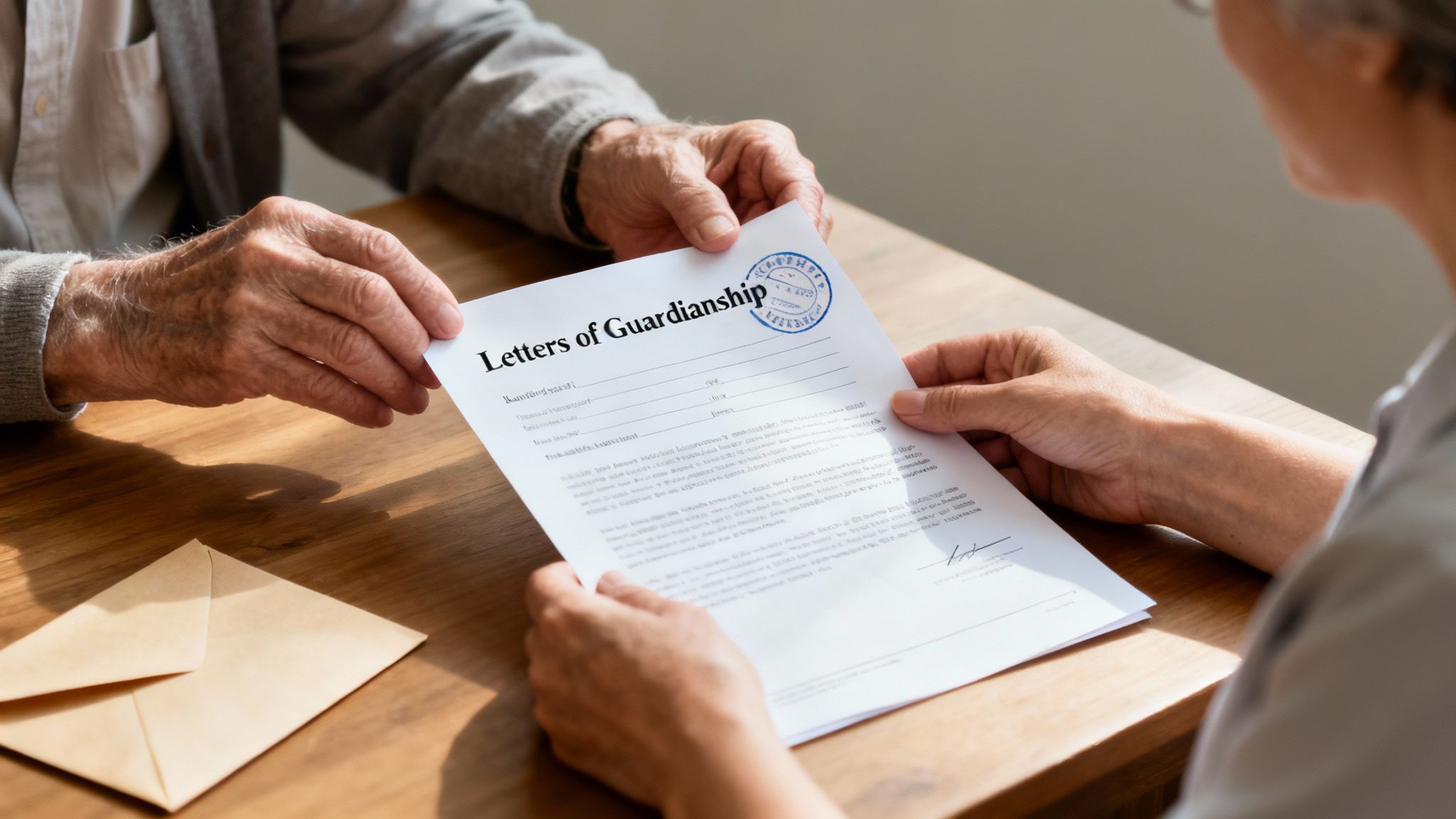
This guide is designed to bring clarity and confidence to Texas families navigating the guardianship process. We understand this journey often comes with a heavy emotional and financial weight, and our mission is to empower you with the knowledge to move forward.
This official document, signed by a judge in a Texas probate court—whether in Harris County, Dallas County, or elsewhere—is absolutely essential. It is the legal key you will show to doctors, banks, schools, and anyone else who needs proof that you are authorized to make critical decisions.
Without valid Letters of Guardianship, you lack the legal standing to manage your loved one's affairs, no matter how pure your intentions are. Let's break down what these letters are and what they mean for your family in practical terms.
Quick Answer: What Are Letters of Guardianship?
| Key Aspect | What It Means for Families |
|---|---|
| Official Court Order | This is not just a form; it's a legal document signed by a judge after a formal hearing. |
| Proof of Authority | It is the official evidence you will show to third parties like banks or hospitals to act for the ward. |
| Grants Specific Powers | The letter details exactly what decisions you are legally permitted to make for your loved one. |
| Has an Expiration Date | These letters must be renewed, typically every 16 months, to remain valid and enforceable. |
This document is the court's official certification that grants a guardian the legal authority to make decisions for another person (the "ward").
In this guide, we will walk you through:
- What these letters actually empower you to do
- The step-by-step process in a Texas probate court for the establishment of guardianship
- The serious responsibilities and duties that come with this role
- Alternatives to guardianship that may be a better fit for your family's situation
Our goal is to demystify the legal requirements found in the Texas Estates Code so you can focus on what truly matters—providing the best possible care for your loved one. This journey requires both compassion and a clear understanding of your legal duties.
Making the decision to pursue a guardianship is a significant one, often filled with emotional challenges. If you are considering this path, understanding all your options is the first critical step. For personalized guidance on your family’s unique situation, we invite you to schedule a free consultation with The Law Office of Bryan Fagan.
What Legal Power Do Letters Of Guardianship Actually Hold?
Letters of Guardianship are far more than a simple piece of paper. Think of them as the official, court-issued key that validates your authority to protect and care for a loved one. When a Texas judge issues this document, it legally empowers you to step in and make critical decisions for someone—now known as the "ward"—who can no longer manage their own affairs.
With valid letters in hand, you gain the legal standing to take charge. For example, you can:
- Make Medical Decisions: Consent to surgeries, approve medications, and guide treatments to ensure your loved one receives the healthcare they need.
- Handle Finances: Access the ward's bank accounts to pay bills, manage their investments, and shield their assets from fraud or mismanagement.
- Choose Living Arrangements: Decide on a safe and suitable place for them to live, whether that’s remaining at home with support, moving to an assisted living facility, or another appropriate setting.
Turning a Court Order into Real-World Action
This level of authority is a profound responsibility granted by a court, usually during what is already a difficult and emotional time for a family. As outlined in the Texas Estates Code, Title 3, Subtitle G, a court grants these powers with one primary goal: ensuring the ward's best interests are always the top priority. The letters you receive will clearly define the scope of your authority—whether it’s limited to personal decisions (Guardian of the Person), financial matters (Guardian of the Estate), or both.
For instance, imagine your elderly mother has advanced dementia and can no longer pay her bills or make medical choices. Without guardianship, you may face roadblocks with banks and doctors. But with Letters of Guardianship, you can step in immediately to manage her mortgage payments from her account and consent to a necessary medical procedure on her behalf, preventing a crisis.
Every action you take must be for the ward's direct benefit. To get a better feel for what this official document looks like, it’s helpful to review a Letter of Guardianship sample. Familiarizing yourself with its structure helps connect the legal weight of the document to the practical, day-to-day responsibilities you will be undertaking.
How to Obtain Letters of Guardianship in Texas
The path to becoming a legal guardian in Texas is a formal court process, which can sound intimidating. However, this process is a series of manageable steps designed to protect your loved one, not to create barriers.
This procedure is consistent across the state, whether you file in a Harris County probate court or one in a smaller county. It begins with filing a formal Application for Appointment of Guardian. This document introduces you to the court and explains why your family member needs a guardian's protection.
Practical Steps in the Guardianship Establishment Process
- File the Application: Your attorney will prepare and file the application, which details the proposed ward's condition and explains why a guardianship is the least restrictive alternative available.
- Court-Appointed Attorney: Once filed, the court’s primary mission is to safeguard the rights of the person you are trying to help. To do this, the judge will appoint an attorney ad litem—a neutral lawyer whose only job is to represent the proposed ward, investigate the situation, and make a recommendation to the court.
- Physician's Certificate: You must prove that your loved one is legally incapacitated, a standard defined in the Texas Estates Code. This almost always requires a signed certificate from a physician detailing their medical condition and its impact on their decision-making ability.
- The Court Hearing: The process culminates in a court hearing. Here, your attorney will present evidence and testimony to the judge to demonstrate that a guardianship is necessary.
This infographic provides a clear overview of the kinds of authority a guardian can be granted once appointed.

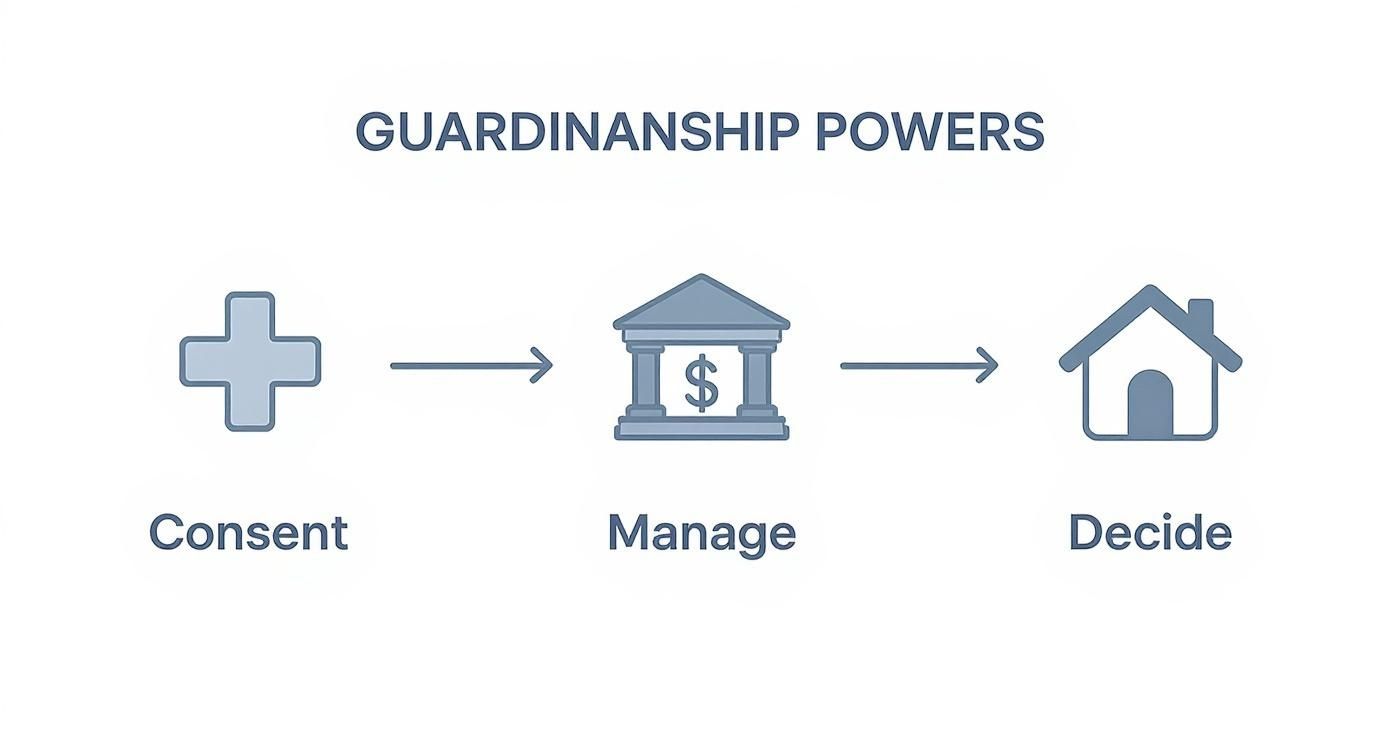
As you can see, the court grants real, practical power to manage someone's life, from their healthcare and finances down to where they live.
Finalizing Your Appointment
If the judge agrees that a guardianship is necessary and you are the right person for the role, they will sign an order appointing you. However, you cannot start making decisions just yet. There are two final, crucial steps you must complete first:
- Take an Oath: You must formally swear an oath, promising to faithfully carry out your duties as guardian.
- Post a Bond: This acts as an insurance policy to protect the ward’s assets from any potential mismanagement on your part.
Only after you have taken the oath and secured the bond will the court clerk issue your official Letters of Guardianship.
For a deeper dive into each part of this journey, please see our detailed guide on how to get guardianship in Texas.
Your Responsibilities After Receiving Guardianship Letters

The moment a Texas judge signs the order and the court clerk issues your official Letters of Guardianship, your role transforms. You are no longer just a concerned family member; you are now a legal fiduciary. This is a profound, long-term commitment that comes with serious legal and ethical duties.
The core of your new role is your fiduciary duty. This legal term means you are required to act with the highest degree of good faith and loyalty, always putting the ward’s best interests far ahead of your own. Every decision, from managing their finances to consenting to medical procedures, must be made purely for their benefit.
Fulfilling Your Reporting Duties to the Court
To ensure you uphold this high standard, the Texas Estates Code holds you accountable to the court that appointed you. This oversight is a critical safety net for vulnerable individuals. Your ongoing responsibilities as a guardian will involve key compliance reporting.
Within 60 days of receiving your letters, you must file a detailed Inventory, Appraisement, and List of Claims. This document provides the court with a complete financial snapshot of the ward's assets and debts at the moment the guardianship officially began.
You will also be required to submit an Annual Account to the court every year. This is a comprehensive financial report that tracks every dollar that came into and went out of the ward's estate. Meticulous record-keeping is not just a good idea; it is a legal necessity to maintain your position as guardian. Guardianship disputes often arise from poor record-keeping, so diligence is key.
This court oversight is absolutely essential. The strict reporting and accountability measures are in place to prevent potential abuse and protect the very people the system is designed to help.
Understanding the full scope of what is expected of you is critical. We dive deeper into these duties in our guide explaining a guardian's responsibilities in Texas. If you feel overwhelmed by these compliance requirements, scheduling a free consultation can bring much-needed clarity and ensure you start your new role on the right legal footing.
Guardianship is not a one-size-fits-all legal tool. When a Texas court intervenes, the goal is always to find the least restrictive option that still keeps your loved one safe. The Letters of Guardianship you receive will be tailored specifically to their needs, spelling out exactly what you can and cannot do. Understanding the different types of guardianship helps you and your attorney request the most appropriate level of support, preserving as much of your loved one's independence as possible.
Guardian of the Person vs. Guardian of the Estate
The most common distinction is between a Guardian of the Person and a Guardian of the Estate. While the same person often fills both roles, Texas law treats them as two separate jobs with distinct duties.
Guardian of the Person: This role focuses on life and health. This guardian makes decisions about the ward’s physical well-being, such as consenting to medical care, choosing where they live, and ensuring their day-to-day personal needs are met.
Guardian of the Estate: This role is entirely about finances. A Guardian of the Estate is responsible for the ward's financial affairs, including paying bills, managing investments and property, and filing all required financial reports with the court, such as the annual account.
Temporary or Emergency Guardianship
Life can be unpredictable. Sometimes, a crisis arises so quickly that you cannot wait for the standard guardianship hearing process. For these urgent situations, a Texas court, such as the Tarrant County Probate Court, can appoint a temporary guardian.
The law is very specific on this matter. Under Texas Estates Code §1251.001, this emergency appointment is only granted when there is substantial evidence that a person or their estate is facing an immediate threat of serious harm. These emergency Letters of Guardianship typically last for only 60 days.
This 60-day period provides families with breathing room to pursue a permanent solution while knowing their loved one is protected from immediate danger. The powers granted to a temporary guardian are strictly limited to what is necessary to resolve the crisis, reinforcing the core principle of using the least restrictive means necessary.
Next Steps for Your Family's Guardianship Journey
A common misconception about guardianship is that it is a permanent, unchangeable arrangement. The reality is that circumstances change, and Texas law provides clear pathways for the guardianship termination or modification.
Thinking about these future possibilities is a key part of the journey. For example, a guardianship established for a minor automatically ends when they turn 18. In other situations, an adult ward may regain their capacity, making the guardianship no longer necessary.
Modifying or Ending a Guardianship
The Texas Estates Code outlines the specific legal steps for changing or closing a guardianship. These are not informal decisions; they require filing a formal motion with the same court that originally established the guardianship.
Here are a few common scenarios where a guardianship might be terminated or modified:
- A Minor Reaches Adulthood: The guardianship terminates by law once the minor becomes a legal adult.
- The Ward Regains Capacity: If a ward's condition improves, a physician’s evaluation can serve as powerful evidence in a motion to restore their legal rights and end the guardianship.
- The Guardian Resigns: A guardian may need to step down due to their own health, a move, or other personal reasons. This requires court approval to appoint a successor guardian.
- The Ward Passes Away: Upon the ward's death, the guardianship ends. The guardian's focus then shifts to closing out the guardianship affairs and transitioning to the Probate process for the deceased's estate.
Once a guardianship is in place, another critical step is ensuring the ward receives the best possible care. For families navigating dementia, this often means finding specialized dementia care services.
Every family’s situation is unique. Navigating these final steps, or planning for them in advance with comprehensive Estate Planning, requires personalized legal advice. To understand your specific rights and options for modifying or ending a guardianship, we invite you to schedule a free consultation with our experienced legal team.
Common Questions About Letters of Guardianship
When families begin exploring guardianship, many questions arise. This is a complex area of law, and feeling uncertain is completely normal. Here are answers to some of the most common questions we hear from Texas families.
How Long Are Letters Of Guardianship Valid In Texas?
This is a critical detail. When a Texas court first issues Letters of Guardianship, they are valid for 16 months from the date they are issued.
After that initial period, you do not receive new "Letters." Instead, you must request a "Certificate of Letters of Guardianship" from the court clerk. This certificate serves as renewed proof of your authority but has a much shorter expiration date, typically 60 to 120 days. You will need to obtain these certificates periodically to present to banks, healthcare providers, and other institutions.
What Is The Difference Between A Guardian And A Power Of Attorney?
The key differences are timing and authority. A power of attorney is a document that a person signs while they still have mental capacity, giving a trusted individual (the "agent") the power to act on their behalf. It is a proactive estate planning tool and an important alternative to guardianship.
Guardianship, conversely, is a court-supervised process that begins only after a person has lost the capacity to make their own decisions. The court steps in because the person can no longer act for themselves. Because it is a court order, a guardian's authority—proven by the Letters of Guardianship—will legally override any pre-existing power of attorney.
Can I Get Letters Of Guardianship Without Going To Court?
No, you cannot. Guardianship involves the removal of some of a person's most fundamental civil rights, and Texas courts treat this with the utmost seriousness.
Because the stakes are so high, the entire process is supervised by a judge to protect the proposed ward. Letters of Guardianship can only be issued after a formal court hearing where evidence is presented and a judge determines that guardianship is absolutely necessary and is the least restrictive option available to protect the individual.
Navigating the complexities of guardianship requires a compassionate and knowledgeable guide. At The Law Office of Bryan Fagan, PLLC, we are dedicated to helping Texas families protect their loved ones with dignity and care. Schedule your free consultation today to discuss your family’s needs and receive clear, practical guidance on your next steps.