Skip to content
When you need to establish legal guardianship for a loved one, the process can feel overwhelming. While the formal "Application for Guardianship" is the core legal document, a well-crafted sample letter for legal guardianship provides the human story behind the paperwork. This letter is your opportunity to explain to the court why guardianship is essential and why you are the right person to provide that care.
At The Law Office of Bryan Fagan, we understand the emotional and financial challenges families face during this time. Our mission is to guide Texas families through guardianship law with clarity and care, turning complex legal requirements into practical, understandable steps.
Why a Guardianship Letter Matters in Texas Courts
Think of your guardianship letter as a direct conversation with the judge. In a busy court like the Harris County Probate Court, a judge reviews countless legal filings. Your letter cuts through the procedural noise. It adds vital personal context that official forms can't capture, painting a clear, compassionate picture of your loved one’s situation and your commitment to their well-being.
This supporting document works alongside the formal application required by the Texas Estates Code, Title 3, Subtitle G. It demonstrates that your request is not just a legal maneuver but a necessary act of love and responsibility, rooted in a deep understanding of your family member’s needs.
Bridging the Personal and the Procedural
A thoughtfully written letter can significantly strengthen your case by achieving several key goals.
- It clarifies the real need for guardianship. Here, you can give specific, real-world examples of why your loved one can no longer manage their personal or financial life safely. For instance, you might describe incidents where they forgot to take crucial medication or were unable to pay their bills.
- It shows you're fit to be a guardian. The letter is your platform to explain your relationship, your capabilities, and the detailed plan you have for providing care.
- It reassures the court. It shows the judge you grasp the serious duties involved and are fully prepared to act in the proposed ward's best interest.
The guardianship process in Texas is designed to protect vulnerable individuals. Your letter helps the court see the person behind the case number, ensuring their dignity and best interests remain the central focus.
We recognize that reaching this point is often the culmination of a long, emotional journey. This is especially true for parents seeking guardianship for an adult child with a disability, who may have faced systemic barriers and frustrating delays. Research has shown that families often endure long waits for diagnoses and support, a struggle that a clear, detailed letter can help the court understand. (Source)
Ultimately, this letter is a crucial piece of evidence. It sets a compassionate tone for the formal proceedings and helps you prepare for what to expect at a Texas guardianship hearing. At The Law Office of Bryan Fagan, we can help you tell your story with the clarity and empathy it deserves. Schedule a free consultation today to discuss your family's unique situation.
Key Elements of a Compelling Guardianship Letter
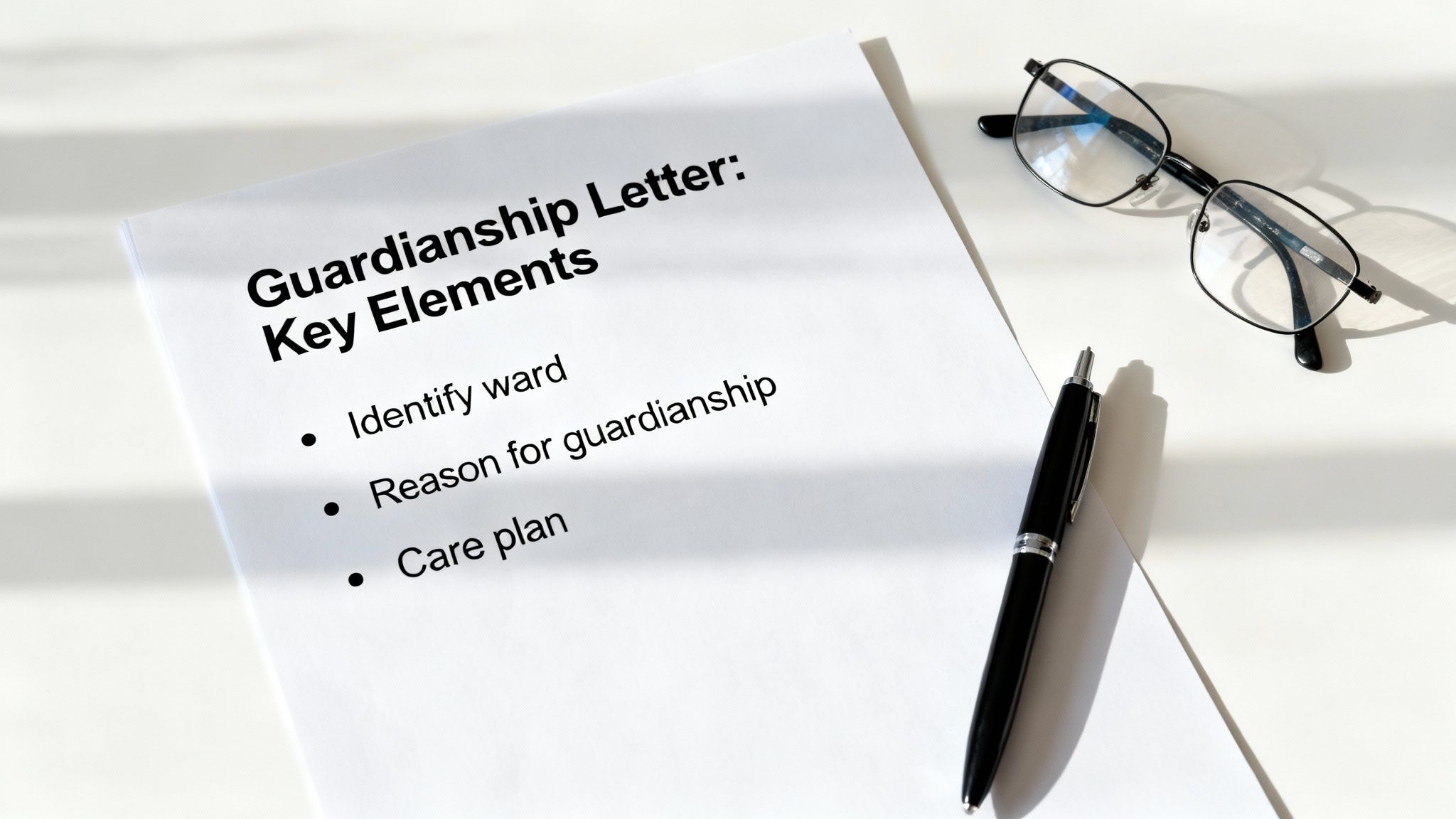
To be effective, your guardianship letter must build a clear, logical, and compassionate case. A judge in a Texas probate court, whether in Fort Bend County or elsewhere, needs specific information to make a decision that is truly in the proposed ward's best interest. Vague statements will not suffice.
Think of the letter as the narrative that connects the facts on your formal application. Each section serves a distinct purpose, from introducing the individuals involved to outlining a practical care plan. By presenting this information clearly, you demonstrate to the court that you understand the serious responsibilities of being a guardian.
Getting Started: Introduce the Key Players and Your Intent
Your letter should open with a straightforward introduction. State your full name, your relationship to the person needing guardianship (the "proposed ward"), and your clear intention to seek appointment as their guardian. This sets a professional tone and immediately informs the court of the letter's purpose.
For example, an adult child seeking guardianship for a parent with Alzheimer's would begin by clearly identifying themselves, their parent, and the purpose of the letter. This is not the time for ambiguity; establishing the core facts from the outset is critical.
The Heart of the Matter: Justifying the Need for Guardianship
This is the most critical part of your letter. Here, you must provide concrete, fact-based reasons why guardianship is necessary. The Texas Estates Code requires a clear demonstration of incapacity, and your letter is where you provide the real-life evidence.
Don't just say, "My mother is forgetful." Provide specific instances. For example, mention that she has missed medication doses on multiple occasions, has gotten lost driving familiar routes, or has been unable to manage her bills, leading to utility disconnections. This is one of the key differences between seeking guardianship and using alternatives like a power of attorney. While there are several alternatives to guardianship, they are only viable if the person still has the capacity to make their own decisions.
A strong justification focuses on observable behaviors and their consequences. It paints a vivid picture of risk and demonstrates why the proposed ward can no longer safely manage their own affairs.
Documenting these events helps the court grasp the urgency of appointing a guardian. This is a very different situation from a power of attorney, which is established when a person still has the capacity to make their own decisions. For a deeper dive, you can learn more about the critical distinction between guardianship vs. power of attorney.
Proving You're the Right Fit: Outline Your Qualifications and Care Plan
Once you've established the need, you must show the court why you are the right person for this crucial role. This section should detail your qualifications and, more importantly, your specific plan for the ward's care. This is where you outline your understanding of the rights and duties of a guardian.
Your plan needs to address key areas of the ward’s life:
- Living Situation: Where will they live? Will they remain at home with support, or move to a facility or your home?
- Medical Care: How will you manage doctor's appointments, medications, and healthcare decisions?
- Financial Management: What is your strategy for handling their finances, from paying bills to protecting their assets?
A thoughtful and detailed care plan shows the judge you have seriously considered the responsibilities ahead. It is your proof that you are prepared to fulfill the duties of a guardian with diligence and care.
Anatomy of an Effective Texas Guardianship Letter
Use this table as a checklist to ensure your letter contains all the critical information the court needs.
| Letter Section | What to Include | Example Focus |
|---|---|---|
| Introduction | Your full name, the proposed ward's full name, and your relationship. Clearly state your intent to become the guardian. | "I, Jane Doe, am the daughter of John Doe, and I am writing to petition the court for appointment as his legal guardian." |
| Justification for Guardianship | Specific, fact-based examples of the ward's inability to manage their affairs. Mention dates, events, and consequences. | "On May 15, my father left the stove on overnight. On three separate occasions in June, he missed his vital heart medication." |
| Your Qualifications | Explain why you are the best person for the role. Mention your stability, proximity, and understanding of the ward's needs. | "As a registered nurse living just 10 minutes away, I am uniquely equipped to manage his complex medical needs." |
| Proposed Care Plan | Detail your plans for the ward's living situation, medical care, and financial management. Be as specific as possible. | "He will reside at the Oakwood Assisted Living facility, and I will manage his pension and Social Security to cover expenses." |
| Conclusion | Reiterate your commitment to acting in the ward's best interests and thank the court for its time and consideration. | "I am fully prepared to take on these duties and respectfully ask the court to approve my request to protect my father's well-being." |
At The Law Office of Bryan Fagan, we can help you articulate these crucial elements effectively to build the strongest case possible. Contact us for a free consultation to ensure your letter is clear, comprehensive, and compelling.
Writing Your Letter with Clarity and Compassion
Knowing what to include in your guardianship letter is one thing, but how you say it is just as crucial. This letter is your chance to move beyond legal formalities and connect with the court on a human level. You are telling a story of care and commitment. The key is to find the balance between professional clarity and genuine compassion, ensuring your voice is heard.
Your tone should be respectful, honest, and focused. While these situations are emotional, the letter must present facts and observations without being overwhelmed by emotion. Instead of using dramatic language, let specific details illustrate why guardianship is necessary. This approach shows a judge, whether in a Dallas County Probate Court or elsewhere, that you are level-headed, thoughtful, and a reliable choice.
Choosing Powerful and Honest Phrasing
The words you choose are incredibly important. Use language that is direct and descriptive, not filled with legal jargon. You don’t need to sound like an attorney; you need to sound like a concerned and capable person who has thought this responsibility through.
- Use the Active Voice: It's more direct. Instead of, “Assistance with daily tasks is needed by my mother,” write, “My mother needs help with daily tasks like preparing meals and managing her medication.”
- Be Specific: Vague claims don't help the court. Replace "He has trouble with his finances" with "He has not paid his utility bills for three months and cannot recall his bank account password." Specifics are your evidence.
- Maintain a Respectful Tone: Always refer to your loved one with dignity. This letter is about their safety and needs, not their shortcomings.
Structuring Your Narrative with Helpful Prompts
Staring at a blank page can be intimidating. To build a strong, coherent narrative, try using these prompts to guide your writing.
- Opening: What is my exact relationship to the person, and what is the primary reason I am writing this letter?
- The Need: What specific, recent event made it clear that they need a guardian to stay safe? (For example, a fall, a financial mistake, or getting lost).
- Your Role: Why am I the best person for this role? What is our relationship like?
- The Plan: What are the first three practical steps I will take to improve their quality of life as soon as I’m appointed?
- Commitment: How will I follow the Texas Estates Code, Title 3, Subtitle G, and always act in their best interest?
Framing your thoughts around these prompts helps you build a letter that is both heartfelt and legally sound.
The most effective letters blend objective facts with personal insight. Your direct observations, when presented clearly, provide the court with the strongest possible argument for why your involvement is essential.
This method helps you create a document that not only meets legal requirements but also genuinely shows your dedication. It proves to the court that you are ready to handle the serious responsibilities of a guardianship with the care and compliance it deserves. If you need help turning your story into a persuasive letter, our team is here to guide you. Schedule a free consultation to get personalized advice for your family’s situation.
A Customizable Sample Guardianship Letter You Can Use
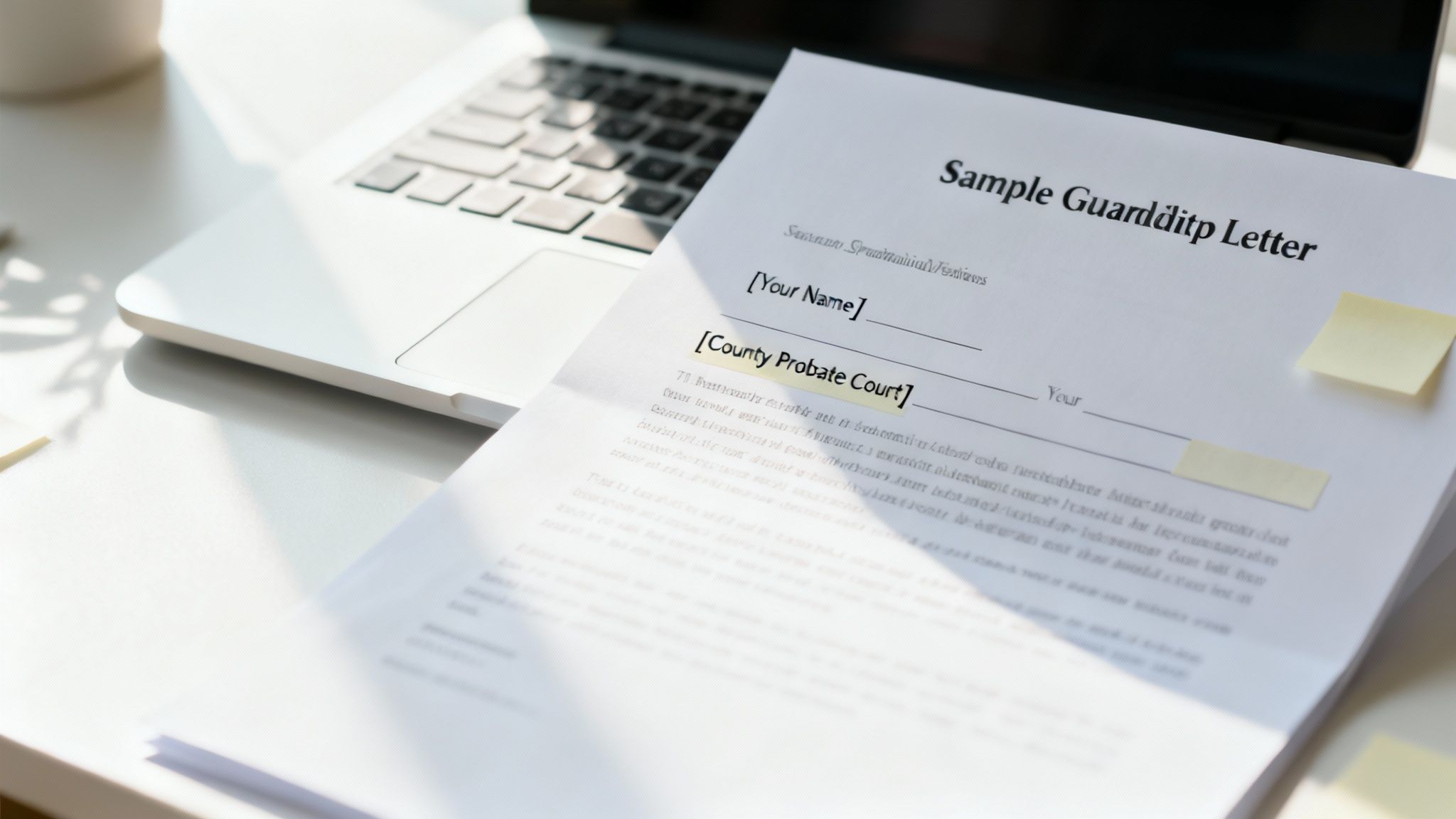
Staring at a blank page can be the most difficult part of this process. To help you begin, we’ve created an annotated template. Think of it less as a fill-in-the-blank form and more as a guided walkthrough.
Every part of this sample letter for legal guardianship is designed to show you what information is critical and why it matters to a Texas court. The placeholders like [Your Name] are paired with expert comments that explain the legal reasoning in plain English. This way, you're not just copying words; you're building a strong, persuasive letter that fits your family's unique situation.
Breaking Down the Template's Structure
This sample letter is formatted to meet the expectations of Texas probate courts, like those in Travis County. It addresses the key points a judge needs to see: clear evidence of the ward’s incapacity, proof of your suitability as a guardian, and a solid, actionable care plan.
The comments in italics throughout the template are for your guidance—be sure to delete them from your final letter. They translate Texas legal standards into practical advice so you can provide the exact details the court is looking for.
Annotated Sample Letter
[Your Full Name][Your Address][Your Phone Number][Your Email Address][Date]
The Honorable Judge [Judge's Name][Name of County Probate Court][Address of Court][City, TX Zip Code]
Re: Letter of Intent to Serve as Guardian for [Proposed Ward's Full Name]
Dear Honorable Judge [Judge's Last Name]:
My name is [Your Full Name], and I am the [Your Relationship to Ward, e.g., adult son, sister] of [Proposed Ward's Full Name]. I am writing to respectfully express my intent to be appointed as the legal guardian of the person and/or estate for [Proposed Ward's Full Name].
Expert Comment: This opening is direct and professional. It immediately establishes your identity, your relationship to the proposed ward, and your purpose for writing, which is a requirement for clarity in legal filings.
[Proposed Ward's Name] currently resides at [Ward's Address] and is [Ward's Age] years old. For the past [Number] months/years, I have observed a significant decline in their ability to manage their personal and financial affairs independently. Specifically, [he/she] has [Provide 2-3 specific, fact-based examples of incapacity. For example: "missed several critical medical appointments," "has been unable to pay essential bills, resulting in utility shutoffs," or "has wandered from home and was unable to find their way back."]
Expert Comment: Specificity here is essential. Vague statements like "she is forgetful" are not enough. Providing concrete examples demonstrates incapacity under the Texas Estates Code and shows the court why intervention is necessary to ensure the ward's safety.
I believe I am well-suited to serve as guardian. I have a stable home at [Your Address] and am financially secure in my role as a [Your Profession]. Most importantly, I have a close, trusting relationship with [Proposed Ward's Name] and a deep understanding of [his/her] needs and wishes. My care plan includes [Outline your specific plan. For example: "arranging for in-home nursing care three days a week," "managing their Social Security and pension income to pay for living expenses at their assisted living facility," and "attending all physician appointments to coordinate medical treatment."]
When preparing your customizable guardianship letter, it can be highly beneficial to refer to resources on the best templates for legal documents to ensure all essential components are included.
I understand the serious fiduciary duties required of a guardian in Texas. I am fully prepared to act in [Proposed Ward's Name]'s best interest, manage [his/her] affairs responsibly, and comply with all court reporting requirements.
Thank you for your time and consideration. I am ready to provide any additional information the court may require.
Sincerely,
[Your Signature]
[Your Typed Full Name]
While creating this letter feels personal and urgent, there is a surprising lack of hard data on guardianship nationwide. The most-cited estimate suggests around 1.3 million adults are under guardianship in the U.S., with guardians managing about $50 billion in assets. However, that figure is based on old, incomplete data.
This scarcity of standardized information means there’s no one-size-fits-all solution. Families like yours must rely on proven legal guidance rather than generic forms. Learn more about the challenges in guardianship data collection.
At The Law Office of Bryan Fagan, we can help you adapt this sample to tell your family's story in a compelling way. Schedule a free consultation for personalized guidance on your probate or guardianship matter.
Common Mistakes That Weaken a Guardianship Letter
Knowing what to include in your guardianship letter is important, but knowing what to leave out is just as critical. We have seen many well-intentioned letters fall short because of simple, avoidable errors. These mistakes can cause frustrating delays, create doubt in a judge's mind, or even weaken your entire application.
The most common pitfall is vagueness. Stating that your loved one “is confused” or “can’t handle their money” is not enough. A Texas probate judge needs specific, factual evidence to determine incapacity. Without it, the court has no justification for removing a person’s fundamental rights.
Being Vague About the Ward’s Needs
Specificity is your best tool. The court needs concrete examples that paint a clear picture of why guardianship is the only responsible option.
- Don't say: “My father is getting forgetful.”
- Do this instead: “On July 15th, my father missed his third consecutive mortgage payment and was unable to identify his bank account information when we spoke to his bank.”
That level of detail provides the judge with the factual basis needed to understand the immediate risk and the necessity of court intervention. For a closer look at this and other potential missteps, you can review some common mistakes to avoid in Texas guardianship cases.
Failing to Present a Clear Care Plan
Another critical error is failing to outline a detailed plan of action. It’s not enough to say you’re willing to be the guardian. The court needs to see that you have thought through the immense responsibilities ahead.
A strong guardianship letter demonstrates foresight. It answers the question, “What will you do on day one?” by showing you have a practical strategy for managing the ward’s health, finances, and daily life.
Your plan should be specific: where the ward will live, how medical decisions will be handled, and what steps you'll take to manage and protect their finances. This shows the judge you are prepared, competent, and ready for the job. In cases where guardianship might become contentious, a clear, proactive plan is your best defense against potential guardianship disputes.
It's also crucial to remember that there's no one-size-fits-all form for a guardianship letter. Legal procedures can vary between jurisdictions. For instance, the percentage of adults with developmental disabilities under guardianship might be 5.5% in one state but as high as 89% in another, reflecting different legal cultures. This underscores the importance of tailoring your letter to the specific expectations of Texas courts.
Avoiding these common mistakes will make your sample letter for legal guardianship more professional and far more persuasive. If you’re concerned about getting the details right, our team at The Law Office of Bryan Fagan is here to help. Schedule a free consultation, and we can ensure your letter presents the strongest possible case.
Wrapping Up: Next Steps and Common Questions
Once you’ve drafted the guardianship letter, you might wonder, "What's next?" This is a normal feeling. Let's walk through some common questions that arise at this stage so you can move forward with confidence.
Do I Need a Lawyer to Write This Letter?
While you can write the first draft yourself using a sample letter for legal guardianship, we strongly recommend having an experienced Texas guardianship attorney review it before filing. Your letter is an emotional appeal, but the official court petition is a legal document that must strictly follow the Texas Estates Code.
A knowledgeable attorney will ensure your letter powerfully supports your formal application and doesn't contain any language that could inadvertently undermine your case. They are not just a document reviewer; they are your guide through the entire legal journey, including the process of guardianship establishment and, if necessary, emergency or temporary guardianship. If you're dealing with other family law situations, it can be helpful to see how specialized support like paralegal divorce services can streamline complex document preparation.
Who Is the Letter Addressed To?
Your letter is ultimately for the judge deciding your case. It is a key piece of evidence that is formally filed with the court clerk alongside your official "Application for Guardianship."
For example, if your case is in Montgomery County, your attorney will handle the submission to the Montgomery County Clerk’s office. This ensures your letter becomes a permanent part of the official court record for the judge's review.
What if Another Family Member Contests the Guardianship?
This is where your letter’s tone and clarity become absolutely critical. If you anticipate a dispute, this document is your opportunity to present a calm, rational, and fact-based argument for why you are the best choice.
Stay focused on the positive. Highlight your strong relationship with the proposed ward and lay out your detailed, practical plan for their care. Resist the urge to speak negatively about other family members; instead, let your preparedness and commitment do the talking. In these emotionally charged situations, having legal representation is non-negotiable.
Is This Letter the Only Document I Need?
No, and this is a crucial point. The letter is a powerful supporting document, but it isn't the main event. The primary legal filing is the “Application for Appointment of Permanent Guardian.”
This formal petition is almost always submitted with other required paperwork, like a physician's certificate of medical examination. Your letter's job is to provide the human story and personal context that the official forms can't capture, helping the court understand the person behind the legal request. A sharp probate attorney will ensure you have every required document filed correctly and on time.
Navigating the complexities of guardianship requires a partner who is both knowledgeable and compassionate. At The Law Office of Bryan Fagan, PLLC, we are dedicated to helping Texas families protect their loved ones with dignity and care. Whether you are just beginning the process, need help with guardianship termination and compliance, or require guidance on estate planning, we are here for you. Schedule your free, no-obligation consultation today to discuss your next steps.