Skip to content
Planning for your family’s future can feel overwhelming, but a power of attorney form in Texas is one of the most effective tools you have to protect the people you love. It’s a compassionate way to ensure your wishes are carried out if you ever become unable to speak for yourself. By granting a trusted person the authority to manage your affairs, you can save your family from a costly, stressful, and public guardianship battle down the road.
What Is a Power of Attorney and Why Does My Family Need One?
A Power of Attorney (POA) is a legal document where you (the “principal”) give someone you trust (your “agent” or “attorney-in-fact”) the power to make financial, legal, or medical decisions for you. Many people worry that signing a POA means giving up control. It’s actually the opposite. This document empowers you to stay in the driver's seat—you decide exactly what powers your agent has and when they can use them.

This document is a cornerstone of any solid Texas Estate Planning strategy. Without one, if you were to become incapacitated from an illness or an accident, your family would have no automatic right to step in. They wouldn’t be able to pay your bills from your bank account or make critical decisions without first going to court.
The Alternative: A Public and Costly Guardianship
Imagine a family in Harris County whose father suffers a sudden, severe stroke. Because he never signed a POA, his adult children can't access his bank account to pay his mortgage or mounting medical bills. Their only option is to file for a formal Guardianship proceeding in a Harris County Probate Court.
This process is anything but simple. As outlined in the Texas Estates Code (Title 3, Subtitle G), establishing a guardianship involves:
- Public Court Hearings: The family's private financial and medical details become a matter of public record.
- Significant Costs: Guardianship isn't cheap. It comes with attorney fees, court costs, and often ongoing reporting expenses.
- Emotional Stress: The court process can drag on for months, adding a heavy layer of emotional strain during an already difficult time.
A properly executed power of attorney form in Texas avoids this entire nightmare scenario. It lets you choose who calls the shots, keeping the courts out of it and your family’s business private. It’s a truly compassionate way to shield your loved ones from unnecessary legal burdens. You can learn more about the role of a power of attorney in Texas and why you might need one to understand the specific authority it grants.
Key Takeaway: A Power of Attorney isn't about giving up your independence; it's about preserving it. You get to choose your decision-maker ahead of time, steering clear of the public, stressful, and expensive alternative of a court-ordered guardianship.
At The Law Office of Bryan Fagan, we've seen firsthand the emotional and financial challenges families face when a plan isn't in place. We can help you create documents that bring clarity and care to your family's future. For personalized guidance on how a Power of Attorney can fit into your unique situation, schedule a free consultation with our experienced team today.
Choosing the Right POA Form for Your Needs
Not all Power of Attorney forms are created equal, and picking the right one for your family is a critical first step. Think of it like a toolbox—each POA is designed for a specific job. In Texas, understanding the key differences is what ensures your wishes are protected exactly as you intend.
The most common and protective option for Texas families is the Statutory Durable Power of Attorney. The word "durable" is key. It means the document stays legally valid even if you become incapacitated later on. This single feature makes it an absolute must-have for proactive planning, ensuring it kicks in precisely when your family needs it most.
A Cornerstone of Texas Estate Planning
A well-drafted Statutory Durable Power of Attorney is a powerful tool that can often prevent the need for a costly and public court-ordered guardianship, which is a major focus of Probate law. It allows you to grant your agent broad authority over your financial and legal life, from managing bank accounts to signing off on real estate deals. The form's structure and powers are clearly defined in the Texas Estates Code, giving you confidence that your agent can step in and act on your behalf without a hitch.
In fact, the form outlined in the Texas Estates Code has become a true cornerstone of estate planning in the state. This document can grant sweeping powers—covering everything from real estate and stocks to business operations, insurance, taxes, and even digital assets—as long as you initial the relevant categories. At The Law Office of Bryan Fagan, PLLC, our team has over 100 years of combined experience helping thousands of clients customize these forms, often coordinating with physicians to get capacity evaluations that stand up to scrutiny and help prevent disputes down the road. The framework for this document is officially recognized by organizations like the State Bar of Texas.
Comparing Types of Texas Power of Attorney Forms
To help you get a clearer picture of which form might be right for you, we've put together a quick comparison of the most common POAs used here in Texas. This table is a great starting point for understanding which document is best suited for different family and financial situations.
| Type of POA | Primary Purpose | When It's Effective | Common Use Case Example |
|---|---|---|---|
| Statutory Durable POA | Comprehensive financial & legal management | Immediately or upon future incapacity; remains valid through incapacity. | A parent with an early dementia diagnosis grants their adult child authority to manage their finances and property. |
| General Power of Attorney | Short-term or temporary financial & legal tasks | Immediately; terminates automatically upon the principal's incapacity. | An individual traveling abroad for six months authorizes a relative to handle their banking and bill payments while they are gone. |
| Medical Power of Attorney | Healthcare and medical treatment decisions | Only upon a doctor's certification that you are unable to make your own medical decisions. | Someone names their spouse to make medical decisions on their behalf if they are unconscious after a car accident. |
| Limited Power of Attorney | A single, specific transaction or task | As specified in the document; often for a very limited time. | A business owner in Dallas authorizes a partner to sign closing documents for a single real estate deal in Austin. |
After reviewing the options, it becomes clear that while each form has its place, the Durable Power of Attorney and the Medical Power of Attorney are the two most critical documents for any long-term plan. For a deeper dive into how these two essential forms work together to protect you, it’s worth exploring the differences between a durable vs. medical power of attorney. Gaining that clarity can help your family make truly informed decisions.
Real-World Scenario: The Andersons in Fort Bend County are helping their father, who is 75 and in good health, prepare for the future. They choose a Statutory Durable Power of Attorney so his daughter can manage his investments and pay his bills if his health declines. They also complete a Medical Power of Attorney to ensure she can speak with doctors and make healthcare decisions according to his wishes. By using both, they create a complete plan that avoids future court intervention.
Ultimately, choosing the right power of attorney form in Texas is a deeply personal decision that must align with your specific goals. At The Law Office of Bryan Fagan, we are committed to guiding Texas families through these important choices with compassion and clarity. For personalized guidance, please schedule a free consultation with our team.
How to Complete the Texas POA Form Correctly
Filling out a legal document like a Power of Attorney can feel intimidating, but the Texas Statutory Durable Power of Attorney form is designed to be straightforward. As you complete it, remember that you're taking a powerful step to protect your family, making sure your wishes are clear and legally binding when it counts. Let's walk through the practical steps together.
First, you need to identify the key players. You are the principal—the person granting the authority. The individual you select to act on your behalf is your agent. Use the full legal names and current addresses for both you and your primary agent. This simple information is the foundation of the entire legal relationship.
This flowchart helps visualize how the Durable POA fits into the bigger picture alongside other important documents like a Medical POA or a Limited POA.
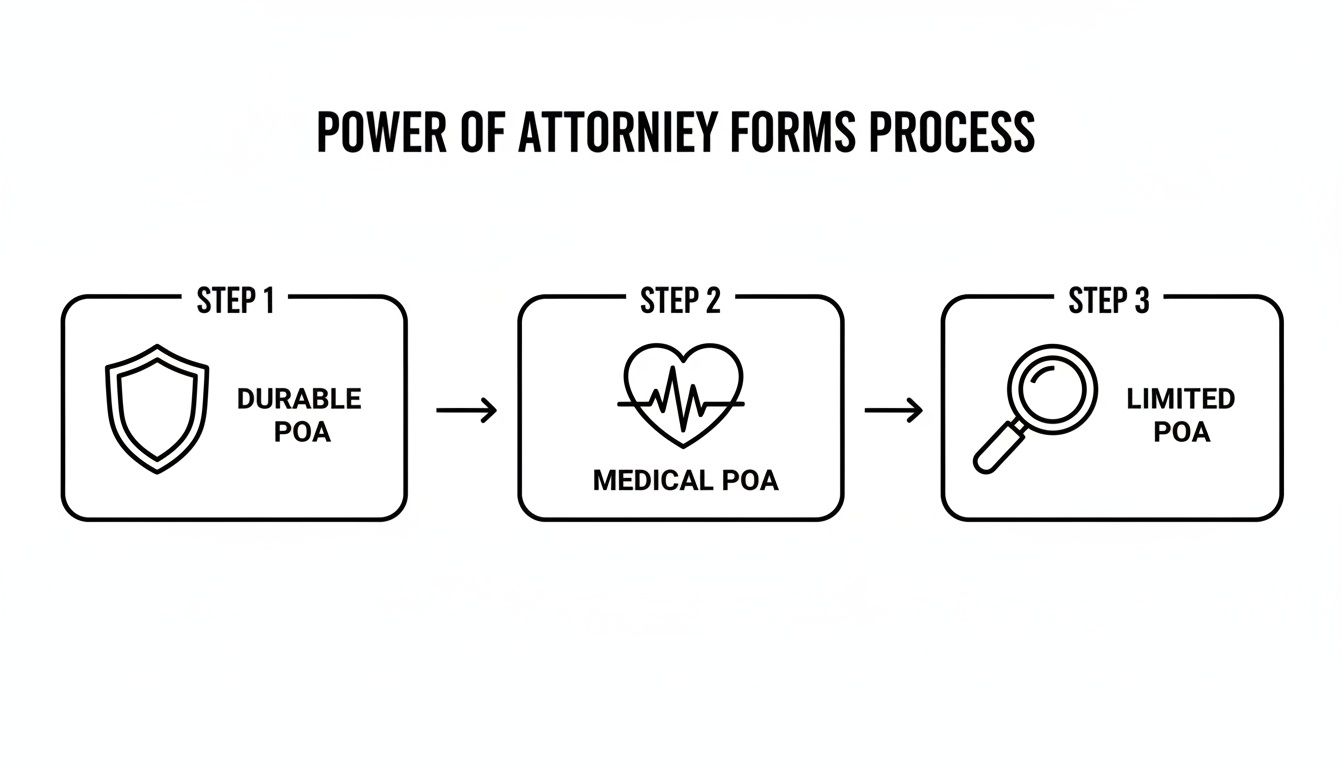
As you can see, different POAs serve different purposes. The Durable Power of Attorney is specifically designed to provide the most comprehensive protection for your financial life.
Defining Your Agent's Authority
The heart of the power of attorney form Texas is the section where you grant specific powers. This is not an all-or-nothing choice. The form lists different categories of authority, and you must initial each one you want your agent to have.
Let’s look at a practical example. Imagine Maria is helping her elderly mother, Elena, fill out the form. Elena wants Maria to handle her finances if she ever becomes unable to manage them herself.
- (G) Banking and other financial institution transactions: Elena must initial this so Maria can pay bills, make deposits, and manage her checking account. Without this specific authority, the bank would reject Maria's requests, even in an emergency.
- (I) Personal and family maintenance: Initialing this power allows Maria to use Elena’s money to pay for her housing, medical bills, and other essential living costs.
- (K) Benefits from governmental programs or civil or military service: This is absolutely critical for Maria to be able to talk to Social Security or Medicare on Elena’s behalf.
This level of detail puts you in complete control. You can tailor the document to your exact needs and comfort level, granting every power or just a select few.
Making Key Decisions on Timing and Backups
Beyond granting powers, the form requires a few more crucial choices. One of the most important is deciding when the POA actually goes into effect. You have two primary options:
- Effective Immediately: The POA is valid the moment you sign it. Your agent can act for you right away, even while you are still capable. Many people choose this for convenience.
- Effective Upon Incapacity: The POA only "springs" into effect if a doctor certifies in writing that you are no longer able to manage your own affairs.
It's also vital to plan for the "what ifs." What if your primary agent is unable or unwilling to serve when the time comes? The form gives you a space to name a successor agent (or even a second successor). Naming a backup prevents a scenario where your POA fails because your first choice can't act, which could force your family into a lengthy and expensive guardianship proceeding.
Key Takeaway: You must actively initial each specific power you wish to grant your agent. Failing to initial a category means your agent will not have that authority. Being thorough in this section is the best way to ensure your plan works as intended.
Understanding Special Instructions and Limitations
The Texas form also includes a "Special Instructions" section. This is your chance to add custom limits or grant specific authority not already listed. For example, you might state that you want your agent to continue making annual birthday gifts to your grandchildren. On the other hand, you could explicitly prohibit your agent from selling your family home in Fort Worth.
This section requires careful and clear wording. Vague instructions can create confusion or be difficult for third parties like banks to interpret. This is one area where talking to an attorney can be incredibly valuable to ensure your custom clauses are enforceable and don’t accidentally conflict with the standard powers you granted.
Completing a power of attorney form in Texas is a detailed but manageable process. By carefully considering each section—from identifying your agent to initialing powers and naming successors—you create a powerful legal shield for your family. This document ensures continuity and care, guided by your own choices.
At The Law Office of Bryan Fagan, we understand the emotional weight of these decisions. Our mission is to guide Texas families with clarity and compassion. If you have questions about completing your POA or need personalized advice for a complex situation, please schedule a free consultation with our team.
Finalizing and Executing Your Power of Attorney
You've done the hard work of choosing your agent and spelling out their powers. Now comes the most important part: making your power of attorney form texas legally binding. Until it's properly signed and executed, it's just a piece of paper. This final step is what gives it real legal power and helps prevent future guardianship disputes.

Under Texas law, your signature as the principal must be acknowledged before a notary public. A notary serves as an impartial, official witness. Their role is to verify your identity and confirm you're signing the document willingly, without any pressure.
Finding a notary is usually straightforward—they're at most banks, shipping stores, and law offices. When you go, you must bring a valid, government-issued photo ID, like your driver's license or passport. A crucial tip: do not sign the document ahead of time. You must sign it in the notary's physical presence.
Witnesses for a Financial POA: A Common Point of Confusion
One of the questions families ask us most often is about witnesses. This is a classic source of confusion, so let's be crystal clear.
While a Texas Medical Power of Attorney requires two qualified witnesses, the Statutory Durable Power of Attorney (for financial matters) does not. For your financial POA, all that's needed is your signature and the notary's seal.
This difference actually simplifies things for the financial POA, but it also shows why paying close attention to the specific rules for each document is so critical. A complete estate plan often involves several documents working together, and our guide on planning for incapacity with powers of attorney and advanced directives in Texas can help you see the bigger picture.
Storing the Document and Talking With Your Agent
Once your POA is notarized, you have a legally valid original document. Keep it somewhere safe but also accessible. A fireproof box at home or a safe deposit box are good options, but make sure your agent knows exactly where to find it when the time comes. It's a smart move to give them a high-quality copy for their records.
Just as critical as the paperwork is the conversation you have with your agent. This isn't just a formality; it's a deep discussion about trust and responsibility. Talk to them about your wishes, your values, and the duties of a guardian. Taking this step ensures they are truly prepared and understand the responsibilities they are agreeing to take on. And if your POA needs to be understood by non-English speakers or used in another country, you may need to look into reputable legal document translation services.
When to Record Your Power of Attorney
For the most part, your POA will remain a private document between you, your agent, and the institutions they interact with. However, Texas law carves out one major exception: real estate transactions.
If you intend for your agent to have the power to buy, sell, mortgage, or otherwise deal with property on your behalf, the original POA must be recorded. This is done at the county clerk's office in the county where the property is located. For instance, if you're selling a home in Houston, the POA would need to be filed with the Harris County Clerk.
Key Takeaway: A financial Power of Attorney in Texas is only valid after the principal signs it in front of a notary. Recording it with the county clerk is only required if your agent will be handling real estate matters.
Getting these final steps wrong can lead to serious problems down the road. Without a valid POA, families are often forced into Texas guardianship proceedings, which have surged as the population ages. These last actions are what transform your careful planning into an enforceable legal tool, protecting both your rights and the duties of your chosen guardian. If you want to make sure every detail is handled correctly, schedule a free consultation with our team.
Common Mistakes That Can Derail Your Power of Attorney
A Texas Statutory Power of Attorney is a powerful tool designed to be accessible, but simple mistakes can create serious headaches for your family. Understanding these common pitfalls ahead of time is the best way to make sure your document provides the protection you intend instead of causing confusion when your loved ones need clarity most.
Getting this right is critical. A properly prepared POA can be the difference between a smooth, private transition of financial management and a costly, court-supervised guardianship.
Choosing the Wrong Agent
Hands down, the single most important decision you will make is who you name as your agent. This person will have immense power over your finances and property. The biggest mistake is choosing someone out of obligation—like an eldest child—rather than on sheer trustworthiness and capability.
Think about it. An agent who is financially irresponsible, easily swayed, or just a poor communicator can create a disastrous situation. You need someone who is organized, ethical, and fully grasps the immense responsibility of acting as a fiduciary—a person legally bound to act only in your best interest, similar to the rights and duties of a guardian.
Being Too Vague or Too Broad
The statutory form is set up like a checklist, requiring you to initial each specific power you want to grant. A common error is to either initial everything without thinking through the implications, or to miss a critical power your agent will need. For instance, if you forget to initial "(G) Banking…" your agent might be blocked from paying your bills out of your main checking account.
On the flip side, some situations call for clear limits. The "Special Instructions" section is a potent tool but is often misused or underutilized. Vague instructions like "use my money for good causes" are completely unenforceable. This section is for clear, actionable directives, such as:
- "Do not sell my primary residence located at 123 Oak Street, Austin, Texas."
- "Continue my annual $500 donation to St. Mary's Church."
Forgetting to Name Alternate Agents
Life happens. Your primary agent could get sick, pass away, or simply be unwilling or unable to serve when the time comes. Failing to name at least one successor (or alternate) agent is a critical oversight that can render your entire POA useless. This is a crucial step before any guardianship hearing.
If your first choice is unavailable and there's no backup listed in the document, your family is stuck. Their only option would likely be petitioning a court, such as a Dallas County Probate Court, for a guardianship—the very outcome the POA was designed to avoid.
Key Takeaway: A Power of Attorney fails if your chosen agent can't act and you haven't named a backup. Always designate at least one successor agent to ensure your plan remains effective no matter what happens.
Not Knowing When You Need an Attorney
While the statutory power of attorney form Texas provides is an excellent starting point, it's not a one-size-fits-all solution. Certain family dynamics or financial situations are just too complex for a standard form and need the custom touch of an experienced attorney, especially when guardianship disputes are possible.
You should absolutely seek legal counsel if your situation involves any of these scenarios:
- Blended Families: The potential for conflict between a current spouse and children from a previous relationship is incredibly high.
- Significant Business Assets: An attorney can add specific clauses to give your agent the authority to properly manage your business interests.
- Special Needs Trusts: You need expert advice to make sure the POA doesn't accidentally interfere with a loved one's eligibility for government benefits.
- Questionable Capacity: If the principal's mental state could be challenged later, an attorney can help document their competency now to head off future disputes.
- Existing Family Conflict: When disagreements are already simmering, a lawyer can help draft a more robust document designed to minimize the risk of a full-blown legal battle.
Avoiding these mistakes is crucial. The whole point of a POA in Texas is to prevent costly court intervention and serves as a powerful alternative to guardianship. You can learn more about the protective benefits of a statutory durable power of attorney.
At The Law Office of Bryan Fagan, we specialize in helping families navigate these complexities. We can review your unique situation and help you decide if the statutory form is enough, or if a customized document is the smarter way to fully protect your interests. For a compassionate review of your needs, schedule a free consultation with our team today.
Common Questions We Hear About Texas POAs
Even after you've put a solid plan in place, it's completely normal to have lingering questions about how a power of attorney form in Texas actually works day-to-day. Getting these last few details ironed out can give you the peace of mind that your documents will hold up when they’re needed most. Below, we’ve tackled some of the practical questions we hear all the time from Texas families just like yours.
Can I Revoke or Change My Power of Attorney?
Yes, absolutely. As the principal, you are always in the driver's seat as long as you are mentally competent. You can amend or completely cancel your Power of Attorney at any time, which is a key step in guardianship compliance and termination.
To do this properly, you must create a formal written notice called a "revocation of power of attorney." This document should clearly state your intent to cancel the previous POA, list its original date, and name the agent whose authority you are ending. Crucially, it must also be signed and notarized.
Once the revocation is signed, you must deliver a copy to your former agent. You also have to notify any banks, doctors' offices, or other institutions that have the old POA on file. This is how you prevent them from accidentally honoring a document that's no longer valid. If you just want to make a few tweaks, the cleanest and safest route is usually to revoke the old one entirely and start fresh with a brand new, updated POA.
Does a Power of Attorney Need to Be Filed With a Court?
In most cases, no. One of the biggest advantages of a Power of Attorney is that it's a private document. It doesn't get filed with a Texas court to become legally effective, which is a stark contrast to a guardianship proceeding that becomes a public court record. For many families, keeping personal and financial matters private is a huge relief.
The main exception to this rule involves real estate.
If your agent needs to handle property transactions—like selling your home or refinancing a mortgage—the Durable Power of Attorney must be recorded with the county clerk where the property is located. For a house in Houston, for instance, you'd file it with the Harris County Clerk. This filing makes the agent's authority part of the public land records, a legal requirement for any real estate deal to move forward.
For everything else, from managing bank accounts to talking with Medicare or making healthcare choices, no court filing is required.
What Happens Without a Power of Attorney?
If you become incapacitated and don't have a valid Power of Attorney, your family can't just step in and start managing your affairs. They have no automatic legal authority to access your bank accounts, pay your mortgage, or make binding decisions on your behalf. This is when emergency or temporary guardianship may become necessary.
To get that authority, they would be forced to go to court and ask a judge to establish a guardianship. This process, often handled in a Texas probate court like those in Dallas County or Bexar County, is almost always something to avoid. A guardianship is:
- Public: Your private medical and financial details become part of the public court file, open for anyone to see.
- Expensive: Guardianships come with hefty attorney fees, court costs, and other administrative expenses that can drain an estate.
- Slow: The entire process can drag on for months.
A judge would first have to declare you legally incapacitated and then appoint a guardian to take over. The court continues to supervise the guardian's every move, demanding annual reports and detailed accountings. A power of attorney form in Texas lets you name your own trusted decision-maker ahead of time, saving your loved ones from the expense, stress, and public scrutiny of a court-mandated guardianship.
Navigating the complexities of a Power of Attorney can feel overwhelming, but you don't have to go it alone. The compassionate attorneys at The Law Office of Bryan Fagan, PLLC are here to provide the clarity and care your family deserves. We can help you create documents that protect your wishes and prevent future legal burdens. For personalized guidance on your specific situation, schedule a free and confidential consultation with our team today.