Skip to content
When a family member begins to need help with major life decisions, the path forward can feel overwhelming and emotionally charged. For many families in Texas, the first thought is often Guardianship—a legal process where a court transfers an individual's decision-making rights to someone else.
While guardianship is absolutely necessary in some situations, it is a profound step that removes a person's fundamental right to direct their own life. We understand the emotional and financial challenges that come with this process.
But there is another way. A powerful and compassionate alternative that keeps independence and dignity at the forefront: Supported Decision-Making (SDM).
Empowering Choices Over Legal Control
Supported Decision-Making is a legally recognized alternative to guardianship that allows individuals to make their own choices with the help of a trusted team of supporters. Instead of having a guardian make decisions for them, SDM preserves an individual's autonomy and legal rights.
Think of SDM as building a personal "board of advisors." The individual remains the CEO of their own life, making the final call on every decision. Their chosen supporters—who can be family, friends, or even professionals—act as their trusted consultants.
These supporters help by:
- Gathering information and breaking down complex topics in plain English.
- Walking through the potential outcomes of different choices.
- Helping communicate the individual's final decision to others, like doctors or bankers.
This collaborative approach is a world away from guardianship, where a court-appointed guardian is given the legal authority to make choices for the individual, often without their consent. Guardianship can be a vital protection for those who truly cannot make or communicate decisions, but SDM offers a less restrictive option that fosters dignity and self-worth.
A Side-by-Side Look: SDM vs. Guardianship
To really understand the difference, it helps to see the two models next to each other. The table below breaks down the core distinctions in simple terms.
Supported Decision-Making vs. Guardianship at a Glance
| Feature | Supported Decision-Making (SDM) | Guardianship |
|---|---|---|
| Decision-Maker | The individual makes the final decision. | The court-appointed guardian makes the final decision. |
| Legal Rights | The individual retains all of their legal rights. | The individual's legal rights are transferred to the guardian. |
| Process | Voluntary agreement; does not require court approval. | Involuntary process initiated and supervised by a court like the Harris County Probate Court. |
| Focus | Empowerment, autonomy, and collaboration. | Protection and substitution of judgment. |
| Flexibility | Highly flexible; can be changed or ended by the individual. | Rigid; can only be changed or ended by a court order. |
| Best For | Individuals who can make decisions with support. | Individuals who cannot make or communicate decisions, even with support. |
As you can see, the core philosophy is fundamentally different. SDM is built on the belief that people can and should direct their own lives, even when they need a little help to do so. Guardianship, on the other hand, is a tool of last resort for when self-direction is no longer possible.
Why Supported Decision-Making Matters in Texas
With at least 1.5 million adults under guardianship in the U.S. and that number expected to grow, exploring alternatives like SDM is more critical than ever. Supported decision-making provides a legal framework to formalize a support system, empowering your loved one and ensuring their voice is heard in every aspect of their life.
This shift toward preserving autonomy is a key development in Texas law, and you can learn more about how new guardianship models are evolving to focus on empowerment.
Choosing between supported decision-making and guardianship is a profound decision for any family. Understanding the differences is the first step toward making a choice that honors your loved one's capabilities and protects their future. At The Law Office of Bryan Fagan, we recognize the emotional weight of these choices and are here to provide clear, compassionate guidance.
To explore whether supported decision-making is the right path for your family, schedule a free consultation for personalized guidance.
Understanding Supported Decision-Making in Texas Law
When Texas families start looking for ways to support a loved one without resorting to guardianship, a common question comes up: Is Supported Decision-Making (SDM) a real, legally recognized option? The answer is a resounding yes. SDM isn't just a nice idea; it's a formal legal framework in Texas built to empower individuals with disabilities while making sure they have the help they need.
The legal muscle behind this powerful tool is found in the Texas Estates Code, specifically Title 3, Subtitle G, Chapter 1357. This law officially establishes Supported Decision-Making Agreements as valid legal documents. You can think of it as being similar to a Power of Attorney, but with a critical difference: instead of handing over control, it formally recognizes a support system. It gives individuals the right to choose supporters to help them make their own life decisions.
This legal recognition is everything. It means a properly created SDM agreement isn't just a casual family arrangement—it’s a document that doctors, banks, and schools are required to take seriously.
How It Works Under Texas Law
Under Chapter 1357, an adult with a disability can enter into an SDM agreement with one or more people they trust. This agreement gives the supporter the legal ability to do two key things:
- Get Information: The supporter can access the person's confidential information, whether it's medical records from a hospital in Harris County or financial statements from a bank in Dallas.
- Help Communicate: The supporter can be in the room for important talks, helping the individual understand the options and communicate their final decision clearly.
It's just as important to understand what an SDM agreement doesn't do. A supporter cannot make a decision for the individual. The person using SDM always, always has the final say. The supporter is like a co-pilot, helping to navigate and read the maps, but the individual is always the one flying the plane.
The Role of the Supporter: A Hypothetical Scenario
A supporter is a trusted advisor, not a substitute decision-maker. Their job is to help the individual gather and process information so their own voice can be heard loud and clear.
Let's imagine a young adult named Alex in Austin who has a developmental disability and is ready to find his own apartment.
- Without SDM: Alex might feel completely overwhelmed trying to decipher lease agreements, set up utility contracts, and figure out a monthly budget. His family might feel the only option is guardianship to manage his finances and housing.
- With SDM: Alex chooses his older sister, Maria, as his supporter. Maria sits down with him to explain the legal jargon in the lease in plain English. She helps him build a simple budget and goes with him on apartment tours to ask good questions. Alex still picks the apartment that feels like home, but he gets to make that choice with confidence.
A Supported Decision-Making Agreement is a formal declaration of interdependence. It legally affirms that needing help doesn’t mean giving up your rights, and it provides a clear roadmap for how that help will be provided and respected.
Practical Applications in Daily Life
The real power of an SDM agreement shines through in the everyday situations that families across Texas navigate. From medical appointments in Travis County to financial planning in Bexar County, these agreements offer a structured way to give support where it's needed most. They can be tailored to cover specific areas, like:
- Healthcare Decisions: Helping a loved one understand a doctor's diagnosis, weigh different treatment options, or communicate their wishes for care.
- Financial Matters: Assisting with budgeting, paying bills, or making sense of financial documents without ever taking control of their bank account.
- Personal Life Choices: Providing guidance on big decisions like where to live, work, or go to school.
By making the support role official, an SDM agreement clears up any confusion and empowers both the individual and their chosen supporters. For families weighing their next steps, understanding these alternatives to guardianship for adults with disabilities is a crucial first step in preserving a loved one's autonomy and dignity.
How to Create a Texas Supported Decision-Making Agreement
Putting together a Supported Decision-Making (SDM) agreement is a deliberate, proactive step that formalizes a support network for your loved one. While it's far less complicated than a court-supervised guardianship, it still requires thoughtful planning to make sure it’s effective and legally solid. Following a clear process is a practical step families can take to build an agreement that genuinely empowers their loved one.
The entire process boils down to three core actions: gathering information, talking through the options, and then making the final call. This simple flow shows how collaborative supported decision-making truly is.
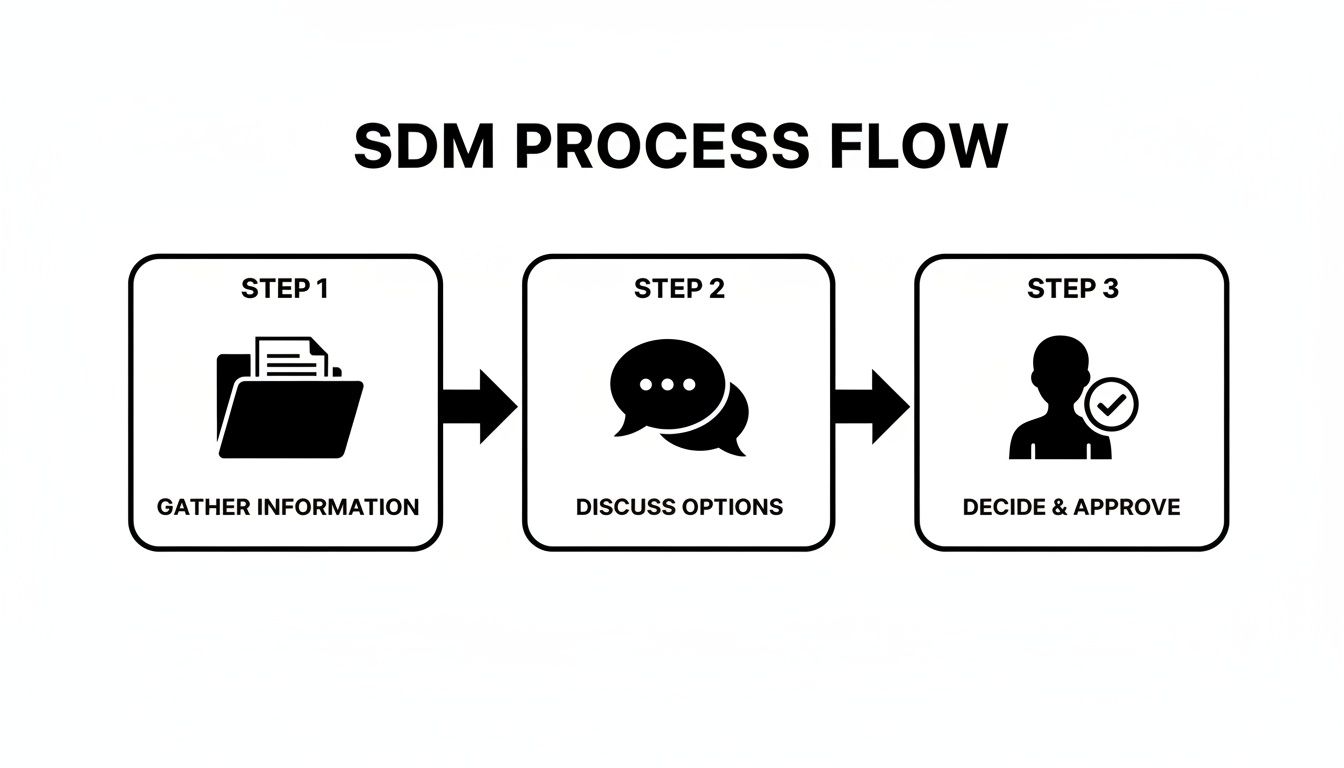
This visual underscores a key point: the individual always stays at the center of the decision. Supporters are there to provide a foundation for an informed choice, not to take over.
Step 1: Identify Trusted Supporters
The very first step belongs to the individual: choosing their supporters. These need to be people they trust completely to act in their best interest, respect their autonomy, and help them make sense of complex information without pushing their own agenda.
A supporter could be a family member, a close friend, a trusted professional, or anyone who has a strong, positive relationship with the person. The foundation is trust and a shared commitment to the individual’s independence.
It's often a good idea to name more than one supporter. This creates a solid team and gives you a backup if one person isn't available when needed.
Step 2: Define the Areas of Support
No two people need the exact same kind of help. A good SDM agreement is tailored to the person’s specific needs. It's vital to sit down and have an open, honest conversation about which areas of life require support.
Common areas where support is helpful include:
- Healthcare: Helping understand a new diagnosis, walking through treatment options, or communicating with doctors at a clinic in Harris County.
- Finances: Assisting with building a budget, paying bills on time, making sense of bank statements, or reviewing financial contracts.
- Living Arrangements: Exploring different housing options, reading and understanding a lease, or getting utilities set up.
- Education and Employment: Helping navigate the school enrollment process, applying for jobs, or understanding workplace policies.
By clearly defining these areas, the agreement gives supporters specific authority without being overly broad. This targeted approach is a core strength of supported decision-making.
Step 3: Draft the Agreement with Clear Language
Once the supporters and support areas are locked in, it’s time to draft the agreement itself. While you can find templates online, it is absolutely essential to customize the document for the unique situation. The language needs to be clear, simple, and direct.
An effective agreement should include:
- The full legal name of the individual (the "principal").
- The full legal names of every chosen supporter.
- A clear statement that the individual is entering the agreement voluntarily.
- The specific life areas where supporters are authorized to help.
- The powers granted to supporters, like the right to access confidential information.
For example, a clause might read: "My supporter, Jane Doe, is authorized to obtain and review my protected health information to help me make my own healthcare decisions. She is not authorized to make decisions for me."
This kind of specificity prevents confusion and ensures third parties, like doctors or bankers, understand the supporter’s role. While some families try to handle this on their own, consulting an attorney is a wise move. Legal guidance ensures the agreement fully complies with Texas Estates Code Chapter 1357 and is strong enough to be honored. In complicated family dynamics, a clear framework can also head off future disagreements—a key goal when looking for ways to establish Texas guardianship out of court.
Step 4: Properly Execute the Document
For a Texas SDM agreement to be legally valid, it has to be signed correctly. The individual must sign the document voluntarily and in the presence of two credible adult witnesses.
The witnesses cannot be:
- A person named as a supporter in the agreement.
- The person’s healthcare provider or an employee of the provider.
- A residential care provider or an employee of the provider.
The witnesses must also sign a statement confirming that the individual appeared to sign the document willingly and was not under duress or undue influence. This formal execution step is what gives the document its legal authority, and it's critical for it to be recognized by institutions.
Taking these steps helps create a powerful legal tool that protects autonomy while providing essential support. For personalized guidance in drafting and executing an agreement that fits your family’s unique needs, contact The Law Office of Bryan Fagan for a free consultation.
When Guardianship Is the Necessary Choice
Supported decision-making (SDM) is a wonderful, empowering tool, but it's built on one non-negotiable foundation: the individual must have the capacity to make their own choices, even with help. There are heartbreaking situations where that foundation crumbles. In those moments, the most compassionate and protective step a family can take is to pursue guardianship.
Realizing this isn't a failure or giving up on your loved one. Far from it. It's a courageous act of protection, a legal shield to safeguard them when they are at their most vulnerable. The goal simply shifts from supporting autonomy to providing essential protection when self-direction is no longer possible.
Recognizing the Limits of Supported Decision-Making
Supported decision-making shines when a person can understand information, weigh the consequences of a decision, and clearly express what they want. But some circumstances can make SDM insufficient or even dangerous. When that happens, guardianship may be the only responsible path forward.
There are a few key scenarios where guardianship is almost always required:
- Severe Cognitive Decline: In cases of advanced dementia, a major brain injury, or other conditions that severely impair cognitive function, a person may simply no longer be able to grasp their choices or communicate their wishes.
- Active Exploitation or Undue Influence: If a loved one is being manipulated or financially taken advantage of by someone, an SDM agreement often isn't strong enough to stop the harm. A guardian has the legal authority to step in, void predatory contracts, and protect their assets.
- Urgent Medical Crises: During a sudden medical emergency where an individual is incapacitated and can't consent to life-saving treatment, an emergency or temporary guardianship might be necessary to give a trusted family member the authority to make critical healthcare decisions.
When weighing whether guardianship is the right move, it’s crucial to look at the person's specific support requirements and their actual ability to navigate daily life. This includes understanding things like the significant support needs of individuals with ASD Level 2 or other conditions that can impact decision-making capacity.
The Legal Standard for Incapacity in Texas
Choosing guardianship isn't just a family decision; it's a formal legal process with a very high bar. A Texas probate court, whether in Tarrant County or Bexar County, will not strip away a person's rights casually. To establish a guardianship, you have to prove that the individual is legally incapacitated.
Under the Texas Estates Code, Title 3, an adult is considered incapacitated if, because of a physical or mental condition, they are:
- Substantially unable to provide their own food, clothing, or shelter.
- Unable to care for their own physical health.
- Unable to manage their own financial affairs.
A judge makes this call after reviewing substantial evidence, including a physician's evaluation called a "Certificate of Medical Examination." This document details the person's condition, the degree of their cognitive impairment, and their ability to make decisions. The judge's sole focus is the best interest of the proposed ward.
A guardianship proceeding is a profound legal step. It’s designed to protect those who can no longer protect themselves. It replaces the collaborative spirit of supported decision-making with the legal authority necessary to ensure safety when a person's health or finances are in immediate danger.
Ultimately, the choice between SDM and guardianship comes down to one question: Can the individual still make and communicate their own choices with support? If the answer is yes, SDM is the preferred, less restrictive path. If the answer is no, then pursuing a Guardianship is the responsible and loving thing to do.
This is a heavy, emotional decision, and you shouldn't have to make it alone. At The Law Office of Bryan Fagan, we can help you assess your loved one's situation with compassion and clarity. Schedule a free consultation with us to talk about your family's needs and figure out the right path forward.
Putting Your SDM Agreement into Practice
You’ve done the hard work, and the Supported Decision-Making (SDM) agreement is signed. That’s a huge step, but the document itself is just a piece of paper until you put it into action. Its real power comes alive when you confidently present it to the people who need to see it—doctors, bankers, and other professionals.
Think of it this way: having the agreement is step one. Step two is making sure the rest of the world understands and respects its authority. This is where your loved one and their supporters truly become advocates for the power of supported decision-making.

Introducing the Agreement to Professionals
Walking into a doctor’s office or a bank with a legal document can feel a bit formal, even intimidating. It's very likely the person you’re speaking with has never seen an SDM agreement before. The key is to be prepared, patient, and clear in your communication. A practical step is to provide a copy of the agreement ahead of an appointment.
You could even attach a simple one-page summary that explains what it is in plain English, mentioning that it’s legally recognized under Texas Estates Code Chapter 1357.
Here are some simple, effective talking points you can adapt:
- For a Doctor: "Hi, I'd like to introduce my supporter, [Supporter’s Name]. We have a Supported Decision-Making Agreement that legally authorizes them to be here, look at my medical information, and help me talk through my healthcare choices. I'll still be making the final decision."
- For a Banker: "I'm here today with my supporter, [Supporter’s Name]. Under this Texas SDM agreement, they can help me review my bank statements and understand the options for my account. Just to be clear, I am still the only owner and decision-maker."
This kind of direct, straightforward language immediately clarifies the supporter’s role while reinforcing the individual’s own authority.
A Real-World Houston Medical Scenario
Let’s picture Sarah, a young woman with a developmental disability, at a medical clinic in Houston. She has some new symptoms that are worrying her, so her older brother and supporter, David, is with her.
When they get to the front desk, David calmly gives the receptionist a copy of Sarah's SDM agreement. He explains, "Sarah has asked me to be her supporter. This document just lets you know I’m allowed to be in the appointment with her and help her process the doctor's advice."
Later, in the exam room, the doctor starts explaining a complicated diagnosis, and Sarah looks overwhelmed. This is where David steps in—not to speak for her, but to help her speak for herself. He asks the doctor to explain a medical term more simply and jots down a few notes. Then, he turns to Sarah and asks, "Does that make sense? What are your thoughts on the two treatment options he just laid out?"
Thanks to the SDM agreement, David has the access he needs to help Sarah make a truly informed choice. Feeling supported instead of sidelined, Sarah confidently tells the doctor which treatment plan she wants. This is exactly what supported decision-making looks like in action. It protects dignity and makes sure the individual’s voice is the one that matters most.
An SDM Agreement empowers supporters to unlock information and facilitate communication. It transforms a potentially confusing situation into a collaborative process, building confidence for the individual and ensuring their choices are truly their own.
Making your agreement work smoothly also means treating it like any important document. Learning about contract management best practices can offer useful tips for keeping things organized and ensuring everyone follows the plan over the long term.
Even though a properly signed SDM is legally binding in Texas, you might run into someone who isn’t familiar with the law and pushes back. If a hospital or bank refuses to honor the agreement, an experienced attorney can step in to enforce your loved one's rights. At The Law Office of Bryan Fagan, we can help ensure your family's choices are respected. Schedule a free consultation to see how we can support you.
How We Help Texas Families Navigate This Journey
Deciding between supported decision-making and guardianship is one of the toughest, most important crossroads a family can face. The legal maze and the emotional weight of it all can feel crushing. But you absolutely do not have to figure this out on your own. At The Law Office of Bryan Fagan, we offer clear, compassionate legal guidance to families all across Texas, helping you make confident choices that protect your loved one’s future while honoring their dignity.
Our process always starts with listening. We take the time to truly understand your family's unique situation, hear your concerns, and explain every option in plain, simple English—no confusing legal jargon.
Comprehensive Support, Every Step of the Way
Whether you’re in Houston, Dallas, or anywhere in between, our team is ready to help you build a secure and legally solid plan. We focus our support in a few key areas:
-
Evaluating Your Options: We'll sit down with you and carefully weigh the freedom of a supported decision-making agreement against the vital protections of a formal Guardianship. Our main goal is always to find the least restrictive path that still guarantees your loved one's safety and well-being.
-
Drafting Strong SDM Agreements: If supported decision-making is the right fit, we’ll help you craft a custom agreement that is clear, thorough, and fully compliant with the Texas Estates Code. A well-written agreement is your best defense to ensure banks, doctors, and other institutions respect your loved one’s decisions.
-
Navigating Guardianship Proceedings: When guardianship is the necessary choice, our experienced attorneys will manage the entire process from start to finish. We handle everything with precision and care, from filing the initial application in the appropriate probate court (like the Harris County Probate Court) to representing you at the hearing.
Choosing the right legal path is a profound act of love and protection. We are committed to making sure your final decision is one you can feel confident in, knowing it truly serves the best interests of your family member.
We know how draining these proceedings can be, both financially and emotionally. That’s why we’re dedicated to providing supportive guidance at every turn. You can learn more about our comprehensive services by exploring our Probate and Estate Planning pages.
Your family’s peace of mind is what matters most to us. Schedule a free, no-obligation consultation today to talk through your situation and discover how we can help you create a personalized legal strategy for your loved one.
Common Questions About Supported Decision-Making
As families in Texas start looking at options beyond guardianship, a lot of questions pop up about how Supported Decision-Making actually plays out in the real world. This is a process built on trust and open communication, so getting a handle on the details can give you the confidence you need to take the next step. Here are some of the most common questions we hear.
What If a Supporter Disagrees With a Decision?
This is a big one, and it gets right to the heart of what makes SDM different. The foundational rule of supported decision-making is that the person with the disability always has the final say. The supporter's job is to advise, help weigh the pros and cons, and bring information to the table—not to give a thumbs-up or thumbs-down on the final choice.
Even if a supporter strongly feels another path is better, they can't legally block the individual's decision. The SDM agreement is specifically designed to protect that person's autonomy. This is the critical line that separates SDM from guardianship, where the guardian holds all the decision-making power.
Can We Change or Cancel an SDM Agreement?
Yes, absolutely. One of the best things about a Supported Decision-Making Agreement is its flexibility. Under Texas law, the person who made the agreement can change it or revoke it completely at any time they choose.
This freedom is a world away from guardianship. Ending a guardianship is a major legal undertaking that involves going back to probate court and convincing a judge that it’s no longer needed. With an SDM, the power to change the support system stays exactly where it should: with the individual.
Think of an SDM agreement as a living document. It's meant to adapt as a person's needs, goals, and relationships shift over time. This flexibility ensures the support structure is always working for the individual, not the other way around.
Are Doctors and Banks Required to Honor an SDM Agreement?
Once it's properly drafted and signed, a Supported Decision-Making Agreement is a legally binding document in Texas under Chapter 1357 of the Estates Code. This means that institutions like hospitals, doctors' offices, and banks are legally required to respect it.
But let's be realistic—SDM is still a newer concept than guardianship, and not everyone is up to speed. You may run into professionals who simply aren't familiar with it. In those cases, a little education goes a long way. It’s always a good idea to bring a copy of the agreement to appointments and be ready to calmly explain what it is and the law that backs it up.
If an institution in a place like Harris County or Dallas County digs in its heels and refuses to honor a valid SDM agreement, that isn't the end of the story. An experienced attorney can step in, communicate directly with the institution, clarify their legal obligations, and enforce your loved one’s rights. This is one of the key reasons why having professional legal guidance in your corner can make all the difference.
At The Law Office of Bryan Fagan, PLLC, we know that no two families are alike. If you have more questions about supported decision-making or aren't sure which path is right for your loved one, we're here to help. Schedule a free, no-obligation consultation to get personalized advice and compassionate support. https://texasguardianshiplawyer.net