Skip to content
For many Texas families, an attorney-drafted estate plan usually falls between $2,000 and $5,000, while simpler documents can cost less and more complex matters involving guardianship or incapacity can cost more. A basic will may be much lower, but once your plan needs trusts, powers of attorney, or court-related protection for a vulnerable loved one, the estate planning attorney cost often rises into the low-to-mid thousands.
If you're reading this, there's a good chance something real is happening in your family right now. Maybe a parent in Houston is starting to forget bills and medications. Maybe you and your spouse in Dallas have children and keep meaning to get a will done. Maybe a doctor has raised concerns about capacity, and you're worried that what looked like a routine estate plan could turn into a guardianship case in Harris County Probate Court.
That confusion is normal. Most online cost guides talk about wills and trusts as if every family has the same needs. Texas families often don't. A plan that includes possible incapacity, guardianship nominations, or future court involvement is different from filling out a simple online form.
Texas law treats guardianship as a serious step. Under Texas Estates Code Title 3, Subtitle G, a court can appoint a guardian for a person who is found incapacitated, but only after legal procedures, notice, evidence, and judicial review. That process can protect vulnerable people, but it also adds time, responsibility, and expense. In many families, the core question isn't just "How much does a will cost?" It's "How much will it cost to protect my loved one if they can no longer protect themselves?"
Understanding Attorney Fee Structures Flat Fee vs Hourly
Most families first want to know how lawyers charge. That's the right place to start, because the fee structure often matters almost as much as the final number.
Flat fee means a set package
A flat fee is like ordering a combo meal. You know what is included, and you know the price before you begin. In estate planning, that often means a lawyer quotes one set amount for a defined group of documents, such as a will, durable power of attorney, medical directives, and related signing instructions.
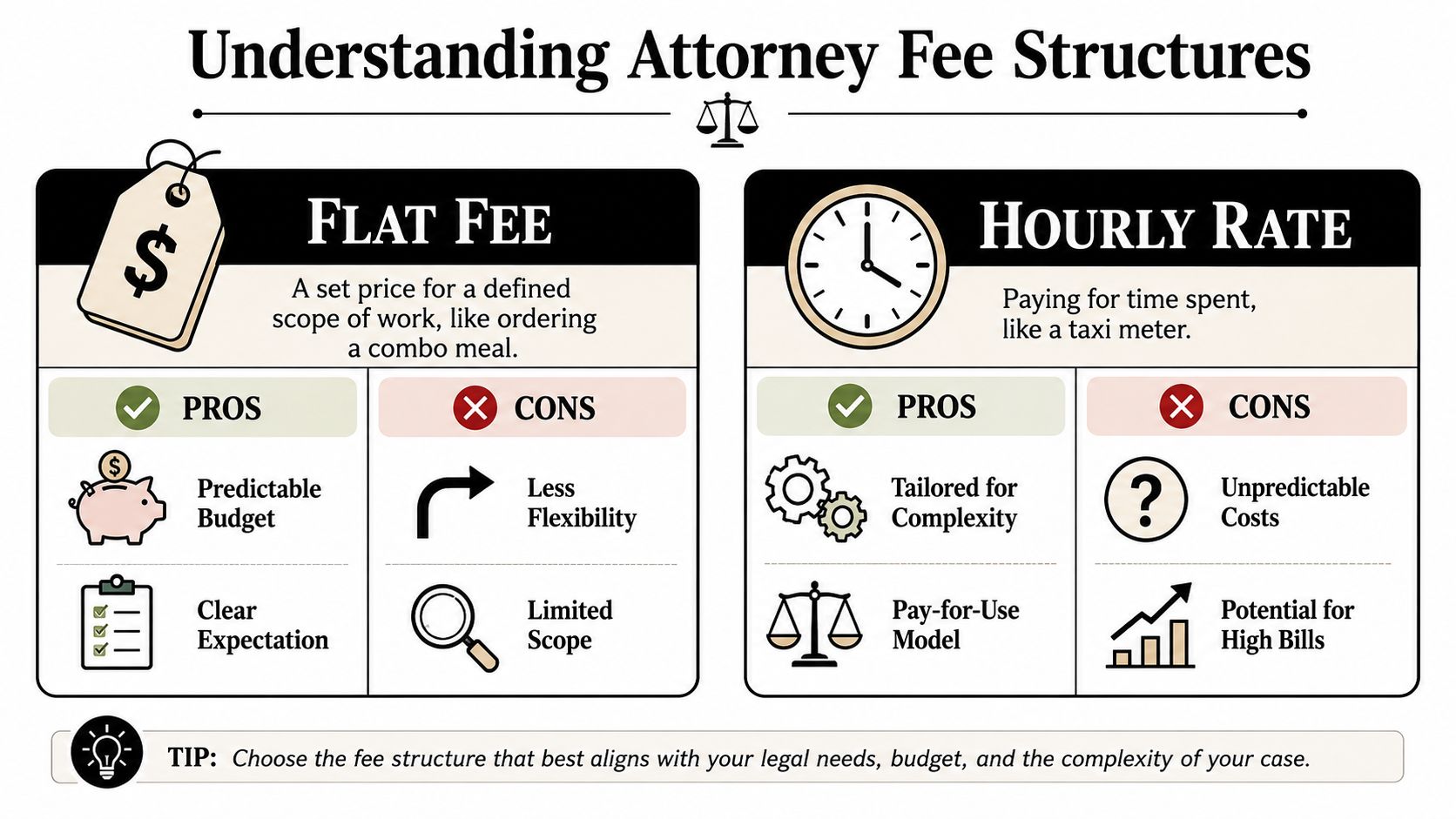
Families usually like flat fees because they reduce surprises. You can plan your budget. You also know whether meetings, revisions, and signing support are part of the scope or outside it.
Practical rule: Ask for the scope in writing. A flat fee only feels predictable if you know exactly which documents, meetings, and follow-up work are included.
Hourly billing means you pay for time
Hourly billing works more like a taxi meter. The more time the lawyer spends, the more the bill grows. In several U.S. markets, estate planning attorneys commonly charge $200 to $500 per hour, while flat-fee packages for thorough planning can approximate $2,000 to $3,000 or more, depending on locality and complexity, according to LegalShield's discussion of estate planning costs.
Hourly billing isn't wrong. It often makes sense when the work is hard to predict. That's common in probate-adjacent matters, contested issues, emergency filings, or when a family may need both estate planning and guardianship advice.
Why this matters in Texas guardianship planning
When incapacity is a concern, the line between "estate planning" and "court work" can blur fast. A lawyer may prepare powers of attorney to help avoid guardianship, but if the person has already lost capacity, the family may need to pursue a court appointment under Texas Estates Code Title 3, Subtitle G. That's a very different type of legal work.
A family may also need to understand whether they are dealing with a guardian over personal decisions, financial decisions, or both. Guardian of the Person vs. Guardian of the Estate explains the two distinct types of Texas guardianship and what each controls.
For routine planning, many firms, including The Law Office of Bryan Fagan, PLLC, often use flat-fee arrangements because they give families more predictability. For disputes, hearings, or unusual facts, hourly billing may still appear. The key is to ask early, before the work begins.
Cost Ranges for Common Texas Estate Plans
Once you understand the billing method, the next question is what families pay for common planning documents. The clearest way to think about it is to separate standalone documents from bundled plans.
Typical starting points
A 2026 national study found median fees of $625 for a last will and testament and $2,475 for a revocable living trust. When sold as part of a package, the same study found median costs of $1,000 for a will package and $2,700 for a trust-based package, according to Legal Templates' 2026 estate planning cost study.
Those aren't promises for every Texas county. A lawyer in Houston, Austin, San Antonio, or a smaller community may price differently. But they give families a realistic baseline. A plan built around a trust usually costs more than a basic will because it requires more drafting, more coordination, and often more follow-through.
Typical Attorney Costs for Texas Estate Planning 2026 Estimates
| Document / Package | Typical Flat Fee Range |
|---|---|
| Last Will and Testament | $625 median |
| Revocable Living Trust | $2,475 median |
| Will Package | $1,000 median |
| Trust-Based Package | $2,700 median |
Why packages often cost more than a single document
A package isn't just "more paper." It usually includes legal decisions that work together. For example:
- A will-based package may include a will plus incapacity documents so someone can act if you're alive but unable to manage your own affairs.
- A trust-based package often coordinates asset management, distribution instructions, successor control, and probate avoidance goals.
- A family-focused plan may also include guardian nominations for children or planning for a loved one with disabilities.
That's where readers often get tripped up. They compare the price of one document to the price of a complete plan and think the attorney fee seems high. In reality, they're not comparing the same thing.
A low quote for one document can become expensive later if your family actually needs a coordinated plan.
If your planning includes concerns about who could serve if a guardian is ever needed, Who Can Be a Guardian in Texas? Qualifications and Disqualifications gives a helpful overview of who is eligible to serve and who Texas law may disqualify.
What Factors Drive Your Estate Planning Costs
Two families can walk into the same law office and leave with very different quotes. That isn't arbitrary. It usually reflects how much customization the attorney has to build into the plan.

Family facts change the price
A single adult with straightforward assets usually needs less drafting than a married couple with children, a blended family, or a loved one with special needs. The more people involved, the more careful the language must be.
Here are common cost drivers:
- Minor children: Parents usually need more than asset transfer language. They also want guardian nominations and backup decision-makers.
- Blended families: These plans often need careful balancing so a surviving spouse is protected without unintentionally disinheriting children from a prior relationship.
- Special needs concerns: Families often need highly individualized planning so benefits, care, and long-term management work together properly.
Assets and goals matter too
A family with one house, checking accounts, and a car has a different planning job than a family with rental property, investment accounts, or business interests. More assets often mean more drafting, more coordination, and more follow-up.
Many firms use tiers for that reason. Independent pricing research notes that detailed trust-based estate packages for mid-market clients typically run $2,000 to $5,000, while tax-planned or high-net-worth estates can exceed $5,000 up to $15,000 or more, as described in LeanLaw's discussion of tiered estate package pricing.
A simple way to think about tiers
Lawyers often group planning into practical bands:
Basic
Best for a person or couple with straightforward assets and uncomplicated distribution goals.Custom
Better when children, second marriages, disability planning, or multiple asset types create risk if the language is too simple.Tax-planned or highly customized
Often used when a family has significant wealth, business succession concerns, or advanced planning goals.
What you're paying for is precision. A higher fee often means the attorney is solving more problems before they become expensive ones later.
Planning for Incapacity The Costs of Guardianship
This is the part many online cost articles skip. They tell you what a will or trust may cost, but they don't explain what happens when a loved one can no longer sign documents, manage money, or make safe decisions.
In Texas, that gap matters.
Why incapacity planning changes the cost conversation
Most online guides on estate planning attorney costs focus on routine will-and-trust packages and rarely address how fees translate to guardianship-related planning, such as court-filed applications, capacity evaluations, and ongoing fiduciary reporting, which can materially increase legal bills in Texas, as noted by the National Council on Aging's estate planning fee overview.
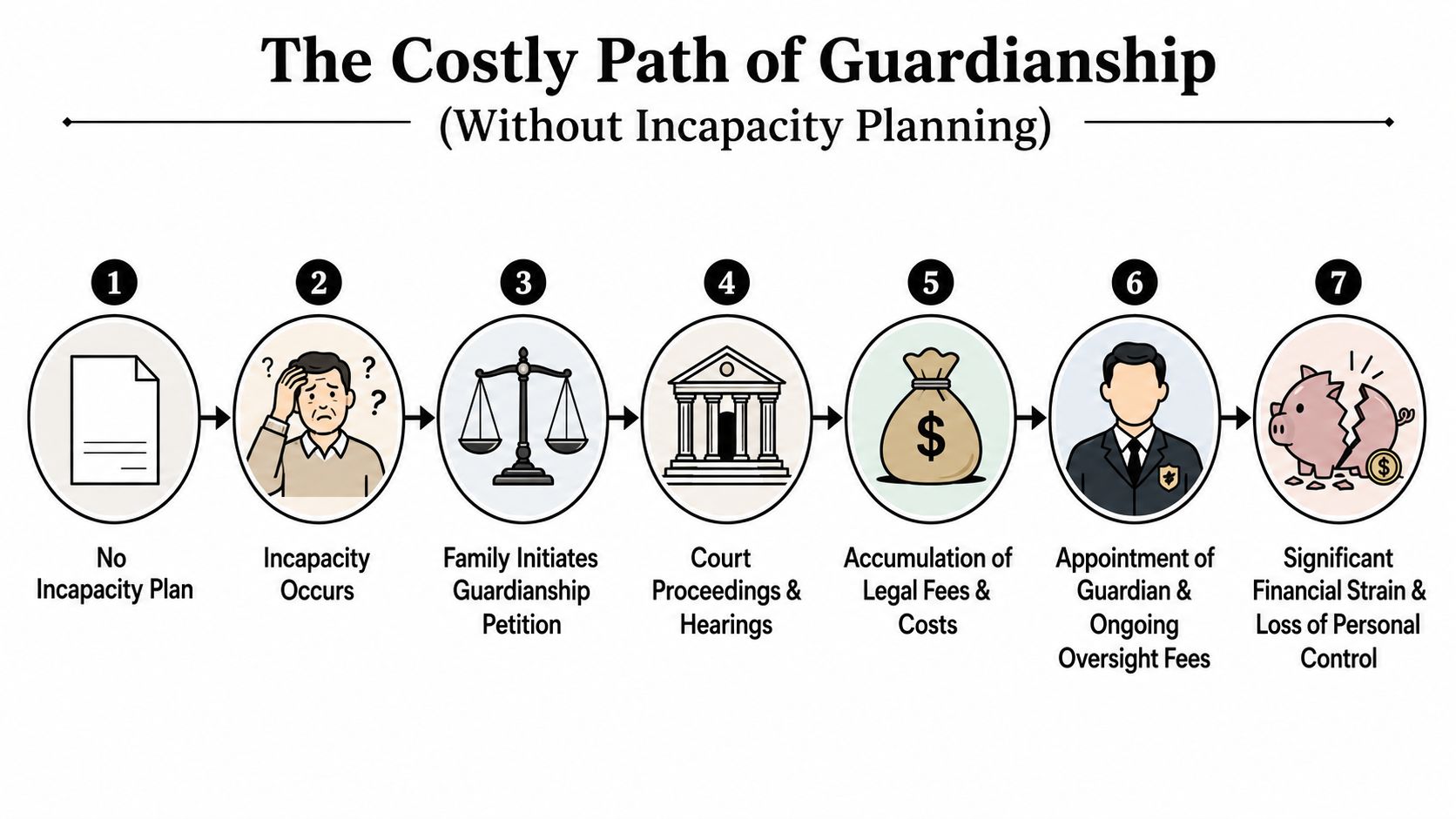
If a parent never signed a durable power of attorney, medical directives, or a well-structured trust while they had capacity, the family may have to ask a court for authority. Under Texas Estates Code Title 3, Subtitle G, that can involve an application, notice to interested persons, medical evidence, a hearing, and a court order. The court may also require ongoing duties after appointment.
What families often face in a Texas guardianship case
In practical terms, a guardianship matter may involve:
- Court filings: The process begins with a formal application in the proper court, such as Harris County Probate Court.
- Capacity evidence: Families often need a physician's evaluation or other evidence showing the person cannot manage personal or financial matters safely.
- Hearing preparation: The court must review whether guardianship is necessary and whether a less restrictive alternative would work.
- Post-appointment duties: Guardians may have to file reports, accountings, or other updates, depending on the type of guardianship.
Texas courts don't treat guardianship lightly. They are balancing safety with personal liberty. That's why the law requires procedure, proof, and continued compliance.
Guardianship can be necessary and protective. It can also be public, court-supervised, and more demanding than families expect.
Before, during, and after the hearing
Before a hearing, families should gather medical records, identify possible alternatives, make a list of assets and risks, and think carefully about who should serve. During the case, they should respond quickly to requests from the court and attorney, attend hearings, and stay focused on the proposed ward's best interests. After appointment, they need to follow the court's rules, keep records, and meet reporting deadlines.
Emergency or temporary guardianship can arise when immediate harm is possible. Those cases move fast and can feel overwhelming. Disputes also happen. One sibling may think a guardianship is necessary, while another may argue for a less restrictive option. In either situation, preparation matters.
If you'd like a more focused discussion of court-related expenses, the guide on how much guardianship can cost in Texas can help you understand where families often encounter added expense.
Families should also remember that guardianship isn't the only path. Depending on timing and capacity, alternatives may include powers of attorney, supported decision-making, or trust-based planning. The best option depends on the person's condition, the urgency, and whether valid documents can still be signed.
Texas Cost Scenarios From Simple Wills to Complex Trusts
Numbers make more sense when they show up in real family situations. These examples are hypothetical, but they reflect the kinds of Texas decisions families face every week.

Sarah in Dallas
Sarah is single, works in Dallas, owns a car, has savings, and wants someone she trusts to handle medical and financial matters if she's ever incapacitated. She doesn't need a complex trust. She needs a clean, well-drafted foundation.
Her likely planning focus is a will-based package. Based on the median package data discussed earlier, a reasonable starting point for this kind of plan is around the level of a will package at $1,000 median. If her circumstances stay simple, her estate planning attorney cost may remain relatively modest.
The most important lesson in Sarah's case isn't the price. It's timing. If she signs incapacity documents now, her family may avoid far more difficult court involvement later.
The Garcia family in Houston
The Garcias live in Houston, have minor children, own a home, and want to make sure money is managed responsibly if something happens to both parents. They also want to nominate who would care for their children and who would manage inherited property.
Many families move from a basic will to a trust-centered plan. Their likely range is closer to a trust-based package, often within the broader $2,000 to $5,000 range for trust-based planning already covered above. If they want to better understand how trusts work in this context, this overview of living trusts in Texas is a useful starting point.
A family like the Garcias may also think beyond legal drafting. If they're worried about future care expenses for parents or long-term planning needs, educational resources such as My Policy Quote insurance can help them think through the broader financial side of aging and incapacity.
David in Austin
David's mother in Austin never signed powers of attorney. Her memory has declined, bills are unpaid, and family members disagree about what to do. David isn't really shopping for a routine estate plan anymore. He's looking at possible guardianship.
His cost picture is different from Sarah's or the Garcias'. It may include attorney time for emergency evaluation, application preparation, hearings, and post-appointment duties. It may also involve disputes if relatives disagree. That doesn't mean guardianship is the wrong choice. It means the legal work is broader and more court-driven than a standard planning package.
The most expensive estate plan is often the one a family meant to finish but never signed.
These examples show why one online number rarely tells the full story. Your cost depends on whether you're planning ahead, protecting children, managing complexity, or stepping into court after a crisis has already started.
Smart Strategies to Manage Your Legal Budget
Families often feel better once they move from worry to preparation. You can't control every legal issue, but you can make your first meeting far more efficient.
What to gather before the consultation
Bring the basics first, not every paper in your house.
- Asset list: Include homes, bank accounts, investment accounts, business interests, and major personal property.
- Family information: Write down legal names, relationships, and anyone you want to name as beneficiary, executor, trustee, or possible guardian.
- Existing documents: Bring old wills, trusts, powers of attorney, deeds, or court orders if they exist.
- Health and capacity concerns: If the issue involves an aging parent or adult child, note practical concerns like missed bills, unsafe driving, or memory problems.
Questions worth asking the attorney
A good consultation should leave you calmer, not more confused. Consider asking:
- Do you charge a flat fee or hourly rate for my situation?
- What documents or services are included in that fee?
- If guardianship becomes necessary, how does the billing change?
- What does the Texas court process usually require in my type of case?
- What can I do now to reduce future court involvement?
- Who will handle communication with me during the case or planning process?
If you're comparing lawyers, a resource on how to choose an estate planning attorney can help you ask sharper questions and spot whether the fit feels right.
One final budgeting tip matters more than people expect. Be honest in the first meeting. If there are sibling conflicts, possible incapacity, past marriages, or a child with special needs, say so early. Hidden complexity usually becomes expensive complexity.
Your Next Steps and Frequently Asked Questions
Estate planning attorney cost is really about two things. First, what documents your family needs. Second, whether you're planning early enough to avoid a crisis-driven court process. For many Texas families, paying for a solid plan now is an act of protection. It can preserve dignity, reduce conflict, and give loved ones clear authority when it matters most.
That matters even more when guardianship is part of the picture. Some jurisdictions see probate attorney fees average between 1% and 7% of the estate value, illustrating how percentage-based fees can arise in court processes if a plan isn't properly structured, as explained in this discussion of probate fee mechanics in North Carolina. Texas cases differ, but the practical lesson is the same. Clarify the fee structure up front.
Common questions families ask
Is a DIY online will good enough?
Sometimes a simple form may cover a simple situation. But if your family has children, blended-family concerns, disability planning, trust goals, or possible incapacity issues, a generic form can miss important protections.
Can guardianship be avoided?
Sometimes, yes. Powers of attorney, trusts, and other less restrictive tools may help if the person still has capacity to sign. Once capacity is lost, court involvement may become necessary.
What happens after a guardianship hearing?
If the court appoints a guardian, the work doesn't end there. Guardians often have ongoing duties, reporting obligations, and fiduciary responsibilities under Texas law.
What if I'm also trying to understand executor responsibilities after a death?
Practical education helps. Families often benefit from outside guides such as DIYAuctions resources for executors, especially when they're trying to understand the settlement process alongside probate or guardianship issues.
If your family is weighing wills, trusts, incapacity planning, or guardianship in Texas, personal advice makes a real difference.
The attorneys at Law Office of Bryan Fagan, PLLC help Texas families with guardianship, probate, and estate planning issues across Houston, Dallas, Austin, San Antonio, and statewide through virtual consultations. If you're worried about a parent, planning for children, facing a guardianship hearing, or trying to avoid one, schedule a free consultation to get guidance specific to your family, your county, and your next step.