Skip to content
When a person passes away, "probate" is the legal process of officially proving their will is valid and then carrying out its instructions. It’s the court-supervised path for making sure the deceased person's debts are settled and their property is legally transferred to the people they named in their will. We understand that this is an emotional and challenging time for your family, and our goal is to provide a clear, compassionate guide to help you navigate this process.
Your Compassionate Guide to Navigating Texas Probate

Losing a loved one is one of life's most difficult experiences. The last thing you want to deal with while grieving is a mountain of confusing legal paperwork. At The Law Office of Bryan Fagan, we get it. We know the emotional and financial weight your family is shouldering, and this guide is our way of offering a helping hand.
Think of this as a clear, straightforward roadmap. Our goal is to demystify the legal jargon and give you the practical knowledge you need to handle this process with confidence, empowering you with understanding and direction.
What is Probate and Why is it Necessary
So, what exactly is probate? At its core, probate is the legal process that gives an executor the official authority to manage a deceased person's estate. Without going through probate, bank accounts can stay frozen, real estate can't be sold, and beneficiaries have no legal standing to receive their inheritance.
The whole procedure is laid out in the Texas Estates Code and serves a few vital purposes:
- Validates the Will: The court officially confirms that the will is the deceased's true and final testament.
- Appoints an Executor: The person named in the will is formally appointed by the court and receives "Letters Testamentary"—the legal document proving they have the authority to act for the estate.
- Protects Creditors and Beneficiaries: It creates an orderly system to ensure legitimate debts are paid before the remaining assets are handed over to the heirs.
- Resolves Disputes: If someone challenges the will or beneficiaries disagree, the court provides a formal setting to sort things out.
Gathering all the financial records, the original will, and other essential estate planning documents from the start can make this entire process run much more smoothly.
The Two Main Paths of Texas Probate
In Texas, probate isn't a one-size-fits-all process. It generally follows one of two tracks: independent administration or dependent administration. This is a critical distinction your family needs to understand right away.
Most well-drafted Texas wills specifically request independent administration. This is the preferred, streamlined path. It allows the executor to handle most of the estate’s business—like paying bills, selling assets, and distributing property—without having to run back to the judge for permission every time. This saves a huge amount of time, money, and hassle.
On the other hand, dependent administration is much more restrictive. The executor must get court approval for nearly every single action. It's a slow, cumbersome, and expensive process that is typically only used when there's no will or if the will doesn't specify independent administration. Knowing which path you're on will set the right expectations for the road ahead.
The First Moves: Filing the Will and Meeting Deadlines
Taking that first step after a loved one’s passing often feels the most overwhelming. We get it. You're carrying a heavy emotional weight, and our goal here is to give you a clear, practical plan to get the Texas probate process started.
The journey kicks off by filing an Application for Probate. This is a formal request submitted to the right court, which is almost always in the Texas county where your loved one had their permanent home. Whether that's a massive metroplex like Harris County or Dallas County or a smaller rural one—jurisdiction follows their primary residence.
The Critical Four-Year Deadline
If there's one rule you absolutely cannot ignore in Texas probate, it's this one: a strict timeline. The Texas Estates Code gives you just four years from the date of death to file a will for probate. Miss that window, and the will is likely to be rejected. The court will then probably treat the estate as if no will ever existed at all.
Hypothetical Scenario: What Happens When You Wait Too Long?
Picture a family in Austin. After their father passes away, his three adult children are grieving and decide to put off dealing with the will. Five years go by. When they finally try to sell his house, they hit a brick wall—they can't legally transfer the title. They attempt to probate the will, but the Travis County court denies their application because the four-year deadline has passed. Now, the house has to be divided according to Texas's intestate succession laws, which might not be what their father wanted and could easily spark family fights and expensive legal battles.
This scenario is all too common, and it’s a powerful reminder of why acting quickly is so important. While there are a few very narrow exceptions for filing late, proving you weren't "in default" is an uphill battle that rarely succeeds.
Gathering Your Essential Documents
Before you or your attorney can even file the application, you'll need to pull together a few key documents. Having these ready from the get-go will make the initial steps feel much more manageable. Think of it like getting all your ingredients prepped before you start cooking—it saves a lot of time and frustration later.
Here’s a practical checklist of what you'll need right at the start:
- The Original Will: The court needs the actual, signed document, not a copy. If the original is lost, the process gets a whole lot more complicated.
- A Certified Death Certificate: This is the official proof of death. You can order it from the Texas Bureau of Vital Statistics or the county clerk where the death occurred.
- The Application for Probate: This is the legal document that contains all the necessary information about the deceased, the will, the beneficiaries, and who is proposed to be the executor. Your attorney will handle preparing this for you.
For estates that are very straightforward with minimal assets and no debts, you might have simpler options. For example, it could be worth looking into the requirements for a small estate affidavit in Texas to see if you qualify.
The First Hearing and Letters Testamentary
Once the application is filed, the county clerk will post a notice at the courthouse. This starts a mandatory waiting period of about two weeks, after which the court will schedule the first hearing. This is usually a short, formal proceeding, not a dramatic courtroom showdown.
The judge’s main job during this hearing is to legally validate the will and officially appoint the executor named in it. You will likely be asked to give brief testimony to confirm the facts laid out in the application.
If everything is in order, the judge signs an order admitting the will to probate. Soon after, the court issues a critical document called Letters Testamentary. This is the official certificate that gives the executor the legal power to act for the estate—things like accessing bank accounts, talking to creditors, and managing property. It’s the key that unlocks your ability to carry out your loved one's final wishes.
The Executor's Playbook: Fulfilling Your Duties with Confidence
Once a Texas court officially names you the executor and issues Letters Testamentary, your role undergoes a fundamental shift. You're no longer just a loved one; you are now a fiduciary. It's a legal term with real weight—it means you have a profound duty to act solely in the best interests of the estate and its beneficiaries.
While it's a significant responsibility, it doesn't have to be overwhelming. Think of this as your practical guide to navigating the core duties of an executor with both confidence and care.
The First 90 Days: Your Most Critical Window
The period right after your appointment is by far the most intense. The Texas Estates Code is very clear on one of your first major deadlines: you have just 90 days from the date you're appointed to file a complete inventory of the estate's assets with the court. This isn't a flexible guideline; it's a hard legal requirement.
This crucial document is formally called the "Inventory, Appraisement, and List of Claims." It’s essentially a detailed snapshot of every single thing the deceased owned at the time of their passing, along with any money that was owed to them.
A Houston Family's Real-World Example
Take Sarah, whose mother recently passed away in Houston. After the Harris County Probate Court appointed her as executor, her first big job was this inventory. She methodically went through her mother's life—listing the house, the car, the checking account balance, a modest stock portfolio, and even some valuable jewelry. For items like the house and jewelry, she hired professional appraisers to get accurate values. By filing this comprehensive list well within the 90-day window, Sarah fulfilled a key legal obligation and built a solid foundation for the rest of the probate process.
Notifying and Communicating with Heirs and Creditors
One of your earliest tasks is to formally notify every beneficiary named in the will. This is usually as simple as mailing them a copy of the will itself, along with the court order that admitted it to probate. Keeping everyone in the loop with this simple act of communication can head off a world of misunderstandings and potential disputes down the line.
At the same time, you have to let potential creditors know what's happening. The standard way to do this is by publishing a notice in a local newspaper. This public announcement gives anyone the deceased owed money a specific window to come forward and make a formal claim against the estate. It’s a vital step to ensure all legitimate debts are identified and settled before any property is distributed.
This flowchart gives you a simplified look at the path from filing the will to getting the green light to act as executor.
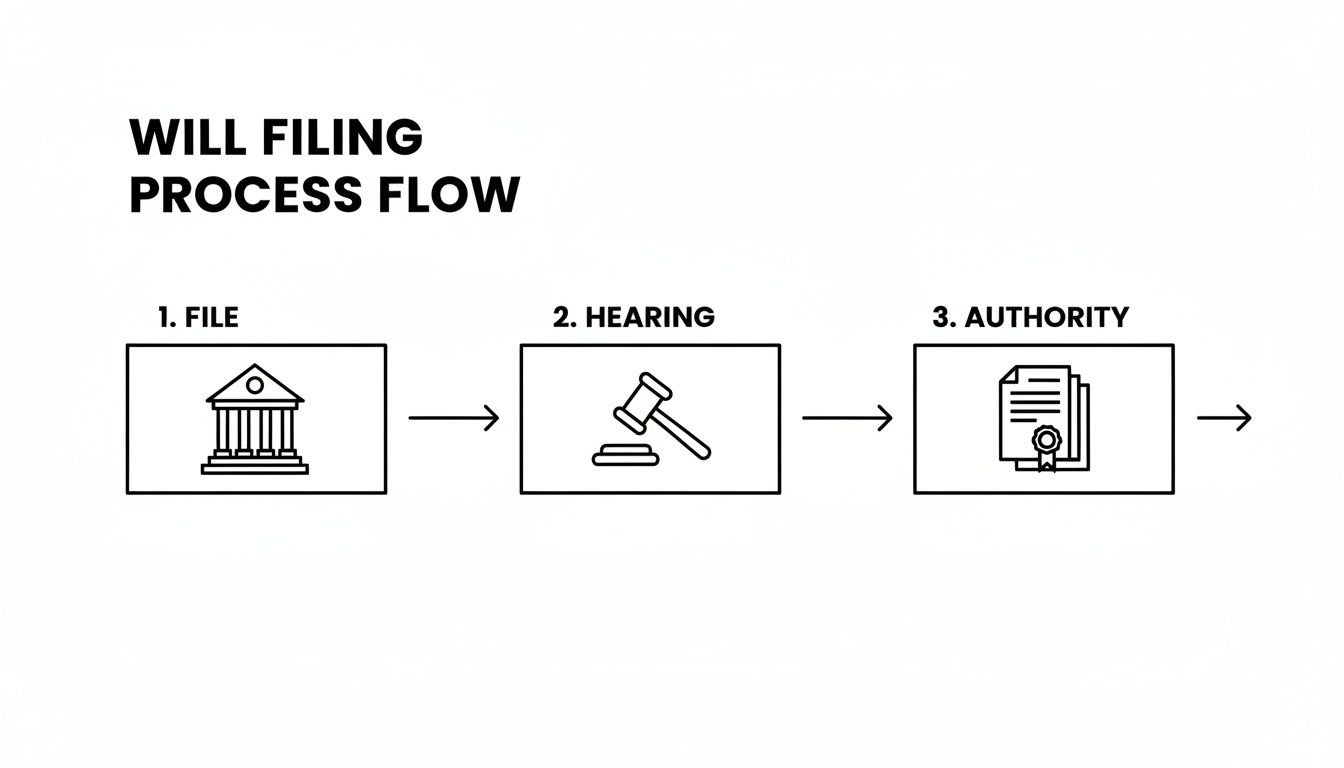
As you can see, getting those Letters Testamentary is the key that unlocks your ability to manage all the other duties of the estate.
Marshalling Assets and Settling Debts
"Marshalling assets" is just the legal term for gathering and taking control of all the estate's property. This is a hands-on job where organization and a sharp eye for detail are your best friends.
Here’s what this phase typically involves:
- Securing Property: This means practical steps like changing the locks on the deceased’s home, making sure vehicles are safely parked or stored, and gathering all the important financial and personal papers.
- Consolidating Finances: You’ll need to open a brand-new bank account specifically for the estate. All cash from the deceased's personal accounts gets moved here, and every single estate expense—from utility bills to appraisal fees—must be paid from this account.
- Paying Valid Claims: After creditors submit their claims, your job is to review them and pay the legitimate debts using funds from the estate account.
Staying on top of all the paperwork can feel like a full-time job. Exploring effective document management strategies can make a world of difference. Remember, keeping meticulous records of every transaction isn’t just good practice—it's a legal requirement that protects you from personal liability.
To keep you on track, here's a quick look at the major deadlines you'll need to hit.
Key Executor Deadlines in Texas Probate
Meeting these timelines is essential for keeping the probate process moving forward smoothly. Missing them can cause unnecessary delays and complications with the court.
| Task | Deadline After Executor is Appointed | Texas Estates Code Reference (Example) |
|---|---|---|
| Notice to Beneficiaries | Within 60 days | § 308.002 |
| Notice to Creditors | Within 1 month (for publication) | § 308.051 |
| Inventory & Appraisement | Within 90 days | § 309.051 |
Always double-check these timelines with your attorney, as the specifics of your case might introduce other important dates you need to be aware of.
Final Tax Returns and Estate Closure
Finally, you’re responsible for filing the deceased’s final personal income tax return. If the estate itself generated any income during the probate process—for instance, from the sale of a property or interest earned on bank accounts—an estate income tax return (Form 1041) might also be necessary.
Only after every box has been checked—assets gathered, notices sent, debts paid, and taxes filed—can you finally distribute the remaining property to the beneficiaries according to the will. Performing these executor duties diligently ensures you honor your loved one's final wishes properly and legally.
For a deeper dive into the full spectrum of an executor's responsibilities, check out our comprehensive guide on the duties of a will executor in Texas.
What to Expect in Probate Court and How to Handle Delays
The thought of going to court can be daunting, but knowing what you're walking into can take a lot of the stress out of the process. Let's pull back the curtain on how Texas probate courts work and, more importantly, how to prepare for the delays that can pop up.
For a lot of families, the biggest surprise is just how slowly things can move. This is especially true in Texas's biggest cities, where the probate courts are juggling a massive number of cases every single day.
Navigating Court Backlogs in Major Texas Counties
It’s an unfortunate but true fact of life: courts in heavily populated areas often have serious backlogs. The Harris County probate court backlog is a perfect example, hitting families hard as caseloads continue to climb. As the state’s most populous county, Houston and its sprawling suburbs—from Katy all the way to The Woodlands—are seeing a flood of filings that the courts struggle to keep up with.
What this means for your family is that executors and heirs are often left waiting longer than they’d like for hearings, for the judge to issue Letters Testamentary, or for the final green light to close out the estate. You can get more insights into how these backlogs impact Texas families on mcmfirm.com.
And this isn't just a Houston problem. The probate courts in Dallas, Tarrant (Fort Worth), and Travis (Austin) counties are all feeling similar pressure.
The absolute best way to handle potential court delays is to be perfectly prepared. Your paperwork has to be filed correctly and on time, every time. Even a tiny mistake can get your case kicked to the back of the line, easily adding weeks or months to your probate timeline.
Independent vs. Dependent Administration: A Critical Difference
This is where the way your loved one’s will was written becomes incredibly important. A properly drafted Texas will almost always calls for independent administration, a process specifically designed to keep court involvement to a minimum.
Under an independent administration, once the executor is officially appointed and the estate inventory is filed, they can pretty much handle the estate's business without constantly asking the judge for permission. This includes:
- Paying off legitimate debts and estate expenses.
- Selling property, whether it's a house or a car.
- Distributing the remaining assets to the beneficiaries listed in the will.
This freedom is a game-changer. It lets the executor work efficiently and saves the family a ton of time and money that would otherwise be spent on court appearances and legal fees.
On the flip side, dependent administration is what you get when a will doesn't specify independent administration, or when there's no will at all. It's a much slower, more frustrating, and more expensive process. The executor (called an "administrator" in this case) has to get the judge's approval for nearly every single action—from paying the electric bill to selling a vehicle. Every step means more motions, more hearings, and more costs, dragging the whole process out.
Preparing for Your Day in Court
Even with a streamlined independent administration, you'll still have at least one initial hearing to attend. Being ready for it will make it a quick and painless event.
Your attorney will take care of all the legal filings, but as the person nominated to be the executor, you'll probably have to give some brief testimony. The judge will likely ask you a few simple questions just to confirm what's in the application, such as:
- Confirming the name and date of death of the person who passed away.
- Verifying that they lived in that specific county.
- Stating that, to the best of your knowledge, the will being presented is their final, valid will.
Having your paperwork in perfect order isn't just a suggestion—it's essential. Any mistakes or missing documents can lead the court to reject your application. You'll have to fix the problem and get back in line for another hearing which, thanks to those court backlogs, could set you back significantly.
Our team at The Law Office of Bryan Fagan is here to guide you through every step of the Probate process. If you have questions about what to expect in court or need help getting your case started, schedule a free consultation with us today.
Simpler Alternatives to Traditional Probate in Texas

Does every single estate have to go through a full, formal probate process? Many Texas families are relieved to learn the answer is no. For straightforward estates, the law provides simpler, faster, and more affordable paths that can be a true lifesaver during a difficult time.
These alternatives are designed to avoid the time and expense of appointing an executor and the detailed court supervision that follows. Knowing about these options can help you have a more productive conversation with your attorney about the most efficient route for your family's unique situation.
Using a Muniment of Title for Clear Ownership
One of the most valuable alternatives in Texas is probating a will as a Muniment of Title. This is a special legal process that essentially proves the validity of a will and records it in the public record to officially transfer ownership of property.
Think of it as a shortcut. Instead of a full probate where an executor is appointed to manage the estate, a Muniment of Title serves as a legal bridge, moving assets directly from the deceased person to the beneficiaries named in the will. It's particularly useful for transferring real estate.
To qualify for this streamlined process, the estate must meet one key condition:
- No Unsecured Debts: The deceased must not have had any debts other than those secured by real estate, like a home mortgage.
If the estate qualifies, the court validates the will and issues an order recognizing it as the official document transferring title. This court order acts like a new deed, giving beneficiaries clear and legal ownership of the property without the hassle of a full administration.
The Small Estate Affidavit for Modest Estates
What if the estate is relatively small and there isn't even a will? For these situations, Texas law offers the Small Estate Affidavit (SEA). This tool allows heirs to collect a deceased person’s property without ever stepping into a formal probate courtroom.
This option is available only if the estate's value is $75,000 or less, not including the value of the homestead (the primary residence) and other exempt property. Just as importantly, the estate’s assets must be greater than its known debts.
Hypothetical Scenario: Quick Access for a Grieving Family
Imagine a widower in San Antonio passes away, leaving behind a checking account with $15,000 and his paid-for home. His adult children need to access the bank account to pay for funeral expenses. Since the estate is well under the $75,000 limit and has no debt, they can file a Small Estate Affidavit with the Bexar County court. Once a judge approves it, they can take the signed court order directly to the bank to close the account and access the funds, bypassing the lengthy probate process entirely.
Comparing Your Options
Choosing the right path forward is a critical decision. To help you understand the best path for your family's situation, this table breaks down the key differences between traditional probate and these simpler alternatives.
Probate vs. Alternatives in Texas
| Feature | Traditional Probate | Muniment of Title | Small Estate Affidavit |
|---|---|---|---|
| Primary Use | Estates with debts or complex assets. | Transferring property when there are no unsecured debts. | Small estates (under $75,000) with no will. |
| Executor Needed? | Yes, the court appoints an executor. | No, an executor is not appointed. | No, an executor is not appointed. |
| Will Required? | Yes, a will is required. | Yes, a valid will is necessary. | No, used when there is no will. |
| Court Oversight | Can be significant, especially in dependent administration. | Minimal, just one hearing to approve. | Minimal, just one hearing to approve. |
As you can see, these alternatives are powerful tools, but they aren't the right fit for every situation.
It's also worth noting that proactive estate planning can create even easier paths for asset transfer. For instance, understanding how a Texas Lady Bird Deed can transfer property outside of probate is another valuable piece of the puzzle.
Discussing these options with an experienced probate attorney is the best way to determine the most compassionate and efficient path for your family. A consultation can provide the clarity and direction you need.
Answering Your Top Texas Probate Questions
When a loved one passes away, you're suddenly faced with a legal process that feels overwhelming and confusing. It's completely normal. The questions start piling up about probating a will in Texas—how much will it cost, how long is this going to take, and what exactly are the rules?
We hear these same questions from families every day. Let's walk through them one by one to replace some of that uncertainty with clear, straightforward answers.
How Much Does it Cost to Probate a Will in Texas?
This is usually the first thing people ask, and for good reason. Unfortunately, there's no single price tag for probate in Texas; the cost really depends on the complexity of the estate and the type of probate you're dealing with.
Here’s a breakdown of the typical expenses:
- Court Filing Fees: This is a fixed cost to get the case started with the county clerk. You can expect this to be a few hundred dollars.
- Attorney's Fees: This is the biggest variable. For a simple, uncontested case, some attorneys charge a flat fee. For more complicated situations, they'll likely bill by the hour. An independent administration will always be cheaper than a dependent administration because it requires far less court involvement.
- Executor Fees: The person named as executor is legally entitled to compensation, which is usually a percentage of the estate's value. However, it's very common for a family member serving as executor to waive this fee.
- Other Costs: Think of things like the fee to publish a notice to creditors in a local newspaper, appraisal fees for property, and even postage for sending out required legal notices.
For a straightforward estate with no family disputes, the costs can be quite manageable. But if someone contests the will or the assets are complex, you can expect the costs to climb.
How Long Does the Texas Probate Process Take?
Patience is key here. The timeline for probating a will in Texas is rarely quick and depends entirely on the estate's specifics.
For a smooth independent administration where everyone is in agreement, you can generally expect the process to take anywhere from six to twelve months. That timeline accounts for the initial court hearing, the 90-day deadline to file the estate inventory, the mandatory notice period for creditors to make claims, and the final distribution of assets.
But a few things can really slow the process down:
- Dependent Administration: If the court has to supervise every single step, the timeline can easily stretch to over a year, sometimes much longer.
- Will Contests: If a disgruntled heir challenges the will's validity, the resulting court battle can add months, or even years, to the process.
- Complex Assets: An estate with a family business, multiple real estate properties, or tricky investments just takes more time to value and manage correctly.
- Court Delays: Let’s be realistic—courts in major counties like Harris or Dallas are incredibly busy. Just getting an initial hearing date on the docket can sometimes take a while.
We always tell families to set their expectations for a process that will take several months at a bare minimum. Knowing that from the start helps manage the stress and frustration that can come with unavoidable delays.
Do I Need an Attorney to Probate a Will?
You might be tempted to handle probate yourself—what's known as "pro se"—to save on legal fees. However, in Texas, the courts almost always require you to hire an attorney for formal probate.
The reason is simple but critical: as an executor, you aren't just representing yourself. You're a fiduciary, responsible for protecting the interests of all the beneficiaries and the estate's creditors. Because you're acting on behalf of others, the court needs assurance that a licensed attorney is guiding the process to prevent costly mistakes and protect everyone involved.
The Bexar County Probate Court puts it plainly: your attorney represents you in your official role as executor and helps you meet your legal duties to everyone else. Trying to navigate the Texas Estates Code alone can lead to serious errors, personal liability, and major delays.
What Happens If Someone Dies Without a Will?
When someone passes away without a will, it's known as dying "intestate." This is where a lot of misconceptions pop up. The state of Texas doesn't just swoop in and take all the property—that only happens in the extremely rare case that a person has zero living relatives.
Instead, the Texas Estates Code has a strict, predetermined formula for how the assets are divided among the deceased's closest family members. For example:
- Married with children: The spouse and children will split the community and separate property according to a specific, and often surprisingly complex, set of rules.
- Single with children: The children inherit everything, split equally among them.
- Single with no children: The estate will typically go to their surviving parents. If the parents are no longer living, it passes to their siblings.
The problem is, this rigid formula might be the exact opposite of what your loved one would have wanted. This is why having a will is such a foundational part of any good Estate Planning strategy—it’s the only way to ensure your wishes are the ones that are followed.
The journey of probating a will in Texas can feel complex, but you don't have to walk it alone. At The Law Office of Bryan Fagan, PLLC, our experienced attorneys are here to provide the clear, compassionate, and professional guidance your family deserves. We can answer your specific questions, help you understand your options, and manage the legal details so you can focus on healing.
For personalized support, schedule a free, no-obligation consultation with our team today. Visit us at https://texasguardianshiplawyer.net to get started.