Skip to content
When you're putting a plan in place for the future, the main difference between a Durable Power of Attorney and a Medical Power of Attorney boils down to one simple thing: one handles your money, and the other handles your health. We understand that thinking about these topics can be overwhelming, but taking these steps is an act of love for your family.
A Durable Power of Attorney lets a trusted person manage your financial and legal affairs if you can't. A Medical Power of Attorney, on the other hand, gives someone the power to make healthcare decisions for you.
Understanding Your Key Planning Documents

Planning for a time when you might not be able to speak for yourself is one of the kindest things you can do for your family. It protects your wishes and saves your loved ones from the stress and emotional hardship of guessing what you would have wanted.
In Texas, these two documents are the cornerstones of that protection. Without them, your family might be forced into a public, expensive, and emotionally draining court process to get a guardianship—an alternative we strive to help families avoid.
These documents are not interchangeable—they cover completely separate, but equally critical, areas of your life. The person you name to handle your healthcare can't use that authority to access your bank account. Likewise, the person managing your finances has no say in your medical treatments.
Why Texas Families Need Both Documents
Imagine this hypothetical scenario: a parent in Harris County has a sudden stroke. Without a Medical Power of Attorney, their adult children might argue over treatment options, creating conflict and confusion for the medical team. At the same time, if there's no Durable Power of Attorney, bills could pile up and bank accounts could be frozen, causing a financial crisis on top of the medical one. This is a situation no family should have to face.
This is why these documents are designed to work in tandem, creating a complete safety net:
- The Medical Power of Attorney ensures your healthcare wishes are honored.
- The Durable Power of Attorney keeps your financial life running smoothly.
Together, they are a fundamental part of any solid Estate Planning strategy. More people are catching on to the importance of planning ahead. In fact, about 45% of American adults over 55 now have a durable power of attorney for their finances. This shows a growing awareness of the need to protect assets and decision-making power. You can learn more about what a power of attorney is from the National Council on Aging.
Quick Comparison Durable Power of Attorney vs Medical Power of Attorney
To get a clear picture of how these documents differ, here’s a quick side-by-side look at their core functions, what they cover, and when they kick in here in Texas.
| Feature | Durable Power of Attorney (Financial) | Medical Power of Attorney (Healthcare) |
|---|---|---|
| Primary Purpose | To manage financial and legal matters, like property, investments, and banking. | To make healthcare and medical treatment decisions. |
| Scope of Decisions | Paying bills, managing real estate, filing taxes, accessing bank accounts. | Consenting to surgery, choosing doctors, accessing medical records, end-of-life care. |
| Effective Date | Can be effective immediately upon signing or "spring" into effect upon your incapacity. | Only becomes effective after a physician certifies that you're unable to make your own medical decisions. |
Knowing these key differences is the first step in creating a plan that truly protects you and empowers your family. If you have questions about getting these critical documents in place, our team is here to offer clear, compassionate advice. We invite you to schedule a free consultation to talk about your family's unique situation.
Comparing Powers and Agent Responsibilities
While both a Durable Power of Attorney and a Medical Power of Attorney put a trusted person in charge, the powers they grant are entirely separate. This is a critical distinction to grasp: the person you choose to handle your finances has zero legal say in your medical care, and the person making healthcare choices can't touch your bank accounts.
Think of it this way: one document manages the business of your life, while the other protects the integrity of your body and health.
The Role of a Durable Power of Attorney Agent
Under the Texas Estates Code, the agent you name in a Durable Power of Attorney gets the authority to manage your financial and property matters. This person legally becomes your fiduciary, which is a formal way of saying they have a duty to act in your best interest, handle your money wisely, and steer clear of any conflicts of interest. Their responsibilities are broad and can be tailored to your specific needs right in the document.
Common powers include:
- Banking Transactions: Opening or closing accounts, paying your bills from your funds, and managing deposits.
- Real Estate Management: Buying, selling, or leasing property on your behalf, as spelled out in the Texas Estates Code, Title 3, Subtitle G.
- Investment Decisions: Overseeing stocks, bonds, and retirement accounts to keep your financial situation stable.
- Government Benefits: Applying for and managing benefits like Social Security, Medicare, or VA benefits.
- Tax Matters: Filing your income tax returns and dealing with the IRS for you.
Your financial agent essentially steps into your shoes, making sure your bills get paid and your assets are safe if you can't manage them yourself.
The Role of a Medical Power of Attorney Agent
On the other side of the coin, the agent you appoint in a Medical Power of Attorney has absolutely no power over your money. Their role is strictly limited to healthcare decisions, and they can only step in after a doctor has certified that you are incapacitated and unable to make these choices for yourself.
Their duties are deeply personal and require someone who truly understands your values and what you would want:
- Consent to Treatment: Approving or refusing medical procedures, from routine surgeries to complex treatments.
- Choosing Providers: Selecting or even firing doctors, specialists, and care facilities.
- Accessing Medical Records: The right to review your health information to make well-informed decisions.
- End-of-Life Choices: Making the tough calls about life support, resuscitation, and comfort care that align with your wishes.
The weight of this role is immense, yet it's shocking how many people haven't prepared for it. A 2021 study found that only about 36% of adults aged 65 and older had a medical power of attorney in place. This gap often throws families into crisis mode at the worst possible time. You can read the full study in the Journal of the American Medical Association for more details.
Critical Distinction: These two agents have to work together. Your medical agent might green-light a necessary surgery, but it's your financial agent who has to access your bank accounts to pay the hospital. This separation creates a vital system of checks and balances.
This partnership is fundamental. One agent honors your wishes for your physical well-being, while the other provides the financial means to make it happen. Both are essential for a complete Estate Planning strategy that gives you peace of mind and keeps the courts out of your personal affairs. If you're unsure how these roles would work for your family, we invite you to schedule a free consultation with our team.
When Each Document Kicks In: Timing is Everything in Texas
It's one thing to understand the difference between a durable and a medical power of attorney, but it’s just as critical to know when your agent can actually start making decisions for you. The activation "triggers" for these documents are not the same under Texas law, a distinction that has huge real-world consequences for your care and your finances.
Many families assume both documents spring into action at the same time. That’s not how it works. Texas law handles their effective dates very differently—giving you flexibility for financial matters while putting strict protections in place for your healthcare choices. This setup is designed to keep you in control for as long as possible while ensuring a safety net is ready when you need it.
The Flexible Timing of a Durable Power of Attorney
When it comes to your money and property, Texas law gives you a choice. A Durable Power of Attorney can be set up in one of two ways, and your decision determines exactly when your agent’s authority begins.
-
Immediate Power of Attorney: This document is effective the moment you sign it. Your agent gets the legal authority to act for you right away, even if you are perfectly healthy and capable. This is a common choice for convenience, allowing a trusted spouse or adult child to help manage finances or handle a real estate transaction when you're traveling or just need a hand.
-
Springing Power of Attorney: This version only “springs” into effect after a specific event happens—your incapacity. The document must spell out exactly what triggers it, which is usually a written declaration from one or more doctors stating that you can no longer manage your own financial affairs. This approach guarantees you keep sole control over your finances until it's medically necessary for someone else to step in.
A springing power of attorney provides a valuable layer of protection by delaying your agent's access to your finances. But it can also create delays in a crisis. Getting the required physician's certification takes time—time you might not have when bills are due or urgent financial decisions need to be made.
The Clear Trigger for a Medical Power of Attorney
Unlike the financial POA, the timing for a Medical Power of Attorney in Texas is rigid. It is always a springing document. Your agent has absolutely zero authority to make healthcare decisions for you as long as you can understand and communicate your own wishes.
The activation process is laid out clearly in the Texas Estates Code:
- Your attending physician must certify in writing that you are incompetent or otherwise unable to make your own medical decisions.
- This written certification must be filed in your medical record.
- Only after both of these steps are complete can your designated agent start making decisions on your behalf.
This strict requirement is a vital safeguard. It protects your right to bodily autonomy and ensures your voice is the most important one in your own healthcare for as long as possible. We cover this and other key topics in our guide to planning for incapacity with powers of attorney and advanced directives in Texas.
Think about it this way: a Fort Bend County resident with a gradual cognitive decline from Alzheimer's might have a springing Durable Power of Attorney that doesn't activate for years. Their Medical Power of Attorney, however, would only become effective once their doctor officially determines they can no longer consent to treatment. On the other hand, a sudden car accident in Harris County could trigger both documents almost at the same time.
Understanding these activation rules is essential for creating a plan that actually works when you need it most. If you're not sure which approach is right for your family, our compassionate attorneys can provide the clarity you need.
How to Choose the Right Agent for Each Role
Picking the person who will act on your behalf is easily the most important decision you'll make in this entire process. This isn't about choosing your favorite child or your closest sibling; it’s about hiring the right person for the right job. The skill sets needed for financial and medical agents are often worlds apart, and your choice here demands some careful, honest thought.
The person you trust with your finances needs to be organized, scrupulous, and completely trustworthy. On the other hand, the agent for your Medical Power of Attorney has to be level-headed in a crisis, a fierce advocate for your wishes, and someone who genuinely understands your values about life and health. These are distinct roles that call for different strengths.
Key Traits for a Durable Power of Attorney Agent
Your financial agent, sometimes called an agent-in-fact, will have the keys to your financial kingdom. Trust and integrity are the absolute baseline—they are non-negotiable. This person must be able to handle the nuts and bolts of paying bills on time, managing bank accounts, and keeping pristine records.
Look for someone who demonstrates:
- Financial Responsibility: Are they good with their own money? Do they have a track record of making smart financial choices?
- Organization and Attention to Detail: This role is swimming in paperwork, deadlines, and tracking funds. A detail-oriented person is far less likely to make a simple but costly mistake.
- Assertiveness: Your agent might need to deal with banks, insurance companies, or even government agencies for you. A little confidence and a clear voice go a long way.
Key Traits for a Medical Power of Attorney Agent
Your medical agent must be your champion in a healthcare setting, plain and simple. Their job is to make sure your wishes are heard and respected by doctors and nurses, even when it's tough. This requires a unique mix of compassion and backbone.
You'll want a candidate who is:
- Calm Under Pressure: Medical emergencies are chaotic and stressful. You need an agent who can think clearly and make rational decisions when the stakes are incredibly high.
- A Good Communicator: They have to listen to doctors, ask the hard questions, and then clearly explain your wishes to the medical team and other anxious family members.
- Respectful of Your Values: This is the big one. They must be willing to put their own feelings aside and make the decisions you would have made for yourself.
The most loving family member might be the one person who is emotionally incapable of making a difficult end-of-life decision. Be brutally realistic about who can handle the immense weight of honoring your wishes, especially when things get tough.
This decision tree helps visualize the critical difference in when each power of attorney kicks in, a key factor in your planning.
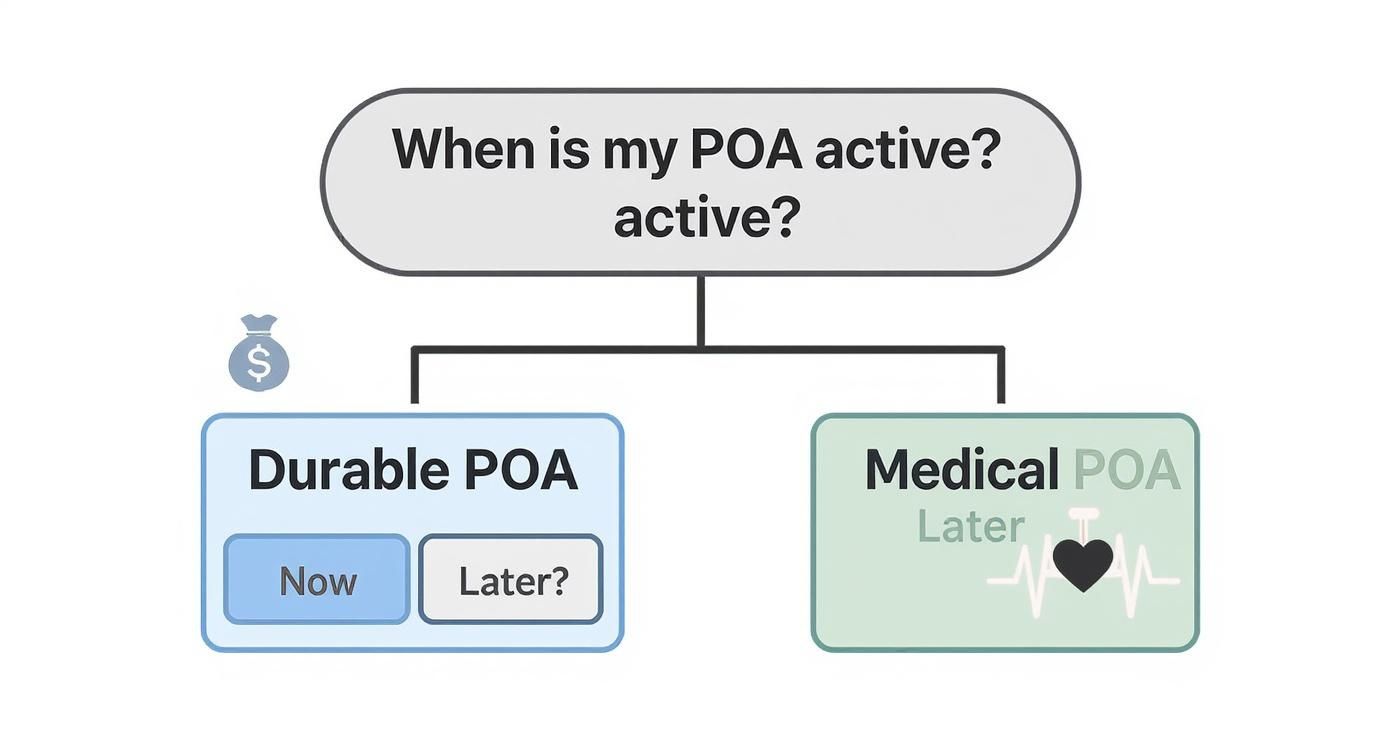
As the flowchart shows, you have some flexibility with when a financial POA becomes active, but a medical POA in Texas is strictly for situations where you can no longer speak for yourself.
To help you think through potential candidates, we've put together a checklist comparing the ideal traits for each role.
Agent Suitability Checklist: Key Traits for Each Role
This practical checklist is designed to help you evaluate potential candidates for your financial and medical agents, ensuring you select the most suitable person for each critical responsibility.
| Trait to Consider | Ideal for Durable (Financial) Agent | Ideal for Medical Agent |
|---|---|---|
| Financial Savvy | Essential. Must understand budgeting, bill payment, and basic financial management. | Not Required. Financial skill is irrelevant to their duties. |
| Emotional Fortitude | Helpful. Needs to be firm with institutions, but less emotionally taxing role. | Critical. Must remain calm and decisive during medical crises and family stress. |
| Communication Style | Direct & Assertive. Needs to communicate clearly with financial and legal professionals. | Empathetic & Advocate. Must listen to doctors and firmly advocate for your wishes. |
| Attention to Detail | Critical. Responsible for meticulous record-keeping, deadlines, and avoiding errors. | Important. Needs to understand medical details and treatment options accurately. |
| Geographic Proximity | Convenient. Can manage many tasks remotely, but being local helps with banking. | Highly Recommended. Being physically present for medical decisions is invaluable. |
| Personal Values | Trustworthiness is key. Their personal beliefs are less important than their integrity. | Must align with yours. Must be willing to honor your healthcare and end-of-life choices. |
Thinking through these traits should clarify who in your life is the best fit. It's often not the same person for both documents.
Should You Appoint the Same Person for Both Roles?
Naming one person for both roles can certainly simplify things, giving them a holistic view of your situation. However, it also concentrates an enormous amount of power in one individual's hands. Appointing two different people creates a natural system of checks and balances, but it absolutely requires that your agents can communicate and work together without drama. There's no single "right" answer—it all comes down to your family dynamics and the specific strengths of the people you're considering.
No matter who you choose, always name at least one alternate agent for each document. If your first choice can't or won't serve when the time comes, having a backup ensures your entire plan doesn't fall apart. This kind of proactive planning is common; a 2017 study found that nearly 65% of individuals aged 85 and older had a healthcare power of attorney. This shows a widespread understanding of how vital these documents are. You can learn more about these important findings on healthcare directives from the study itself.
Making these decisions can feel heavy, but you don't have to figure it all out alone. For personalized guidance on picking the best agents for your unique circumstances, schedule a free consultation with our compassionate legal team.
Avoiding Guardianship with Proactive Planning

One of the kindest and most powerful reasons to create a Durable Power of Attorney and a Medical Power of Attorney is to shield your family from the grueling process of guardianship. When you plan ahead, you’re not just organizing paperwork; you’re giving your loved ones the exact tools they need to care for you privately and efficiently. Without these documents in place, their only option might be a long and painful trip to the courthouse.
Guardianship is a formal legal process where a judge appoints someone to make decisions for a person who has been legally declared incapacitated. While it’s absolutely necessary in some situations, it's almost always the option of last resort. Thoughtful planning with powers of attorney keeps control where it belongs: in your hands and with the people you’ve personally chosen, not a judge.
The Hard Realities of the Guardianship Process in Texas
When someone becomes incapacitated without powers of attorney, their family is forced to petition a Texas probate court, whether in Harris County, Dallas County, or elsewhere, to establish a guardianship. This entire process, which is laid out in Title 3, Subtitle G of the Texas Estates Code, is designed to protect vulnerable people, but it comes with serious downsides that you can sidestep with good planning.
For starters, guardianship is a public affair. Every filing, hearing, and decision becomes part of the public record. This means sensitive family medical details and private financial information are laid bare for anyone to see, which can be deeply unsettling for a family already in crisis.
On top of that, the costs can be staggering. Families find themselves paying for:
- Court filing fees and other associated costs.
- The fees for their own attorney who files the application.
- The fees for an "attorney ad litem," who the court appoints to represent the proposed ward.
- Potentially, fees for a court-appointed investigator or medical examiner.
These expenses can pile up fast, placing a tremendous financial strain on a family when they're at their most emotionally vulnerable. Beyond the money, the process itself strips a person of their basic right to make their own choices.
Powers of Attorney: The Private and Empowering Alternative
This is where the true value of comparing a durable vs medical power of attorney really hits home. These documents are your personal instructions, created on your terms, spelling out exactly who should manage your affairs. They stand in stark contrast to the court-mandated structure of a guardianship.
By executing these documents, you stay in control. You are the one who decides who handles your finances and who makes your medical decisions—not a court. This ensures the people managing your life are the ones you trust implicitly and who truly understand your values and wishes.
The single greatest benefit of having powers of attorney in place is the preservation of dignity and autonomy. Guardianship, by its very design, involves a public declaration that you are incapable and a formal transfer of your rights to someone else. Powers of attorney, on the other hand, allow for a quiet, seamless transition of decision-making authority that honors the choices you made when you were well.
This approach saves your family from the emotional and financial wringer of court proceedings. There are no public hearings, no court battles over who should be in charge. Your chosen agents can step in the moment they're needed, ensuring your bills get paid and your medical care continues without a single hiccup. You can get more details on this subject in our guide covering the key differences between guardianship vs power of attorney.
Ultimately, planning ahead is an act of love for your family. It gives them a clear roadmap, heads off potential disputes, and spares them from an expensive and public court process. For help creating a plan that protects your legacy and keeps guardianship out of the picture, we invite you to schedule a free consultation with our compassionate team.
How to Create Your Texas Powers of Attorney
Knowing the difference between a durable and a medical power of attorney is a great first step. But the next move is what truly matters: creating legally sound documents that will actually work when you need them. Taking action is how you turn knowledge into real protection for yourself and your family.
In Texas, we have specific rules that dictate exactly how these documents must be drafted and signed to be considered valid.
Getting these details right isn’t just about checking off boxes on a form. It’s what ensures your wishes are honored and your chosen agents can step in without a fight. One small mistake in the signing process can invalidate the entire document, which could force your family into the very guardianship court you were trying to avoid.
Key Requirements for Texas Powers of Attorney
To create a valid power of attorney in Texas, you have to follow the legal requirements to the letter. While the documents serve different purposes, the way you sign and finalize them shares a few critical similarities.
- Must Be in Writing: Verbal agreements won't hold up in court. The power of attorney must be a physical, written document.
- Signed by the Principal: You, the person granting the authority, must personally sign the document. If you're physically unable to sign, you can direct another person to sign on your behalf, but it must be done in your presence.
- Properly Acknowledged: This is a big one. You must sign the document in front of a notary public. The notary's job is to verify your identity, witness your signature, and then apply their official seal.
For a Durable Power of Attorney, Texas law adds another layer of protection: it must also be signed by two credible adult witnesses. These witnesses cannot be your agent, your agent’s spouse or children, or the notary public.
Don’t fall for the online templates and do-it-yourself forms. While they might seem like a cheap and easy fix, they are incredibly risky. Many of these generic documents fail to meet the specific requirements of the Texas Estates Code and almost never capture the nuances of your personal and financial wishes.
Why Professional Guidance is Essential
An experienced estate planning attorney does far more than just fill out a form. They act as your guide, helping you think through tough questions and customizing the language in your documents to reflect precisely what you want to happen.
A lawyer ensures every legal formality is handled correctly, from the signing and witnessing at a Harris County office to advising on how to structure your agent's powers for your specific situation. You can learn more about this by reading up on the role of a power of attorney in Texas.
Taking this step is an act of love for your family. It gives them the clarity and legal authority they'll need during what will likely be a very difficult time. To make sure your documents are prepared correctly and your future is secure, we invite you to schedule a free consultation with our compassionate team.
Got Questions? We Have Answers.
When you start digging into the details of durable vs. medical powers of attorney, a lot of practical questions pop up. Families across Texas often find themselves wondering about the real-world logistics, the specific limitations, and how these documents actually play out. Let's tackle some of the most common questions we hear to give you the clarity you need.
Can My Agent Be Sued for Their Decisions?
Yes, but it’s not a free-for-all. In Texas, anyone you name as an agent for either power of attorney is legally considered a fiduciary. That’s a term from the Texas Estates Code with a simple meaning: they have a legal duty to act in your best interest, not their own.
If an agent acts in bad faith—abusing their power, acting carelessly, or siphoning your money for personal gain—they can absolutely be held accountable in court. This could mean being forced to repay misappropriated funds and facing other legal consequences.
What if My Agents Disagree?
This is a scenario we plan for, especially if you appoint different people to handle your money and your health. If your documents are drafted well, they should include a roadmap for resolving disputes, like requiring mediation before things escalate.
But if there's no tie-breaker clause and they reach a total impasse that puts your well-being at risk, a family member might have no choice but to ask a probate court in a county like Harris or Dallas to step in. Unfortunately, this is a fast track to a Guardianship, which is exactly what we're trying to avoid.
Can I Revoke a Power of Attorney?
Absolutely. As long as you are mentally competent, you are always in the driver's seat. You have the right to revoke either power of attorney whenever you want, for any reason.
To do it correctly, you must give a written notice of revocation to your agent. It’s also critical to notify any institution that has a copy of the old document, like your bank or hospital. Just telling your agent you’ve changed your mind isn’t enough; putting it in writing makes the revocation legally binding.
Important Takeaway: Think of these documents as living instruments, not set-in-stone commands. You maintain control and can change your designated agents as long as you have the legal capacity to make that decision.
Do I Need a Lawyer to Create These Documents?
While you can find statutory forms provided by the state, going the DIY route is a huge gamble. An experienced Estate Planning attorney does more than just fill in blanks. They ensure your documents are fully compliant with current Texas law, tailor them to your unique family dynamics and financial picture, and use precise language designed to shut down arguments before they start.
Think of it as an investment in peace of mind. A professionally drafted document is your best guarantee that your wishes will be honored when it matters most.
Making sense of durable vs. medical powers of attorney requires clear, compassionate guidance. At The Law Office of Bryan Fagan, PLLC, our experienced attorneys are here to help you build a plan that protects your wishes and gives your family security. To take the first step, schedule your free, no-obligation consultation by visiting us at https://texasguardianshiplawyer.net today.