Skip to content
When a loved one is in the throes of a mental health crisis, involuntary commitment law in Texas offers a legal lifeline for emergency intervention. We understand this is a deeply painful and confusing time. It's crucial to know that this process is not a punishment. Instead, it's a structured, court-ordered process designed to get someone immediate psychiatric care when they've become a danger to themselves or others because of a severe mental illness.
At The Law Office of Bryan Fagan, our mission is to guide Texas families through guardianship and related legal challenges with clarity and care. This guide is written for you—the families, caregivers, and professionals who are trying to make the best possible decisions during an incredibly difficult time.
What Involuntary Commitment Means for Texas Families
Watching a family member spiral into a severe mental health crisis is one of the most heartbreaking experiences imaginable. It’s a time filled with helplessness, fear, and a profound sense of not knowing where to turn for help. The Texas involuntary commitment law, found in the Texas Health and Safety Code, was created for these exact moments—it's an emergency tool to protect your loved one and the community when they are no longer able to make safe decisions for themselves.
Think of it as a temporary, but critical, pause button. The entire point is stabilization. Governed primarily by the Texas Health and Safety Code, the legal process allows for a temporary hold, giving medical professionals the time they need to conduct a thorough evaluation and provide immediate, life-saving treatment in a secure setting.
Getting to the Core Purpose
It’s important to realize this legal action isn't taken lightly or used for family disagreements or poor life choices. The law sets a very high bar to protect an individual's personal liberties while still providing a safety net for the most acute crises. The process is only initiated when there's solid reason to believe a person:
- Has a diagnosed mental illness.
- Poses a substantial risk of serious harm to themselves or others as a direct result of that illness.
This intersection of severe mental health issues and immediate danger is precisely where the law steps in. For many families in places like Harris County or Dallas County, this process, while emotionally draining, is often the first concrete step toward getting a loved one out of a dangerous spiral and into professional care. Just understanding how it works can bring a small sense of control during an otherwise chaotic time.

A Nationwide Reality
The need for this kind of intervention isn't unique to Texas. Involuntary psychiatric hospitalization is a significant part of mental health care across the United States, accounting for approximately 1.2 million cases annually. In fact, since 2011, the rate of these hospitalizations has climbed three times faster than general population growth, which points to a growing need for crisis intervention services nationwide.
Knowing what mental health services are available is crucial, both for preventing a crisis and for providing support afterward. For those in the Houston area, finding local resources is a key part of building a long-term support network. You can explore a variety of Houston Texas mental health services to find the right support for your family.
Meeting the Legal Standard for Commitment
When a loved one is in the middle of a mental health crisis, your first instinct is to do whatever it takes to get them help. But the Texas legal system has a very high bar for involuntary commitment, and a judge can't act on a family's concern alone. They need solid, factual evidence.
This standard exists for a good reason: to protect individual freedom while still providing a safety net for those in dire need. Under the Texas Health and Safety Code, two specific conditions must be proven before a court can order someone into psychiatric care against their will. Knowing these criteria is the first step to understanding if this is the right path for your family.
The First Criterion: A Diagnosed Mental Illness
The entire foundation of an involuntary commitment case rests on one thing: a diagnosed mental illness. This can't just be a suspicion or a gut feeling. The law is very clear that the person's condition has to be formally identified by a physician, usually a psychiatrist.
This means that no matter how bizarre or concerning someone's behavior is, it must be directly linked to a diagnosable condition. It’s not enough to tell a court that someone is acting strangely or making terrible decisions. The judge needs a professional medical opinion on the record stating that a mental illness is present. That diagnosis is what opens the door to any further legal action.
The Second Criterion: A Substantial Risk of Serious Harm
This is where things get more complicated, and it's often the toughest part for families to prove. It isn’t enough for a person to just have a mental illness. The law demands proof that because of that illness, the person poses a "substantial risk of serious harm" to themselves or others.
So, what does that legal phrase actually mean? It breaks down into specific, observable behaviors that show a clear and present danger.
- Harm to Self: This could be direct threats of suicide, a recent attempt, or behavior showing the person can't care for their own basic needs to the point of endangering their life. For example, a person with paranoid delusions who has refused to eat or drink for several days may meet this standard.
- Harm to Others: This involves clear threats of violence, actual physical aggression, or actions that make others reasonably fear for their safety. For example, a person experiencing psychosis who threatens a family member while holding a weapon would almost certainly meet this standard.
The key here is documentation. You must track these behaviors with as much detail as you can—dates, times, exact words used, and what happened. This isn't just a journal; it's the evidence you'll need to convince the court that the risk isn't just a possibility, but a substantial and immediate threat.
To meet this legal standard, a court often needs a formal determination of the individual's mental capacity. This is a job for specialized capacity assessors who can provide a professional evaluation of the person's ability to make rational decisions about their own safety.
Ultimately, involuntary commitment is a tool for short-term crisis intervention. If your loved one's situation requires more long-term decision-making support because they are consistently unable to care for themselves, other legal paths might be a better fit. You can learn more about how Texas courts handle these long-term scenarios by reading about proving incapacity in Texas courts. If you're facing this incredibly difficult situation, please know you are not alone. The Law Office of Bryan Fagan is here to offer clarity and compassionate guidance.
A Step-by-Step Look at the Involuntary Commitment Process
Facing the legal system during a family crisis is an incredibly stressful experience. When you believe an involuntary commitment is the only way to protect your loved one, understanding the practical steps ahead can bring a small measure of clarity and control. The process is a structured sequence of legal actions, designed to balance the urgent need for safety with the fundamental right to liberty.
Let's walk through the key milestones of this journey, from the initial application to the final court hearing. Knowing what to expect at each stage will help you prepare and feel more confident as you advocate for your family member's well-being.
The First Step: Filing a Sworn Application
The process doesn't start with a phone call to a hospital. It begins with a formal legal document called an Application for Emergency Detention. Any adult with firsthand knowledge of the person's recent behavior can file this sworn statement with the county court, often a local probate court like those in Dallas County or Harris County.
This application is your testimony. It's where you must lay out specific, factual details about your loved one’s mental illness and the dangerous behavior it’s causing. You’ll need to include:
- The identity and location of the person in crisis.
- A detailed description of the specific actions or threats that make them a danger to themselves or others.
- The exact dates, times, and locations of these incidents.
- Your relationship to the individual and how you know these things.
This isn't the place for generalities. Vague statements like "he's acting erratically" simply won't cut it. You must provide concrete examples, such as, "On Tuesday at 3 PM, he threatened to harm himself with a kitchen knife and was convinced he was being followed by government agents."
From Application to Warrant
Once your application is submitted, it goes before a judge for review. The judge will examine your statement to see if there is probable cause—a reasonable basis to believe the person meets the legal criteria for commitment. In other words, does it seem likely they have a mental illness and pose a substantial risk of serious harm?
If the judge agrees, they will issue a Mental Health Warrant. This court order authorizes a peace officer to take the individual into custody and transport them to a designated psychiatric facility for an immediate evaluation. This is a critical step; it is not an arrest for a crime but a civil order to ensure safety and get a medical assessment underway.
A Mental Health Warrant is the legal key that unlocks the door to emergency care. It’s the court’s acknowledgment that the situation is serious enough to demand an immediate, though temporary, intervention to prevent harm.
The process of getting someone into care can feel overwhelming, but this infographic helps illustrate the main stages you'll encounter.
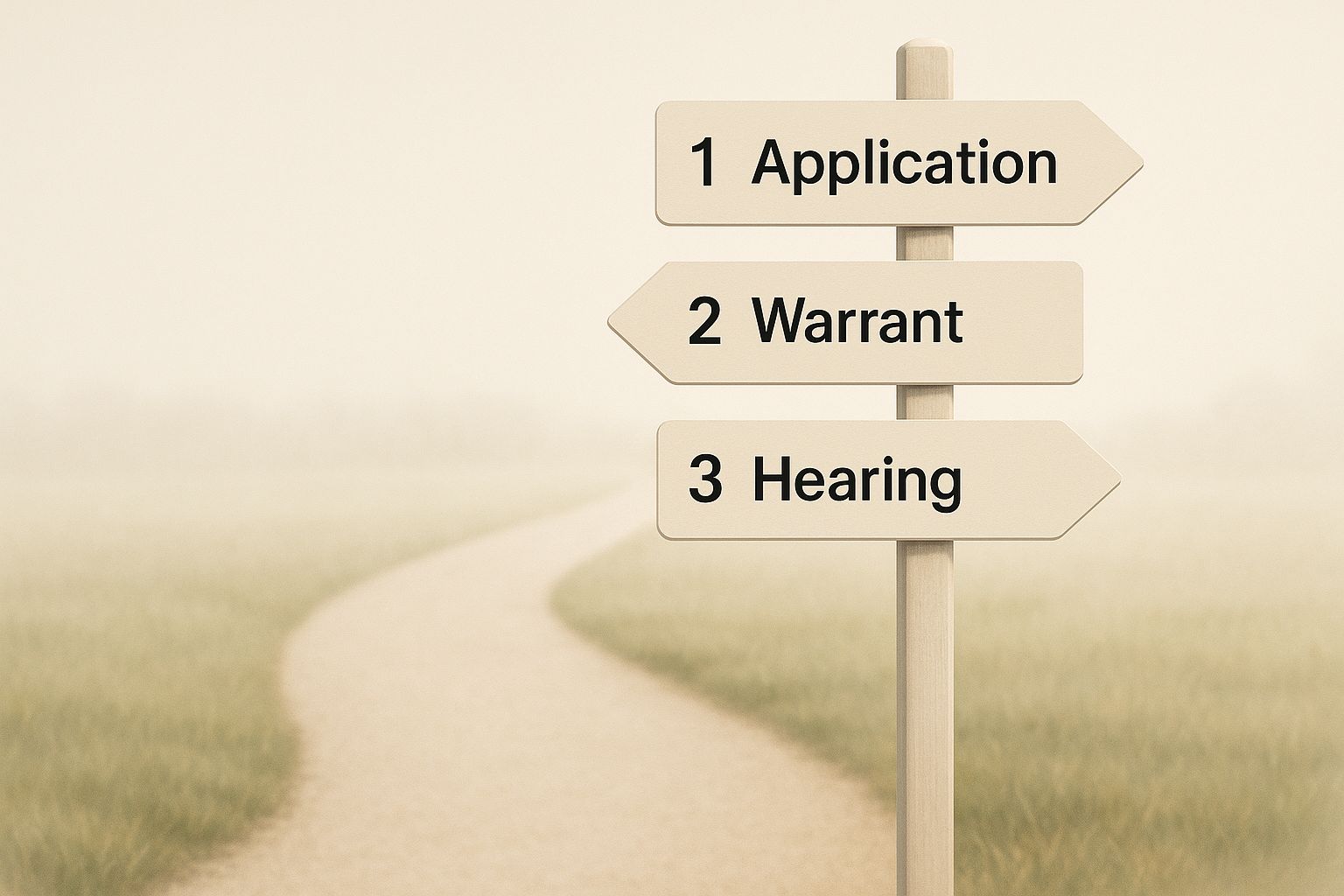
This visual roadmap simplifies the journey from your initial concern to a court-ordered hearing, showing the clear progression from the application and warrant to the final judicial review.
The Evaluation and Court Hearings
After being transported to a facility, your loved one must be examined by a physician within 72 hours. This medical evaluation is the cornerstone of the case, as the doctor will provide a professional opinion to the court on whether the person meets the strict criteria for commitment.
Following that evaluation, two court hearings are scheduled:
- The Probable Cause Hearing: Held within 72 hours of when they were first detained, this initial hearing determines if there's enough evidence to continue holding the person. The judge reviews your application, any police reports, and the doctor's initial assessment.
- The Final Hearing: This is a more formal hearing, usually held within two weeks, where the judge makes a final decision. You may be asked to testify, and your loved one will have a court-appointed attorney to represent their interests. If the judge finds clear and convincing evidence, they can order temporary inpatient mental health services for up to 90 days.
This isn't just a Texas issue; it's a significant part of mental healthcare globally. According to a 2025 World Health Organization report, nearly half of all psychiatric hospital admissions happen involuntarily. Shockingly, over 20% of these admissions last longer than one year, highlighting the profound need for strong legal protections and clear discharge planning. You can read the full report on global mental health services for more insight.
This temporary commitment is designed for crisis stabilization. For situations requiring long-term care and decision-making authority, you may need to explore other legal options. Our firm provides detailed information on Guardianship as a potential next step for sustained support. If you're navigating this difficult process, schedule a free consultation to discuss your family's needs with care and clarity.
Understanding Patient Rights During Commitment
When a loved one is placed under a court-ordered commitment, it's natural to worry they've lost their fundamental rights. But that's not the case. The Texas involuntary commitment law is carefully written to strike a balance between the urgent need for safety and a person's constitutional right to liberty.
For families navigating this incredibly difficult time, understanding these rights is one of the most powerful things you can do. Knowing the legal protections in place ensures your family member is treated with dignity—as a patient who deserves respect, not someone who has forfeited their voice.
The Right to Legal Counsel
One of the most critical protections under Texas law is the absolute right to an attorney. From the moment someone is detained on a mental health warrant, they are entitled to legal representation. If they can't afford a lawyer, the court must appoint one for them, free of charge.
This court-appointed attorney becomes your loved one’s advocate. Their entire job is to represent your family member's wishes, make sure every step of the legal process is followed correctly, and challenge the state's evidence if it doesn't meet the high bar required for commitment. Think of them as a crucial safeguard against the wrongful loss of liberty.
The Right to Be Informed and Participate in Treatment
Your loved one has a right to be told about their diagnosis and the proposed treatment plan in a way they can actually understand. This isn't just a formality; it includes clear information about different therapies, potential benefits, and any risks tied to prescribed medications.
On top of that, patients have the right to refuse certain treatments, especially medication, in specific situations. A doctor can't just force medication on someone. They need a separate court order, which requires proving two things: that the person lacks the capacity to make that decision for themselves, and that the treatment is genuinely in their best interest. This keeps the decision in the hands of the court, not just one physician.
A patient’s voice is legally protected throughout the commitment process. Their right to have an attorney and be informed about their care ensures they remain a participant, not just a subject, of the proceedings.
Broader Context and National Trends
These patient rights are more important than ever. Across the country, involuntary commitment laws are expanding, particularly to address substance use disorders. Between 2015 and 2018, more than 25 states broadened their commitment laws to include addiction.
Massachusetts, for instance, now compels over 6,000 people into addiction treatment each year under its specific statute. This trend is raising important questions about how we balance public health goals with individual rights. To learn more, you can discover more insights about the expansion of involuntary commitment in the U.S..
These protections mirror rights found in other legal arrangements, like guardianship. You can explore this further in our detailed guide on the legal rights of a ward in Texas guardianship cases.
Navigating this complex legal and emotional landscape is challenging. If you are worried about your loved one’s rights during an involuntary commitment or are considering long-term options, you don't have to face it alone. Schedule a free consultation with The Law Office of Bryan Fagan to receive personalized and compassionate guidance.
Life After Commitment Planning the Next Steps
When a court-ordered commitment period wraps up, the immediate crisis might be over, but a whole new set of questions and uncertainties rushes in to take its place. The hospital doors open, but what happens next? This is a pivotal moment for families, a time to shift focus from emergency intervention to building a sustainable path forward for long-term well-being.
The end of a commitment isn't always a dramatic, clear-cut event. It usually happens in one of two ways: either the treating physician decides your loved one no longer meets the strict legal criteria of being a danger to themselves or others, or the court order simply runs its course, typically after a maximum of 90 days. Either way, the goal is the same: making sure the return to the community is safe and supportive for everyone involved.

Building a Bridge to Recovery
Without a doubt, the most important tool you have during this phase is a collaborative discharge plan. This isn’t just a piece of paper with instructions; it's a comprehensive strategy put together by the hospital’s treatment team, your loved one, and your family. A solid plan acts as a bridge, connecting the structured hospital environment back to the realities of daily life.
An effective discharge plan should always cover the essentials:
- Scheduled Follow-up Care: This means having actual appointments booked with psychiatrists, therapists, or counselors before they even leave the hospital.
- Medication Management: A clear outline for prescriptions, how to get refills, and what side effects to watch for.
- Support System Activation: Pinpointing specific family members, friends, or support groups who will take an active role in the recovery process.
- Crisis Prevention: Knowing the warning signs of a potential relapse and having a clear, agreed-upon action plan if those signs appear.
Think of this plan as your roadmap. It provides much-needed structure and predictability during a time that can feel incredibly fragile for everyone.
When Short-Term Care Is Not Enough
Involuntary commitment is a short-term tool designed for a crisis. It stabilizes an emergency situation, but it doesn't fix the chronic, underlying issues that may have led to it. Sometimes, even with the best treatment, a person still might not have the capacity to make safe decisions about their own health, finances, or daily life.
This is where the conversation may need to pivot from temporary intervention to a more permanent support structure. If your loved one remains unable to manage their own affairs because of their condition, a Guardianship could be the necessary next step.
Unlike commitment, which is all about addressing immediate danger, a guardianship provides ongoing legal authority for a responsible person to make critical decisions for someone who is legally incapacitated. This is a significant legal step, governed by the Texas Estates Code, and is designed for long-term protection.
A guardianship, established through a Texas probate court, can create the legal framework needed to ensure your loved one continues to receive care, their bills get paid, and they can live safely. It formalizes your role as a decision-maker, giving you the authority to coordinate with doctors and manage finances when they can't.
Navigating the transition from commitment to long-term stability is a profound challenge. You've weathered the storm of an acute crisis, and now you have to plan for the days, months, and years ahead. Whether that means building a robust support network or exploring more formal legal options like Guardianship and sound Estate Planning, you don’t have to figure it out alone.
If you are facing these difficult decisions, schedule a free consultation with The Law Office of Bryan Fagan. We are here to provide clear, compassionate guidance to help you protect your family’s future.
Is Guardianship the Right Long-Term Solution?
After weathering the storm of a mental health crisis, your attention naturally turns to the road ahead. An involuntary commitment is a crucial, but temporary, fix for an emergency—it's not a permanent plan. This is the point where families start asking the big question: how do we make sure our loved one has consistent, long-term support?
For many, the answer lies in exploring guardianship. This legal tool, established under Title 3, Subtitle G of the Texas Estates Code, offers a durable framework for making decisions for someone who is legally incapacitated and can no longer safely manage their own affairs.
Understanding the Fundamental Difference
It's absolutely vital to understand that commitment and guardianship are not the same thing. They serve entirely different purposes and operate under completely separate parts of Texas law.
An involuntary commitment, governed by the Health and Safety Code, is a short-term crisis tool focused on immediate safety. A guardianship, governed by the Estates Code, is a long-term solution focused on ongoing care and protection.
A commitment order gives a hospital temporary authority to provide psychiatric treatment. A guardianship, on the other hand, grants a trusted person—the guardian—the ongoing legal authority to make critical life decisions for the person under guardianship, who is known as the ward.
To help clarify these two critical legal tools, let's compare them side-by-side.
Involuntary Commitment vs. Guardianship in Texas
This table breaks down the key differences between these legal processes, helping families understand their distinct purposes, timelines, and legal foundations.
| Aspect | Involuntary Commitment | Guardianship |
|---|---|---|
| Primary Goal | Stabilize an immediate mental health crisis to prevent imminent harm. | Provide ongoing care and protection for a person who is incapacitated. |
| Governing Law | Texas Health and Safety Code | Texas Estates Code |
| Duration | Short-term and temporary, often lasting days or weeks. | Long-term, potentially lasting for the ward’s lifetime unless terminated by a court. |
| Authority Granted | Allows a facility to provide medical and psychiatric treatment, often against the person’s will. | Grants a guardian broad authority over the ward's personal, medical, and/or financial decisions. |
| Focus | Immediate safety and acute medical intervention. | Comprehensive life management and long-term well-being. |
| Initiated By | Often initiated by law enforcement, a physician, or a concerned adult through an application. | Typically initiated by a family member or interested party through a formal court application. |
Understanding this distinction is the first step in creating a sustainable care plan that truly serves your loved one's best interests beyond the initial crisis.
When Is Guardianship the Necessary Next Step?
This is a significant legal step, reserved for situations where a loved one, due to a severe mental or physical condition, consistently lacks the capacity to make sound decisions for themselves. A guardianship might be the right path if an individual is unable to:
- Consent to or follow through with essential medical treatments.
- Manage their finances responsibly, leaving them vulnerable to debt or exploitation.
- Arrange for their own food, clothing, and shelter.
For example, consider a family in Harris County whose parent’s dementia has progressed to the point where they forget to take vital medications and can no longer pay their bills. Guardianship provides the legal clarity needed for their adult child to step in and manage these critical tasks, ensuring their parent is safe and cared for.
The guardian’s duties are laid out by the court and can be tailored to the specific needs of the ward, whether that involves overseeing medical care, managing finances, or both. This legal structure gives doctors, banks, and other caregivers clear direction, ensuring someone has the proper authority to advocate for your loved one’s best interests.
Moving from a crisis intervention to a long-term care plan is a profound challenge. If you believe your loved one needs ongoing protection, exploring your options is the most important thing you can do right now. Schedule a free consultation with The Law Office of Bryan Fagan to discuss whether guardianship is the right path for your family.
Frequently Asked Questions About Texas Commitment Law
When a loved one is in a mental health crisis, families are often thrown into a world of legal jargon and urgent, emotional questions. The process can feel overwhelming, and the stakes couldn't be higher. We've put together some straightforward answers to the questions we hear most often from families trying to navigate this difficult path.
Our goal here is to cut through the confusion and give you the direct information you need to understand your options and feel more prepared for what's ahead.
How Long Can Someone Be Held Under an Involuntary Commitment in Texas?
This is usually the first thing families want to know, and the answer highlights the temporary nature of this legal tool. Initially, a person can be held for up to 72 hours under a mental health warrant so that a proper evaluation can happen.
If a judge believes treatment is necessary after that initial period, they can issue a court order for up to 90 days. It's critical to understand that this is meant for crisis stabilization—it's not a permanent solution. For any commitment beyond those 90 days, a completely new court hearing is required.
Can I Use This Law for My Adult Child’s Addiction?
This is a painful and very common question. Texas involuntary commitment laws are specifically written to address situations involving a mental illness. While addiction and mental health struggles often go hand-in-hand, addiction by itself typically won't meet the legal standard.
To get a commitment order, you have to show that a severe mental illness is the direct cause of the person being a danger to themselves or others. If substance abuse is the only issue, this legal path probably isn’t available. It's always best to talk with an attorney who can look at the unique facts of your situation.
A common misconception is that involuntary commitment is a tool for addiction. While related, the law requires evidence of a severe mental illness causing immediate danger, which is a different legal standard than needing substance abuse treatment.
What Is the Difference Between a Mental Health Warrant and an Emergency Detention?
While they both lead to the same place—an emergency evaluation—they start from different points.
- A Mental Health Warrant is a formal court order. A judge issues it only after reviewing a sworn application and finding there is probable cause to move forward.
- An Emergency Detention happens when a peace officer takes someone into custody without a warrant. They can only do this if they have good reason to believe the person meets the commitment criteria and there simply isn't time to get a warrant.
No matter which path is taken, the legal protections are the same. A medical evaluation has to happen quickly, and the court process must start within the required legal timeframe.
What if the Court Releases My Loved One But I Still Believe They Are a Danger?
This is a terrifying and heartbreaking scenario for any family. If a judge decides that your loved one doesn't meet the very high legal bar for involuntary commitment, you can't force them into treatment through this specific process.
At this point, you have to pivot your strategy. That means focusing on creating a solid safety plan, looking into outpatient mental health services, and possibly exploring other legal avenues. If you believe they truly lack the capacity to make safe decisions for themselves long-term, an option like a Guardianship might be the next step to consider.
Trying to navigate the complexities of an involuntary commitment law on your own can feel impossible. At The Law Office of Bryan Fagan, PLLC, we guide Texas families with the clarity and care they deserve during the most challenging times. If you are facing these difficult decisions, schedule a free consultation with us to explore all your legal options.