Skip to content
When your family is grieving, the last thing you want to face is a long, complicated legal process. Thankfully, Texas law offers a more direct path for certain estates. This compassionate alternative is known as probating a will as a muniment of title in Texas. It’s a unique court proceeding designed to avoid unnecessary stress, acting as an express lane for families whose situations qualify.
This process legally recognizes a will and transfers property to the people named in it, all without the need for a full, traditional probate administration.
A Simpler Path for Texas Families
Losing someone is emotionally draining, and the thought of navigating the court system can feel completely overwhelming. We understand the weight of this responsibility. That's why it's important to know that Texas law provides a more direct path for certain estates, allowing families to settle a loved one's affairs with more peace and efficiency. That path is called probating a will as a muniment of title.
Think of it like getting a certified key that unlocks property ownership for the rightful heirs. Instead of appointing an executor and going through all the drawn-out steps of a formal administration, the court simply validates the will. From that point on, the will itself—along with the court's order—becomes the legal document that officially transfers ownership of assets. The entire approach is built to provide clarity and care during a difficult time.
Understanding the Legal Framework
A muniment of title in Texas isn’t some obscure loophole; it's a well-established legal tool. It was specifically created for estates that meet a few key criteria, making it a powerful alternative to a much more involved probate process.
Here’s what you generally need to qualify:
- A Valid Will: The person who passed away must have left a clear, legally valid will.
- No Unsecured Debts: The estate can’t have any outstanding debts, like credit card balances or medical bills. A mortgage on a house is a secured debt and is usually not a problem.
- Direct Transfer: Once a court, like the Harris County Probate Court, approves the application, the order and the will are filed in the county's property records. This act officially transfers title to the beneficiaries.
The core purpose of a muniment of title is to serve as legal evidence of ownership. It effectively bridges the gap between the deceased’s final wishes and the official public record, bypassing many common administrative hurdles.
This process delivers some major benefits. Under Texas probate law, a muniment of title streamlines the court process for proving property ownership through a will. According to Texas Estates Code, Title 3, Subtitle G (specifically Chapter 257), a court order admitting a will as a muniment of title gives legal authority for debtors to pay beneficiaries directly, cutting out the need for an executor entirely.
Statistically, this process can often be wrapped up in just 2-4 months and can cut costs by up to 70% compared to traditional administrations, which can easily drag on for a year or more. You can learn more about how this process efficiently transfers assets and what it could mean for your family.
When to Choose Muniment of Title for an Estate
After a loved one passes, figuring out the right legal path can feel overwhelming. But if you’re dealing with an estate in Texas, understanding what a muniment of title is can provide a lot of clarity, fast. This isn’t a one-size-fits-all solution; it's a specific legal tool designed for estates that tick two very important boxes under the Texas Estates Code.
First, the person who passed away must have left behind a valid will. No will, no muniment of title—it’s that straightforward. Second, the estate can't be saddled with unsecured debts. Think credit card balances, outstanding medical bills, or personal loans. We know that facing potential debts can be stressful, but determining this upfront is a critical step.
Key Eligibility Factors
Now, there's a common and important exception to that "no debt" rule: a mortgage. If the only major debt is secured by real property, like a mortgage on a house, it doesn't automatically disqualify the estate. The debt is tied directly to the asset itself.
Let's walk through a hypothetical scenario. Imagine your parent passes away in Dallas County. They owned their home (which still has a mortgage), a car that's paid off, and a checking account. They had a solid will and no credit card debt or other loans. This situation is a perfect candidate for a muniment of title. It allows for a clean, simple transfer of that property to the heirs named in the will, providing the family with a clear path forward.
This decision tree helps break down the two main questions you need to answer.
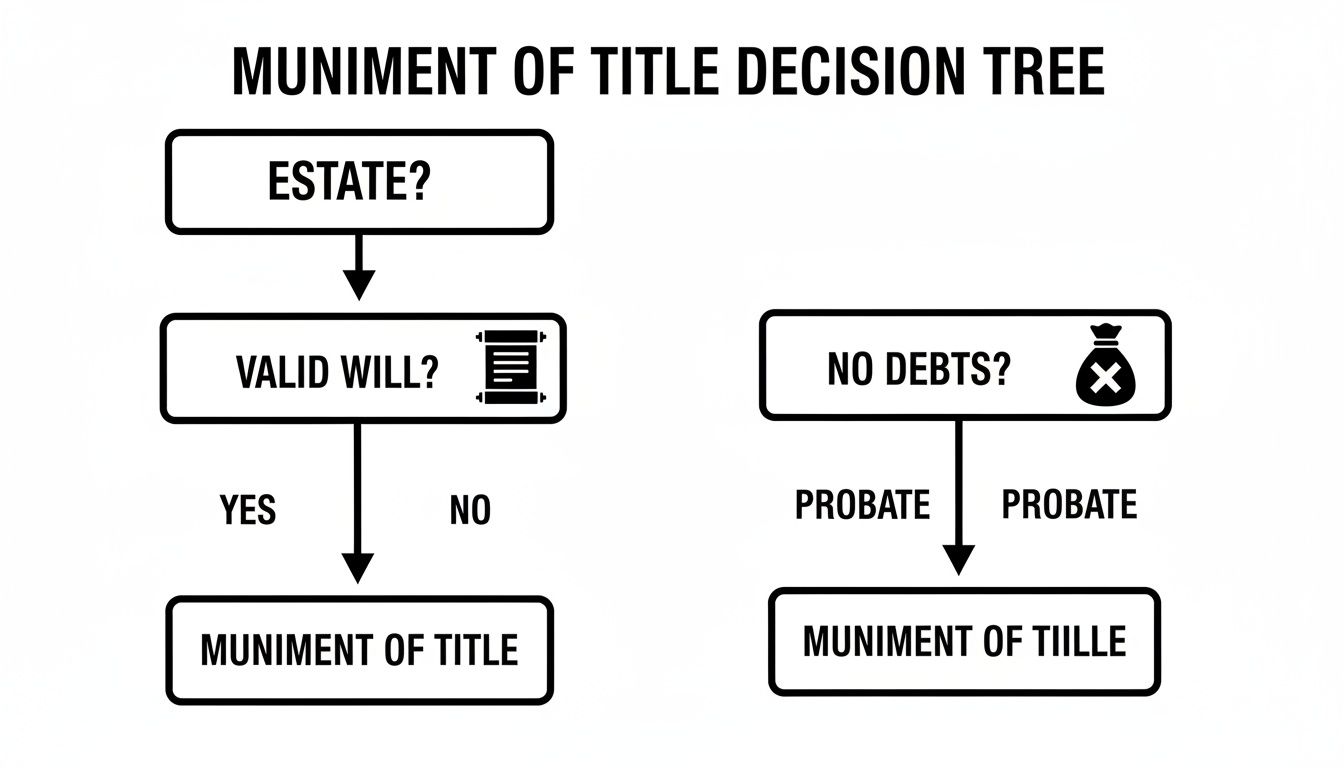
As you can see, if you can confidently answer "yes" to having a valid will and "yes" to having no unsecured debts, a muniment of title is a very strong option to explore.
Important Exceptions to Consider
It pays to be meticulous when you’re assessing an estate’s debts. One critical area people sometimes overlook is Medicaid. If the deceased received benefits from certain state Medicaid programs, Texas might have a claim against the estate to recover those costs. That claim is considered a debt, and it could stop a muniment of title in its tracks.
Historically, this unique Texas process, now formalized in Texas Estates Code §257.001, was created as a shortcut. It was a practical solution to cut through the long delays of traditional probate, where many estates were stuck in administration for over 18 months.
If an estate doesn't quite fit these specific requirements, please don't worry—other simplified options might be on the table. For instance, you can learn about alternatives like the Small Estate Affidavit in our detailed guide.
Navigating the Muniment of Title Process Step by Step
When you're already managing so much, understanding the court process for a muniment of title in Texas can feel like another heavy burden. Our goal here is to pull back the curtain on these legal steps and give you a clear roadmap, building your confidence along the way. We’ll walk through exactly what you need to do to file in a Texas probate court, like the one in Harris County, so there's less uncertainty.
The whole journey starts with gathering the essential paperwork. Think of this less as a chore and more as collecting the legal keys needed to honor your loved one's final wishes.

Step 1: Filing the Application
First things first, you or your attorney will file a document called an "Application to Probate Will as a Muniment of Title" with the correct county court. This isn't something you can put off indefinitely; under Texas law, you have a critical four-year deadline from the date of death to get this filed.
You can't just file the application by itself. You absolutely must include two other vital documents:
- The Original Will: The court needs the real deal—the actual, signed will. A copy just won't cut it.
- The Official Death Certificate: This document officially confirms the passing and its circumstances for the court's record.
Once everything is filed, the court posts a public notice at the courthouse. This triggers a waiting period, usually about two weeks, which gives anyone with an interest in the estate a heads-up about what's happening.
Step 2: The Court Hearing
After the notice period is over, the court will set a date for a hearing. The word "hearing" might sound intimidating, but this is typically a straightforward and relatively brief proceeding designed to confirm the facts.
During the hearing, the judge just needs to confirm a few key facts required by the Texas Estates Code, Title 3, Subtitle G (specifically § 257.001). You'll need to provide testimony to prove:
- The will is valid and was signed correctly.
- You've filed in the right county court (this is called having "jurisdiction").
- The estate has no unpaid debts, other than a mortgage or other lien secured by real estate.
This step is really just a final check to make sure all the legal boxes are ticked before the court officially recognizes the will.
Step 3: Receiving the Court Order
If the judge agrees that all the evidence and testimony line up, they will sign a court order. This document, officially titled an "Order Admitting Will to Probate as a Muniment of Title," is the final piece of the puzzle. It’s what validates the will and gives the green light for transferring property to the beneficiaries.
Think of this order as the court's official stamp of approval. It transforms the will from a piece of paper into a powerful legal tool that makes the transfer of ownership happen, exactly as the deceased wanted.
With a certified copy of this order in hand, you can file it in the real property records of any county where the person owned property. Doing this officially updates the chain of title and puts the property legally into the beneficiaries' names. While this process is far more direct than a full probate, it's worth knowing that other estate planning tools can also make asset transfers simpler. For instance, families looking into different ways to handle real estate can learn more by understanding the Lady Bird Deed in Texas.
Muniment of Title vs Traditional Probate
When you're settling a loved one's estate, the path you choose can make a world of difference for your family's emotional and financial well-being. Thinking about a muniment of title versus a full, traditional probate is like choosing between a direct flight and one with multiple, lengthy layovers. One gets you there efficiently, while the other involves far more steps, time, and stress.
A traditional probate administration can be a long, drawn-out journey. It requires the court to appoint an executor, who then has to tackle a long list of duties. This includes everything from formally notifying creditors and taking inventory of all estate assets to filing extensive paperwork with the court. This process can easily drag on for many months—or even years in complex cases—keeping the family stuck in legal limbo.

Comparing Time, Cost, and Complexity
In contrast, a muniment of title in Texas offers a much more direct route. It doesn't require an executor or that lengthy process of dealing with creditors, so it wraps up much faster—often in just a couple of months. That speed gives families closure and the ability to move forward without a legal process hanging over their heads.
The financial difference is also huge. Traditional probate comes with court costs, attorney fees, and often, compensation for the executor. By cutting out the need for an administrator and many of the formal steps, a muniment of title can be substantially more affordable, which preserves more of the estate's value for the beneficiaries. For families already dealing with the financial impact of losing someone, this can be a massive relief. If you want to dive deeper into the formal process, our firm has a guide to probating a will in Texas that details all these steps.
A Clearer Look at the Differences
The main differences really boil down to the amount of court supervision and the number of tasks required. To make it easier to see why a muniment is often a more compassionate and practical choice for eligible Texas families, we've broken down the distinctions in the table below.
Comparing Muniment of Title and Full Probate Administration
This table highlights the key differences between the two main probate paths in Texas.
| Factor | Muniment of Title | Full Probate Administration |
|---|---|---|
| Executor Required | No executor is appointed. The will and court order directly transfer assets. | Yes, an executor is appointed to manage the entire process. |
| Typical Timeline | Usually completed within 2-4 months. | Can take 6 months to over a year, sometimes longer. |
| Cost | Significantly lower due to fewer legal steps and no executor fees. | More expensive, with costs for court, attorneys, and executor fees. |
| Debt Handling | Only available for estates with no unsecured debts. | Includes a formal process for notifying and paying all creditors. |
| Complexity | Simpler, with a single court hearing and order to transfer property. | Complex, involving inventory, accountings, and multiple court filings. |
Ultimately, a muniment of title is designed to validate a will and transfer property with as little court intervention as possible. For families with a straightforward estate, it provides a path that is kinder, quicker, and less costly, aligning with our mission to offer clarity and care when you need it most.
Common Hurdles and How to Avoid Them
While a muniment of title in Texas is often seen as the simpler path, the process isn't always a straight line. A few unexpected issues can pop up, and knowing about them ahead of time can make all the difference. Think of this as a bit of foresight, a way to prepare so the process stays as smooth and stress-free as possible for your family.
One of the most common snags is finding a debt you didn't know about after you've already started. Since a muniment of title hinges on the estate being free of unsecured debts, this can bring everything to a grinding halt.
Dealing with Unexpected Debts
Imagine this: you've filed for the muniment of title, confident your loved one’s finances were in order, only to discover a forgotten medical bill or an old credit card statement tucked away. That discovery is more than just an inconvenience; it could derail the entire process because a creditor might still have a legitimate claim against the estate.
To get ahead of this, you have to play detective before you ever file with the court. This is a practical step your family can take to ensure a smooth process.
- Review mail and financial records: Go through every piece of mail, every bank statement, and comb through email accounts. You're looking for any hint of recurring payments or notices from collectors.
- Check credit reports: If you can, getting a copy of the deceased’s credit report is an invaluable tool. It can uncover accounts or debts you had no idea existed.
A proactive, thorough search for debts right at the beginning is the single best thing you can do to protect your family from this headache. It confirms that a muniment of title is the right legal path from the get-go.
The Four-Year Filing Deadline
Another critical detail is the clock. The Texas Estates Code, Section 256.003, sets a clear deadline: you generally have four years from the date of death to present a will for probate. Let that deadline slip by, and things get much more complicated.
But the law does recognize that life happens. There's an important exception: a will can be probated after the four-year mark if the person filing can prove they weren't "in default" for the delay. This could be the case if a will was hidden from them or if they genuinely didn't know it existed.
Finally, the court will demand the original will. If all you have is a copy, the law presumes the original was intentionally destroyed or revoked. It's a tough hurdle to clear, requiring strong evidence to convince the judge the original was simply lost. This is where having an experienced attorney in your corner is invaluable—they can help you anticipate these issues and protect your family’s interests.
How a Probate Attorney Can Guide Your Family
Navigating the loss of a loved one is tough enough without getting tangled in legal complexities. For many Texas families, the muniment of title process offers a faster, simpler, and less expensive path than traditional probate, bringing much-needed relief during an already emotional time. It’s a way to honor your loved one's will and transfer property without the drawn-out ordeal of a full estate administration.
But even this more direct route has specific legal hurdles that must be cleared perfectly. This is where an experienced probate attorney becomes your family’s compassionate guide, making sure every step is handled correctly according to the Texas Estates Code.
Providing Clarity and Peace of Mind
An attorney’s job is to bring certainty to a situation that feels anything but. We step in to help your family:
- Confirm Eligibility: We’ll do a thorough review of the will and the estate’s financial picture to confirm a muniment of title is the right move. This protects you from the nasty surprise of discovering unexpected debts down the road.
- Handle Court Filings: Our team manages all the paperwork and court filings. We know what the court is looking for, which prevents simple mistakes that could cause frustrating delays or complications.
- Represent You in Court: We will be right there with you at the hearing, presenting the necessary evidence to the judge so you don't have to face the courthouse alone.
We understand the strength it takes to manage these responsibilities while you're grieving. Our mission is simple: to lift the legal burden from your shoulders so you can focus on what truly matters—your family.
The Law Office of Bryan Fagan is here to offer the clear guidance and supportive counsel you and your family deserve. If you think a muniment of title in Texas might be the right option for you, we invite you to schedule a free consultation. Let us help you find the most peaceful path forward.
Common Questions About Muniment of Title
Navigating the details of settling an estate can feel overwhelming. Let’s clear up some of the most common questions people have about using a muniment of title in Texas so you can move forward with confidence.
Can You Use a Muniment of Title if There Is a Mortgage on the Property?
Yes, absolutely. A mortgage is what’s known as a secured debt—it’s tied directly to the real estate itself. This is a key distinction.
The muniment of title process is designed for estates without unsecured debts, like credit card balances, personal loans, or lingering medical bills. Because a mortgage is secured by the property, its presence doesn't automatically disqualify an estate from this simplified probate path.
Can You Sell Property with a Muniment of Title Order?
You sure can. Once the judge signs the order admitting the will as a muniment of title, that court order itself becomes the legal tool that transfers ownership to the beneficiaries.
To make it official, you’ll file a certified copy of the court's order and the will in the county’s property records. This combination acts as clear proof that the beneficiaries are the new, rightful owners, giving them full authority to sell the property without needing an executor or going through a longer administration.
The real power of a muniment of title is that it puts control directly into the hands of the family. Beneficiaries can manage or sell assets right away, bypassing the delays of a traditional probate process.
What if a Debt Is Discovered After the Muniment Is Granted?
This is where things can get complicated. Finding an unsecured debt after the process is finished can create major headaches for everyone involved.
The muniment process doesn't include a formal step to notify creditors. Because of this, a creditor could still have a valid claim against the estate’s assets, even after they've been handed over to the beneficiaries. This is precisely why it’s so critical to do a thorough, diligent search for any and all debts before you ever file the application.
If a creditor does pop up later, you'll need to speak with a probate attorney right away. Depending on the specifics, you might have to pivot to a more formal estate administration to get the claim properly resolved.
At The Law Office of Bryan Fagan, PLLC, we provide the compassionate, professional guidance Texas families need. If you're wondering whether a muniment of title is the right path for your family, contact us today for a free consultation. Let us help you find the clearest, most supportive way forward.