Skip to content
When a loved one can no longer make decisions for themselves, stepping in to protect them is a profound act of love and responsibility. In Texas, this often requires a legal process called guardianship. The journey frequently begins with a foundational document: the Application for Appointment of Guardian, often referred to informally as a "letter of guardianship." This document is not just paperwork; it is a formal request to a Texas court, like the Harris County Probate Court, to grant you the legal authority to manage another person's medical, personal, or financial affairs.
Navigating this process can feel overwhelming, especially when you are already coping with the emotional and financial stress of a family crisis. Our goal is to demystify this critical first step. This comprehensive guide provides multiple, detailed examples of guardianship letters tailored for different situations, from caring for an incapacitated adult to protecting a minor child.
Each example of a letter of guardianship is broken down and annotated with strategic insights grounded in Texas law, specifically Title 3, Subtitle G of the Texas Estates Code. We will show you not just what to write, but why specific details matter, empowering you with the clarity and confidence needed to move forward. We understand the weight of this responsibility. The Law Office of Bryan Fagan is here to provide the compassionate, professional guidance your family deserves on this important journey. This article will equip you with practical, actionable information to protect the person you care about most.
Guardianship Letter for Incapacitated Adult (Medical & Financial)
When an adult can no longer make safe decisions for themselves due to dementia, a severe illness, or a significant injury, a formal guardianship may be necessary. The first step in this legal process isn't a simple letter but a comprehensive legal document filed with the court, typically called an Application for Appointment of Permanent Guardian. This is the most common type of "letter of guardianship" families in Texas encounter. It serves as a formal petition to the probate court, such as the one in Harris County, requesting the authority to manage the incapacitated person's affairs.
This application is crucial because it initiates the court's involvement and sets the stage for all subsequent proceedings. Under Texas Estates Code Title 3, Subtitle G, it must clearly and convincingly explain why guardianship is essential and why less restrictive alternatives are no longer viable. For instance, if the proposed ward has a Power of Attorney, the application must detail why that document is insufficient, perhaps because the ward is now revoking it due to paranoia or because the appointed agent is unable or unwilling to act.
Analysis of a Sample Application
Let's break down the key components you would find in a strong example of a letter of guardianship, or more accurately, an Application for Appointment of Permanent Guardian.
Sample Excerpt: Statement of Incapacity
"Applicant, Jane Doe, states that the Proposed Ward, John Doe, is an incapacitated person. On or about June 15, 2023, John Doe suffered a severe ischemic stroke, which has resulted in significant cognitive impairment, aphasia, and an inability to manage his daily financial and medical needs. A Physician’s Certificate of Medical Examination is attached as Exhibit A, which confirms this diagnosis and opines that John Doe lacks the capacity to make responsible decisions concerning his health and finances. Due to this incapacity, the Proposed Ward requires the appointment of a guardian of his person and estate."
Strategic Breakdown
- Specificity is Key: The application avoids vague language like "he is sick." Instead, it names the specific medical event (ischemic stroke), the date, and the resulting conditions (cognitive impairment, aphasia). This provides the court with concrete facts.
- Evidence is Paramount: It immediately references the "Physician’s Certificate of Medical Examination" (CME). This is a mandatory component under the Texas Estates Code and serves as the primary medical evidence. Your application is significantly weaker without this expert opinion.
- Clear Request: The language clearly requests a guardian for both the "person" (medical decisions) and the "estate" (financial matters), leaving no ambiguity about the scope of authority needed.
Actionable Takeaways for Your Application
- Gather Medical Documentation First: Before you even begin drafting, secure the CME from the proposed ward's physician. This report is the foundation of your case and will guide the information you include in the application.
- Detail Why Alternatives Failed: The court must consider less restrictive alternatives. Explicitly state why a Power of Attorney, supported decision-making agreement, or other tools are not sufficient. For example, "Although John Doe executed a Durable Power of Attorney in 2018, his current cognitive state prevents him from understanding its purpose, and he has recently attempted to give large, uncharacteristic sums of money to strangers, actions his agent cannot prevent."
- Be Precise and Factual: Stick to objective facts. List specific instances of confusion, unsafe behavior, or financial mismanagement. The goal is to paint a clear picture of the necessity for court intervention, not to air personal grievances.
The application is the first and most critical document the court will review. For a detailed walkthrough of the entire legal journey, from filing this application to attending the hearing, you can find valuable information by navigating the guardianship process in Texas.
2. Emergency/Temporary Guardianship Letter (Urgent Circumstances)
In situations where an individual faces immediate and substantial harm, waiting for the standard guardianship process is not an option. An emergency, or temporary, guardianship provides a rapid legal solution for crises, such as when a loved one is suddenly incapacitated, facing abuse, or needs urgent medical intervention. The "letter" in this context is a formal legal document filed with the court, typically called an Application for Appointment of Temporary Guardian. This petition asks a Texas probate court, like those in Bexar County or Travis County, to grant immediate, short-term authority to protect a vulnerable person.
Under Texas Estates Code §1251.001, the court can hold a hearing and appoint a temporary guardian very quickly if there is substantial evidence that a person or their estate requires immediate appointment of a guardian. This expedited process is designed to prevent imminent danger, such as an elderly parent being exploited financially or a person with dementia wandering into unsafe situations. The application must powerfully convey the urgency and the specific harm that will occur without the court's swift intervention.

Analysis of a Sample Application
Let's examine the critical components of a persuasive example of a letter of guardianship for an emergency situation, specifically the Application for Appointment of Temporary Guardian.
Sample Excerpt: Statement of Imminent Danger
"Applicant, Susan Smith, states that the Proposed Ward, Robert Smith, is in imminent danger of serious physical harm and financial exploitation. On October 26, 2023, Adult Protective Services (APS) found Robert Smith, who suffers from advanced Alzheimer's disease, living in squalor and exhibiting signs of severe malnutrition (see APS Report, Exhibit A). Furthermore, bank statements from the past 30 days show suspicious withdrawals totaling over $15,000 made by an unverified 'caregiver' (see Bank Records, Exhibit B). Without the immediate appointment of a temporary guardian, Applicant believes the Proposed Ward will suffer further physical deterioration and his estate will be completely depleted."
Strategic Breakdown
- Urgency is the Theme: The language immediately establishes a crisis using phrases like "imminent danger" and "serious physical harm." This signals to the court that this is not a standard guardianship case and requires immediate attention.
- Third-Party Corroboration: Referencing an Adult Protective Services (APS) report provides objective, third-party evidence of neglect. This is far more powerful than relying solely on the applicant's personal observations.
- Quantifiable Harm: The application specifies the exact amount of money withdrawn ($15,000) and the timeframe. This tangible evidence of financial exploitation is concrete and compelling for a judge.
Actionable Takeaways for Your Application
- Assemble Emergency Evidence: Before filing, gather any police reports, APS investigations, hospital admission records, or bank statements that prove the crisis. This documentation is the backbone of your request for an expedited hearing.
- Clearly Define the Powers Needed: Be specific about the temporary powers you need. For example: "Applicant requests the specific authority to admit the Proposed Ward to a skilled nursing facility, to consent to all necessary medical treatment, and to freeze all financial accounts in the Proposed Ward's name."
- File Immediately and Be Ready: Do not delay. File the application directly with the appropriate probate court and be prepared to attend a hearing on very short notice, sometimes within 48 to 72 hours. Ensure you and any key witnesses are available to testify.
An emergency application is a powerful tool designed to protect the most vulnerable. Due to its expedited nature and the high stakes involved, navigating this process correctly is critical.
3. Minor Guardianship Letter (Parental Death or Incapacity)
When a minor child loses their parents to death or incapacity, a court-supervised guardianship is often necessary to protect their well-being and assets. Similar to adult guardianship, this process begins not with a simple letter, but with a formal Application for Appointment of Permanent Guardian of a Minor. This legal document is filed in the county court where the child resides, such as the probate courts in Travis or Dallas County. It petitions the court to grant a responsible adult the legal authority to care for the child and manage their property.
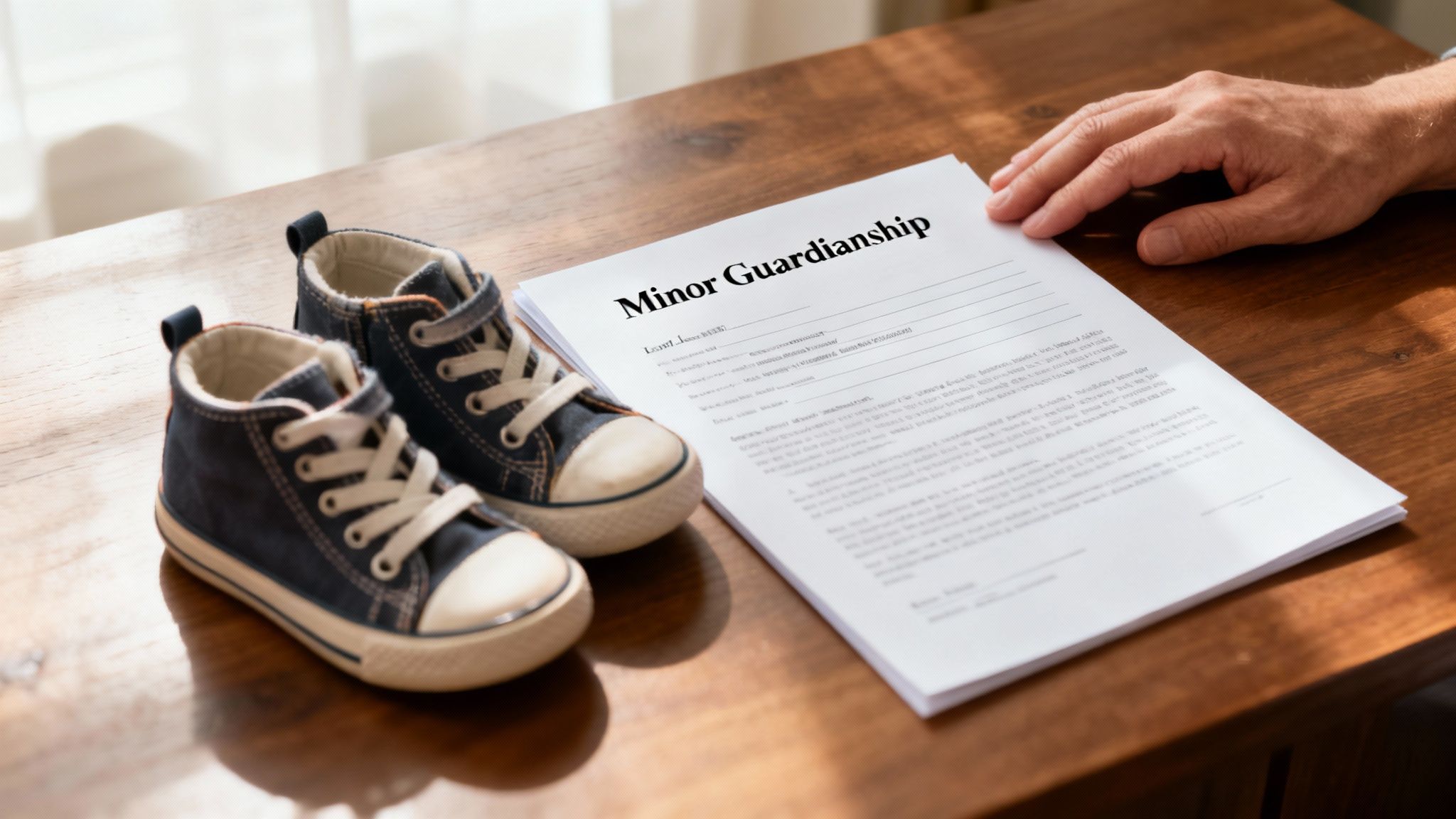
This application is fundamentally different from a custody case in family court. Guardianship establishes a formal fiduciary relationship, overseen by the court, to ensure the child’s personal needs are met and any inheritance, settlement funds, or government benefits are properly managed. This step is critical for relatives, like grandparents or an aunt, who are stepping in to provide a stable home and need the legal authority to make decisions about the child's education, healthcare, and finances.
Analysis of a Sample Application
Let’s examine the key components of a strong example of a letter of guardianship, or more accurately, an Application for Appointment of Guardian for a Minor, in the tragic event of parental death.
Sample Excerpt: Statement of Necessity
"Applicants, Mark and Susan Smith, are the maternal grandparents of the Proposed Ward, Lily Jones, a minor. On August 1, 2023, Lily’s parents, Karen and David Jones, were tragically killed in a motor vehicle accident. Certified copies of their death certificates are attached as Exhibits A and B. Lily Jones currently resides with the Applicants in Bexar County, Texas. The minor is the named beneficiary of a life insurance policy and is expected to inherit from her parents' estates, thus requiring the appointment of a guardian of her person and estate to manage these assets and provide for her care."
Strategic Breakdown
- Establishes Standing: The application immediately clarifies the relationship between the applicants (grandparents) and the child. This establishes their standing and connection to the minor.
- Provides Factual Basis: It clearly states the reason guardianship is needed (parents' death) and provides the necessary proof (death certificates). This is a non-negotiable requirement for the court.
- Identifies the Need for an Estate: The excerpt specifically mentions the existence of assets (life insurance, inheritance). This alerts the court to the need for a guardian of the "estate" in addition to the "person," which involves stricter duties like posting a bond and filing annual accountings.
- Confirms Jurisdiction: By stating the minor resides with them in Bexar County, the applicants confirm they are filing in the correct legal venue, a crucial procedural step.
Actionable Takeaways for Your Application
- Gather Essential Documents First: Before filing, obtain certified copies of the parents' death certificates or a physician's affidavit detailing a living parent's incapacity. These documents are the primary evidence supporting your petition.
- Inventory the Minor’s Assets: Understand what property the child owns or will inherit. This determines whether you need a guardianship of the person only (for care decisions) or also of the estate (for financial management). The court will require a detailed inventory later on.
- Prepare a Parenting and Financial Plan: Be ready to show the court how you will provide for the child’s physical, emotional, and educational needs. Create a basic budget demonstrating how you will manage the child's funds responsibly. This proactive step shows the court you are prepared for the significant responsibilities of a legal guardian.
- Disclose Your Background: The court will conduct a background check. Be transparent and ready to provide character references and information about your own financial stability to demonstrate you are a suitable and qualified guardian.
4. Guardianship Modification/Amendment Letter (Changed Circumstances)
A guardianship is not a static arrangement; it is designed to evolve with the ward's needs. When circumstances change significantly, the original court order may no longer be appropriate. A "letter of guardianship" in this context takes the form of a legal document called a Petition to Modify Guardianship, filed with the same court that established the original guardianship, such as the probate courts in Travis or Bexar County. This is a formal request to alter the guardian's powers or change the guardian entirely.
This petition is vital when the ward's condition improves or declines, or when the current guardian can no longer serve effectively. Under the Texas Estates Code, the court retains jurisdiction to ensure the guardianship continues to serve the ward's best interest. The modification process ensures the arrangement remains the least restrictive option necessary, adapting to new medical realities, financial situations, or the guardian's own life changes.
Analysis of a Sample Petition
Let's examine the essential components of a strong Petition to Modify Guardianship, which serves as the formal "letter" to the court requesting these changes.
Sample Excerpt: Statement of Changed Circumstances
"Petitioner, Sarah Smith, states that a material and substantial change has occurred since this Court’s Order Appointing Guardian was signed on May 10, 2022. The current guardian, Robert Smith, suffered a debilitating cardiac event on August 1, 2024, and is now medically incapacitated and unable to perform his duties as Guardian of the Person and Estate for the Ward, Mary Smith. A letter from Robert Smith’s physician is attached as Exhibit B, confirming his incapacity. Petitioner, the Ward’s daughter, is willing and qualified to serve as Successor Guardian."
Strategic Breakdown
- Direct and Clear Rationale: The petition immediately states that a "material and substantial change" has occurred, using the legal terminology the court looks for. It specifies the event (guardian's cardiac event), the date, and the direct consequence (inability to perform duties).
- Supporting Evidence: Just like in an initial application, evidence is crucial. The excerpt references a physician's letter (Exhibit B) to substantiate the claim of the current guardian's incapacity. This moves the claim from a simple assertion to a verifiable fact.
- Proposed Solution: It doesn't just identify a problem; it offers a clear solution. It names the proposed Successor Guardian (Sarah Smith) and affirms her willingness and qualification to serve, anticipating the court's next question.
Actionable Takeaways for Your Petition
- Secure Updated Evaluations: If the modification relates to the ward's capacity, obtain an updated Physician’s Certificate of Medical Examination (CME). If it's due to the guardian's incapacity, get a similar letter from their doctor. This medical evidence is the cornerstone of your request.
- Articulate the Specific Change Needed: Be explicit about what you are asking the court to do. Do you need to transfer guardianship from one person to another? Do you need to restore some rights to the ward and move to a limited guardianship? Clearly state the "before" and "after" scenario. For example, "Petitioner requests the Court remove Robert Smith as Guardian and appoint Sarah Smith as Successor Guardian of the Person and Estate."
- Provide a Current Accounting: When modifying a guardianship of the estate, you must demonstrate responsible management. File a current accounting of the ward's assets and expenditures with your petition. This shows the court that the estate has been properly handled and provides a clean slate for the proposed changes.
A Petition to Modify is the correct legal tool to ensure a guardianship remains a protective, and not an overly restrictive, measure. For guidance on navigating the complexities of modifying an existing court order, understanding the required legal steps is the first move.
5. Guardianship Termination/Restoration Letter (Ward's Capacity Regained)
Guardianship is not always a permanent state. When a ward's condition improves to the point where they can once again manage their own affairs, Texas law provides a clear path to restore their rights. This process is initiated not with an informal letter, but with a formal legal document filed with the court, often called a Petition for Restoration of Ward's Capacity and Termination of Guardianship. This petition is a critical example of a "letter of guardianship" in reverse, as it seeks to undo the guardianship and return legal autonomy to the individual.
This petition is essential because it formally asks the probate court, like the one in Dallas County, to re-evaluate the ward's condition. It must present compelling evidence that the original reasons for the guardianship no longer exist. Per the Texas Estates Code, the foundation of this request is typically a new medical evaluation certifying that the ward has regained the capacity to make responsible personal and financial decisions. This is common in cases where an adult recovers from a temporary condition, such as a medication side effect, a treatable mental health crisis, or a successful rehabilitation after an accident.
Analysis of a Sample Petition
Let's break down the key components you would find in a strong example of a letter of guardianship, or more accurately, a Petition for Restoration.
Sample Excerpt: Statement of Restored Capacity
"Petitioner, John Doe, the Ward in this matter, states that he has regained the capacity to manage his personal and financial affairs. The initial guardianship was established on August 10, 2022, following a temporary cognitive decline caused by an adverse reaction to a prescribed medication. As detailed in the attached Physician’s Letter from Dr. Emily Carter (Exhibit A), the medication has been adjusted, and Mr. Doe’s cognitive functions have fully returned to their baseline. The letter opines that Mr. Doe now possesses the requisite capacity to care for his own physical health and manage his property. Therefore, Petitioner requests the Court terminate the guardianship of his person and estate and restore all legal rights."
Strategic Breakdown
- Direct and Clear Request: The petition immediately states its purpose: to terminate the guardianship and restore the ward's rights. It directly addresses the court with a clear objective.
- Reference the Original Cause: It wisely references the original reason for the guardianship ("temporary cognitive decline caused by…medication"). This provides context and shows that the underlying issue has been resolved.
- Lead with New Evidence: The petition prominently features the new "Physician’s Letter" as Exhibit A. This medical opinion is the cornerstone of the restoration case and must specifically address the ward's capacity to make decisions.
- Specify Scope of Restoration: It clearly asks to terminate the guardianship of both the "person" and the "estate," ensuring a full restoration of all decision-making authority.
Actionable Takeaways for Your Petition
- Secure a New Medical Evaluation: The first and most crucial step is to obtain a letter or certificate from a physician. This document must explicitly state that the ward has regained capacity. It cannot be vague; it must address the specific abilities to manage health and finances.
- Gather Supporting Documentation: Beyond the physician's letter, collect evidence of improvement. This could include therapy progress notes, results from cognitive tests, or statements from caregivers who have witnessed the ward’s recovery and ability to handle daily tasks.
- File in the Original Court: The petition to terminate the guardianship must be filed in the same court that originally established it. This ensures legal continuity and that the judge has access to the entire case history.
Restoring a person's legal rights is a significant court action that requires a strong, evidence-based argument. To understand the full legal procedure for ending a guardianship, you can find detailed information on the termination of guardianship legal procedures in Texas.
6. Guardianship Contested/Challenge Letter (Incapacity Dispute or Fiduciary Misconduct)
Guardianship is a powerful legal tool designed to protect the vulnerable, but when its necessity is questionable or the appointed guardian fails in their duty, a challenge becomes essential. A "letter of guardianship" in this context is a formal legal filing, such as a Motion to Remove Guardian or a Petition to Contest Guardianship. This document is not a simple letter but a critical legal instrument filed with the probate court, like those in Dallas County or Travis County, to challenge an existing or proposed guardianship.
This petition is filed by an "interested person" – a family member, the ward themselves, or another party with a valid stake. It serves as an official notice to the court that there is a significant dispute. This could be a disagreement over the proposed ward's actual level of incapacity or, more alarmingly, an allegation that the current guardian is mismanaging funds, neglecting the ward, or engaging in self-dealing in violation of their fiduciary duties under the Texas Estates Code.

Analysis of a Sample Challenge
Let's examine the core components of a strong petition to remove a guardian for misconduct, a common type of guardianship challenge letter.
Sample Excerpt: Allegation of Breach of Fiduciary Duty
"Petitioner, Sarah Smith, an adult child of the Ward, Mark Smith, moves to remove the current Guardian, John Smith, pursuant to Texas Estates Code § 1203.051. The Guardian has breached his fiduciary duty by failing to file a sworn inventory and appraisement of the Ward's estate within the statutory deadline. Furthermore, bank statements obtained by Petitioner (attached as Exhibit B) show multiple unexplained cash withdrawals totaling over $50,000 from the Ward's accounts, which appear to constitute misappropriation and self-dealing. These actions demonstrate the Guardian is no longer suitable to serve and is actively harming the Ward's estate."
Strategic Breakdown
- Cite the Law: The petition immediately references the specific section of the Texas Estates Code (§ 1203.051) that grants the court authority to remove a guardian. This shows the court the challenge is based on solid legal grounds.
- Present Factual Evidence: It doesn't just say "he's stealing money." It points to a specific procedural failure (failing to file an inventory) and presents concrete evidence (bank statements showing specific withdrawals). This shifts the burden of proof to the guardian to explain their actions.
- Connect Actions to Unsuitability: The excerpt explicitly links the guardian's actions (breach of duty, misappropriation) to the legal standard for removal ("no longer suitable to serve"). This makes a clear, logical argument for the court to follow.
Actionable Takeaways for Your Challenge
- Gather Undeniable Proof: Suspicions are not enough. Before filing, gather as much documentation as possible. This includes bank records, witness affidavits, photos, emails, and any accounting reports the guardian may have filed.
- Obtain an Independent Evaluation: If you are contesting the initial finding of incapacity, your most powerful tool is a new, independent Physician's Certificate of Medical Examination. A report from a qualified physician stating the ward now has capacity can be compelling evidence to restore their rights.
- Act Immediately and Formally: Do not delay. There are statutes of limitations for challenging guardianships. Hire an experienced guardianship litigation attorney to draft and file the formal petition. Informal emails or calls to the court are not legally effective and will not protect the ward's interests.
Challenging a guardianship is a complex and often emotional process that requires precise legal action. It is a necessary step to protect a loved one from a guardianship that is either unwarranted or abusive. For more guidance on navigating these difficult disputes, see our resources on contested guardianship litigation.
Comparison of 6 Guardianship Letters
| Guardianship Type | Implementation Complexity 🔄 | Resources & Cost ⚡ | Expected Outcomes ⭐ / Impact 📊 | Ideal Use Cases 💡 | Key Advantages ⭐ |
|---|---|---|---|---|---|
| Letter of Guardianship for Incapacitated Adult (Medical/Financial) | 🔄 High — formal petition, statutory language, evidentiary hearing | ⚡ Moderate–High: court filing ($200–400), physician eval ($300–600), attorney fees; timeline ~60–90+ days | ⭐ High legal authority to make medical & financial decisions; 📊 Court-issued guardianship over person and/or estate | 💡 Chronic dementia, stroke survivors, severe illness, financial exploitation | ⭐ Comprehensive protection; clear court record; statutory compliance |
| Emergency/Temporary Guardianship Letter (Urgent Circumstances) | 🔄 Medium–High — expedited petition, emergency affidavits, possible ex parte relief | ⚡ Moderate: urgent physician affidavit, similar fees; hearings often within 2–14 days | ⭐ Immediate temporary authority to protect ward; 📊 Rapid protective measures pending full hearing | 💡 Imminent harm, abandonment, acute medical decisions, active exploitation | ⭐ Fast emergency protection; prevents immediate harm; prioritized by courts |
| Minor Guardianship Letter (Parental Death or Incapacity) | 🔄 High — combines custody and estate duties, background checks, ongoing oversight | ⚡ Moderate: filing ($150–300), possible evaluations; annual accountings if assets significant | ⭐ Authority to care for minor and manage inheritance/benefits; 📊 Court oversight until majority | 💡 Parent death/incapacity; relatives or caregivers stepping in to raise child | ⭐ Secures child's welfare and financial interests; enables school/medical enrollment |
| Guardianship Modification/Amendment Letter (Changed Circumstances) | 🔄 Medium — petition to change scope or guardian, notice to parties, updated evidence | ⚡ Low–Moderate: attorney and updated physician eval may be needed; timeline ~4–8 weeks | ⭐ Adjusts guardian powers or appoints successor; 📊 Better alignment with ward's current needs | 💡 Ward improves/declines, guardian unable to continue, need to narrow/expand authority | ⭐ Flexible way to update orders without recreating guardianship |
| Guardianship Termination/Restoration Letter (Ward's Capacity Regained) | 🔄 Medium — requires convincing medical proof and judicial hearing | ⚡ Moderate: physician affidavit, final accounting; timeline variable depending on docket | ⭐ Restores ward's legal rights and ends supervision; 📊 Return of assets and autonomy | 💡 Ward recovers from temporary impairment or treatment-responsive condition | ⭐ Restores autonomy; properly closes guardianship and returns assets |
| Guardianship Contested/Challenge Letter (Incapacity Dispute or Fiduciary Misconduct) | 🔄 Very High — litigation-level pleadings, evidentiary hearings, complex procedure | ⚡ High: significant legal fees, expert witnesses, forensic accounting; timeline 3–6+ months | ⭐ Possible removal, termination, or restitution; 📊 Rigorous court scrutiny with uncertain outcome | 💡 Alleged guardian misconduct, disputed incapacity, wrongful appointment | ⭐ Protects ward from abuse/self-dealing; provides legal remedy and accountability |
Your Next Steps: From Example to Action with Professional Guidance
Navigating the complexities of guardianship requires more than just templates; it demands understanding, precision, and a deep appreciation for the human element involved. Throughout this article, we have explored several critical examples of letters of guardianship, from initiating the process for an incapacitated adult to challenging an existing appointment. Each scenario, whether in Harris County, Dallas County, or a smaller Texas jurisdiction, underscores a fundamental truth: while the format may be similar, the substance of every letter must be tailored to the unique circumstances of the individual and their family.
These examples are designed to be your roadmap, illustrating the essential components and strategic considerations that transform a simple document into a powerful legal tool. We've broken down how to articulate the need for guardianship with clarity, present evidence of incapacity, and formally communicate with institutions, all while adhering to the stringent requirements of the Texas Estates Code. The goal is to empower you with the knowledge to understand what a compelling example of letter of guardianship looks like and why specific details matter so much to the court.
Key Takeaways for Your Guardianship Journey
As you move from reviewing these examples to taking action, keep these core principles at the forefront of your planning:
- Specificity is Paramount: Vague statements will not suffice. Whether describing a ward's medical condition or detailing a guardian's proposed duties, every claim must be supported by specific, factual information. This is your opportunity to paint a clear picture for the court and other involved parties.
- Compliance with Texas Law is Non-Negotiable: Every letter and petition must align with the Texas Estates Code. This includes proper formatting, required notices, and precise legal language. A seemingly minor oversight can lead to significant delays or even the dismissal of your case.
- Compassion and Professionalism Must Coexist: Guardianship proceedings are inherently emotional. Your communications should reflect empathy for the ward while maintaining a professional tone that demonstrates your capability and respect for the legal process. This balance is crucial for building credibility with the court.
- Documentation is Your Strongest Ally: A well-drafted letter is just one piece of the puzzle. It must be supported by medical records, financial statements, and other evidence that substantiates your claims. Always be prepared to back up your written words with concrete documentation.
Turning Knowledge into Actionable Steps
With these insights in mind, your next steps should be deliberate and strategic. Start by gathering all relevant documents concerning the proposed ward’s health, finances, and personal situation. This includes medical evaluations, bank statements, and any existing powers of attorney or advance directives. Having this information organized will be invaluable when you seek legal counsel.
Next, it’s wise to understand what to expect when you first engage with a law firm. Preparing for this initial consultation will make the meeting more efficient and productive. For those seeking legal representation, understanding the complete guide to law firm client intake can help you prepare your documents and questions for your initial consultations, streamlining the entire process.
Finally, remember that the decision to pursue, modify, or terminate guardianship is a significant legal and emotional undertaking. The examples provided here offer a strong foundation, but they cannot replace the personalized guidance of an experienced attorney who can navigate the specific probate court rules in your county, whether it's in Fort Bend or Bexar County. An attorney ensures your letters and petitions are not just correctly formatted but strategically positioned for the best possible outcome, protecting your loved one’s dignity and well-being every step of the way. You do not have to walk this path alone.
The decision to pursue guardianship is one of the most important you can make for a loved one. The experienced and compassionate attorneys at the Law Office of Bryan Fagan, PLLC are dedicated to guiding Texas families through every step with clarity and care. For personalized guidance on drafting a letter of guardianship or navigating the court process, schedule a free consultation with our team today.