Skip to content
When a loved one passes away, navigating the emotional grief is difficult enough without the added stress of managing their final affairs. A common and critical first question is, "Did they have a will?" The search often begins with a careful look through their personal belongings, focusing on places like a home office, desk, or any file cabinets where they kept important documents.
Your primary goal is to find the original, signed will. However, don't overlook copies or even simple notes that mention an attorney's name—these are invaluable clues that can point you in the right direction. This guide is designed to help Texas families understand the practical steps involved in this search with clarity and care.
Your First Steps When a Will Is Missing
Losing a family member is an incredibly difficult time. The added pressure of locating their will can feel overwhelming, and it's easy to feel lost. We understand the emotional and financial challenges families face during this period.
The key is to create a clear, organized plan for your search. Doing so can bring a much-needed sense of control during a chaotic period. This initial search isn't just about finding a piece of paper; it's about taking the first step to honor your loved one’s final wishes and begin the process of settling their estate.
This simple flowchart shows the most common places to start your search.
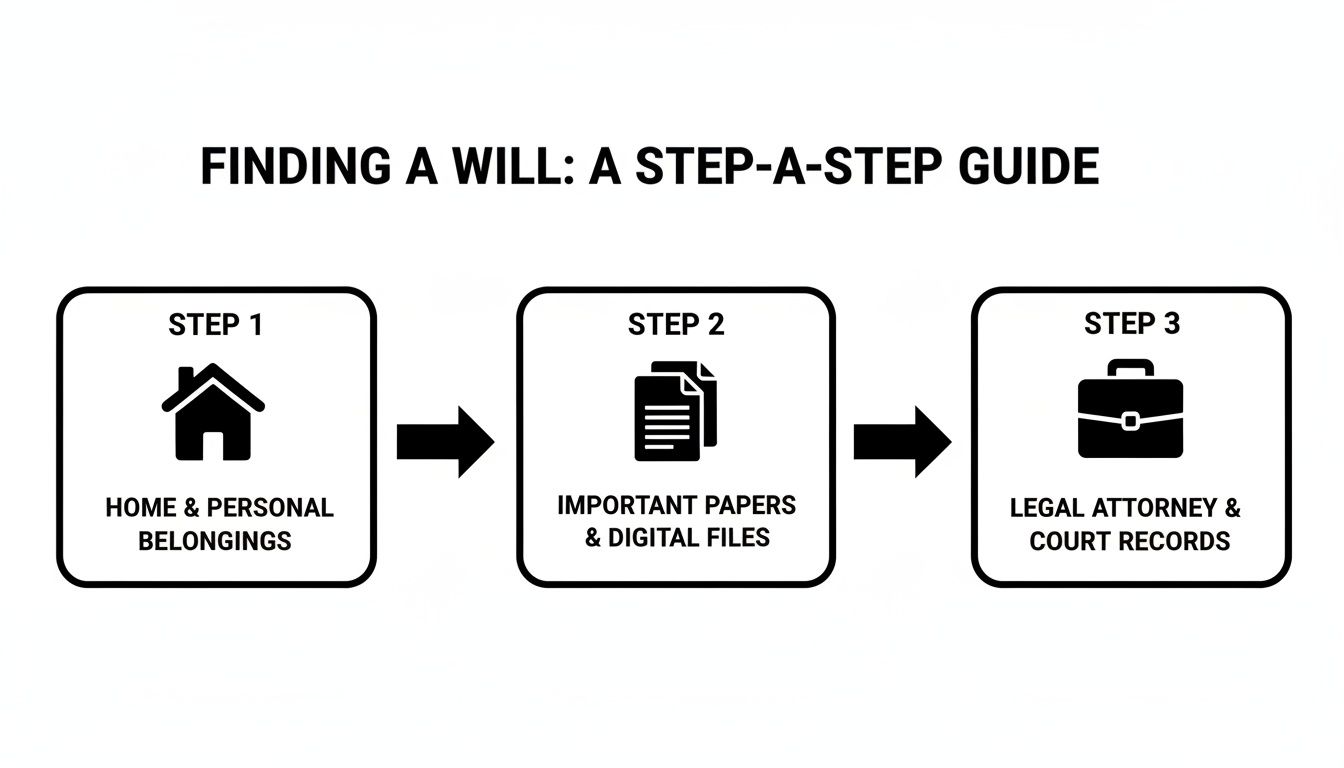
As you can see, the process is a logical one. You start at home and then expand your search outward to professional contacts if needed.
Creating a Search Plan
A methodical approach is your best friend here. Start by making a list of every potential spot your loved one might have stored important papers. This isn’t just for efficiency; it’s also a critical step because a Texas probate court, such as the Harris County Probate Court, may require you to document your search efforts if the original will can't be found.
Here's a simple checklist to get you started, covering the most logical places to begin your search for a will.
Initial Will Search Checklist and Key Pointers
| Location to Search | What to Look For | Key Tip |
|---|---|---|
| Home Office / Desk | Folders labeled "Will," "Estate," or an attorney's name. | Look in the most obvious places first, but don't forget hidden compartments or unusual storage spots. |
| Personal Safe / Firebox | The original, signed and witnessed will document. | These are designed for vital documents, making them a top-tier location to check early in your search. |
| Safe Deposit Box | Original will, deeds, titles, and other critical financial or legal papers. | Gaining access might require a court order, a process a probate attorney can help you navigate if necessary. |
| Filing Cabinets | Any legal correspondence, drafts of wills, or business cards from law firms. | Even a draft or a copy can provide the name of the attorney who holds the original document. |
This table isn't exhaustive, but it covers the high-probability areas where a will is most often kept. As you work through your search, keep detailed notes of where you looked and what you found.
What to Look For
While finding the original signed will is the ultimate goal, don't get discouraged if you only find related documents. Business cards, old invoices, or letters from law firms or estate planning attorneys can be just as valuable. Finding a copy of the will, for instance, almost always leads you to the attorney who has the original stored safely.
A will is the foundational document for settling an estate. The person named in the will to manage this process is the executor. Understanding their responsibilities is key to moving forward once the will is located.
Once you find the will, the next step is understanding the role of the person named to carry out its instructions. You can learn more about what an executor does in our detailed guide. Taking these initial steps carefully builds a solid foundation for the entire probate process ahead.
Searching Personal Papers and Safe Deposit Boxes
Once you've checked the most obvious spots, it's time to dig a bit deeper into your loved one's personal spaces. Finding a will often means you have to think like they did. Where would they have tucked away their most important document? This requires looking beyond the main file cabinet with a more careful eye.
Prime locations are usually a home office, a personal safe, or a fireproof box. Look for folders labeled "Estate Planning," "Last Will," or maybe the name of a law firm. But people sometimes store critical papers in the most unexpected places—a bottom drawer they rarely used, tucked inside a specific book, or even bundled with old family photos and other sentimental items.
Uncovering Digital Clues
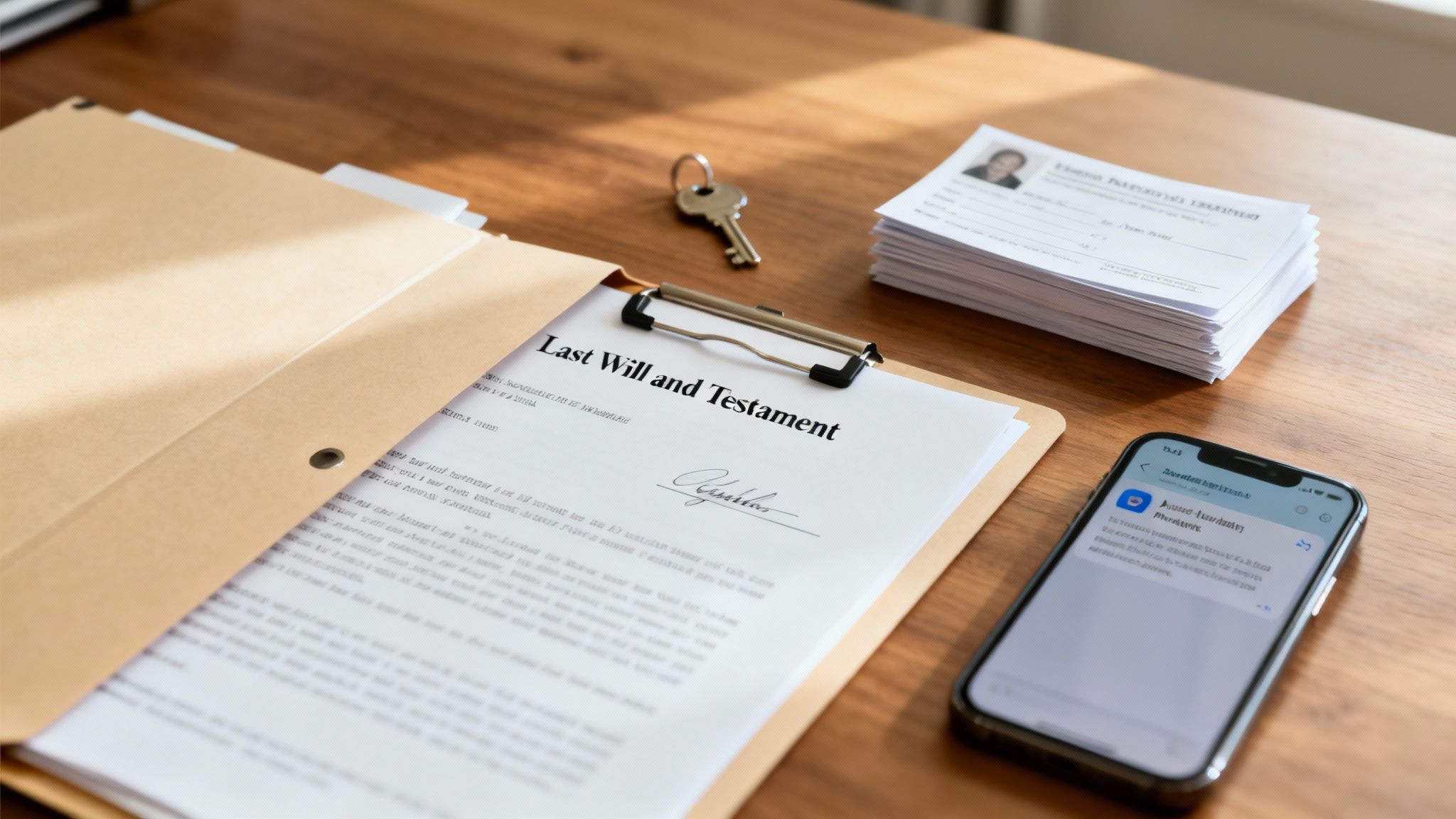
Don't just look for paper. It's just as important to check digital files. A personal computer, laptop, or even an external hard drive could hold drafts of a will, emails back and forth with an attorney, or scanned copies of the signed documents.
Try searching for file names that include words like:
- Will
- Testament
- Estate
- Trust
- Executor
Finding a digital copy isn't the same as finding the original, legally signed document, but it's a huge clue. It can confirm a will actually exists and, most importantly, point you to the attorney who drafted it. That person will likely have the original, legally binding version in their files.
How to Access a Safe Deposit Box in Texas
One of the most common places people store an original will is a bank safe deposit box. This creates a classic catch-22: if you're not a co-owner or signatory on the box, the bank legally cannot let you in. It’s a standard security measure, but for families, it can feel like hitting a brick wall.
Imagine two siblings in Houston whose father just passed away. They know he had a safe deposit box at his local bank, but he never added them to the account. When they go to the bank, the manager has to explain that without legal authority, their hands are tied. This is an incredibly common and frustrating situation, but Texas law provides a solution.
So, what can they do? Thankfully, there's a specific legal process under the Texas Estates Code, Section 151.001, to get limited access to a safe deposit box specifically to look for a will.
The law gives you a path forward, but you have to follow the steps precisely. It typically requires a court order that authorizes the bank to open the box, but only in the presence of a bank officer, to search for a will and other specific documents like burial plot info or life insurance policies.
To get the ball rolling, you'll generally need to file an application with the proper probate court, like the Harris County Probate Court. This application asks the court for an order to let the bank examine the contents of the box. You will absolutely need to provide a copy of the death certificate with your application.
What Happens After You Get a Court Order
Once the court grants the order, you can take it to the bank. A bank officer will then open the box with you present. It's critical to understand that this court-ordered access is very limited.
- You can only look for specific documents: The main goal is finding the will. You're also allowed to look for a deed to a burial plot or any life insurance policies.
- The will is not handed to you: If a will is found, the bank officer is required to deliver it directly to the clerk of the court that issued the order.
- Everything else stays put: Any other valuables—jewelry, cash, property titles—must remain secured in the box until an executor or administrator is legally appointed to manage the entire estate.
This process makes sure the will is properly filed with the court while protecting the rest of the estate's assets. It might seem like a lot of hoops to jump through, but following these steps correctly will prevent major legal headaches down the road. Looking at a Texas last will and testament sample can help you recognize what you're looking for.
And don't forget to think outside the box—literally. Beyond banks, check any self-storage facilities where your loved one might have kept important documents. Getting into one of those often requires similar legal paperwork. Getting guidance from an attorney early in this process can save you a ton of time and frustration by making sure you meet all the legal requirements right from the start.
Contacting Professionals and Other Institutions
If your search through personal papers and safe deposit boxes has come up empty, don't panic. This is a very common scenario, and it doesn't mean you've hit a dead end. The next logical step is to widen your search to the circle of professionals your loved one trusted with their legal and financial life.
Attorneys, accountants, and financial advisors are often deeply involved in the estate planning process. There's a good chance that one of them either has a copy of the will, is holding the original for safekeeping, or can at least confirm whether one was ever drafted.
Reaching Out to the Right People
Start by going through any business cards, old invoices, or professional correspondence you found during your initial search of the home. These documents are your road map. You're looking for the names of professionals your loved one worked with, specifically in these key roles:
- Estate Planning Attorney: This is your most direct line. The lawyer who helped draft the will is the most likely person to have the original signed document or a copy.
- Accountant or CPA: Tax professionals often have a bird's-eye view of a person's financial situation and are frequently consulted during estate planning. They might have a copy for their records or know which attorney was used.
- Financial Advisor or Planner: Much like accountants, financial advisors need to understand a client's estate plan to manage their investments properly. They're another excellent source of information.
Once you have a name, a simple phone call is the most effective way to start. When you call, just be ready to provide your name, how you were related to the deceased, and their date of death.
A Pro Tip for Your Calls: I always tell my clients to keep a simple log of every call they make. Jot down the date, who you spoke with, and a quick note on what they said. This documentation shows you've done your due diligence, which can be surprisingly important for the probate court later on.
A Dallas Family’s Experience
Let’s walk through a realistic scenario. Imagine a family in Dallas is looking for their mother's will. They've searched her house top to bottom and found nothing but a folder of old tax documents prepared by a local CPA. With no other leads, they decide to call the CPA's office.
The conversation could go something like this: "Hello, my name is Sarah, and I'm the daughter of Jane Smith, who passed away recently. We're trying to locate her will and saw that your firm handled her taxes. I was hoping your records might show which attorney she used for her estate planning?"
In this case, the CPA checks his client file and finds a note mentioning a specific law firm downtown. He gives Sarah the name and number. With that one phone call, the family now has a direct lead to the firm holding their mother’s original will. It's a perfect example of how one professional can unlock the whole puzzle.
What to Say and How to Say It
Making these calls can feel a bit awkward, but having a clear, respectful script makes it much simpler. Remember, you're just gathering information.
Here’s a practical script you can adapt:
"Good morning, my name is [Your Name]. I am the [son/daughter/spouse] of [Deceased's Name], who passed away on [Date]. We are in the process of locating their last will and testament and believe they may have been a client of yours. Could you please check your records to see if you have any information about their estate plan or the original will?"
Keep in mind, these professionals are bound by confidentiality, but they can usually confirm if they have a will on file once you provide a death certificate. If they do, they'll tell you the next steps for getting it filed with the right court, like the Dallas County Probate Court. Having an experienced legal guide can make all the difference, and our guide on finding the best probate attorney in Dallas can help you understand what to look for.
It's also important to manage your expectations. A tough reality many families face is that a surprising number of adults never actually create a will. Surveys consistently show that more than half of American adults die "intestate" (without a will), forcing families to search for a document that may not exist. For example, a 2023 report found that only 47% of people knew that a will typically has to go through probate court, highlighting a major gap in public understanding of the process. If you want to dive deeper, you can read the full research on estate planning trends.
This is exactly why a methodical search is so critical. By contacting these professionals, you can either find the will or confidently conclude that one was likely never made—and knowing that for certain is crucial for figuring out what to do next.
Searching Public Records at the County Clerk
If you’ve searched through personal belongings and called all the likely professional contacts with no luck, your next move is to check the public record. This is a step many people miss, but it can be the one that gives you a definitive answer. In Texas, the county clerk’s office is the official keeper of these kinds of vital records, and knowing your way around their system can bring some much-needed clarity.
A little-known option in Texas allows people to file their will for safekeeping with the county clerk before they pass away. It's not something you see every day, but it's absolutely worth checking. The whole point of this service is to make sure an original will is preserved and easy to find when the time comes.

This entire process is laid out in the Texas Estates Code, which spells out how someone can deposit their will. To see if your loved one took this step, you’ll need to get in touch with the county clerk in the county where they lived.
How to Check for a Will Filed for Safekeeping
It's a pretty straightforward process, but it requires you to contact the right county office directly. For example, if your family member lived in Houston, you’d reach out to the Harris County Clerk. If they were in Austin or Dallas, you'd contact the Travis County Clerk or Dallas County Clerk, respectively.
When you call or visit, you'll generally need to have a few things handy:
- Your loved one's full legal name
- Their date of death
- A copy of the death certificate
With that information, a clerk can look through their records to see if a will was ever deposited. If they find one, they'll walk you through the next steps to get it officially filed with the probate court.
Searching Online Probate Records
Another critical search is to find out if someone else has already started the probate process. This is especially important in families with complicated dynamics or where communication isn't always great. The good news is that many Texas counties now have online portals for their court records, making this something you can often do from your own home.
Major counties like Harris, Dallas, and Travis have pretty solid online systems. On the Harris County District Clerk's website, for instance, you can search for probate cases using the deceased person’s name. This will tell you if a case is open, who the executor or administrator is, and even which attorney is handling everything.
A quick online search of probate records can head off a world of confusion and duplicated effort. It lets everyone know if legal proceedings are already underway and can stop you from accidentally starting a second, unnecessary court process.
A Practical Example of an Online Search
Let's say you're trying to find information for your late uncle, John Doe, who lived in Harris County. Here’s what that process would generally look like:
- Go to the Harris County District Clerk’s Website: First, you'd find their online case search tool.
- Enter the Search Details: In the party search field, you'd type in "Doe, John." Some systems let you narrow it down further by adding a date of death.
- Look Over the Results: The search will pull up any probate cases that match the name. You might see something like "The Estate of John Doe, Deceased."
- Check the Case Details: Clicking on the case will usually let you see the docket sheet, which is a running log of every document filed and every action the court has taken. You’ll be able to see who filed the application for probate and the name of their lawyer.
This simple search can instantly clear up the estate's status. If you discover a case has already been opened, your next step is to contact the attorney on record. If the search turns up nothing, that's more evidence that you might be the one who needs to start the probate process. Either way, this step gives you direction and moves you closer to settling your loved one's affairs.
What Happens in Texas When There's No Will?
After turning over every stone—sifting through personal papers, calling professionals, and checking public records—you might face the tough reality that your loved one didn't leave a will. This can be a gut-wrenching discovery, especially when you worry the state's plan won't match what they would have wanted. It's a difficult moment, and my goal here is to bring some clarity to what comes next.
When someone dies in Texas without a valid will, their estate is called intestate. This means that instead of following your loved one’s written instructions, the court will divide their property based on a default set of rules found in the Texas Estates Code.
This legal framework is designed to be predictable, but it's a rigid, one-size-fits-all solution. It can't possibly account for unique family dynamics, personal promises, or complicated relationships. Moving from the search for a will to understanding this legal path is a major shift.
Understanding Texas Intestacy Laws
The rules for intestate succession are basically a formula based on the deceased's family tree, dictating who gets what. The law gives top priority to the closest relatives, starting with the surviving spouse and children. But the exact distribution gets surprisingly specific depending on the family structure and the type of property involved.
Under the Texas Estates Code, Chapter 201, the law draws a hard line between two kinds of property:
- Community Property: This is almost everything acquired by either spouse during the marriage.
- Separate Property: This includes assets owned before the marriage or anything received during the marriage as a gift or inheritance.
How these assets get split up depends entirely on who survived the deceased.
The core idea behind intestacy is simple: Texas law creates an estate plan for people who didn't make one for themselves. While it's an orderly system, it's completely inflexible and often doesn't reflect what a person truly wanted or what a family actually needs.
Common Inheritance Scenarios Without a Will
To make this less abstract, let’s walk through a few common family situations. These examples show how Texas intestacy laws play out in the real world, often with results that catch families completely off guard.
Scenario 1: Surviving Spouse and Their Shared Children
- The Situation: A husband dies, leaving his wife and the children they had together.
- The Outcome: The wife inherits all the community property. She also gets one-third of her husband's separate personal property (like cash, stocks, or cars) and the right to use their separate real estate for the rest of her life. The children inherit the other two-thirds of his separate property.
Scenario 2: Surviving Spouse and Children from Another Relationship
- The Situation: A wife passes away. She is survived by her current husband and her children from a previous marriage.
- The Outcome: Her husband keeps his one-half of the community property. The wife’s one-half share goes directly to her children. For her separate property, the husband gets one-third of the personal property and a "life estate" in the real property, with the rest going to her children. This can create seriously complicated co-ownership issues between the surviving spouse and step-children.
It’s easy to see how these default rules can quickly create messy legal and financial entanglements, especially in blended families.
The Legal Process for an Intestate Estate
Without a will, you can't use the standard probate process. Instead, you'll need to start a different kind of court case. The two most common routes are an Application to Determine Heirship or an Administration of the Estate.
An heirship proceeding is a formal court process to legally identify and declare the deceased's heirs. The court will appoint an "attorney ad litem" to track down and represent any unknown or missing heirs, making sure everyone's potential interests are protected. Once the judge signs a Judgment Declaring Heirship, that document becomes the official proof of who is entitled to the property.
Even when a will is found, getting it through the courts is becoming a longer ordeal. Recent data shows a 65% rise in probate cases taking over a year, bogged down by administrative delays. When a will is missing entirely, these delays can stretch even further as the court demands extensive proof to figure out who the rightful heirs are. You can learn about the findings on modern probate delays to get a better sense of these challenges.
Navigating an intestate estate demands skilled legal guidance to make sure you meet every requirement of the Texas Estates Code. Whether you need to establish heirship or administer an estate, having an experienced attorney from The Law Office of Bryan Fagan can help you manage the process with confidence. To get help with your specific situation, please schedule a free consultation with our compassionate team today.
Why You Need an Experienced Probate Attorney
So, where do you go from here? Whether your search for the will was successful, turned up just a copy, or left you completely empty-handed, the next part of the journey almost always leads to the Texas probate system. This is precisely the point where bringing an experienced attorney on board becomes critical to protecting your family’s interests and truly honoring your loved one’s legacy.

A skilled probate lawyer does far more than just file some paperwork with the Harris County Probate Court. Think of them as your strategic guide, your direct line of communication with the court, and a steady, compassionate hand to guide you through what is almost always an emotionally draining time.
Navigating Complex Legal Scenarios
Every family's situation is unique, and each one demands a different legal strategy. A good attorney brings clarity to the table, helping you understand the best path forward while making sure every action complies with the Texas Estates Code.
Here are just a few common situations we see where professional guidance is not just helpful, but essential:
- Probating a Copy of a Will: Did you only find a copy? Texas law doesn't make it easy. Proving a copy is a valid reflection of the decedent's final wishes involves a much more complex court proceeding. You'll need to overcome a legal presumption that the original was destroyed on purpose.
- Initiating Heirship Proceedings: When no will can be located, you can't just divide the assets. An attorney will need to guide you through a formal court process to legally declare who the heirs are according to state law.
- Resolving Family Disputes: Grief can bring out the worst in family dynamics. If disagreements pop up—and they often do—a lawyer can help mediate the conflict or, if necessary, represent your interests in court to prevent the estate from being drained by costly litigation.
At The Law Office of Bryan Fagan, our entire approach is built on clarity and care. We work to demystify the legal maze, giving your family the confidence to make informed decisions and find a way forward.
The path ahead might feel intimidating, but you absolutely do not have to walk it alone. Our team has helped countless Texas families navigate these exact same challenges. For personalized guidance on your family's specific needs, we invite you to schedule a free consultation with our team today.
Common Questions When Searching for a Will
The search for a will can bring up some specific, often urgent, questions. Let's tackle a few of the most common concerns we hear from Texas families to give you some clarity during this tough time.
What Happens If We Can Only Find a Copy of the Will?
Finding only a copy of a will isn't a dead end in Texas, but it does make the court process a bit more complicated. You can probate a copy, but you'll have to prove to the judge that the original document was simply lost and wasn't intentionally destroyed or revoked by the person who passed away.
This usually involves showing evidence of your thorough search for the original and might even require testimony from witnesses. Having an experienced probate attorney on your side is critical here, as they'll know how to meet the specific legal standards for getting a copy validated in court.
How Long Do I Have to Find and File a Will in Texas?
In Texas, you generally have four years from the date of the person's death to file their will for probate. This deadline is extremely important.
If you miss this four-year statute of limitations, probating the will becomes incredibly difficult. You’d have to convince the court that you weren't at fault for the delay, which is a high legal bar to clear. This is why a prompt and exhaustive search is so crucial.
Can I Get into a Safe Deposit Box If I'm Not a Signatory?
No, the bank won't grant you access to a safe deposit box without legal authority. If your name isn't on the account as a co-owner, you’ll need a court order to get it opened.
A probate attorney can help you petition the court for a specific order under the Texas Estates Code. This court order instructs the bank to open the box, but only in the presence of a bank officer, and only for the purpose of looking for a will, a burial plot deed, or life insurance policies.
Navigating the complexities of locating a will and the probate process that follows requires a steady, knowledgeable hand. At The Law Office of Bryan Fagan, PLLC, we provide Texas families with compassionate and clear legal guidance on probate, estate planning, and guardianship matters. Schedule a free consultation with us today to discuss your situation and get the support you need.