Skip to content
When a loved one passes away, being named the executor of their will is both a tremendous honor and a serious undertaking. We understand this role often arrives during a time of grief, adding legal and financial duties to an already emotional period. It means your loved one trusted you, above all others, to carry out their final wishes.
As the executor, you are legally tasked with navigating the entire process of settling their final affairs—everything from finding property to making sure assets get to the right family members and loved ones. It's a job that demands diligence, integrity, and a careful understanding of Texas law. At The Law Office of Bryan Fagan, our mission is to guide Texas families through these challenges with clarity and care.
What an Estate Executor in Texas Is Truly Responsible For
Stepping into the executor role is a major responsibility, and it usually happens while you're also grieving. The best way to think about it is that you've been named the captain of a ship—the estate—and your job is to steer it through the legal waters of probate until it reaches its final destination: the beneficiaries. This journey is about honoring your loved one’s legacy with precision and compassion.

This entire process is officially known as estate administration. It involves a sequence of specific duties that must be handled in the correct order. Every step is guided by the Texas Estates Code, and missing a step can lead to frustrating delays, family disputes, and even put you at risk of personal financial liability.
Your Fiduciary Duty
At the very core of being an executor is what the law calls a fiduciary duty. This isn't just a fancy legal term; it's the highest standard of care recognized by law. It legally obligates you to act solely in the best interests of the estate and its beneficiaries, period. We know this sounds daunting, but understanding this duty is key to protecting both the estate and yourself.
This duty requires you to be:
- Loyal: You must put the estate's interests ahead of your own. For example, you cannot sell estate property to yourself for a discounted price.
- Prudent: You have to manage the estate's assets responsibly, just as any careful person would manage their own property.
- Impartial: You must treat every beneficiary fairly and according to the terms of the will, without playing favorites.
An executor’s fiduciary duty isn't just a suggestion—it is a legal mandate. Texas courts, like the Harris County Probate Court, take this responsibility very seriously. Any breach can result in your removal as executor and significant financial penalties.
The Scope of Your Responsibilities
To give you a clearer picture of what's involved, we can break down your duties into several key categories. The world of inherited assets and legal obligations is vast, and getting familiar with general trusts and estates law can provide helpful context.
The table below offers a high-level roadmap of what's ahead. Think of it as your starting point.
An Executor's Core Responsibilities at a Glance
| Duty Category | Key Tasks and Responsibilities |
|---|---|
| Initial Steps & Probate | Locate the will, hire a probate attorney, and file the will with the appropriate Texas court to receive official authority (Letters Testamentary). |
| Asset Management | Secure all estate property, create a detailed inventory of assets and debts, and open a dedicated estate bank account to manage finances. |
| Creditor Notification | Formally notify all known and potential creditors of the death and evaluate the validity of any claims they submit against the estate. |
| Financial Obligations | Pay all legitimate debts, funeral expenses, and taxes from estate funds. This includes filing the deceased's final income tax return. |
| Asset Distribution & Closing | Distribute the remaining assets to the beneficiaries according to the will, get receipts, and file the necessary documents to formally close the estate. |
Seeing it all laid out like this might seem overwhelming, but you don't have to do it alone. Understanding these duties is the first, and most critical, step toward successfully fulfilling your role and honoring the trust placed in you.
Your First Steps: Securing and Inventorying Estate Assets
Once the court officially appoints you as executor, your very first duty is to step into the role of protector for the estate. Think of yourself as the immediate guardian of everything your loved one owned. This isn't just a suggestion; it’s a critical legal responsibility to prevent any property from being lost, damaged, or stolen while the estate is being settled.
Your first practical moves should be focused on securing all physical property. This means you may need to change the locks on the deceased's home in Harris County, ensure vehicles are parked securely, and gather valuable items like jewelry and heirlooms to put them in a safe place. You also have to confirm that important insurance policies, like homeowner's and auto insurance, are still active to protect the estate from potential liability.
Locating the Will and Gathering Key Documents
Before you can truly begin, you must find the original, signed last will and testament. This document is the cornerstone of the entire probate process. It lays out your loved one's final wishes and is the document that names you as the executor. It might be in a safe deposit box, a home safe, or filed with their attorney. For families struggling with this crucial first step, our guide on how to find a deceased person's will can offer valuable direction.
At the same time, you'll need to order several official copies of the death certificate. You'll need these for almost every task ahead, from notifying banks and government agencies to closing accounts.
The Foundation of Your Duties: The Estate Inventory
With the will in hand and the property secured, your next major task is to create a detailed inventory of everything the deceased owned. This isn't just a casual list. It's a formal, legal document required by Texas law known as the “Inventory, Appraisement, and List of Claims.” This document becomes the financial foundation for the entire probate process.
Under Texas Estates Code § 309.051, an executor must file this inventory with the court, usually within 90 days of being officially appointed. It must be a complete and sworn accounting of all estate property.
Think of the estate inventory as a complete financial snapshot of your loved one’s life at the moment of their passing. A thorough and accurate inventory is essential for transparency and ensures a fair and proper distribution to beneficiaries down the line.
The inventory must include everything, from obvious assets to those easily overlooked.
- Real Estate: Homes, land, or commercial properties, with their full legal descriptions.
- Financial Accounts: All checking and savings accounts, CDs, and money market accounts.
- Investments: Any stocks, bonds, mutual funds, and brokerage accounts.
- Vehicles: Cars, trucks, boats, and recreational vehicles.
- Personal Property: This covers furniture, art, collectibles, and general household goods. An executor's key initial duty is to accurately identify all assets, including items with specialized value. Learning about the nuances of understanding estate jewelry can be a valuable resource during this process.
- Life Insurance Policies: But only if the estate itself is named as the beneficiary.
While most people have a general idea of what an executor does, many are surprised by the immediate and detailed nature of these first steps. Research shows that 44% of people didn't realize an executor has to secure property right after a death. This initial phase is demanding, but getting it right protects both the estate and you from serious complications later on.
How to Navigate the Texas Probate Process
The word "probate" can sound intimidating, but it's really just the court-supervised process for validating a will. It’s how the court officially gives you, the executor, the legal green light to begin your work. Think of it as a formal journey with clear signposts that, with the right guidance, you can navigate successfully. This step is what transforms your designated role into a legal authority.
Let’s imagine "Maria," who has just been named the executor for her father's estate in Travis County. She's grieving but also feels the weight of her responsibilities. Her first step is to team up with an experienced probate attorney. Together, they file an Application to Probate Will and for Issuance of Letters Testamentary with the county court. This application officially starts the probate process.
The Court Hearing and Getting Your Authority
Once the application is filed, the court schedules a brief, formal hearing. Maria's attorney ensures she knows exactly what to expect. At the hearing, Maria gives simple testimony to a judge, confirming basic facts about her father and his will. This is typically a very straightforward procedure to confirm the will is authentic.
After the judge validates the will, they sign an order officially admitting it to probate. Shortly after, the court clerk issues a critical document: the Letters Testamentary.
Think of Letters Testamentary as your official badge of authority. This one-page certificate is the legal proof you’ll show to banks, financial institutions, and anyone else who needs to know you have the right to manage the estate’s assets. Without it, you can't access accounts or transfer property.
The graphic below highlights the first crucial steps every executor needs to tackle. These actions lay the foundation for a smooth probate filing.
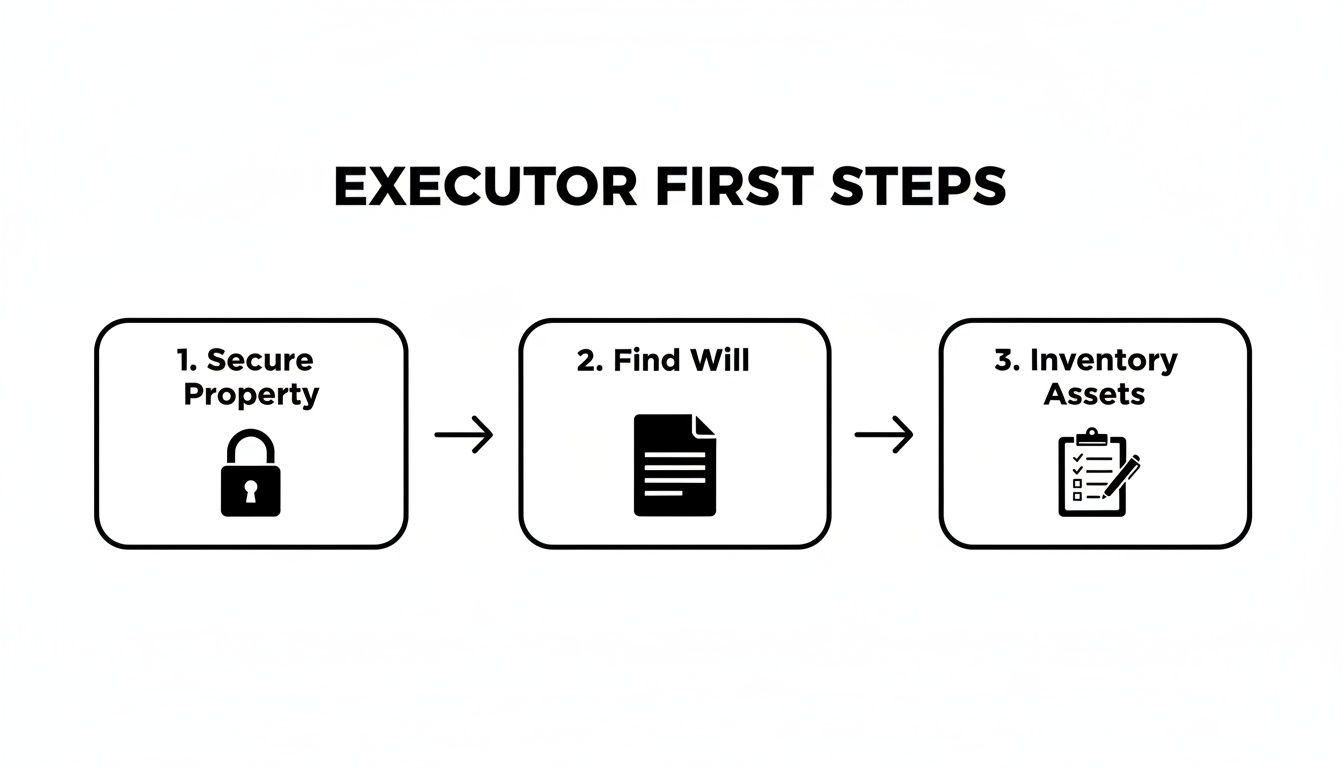
This initial sequence—securing property, locating the will, and starting an inventory—is the bedrock upon which your entire probate application will be built.
Understanding Independent Administration in Texas
One of the most helpful aspects of probate law in Texas is the concept of independent administration. Most modern Texas wills are drafted to include this, and it makes an executor's job significantly easier and less stressful.
What does that mean for you?
- Less Court Supervision: With independent administration, you can handle most duties—paying debts, selling property, and distributing assets—without needing court permission for every action.
- Lower Costs: Less court involvement means fewer legal filings and hearings, which translates to lower attorney's fees and court costs for the estate.
- A Faster Process: Cutting out the need for constant court approval helps you settle the estate far more efficiently.
This streamlined approach is allowed under Title 3, Subtitle G of the Texas Estates Code, which was designed to make settling estates more manageable for Texas families. If the will doesn't mention independent administration, it can sometimes be granted if all beneficiaries agree. For a more detailed look, you can learn more about the steps for probating a will in Texas in our complete guide.
Getting through the probate process is a cornerstone of your role. While the legal steps are clear, the emotional and financial weight can feel overwhelming. At The Law Office of Bryan Fagan, we understand you're carrying both burdens. We are here to guide Texas families through these procedures with clarity and compassion. Schedule a free consultation with us today and feel the peace of mind that comes from having a dedicated partner on your side.
Managing Estate Debts, Taxes, and Finances
This is where your duties as an executor become most critical. Managing the estate’s finances is where your fiduciary duty is truly tested. If mistakes are made here, you can be held personally liable.
Think of yourself as the accountant for a business that's closing its doors. Before anyone receives their inheritance, you must account for every penny, pay every outstanding bill, and settle up with the government. Only then can the remaining assets be distributed to the beneficiaries. This is a fundamental part of an executor's role.
Notifying and Paying Creditors
Before a single beneficiary receives anything, the estate’s legitimate debts must be paid. The Texas Estates Code lays out a specific process for this, starting with giving creditors official notice. This is a legal requirement designed to protect everyone involved from future claims.
You'll need to handle two types of notice:
- Published Notice: You must publish a general announcement in a local newspaper in the county where the probate was filed. For an estate in Harris County, for example, that would be a publication like the Houston Chronicle. This notice alerts any unknown creditors and gives them a timeframe to make a claim.
- Direct Notice: For any debts you already know about—like mortgages, car loans, or credit card bills—you are required to send a formal, written notice directly to that specific creditor.
Once a creditor submits a claim, it's your job to review it. Is the debt valid? Is the amount correct? You have the power to either accept or reject their claim. If you pay an invalid debt or overpay a creditor, you could be personally responsible for that loss to the estate. All valid debts, funeral bills, and administrative costs are paid from the estate’s bank account.
It's absolutely essential to know which assets are part of this process and which aren't. Our guide on probate and non-probate assets breaks this down clearly.
Handling Tax Obligations
Just like debts, taxes are a non-negotiable part of closing an estate. As the executor, you're responsible for filing all necessary tax returns for both the deceased person and for the estate itself. Missing deadlines or filing incorrectly can lead to penalties and interest, which are paid from the estate's funds—reducing what the beneficiaries receive.
Here are the main tax filings you’ll likely be responsible for:
- The Decedent’s Final Income Tax Return (Form 1040): This covers the income the person earned from January 1st of the year they died up to their date of death.
- The Estate’s Income Tax Return (Form 1041): An estate becomes a separate taxable entity. If it generates more than $600 in income during the year (from things like dividends or interest), you must file this return.
A major source of stress for families in Texas is the federal estate tax. Here’s the good news: for 2024, the federal estate tax exemption is a staggering $13.61 million per person. This means that unless your loved one’s estate is valued above this incredibly high amount, you won't owe any federal estate tax.
Handling these financial tasks demands an organized system. From notifying creditors to filing that final tax return, every step needs precision. Getting this right fulfills your legal duties and ensures you're honoring your loved one's legacy responsibly. If you're feeling overwhelmed by the financial details, The Law Office of Bryan Fagan is here to provide clarity. Schedule a free consultation to make sure every financial move is the right one.
Distributing Assets and Closing the Estate
You’ve reached the final leg of your journey as an executor. This is the moment you get to honor the wishes your loved one carefully laid out in their will. After the hard work of securing assets, navigating probate, and settling every bill, this final phase brings a sense of closure. It's where your diligence pays off as the estate’s legacy is officially passed on to the beneficiaries.

There’s a critical order you have to follow: You must pay all legitimate debts, final taxes, and estate administration expenses before distributing assets to any beneficiary. Distributing assets too early can create a legal nightmare, potentially making you personally liable for the estate’s unpaid obligations.
The Practical Steps of Transferring Assets
Once all bills are settled, you can finally start transferring the remaining assets to the heirs named in the will. How you do this depends on the type of asset.
For instance, getting an inheritance into the right hands can look a few different ways:
- Cash Bequests: For specific cash gifts (like "$10,000 to my nephew"), you’ll simply write a check from the dedicated estate bank account.
- Real Estate: If a home is left to someone, you'll work with an attorney to draft and file a new deed to legally transfer ownership. If the will says to sell the house and split the money, you'll manage that sale and then distribute the cash.
- Vehicles: To transfer a car, you’ll have to retitle the vehicle in the beneficiary's name through the Texas Department of Motor Vehicles.
- Financial Accounts: Moving investment or retirement accounts usually means working directly with the financial institution to officially transfer ownership.
The Importance of Receipts and Final Accounting
For every asset you hand over, it is crucial to have the beneficiary sign a receipt. This document, often called a Receipt and Release, is your official proof that they’ve received their inheritance. It protects you from any future claims that a beneficiary didn’t get what they were owed.
Before making final distributions, it's also a smart move to provide all beneficiaries with a final accounting. This is a clear summary of all financial activity that occurred while you managed the estate. It should show:
- The initial value of the estate's assets.
- Any income the estate earned (like interest or dividends).
- A list of all debts, taxes, and expenses that were paid.
- The final amount each beneficiary is set to receive.
Think of the final accounting as a transparent closing statement. It provides clarity and reassurance to the beneficiaries, showing them that you managed their loved one's estate with integrity and care, fulfilling your fiduciary duty.
Once every beneficiary has signed their receipt and all assets are distributed, you can formally close the estate. This might involve filing a final report with the probate court in a county like Bexar County, which officially wraps up your duties as executor.
This final stage is both a relief and a major responsibility. The Law Office of Bryan Fagan is here to make sure this last step is handled flawlessly, protecting both you and the estate. For personalized guidance on asset distribution and estate closure, Schedule a free consultation with our compassionate legal team today.
Common Executor Mistakes and When to Get Help
Taking on the role of an estate executor is a marathon, not a sprint, especially while you're navigating your own grief. The sheer volume of tasks and strict legal deadlines under the Texas Estates Code can make even the most organized person feel overwhelmed. This is a job where good intentions aren't enough; you need precision and timeliness to protect both the estate and yourself.
The emotional and practical weight of these duties can be immense. The numbers don't lie—this insightful ClearEstate poll shows that 74% of executors felt settling an estate was one of the most difficult challenges they'd ever faced. On top of that, 63% reported that the responsibility completely disrupted their personal or professional lives.
Errors That Can Lead to Personal Liability
Even a small misstep can quickly snowball into a major legal and financial headache. As an executor, your fiduciary duty means you can be held personally responsible for any financial losses if you breach that duty, even accidentally.
Here are some of the most common—and costly—mistakes we see:
- Distributing Assets Too Soon: It's tempting to start giving assets to beneficiaries right away, but if you do it before all debts and taxes are settled, you could be in for a nasty surprise. Should an unexpected creditor or tax bill appear later, you might have to cover that debt out of your own pocket.
- Failing to Communicate: Keeping beneficiaries in the dark is a recipe for disaster. When people don't know what's going on, they tend to assume the worst. A lack of clear, regular updates breeds mistrust, fuels family disputes, and can lead to legal challenges that halt the entire process.
- Missing Critical Deadlines: The probate process has many deadlines, from filing the inventory with the court to paying taxes. Missing one can trigger fines and penalties that reduce the value of the estate.
Knowing When to Ask for Professional Guidance
Recognizing that you need help is a sign of strength. Trying to juggle every legal and financial detail on your own, especially if you've never done this before, is an unnecessary risk. Hiring a probate attorney isn’t admitting defeat; it’s a smart, strategic move to protect the estate, maintain family peace, and shield yourself from personal liability.
Hiring an experienced probate lawyer is like bringing on a professional navigator for a complex journey. They know the route, anticipate the obstacles, and ensure you reach your destination safely and efficiently, honoring your loved one’s final wishes without costly detours.
The compassionate attorneys at The Law Office of Bryan Fagan act as your professional guide, making sure every step you take is compliant, organized, and as stress-free as possible. We handle the legal complexities so you can focus on your family. To gain the clarity and confidence you deserve in this important role, Schedule a free consultation with our team today.
Common Questions About Executor Duties in Texas
When you step into the role of an executor, you’re bound to have questions. It’s a significant responsibility, and navigating the legal and practical duties can feel overwhelming. Below, we've answered some of the most common concerns we hear from Texas families, giving you the straightforward information you need to move forward.
How Long Does It Take to Settle an Estate in Texas?
Every family's situation is unique, but a relatively straightforward estate in Texas usually takes between 9 and 12 months to settle completely. This timeframe provides enough room to handle essential steps like probating the will, notifying creditors, and filing tax returns.
Of course, things can get complicated. If the will is contested, beneficiaries are hard to find, or you run into major disputes, the process can stretch out for months or even years. This is where an experienced probate lawyer can make all the difference, helping you manage these roadblocks efficiently.
Can I Get Paid for My Work as an Executor?
Yes, absolutely. Texas law recognizes that being an executor is a lot of work. Because of this, you are allowed to receive reasonable compensation for your services. The Texas Estates Code § 352.002 even sets out a standard commission structure.
As a general rule, the commission is five percent (5%) of all the cash the estate receives and five percent of all the cash it pays out. An attorney can help you determine the appropriate fee, especially if the will has specific instructions or the estate is particularly complex.
What Happens If I Make a Mistake as an Executor?
This is a critical point to understand. As an executor, you have a "fiduciary duty" to the estate, which is the highest standard of care recognized by law. This means you can be held personally liable for any financial losses the estate suffers because of your mistakes or negligence.
For instance, if you distribute assets to beneficiaries before paying off all the estate's debts or fail to manage the funds properly, you could be on the hook to personally cover that shortfall. This personal risk is one of the biggest reasons why getting professional legal guidance from a firm like The Law Office of Bryan Fagan is so important.
Do I Have to Hire a Lawyer to Be an Executor?
While Texas law doesn't always force you to hire an attorney, it is highly recommended. The probate process is filled with court filings, strict legal deadlines, and complex financial duties that are easy to get wrong.
A good probate attorney does more than just fill out paperwork. They protect you from personal liability, make sure you meet every legal requirement on time, and provide invaluable support during what is often a very difficult and emotional period for your family.
The duties of an estate executor are demanding, but you don’t have to face them on your own. At The Law Office of Bryan Fagan, PLLC, we guide Texas families through the probate process with clarity and compassion. Schedule a free consultation today to get the support and direction you deserve.