Skip to content
When your family is facing the possibility of a long-term illness or the need for a guardianship, planning for the future can feel overwhelming. A living trust in Texas is a private legal document that can provide clarity and peace of mind during these emotional times. It allows you to control your assets while you're alive and then pass them on to your loved ones after you're gone, all without court involvement. It's a powerful tool designed to help your family avoid the public and often lengthy probate process, offering a compassionate alternative to a standard will.
Why a Living Trust Matters for Texas Families

When someone passes away with only a will, their estate almost always has to go through probate court. This process, overseen by a judge in places like the Harris County Probate Court or Dallas County Probate Court, is where a will gets validated and the estate gets settled. Unfortunately, probate can be slow, expensive, and it makes all of your family’s financial business a matter of public record. For a family already grieving, this public scrutiny can be an added emotional and financial burden.
A living trust offers a much more compassionate and efficient alternative. Think of it as a private rulebook for your assets. You create the trust, transfer your property into it, and then manage everything as the trustee.
Key Roles in a Living Trust
To understand how a living trust can help your family, it’s important to know the key players involved:
- Grantor (or Settlor): This is you—the person creating the trust and putting assets into it for the benefit of your loved ones.
- Trustee: This is the person or institution in charge of managing the trust's assets according to your instructions. While you're alive and well, you are almost always your own trustee.
- Successor Trustee: This is the person you handpick to take over as trustee if you become incapacitated or pass away. This is a crucial decision, as they will be responsible for carrying out your wishes.
- Beneficiaries: These are the people or organizations who will receive the assets from your trust after your death.
This structure creates a seamless transition of control. If you ever become unable to manage your own affairs, your chosen successor trustee can step in immediately. There is no need to go to court to establish an emergency guardianship, a process that can be stressful and costly. This proactive step is a cornerstone of effective estate planning, preserving your dignity and independence while protecting your family.
A living trust is fundamentally about maintaining control—over your assets during your life, during a potential incapacity, and after you are gone. It empowers your family to follow your wishes privately and efficiently, without the delays and public scrutiny of probate court.
A Stark Reality in Estate Planning
Despite these clear benefits, many Texas families are left unprotected. National surveys for 2025 show that only 13% of Americans have a living trust, while 24% have a will. This gap reveals a major vulnerability, especially for those caring for aging parents or children with special needs.
Without a trust, families in counties like Travis and Hayes will face a probate process where wills are posted online for anyone to see, exposing sensitive family information. You can find more insights on these estate planning trends and how they affect Texas families at TXProbateLawyer.net.
For any family considering guardianship or looking for better ways to support a loved one, a living trust provides a clear, private, and legally solid path forward. It’s much more than just a document; it’s a plan that shows your care and foresight for the people who matter most.
Understanding Revocable and Irrevocable Trusts
When you start exploring a living trust in Texas, you’ll quickly hear two key terms: revocable and irrevocable. Understanding this choice is critical—it determines how much control you keep over your assets and how your family is protected down the road.
Let’s break it down in plain English.
Imagine a revocable trust as a document written in pencil. As long as you’re alive and well, you can erase, rewrite, or even tear up the whole thing. You remain in complete control. You can change beneficiaries, move assets in or out, or decide to dissolve the trust completely.
For the vast majority of Texas families we work with, the revocable living trust is the foundation of their estate plan. Its main goals are straightforward: to steer clear of the public probate process and to plan for a time when you might not be able to manage your affairs yourself. It’s a flexible tool that can grow and change with your life—whether you get married, have another child, or your financial situation changes.
The Flexible Revocable Trust
A revocable trust is built for maximum flexibility. You can name yourself as the trustee, so you continue managing your property and finances exactly as you always have. Your successor trustee only steps in if you become unable to handle your own affairs, which is a wonderful alternative to a court-supervised guardianship. This avoids the emotionally difficult process of having a court declare you incapacitated.
This adaptability is why it’s the most common choice for families who simply want to make things easier for their loved ones. It keeps your family’s business private and out of the courts in places like Harris or Bexar County, giving them a much smoother path forward during a challenging time.
Because you have the power to change or revoke it, the assets inside a revocable trust are still considered yours for tax purposes and by creditors. This is a tool for probate avoidance and incapacity planning—not for asset protection during your lifetime.
When an Irrevocable Trust is Necessary
Now, let's consider the alternative. An irrevocable trust is like a document written in permanent ink. Once you sign it and transfer your property into it, those decisions are generally set in stone. You can't make changes or take the assets back.
Losing that control is a significant step, and it’s a trade-off you only make when you need the powerful benefits that come with it.
Families usually turn to irrevocable trusts for more advanced estate planning goals. For instance, these are essential when the main goal is shielding assets from creditors or helping a loved one qualify for long-term care benefits like Medicaid.
For example, an irrevocable trust is a cornerstone of any strategy for protecting assets from nursing home costs. By moving assets into this type of trust well ahead of time (due to Medicaid's look-back period), they may not be counted when determining eligibility, which can be the key to preserving a family’s financial legacy.
This type of planning absolutely requires careful legal guidance from an attorney who understands Texas law. The choice between revocable and irrevocable depends entirely on your family’s unique situation and what you hope to achieve.
What a Texas Living Trust Can Do for Your Family
When you create a living trust, you’re doing more than just signing legal documents. You're creating a solid, private plan for your family's future, giving them security and stability when they'll need it most. A living trust in Texas goes beyond legal jargon to solve real-world problems. It's about avoiding probate, planning for incapacity, protecting your beneficiaries, and making it easier to manage property across state lines.
Let's break down what these advantages really mean for you and the people you love. Each one is designed to make life’s transitions smoother and less stressful.
Sidestep the Headaches and Costs of Probate
The biggest reason most families set up a living trust is to completely bypass the probate process. With only a will, your estate must go through a court-supervised ordeal that can be painfully slow, expensive, and surprisingly public. Court filings, legal fees, and administrative costs can take a significant bite out of the inheritance you intended for your family.
Worse yet, probate proceedings in counties like Harris or Travis are public record. This means anyone can look up the details of your assets and see who inherited what—a major intrusion of privacy during an already difficult time.
A living trust keeps your family's business private. Since the trust owns the assets—not you personally—your successor trustee can distribute them directly to your beneficiaries according to your instructions, with no court approval needed. This privacy and efficiency is one of the kindest gifts you can give a grieving family.
Plan for Incapacity Without a Guardianship Battle
One of the toughest challenges a family can face is watching a loved one become unable to manage their own affairs. Without a plan, your family may be forced to go to court to establish a guardianship. This process is emotionally draining, costly, and can end with a judge appointing someone to make decisions for you.
A living trust offers a much more private and dignified alternative. By naming a successor trustee in your trust document, you have already hand-picked a trusted person to step in and manage your financial life if you ever can't.
With a living trust, your chosen representative can seamlessly take over, paying your bills and managing investments without ever setting foot in a courtroom. This preserves your independence and spares your family the painful process of having to prove you're incapacitated in a public hearing.
Taking this step now is an act of compassion for your family, ensuring things are handled on your terms, no matter what happens.
Protect Your Beneficiaries and Their Inheritance
A living trust gives you incredible control over how—and when—your beneficiaries receive their inheritance. This is invaluable if you have minor children, a loved one with special needs, or even a family member who isn't ready to handle a large sum of money.
Instead of your assets being handed over in one lump sum, you can structure the trust to provide support over time.
- For Minor Children: You can name a trustee to manage their inheritance until they reach an age you choose (e.g., 25 or 30), using the funds for their education, health, and well-being along the way.
- For Beneficiaries with Special Needs: A specially designed trust (a Special Needs Trust) can provide financial support without disqualifying them from essential government benefits like Medicaid or SSI.
- For "Spendthrift" Beneficiaries: You can protect a loved one from poor financial habits by setting up staggered distributions or limiting funds for specific purposes, like a down payment on a house.
This level of detailed control ensures your legacy helps your loved ones, rather than creating new problems for them.
Simplify Managing Property Outside of Texas
If you own real estate in another state—like a vacation cabin in Colorado or a rental property in Florida—your family could face an administrative nightmare without a trust. They would likely have to open a separate probate case, known as ancillary probate, in every single state where you own property.
That means hiring multiple lawyers, navigating different state laws, and dealing with a process that gets more complex, expensive, and time-consuming with each property.
By placing all of your real estate into your Texas living trust, you bring everything under one roof. Your successor trustee can then manage or sell all the properties without getting tangled up in probate courts across the country. It simplifies a messy situation and saves your family a world of trouble.
For personalized guidance on how a living trust can protect your family, we invite you to schedule a free consultation with our experienced team.
How to Create and Fund Your Living Trust in Texas
Bringing a living trust to life is a two-part process. First, you create the legal document itself. Second, you must transfer your assets into it—a critical step we call "funding."
Think of it like building a family safe. You wouldn't just build the safe and leave it empty, would you? The whole point is to put your valuables inside for protection. Skipping the funding step is like leaving that brand-new safe empty; it can't protect anything.
Let's walk through both stages, step-by-step, so you can feel confident your trust will work exactly as intended when your family needs it most.
The First Step: Creating Your Trust Document
Drafting the legal framework for your living trust in Texas is a detailed process you’ll navigate with your attorney. The goal is to ensure every line reflects your wishes and aligns perfectly with the Texas Estates Code, especially Title 3, Subtitle G, which governs trusts.
Here’s what that typically looks like:
- Define Your Goals: First, we discuss what you want to accomplish. Is your main priority avoiding probate? Are you planning for the possibility of future incapacity to avoid guardianship? Or do you need to protect a beneficiary with special needs?
- Choose Your Key People: You'll need to name a successor trustee—the person who will step in to manage the trust if you can't. You'll also identify your beneficiaries, who are the people or organizations that will ultimately receive your assets.
- Draft the Trust Agreement: Your attorney will then translate your wishes into a formal trust document. This is your instruction manual, detailing everything from how assets should be managed to when they should be distributed.
- Sign and Notarize: Once the document is exactly how you want it, you’ll sign it in front of a notary public. In Texas, that’s the final step to making it an official, legally valid trust.
This first phase is the foundation of your entire plan. It’s absolutely critical to get it right with professional guidance.
The Critical Second Step: Funding Your Trust
A trust is just a stack of paper until you transfer assets into it. This is the funding phase, and it's where many well-intentioned plans fail. An unfunded trust is a common and costly mistake, because any assets left in your personal name will probably have to go through probate anyway.
Funding simply means retitling your assets from your individual name into the name of the trust.
For example, a deed for a home in Harris County would need to be changed from "Jane Smith" to "Jane Smith, Trustee of the Jane Smith Revocable Living Trust." This is the official legal step that moves the house under the trust's protection.
The infographic below shows how a fully funded trust works to keep your estate out of court, protect you during incapacity, and provide for your heirs privately and efficiently.
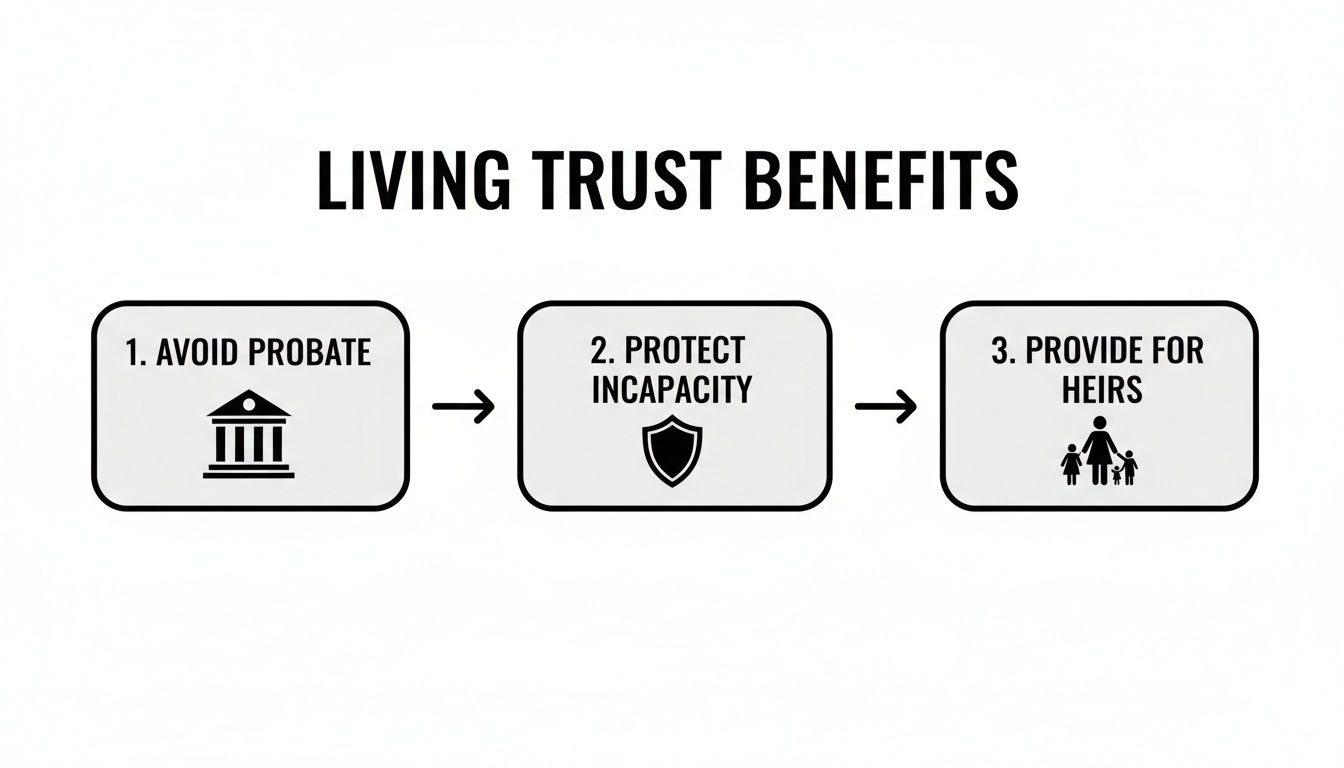
As you can see, the trust acts as a seamless container for your assets, ensuring your instructions are followed without the need for court intervention.
A Practical Checklist for Funding
Transferring different assets into a trust requires different steps. This checklist breaks down the process to help you stay organized and ensure nothing gets missed.
Checklist for Funding Your Texas Trust
| Asset Type | Action Required to Fund Trust | Common Pitfall to Avoid |
|---|---|---|
| Real Estate | Sign a new deed transferring the property to the trust. Record it with the county clerk. | Forgetting to record the new deed, which means the transfer isn't legally complete. |
| Bank Accounts | Go to the bank with your trust documents. Open new accounts in the trust's name or retitle existing ones. | Assuming the bank will do this automatically. You must initiate the change. |
| Investment Accounts | Contact your brokerage firm or financial advisor for their specific paperwork to change the account owner to the trust. | Not updating beneficiary designations on retirement accounts to coordinate with the trust. |
| Personal Property | Use a document called an "Assignment of Property" to formally transfer valuable items like art, jewelry, or collections to the trust. | Lacking a clear record of what's included, leading to confusion for your successor trustee. |
Funding isn't a "set it and forget it" task. It's an active process that ensures your estate plan functions correctly.
Recent estate planning data shows a clear sense of urgency is needed. The generational gap is striking: while 66% of the Silent Generation have wills, only 26% of Gen X and 22% of Millennials do. For Texas parents of adults with special needs or those caring for aging relatives, a funded living trust is especially vital—it can be the key to avoiding a public, stressful, and expensive guardianship battle down the road. You can discover more about these demographic breakdowns and their impact on estate planning in recent studies.
Properly funding your trust is what makes your plan work when it matters most. For hands-on guidance creating and funding a living trust in Texas, schedule a free consultation with our team today.
Common Misconceptions and Pitfalls to Avoid
Creating a living trust is a powerful act of love and foresight for your family. However, misinformation can lead to costly mistakes, undermining your best intentions.
Knowing the difference between myth and reality—and which pitfalls to sidestep—is critical for making sure your living trust in Texas actually works the way you planned. Let's clear up some common confusion and highlight the errors we see families make time and again.
Myth Busting Common Trust Misconceptions
Many families hesitate to explore trusts because of things they've heard that just aren't true. It's time to separate fact from fiction.
-
"Trusts are only for the extremely wealthy." This is perhaps the most persistent myth. The reality? A living trust is for anyone who owns property and wants their family to avoid the public, expensive, and time-consuming probate process. If you own a home in Harris County or have a modest investment account, a trust can provide immense value.
-
"A living trust helps you avoid all taxes." This is a significant misunderstanding. While complex irrevocable trusts are used for high-level estate tax planning, a standard revocable living trust does not make estate or income taxes disappear. Its primary purpose is probate avoidance and incapacity planning, not tax evasion.
-
"Once I create a trust, I lose control of my assets." This is absolutely not true for a revocable living trust. As the grantor and the initial trustee, you maintain 100% control. You can buy, sell, invest, and manage your property exactly as you always have, with total freedom to change or even dissolve the trust whenever you want.
The Single Biggest Pitfall: An Unfunded Trust
If there is one mistake that can render your entire trust useless, it’s this: failing to fund it.
As we've discussed, a trust is like an empty box; it only protects what you put inside. Simply signing the trust document is not enough. You must legally transfer your assets—your house, your bank accounts, your investments—into the trust's name.
Any asset left sitting in your individual name when you pass away will likely have to go through probate, defeating the very reason you created the trust in the first place.
An unfunded or partially funded trust is a heartbreakingly common error. It often leads to the exact court processes, expenses, and public exposure that families were trying to avoid, creating an unnecessary burden for grieving loved ones.
Other Critical Mistakes to Sidestep
Beyond funding, a few other missteps can jeopardize your family’s security. Being mindful of these potential issues is a key part of responsible planning.
Choosing the Wrong Successor Trustee
Your successor trustee will hold immense power. This is the person who will manage your finances if you become incapacitated and distribute your assets after you’re gone. Choosing someone based purely on emotion, without considering their financial responsibility or organizational skills, can be a recipe for disaster.
This individual has a legal duty to act in the best interests of the beneficiaries. You can learn more about the serious nature of the fiduciary responsibility of a trustee in our detailed guide. It's essential to pick someone who is trustworthy, capable, and impartial.
Relying on Generic Online Templates
A one-size-fits-all document from an online service simply cannot account for your unique family dynamics or comply with the nuances of the Texas Estates Code. These templates often lack critical provisions for blended families, beneficiaries with special needs, or specific types of assets. Using a generic form risks creating a flawed document that could easily lead to family disputes and expensive legal battles down the road.
Navigating these challenges requires careful thought and professional guidance. To ensure your trust is structured correctly and avoids these common pitfalls, schedule a free consultation with us. We are here to help you protect your legacy with compassion and precision.
Partnering With a Texas Estate Planning Attorney

While this guide provides a solid foundation, creating a living trust in Texas is a significant legal step. This is not something to approach lightly.
Online templates and DIY solutions might seem tempting, but they simply can't account for the deeply personal—and often complex—realities of family life. An experienced estate planning attorney is your trusted partner, ensuring your wishes are not only heard but legally protected under Texas law.
In some cases, professional guidance isn't just helpful; it's absolutely essential to prevent costly mistakes and painful family disputes down the road.
When Professional Legal Counsel is Crucial
Working with an attorney is particularly important if your family's situation includes any of the following:
- Blended Families: Crafting a trust that fairly provides for children from a previous marriage and a current spouse requires careful, nuanced language to avoid future conflict or misunderstanding.
- Business Ownership: Transferring ownership of a business into a trust has specific legal and tax implications that must be handled correctly to ensure a smooth transition without disrupting operations.
- Beneficiaries with Special Needs: A standard trust could accidentally jeopardize a loved one's eligibility for vital government benefits. A specialized trust is needed to provide financial support without causing unintended harm.
- Potential for Disputes: If you anticipate family disagreements over your estate, a professionally drafted trust is your strongest defense against legal challenges from disgruntled heirs.
An attorney’s role is to identify these challenges and build a plan that is resilient, clear, and legally sound. A key part of choosing the right lawyer for your living trust involves checking their professional online presence, which is often reflected in their firm's approach to specialized estate planning web design.
Your attorney is more than just a document preparer; they are your advocate and strategist, helping you navigate sensitive family dynamics and complex Texas laws to build a plan that provides true peace of mind.
At The Law Office of Bryan Fagan, we understand the emotional weight of these decisions. We are committed to guiding Texas families through this process with clarity and compassion. We’ll help you create a customized living trust that protects what you’ve built and provides for the people you love.
To discuss your unique family needs and secure your legacy, schedule a free consultation with our team today.
Frequently Asked Questions About Texas Living Trusts
When you begin planning for your family's future, it's natural to have questions. A living trust in Texas is a significant step, and you deserve to feel confident about your decisions. We've gathered some of the most common questions our clients ask to provide clear, straightforward answers.
How Much Does a Living Trust Cost in Texas?
This is often one of the first questions people ask, and the honest answer is: it depends on the complexity of your estate. Generally, in Texas, you can expect the cost for a revocable living trust to fall somewhere between $1,000 and $4,000. Most straightforward family estates land right around the $2,000 mark.
The final cost often reflects the local cost of living and how much customization your plan needs. For a deeper dive into the factors that influence estate planning, this article on top estate planning topics in Texas offers a great perspective.
While the initial investment is more than a simple will, remember that a trust can save your family thousands in probate fees and legal headaches later on. Think of it as an investment in your family's future peace of mind.
Can I Change My Living Trust After It Is Made?
Yes, absolutely—and that's one of its greatest strengths, provided it's a revocable living trust. Life is unpredictable, and your estate plan needs to be able to adapt with you.
As long as you have the legal capacity to do so, you can amend your revocable trust at any time. This means you can:
- Change your beneficiaries
- Appoint a different successor trustee
- Add new assets to the trust or remove old ones
- Update the instructions for how your property is distributed
This flexibility is key to ensuring your trust always reflects your wishes for your family, no matter what changes life brings.
Does a Trust Protect My Assets From Creditors?
This is a very important distinction. A standard revocable living trust does not shield your assets from your own creditors while you are alive. Because you still have full control and can dissolve the trust whenever you want, the law still considers those assets yours.
On the other hand, an irrevocable trust can provide powerful asset protection. When you create an irrevocable trust, you give up control and the ability to make changes. This legally separates the assets from your personal estate, which can place them out of reach of future creditors or lawsuits. This is a more complex tool used for very specific goals, like planning for long-term care needs.
The main job of a revocable living trust is to help your estate avoid probate and plan for incapacity. It's not designed to be a creditor shield during your lifetime.
Do I Still Need a Will if I Have a Trust?
Yes, and this surprises many people. Even with a well-drafted living trust, you still need a will. We call this a "pour-over will," and it serves as a critical safety net for your entire estate plan.
Its purpose is to "catch" any assets you might have forgotten to transfer into your trust, or assets you acquired just before you passed away. The pour-over will simply directs that any of these leftover assets get moved into your trust. While those specific assets might have to go through probate, the will ensures everything ultimately gets managed according to your trust's instructions, keeping your master plan intact. Furthermore, a will is the only legal document where you can name a guardian for your minor children.
At The Law Office of Bryan Fagan, PLLC, our goal is to provide clear, compassionate answers to all your estate planning questions. Schedule your free consultation today to get personalized guidance on creating a living trust that truly protects your family's future.