Skip to content
When your family is grieving, the last thing you want to deal with is a long, complicated court battle. For some families in Texas, the small estate affidavit offers a much simpler path, letting them transfer a loved one's property without the full-blown expense and time commitment of traditional probate. This legal tool is specifically designed for estates with modest, straightforward assets, providing a compassionate alternative during a difficult time.
A Simpler Path for Modest Estates
Losing a family member is emotionally overwhelming, and the thought of navigating the legal system on top of that can be a heavy burden. The Texas Legislature understood this and created the Small Estate Affidavit (SEA) as a practical alternative to a formal, court-supervised probate administration. We know that facing legal paperwork can feel intimidating, but our goal is to demystify this process for you.
At its core, it's a sworn statement filed with the court. Once a judge approves it, the affidavit legally transfers the decedent's property to their heirs. Think of it as an expedited process for situations where the estate is small and doesn't have any complex issues. Instead of months tied up in court dates and mounting legal fees, the SEA can often wrap things up more quickly and affordably.
What is the Asset Limit for a Small Estate Affidavit?
The main requirement for using a Small Estate Affidavit comes down to the estate's value. The total value of the decedent’s assets must be $75,000 or less. But here's a critical detail that makes this option available to more families than you might think.
The $75,000 limit only counts "non-exempt" assets. This means the value of your loved one's primary home (their homestead) and certain other personal property is not included in that total.
This distinction is incredibly important. A person could have owned a home worth several hundred thousand dollars, but if their other assets—like bank accounts, cars, or investments—are valued at less than $75,000, their estate may still qualify for the SEA. Understanding the difference is the first step in figuring out if this streamlined procedure is right for you. You can learn more by exploring the distinctions between probate and non-probate assets in our detailed guide.
How Does the Small Estate Affidavit Work?
Under Texas Estates Code, Title 3, Subtitle G, Chapter 205, the SEA is a tool to streamline property transfers for these smaller estates. The process involves the heirs and two disinterested witnesses signing a detailed affidavit that lays out all the assets, debts, and the family history. A key timing rule is that this affidavit can only be filed at least 30 days after the person has passed away.
This whole approach is designed for estates valued at $75,000 or less (excluding that exempt property we talked about), allowing families to sidestep the complexities of a full probate process.
Who Can Use the Small Estate Affidavit?
While the asset limit gets the most attention, a few other crucial conditions must be met. Generally, the SEA is only an option when:
- The person died without a will (this is known as dying "intestate").
- The value of their non-exempt assets is $75,000 or less.
- The estate's assets are worth more than its known debts.
- No one has already been appointed as a personal representative for the estate.
Let's look at a practical scenario. Imagine a parent in Harris County passes away, leaving behind their family home, a car worth $10,000, and $5,000 in a checking account. If they had no will and only minor debts, their heirs could likely use a Small Estate Affidavit. The home's value wouldn't count toward the limit, and the remaining assets ($15,000) fall well below the $75,000 threshold.
Figuring out these rules can feel complicated, especially when you're already dealing with a loss. But you don't have to go through it alone. The Law Office of Bryan Fagan is here to offer clarity and support. If you think a Small Estate Affidavit might be the right choice for your family, we encourage you to schedule a free consultation with our experienced attorneys. We can help you understand your options and guide you with compassion.
Confirming Your Loved One's Estate Qualifies
Before you jump into filling out any legal forms, the very first step is to confirm that your loved one’s estate actually meets the strict criteria for a small estate affidavit (SEA). Taking the time to get this right from the start can save your family from frustrating delays and the possibility of the court rejecting your filing down the road. This is where the details in the Texas Estates Code really matter.
The number everyone knows is the $75,000 asset limit, but that figure is often misunderstood. The real key is understanding what the law calls "exempt" versus "non-exempt" property, because only the non-exempt assets are counted toward that total.
Calculating the Estate's Value
To figure out if you qualify, you need to sort the assets into two distinct piles. A good way to think about it is that the law sets aside certain essential property for the family's use, so it doesn't include it when deciding if an estate is truly "small."
-
Exempt Property: This is everything that is not counted toward the $75,000 limit. The biggest one is almost always the decedent's primary residence, also known as their homestead. Other common exempt items include one vehicle for each licensed driver in the household, home furnishings, and even certain farm animals.
-
Non-Exempt Property: This is the property that does count. This category typically includes things like cash in bank accounts, any second homes or investment properties, stocks, bonds, and any extra vehicles beyond what's exempt.
This crucial distinction is what allows many families, who may have a valuable family home but very few other assets, to still take advantage of the much simpler SEA process.
A Real-World Harris County Example
Let's walk through a common scenario. Imagine a family in Harris County whose mother recently passed away without a will. Her only assets were:
- Her home in Houston, valued at $300,000.
- Her car, valued at $15,000.
- A checking account with a $10,000 balance.
- She also had $5,000 in outstanding medical bills.
At first, you might add it all up and see $325,000 in assets, which is way over the limit. But here's how the law sees it: her home was her homestead, so it’s exempt. Since she was the only licensed driver, her car is also exempt property.
That means the only asset that actually counts toward the $75,000 limit is the $10,000 in her checking account. Since $10,000 is well under the threshold, her estate is a perfect candidate for a small estate affidavit form texas.
This decision tree gives you a quick visual guide to see if an SEA is the right path for your family based on these core requirements.
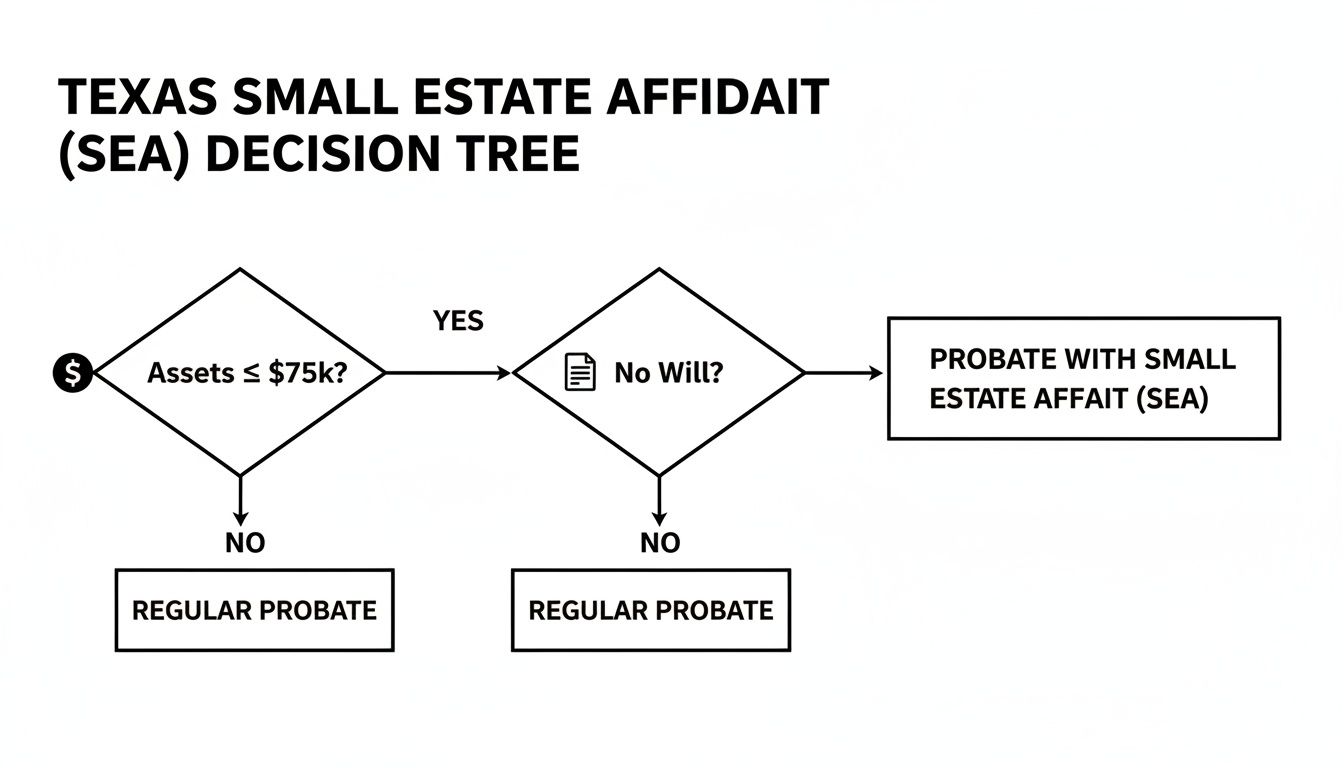
As the graphic shows, the two biggest questions—the value of non-exempt assets and the absence of a will—are the main gatekeepers for using this simplified process.
Other Critical Qualifications to Meet
Beyond the asset math, there are a few other conditions that are absolute deal-breakers. The estate will only qualify if:
- The Decedent Died Without a Will: The SEA is designed exclusively for "intestate" estates. If your loved one left a valid will, you'll need to go through the formal probate process instead.
- Assets Exceed Debts: The total value of the non-exempt assets must be more than the total of all known debts. You cannot use an SEA if the estate is "underwater" or insolvent.
- No Other Applications Filed: No one else can have already started the process of applying to be the personal representative of the estate.
If you find yourself dealing with a more complex family tree or you're just not sure how to classify certain assets, another tool called an Affidavit of Heirship might be a better fit, especially when the main goal is to establish clear title to real estate. You can learn more about how an Affidavit of Heirship works in Texas in our detailed article.
Making sure you check every one of these boxes isn't just a good idea—it's a legal requirement for getting the court's approval. If you have any doubts about your family's eligibility or need a hand with the estate calculations, The Law Office of Bryan Fagan is here to bring clarity to the situation. Schedule a free consultation with us today for compassionate, professional guidance.
How to Complete the Texas Small Estate Affidavit Form
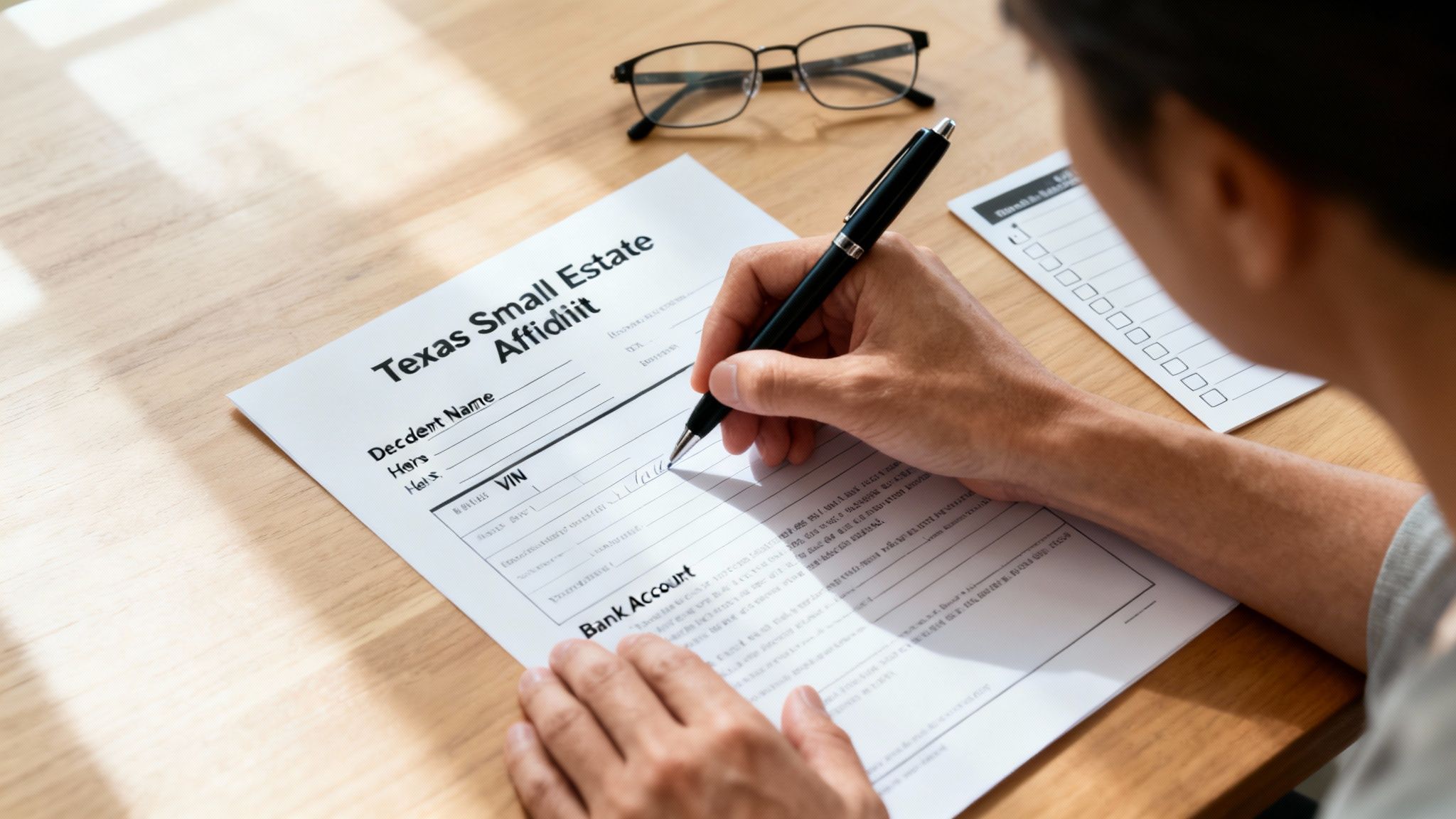
Staring down any legal document after a loss can feel like a monumental task. The good news is the Texas Small Estate Affidavit (SEA) form is far more approachable than it first appears. With some focused attention to detail, your family can fill it out correctly and avoid the common pitfalls that cause delays.
Let's walk through the form's main sections. Think of it as telling the court a complete and transparent story about your loved one's estate. Every single piece of information you provide helps the judge confirm that the estate is eligible for this simpler process.
Identifying the Decedent and Heirs
The first part of the form is mostly biographical, but absolute precision is key. You'll need to enter the decedent's full legal name, their date of death, and the county where they died. This info must be a perfect match to what's on the death certificate.
Next comes the part where many applications stumble: listing all the legal heirs. This is arguably the most critical section of the entire document.
- List everyone: You are required to name every single person legally entitled to inherit under Texas law. This includes heirs who are minors or even those whose whereabouts are currently unknown.
- Provide full details: For each heir, you must write their full name, current address, phone number, and their exact relationship to the person who passed away (e.g., "son," "surviving spouse").
- Include shares: You'll also need to state the precise share of the estate each heir is supposed to receive. This can get tricky, especially when figuring out the difference between separate and community property.
For instance, if the decedent was married with two children from that marriage, the surviving spouse often inherits all the community property. However, separate property gets divided differently. Getting these calculations wrong is one of the top reasons a court will reject an affidavit.
Listing All Assets and Liabilities
There’s no room for ambiguity here—accuracy and detail are everything. If you’re vague, the court will simply send the form back and ask for more information. Your objective is to give enough detail so that a bank, the DMV, or any other institution can easily identify and transfer the asset.
Be as specific as possible when listing assets:
- Bank Accounts: Don't just put "Checking Account." You need the full name of the bank, the complete account number, and the exact balance as of the date of death.
- Vehicles: Simply writing "2018 Ford F-150" won't cut it. Include the full Vehicle Identification Number (VIN), the license plate number, and a reasonable estimate of its fair market value.
- Real Property: If the homestead is the only piece of real estate, you must provide its full legal description from the property deed, not just the street address.
The same level of detail applies to debts. List every known liability with the creditor's name, the amount owed, and a brief description of what the debt was for. This covers everything from funeral costs and final medical bills to outstanding credit card balances.
A Note on Community vs. Separate Property: Texas is a community property state, a fact that has a massive impact on who inherits what. The affidavit requires you to distinguish between assets the decedent owned before the marriage (separate property) and those acquired during it (community property), because the law distributes them differently.
The responsibility for painting a full and accurate picture rests entirely on the people filing. When it’s done right, though, the process can be incredibly fast. In fact, some Texas probate courts have been known to approve a properly filed small estate affidavit form Texas in just a few days, which shows how efficient this process is under Estates Code §205.003. You can learn more about the standardized forms designed to boost success rates.
The Sworn Statements and Signatures
The home stretch of the affidavit requires signatures from all adult heirs plus two "disinterested" witnesses. When the heirs sign, they are swearing under penalty of perjury that every piece of information in the document is true and complete to the best of their knowledge.
The disinterested witnesses—people who will not inherit anything from the estate—are also making a sworn statement. They must affirm that they knew the decedent, are familiar with their family and financial situation, and can corroborate the facts laid out in the affidavit.
Completing this form correctly takes diligence, but it’s an achievable goal for many families. However, if you're wrestling with complex heirship questions, can't distinguish between property types, or just feel overwhelmed, you are not alone. The compassionate team at The Law Office of Bryan Fagan is here to help. Schedule a free consultation with us today for personalized guidance through every step of the process.
Getting Your Documents and Witnesses in Order
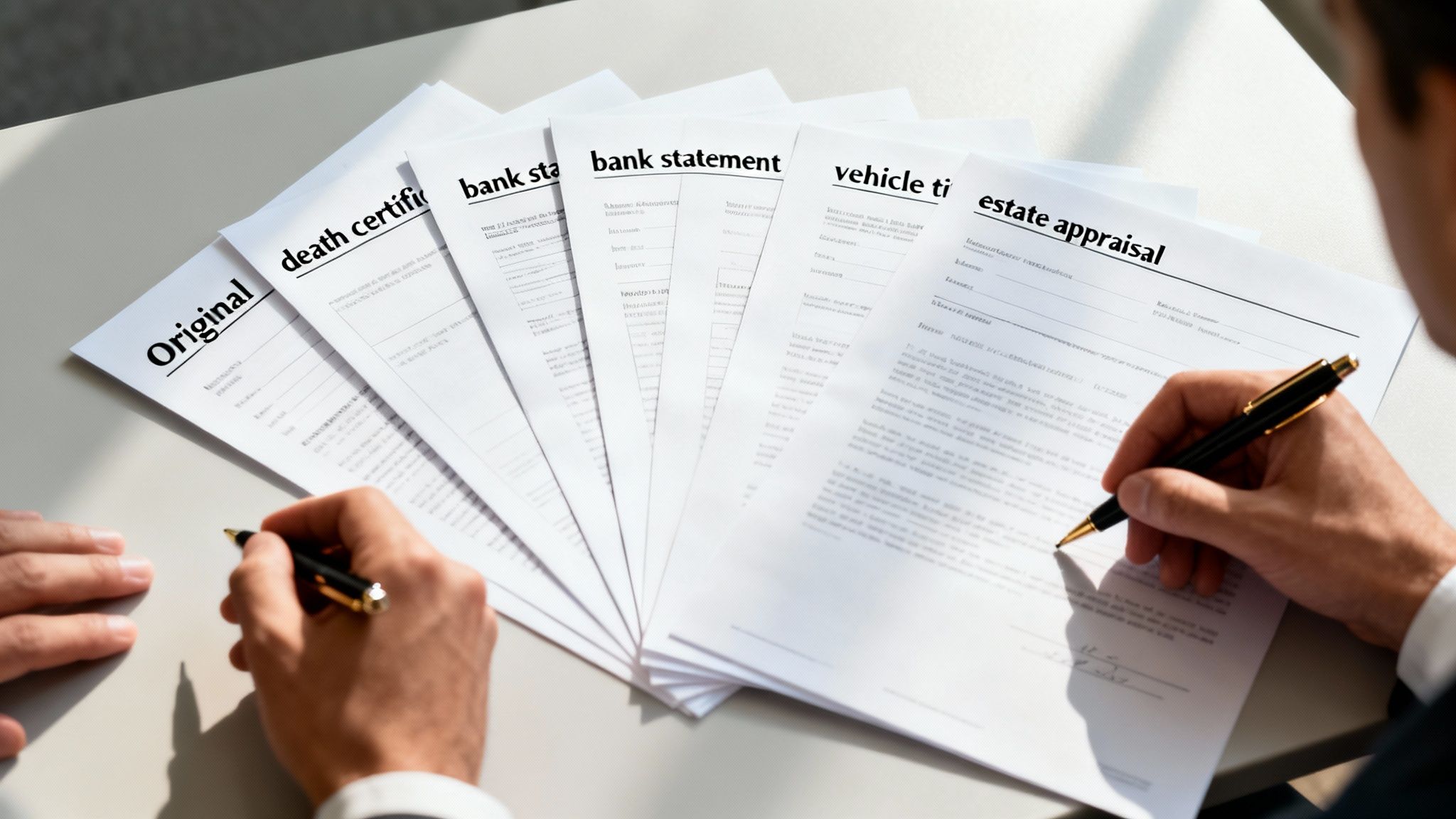
A perfectly filled-out small estate affidavit form in Texas is only as good as the proof you have to back it up. The court isn’t just taking your word for it; it needs official paperwork to verify every fact you're swearing to. Think of this part of the process as building your case file.
We understand that gathering all these documents can feel like a scavenger hunt during an already overwhelming time. But having everything organized upfront is the single best thing you can do to avoid frustrating delays down the road. A complete, well-supported application shows the court—whether in Dallas County or Bexar County—that you’ve done your homework and respect the legal process.
Your Document Checklist
Before you get anywhere near the courthouse, you need to pull together a small portfolio of paperwork. The main goal here is to give the court a clear and verifiable snapshot of your loved one's family and financial life.
Here’s a practical list of what you'll almost always need to have on hand:
- Certified Copy of the Death Certificate: This is non-negotiable. You simply cannot file a Small Estate Affidavit without it.
- Proof of Asset Value: For every non-exempt asset you list, you’ll need to show what it was worth on the day your loved one passed away. This could be bank statements, a vehicle title with a Kelley Blue Book valuation, or official appraisals for things like jewelry or real estate.
- Documentation for Debts: Round up any final medical bills, outstanding credit card statements, or receipts for funeral expenses. This is how you confirm the liabilities you've listed on the affidavit.
- Proof of Homestead Exemption (if applicable): If the decedent owned a home, a copy of the property tax statement showing a homestead exemption is powerful evidence to solidify its status as exempt property.
Doing this prep work not only makes your filing stronger but also helps you double-check that you meet all the strict qualifications before you even start the official process.
The Role of Disinterested Witnesses
One of the most unique parts of the Texas Estates Code is the requirement for two disinterested witnesses. This is a critical safeguard built into the system, and it’s vital to understand what the court is looking for.
A "disinterested witness" is someone who knew the decedent and their family personally but stands to inherit absolutely nothing from the estate. They have no financial skin in the game, which is why their word is considered impartial.
These individuals aren't just signing a piece of paper; they are legally swearing under oath that the family history and list of heirs in the affidavit are true and complete.
Finding the right people can sometimes be tricky. You need individuals who genuinely knew your loved one and the family dynamics. Good candidates are often:
- A longtime family friend
- A trusted neighbor
- A fellow member of their church or a community group
- A co-worker who also knew the family on a social level
It’s crucial that your witnesses understand exactly what they are signing. They are attesting to the family tree and the financial facts you’ve presented, and their signatures add a powerful layer of credibility to your affidavit.
Trying to manage these requirements while grieving is a heavy burden. If you're struggling to track down the right documents or have questions about who can serve as a witness, please don't hesitate to reach out. Schedule a free consultation with us today with The Law Office of Bryan Fagan, and let our team guide you with the clarity and compassion you deserve.
Filing Your Affidavit and Avoiding Common Pitfalls
You’ve done the hard work of gathering information, filling out the affidavit, and collecting all the supporting documents. Now you're at the final, crucial step: filing the Small Estate Affidavit (SEA) with the court. This is where your careful preparation pays off, but it’s also a point where a few common, seemingly minor errors can cause frustrating setbacks.
First things first, you need to file in the right place. The small estate affidavit form Texas must be filed in the probate court of the county where your loved one called home when they passed away. So, if they lived in Houston, your destination is the Harris County Probate Court.
You also have to be mindful of the calendar. The Texas Estates Code requires a mandatory waiting period; you cannot file the SEA until at least 30 days have passed since your loved one’s death. This isn't just a formality—it's a "cooling-off" period designed to give enough time for all assets and liabilities to come to light.
Navigating the Most Common Filing Errors
Over our years of helping Texas families, we've seen the same honest mistakes trip people up again and again. These errors don't happen because of a lack of effort. They usually stem from a simple misunderstanding of how exacting the court's requirements are for detail and accuracy.
Knowing what these pitfalls are is the best way to steer clear of them.
- Vague Asset Descriptions: Simply writing down "Bank Account" won't cut it. The court needs specifics: the full name of the bank, the complete account number, and the exact balance down to the penny. The goal is to provide enough detail that the bank can identify and transfer the asset without a shadow of a doubt.
- Incomplete Heir Information: You must list every single legal heir, period. It doesn't matter if you haven't spoken to a distant cousin in years or don't know their current address. Forgetting an heir or providing incomplete contact information will bring the entire process to a grinding halt.
- Miscalculating Inheritance Shares: This is a minefield, especially in blended families or when you're trying to distinguish between community and separate property. Every heir's share has to be calculated precisely according to Texas intestacy laws.
You don't have to take our word for it. Probate court checklists often show just how common these issues are. In fact, statistics from some Texas courts reveal that up to 40% of rejected SEAs contain undetailed asset information, and another 30% involve miscalculations of inheritance shares.
Common Small Estate Affidavit Filing Errors and How to Prevent Them
We've put together this quick-reference table to highlight the most frequent mistakes we see in Texas probate courts. A few moments reviewing this can save you weeks of delay.
| Common Error | Why It Happens | How to Avoid It |
|---|---|---|
| Missing the 30-Day Waiting Period | Families are eager to settle affairs and sometimes file too soon after the date of death. | Mark your calendar for the 31st day after the death. Do not file any paperwork with the court before this date. |
| Filing in the Wrong County | It's easy to assume any courthouse will do, or to file where you live instead of where the deceased lived. | Confirm the decedent's official county of residence at the time of their death. That's the only county where you can file. |
| Omitting Liabilities | People sometimes forget to list all debts, thinking only about assets. | Gather all bills, credit card statements, and loan documents. The affidavit requires a full picture of the estate's finances—assets and debts. |
| Vague or Incomplete Descriptions | Listing "Car" or "Checking Account" without details. | For vehicles, include the VIN, make, model, and year. For accounts, list the financial institution, full account number, and exact balance. |
| Incorrect Heirship Information | Forgetting a distant relative, or miscalculating shares based on complex family structures. | Consult Texas intestacy laws carefully. When in doubt, a family law attorney can help map out the family tree and calculate shares correctly. |
Remember, the court clerk's job is to enforce the rules, not to provide legal advice. Getting it right the first time is entirely on you.
What to Expect After You File
Once your affidavit is submitted, a probate judge or clerk will review it. One of the benefits of an SEA is that, unlike formal probate, there usually isn't a court hearing you need to attend. The court simply examines the paperwork to make sure it ticks every single legal box.
If everything is in order, the judge will sign a court order approving the affidavit. This signed order is the golden ticket—it's the legal document that gives you the authority to collect the estate's assets. You'll present a certified copy of this order to banks, the DMV, and anyone else holding estate property to get it transferred to the rightful heirs.
It's worth noting that the $75,000 limit for a Texas small estate affidavit doesn't include the value of the homestead. This is a huge help, considering that over 65% of Texas seniors own their homes. It allows many families with a valuable home but modest personal property to qualify. However, you can see how this flexibility also demands precision. You can get a better sense of the court's expectations by reviewing a detailed probate court checklist, like this one from the Cameron County website.
Filing an SEA can feel like the final exam after an emotional marathon. If you’re feeling uncertain about any part of the process, or just want the peace of mind that comes from having an expert double-check your work, The Law Office of Bryan Fagan is here to help. Schedule a free consultation with us today with our compassionate team to ensure your filing is correct, complete, and ready for a smooth approval.
When to Consider Alternatives to the SEA
The Small Estate Affidavit (SEA) can be a fantastic, streamlined tool for many Texas families, but it’s certainly not a one-size-fits-all solution. Knowing its limits is just as critical as understanding its benefits. Realizing early on that a different legal path is necessary can save you a world of time, money, and frustration by preventing an almost certain court rejection.
Simply put, the SEA has some hard-and-fast rules. If your loved one left a will, the estate has to go through formal probate to follow their wishes—no exceptions. Similarly, if the value of their non-exempt assets (think bank accounts, stocks, or a second car) adds up to more than the strict $75,000 limit, the estate is automatically out of the running for an SEA.
When Formal Probate is Unavoidable
Family dynamics are another huge factor. The SEA process hinges on everyone being on the same page. If there's even one disagreement among the heirs about who gets what or who even qualifies as an heir, the court will pump the brakes. In those cases, a more structured process like formal probate is required to sort out the conflicts.
Here are a few common scenarios where you’ll need to look at alternatives:
- A Valid Will Exists: The SEA is strictly for estates where there is no will (intestate). If a will was left behind, you must follow the steps for probating a will in Texas.
- The Estate is Insolvent: If the estate owes more in debts than it holds in assets, you cannot use an SEA.
- A Minor Heir Needs a Guardian: If a minor child is in line to inherit property, the court will likely require a formal guardianship to be set up to manage their inheritance, which is outside the scope of an SEA.
Exploring Other Legal Paths
Just because the SEA isn't a good fit doesn't mean you're doomed to a long, drawn-out court battle. For instance, an Affidavit of Heirship is a common tool used to establish a clean title to real estate, especially when the main goal is just to sell the family home. Beyond that, there are many comprehensive estate planning tools and strategies to avoid probate court entirely that might apply.
The key takeaway is to be honest about your family’s circumstances. Trying to force a complex situation into the simple SEA framework often leads to more problems than it solves.
Navigating these rules can feel overwhelming, especially when you're grieving. If you’re not sure whether a small estate affidavit form Texas is the right move for your family, we can help you find clarity. Schedule a free consultation with us today with The Law Office of Bryan Fagan for compassionate, straightforward guidance on what to do next.
Your Top Questions About the Texas SEA Process, Answered
When families are looking at a Small Estate Affidavit, a lot of the same practical questions come up. Let's walk through some of the most common ones we hear, so you can move forward with more confidence.
What Happens If Another Asset Is Discovered Later?
This is a scenario that can definitely throw a wrench in the works. If an asset pops up after the SEA has been approved and that new discovery pushes the estate's non-exempt value over the $75,000 threshold, the affidavit becomes invalid. At that point, you’re likely looking at having to start a more formal probate administration.
It’s exactly why we stress the importance of doing a thorough asset search before you file. If the newly found asset still keeps the total value under the limit, you might just need to amend your filing. The best move here is to check in with the court or an attorney to figure out the right way to handle it.
Can an SEA Be Used to Sell the Family Home?
No, and this is a major point of confusion for many people. The homestead's value is excluded when you're calculating that $75,000 limit, which is great. However, the SEA itself can only transfer the title of the home to the legal heirs.
An affidavit doesn't give the heirs the power to actually sell the property. To get a clear and marketable title that a buyer will accept, you'll need a different legal tool. This usually means an Affidavit of Heirship or going through a formal probate process.
Must Debts Be Paid Before Distributing Assets?
Yes, without a doubt. The small estate affidavit form Texas specifically requires you to list out every known debt the estate owes. The law is crystal clear on this: all of those liabilities—from final medical bills to credit card balances—must be paid from the estate's non-exempt assets before anyone receives a single dollar. If you distribute assets without paying known creditors, the heirs could find themselves personally on the hook for those debts.
How Long Does the SEA Process Take?
Every county has its own pace, but it's almost always significantly faster than a full probate. Legally, you have to wait at least 30 days after the person has passed away to file the affidavit.
Once it's filed, assuming everything is filled out correctly and completely, a judge could approve it in just a few weeks. Often, no court hearing is even necessary.
Trying to figure all this out while you're grieving can feel overwhelming. The experienced team at The Law Office of Bryan Fagan, PLLC is here to offer the clarity and compassionate guidance your family deserves. Schedule a free consultation with us today to talk through your specific situation and make sure you’re on the right track.