Skip to content
A sample Texas last will and testament can show you what to write, but understanding why you need one is the real first step. Think of a will as your legally binding instruction manual. It’s the final message you leave for your family, directing exactly how your property should be handled, who should manage your estate, and—most importantly—who will care for your minor children.
We understand that thinking about these topics is emotionally challenging. Our goal is to provide clear, compassionate guidance to help you make these crucial decisions with confidence. A will is a foundational act of care for your family's future, and we are here to support you through the process.
Why a Texas Will Is a Foundational Act of Family Care
Talking about the end of life is never easy. For many families, the thought of creating a will feels heavy and emotionally draining because it forces us to face tough realities. But from our experience guiding countless Texas families through estate planning, we see it as one of the most powerful acts of love and protection you can give.
This document ensures your wishes are honored and your family is spared from confusion and conflict during an already painful time. If you don't have a will, you're leaving those critical decisions up to the State of Texas.
The Consequences of Not Having a Will in Texas
When someone passes away without a valid will, it's known as dying "intestate." In these cases, the Texas Estates Code takes over, dictating how your assets are divided based on rigid, impersonal formulas of heirship.
Key Takeaway: The state’s plan rarely lines up with what you would have wanted. Intestacy laws could force your spouse to share property with your children from a previous relationship or completely cut out a lifelong partner you weren't legally married to.
This rigid legal process often causes friction, financial strain, and heartache for the very people you wanted to protect. A will eliminates all that ambiguity. It gives you complete control.
Putting Your Wishes into a Legal Framework
A well-drafted Texas will is your opportunity to clearly define your intentions. It lets you provide for your loved ones in the way you see fit, not how a court decides.
With a will, you can:
- Appoint an Executor: You get to choose a trusted person or institution to manage your estate, pay any outstanding debts, and distribute your assets exactly as you've instructed.
- Nominate a Guardian: This is the most critical function of a will for parents with minor children. You can name the person you trust to raise your kids if the unthinkable happens.
- Distribute Your Property: You can make specific gifts, like leaving a cherished family heirloom to a specific grandchild or ensuring your home goes directly to your spouse.
Recent statistics reveal a troubling trend: only 33% of Americans have a will, even though most agree it's important. This gap between intention and action leaves millions of families vulnerable when a loved one passes.
Before you start drafting, it helps to understand the language you'll encounter. Legal terms can be intimidating, but they don't have to be.
Decoding Your Texas Will: Key Terms
Here's a quick reference table to break down the essential legal jargon into simple, understandable language. Knowing what these terms mean will help you feel more confident as you map out your family's future.
| Legal Term | Simple Explanation | Why It Matters for Your Family |
|---|---|---|
| Testator | The person making the will (that's you!). | Your will is your voice. Being the Testator means you are in control of the decisions that will protect your family's future. |
| Executor | The person or institution you name to carry out your will's instructions. | Choosing a reliable Executor ensures your wishes are followed precisely and that your assets are managed responsibly for your loved ones. |
| Beneficiary | The person(s), charity, or trust receiving assets from your will. | This is how you provide for your spouse, children, and others. Clearly naming beneficiaries prevents disputes and confusion. |
| Guardian | The person you choose to care for your minor children if you can't. | This is arguably the most important decision for parents. It ensures your children are raised by someone you trust and love. |
| Residuary Estate | Everything left in your estate after specific gifts are made and debts are paid. | This "catch-all" clause ensures no asset is left unaccounted for, preventing it from being distributed by the state's default rules. |
| Self-Proving Affidavit | A separate statement signed by you and your witnesses that makes proving the will easier in court. | This simple document speeds up the probate process, saving your family time, money, and stress during a difficult period. |
Understanding these key terms is the first step toward creating a document that truly reflects your wishes and protects your family's legacy.
A Texas will is a critical piece of a much larger puzzle. To see how a will fits into broader financial and medical decisions, this comprehensive end-of-life planning guide offers valuable context on directives and finances. At The Law Office of Bryan Fagan, we can help you take this essential step. Schedule a free consultation today to discuss how we can create a plan that provides peace of mind for you and security for your family.
Breaking Down a Texas Will: What Goes Inside?
Thinking about a will can feel overwhelming. It’s easy to picture it as one giant, complicated legal document. But it’s much simpler to think of it as a collection of specific instructions—or clauses—each with its own important job. By walking through the key parts of a typical Texas last will and testament sample, we can see exactly how they fit together to protect your family.
Let's imagine a young family from right here in Harris County: Sarah and Tom. They have two small kids, Emily, who's 8, and David, who's 5. They own their home, have some savings, and their biggest worry is making sure the kids are taken care of, no matter what. Their will would be built from a few crucial components.
The Initial Declaration
Every will kicks off with a simple but powerful opening statement. This first part, legally known as the exordium clause, does three critical things right away:
- It Identifies You: The will clearly states your full legal name and where you live (e.g., "I, Sarah Miller, a resident of Harris County, Texas…").
- It Declares Its Purpose: It makes no bones about what this document is: your official Last Will and Testament.
- It Revokes Prior Wills: This is huge. It formally cancels out any and all previous wills or amendments (codicils) you might have made. This single sentence prevents old, forgotten documents from creating chaos and confusion down the line.
This section might seem basic, but it’s the legal foundation for everything that follows. It establishes who you are and what you intend to do.
Appointing Your Executor
This is arguably the most important decision you'll make in your will. You need to name an Executor—the person or institution you trust to carry out your instructions. This individual will be responsible for managing your estate, paying off final bills, and making sure your assets get to the right people. It's a role that demands integrity, good organization, and a whole lot of patience.
In our example, Sarah and Tom might pick Tom's sister, a sharp and responsible accountant, to be their primary Executor. But what if, when the time comes, she's unable to serve? Life happens.
Pro Tip: Always, always name a successor Executor. This backup choice is your safety net. It stops the court from having to step in and appoint someone for you—a person you might never have chosen yourself. Sarah and Tom could name Sarah’s brother as their alternate, ensuring a trusted person is always on deck.
The Executor's job comes with significant responsibilities. To get a better handle on what the role involves, check out our detailed guide on what are the duties of a will executor.
Nominating a Guardian for Minor Children
For parents like Sarah and Tom, this is hands down the most emotional and vital part of the will. The guardianship clause is where you name who you want to raise your minor children if something happens to both parents. If you don't make this choice, a judge in a place like Fort Bend County will have to decide for you, and that outcome might be the last thing you would have wanted.
This isn't a decision to take lightly. You need to think about:
- Shared Values: Who sees the world the way you do when it to comes education, faith, and family life?
- Stability: Who has the emotional and financial stability to take on such a huge responsibility?
- Willingness: This is a big one. Have you actually talked to this person? You need to have a frank conversation to make sure they are truly willing and able to step into this role.
Sarah and Tom might decide on Sarah's parents as the primary guardians. And just like with the Executor, they absolutely should name an alternate, like Tom's older brother and his wife, as a backup plan.
Distributing Your Property with Bequests
Okay, now we get to the part where you decide who gets what. In a Texas will, you can make two main types of gifts, or "bequests."
Specific Bequests are pretty straightforward—they are gifts of particular, identifiable items. For instance, Sarah might include instructions like:
- "I give my grandmother’s diamond ring to my daughter, Emily."
- "I give my collection of antique maps to my brother, Mark."
These direct gifts make sure treasured heirlooms or items with sentimental value go exactly where you want them to.
The Residuary Clause is the all-important safety net for your property. After all the specific gifts are handled and all the estate’s debts and expenses are paid, this clause says who gets everything else—the residuary estate.
For Sarah and Tom, their residuary clause would likely state that if one of them passes away, the other gets everything. But if they both pass, the residuary estate would go to their children, Emily and David, in equal shares. This clause is absolutely critical. Without it, any asset not specifically mentioned could be left in limbo, forcing it to be distributed according to rigid state intestacy laws instead of your wishes.
The Self-Proving Affidavit
Finally, every well-drafted Texas will should have a self-proving affidavit. This isn’t technically part of the will itself, but a separate sworn statement that gets attached to it. Here, you and your two witnesses sign in front of a notary public, all swearing under oath that the legal formalities for signing the will were followed to the letter.
The specific language is laid out in the Texas Estates Code, Section 251.104. It may look like a minor technicality, but its impact is massive.
A self-proving affidavit lets the will be admitted to probate court without dragging your witnesses in to testify. This one simple step can save your family a ton of time, money, and hassle during an already painful time. It helps streamline the whole probate process, letting your Executor get to work carrying out your wishes much faster.
When you understand these building blocks, what once seemed like an intimidating document becomes a clear, logical plan—your personal roadmap for protecting the people you love most. If you're ready to put this essential plan in place, feel free to schedule a free consultation with our team for personalized guidance.
The Nuts and Bolts: Critical Legal Requirements for a Valid Texas Will
Creating a will is more than just jotting down who gets what; it's a formal legal act. For a Texas will to be worth the paper it's written on and stand up in probate court—whether in Harris County, Dallas County, or anywhere in between—it has to hit several strict requirements laid out in the Texas Estates Code. If you miss these details, the whole document could be tossed out, leaving your family in the lurch without the clear instructions you meant to provide.
The need for legally sound wills is more pressing than ever. During the pandemic from 2020-2022, estate filings in Texas shot up by 24%. While things have cooled slightly, the 2023 caseload was still a staggering 65,944. This surge even led the Texas Supreme Court to approve some DIY will forms to help people out. But don't be fooled—even those templates demand you follow the legal formalities to a T. You can dig into these trends yourself by checking out the latest judicial data from the Texas Courts.
You, the Testator, Must Sign the Will
The most fundamental rule is that the will has to be in writing and signed by you, the testator. That signature is your official seal of approval on the whole document.
Of course, life is complicated, and Texas law gets that. If you're physically unable to sign your name, someone else can sign the will for you. The key is that it must be done at your direction and in your presence. This makes it crystal clear that the signature is there on your command.
This flowchart breaks down the core pieces of a Texas will, from picking your executor and guardian to deciding how your assets will be distributed.
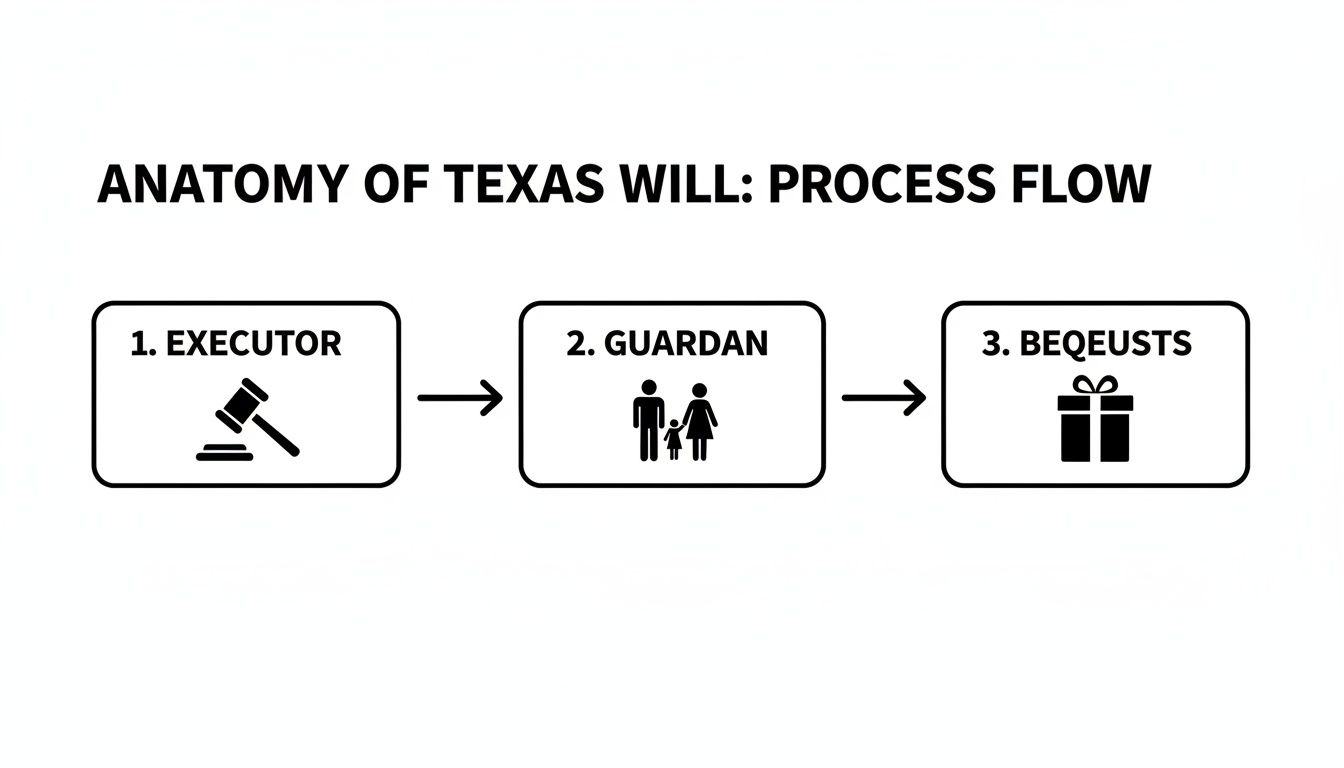
As you can see, each decision builds on the last. Choosing your executor, naming guardians, and making bequests all come together to form a solid plan for your family's future.
The Crucial Role of Credible Witnesses
Your signature alone isn't enough. The will has to be "attested to" by two credible witnesses. This step, known as the attestation, is a vital safeguard against fraud or someone pressuring you into signing.
The law is very specific about who can serve as a witness:
- Age: They must be at least 14 years old.
- Credibility: This just means they are competent and could testify in court if it ever came to that.
- Presence: Here's the important part—they have to sign the will in your presence. Everyone should be in the same room, watching you sign or acknowledge your signature.
Key Takeaway: Whatever you do, don't ask a beneficiary to be a witness. If someone who stands to inherit from the will also signs as a witness, it creates a massive conflict of interest. At best, it's a headache; at worst, it could void the gift they were supposed to receive. Always use disinterested parties—people with nothing to gain from your will.
The Hidden Dangers of Holographic Wills
You might have heard about holographic wills. Texas is one of the few states that recognizes them. A holographic will is one written entirely in your own handwriting. It sounds simple and cheap, but in practice, they often cause more problems than they solve.
For a holographic will to be valid, every single word—from "I" to the final period—must be in the testator's handwriting. No typed text, no witness signatures. While it's technically legal, think about what happens later. Your family will have to prove to a judge that the handwriting is genuinely yours. This often means hiring expensive handwriting experts and tracking down people to testify.
These potential complications are exactly why a formally executed and witnessed will is almost always the smarter, safer choice for ensuring your wishes are followed without a fight.
Common Pitfalls of Using Generic Will Samples

Grabbing a generic "Texas last will and testament sample" off the internet feels like a win—it's fast, easy, and cheap. But these templates are a classic case of "you get what you pay for." A one-size-fits-all document simply can't anticipate the unique twists and turns of your family, your finances, or your final wishes.
Relying on a generic sample is like trying to navigate Dallas with a map from 1990. The main highways might still be there, but you’re bound to hit dead ends and miss all the new, better routes. The mistakes caused by these templates can be emotionally and financially devastating for the people you leave behind.
The Dangers of Vague Language
One of the most damaging mistakes in DIY wills is vague or unclear language. A phrase that seems crystal clear to you can be interpreted in a dozen different ways by a probate judge or, worse, by feuding relatives.
Take a simple clause like, "I leave my car to my nephew." If you have three nephews, which one gets it? What if you sell that car and buy a new one before you pass? Does your nephew get the new vehicle, or is the gift now void? This kind of ambiguity forces a court to guess at your intent, often sparking costly legal battles that eat away at the very inheritance you wanted to protect.
Overlooking Contingent Beneficiaries
Life is full of curveballs. What happens if the person you name to inherit your home passes away before you do? It’s a sad thought, but it’s a reality you have to plan for. A shocking number of generic will samples either skip this step or handle it poorly, leaving a gaping hole in your estate plan.
Forgetting to name a contingent beneficiary—a backup person—can have disastrous results. If your primary beneficiary can't inherit and there’s no alternate named, that asset could fall into your residuary estate or be distributed according to Texas intestacy laws. This means a stranger in a courtroom, not you, ultimately decides who gets your property.
The Blended Family Scenario: A Cautionary Tale
Imagine a blended family right here in Texas. Mark has two children from his first marriage, and his second wife, Lisa, has one child of her own. They use a cheap online will template, each leaving everything to the other and trusting that the survivor will "do the right thing" and provide for all three kids.
When Mark passes away, Lisa inherits everything, just as they planned. But years later, when Lisa dies, her own will leaves all the remaining assets—including everything she inherited from Mark—solely to her biological child. Mark's children are completely, though unintentionally, disinherited.
This heartbreaking scenario is far too common. A generic template almost never includes the sophisticated legal tools, like trusts, needed to protect children from a prior marriage. An experienced attorney would spot this risk from a mile away and structure the plan to ensure all children were protected according to Mark's true wishes.
Proper Estate Planning is all about anticipating these complex family dynamics and building a plan that holds up under pressure.
Life Changes and Your Will: Keeping It Current
A will isn't a "set it and forget it" document. It’s a living document that needs to evolve as your life does. Major life events should always trigger a review of your will.
These events include:
- Getting married or divorced
- The birth or adoption of a child
- A major change in your financial picture (good or bad)
- The death of someone you named as an executor or beneficiary
For a minor tweak, like changing your executor, you can use a legal amendment called a codicil. But for bigger changes, it's often cleaner and safer to just create a brand-new will that revokes the old one. Trying to update a generic template you don't fully understand is risky; you could accidentally invalidate the entire document.
Making the right choice for your will comes down to understanding the trade-offs. While a DIY sample might seem convenient, the risks it introduces can have lasting consequences for your family's security and peace of mind.
DIY Will Sample vs Attorney-Drafted Will
| Feature | DIY Will Sample | Attorney-Drafted Will (Law Office of Bryan Fagan) |
|---|---|---|
| Customization | Offers a generic, one-size-fits-all structure that may not address your unique family or financial situation. | Tailored specifically to your family's needs, asset structure, and long-term goals. |
| Legal Counsel | Provides no legal advice, leaving you to interpret complex laws and potential risks on your own. | Includes professional legal guidance to prevent errors, address contingencies, and avoid future family disputes. |
| Complex Situations | Fails to adequately handle blended families, special needs children, or business succession planning. | Expertly structures complex arrangements using trusts and other legal tools to protect all loved ones. |
| Future Security | High risk of being contested, misinterpreted, or invalidated during Probate, causing stress and expense for your family. | Ensures the document is legally sound and precisely reflects your wishes, providing true peace of mind. |
While a free sample feels like a bargain, the potential fallout can create a nightmare for your family. For guidance you can trust, schedule a free consultation with our team. We'll help you create a will that truly protects the ones you love.
When Your Texas Family Needs More Than a Simple Will
A basic will is a fantastic start—it's the foundational layer of protection every Texas family should have. But just as your family's needs are unique, your estate plan sometimes needs to be more than just a standard document. Certain life situations call for more advanced planning to truly safeguard your loved ones and your assets.
Recognizing when a simple will just won't cut it is a critical first step. For many families, a standard texas last will and testament sample simply doesn't cover the complexities of their lives. This can leave dangerous gaps that might lead to serious distress and financial hardship down the road.
Identifying Scenarios That Require Advanced Planning
Certain family dynamics and financial situations are immediate red flags, signaling the need for more specialized estate planning tools, like trusts. And no, these aren't just for the ultra-wealthy; they are practical tools for anyone whose circumstances fall outside the "typical" scenario.
Think about whether any of these common situations sound familiar:
- Providing for a Child with Special Needs: If you have a child who receives—or might need—government benefits like Medicaid or SSI, leaving them a direct inheritance through a will could disqualify them from receiving that aid. A Special Needs Trust is specifically designed to hold assets for their benefit without jeopardizing that critical support.
- Protecting Assets from Creditors: Are you a business owner in Austin or a professional with liability concerns? A will offers zero protection for your assets against future lawsuits or creditors. Certain types of trusts, however, can provide a powerful layer of protection that a will simply cannot.
- Managing Complex Family Structures: Blended families, with children from previous marriages, demand incredibly careful planning to ensure everyone is treated fairly. A trust allows you to provide for your current spouse while also guaranteeing that your children from a prior relationship receive their intended inheritance.
These are just a few examples of where a will alone falls short. The real goal is to build a plan that addresses your family’s specific challenges with precision and genuine care.
The Key Difference: Wills vs. Living Trusts
A lot of people hear the word "trust" and immediately think it's something overly complicated, but the core difference is actually pretty straightforward. A will is essentially an instruction manual for what happens after you die. It has to go through a court process known as probate before it has any legal effect.
A living trust, on the other hand, is a legal entity you create while you are alive. You transfer ownership of your assets into the trust and continue to manage them as the trustee. When you pass away, the successor trustee you've already named steps in and distributes the assets according to your instructions—completely bypassing the probate court.
Key Takeaway: The single biggest benefit of a living trust is avoiding probate. This can save your family a significant amount of time, money, and the public stress of a court proceeding in a place like the Harris County Probate Court.
The sheer scale of estate administration in our state is immense. Texas probate courts have been known to manage a staggering 165,000 probate cases annually, on top of 60,000 active guardianships that oversee an estimated $6 billion in estate assets. These numbers alone show why a well-structured plan is so vital for Texas families.
Even with a trust, you don't completely abandon the will. You'll still need a special kind of will, often called a "pour-over will," which acts as a safety net to catch any assets you might have forgotten to put into the trust. Navigating these more intricate options really calls for professional guidance. Our team can help you explore all the essential estate planning documents your family might need.
If your family’s situation involves any of these complexities, it's a clear sign that you've outgrown a simple will. Taking the next step to explore more robust planning tools isn't an expense—it's an act of profound care for the people you love most.
Answering Your Questions About Texas Wills
Even after you've got the basics down, real-world questions always pop up when you start thinking about your own will. That’s a completely normal—and important—part of the process. We've put together answers to some of the most common questions we hear from Texas families to give you some quick, clear guidance.
The goal here is to pull back the curtain on this process and give you the confidence to take this vital step in protecting the people you care about most.
What Happens If I Die Without a Will in Texas?
If you pass away without a will, the state calls this dying "intestate." When that happens, Texas intestacy laws take over and a court will divide up your assets based on a rigid legal formula. The problem is, this formula often doesn't match what people actually wanted.
For example, your spouse could be forced to share community property with your children from a previous relationship. This can create unexpected financial hardship and, unfortunately, family conflict. A will is the only tool you have to guarantee your assets go exactly where you want them to.
Can I Create a Texas Will Without a Lawyer?
Yes, Texas law allows you to create your own will, and the state has even approved some basic statutory forms. However, working with an experienced attorney is almost always the smarter move, especially if your situation involves minor children, a business, or a blended family.
An online texas last will and testament sample just can't provide legal advice or adapt to your specific family and financial situation. A knowledgeable attorney will help you sidestep costly mistakes, prevent future family fights, and ensure your will is legally solid and will actually hold up in court when it matters most.
How Much Does It Cost to Create a Will?
The cost really depends on how complex your estate is. While a free online template might look tempting, the potential cost of having that will invalidated—or causing a family feud during probate—is astronomically higher.
Investing in a professionally drafted will buys you something priceless: peace of mind. Think of it as a proactive step to shield your family from a world of stress and expense down the road. We offer a free consultation to talk about your specific needs and give you clear, upfront information on our estate planning services.
It’s also helpful to understand the court process your will goes through after you're gone. You can learn more by reading our detailed guide on probating a will in Texas.
Where Is the Best Place to Store My Will?
You need to keep your original, signed will somewhere safe but also accessible to the person you named as your Executor. A fireproof box at home or a safe deposit box at a bank are both great options.
Just a heads-up: if you use a bank's safe deposit box, make sure your Executor is legally authorized to access it. It's absolutely critical that you tell your Executor where the original is located and give them a copy for their own records. The probate court in places like Harris County will demand the original document to get the process started. Without it, your family could face serious delays and complications.
Planning your will is a profound act of care for your family's future. The team at the Law Office of Bryan Fagan, PLLC is here to guide you through every step with compassion and legal clarity. Schedule your free consultation today to create a plan that provides security and peace of mind for you and your loved ones.