Skip to content
Navigating the future care of a loved one is a profound responsibility, often filled with uncertainty. When someone you love can no longer manage their own affairs, Texas law provides two primary paths for support: a Power of Attorney and a Guardianship. The core difference is a matter of timing and control: A Power of Attorney is a proactive choice made by an individual while they are still capable, whereas a Guardianship is a reactive, court-ordered intervention when that capacity is lost.
Think of it this way: a Power of Attorney is like giving a trusted family member the keys to your car before a long trip. A Guardianship is what happens when a court must appoint a driver because you can no longer navigate safely on your own. Understanding the distinction is crucial for protecting your loved one's autonomy and well-being.
Understanding Your Legal Options for a Loved One's Care
Deciding how to care for a loved one's future is one of the most profound responsibilities a family can face. It's a journey filled with love and concern, but often, a great deal of uncertainty. When someone’s ability to manage their own affairs starts to fade, Texas law offers two primary tools to step in and help: a Power of Attorney (POA) and a Guardianship.

Although both are designed to protect vulnerable individuals, they operate in fundamentally different ways. Grasping these differences is crucial for any Texas family wanting to honor their loved one's independence while ensuring their safety and well-being.
A POA is a private legal document created by an individual (the "principal") while they still have the mental capacity to grant decision-making authority to someone they trust (the "agent"). It's a private agreement that completely avoids court involvement and is a key part of comprehensive estate planning strategies.
Guardianship, on the other hand, is a formal legal process initiated in a Texas probate court, like the Harris County Probate Court. It becomes the necessary path when a person is legally deemed "incapacitated," can no longer make sound decisions, and doesn't have an effective POA in place. This is a serious step, taken only when less restrictive alternatives are not sufficient.
To make things clearer, let's break down the key distinctions in a quick side-by-side comparison.
Guardianship vs Power of Attorney At a Glance
The table below offers a snapshot of how these two legal tools stack up against each other, highlighting their most important differences.
| Feature | Power of Attorney (POA) | Guardianship |
|---|---|---|
| Initiation | Voluntarily created by the individual (Principal) | Court-ordered through a legal proceeding |
| Authority Source | The individual grants power via a legal document | A judge grants power after a court hearing |
| Prerequisite | The individual must have legal capacity to sign | The individual must be found incapacitated by a court |
| Cost & Time | Lower cost, faster process, private | Higher cost, lengthy process, public record |
| Flexibility | Highly flexible; powers can be broad or limited | Powers are defined by court order and state law |
| Oversight | Monitored by the Principal; less formal oversight | Strict court supervision, including annual reports |
As you can see, the path taken—whether it's the private, flexible route of a POA or the public, court-supervised process of a Guardianship—has significant implications for everyone involved, both emotionally and financially.
How a Power of Attorney Protects Your Autonomy
When it comes to Texas Estate Planning, a Power of Attorney (POA) is one of the most fundamental tools for protecting your independence. It's a legal document where you, the "principal," give a trusted person, your "agent," the authority to act on your behalf. Think of it as a proactive step—one that keeps you in the driver's seat of your own life, not a reactive measure taken when it's too late.

This is a world away from a guardianship, where a court steps in and imposes a decision-maker on you. With a POA, you make the choice. That choice is a powerful expression of your own autonomy.
Practical Applications of a Power of Attorney
A POA isn't a generic, one-size-fits-all form. Texas law allows for different types designed for specific situations, which lets you grant exactly the authority you want—no more, no less.
For instance, a Medical Power of Attorney is designed to give your agent the power to talk with your doctors, see your medical records, and make tough healthcare decisions if you're ever incapacitated. It ensures that the person guiding your care is someone who truly understands your values.
Then there's the Durable Power of Attorney for financial matters, which keeps the practical side of your life running smoothly. If an unexpected illness or accident leaves you unable to manage things, your agent can step right in to pay the mortgage, handle your banking, and manage investments.
A Durable Power of Attorney is one of the most effective tools for avoiding guardianship. By planning ahead, you create a seamless transition of authority that functions privately, efficiently, and without the need for court intervention.
Preserving Control and Preventing Court Action
The real beauty of a POA is that it keeps you in control. You are the one who defines the scope of your agent's powers, spelling out precisely what they can and cannot do. By putting a POA in place while you have full legal capacity, you create a clear roadmap that can head off painful family arguments and the need for a costly, public guardianship proceeding down the road. Looking at how these documents are structured, like this Power of Attorney Arkansas Form, can offer helpful insight into the process. This kind of proactive planning is truly an invaluable gift to yourself and your loved ones, protecting your legacy and your independence for years.
When a Texas Guardianship Becomes Necessary
While a Power of Attorney (POA) is a tool for proactive planning, a Texas Guardianship is a serious, protective measure—often a last resort. It becomes the necessary path when someone can no longer make safe decisions for themselves, and there isn't an effective, less restrictive option like a POA already in place. This is a court-supervised process, reserved for situations where the need for protection is so great that it outweighs the profound loss of personal freedom it involves.

The entire legal basis for guardianship hinges on the concept of incapacity. According to the Texas Estates Code, Title 3, Subtitle G, a person is legally incapacitated if a physical or mental condition leaves them substantially unable to provide their own food, clothing, or shelter, care for their health, or manage their financial affairs. This isn't a casual determination; it's a high legal bar that must be proven in a Probate court with clear and convincing evidence, which almost always includes a formal evaluation from a physician.
When Court Intervention Is Unavoidable
So, when does a family have no other choice? A guardianship proceeding is often the only viable option in a few difficult circumstances. The most common scenario is when a loved one has already lost capacity and never signed a POA. Another critical situation is when an existing POA agent is not acting in the person’s best interests, whether through financial exploitation, neglect, or outright abuse, leading to a guardianship dispute.
A court-ordered guardianship is a powerful legal intervention designed to protect the most vulnerable. It can revoke an existing Power of Attorney if an agent is failing their duties, placing the individual under the direct supervision and protection of the court.
Let's look at a hypothetical scenario. Imagine a family in Harris County notices their elderly father, who has advancing dementia, is making large, strange withdrawals from his bank account. They soon discover he's been targeted by phone scammers and has lost thousands of dollars. Since he never created a POA and can no longer understand the risks, his children have zero legal authority to intervene. In this case, filing for guardianship may be the only way to safeguard his remaining assets and ensure his well-being.
The Guardian and the Ward: Rights and Duties
Once a court agrees that a guardianship is necessary, it appoints a guardian to make decisions for the incapacitated person, who is then legally referred to as the ward. The court order will be very specific about the guardian's powers and duties—whether they relate to the "person" (healthcare, living decisions) or the "estate" (financial management), or both. A guardian has a fiduciary duty to act in the ward's best interest and is required to file annual reports with the court, ensuring compliance and transparency.
The fundamental difference between guardianship and power of attorney comes down to this court-ordered authority. A POA is a grant of power from one person to another. A guardianship, on the other hand, is a legal process where a court removes certain rights from the ward and transfers them to the guardian. It’s a serious, life-altering step, which is why it's only used when all other options are off the table.
We understand these are tough conversations to have. To explore whether a guardianship is the right step for your loved one, or to learn more about alternatives, we invite you to schedule a free consultation. Our experienced attorneys can provide the clarity and support your family needs during this difficult time.
Comparing the Path to a POA vs a Guardianship
Understanding the difference between a Power of Attorney (POA) and a Guardianship isn't just about their legal authority—it’s also about the vastly different journeys your family must take to put them in place. One is a private, proactive choice, while the other is a public, court-ordered intervention. The contrast in time, cost, and emotional energy is significant.
This simple infographic illustrates the two distinct paths, from initial steps to final outcome.
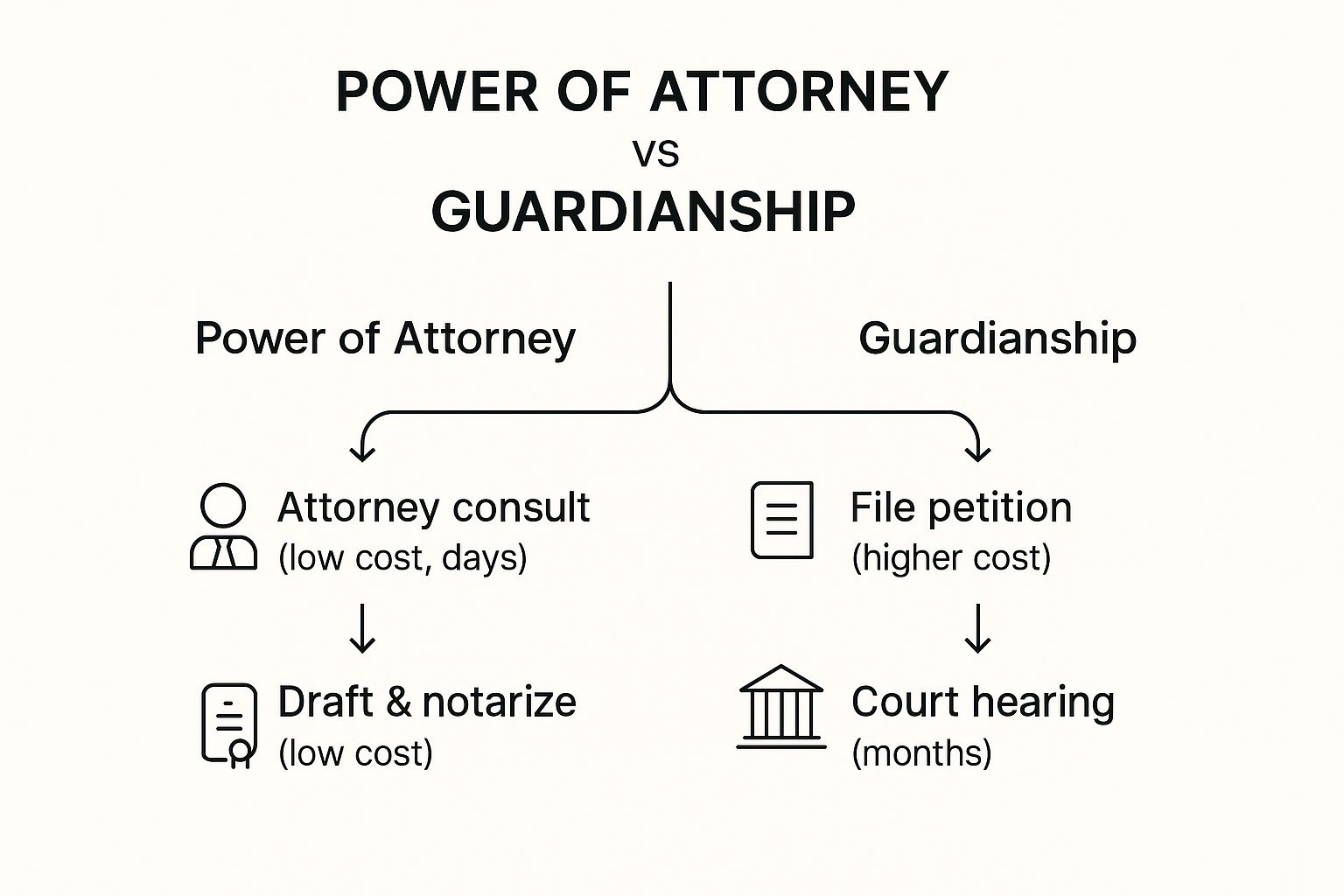
As you can see, a Power of Attorney is a swift, private arrangement. Guardianship, on the other hand, is a much longer and more complex court process.
The Straightforward Process for a Power of Attorney
Creating a POA is a private matter handled entirely outside of a courtroom. It's a planning tool you put in place while you still have the full capacity to make your own decisions.
The process is generally direct and efficient:
- Consult an Attorney: You meet with an experienced estate planning lawyer to discuss your wishes and who you trust to act as your agent.
- Draft the Document: The attorney drafts a POA tailored to your specific needs—whether for medical or financial decisions—clearly outlining the agent’s powers.
- Sign and Notarize: You sign the document in front of a notary public, making it legally valid. This entire process can often be completed in a matter of days.
A Power of Attorney is an exercise in personal autonomy. By choosing your agent and defining their powers in advance, you maintain control and can prevent the need for a court to ever get involved in your personal affairs.
Navigating the Guardianship Court Process
In stark contrast, establishing a guardianship is a formal lawsuit filed in a Texas probate court, like those in Dallas or Travis County. This path becomes necessary when an individual has already lost capacity and can no longer sign a POA.
The guardianship establishment process is lengthy, public, and strictly governed by the Texas Estates Code. It involves several mandatory steps:
- Filing an Application: A concerned family member files a formal application with the court to kick off the guardianship proceeding.
- Appointing an Attorney Ad Litem: The court must appoint an independent attorney, known as an attorney ad litem, whose sole job is to represent the best interests of the proposed ward.
- Physician’s Evaluation: A doctor must examine the proposed ward and submit a formal letter to the court confirming their diagnosis and level of incapacity.
- Court Hearing: A judge presides over a formal hearing where evidence is presented. The judge then decides if the person is legally incapacitated and if a guardianship is the least restrictive option to protect them.
- Post-Hearing Compliance: After appointment, the guardian must qualify by taking an oath and posting a bond, followed by annual reporting to the court.
A court-granted guardianship can override an existing POA, especially if an agent is failing their duties or the person is at risk. It's a critical distinction to understand, as the line between proactive choice and reactive intervention is clear. If you find yourself in this difficult situation, you can learn more about how to transition from a Power of Attorney to guardianship in Texas.
Choosing the Right Option for Your Family
Understanding the textbook definitions of guardianship and power of attorney is one thing, but figuring out which one fits your family’s emotional and complicated reality is something else entirely. The best path forward hinges on the specific circumstances your loved one is facing. Looking at a few hypothetical scenarios makes the difference between these two legal tools crystal clear.
These situations really drive home how a person’s mental capacity and existing legal documents are the deciding factors. Making this choice requires a careful, honest assessment of your family's situation.
Scenario 1: Proactive Planning with a POA
Imagine your mother, recently diagnosed with early-stage Alzheimer's, is still sharp and fully in charge of her life. She understands her diagnosis and wants to make sure her adult daughter can manage her finances and talk to doctors for her when the time comes.
In this case, a Durable Power of Attorney and a Medical Power of Attorney are perfect. Because your mother still has her legal capacity, she can proactively choose who she wants as her agent and decide exactly what powers to give them. This is a private process, guided by an attorney, that respects her autonomy and completely avoids court intervention—saving everyone time, money, and a lot of stress.
Scenario 2: Responding to a Sudden Crisis with Emergency Guardianship
Now, let's look at a completely different situation. A 22-year-old is in a terrible car accident, suffers a traumatic brain injury, and is now in a coma. He’s legally an adult but has no Power of Attorney or any other documents in place. His parents desperately need the authority to make medical decisions and handle his finances, like his insurance claims.
This is where Guardianship becomes necessary. Since he is incapacitated and never created a POA, his parents have no choice but to petition a Texas probate court for authority. Given the urgency, they would likely seek an emergency or temporary guardianship to gain immediate control while the permanent guardianship case moves forward.
Scenario 3: Protecting a Loved One from Harm and Guardianship Disputes
Here’s a tougher scenario involving a guardianship dispute. An elderly father created a Durable Power of Attorney years ago and named his son as his agent. But now, his other children have discovered the son is dipping into their dad's bank accounts for his own personal use, and the nursing home bills are going unpaid.
Even though a POA exists, a Guardianship is required to protect the father. A court-ordered guardianship will immediately revoke the son's power as an agent, remove him from that role, and appoint a responsible guardian who is under the court's strict supervision. This highlights a crucial difference: guardianship is the ultimate safety net when a less restrictive tool like a POA has failed or is being abused. You can explore more about these alternatives to guardianship in our detailed guide.
Every family's story is different. If you are facing one of these challenging situations and are unsure of the next step, our firm is here to help. Schedule a free consultation with our compassionate attorneys to receive personalized guidance for your family’s needs.
Common Questions About Texas Guardianship and POA Law
When families in Texas face the tough reality of a loved one's declining ability to make decisions, specific and pressing questions always come up. We hear these concerns all the time. This section gives you clear, direct answers grounded in the practicalities of Texas law. Our goal here is to cut through the legal jargon and give you the confidence to figure out what's next.
Can a Texas Guardianship Override a Power of Attorney?
Yes, it absolutely can. If a Texas court decides someone is legally incapacitated and needs the protection of a guardian, that court order takes precedence. It will effectively terminate the authority of any agent who was previously named in a Power of Attorney.
This isn’t just a technicality; it’s a critical legal safeguard. It’s designed to protect a vulnerable person, especially in situations where the current POA agent might be mismanaging money, dropping the ball on their duties, or simply not acting in the person’s best interests. The court's primary duty is to protect the incapacitated person, who is referred to as the "ward."
What Are the First Steps if I Believe a Loved One Needs a Guardian?
Before you do anything else, your first and most important move is to schedule a consultation with an attorney who has deep experience in Texas guardianship law. This is not a path you want to walk alone.
An experienced attorney will help you:
- Evaluate whether your loved one actually meets the legal standard for incapacity laid out in the Texas Estates Code.
- Explore if less restrictive alternatives have truly been exhausted.
- Walk you through the practical steps of filing the "Application for Guardianship" with the correct probate court, whether that’s in Tarrant, Bexar, or your local county.
How Do the Costs of a POA and Guardianship Compare?
The financial gap between the two is huge. A Power of Attorney is a private legal document that an attorney prepares for you. Because it completely avoids the courtroom and all the associated expenses, it's a much more affordable and faster option.
A guardianship, on the other hand, is a formal lawsuit. The costs are significantly higher and typically include:
- Court filing fees.
- Fees for your own attorney.
- Fees for the court-appointed attorney ad litem, who is required to represent the person you’re seeking guardianship over.
The entire process is not only more expensive but also takes much longer due to the multiple legal hurdles and court approvals required, creating financial challenges for families.
Can a Temporary Guardianship Be Established in an Emergency?
Yes. The Texas Estates Code, Title 3, Subtitle G, has a provision for a temporary guardianship in urgent situations. This is typically used when a person faces an immediate and substantial risk of serious physical harm or major financial loss.
A judge can grant an emergency or temporary guardianship very quickly to provide immediate protection. This type of order usually lasts for up to 60 days. It gives the family a crucial window of time to pursue a permanent guardianship while knowing their loved one is safe from harm.
Understanding the crucial difference between guardianship and power of attorney is the first step toward protecting your loved ones. At the Law Office of Bryan Fagan, PLLC, we guide Texas families through these sensitive matters with clarity and compassion. We recognize the emotional and financial challenges you face and are dedicated to empowering you with understanding and direction. If you are unsure which path is right for your family, we are here to help. Schedule a free, no-obligation consultation with our experienced attorneys today to get personalized guidance for your unique situation.