Skip to content
A call from the bank. A hospital discharge planner who says your mother can't be sent home alone. A neighbor who reports your father wandered outside and couldn't find his way back. In those moments, families usually ask the same question first: How do we get legal authority fast enough to protect them?
Texas law does provide a fast path, but only for real emergencies. If a loved one is incapacitated and facing immediate danger, a court can appoint a temporary guardian to step in quickly and make limited decisions for the person, the estate, or both. That order is meant to stop harm now, not to settle every long-term issue at once.
This process moves faster than a standard guardianship, but speed only helps if your filing is complete and your proof is specific. Judges don't grant emergency authority because a situation feels troubling. They grant it when the evidence shows a present risk of harm and no safer legal alternative will protect the person in time.
A Family Crisis Answering the Call for Urgent Action
The call usually comes at the worst time. A hospital says your father cannot be discharged safely. A caregiver quits, and your adult son with disabilities is alone without medication supervision. A bank flags unusual withdrawals from your mother's account after a recent stroke. Families know they need help fast, but they often do not know which legal step will protect their loved one by tomorrow, not next month.
In Texas, that fast-response tool is usually a temporary guardianship under Texas Estates Code § 1251. People still say "emergency guardianship," but in practice the court is usually being asked to appoint a temporary guardian for a short, specific crisis. The point is immediate protection with court oversight and clear limits on the guardian's authority.
That distinction matters in real cases. Temporary guardianship is designed to stop a current danger, preserve assets, and keep care decisions from falling through the cracks while the court decides what should happen next. Families who understand that purpose make better filings because they focus on proof of present harm, not frustration, old family conflict, or a general sense that something is off.
What emergency guardianship is and what it is not
A temporary guardianship can give someone legal authority to consent to medical treatment, arrange a safe placement, secure a residence, stop suspicious transfers, or prevent a vulnerable adult from being exploited during a crisis. The authority can cover the person, the estate, or both, depending on the risk the court sees.
Courts do not grant this relief because relatives disagree about care.
They grant it when the evidence shows immediate danger and no less restrictive option will protect the proposed ward in time. Sometimes families should first look at powers of attorney, supported decision-making, or determining if in-home support is right. But if those options are missing, compromised, or too slow for the situation, temporary guardianship may be the right filing.
Why families lose time
The first mistake is treating the case like a family meeting instead of a court case. Judges need dates, records, names, discharge instructions, photos, bank activity, medication failures, incident reports, and witness statements that tie the incapacity to a present risk. A stack of worried texts rarely carries the same weight as one hospital note saying the person cannot safely manage medications or one bank record showing rapid unusual withdrawals.
The second mistake is ignoring the next 60 days. Temporary relief solves the immediate crisis, but it also starts a short clock. Families should be prepared from day one to protect the ward without creating a legal gap when the temporary order expires. That means choosing the right applicant, gathering records early, and thinking ahead about whether a permanent guardianship, a care plan, or another legal arrangement will be needed before the temporary authority ends.
A fast case usually starts with three things:
- A short, specific emergency summary that explains the danger in one or two direct sentences.
- An applicant the court can trust to act quickly, follow orders, and avoid conflicts.
- Evidence gathered in usable form so the judge can see the risk immediately.
In busy Texas probate courts, speed usually goes to the family that shows the court exactly what is happening, exactly why delay is dangerous, and exactly what protection is needed right now.
Defining the Emergency Grounds for Guardianship in Texas
Texas probate judges decide temporary guardianship requests by looking at two things at the same time. The proposed ward must be incapacitated, and the family must show imminent danger if the court does not act now under Texas Estates Code § 1251.

What incapacity looks like in real life
Families often expect incapacity to mean a person cannot speak, cannot move, or is completely unaware of what is happening. Many emergency cases are less obvious than that. The person may still hold a conversation, insist they are fine, and even reject help, while missing insulin doses, wiring money to scammers, wandering outside at night, or agreeing to discharge plans they do not understand.
That difference matters in court. A diagnosis alone does not win a temporary guardianship. Dementia, stroke, traumatic brain injury, psychosis, or severe mental illness may explain the problem, but the judge still needs proof that the condition is now affecting specific decisions about health, safety, or property.
Good evidence usually answers a practical question: what can this person no longer do safely today?
Examples courts see often include:
- Medical decision failures: the person cannot understand medication instructions, refuses treatment without capacity to weigh the consequences, or cannot consent to discharge planning in a meaningful way.
- Unsafe daily living: the home has spoiled food, no working utilities, fall hazards, missed dialysis, or signs of self-neglect.
- Financial exposure: unusual withdrawals, new “friends” on accounts, changed beneficiaries, unpaid bills despite available funds, or property transfers the person cannot explain.
- Disorientation and wandering: the person leaves home confused, cannot state where they are, misses meals, or is found by police or neighbors.
If the problem can still be addressed with support rather than court intervention, families should consider determining if in-home support is right. In some cases, added supervision, medication help, or home care closes the safety gap. In other cases, those measures fail because no one has legal authority to consent, access funds, or stop active exploitation.
What imminent danger means
Imminent danger is the part families often underestimate.
The court is not deciding whether help would be useful. The court is deciding whether waiting is likely to cause probable and irreparable harm to the person's health, safety, or estate. That is a high bar, and judges expect the facts to be recent, specific, and tied to a present risk.
A strong filing usually identifies three points clearly. What happened. When it happened. Why the danger will continue or get worse without a court order.
For example, “Mom is getting worse” is too vague. “Mom was discharged yesterday after a stroke, cannot identify her medications, lives alone, and has already missed required doses” gives the court something it can act on.
The same rule applies in financial cases. “Uncle may be getting scammed” is weak. “Uncle made large unexplained withdrawals this week, cannot explain where the money went, and a new acquaintance is pressuring him to sign documents” is the kind of timeline judges examine closely.
Evidence that usually persuades a judge
The most persuasive emergency proof connects the condition to immediate harm. Medical records often do that well, especially when they explain functional limits instead of listing a diagnosis. A recent doctor's statement or Physician's Certificate of Medical Examination for a Texas guardianship case can be especially useful when it explains why the person cannot manage the decisions now at issue.
Judges also look closely at whether a less restrictive option already exists and still works. If there is a valid power of attorney, medical power of attorney, trust arrangement, or reliable caregiver with authority to act, the court will want to know why that option does not solve the immediate problem. Sometimes the document is invalid. Sometimes the named agent is absent, conflicted, exploiting the person, or refusing to act. Sometimes the institution involved will not honor the paperwork without further action. Those details matter.
Quick comparison of weak and strong claims
| Claim style | Usually weak | Usually stronger |
|---|---|---|
| Medical risk | "Dad is declining." | "Dad was discharged after a medical event, cannot manage medication, and has no safe decision-maker in place." |
| Financial risk | "Someone may be taking advantage of Mom." | "Recent unexplained withdrawals and account activity show ongoing risk to Mom's estate." |
| Safety risk | "He shouldn't live alone." | "He has recent episodes showing he cannot remain safely unsupervised." |
Families do not need perfect proof on day one. They do need enough reliable proof to show the court that the danger is current, concrete, and serious enough that delay creates real harm.
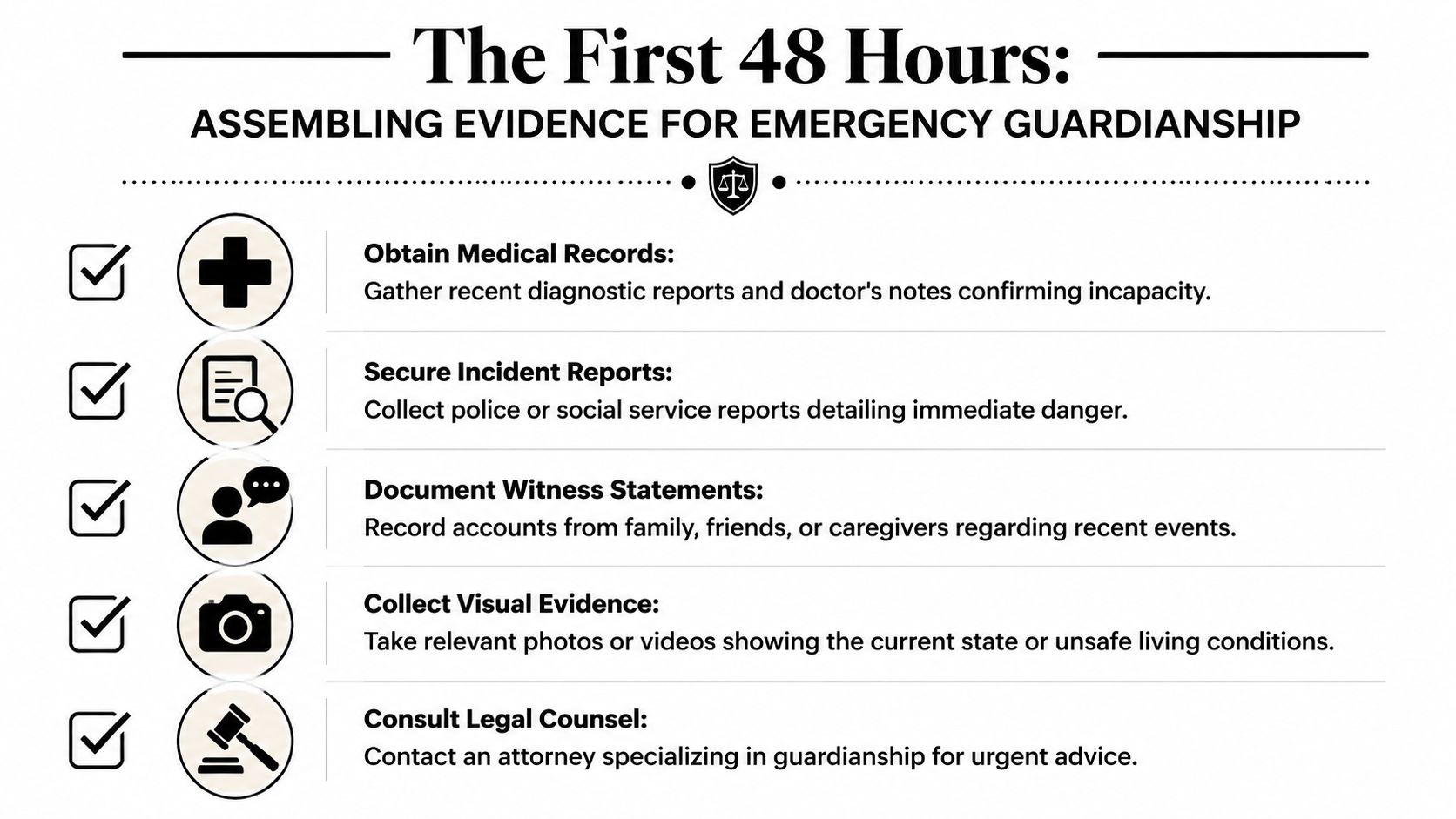
The First 48 Hours Assembling Your Evidence for the Court
The decisive factor in emergency cases is proof. A temporary guardianship petition rises or falls on proof. According to this review of key facts about emergency guardianship in Texas, 85% of successful emergency applications include a Physician's Certificate of Medical Examination, and the court can schedule a hearing within 10 days, with urban courts in Dallas or Houston often hearing complete cases in 3 to 5 days.
That doesn't mean a doctor's certificate is the only thing that matters. It means evidence matters, and medical evidence often carries the most weight.
Start with the physician
If you can get a recent physician evaluation quickly, do it. The doctor should address the person's condition, functional limits, and why the person cannot safely manage the decisions at issue. The strongest letters connect the diagnosis to real-world risks.
For example, a useful physician statement doesn't stop at "patient has cognitive impairment." It explains that the patient can't understand medical instructions, can't protect against exploitation, or can't safely live alone without intervention.
If you need a clearer picture of that requirement, this guide on the Physician's Certificate for guardianship in Texas is a helpful starting point.
Build an evidence bundle, not a stack of loose papers
Judges need a story they can follow. The best filings organize documents around the danger.
Use this checklist:
- Medical proof: Recent records, discharge paperwork, medication noncompliance notes, or a physician certificate.
- Witness affidavits: Statements from neighbors, caregivers, adult children, social workers, or facility staff who saw the risk firsthand.
- Financial documents: Bank statements, transaction records, missed bills, shutoff notices, or suspicious withdrawals.
- Incident records: Police reports, APS records if available, EMS contact notes, or photographs of unsafe living conditions.
- Alternative decision-maker review: Proof that no valid power of attorney or other functioning representative can solve the problem.
What a judge wants to see in the file
A judge in Harris County Probate Court or a Dallas probate court isn't looking for drama. The court wants reliable, recent, sworn facts.
A strong evidence packet often answers these questions:
- What happened recently?
Give dates and events. Hospitalized last week. Found wandering on Tuesday. Bank account drained over recent days. - Why is the person unable to protect themselves?
Connect the condition to the failure in judgment or function. - Why must the court act now?
Explain the harm that is likely if no order is signed. - Why are you the right person?
State your relationship, availability, and lack of disqualifying conflict.
Here is a practical walkthrough that many families find useful before filing:
What works and what doesn't
What works is specificity. "My mother has missed insulin, left home confused, and was found by police" is far better than "my mother's health is getting worse."
What doesn't work is overloading the court with irrelevant history. If the emergency is current exploitation, five years of family conflict won't help much. If the emergency is a medical crisis, focus on the person's present inability and the immediate risk.
Evidence rule of thumb: Bring the most recent, most objective, most specific records first. Use family statements to support the record, not replace it.
If you're out of state, don't assume you have to be physically present to begin. Much of the record gathering can start by phone, secure email, and e-filing coordination, especially when hospitals, banks, and care facilities are involved.
Filing the Petition and What to Expect at the Hearing
Once the proof is ready, the case moves from crisis management to court procedure. This part feels intimidating to families because it combines paperwork, deadlines, service rules, and a hearing that may happen quickly. The good news is that the path is fairly predictable when the filing is complete.
According to this explanation of how emergency guardianship works in Texas, uncontested full guardianships can take 30 to 60 days, while emergency hearings under Estates Code §1251.001 are expedited and can be set within days of filing. The basic sequence is filing the application, securing the physician's certificate, requesting the emergency hearing with evidence, and preparing to post a bond if financial authority is involved.

The filing day
The application usually goes to the proper probate court or other court with guardianship jurisdiction in the county where the proposed ward resides. In counties like Harris, Dallas, Travis, and Bexar, that often means a statutory probate court.
The application needs to identify the proposed ward, explain the incapacity, describe the imminent danger, state the powers requested, and explain why the proposed temporary guardian is suitable. If you ask for authority over finances, bond issues usually come into play.
Notice and service rules are technical, and mistakes there can slow an urgent case. This resource on mastering notice requirements for guardianship in Texas helps families understand the service side of the process.
Who is in the courtroom
The hearing is usually focused and practical. The judge wants direct testimony. The proposed ward may have an attorney ad litem appointed to represent their interests. The applicant, often an adult child or spouse, may need to testify under oath. In some cases, a doctor or other witness may appear or provide sworn support through documents allowed by the court.
A typical hearing may involve these roles:
- Judge: Decides whether the legal standard is met and what powers, if any, should be granted.
- Applicant: Explains the emergency, relationship to the ward, and need for immediate authority.
- Attorney ad litem: Protects the proposed ward's rights and may question whether the request is necessary or too broad.
- Court staff and clerk: Handle filing, scheduling, and issuance of letters after the order.
Questions families should expect
The questions are usually straightforward, even if the moment feels heavy.
A judge may ask:
- Why is this an emergency today?
- What happened recently that shows imminent danger?
- Is there already a power of attorney or other legal representative?
- Why are you the right person to serve?
- What specific powers do you need right now?
- What less restrictive option did you consider?
When applicants struggle, it is usually because they ask for broad control but present narrow proof. Ask for the authority the emergency actually requires.
A simple example helps. Suppose a daughter files because her father had a stroke, is being discharged, and can't understand treatment instructions. The strongest request may be temporary authority for medical and placement decisions, not every possible financial power. Narrow requests often look more credible because they match the immediate harm.
If the judge grants the application, the court signs the order, sets bond if required, and the clerk can issue temporary letters of guardianship once the required post-order steps are complete. That order is your legal authority. Until then, even close family members often can't act.
The 60-Day Clock Your Duties as a Temporary Guardian
Many families feel relief when the temporary order is signed. That relief is justified, but it can also create a dangerous pause. A temporary guardianship is short by design, and the court expects action, records, and restraint.

The first duties after appointment
Once appointed, the temporary guardian may need to take an oath and post bond before letters issue. If the court gave financial authority, compliance begins quickly. Under §1251.101, the temporary guardian must file an inventory of the ward's estate within 30 days if financial powers are granted, as noted in this article on emergency guardianships and post-appointment compliance in Texas.
That same discussion reports that Harris County saw a 65% temp-to-permanent conversion rate with proactive filings by Day 30, compared with a 35% statewide average. The lesson is practical. Families who treat the first month as planning time usually protect the ward better than families who wait until the order is about to expire.
If you need a closer look at the role itself, this page on temporary guardian appointment in Texas explains the framework in more detail.
What your authority actually means
A temporary guardian only has the powers the court granted. If the order authorizes medical decisions, that doesn't automatically authorize asset transfers. If it authorizes managing urgent finances, that doesn't mean you can make permanent estate changes.
Keep careful records of every action. Save receipts, notes from care providers, placement paperwork, and account records. If the court asks what you did and why, you should be able to answer without guessing.
Use the 60 days wisely
This period should answer one question. Has the crisis been stabilized enough to end the temporary order, or does the ward need a permanent guardianship petition under the regular process?
A useful working plan looks like this:
| Time period | Priority |
|---|---|
| First week | Stabilize medical care, housing, or account access within the order's limits |
| First month | Complete required filings, gather updated records, and evaluate long-term need |
| Before expiration | Seek permanent relief if needed, or prepare for the guardianship to end if the crisis has resolved |
Next-step warning: The court will not assume protection should continue just because the temporary order was once necessary. Someone has to ask for the right relief before the order lapses.
This is also when family conflict can grow. A sibling who stayed quiet during the emergency may object once longer-term control is at stake. Early communication, clear records, and narrowly focused requests often reduce that tension.
Common Pitfalls Alternatives and Getting Expert Guidance
By the time families reach this stage, the emergency usually feels obvious. In court, obvious is not enough. The cases that stall are often the ones where the family can describe a crisis in detail but cannot tie that crisis to specific, recent proof of imminent danger.
A judge is looking for a short, credible chain of facts. What happened, when it happened, why it creates immediate risk, and why a temporary guardian is needed now. The strongest filings usually include hospital records, discharge papers, APS reports, photographs, bank records showing unusual withdrawals, medication noncompliance notes, police incident reports, or written statements from people who saw the danger firsthand. General statements such as "he is getting worse" or "she cannot live alone" rarely carry an emergency case by themselves.
Texas courts also look closely at alternatives. If a valid power of attorney, medical consent document, trust arrangement, supported decision-making agreement, or a workable care plan can address the immediate problem, the court may decide guardianship is too restrictive. That does not mean families should avoid filing when real danger exists. It means the petition should explain why those options have failed, are unavailable, or do not give the authority the emergency requires.
Where families often stumble
- They describe worry instead of proving risk. Judges need dates, records, names, and recent events that show likely harm without prompt court action.
- They ask for more power than the facts support. Narrow requests often read as more credible and are easier for a court to grant quickly.
- They wait too long to plan for day 30, 45, and 60. Temporary relief can expire before the family is ready for the next step.
- They let family conflict become the main issue. A hearing about protection can turn into a fight about control if no one defines the emergency clearly.
One trap deserves special attention. Families often focus so hard on getting the temporary order that they do not prepare for what comes next. If the ward will still need help after the temporary period, start building that record immediately. Get updated physician evaluations, organize financial records, confirm where the ward will live, and identify who can testify if a longer guardianship is contested. That work during the 60-day period often determines whether protection continues without a dangerous gap.
Alternatives also need a realistic look, not a checkbox analysis. A power of attorney may exist but be useless because the bank refuses it, the principal lacked capacity when signing it, or the agent is the person causing the harm. A supported decision-making agreement may help with routine choices but not with urgent medical placement or stopping exploitation. Courts respond better when families explain these limits with documents and examples instead of broad conclusions.
Why legal guidance helps
Emergency guardianship cases move fast, but the strategy cannot be rushed. Counsel can help you decide whether the facts fit temporary guardianship, what evidence belongs in the first filing, which powers to request, and how to avoid overreaching. That matters in contested cases, but it also matters in uncontested ones because a weak petition can delay protection when time is short.
The Law Office of Bryan Fagan, PLLC handles Texas guardianship filings, physician coordination, hearings, and post-appointment compliance for families dealing with urgent incapacity and safety concerns.
If your family is trying to protect a loved one in immediate danger, get organized before filing. Build a timeline. Gather records from the last few days or weeks. Identify the exact decisions that cannot wait. Then get legal advice early enough to protect the ward now and carry that protection through the 60-day transition without avoidable gaps.