Skip to content
A lot of families reach the same painful point the same way. One child sees that a parent can't safely manage bills, medications, appointments, or daily decisions anymore. Another child insists nothing is wrong, refuses to share records, blocks access, or turns every discussion into an old family argument. Meanwhile, the parent's needs don't stop.
If that sounds familiar, you're not dealing with a rare problem. You're dealing with a legal problem wrapped inside a family problem. In Texas, the court's focus isn't which sibling is louder, older, or more offended. The court looks at capacity, safety, finances, and the proposed ward's best interests under the Texas Estates Code, especially Title 3, Subtitle G. That shift in mindset matters. Families often lose time by arguing about fairness when they should be building proof.
What to Do If a Sibling Is Blocking a Guardianship Case in Texas starts with that shift. Stop trying to win the family debate. Start preparing the facts a probate judge in Harris County, Dallas County, Travis County, or Bexar County can act on.
When Family Disagreements Stall a Necessary Guardianship
It often starts at a kitchen table, in a hospital room, or over a series of ignored phone calls. One sibling says, “Mom forgot to turn off the stove again.” Another says, “She's fine. You're overreacting.” Then the records go missing, doctor updates stop, and no one can get a straight answer about money.
That kind of conflict is emotionally draining because it feels personal. It usually is personal. But Texas probate courts don't decide guardianship cases by sorting out decades of resentment. They decide them by asking whether the proposed ward lacks capacity, whether a guardian is necessary, whether a less restrictive alternative will work, and whether the person seeking authority is acting in the ward's best interests under the Texas Estates Code.

A hard lesson from contested cases is that obstruction can backfire. A Texas Tribune report on guardianship battles in Texas described a Denton County case in which a sibling's repeated failure to provide documents led a judge to approve over $200,000 in legal fees against that side. Courts notice when a party withholds records, ignores orders, or turns a legal case into a standoff.
What courts care about most
If your sibling is blocking a guardianship case, the judge is usually asking questions like these:
- Is there reliable medical evidence that your parent or loved one lacks capacity for some or all decisions?
- Is there current harm or risk, such as unpaid care bills, unsafe living conditions, missed medications, or financial confusion?
- Is guardianship necessary, or would a less restrictive option work?
- Who is acting like a fiduciary, meaning who is organized, transparent, and focused on the ward rather than family score-settling?
Practical rule: Probate judges respond to records, timelines, and witness testimony. They don't reward emotional speeches about who was the better child ten years ago.
The argument that usually fails
“I'm the one who's always cared the most” is not a legal standard.
Neither is “my brother has always been controlling,” unless you can tie that conduct to something the court can verify. The stronger path is to turn family friction into specific, documented issues. For example: blocked doctor communication, refusal to produce bank records, missed rent, sudden withdrawals, or isolation from neutral third parties.
Families who want to reduce conflict before it becomes litigation often benefit from practical planning and communication tools like those discussed in how to avoid a family feud over guardianship decisions. But once a sibling is actively blocking action, the case has to move from feelings to proof.
Your Initial Actions When a Sibling Creates Roadblocks
The first question isn't whether your sibling is being difficult. The first question is whether your loved one is in immediate danger. That answer determines whether you need ordinary guardianship proceedings, a request for temporary relief, or emergency action right away.
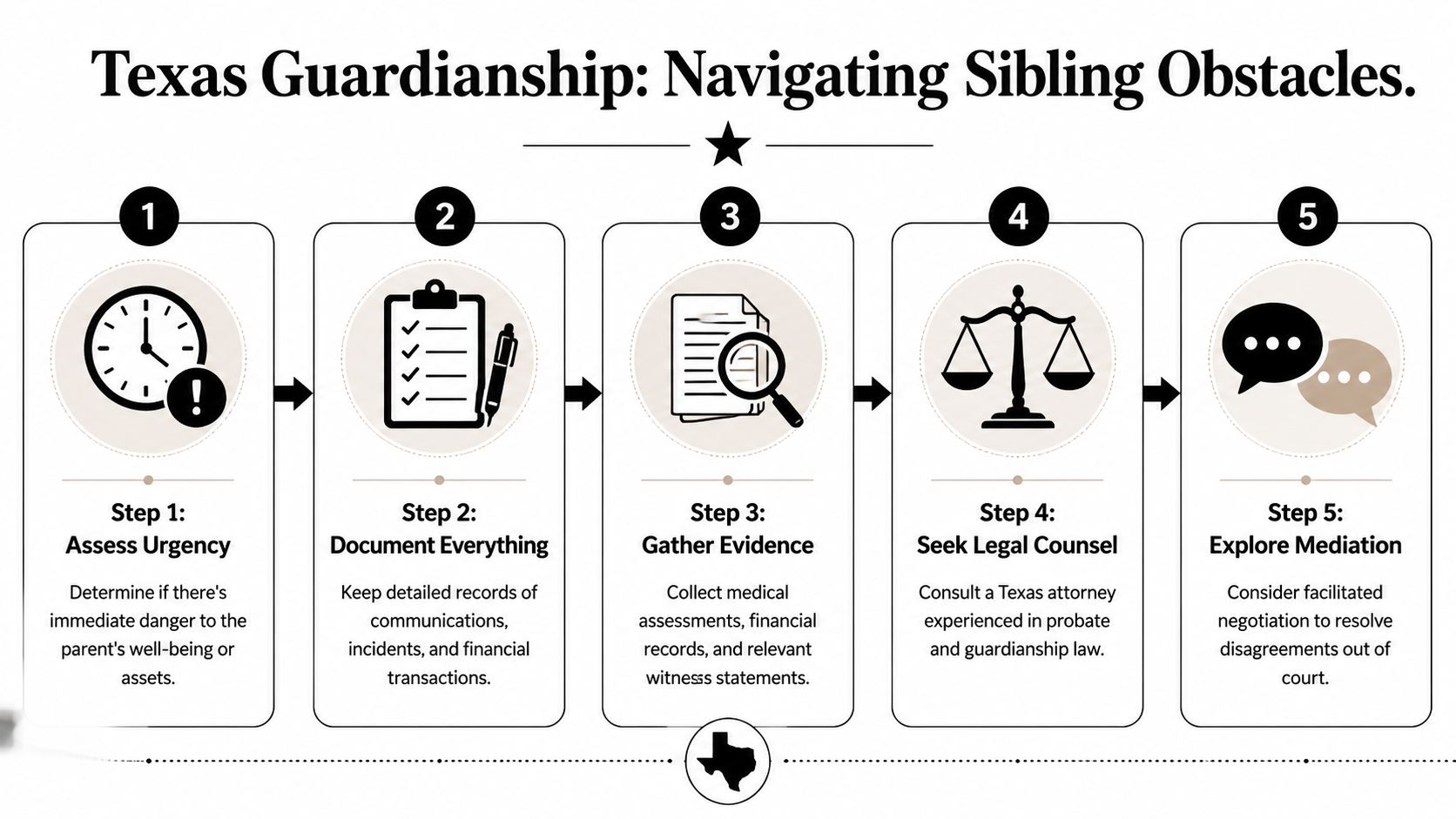
Step one is urgency, not outrage
Under Texas Estates Code Chapter 1251, a court can appoint a temporary guardian when the evidence shows immediate need and danger to the person or property of the proposed ward. In plain English, that means the court may step in when waiting for a full contest would put someone at serious risk.
In counties such as Harris County Probate Court, judges usually want concrete facts, not broad fears. “My sister is impossible” won't get emergency relief. “Dad was discharged from the hospital, can't manage insulin, and no one with authority can consent to care because my brother is blocking access” is a legal problem the court can evaluate.
Signs you may need temporary guardianship
Consider fast action if you're seeing facts like these:
- Medical danger: Your loved one is refusing essential care because no one has authority to coordinate treatment, consent, or placement.
- Financial exploitation in progress: Bills are unpaid, accounts are being drained, or property is being transferred without clear benefit to the ward.
- Self-neglect: The home is unsafe, food is spoiled, medications are unmanaged, or the person is wandering or living in conditions that threaten health.
- Isolation with consequences: A sibling is cutting off access in a way that keeps doctors, facilities, or banks from sharing information needed to protect the ward.
Build your emergency packet
If you need to move quickly, start collecting the material a judge can review in a hearing.
-
Current medical proof
Get a physician's letter or certificate that describes the condition, the functional limits, and why delay is risky. -
Specific incidents with dates
Write down what happened, when it happened, who saw it, and why it mattered. “Mom seemed confused” is weak. “On April 14, she left the stove on and could not explain how long it had been burning” is useful. -
Financial records
Gather late notices, unpaid invoices, suspicious withdrawals, returned checks, or notices from a facility or landlord. -
Witness names
Nurses, social workers, bankers, caregivers, neighbors, and facility staff can be more persuasive than family accusations. -
A narrow request
Ask only for authority necessary to stop the immediate harm. Courts are more receptive when the requested powers match the emergency.
When the problem is urgent, ask for relief tied to the danger. Don't ask the court to fix every family grievance in one hearing.
Don't make these early mistakes
The most common early errors are avoidable:
- Don't argue by text message. Save communications, but don't try to litigate the case in family group chats.
- Don't clean up the evidence. Preserve documents as they are. Don't write on originals or alter screenshots.
- Don't overreach. If the issue is unpaid memory care bills, focus there. Don't add claims you can't support.
- Don't ignore less restrictive alternatives. Texas courts prefer the least restrictive option that protects the ward. If supported decision-making, a valid power of attorney, or a limited guardianship can solve the problem, the court will want that addressed.
A short example helps. If an adult daughter in Austin learns that her father in Houston can no longer manage his medications and a sibling is preventing communication with doctors, her next move isn't to accuse that sibling of being selfish. Her next move is to get medical documentation, preserve communications, identify immediate risks, and prepare a focused filing under Chapter 1251 if emergency relief is needed.
Building Your Case With Evidence Not Emotion
The families who do best in contested guardianship cases usually make the same adjustment. They stop trying to prove that a sibling is difficult. They start proving facts the court can verify.

Texas guardianship law is evidence driven for a reason. A guardianship can remove major rights from an adult. Under Texas Estates Code Chapter 1101 and related provisions in Title 3, Subtitle G, the court needs reliable proof of incapacity and proof that the requested relief is necessary. That's why emotional arguments tend to collapse in a courtroom. They don't answer the judge's legal questions.
Start with medical evidence
A guardianship case usually rises or falls on the quality of the medical record. A current Physician's Certificate of Medical Examination should describe the diagnosis, functional limitations, and the areas where the person can't understand or communicate decisions.
If the doctor's paperwork is vague, stale, or incomplete, your case starts weak. If it is specific and current, the court has something concrete to evaluate. In a contested case, that often matters more than a stack of angry emails between siblings.
Keep a chronology, not a diary
Many families keep notes. Few keep a useful chronology. A probate judge needs a clean timeline.
Use a simple format:
- Date and time
- What happened
- Who observed it
- What record supports it
- Why it matters to care, safety, or finances
That log may include blocked visits, refused access to records, missed appointments, unexplained transfers, utility shutoff notices, or facility complaints. It should read like a business record, not a journal entry.
Case-building tip: If you can't attach a document, identify a witness. If you can't identify a witness, be careful about making the claim.
Financial proof gets attention fast
When families suspect abuse, they often lead with conclusions. Courts want the paper trail first.
A discussion of improper guardianship management in Texas notes that in Fiscal Year 2024, a Texas state program identified 707 guardianships out of compliance, and that abuses included a guardian spending $65,000 of a ward's funds on personal vehicles. That is exactly why judges focus on records such as bank statements, accountings, receipts, unpaid rent, unpaid medical bills, and unexplained withdrawals. Specific proof moves a case forward. Vague accusations usually don't.
Here's the practical contrast:
| Weak approach | Strong approach |
|---|---|
| “My brother is stealing from Mom.” | “The bank statements show withdrawals that don't match Mom's care expenses, and the assisted living invoices remain unpaid.” |
| “She keeps Dad from seeing anyone.” | “The facility log shows three denied visits, and staff can testify that access was restricted.” |
| “He's hiding everything.” | “I requested the annual accounting and supporting records on these dates and received no response.” |
Later in the process, many families find it helpful to review what evidence matters most in a contested hearing, especially in a setting like an evidentiary hearing in a Texas guardianship case.
Neutral witnesses often matter more than relatives
A sibling may think, “The judge should believe me because I’m the one who’s been present.” Sometimes that helps. Often, a neutral witness helps more.
Useful witnesses may include:
- Treating physicians
- Nurses or social workers
- Bank employees
- Memory care or assisted living staff
- Home health providers
- Neighbors who observed daily conditions
This is also a good point to hear a plain-English overview of how courts look at proof and incapacity:
What to leave out
Not every true thing belongs in a guardianship case. If your sibling was selfish in childhood, rude at holidays, or favored by a parent for years, that may explain the conflict but it doesn’t decide the legal issue.
Leave out what doesn’t prove incapacity, risk, mismanagement, or the need for court protection. That discipline is hard. It also wins cases.
Your Procedural Options in a Contested Guardianship
Once you have enough proof to move beyond frustration, the next question is procedural. What do you ask the court to do? In Texas probate courts, the answer depends on whether you’re trying to start a guardianship, force production of records, limit obstruction, or remove someone already serving.
Under Title 3, Subtitle G of the Texas Estates Code, contested guardianship cases often involve a mix of applications, motions, notices, discovery, and hearings. The words can sound intimidating. The purpose behind each tool is usually simple.
Legal options to counter sibling obstruction
| Legal Action | Primary Purpose | Best Used When… |
|---|---|---|
| Application for Appointment of Guardian | Starts the guardianship case and asks the court to appoint a guardian of the person, estate, or both | Your loved one lacks capacity and no valid less restrictive alternative is enough |
| Application for Temporary Guardianship | Seeks short-term emergency authority under Chapter 1251 | There is immediate danger to the person or property of the proposed ward |
| Motion to Compel | Asks the court to order a party to produce records or comply with discovery | A sibling is withholding documents, account records, or other information after proper requests |
| Petition to Remove an Existing Guardian | Requests removal of a guardian who is failing fiduciary duties or harming the ward | A guardian is not filing reports, mismanaging funds, neglecting care, or violating court duties |
| Petition to Appoint a Co-Guardian or Limit Powers | Seeks shared authority or narrower authority to reduce abuse risk | One person shouldn't hold unchecked control, but total removal may not yet be necessary |
A motion to compel is about leverage, not punishment
If your sibling won't turn over records voluntarily, discovery may be the turning point. In a contested probate case, discovery can include requests for documents, written questions, subpoenas, and depositions. If the other side refuses to comply, a motion to compel asks the judge to order compliance.
Families often get stuck waiting for bank records, accountings, communications with facilities, or medical information that should have been produced. A motion to compel shifts the issue from family stonewalling to court-enforced compliance.
Courts respond better to “we requested these documents and need an order compelling production” than “they're hiding things and being impossible.”
Removal focuses on duties, not personality
If a guardian has already been appointed, the issue may not be appointment at all. It may be removal. Texas courts take fiduciary duties seriously. That includes annual reporting, proper use of funds, care decisions, and obedience to court orders.
Removal requests work best when tied to specific failures:
- missed annual accountings
- unpaid care bills
- unexplained withdrawals
- unsafe placement decisions
- isolation that harms the ward
- refusal to provide records required by the court
A petition that says, “My sister is awful and controlling,” is weak. A petition that says, “The guardian failed to account, unpaid medical invoices are attached, and bank statements show transfers with no ward-related purpose,” is a legal claim.
Co-guardianship and limited powers can be practical middle ground
Sometimes the best answer isn't total victory for one sibling. It may be a co-guardian arrangement or an order that limits one person's powers. That can work when one sibling handles daily care well but transparency is poor, or when one sibling has financial skills but shouldn't control personal decisions alone.
Courts in Texas often prefer the least restrictive solution that still protects the ward. If a narrower order can solve the underlying problem, that may be more realistic than trying to win every issue at once.
Competing applications require strategy
Some disputes turn into dueling filings, with each sibling asking to be appointed. When that happens, the court is comparing credibility, practical ability, caregiving history, financial reliability, and willingness to comply with fiduciary duties.
If you're facing that posture, it helps to understand how competing guardianship applications in Texas are evaluated. The strongest applicant is usually the one who presents a disciplined record, a workable care plan, and a narrow request rooted in the ward's actual needs.
Don't overlook less restrictive alternatives
In a contested hearing, the other side may argue that guardianship is too extreme. Sometimes they're wrong. Sometimes they're partly right.
You should be prepared to address alternatives such as supported decision-making, powers of attorney, representative payee arrangements, trusts, or limited guardianship. Even if those options won't solve the whole problem, the court will want to know why they are not enough.
That's a key trade-off in these cases. Asking for too much can hurt credibility. Asking for too little can leave the ward exposed. The right filing matches the actual risk.
Finding Resolution Through Mediation or Legal Counsel
Not every guardianship fight should end in a full trial. Some should. Many shouldn't. The smart question is whether a negotiated solution can protect the ward without draining the estate and damaging the family beyond repair.

Mediation works when the dispute is about control, not reality
Mediation is often effective in high-conflict guardianship matters because it changes the setting. People who won't compromise in a hallway outside probate court will sometimes agree in a structured session with a mediator.
According to guidance on Texas sibling guardianship disputes, mediation resolves 70-80% of high-conflict sibling guardianship disputes in Texas, and courts appoint a neutral third-party guardian in approximately 20% of battles when the conflict is irreconcilable. That creates a real strategic choice. If both siblings keep fighting for control, both may lose control.
Good mediation targets
Mediation is usually worth serious effort when the family disagrees about management but agrees on the basic problem. For example:
- one sibling should manage money, but another should handle medical decisions
- the ward needs placement, but the family disputes where
- one side wants a guardianship, the other wants a limited guardianship
- communication rules, visitation terms, or reporting requirements could reduce distrust
In those situations, a mediated agreement may preserve more family dignity and more estate resources than a trial.
Sometimes the best outcome is not “I win guardianship.” It's “my loved one is protected, the records are transparent, and the fighting stops.”
When you need legal counsel right away
Some cases are too risky for informal problem-solving. You should treat legal representation as urgent when:
- A sibling already has counsel
- A temporary guardianship may be necessary
- Significant assets are involved
- There are signs of fiduciary misconduct
- Medical evidence is disputed
- You live out of state and need Texas probate guidance
- The case is in a busy court such as Harris County Probate Court or Dallas County probate court and deadlines matter
A lawyer's role in these cases isn't just arguing in court. It includes choosing the right filing, narrowing claims, coordinating medical proof, preparing witnesses, handling discovery, and keeping the case focused on the ward.
Don't ignore related planning issues
A contested guardianship case often exposes broader planning problems. Sometimes there is no valid estate plan. Sometimes there are outdated powers of attorney. Sometimes probate issues are waiting in the background if the loved one dies before the case is resolved.
That's why families often need to look beyond the immediate fight and consider related areas such as Texas probate matters and estate planning in Texas. A guardianship case may solve today's authority problem, but planning is what reduces the next crisis.
Common Questions About Sibling Conflicts in Guardianship
Can one sibling stop a guardianship just by objecting
No. An objection can turn the case into a contest, but it does not automatically defeat the application. The court still decides based on capacity, necessity, less restrictive alternatives, and the ward's best interests under the Texas Estates Code.
If your sibling objects, expect a slower process and more evidence requirements. That means better medical proof, cleaner records, and more disciplined testimony.
What if my sibling keeps me from seeing our parent
That depends on the facts and on who currently has legal authority. If there is an existing guardian, the court can address conduct that harms the ward, including isolation. If there is no guardian yet, blocked access may still matter if it interferes with care, medical evaluation, or evidence gathering.
The important point is to document each incident. Note dates, times, witnesses, and any messages or facility logs that support your account.
Can I seek guardianship if I live in another state
Yes, an out-of-state relative can still play a meaningful role in a Texas guardianship case. The key issue is not your ZIP code. It's whether you have standing, credible evidence, and a realistic plan for the ward's care and finances.
Remote involvement can include reviewing court records, collecting financial discrepancies, coordinating with doctors, and appearing through Texas counsel where appropriate.
What if there's already a guardian in place and that guardian is my sibling
Then the question may be modification, limitation of powers, or removal. Courts are more responsive when you point to narrow, documented violations than when you relitigate family history.
Examples include missed reporting, unpaid bills, unsafe living conditions, or unexplained transactions. Focus on the duty that was breached and how the breach affects the ward.
Does the court always choose a family member
No. If the conflict is severe enough, the court may decide that no family member should serve. In some cases, a neutral third party is the safer option.
That result can be necessary, but many families find it frustrating because it removes personal control and adds a professional decision-maker to the case. If you want to avoid that outcome, act like a fiduciary early. Be organized, transparent, and focused.
Are alternatives to guardianship worth raising if I think full guardianship is needed
Yes. Texas courts prefer the least restrictive option that will protect the person. Raising alternatives doesn't weaken your case if you explain clearly why they are inadequate.
For example, a durable power of attorney may not help if capacity is already impaired, if documents are disputed, or if an agent is misusing authority. Addressing those limits shows the court you are thinking carefully, not overreaching.
If your family is facing a blocked guardianship, an emergency care issue, or a fight over who should serve, personalized legal guidance can make the difference between a focused case and months of costly conflict. The Law Office of Bryan Fagan, PLLC helps Texas families with guardianship applications, contested hearings, temporary guardianships, probate, and estate planning across Houston, Dallas, Austin, San Antonio, and statewide through virtual consultations. Schedule a free consultation to discuss your options and build a strategy that protects your loved one.