Skip to content
When a family crisis hits, leaving a loved one suddenly unable to make critical decisions for themselves, the legal system can feel overwhelming. We understand how stressful these moments are for Texas families. In these urgent times, an emergency guardianship in Texas can be a lifeline, offering immediate protection when someone's health or finances are in imminent danger. Think of it as a legal first-response tool for the most critical situations.
What Is Emergency Guardianship in Texas?

When you're thrown into a sudden family emergency, understanding your options is the first step toward finding a solution. In Texas, what many people call an emergency guardianship is officially known in the courts as a temporary guardianship. It's a powerful legal measure that allows a court to act quickly, appointing a responsible person to make crucial decisions for someone who has become incapacitated and is in immediate peril.
The entire point of a temporary guardianship is speed and safety. It's not the same as a permanent guardianship, which involves a much longer and more detailed court process. This is an emergency fix, designed to grant a guardian the legal authority to act on behalf of the incapacitated person (called the "ward") right away.
The Standard of Imminent Danger
A Texas court, like a Harris County Probate Court, doesn't grant a temporary guardianship without very good reason. As outlined in the Texas Estates Code, the law demands "substantial evidence" that the person is facing "imminent danger." This isn't just a general worry about what might happen down the road; it’s a clear and present threat to their physical health or financial stability that requires someone to step in now.
For instance, imagine your elderly father has a severe stroke and is unconscious in the hospital. He can't give consent for a necessary life-saving procedure, and delaying it could be fatal. The standard guardianship process would take too long. This is exactly the kind of scenario where an emergency guardianship gives you the power to authorize that medical care immediately.
A temporary guardianship acts as a legal bridge, spanning the gap between a sudden crisis and a long-term solution. Its goal is to protect a vulnerable person from immediate harm while allowing time to determine the need for ongoing support.
Common Scenarios Requiring Emergency Action
Knowing when this tool is the right one can help you spot a crisis before it gets worse. A few situations that frequently justify an emergency guardianship in Texas include:
- Sudden Medical Incapacity: A person is in a coma after an accident or has another serious medical event that leaves them unable to communicate or make their own healthcare decisions.
- Aggressive Financial Exploitation: A new "friend" or a scammer is rapidly draining an elderly parent's bank accounts, and there's a real risk the money will be gone before a permanent guardianship can be put in place.
- Severe Neglect or Abandonment: A caregiver for an adult with disabilities suddenly leaves, abandoning them without access to food, medicine, or basic personal care.
In Texas, a temporary guardianship is only triggered when there is probable cause that someone is incapacitated and faces an immediate threat to their health, safety, or property. This temporary appointment, which is governed by the Texas Estates Code (Title 3, Subtitle G), is specifically designed to be short-term, lasting no more than 60 days. This brief window allows for a swift intervention to stabilize the situation without the delays of a full permanent proceeding.
It's crucial to understand that this is not a permanent solution. It’s a temporary shield, giving families the legal authority they need to manage a crisis and protect their loved one from harm. For a more detailed look into how this process works, you can explore more about understanding temporary guardianship in Texas. If you believe your family member is in immediate danger, taking prompt, informed action is the most important thing you can do.
Emergency vs. Permanent Guardianship at a Glance
To make the distinction clearer, it helps to see the two types of guardianship side-by-side. Each serves a very different purpose and operates on a completely different timeline.
| Feature | Emergency (Temporary) Guardianship | Permanent Guardianship |
|---|---|---|
| Purpose | To address an immediate, life-threatening crisis or prevent imminent harm to a person or their property. | To provide a long-term solution for an individual who is proven to be incapacitated and unable to care for themselves. |
| Legal Standard | Requires "substantial evidence" of incapacity and imminent danger. The focus is on the emergency. | Requires "clear and convincing evidence" of incapacity. The court will also explore less restrictive alternatives. |
| Duration | Strictly temporary, lasting no more than 60 days. It cannot be made permanent on its own. | Can last for the rest of the ward's life, or until the court determines it is no longer necessary. |
| Court Process & Timeline | Very fast. A hearing can often be held within a few days of filing the application. | A much longer process involving detailed applications, a court-appointed attorney for the ward, and thorough evaluations. |
| Guardian's Powers | Limited to the specific powers granted by the court to address the immediate emergency. | Can be broad, covering all personal and financial decisions, or limited to specific areas as defined by the court. |
This table highlights that while both are serious legal actions, an emergency guardianship is a sprint, and a permanent guardianship is a marathon. The emergency order is designed to put out the fire, giving you the time and legal standing to figure out the next steps for your loved one's long-term care and protection.
Recognizing When Emergency Guardianship Is Necessary
Knowing when to step in is often the hardest part of any family crisis. We know that the line between a tough situation and a true emergency can feel blurry, leaving you wrestling with doubt. But when it comes to pursuing an emergency guardianship in Texas, the law is actually quite clear: it all boils down to the principle of imminent harm.
An emergency guardianship is a powerful legal tool, but it's reserved for situations where a person’s health, safety, or property is in immediate peril. This isn’t about worrying over long-term decline; it’s about a clear and present danger that demands swift action. Seeing what these situations look like in the real world can give you the clarity needed to protect your loved one.
Scenarios of Imminent Medical Danger
A sudden medical crisis is probably the most common reason families find themselves needing an emergency guardianship. In these moments, life-or-death decisions have to be made, but the person is physically or mentally unable to make them. If there's no legal guardian or a valid Medical Power of Attorney in place, doctors can find their hands tied, unable to provide essential treatment.
Think about these urgent medical scenarios:
- A Loved One in a Coma: Your spouse is in a terrible car accident and is now unconscious in the ICU. The doctors need to perform a high-risk surgery to save their life, but they can't get consent. An emergency guardianship gives you the authority to approve that vital medical care without delay.
- A Sudden Stroke or Aneurysm: An elderly parent suffers a massive stroke, leaving them unable to speak or communicate. They need to be moved to a specialized care facility right away, but no one has the legal standing to authorize the transfer or access their funds to pay for it.
- An Unexpected Caregiver Loss: An adult with a profound intellectual disability depends entirely on their aging parent for everything. If that parent suddenly passes away or is hospitalized, the disabled adult is left completely vulnerable, with no one legally authorized to manage their medication, housing, or personal safety.
According to the Texas Estates Code, a temporary guardianship can be established if there is substantial evidence that a person is incapacitated and "imminent danger to the physical health or safety of the proposed ward or the safety of the proposed ward's property will result" before a permanent guardian can be appointed.
Situations Involving Financial Peril
Financial emergencies can be just as destructive as medical ones, and we recognize the emotional toll this takes on families. Vulnerable adults, especially those with cognitive decline, are unfortunately prime targets for scams and exploitation. An emergency guardianship can be the key to freezing accounts and stopping the financial bleed before it’s too late.
These examples show when immediate financial intervention is non-negotiable:
- Aggressive Financial Exploitation: Your mother, who has early-stage dementia, has been befriended by a new neighbor. You start noticing large, strange withdrawals from her bank account and then discover she was pressured into signing over the title to her car. An emergency guardianship of the estate empowers you to block access to her accounts and start the legal process to recover her stolen property.
- Sudden Inability to Manage Affairs: A business owner suffers a traumatic brain injury. Suddenly, they can no longer pay employees, handle payroll, or settle accounts with critical vendors. The company is teetering on the brink of collapse, jeopardizing the livelihoods of its entire staff. A temporary guardian of the estate can step in to manage the business and prevent total financial ruin.
These are the kinds of clear, urgent scenarios that emergency guardianship in Texas was built for. It's a protective measure for those moments when waiting simply isn't an option. Recognizing these red flags allows you to shift from a state of worry to one of informed action, ensuring your loved one is protected when they are at their most vulnerable.
If you are facing a situation like this and believe a loved one is in immediate danger, do not wait. The compassionate attorneys at The Law Office of Bryan Fagan are here to help. Schedule a free consultation today to discuss your circumstances and get the clear guidance you need to act quickly.
Meeting the Legal Standard for Incapacity and Imminent Danger

To obtain an emergency guardianship in Texas, you must do more than just tell a judge your loved one needs help. The court requires compelling proof that meets a specific two-part legal test: incapacity and imminent danger. Understanding what these terms really mean—and how you prove them—is the key to a successful application.
We know this can feel overwhelming, especially when you're already in the middle of a crisis. The legal system has very precise requirements, but they exist to protect the rights of the person you're trying to help. Let's break down exactly what you need to show the court.
Proving Incapacity: The Physician's Certificate
The first pillar of your case is proving your loved one is legally incapacitated. This means demonstrating they can no longer make rational decisions about their own health, safety, or finances. While your own testimony helps, the single most important piece of evidence is a Physician's Certificate of Medical Examination (CME).
This isn't just a doctor's note; it's a formal document where a physician gives their professional opinion on the person's condition. The Texas Estates Code is very clear: this certificate must be recent, dated within 120 days of when you file the guardianship application.
A proper CME needs to explain:
- The nature and severity of the person's physical or mental condition.
- How that condition affects their ability to make decisions.
- A firm medical opinion on whether they are truly incapacitated.
Without this medical evidence, a court in Texas—whether it's in Harris County or Dallas County—will almost certainly deny the application. You can dig deeper into the specifics of proving incapacity in Texas courts in our detailed guide.
Demonstrating Imminent Danger: Tangible Evidence is Key
The second, equally critical, pillar is proving imminent danger. This is the "emergency" in emergency guardianship. You must convince the court that without immediate intervention, your loved one faces substantial harm to their health, safety, or finances.
An emergency guardianship is granted when the risk isn't just possible—it's happening now or is about to happen. The court needs to see a direct link between the person's incapacity and the immediate threat they face.
This is what sets an emergency guardianship apart. The standard is much higher, and it’s why the process is so much faster and more powerful than other legal options.
Building Your Case with Strong Evidence
So, how do you show imminent danger? Vague fears and general concerns won't cut it. You need to present concrete, tangible evidence that paints a clear and undeniable picture of the crisis for the judge.
Think about gathering documents like these:
- Financial Records: Bank or credit card statements showing large, uncharacteristic withdrawals, unpaid bills, or suspicious transactions that point to fraud or exploitation.
- Photographs or Videos: Pictures or clips of unsafe living conditions (hoarding, filth), unexplained injuries, or property damage.
- Written Communication: Printouts of emails, text messages, or letters from scammers, con artists, or other manipulative individuals.
- Witness Testimony: Statements from friends, neighbors, or other family members who have seen the person's confusion, neglect, or dangerous behavior firsthand.
- Medical Reports: Hospital discharge papers or doctor's notes that show a sudden health decline or a refusal to accept critical medical treatment.
Presenting this kind of hard proof is what turns your application from a worried plea into a compelling legal case. It gives the judge the justification they need to act swiftly and grant the emergency orders to protect your family member.
Navigating the Texas Court Process Step by Step
Walking into a courtroom during a family crisis is a daunting prospect. But knowing the exact path ahead can make all the difference. The process for securing an emergency guardianship in Texas is built for speed, but it still follows a precise legal sequence. We’ll break down each step so you know exactly what to expect.
From the moment you decide to act to the final court hearing, every step builds on the last. Think of it as constructing a legal case to protect someone you love.
Step 1: File the Application
Your first practical step is to file an "Application for Appointment of Temporary Guardian" with the correct court. This is almost always the probate court in the county where your loved one (the proposed ward) resides, such as the Harris County Probate Court or the Dallas County Probate Courts. This application clearly states who you are, who needs protection, and the specific reasons for the emergency. You will attach your key evidence, including the physician’s letter, to this filing.
Step 2: Secure the Required Physician’s Letter
The Physician’s Certificate of Medical Examination (CME) is absolutely non-negotiable. You must file this document, which has to be completed by a doctor who has examined your loved one recently, right along with your application. It gives the court a professional medical opinion on the person’s condition and why they can’t make decisions for themselves. Frankly, without a valid CME, your application is dead on arrival. It’s the cornerstone for proving incapacity under the Texas Estates Code.
Step 3: Notify Family and Understand the Ad Litem
Once your application is filed, things move very quickly. The next stage has two key parts: serving notice to interested parties and the court’s appointment of an attorney ad litem.
- Serving Notice: Texas law is strict on this. The proposed ward must be personally served with a copy of the application and a notice of the hearing. This is a fundamental protection of their rights. Other family members, like a spouse or adult children, also have to be notified.
- The Attorney Ad Litem: The judge will immediately appoint an independent lawyer, known as an attorney ad litem, whose only job is to represent the proposed ward. This attorney acts as a neutral party, advocating for the ward’s best interests. They will meet with your loved one, explain the proceedings, and then report their independent findings back to the judge.
The role of the attorney ad litem is a vital safeguard in the Texas guardianship system. This neutral third party ensures the proposed ward has a voice and that their rights are not being overlooked in the rush of an emergency proceeding.
Step 4: Prepare for the Court Hearing
The court hearing for an emergency guardianship in Texas is usually scheduled within just a few days of filing. This is your moment to present your case directly to the judge. You need to be ready to testify clearly and confidently about the imminent danger your loved one is in.
During this hearing, the judge will:
- Review your complete application and the physician’s certificate.
- Listen to your testimony about the emergency.
- Hear the official report from the attorney ad litem.
- Consider any other proof you’ve brought, like financial records or witness statements.
To build a strong case, legal professionals often rely on sophisticated tools to quickly analyze statutes and case law. For anyone curious about how modern legal work gets done, an AI Legal Case Researcher offers a glimpse into these evolving technologies. The judge’s final ruling will be based solely on whether the evidence you present meets the high standard of imminent harm.
If the judge agrees there is substantial evidence of both incapacity and imminent danger, they will sign an order appointing you as the temporary guardian. This court order will list your specific powers and state that the guardianship can last no more than 60 days.
Trying to navigate this rapid process on your own is an incredible weight to bear. The compassionate team at The Law Office of Bryan Fagan can handle every step for you, from filing the initial paperwork to representing you in court. Schedule a free consultation to get the immediate help your family deserves.
Exploring Alternatives to Guardianship That Are Less Restrictive
When a crisis hits, your first instinct is to find the strongest possible shield for your loved one. While an emergency guardianship in Texas is a powerful tool, it's also incredibly restrictive. It temporarily takes away a person's most basic right: the power to make their own choices.
That's why Texas law requires judges to look at other options first. Before a court will grant a guardianship, a judge—whether in Harris County, Travis County, or anywhere else in the state—has to be sure there are no less restrictive alternatives that could meet the person’s needs. Often, the best way to avoid court intervention is through proactive planning.
Proactive Planning Tools
The most powerful alternatives are legal documents you put in place before a person loses their ability to make decisions. These tools let someone choose, in advance, who they trust to step in if they ever become unable to manage things on their own.
- Durable Power of Attorney: This document allows a person (the "principal") to name someone they trust (the "agent") to handle their financial matters. The key here is the word "durable," which means it stays in effect even if the principal becomes incapacitated.
- Medical Power of Attorney: This works just like the financial power of attorney but for healthcare. It lets a person designate an agent to make medical decisions for them if they can’t.
- Living Will (Directive to Physicians): This document specifically states a person's wishes about end-of-life medical care, like whether they want life-sustaining treatments.
These documents are the foundation of any solid estate plan. They create a clear, legally recognized path for decision-making that keeps your family out of the courtroom during an already difficult time. The only catch is the timing: they must be signed while the person still has the mental capacity to fully understand them. A power of attorney signed by someone with advanced dementia, for example, won't hold up in court.
Supported Decision-Making Agreements
Another option is a Supported Decision-Making Agreement. This is a tool recognized in Texas that lets a person with a disability select trusted advisors—family, friends, or even professionals—to help them process information, understand their options, and ultimately make their own decisions.
A Supported Decision-Making Agreement empowers an individual by providing them with support, rather than removing their right to make decisions. It formalizes a collaborative process where the person remains in control.
This works incredibly well for adults who can still make sound choices but might get overwhelmed by complex medical or financial information. It keeps the individual at the heart of their own life, which is always the goal.
The following table gives you a quick snapshot of how these different tools compare.
Decision-Making Tools for Texas Families
| Legal Tool | When It's Used | Key Benefit |
|---|---|---|
| Emergency Guardianship | During a crisis when there's an imminent threat of harm. | Provides immediate, court-ordered protection for an incapacitated person. |
| Power of Attorney | Before a person becomes incapacitated. | Allows the individual to choose who will manage their affairs. |
| Supported Decision-Making | When a person has a disability but can still make choices with help. | Keeps the individual in control while providing a formal support system. |
Each of these tools serves a different purpose, and the right one depends entirely on the specific circumstances your family is facing.
When these proactive measures aren't in place, a guardianship might be the only path forward. The infographic below shows the basic court process that follows.
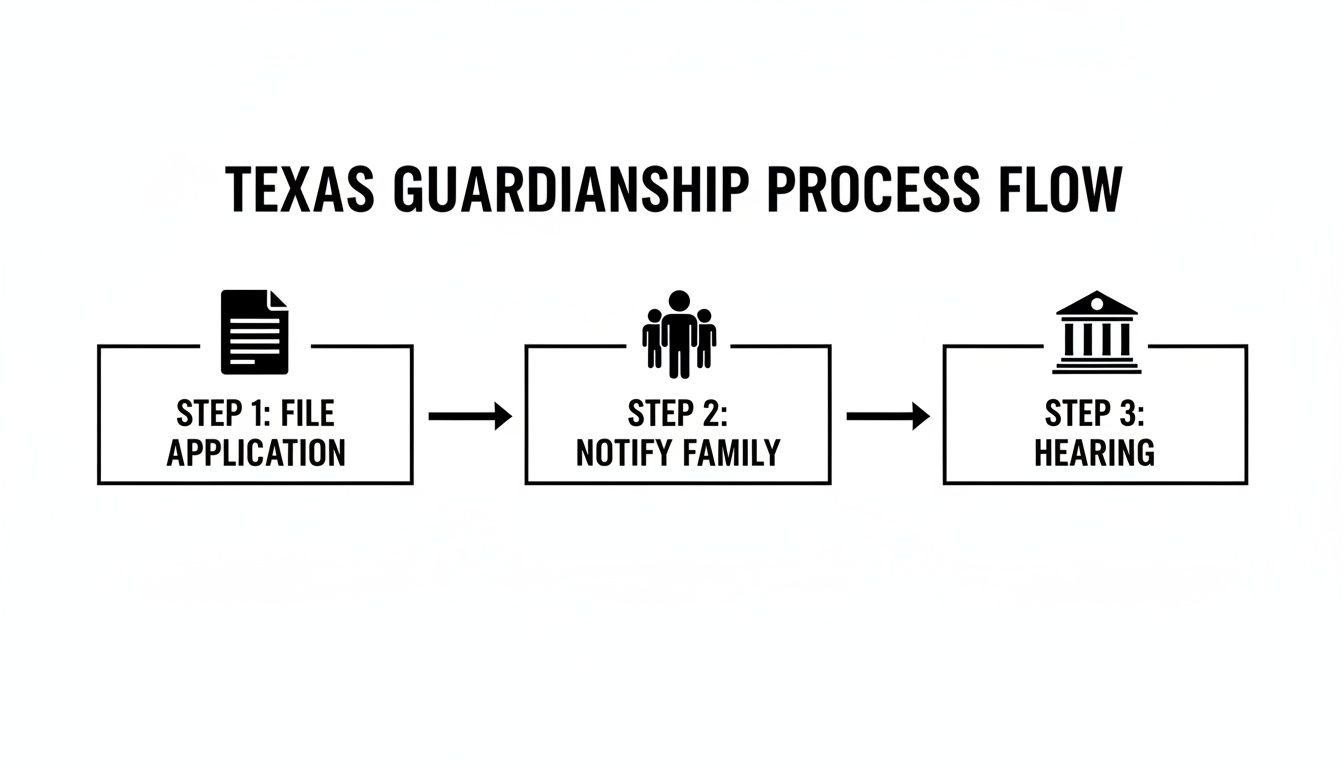
This visual breaks down the core legal steps—filing the application, notifying family, and the court hearing—that must be followed to secure a guardianship. You can see why exploring less restrictive options for decision-making first is so important. If you’re not sure which path is right for your family, we can help you find clarity.
Your Responsibilities as a Temporary Guardian

Once a judge approves your application for an emergency guardianship in Texas, you’re handed a tremendous and immediate responsibility. That court order isn't just a piece of paper—it’s the legal authority you need to protect your loved one in a crisis. To act effectively and legally, you must understand exactly what the court expects of you.
The very first thing you need to do is read the court order from top to bottom. This document is your rulebook, and it will spell out the precise scope of your powers. A judge can appoint you as a guardian of the “person,” the “estate,” or both.
Guardian of the Person: This role is all about your loved one’s personal well-being. The court might authorize you to make critical decisions about their medical care, where they live, and their day-to-day needs.
Guardian of the Estate: This duty centers on managing the ward's financial life. Your powers could include paying their bills, accessing their bank accounts to cover necessary expenses, and protecting their assets from being stolen or wasted.
Keep in mind, these powers aren't a blank check. The court order will clearly define your authority, and you have to operate strictly within those lines.
Understanding Your Fiduciary Duty
When the court names you as a temporary guardian, you officially take on a fiduciary duty. It’s a legal term with a simple, powerful meaning: you must act solely in the best interests of the ward. Every single decision, whether it’s about their health or their finances, must put their well-being first—even before your own.
Your fiduciary duty is the highest standard of care the law recognizes. It demands absolute loyalty, honesty, and good faith. Violating this duty is a serious misstep that can lead to your removal as guardian and being held personally liable for any harm you caused.
This means you can't use the ward’s money for yourself, make choices that benefit you, or do anything that creates a conflict with their needs. For example, if you’re the guardian of your parent’s estate, you cannot use their money to pay off your own credit card bill, even if you fully intend to pay it back.
Practical First Steps After Appointment
On top of your fiduciary duty, a Texas court will have you take care of a few practical steps right after your appointment. One of the most important is to post a bond. Think of a bond as an insurance policy that protects the ward’s assets from any potential mismanagement on your part. The judge sets the bond amount, which is often tied to the value of the ward’s estate.
As the 60-day temporary guardianship period comes to a close, you’ll have another major decision to make. If your loved one is still incapacitated and unable to manage their own affairs, you will need to think about applying for a permanent Guardianship. This is a completely separate legal process; it isn't an automatic extension of your temporary role.
Taking on the role of a temporary guardian is a huge commitment, especially during an emotional and stressful time. You don’t have to handle this weight by yourself. The attorneys at The Law Office of Bryan Fagan are here to offer clear, compassionate guidance. Schedule a free consultation to make sure you are fully prepared to meet your responsibilities and protect your loved one.
Answering Your Pressing Questions About Emergency Guardianship
When you’re in the middle of a crisis, you don't have time for legal jargon. You need straight answers, and you need them now. We've heard the same urgent questions from families across Texas, and we're here to provide the clarity you need to move forward.
How Quickly Can I Get an Emergency Guardianship?
This process is built for speed. Once the application and the required doctor's letter are filed, a judge can hold a hearing in just a matter of days. In truly dire situations—where a person faces immediate, life-threatening danger—a Harris County probate judge might issue temporary orders even faster to bring things under control.
What Does an Emergency Guardianship Cost?
We understand that financial concerns are very real for families facing a crisis. The total cost will depend on how complex your situation is. Generally, you can expect a few key expenses:
- Court Filing Fees: These are the standard administrative fees just to get your application filed with the court.
- Attorney Fees: This covers the legal work of preparing your case, gathering evidence, and representing you at the hearing.
- Bond Premiums: This is an insurance payment required by the court to protect the proposed ward’s assets from any potential mismanagement.
The best way to get a firm number is to discuss the specifics of your case with an attorney who can give you a realistic estimate.
While costs are a valid concern, it’s helpful to see it as a critical investment. You're taking action to protect a loved one’s health and potentially their entire life savings from very real and irreversible harm.
Can I Get Guardianship if I Live Out of State?
Yes, it's absolutely possible for someone living outside of Texas to be appointed as a temporary guardian. That said, it does create some practical hurdles. Having a local Texas law firm on your side is invaluable here, as they can handle the court filings, make appearances on your behalf, and make sure every local rule is followed to the letter.
What Happens After the 60 Days Are Over?
This is a critical point to understand: an emergency guardianship automatically ends after 60 days. It cannot be extended. As that deadline approaches, if your loved one is still unable to manage their own affairs, you have a decision to make. The next step is either to begin the process for a permanent Probate and Guardianship or let the emergency order expire.
Trying to navigate the legal system during an emergency can feel impossible. At The Law Office of Bryan Fagan, PLLC, our compassionate attorneys are ready to give you the clear guidance and swift action your family deserves. Schedule a free, no-obligation consultation to discuss your case by visiting us at https://texasguardianshiplawyer.net.