Skip to content
When a Texas court is tasked with deciding a guardianship case, it often appoints a Guardian Ad Litem (GAL) to serve as its neutral investigator. The core guardian ad litem duties involve digging into the facts of the case and recommending what is truly in the best interest of the person who might need a guardian, known as the proposed ward. This role is absolutely critical for ensuring a fair and just outcome for your loved one.
We understand that facing a guardianship can be an emotionally taxing experience. Our goal at The Law Office of Bryan Fagan is to provide Texas families with the clarity and support needed to navigate this complex legal journey with confidence.
Understanding the Guardian Ad Litem in a Texas Guardianship
When your family is facing the possibility of a guardianship, the introduction of a court-appointed stranger can feel intimidating. We see families tense up at the mere mention of it. But understanding the Guardian Ad Litem’s purpose can bring a sense of clarity and ease some of that anxiety.
It’s best to think of the GAL not as an adversary, but as the "eyes and ears of the court." This person, who is almost always an experienced attorney, has just one mission: to give the judge an impartial, fact-based assessment of the situation.
The GAL's role is required by law—specifically under Title 3, Subtitle G of the Texas Estates Code—to protect the rights and well-being of the proposed ward. Their primary job is to investigate everything from a neutral standpoint, completely separate from the wishes of the family member applying for the guardianship or anyone else involved.
The GAL as a Neutral Investigator
Think of it this way: the judge can't personally visit your loved one's home, speak with their doctors, or interview family members. So, the court hires a trusted detective—the Guardian Ad Litem—to go out and gather all of that vital information.
The GAL's investigation is guided by the Texas Estates Code and focuses on answering a few critical questions:
- Is the proposed ward truly incapacitated and unable to manage their own affairs?
- Is a full guardianship really the least restrictive option available to protect them? Could alternatives to guardianship work instead?
- If a guardianship is necessary, who is the best person to serve as the guardian?
To get these answers, the GAL conducts a thorough inquiry. This usually means personal visits to the proposed ward's home, confidential interviews with them to understand their wishes, and talks with caregivers, relatives, and doctors. This process ensures the court in places like Harris County Probate Court or a court in Dallas County has a complete, unbiased picture before making a life-altering decision.
For families navigating this for the first time, it's helpful to understand all the different players involved. While the GAL investigates for the court, other roles like the Guardian and the Attorney ad Litem have completely different responsibilities.
Key Roles in a Texas Guardianship Case
| Role | Primary Responsibility | Who They Represent |
|---|---|---|
| Guardian ad Litem (GAL) | Investigates the facts and reports to the court on the proposed ward's best interest. | The Court |
| Attorney ad Litem | Acts as the proposed ward's lawyer, advocating for their stated wishes and protecting their legal rights. | The Proposed Ward |
| The Guardian | Once appointed, manages the ward's personal and/or financial affairs as directed by the court. | The Ward (after appointment) |
Understanding these distinctions is key. As you can see, only the Attorney ad Litem directly represents the proposed ward's legal interests, while the GAL's client is the court itself. You can learn more about the guardian's specific duties after they're appointed in our article on what a court-appointed guardian is.
Key Takeaway: The Guardian Ad Litem does not represent you or any other family member. Their only client is the court, and their sole objective is to determine and recommend what serves the best interest of the proposed ward.
It’s completely natural for families to feel nervous about this level of scrutiny. We see it all the time. But it's important to remember this process is designed to add a crucial layer of protection for your vulnerable loved one.
By being open and cooperative, you help the GAL do their job, which ultimately helps the judge make the most informed and compassionate decision possible. This impartial investigation is a cornerstone of Texas guardianship law, ensuring every appointment is both necessary and right for the person it’s meant to protect.
The Guardian Ad Litem Investigative Process
Once a Texas probate court, maybe one right here in Bexar County, appoints a Guardian Ad Litem (GAL), their real work begins. This is the investigation phase, and it’s the absolute heart of all guardian ad litem duties. Think of it as a thorough, fact-finding mission designed to give the judge a crystal-clear, unbiased picture of your loved one's life.
For families, this part of the process can feel like being put under a microscope. It’s natural to feel that way. However, knowing what the GAL is looking for can help demystify everything and make you feel more prepared. Their goal isn’t to find fault; it’s to gather the facts needed to protect the proposed ward.
Everything the GAL does is guided by the Texas Estates Code and is laser-focused on the proposed ward's best interests. They piece together a complete puzzle of the person's life, abilities, and needs.
Confidential Interviews and Personal Visits
A GAL’s first, and arguably most important, move is to meet with the proposed ward in person. This confidential meeting is non-negotiable. It’s where the GAL forms their own, independent opinion on the person's capacity, sees their living conditions firsthand, and—most critically—hears directly from them about their wishes.
The GAL will then speak with a wide circle of people connected to the proposed ward's life. This almost always includes:
- The Applicant: The person who started the guardianship case.
- Family Members: Spouses, kids, siblings, and other relatives who can offer their perspective.
- Caregivers: Anyone providing daily help, from an in-home aide to the staff at a care facility.
- Medical Professionals: Doctors, nurses, and therapists who understand the person’s physical and mental state.
For example, in a guardianship establishment process for an elderly parent in San Antonio with early-stage Alzheimer's, the GAL would visit them at home. They would then talk to the adult children (one of whom filed for the guardianship) and interview the home health aide who comes every day. This 360-degree approach is designed to prevent a one-sided story from reaching the judge.
Document and Record Review
Beyond the interviews, the GAL has the authority to review all the critical paperwork. This part of the investigation provides the hard evidence to either support or challenge the need for a guardianship in the first place.
Key Takeaway: The GAL's investigation is like assembling a complex puzzle. Each interview, home visit, and document review is a piece that helps form a complete picture for the court, ensuring the final decision is based on facts, not just feelings.
Typically, the GAL will ask for and carefully analyze:
- Physician’s Letters: The official letter from a doctor assessing the proposed ward's physical and mental capacity is a cornerstone of any guardianship case.
- Medical Records: These documents create a detailed timeline of a person’s health challenges. A GAL’s investigation often digs into the ward's mental status, and this guide to mental health assessment can offer more insight into what that involves.
- Financial Statements: If a guardianship of the estate is on the table, the GAL will need to look at bank statements, property records, and other financial papers to confirm that help is truly needed.
This simple flowchart shows how the GAL's role fits into the bigger picture.
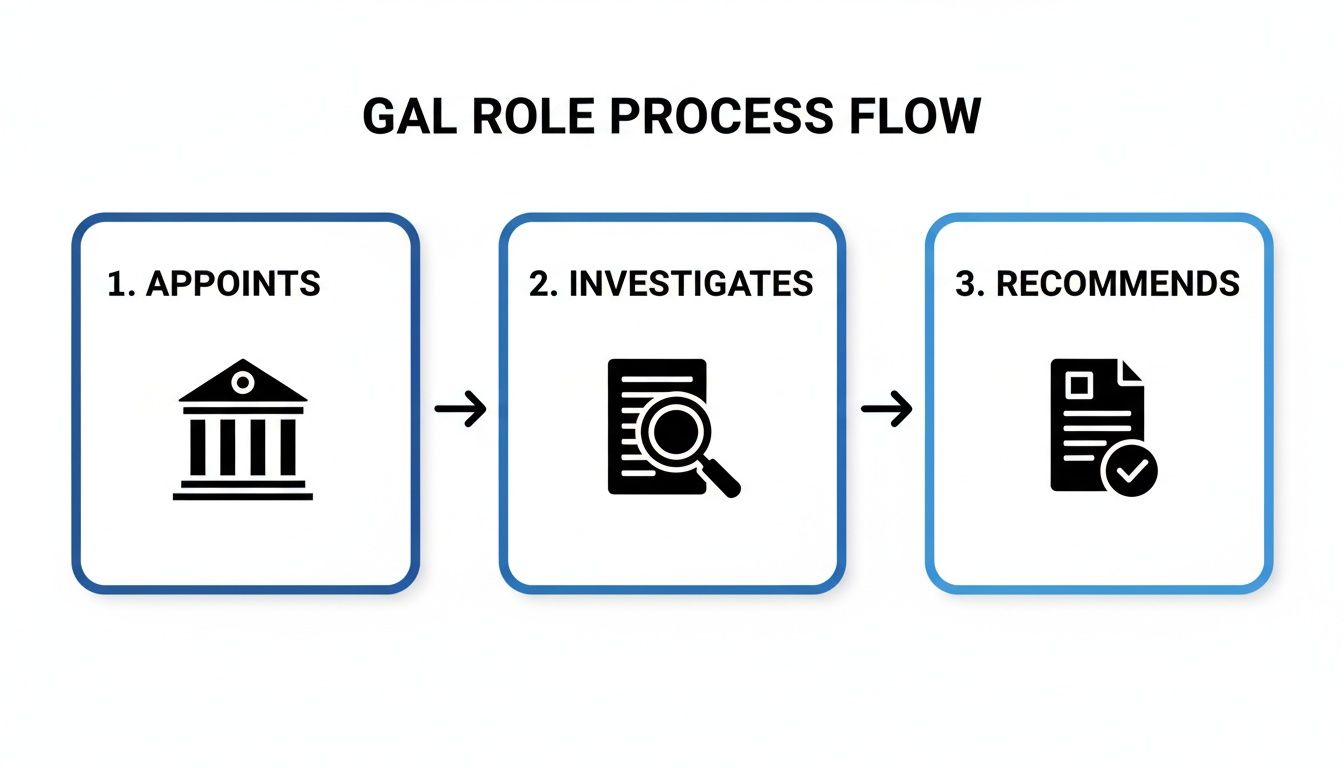
As you can see, the GAL's job is to step in after the court makes an appointment and conduct an impartial investigation before giving a recommendation.
This entire investigative phase is something your family can—and should—prepare for. For more specific advice, take a look at our guide on how to prepare for a guardianship evaluation in Texas. Just having your documents and thoughts organized can make your interactions with the GAL much smoother and more productive.
The investigation is over when the GAL feels they have enough information to form a confident, well-supported opinion. They will then compile all their findings into a formal report for the court, which we will dive into in the next section.
How the GAL Report Influences Your Guardianship Case

After all the interviews, home visits, and background checks are done, the Guardian Ad Litem’s work boils down to one critical document: their formal report to the court. This report is arguably the most important piece of the guardian ad litem duties, giving the judge an impartial summary of the facts and a professional opinion. For any family involved in a guardianship case, understanding how much this report matters is essential.
While the judge always makes the final call, the GAL's report carries immense weight. Judges in busy Texas probate courts, like those in Harris or Travis County, lean on these reports. They come from a neutral party whose only goal is to protect the proposed ward’s best interests, providing an evidence-based roadmap that helps guide the court's final decision.
What Is Inside the GAL Report
The GAL report isn't just a simple summary; it’s a detailed, structured analysis that organizes every finding from the investigation. While the exact layout can differ, every report is built to answer the core questions of the case and must follow the standards laid out in the Texas Estates Code.
You can almost always expect to find these key sections in a typical GAL report:
- Findings of Fact: This part is a transparent log of the GAL’s work. It details who they interviewed, the documents they reviewed, and the places they visited.
- Assessment of Capacity: Here, the GAL gives their professional opinion on the proposed ward's ability to handle their own health, safety, and finances.
- The Ward’s Preferences: The GAL has a duty to tell the court what the proposed ward wants—their expressed wishes about the guardianship and who they’d prefer as a guardian—even if those wishes don't seem like the best idea.
- Final Recommendations: This is the bottom line. The GAL will recommend whether a guardianship is necessary, what kind is best (full or limited), and who they believe should be appointed guardian.
A Real-World Example of a GAL Report
Let’s imagine a case involving a 25-year-old man named David who has an intellectual disability. His parents have cared for him his entire life and are now applying for guardianship to manage his medical care and a small inheritance. The GAL's report would be central to the outcome.
The report might note that David is in a safe and loving home, highlighting his parents’ deep involvement in his day-to-day life. Critically, the GAL would also report that during a private interview, David said he trusts his parents and wants them to keep helping him.
Based on these facts, the GAL would almost certainly recommend that a guardianship is in David’s best interest. Their recommendation would likely support appointing his parents as co-guardians. This gives the court the independent validation it needs to approve the guardianship, aligning the legal outcome with the family's goals.
A Critical Point for Families: The GAL's report often becomes the foundation for the judge's final order. Full and honest cooperation with the GAL is not just helpful—it is the best way to ensure your perspective and your loved one's needs are accurately reflected.
Ultimately, this report is entered into evidence at the final guardianship hearing. Your attorney and the opposing side will get to review it and even ask the GAL questions about their findings and recommendations. To get a better sense of how this plays out, take a look at our guide on what to expect at a Texas guardianship hearing. An experienced attorney can help you prepare for this crucial stage of your case.
How to Work Effectively with a Guardian Ad Litem

When a Guardian Ad Litem (GAL) is appointed to your case, it’s natural to feel on edge. Suddenly, a court-appointed professional is stepping into your life to closely examine your family’s most private matters. But this doesn't have to be a negative experience.
The most important thing to remember is that the GAL isn't your opponent. They are a neutral investigator for the court, tasked with being its "eyes and ears." Their job is to fulfill their guardian ad litem duties by gathering facts to help the judge make a sound decision about what’s best for your loved one.
Choosing to cooperate with the GAL is one of the most powerful moves you can make. It shows the court you are transparent and, above all, focused on the well-being of the proposed ward.
Preparing for Your Meeting with the GAL
Your first conversation with the GAL often sets the tone for the entire process. Coming prepared shows you respect their role and helps establish your credibility right from the start.
Before the GAL visits or calls, spend some time getting your key documents in order. This simple, proactive step makes the meeting far more productive and helps you clearly present why your involvement is in your loved one’s best interest.
Here are some of the items you should have ready to go:
- Medical Documents: Gather the Physician's Letter of Incapacity, any recent medical records, and a complete list of doctors and medications.
- Financial Information: If you're seeking to be a guardian of the estate, prepare bank statements, recent bills, and any property information. This demonstrates the need for financial oversight.
- Legal Papers: Make copies of any existing Power of Attorney documents, advance directives, or living wills. These may serve as alternatives to guardianship.
- Contact List: Compile a list of names and phone numbers for important people in your loved one’s life, like caregivers, family members, and close friends who can provide insight.
Having these documents on hand proves you are organized and have nothing to hide. It helps the GAL perform their duties efficiently and build an accurate picture of the situation.
The Dos and Don'ts of GAL Interactions
How you communicate with the GAL is just as critical as the information you provide. The goal is to position yourself as a reasonable and trustworthy source. If you see the GAL as an ally in protecting your loved one—not an obstacle—you’ll naturally steer the interactions toward a positive outcome.
Our Compassionate Advice: Treat the Guardian Ad Litem with the same respect you would give a judge. Be on time, be courteous, and above all, be honest in every conversation. This level of professionalism speaks volumes about your character and your intentions.
To help you navigate these crucial conversations, stick to this simple checklist of dos and don'ts.
Do:
- Be completely honest and transparent. A GAL is trained to spot inconsistencies, and they will likely find out the truth anyway. Honesty is the only path to building trust.
- Organize and provide documents promptly. Quick and efficient responses show you’re cooperative and take the legal process seriously.
- Focus on the needs of the proposed ward. Always frame your answers and concerns around what is best for your loved one, not what you personally want.
- Ask clarifying questions. If you're unsure what the GAL is asking, say so. It’s always better to ask for clarification than to guess and give an inaccurate answer.
Don't:
- View the GAL as an opponent. They are not on anyone's "side." Their only duty is to the court and the best interests of the proposed ward.
- Speak negatively about others without facts. Avoid getting drawn into emotional arguments or making claims you can't back up. Stick to objective, verifiable information.
- Withhold relevant information. Hiding details, even if you think they’re unfavorable, will only damage your credibility and make it look like you're not acting in good faith.
- Coach or pressure your loved one. The GAL needs to understand the proposed ward's genuine thoughts and feelings. Any attempt to influence them will backfire.
Effectively interacting with a GAL is a skill that can make or break a guardianship case. By being prepared, honest, and respectful, you help the GAL fulfill their guardian ad litem duties while ensuring your side of the story is represented clearly and credibly. This cooperative approach can make all the difference in the court's final decision.
For personalized advice on your specific case, don't hesitate to reach out. The Law Office of Bryan Fagan offers a free consultation to help Texas families navigate these challenges with clarity and confidence.
What to Do When You Disagree with the GAL Report
Even though a Guardian Ad Litem (GAL) is meant to be a neutral investigator for the court, they are still human. It’s entirely possible to read their final report and feel that it completely misses the mark. You might find that it misinterprets key facts or recommends a course of action you firmly believe is wrong for your loved one. This is a common point where guardianship disputes can arise.
We know how gut-wrenching that can be. After putting your faith in the process and cooperating fully, seeing a report that feels disconnected from your family’s reality is incredibly discouraging. But it's crucial to remember this: the GAL’s report is not the final word.
The moment you realize you disagree with the GAL's findings is the exact point where having an experienced guardianship attorney shifts from being a good idea to an absolute necessity.
Your Legal Options for Challenging the Report
You have every right to challenge a GAL report, but it has to be done strategically through the proper legal channels. Simply telling the judge you don't like it won't be enough. Your attorney can take several powerful and specific steps to contest the report’s conclusions and build a stronger case for your position.
These steps often include:
- Filing Formal Objections: Your attorney can file a legal document that formally objects to the GAL's report. This document will outline the specific findings or recommendations you dispute and clearly state the reasons why.
- Presenting Countervailing Evidence: A strong objection isn’t just about disagreeing—it’s about proving a different set of facts. Your lawyer can introduce new evidence, like witness testimony or additional records, that directly contradicts what the GAL concluded.
- Cross-Examining the GAL: During the final guardianship hearing in a Harris County Probate Court or another Texas court, your attorney has the right to question the GAL on the witness stand. This is a critical opportunity to challenge their investigation methods, question their reasoning, and point out any biases or gaps in how they fulfilled their guardian ad litem duties.
This formal legal process makes certain your side of the story is heard and properly considered by the judge before any final decision is made.
Our Professional Guidance: Disagreeing with a GAL report is a serious legal fight. It demands a swift, strategic response from an attorney who knows the rules of evidence and courtroom procedure inside and out. This is not a battle you should ever try to fight on your own.
A Scenario: Proving a Family Member's Fitness
Let’s imagine a situation where an elderly mother needs a guardian. Her devoted daughter, who has been her primary caregiver for years, applies for the role. However, the GAL, perhaps worried about the daughter’s full-time job, recommends appointing a professional guardian instead.
The daughter is heartbroken. She believes a stranger could never offer the same love and personal attention. This is where we would step in. Our first move is to file a formal objection to the report.
Next, we get to work proving the daughter’s fitness by:
- Presenting a Detailed Care Plan: We help her create a comprehensive plan that shows exactly how she will manage her mother's care alongside her job, maybe with scheduled help from other relatives or a part-time aide.
- Gathering Witness Testimony: We arrange for friends, neighbors, and the mother's doctor to testify about the daughter's unwavering dedication and the powerful, loving bond she has with her mother.
- Challenging the GAL's Assumptions: In court, we would cross-examine the GAL, asking them to point to specific evidence showing the daughter was unfit. This often reveals their recommendation was based on an assumption, not on fact.
By taking these steps, we can effectively show the judge that our client is not only fit but is the best person to care for her mother. This gives the court the evidence it needs to rule in her favor.
If you find yourself on the receiving end of a GAL report you disagree with, don’t lose hope. It’s time to take action. The Law Office of Bryan Fagan is here to give you the expert legal advocacy you need. Schedule a free consultation with us today to discuss your case and learn how we can protect your family's best interests.
Your Attorney's Role in a GAL Investigation
It’s easy to get confused about who’s on whose side in a guardianship case. Let’s be clear: there’s a massive difference between a Guardian Ad Litem (GAL) and your own guardianship attorney. While both are involved in the court process, their jobs—and their loyalties—are completely separate. The GAL’s duty is to investigate and report back to the court on what they believe is in your loved one’s best interest.
Our duty, at The Law Office of Bryan Fagan, is exclusively to you and your family.
We see it time and again: families think that because a GAL is involved, they don't need their own lawyer. This is a dangerous and costly mistake. The GAL is an investigator for the court, not your personal advocate. They can't give you legal advice, and their final recommendation might be the exact opposite of what your family wants or believes is necessary.
Navigating Systemic Challenges
Here’s the hard truth: even the most dedicated GALs are often working against a tough system. Sky-high caseloads and tight resources can limit how deep they can dig during their investigation, which is a critical part of their guardian ad litem duties. This isn't a knock on their commitment; it's a systemic reality that can leave huge gaps in the information presented to the judge.
For a bit of perspective, look at the Guardian ad Litem program in Florida. Over a 15-16 year period, its budget exploded by 500%, but it has never been able to provide a representative for every single child in the foster care system. By late 2018, appointment rates were only at 79.7%. While this is about child welfare, it paints a clear picture of how even well-funded systems struggle, reinforcing why having your own dedicated advocate is non-negotiable. You can read more about these systemic strains and their impact at RobertLathamEsq.org.
These realities prove you can't afford to leave your family's future up to chance. You need a fierce advocate whose only job is to fight for your rights and champion the outcome you know is best for your loved one.
Our Commitment to You: While a Guardian Ad Litem works for the court, our firm works for you. Our mission is to ensure your voice is heard, your rights are protected, and your loved one receives the dedicated protection they deserve at every turn.
Your attorney’s role is both proactive and protective. We don’t just sit back and wait for the GAL’s report. We get actively involved. We make sure the GAL sees all the evidence that supports your position, we help you prepare for interviews, and we are always ready to challenge any findings that don't square with the facts.
This is exactly why The Law Office of Bryan Fagan exists. We bring the detailed, focused, and relentless advocacy needed to win in the Texas guardianship system. In a process where the GAL serves the court, we make sure there is someone who serves only you.
For personalized guidance on your specific case, call us to schedule a free consultation and let us put our experience to work protecting what matters most.
Frequently Asked Questions About Guardian Ad Litem Duties
When you're dealing with a guardianship case in Texas, the legal terms can be overwhelming. One role that often causes confusion is the Guardian Ad Litem, or GAL. We hear a lot of the same questions from families trying to understand the process, so we've put together some straightforward answers to help clear things up.
Does a Guardian Ad Litem Make the Final Decision?
That’s a common misconception, but no. Think of the Guardian Ad Litem as a special investigator for the court. Their official job is to dig into the facts of the case and give the judge an unbiased, evidence-based recommendation.
The judge in the probate court, whether it's in Harris County or anywhere else in Texas, takes the GAL’s report very seriously. After all, it comes from a neutral expert. However, the judge makes the final decision after considering the GAL's report along with all the other evidence and testimony from the guardianship hearing. The GAL’s input is highly influential, but it isn’t legally binding.
Who Pays for the Guardian Ad Litem in Texas?
This is a practical and important question for every family involved. According to the Texas Estates Code, the fees for the Guardian Ad Litem are usually paid out of the proposed ward's estate. The court considers it a necessary cost of the legal proceeding. We understand this adds another financial challenge to an already stressful time.
But what if the estate doesn't have the money? In that situation, the court can order another party to pay the bill. This often means the person who applied for the guardianship ends up covering the cost. It's a crucial financial piece of the puzzle to consider, and an attorney can help you anticipate these potential expenses before you file.
What Is the Difference Between a Guardian Ad Litem and an Attorney Ad Litem?
It’s easy to get these two roles mixed up, but they are fundamentally different. In fact, a court will often appoint both to make sure the proposed ward is completely protected from every angle.
- A Guardian Ad Litem (GAL) acts as the "eyes and ears" of the court. Their sole duty is to investigate the situation and recommend what they believe is in the proposed ward’s best interest.
- An Attorney Ad Litem (AAL) is the proposed ward’s personal lawyer. Their duty is to be the legal voice for the ward, advocating for their stated wishes and protecting their legal rights—even if those wishes don't align with what others think is best.
A simple way to remember it: The GAL represents the ward's best interests, while the AAL represents the ward's legal voice.
Can I Talk to the Guardian Ad Litem Without My Attorney?
While you technically can speak with the GAL on your own, it's something we strongly advise against. You should always consult with your guardianship attorney first. Your lawyer can prepare you for the interview, so you know what to expect and what information will be most helpful to share.
Having an attorney guide your conversation ensures your side of the story is presented clearly and effectively to support your case and, most importantly, protect your loved one. When a case involves complex investigations or potential litigation, the support team becomes even more critical. Understanding What Does a Litigation Paralegal Do can also shed light on how a well-prepared legal team manages all the moving parts of a case.
Navigating the nuances of guardian ad litem duties and the entire guardianship process requires skilled legal guidance. At The Law Office of Bryan Fagan, PLLC, our compassionate team is dedicated to protecting your family's interests with clarity and strength. Our experience extends across Guardianship, Probate, and Estate Planning matters, ensuring comprehensive support for your family's needs. For personalized advice on your case, schedule a free consultation with us today by visiting https://texasguardianshiplawyer.net.