Skip to content
When you're faced with the heart-wrenching decision to protect a loved one who can no longer make decisions for themselves, the practical question of "how much does guardianship cost?" is never far behind. In Texas, you can generally expect the total expense for an uncontested guardianship to range from $4,500 to over $10,000. We understand this is a significant investment. This isn't one single fee, but a combination of legal, court, and professional costs that shift depending on your family's unique situation.
The True Cost of Establishing Guardianship in Texas
We understand that adding financial stress to an already emotional time is the last thing you need. The entire purpose of guardianship is to provide protection, and the legal process to make it official has several necessary financial steps. At The Law Office of Bryan Fagan, we believe in guiding Texas families through guardianship law with clarity and care, and that starts with demystifying these expenses.
Think of establishing guardianship as building a protective shelter for your loved one. The total cost really depends on the complexity of that shelter. A straightforward, uncontested case where everyone agrees is like building from a clear blueprint. However, a complex or disputed case can bring unexpected challenges that drive up the final price, turning a difficult situation into a costly one.
To give you a clearer picture, here’s a quick breakdown of the typical costs you might encounter in a standard, uncontested guardianship case in Texas.
Estimated Guardianship Costs in Texas at a Glance
| Cost Component | Estimated Range (Uncontested) | Description |
|---|---|---|
| Attorney's Fees | $3,000 – $7,500+ | Covers legal strategy, document preparation, court appearances, and compassionate guidance. This is often the largest expense. |
| Court Filing Fees | $350 – $500 | The fee paid to the county clerk (e.g., in Harris County) to officially open the guardianship case. This varies by county. |
| Attorney Ad Litem | $1,000 – $2,500 | Fee for the court-appointed attorney who represents the proposed ward’s best interests and ensures their rights are protected, as required by the Texas Estates Code. |
| Physician's Evaluation | $500 – $1,500 | A required medical report (Certificate of Medical Examination) from a doctor confirming the proposed ward's incapacity. |
| Guardian's Bond | $250 – $1,000+ (Annual) | An insurance policy to protect the ward's assets, with the premium based on the estate's value. |
| Miscellaneous Costs | $200 – $500 | Includes fees for serving legal notices (citation), court reporter fees, and other administrative expenses. |
These figures represent a typical scenario, but several factors can cause them to go up or down.
Key Factors That Influence Guardianship Costs
Every family's journey is different, and a few key variables will directly impact the final cost of the guardianship proceeding. Understanding them can help you better prepare for the financial commitment ahead.
- Case Complexity: A simple case where everyone is in agreement is always going to be less expensive than a contested one. When family members dispute who should be the guardian—or if one is needed at all—costs can escalate quickly due to increased legal work.
- County and Court: Filing fees and what attorneys charge can vary between a major urban center like a Harris County Probate Court and a smaller, rural Texas county.
- The Proposed Ward’s Estate: The size and complexity of your loved one's assets play a significant role. A larger, more complicated estate often means a higher guardian's bond premium and more work for the required annual accountings.
Data from Texas probate courts backs this up. One analysis of over 5,000 guardianship cases showed that while the average uncontested case is a significant expense, contested guardianships can see costs skyrocket to between $15,000 and $25,000. Those same figures reveal that 62% of applicants face upfront costs exceeding $5,000, which covers attorney fees, court costs, and mandatory physician evaluations as laid out in the Texas Estates Code. You can explore more about these trends in this detailed 2026 report.
Navigating this process starts with having a solid grasp of the practical steps involved. You can get a head start by reading our in-depth guide on how to get guardianship in Texas.
A guardianship is a legal process supervised by a court, as outlined in Title 3, Subtitle G of the Texas Estates Code. This structure ensures that every step is taken to protect the rights and best interests of the person who may need a guardian, who is referred to as the "ward."
The journey to protect a loved one doesn’t have to be confusing. While the costs are a real consideration, having an experienced legal team by your side provides peace of mind and ensures the process is handled as correctly and efficiently as possible. We are here to help you understand every expense and map out a clear path forward for your family.
A Detailed Breakdown of Guardianship Expenses
To truly get a handle on guardianship costs, you have to look at where every dollar goes. The final price tag isn't a single fee; it's a combination of different legal and administrative expenses. Knowing these costs upfront helps you budget for what's ahead and can remove some of the financial sting from what is already an emotional time for your family.
Let's walk through the main costs you can expect when establishing a guardianship in Texas. Each one plays a specific role in the court's process for protecting your loved one.
Your Attorney's Fees
Your attorney is your most important guide through this legal maze, so it’s no surprise their fees are usually the largest part of the total cost. Most Texas guardianship lawyers will bill you in one of two ways:
- Hourly Billing: You are charged for the actual time your lawyer spends working on your case. This is common for cases that have the potential to become complicated or if a family member contests the guardianship.
- Flat Fee: You pay a single, fixed price for the entire uncontested process. This gives you certainty about the cost and works best for straightforward cases where everyone is on the same page.
Here at The Law Office of Bryan Fagan, we believe in transparent pricing. We’ll sit down with you during a free consultation to determine the best approach for your specific situation, empowering you with a clear understanding of the investment.
Court-Appointed Attorney Fees
Under Texas law, the court must appoint an independent attorney to protect the best interests of the person who might need a guardian (the "proposed ward"). This person is called an Attorney Ad Litem. Their job is to investigate the situation, meet with your loved one, and report back to the judge with their findings.
The Ad Litem acts as the eyes and ears of the court. Their sole focus is to ensure the proposed ward’s rights are protected at every step. Their fees are a mandatory expense, typically paid from the ward's own estate if one exists.
You can generally expect Ad Litem fees to be between $1,000 and $2,500. However, this can change depending on the complexity of the case and the county you're in, as probate courts in places like Bexar County or Dallas County may have different fee structures.
Court and Administrative Costs
Filing for guardianship always comes with standard court fees. These are the costs that cover the court's administrative work to process your case.
- Filing Fees: This is what you pay the county clerk to officially open the case. It usually runs between $350 and $500.
- Citation & Service Fees: This covers the cost of formally notifying all interested parties about the guardianship hearing, as required by law.
- Court Reporter Fees: This pays for a court reporter to create an official transcript of the hearing.
This flowchart breaks down how these primary costs all add up to the total expense.
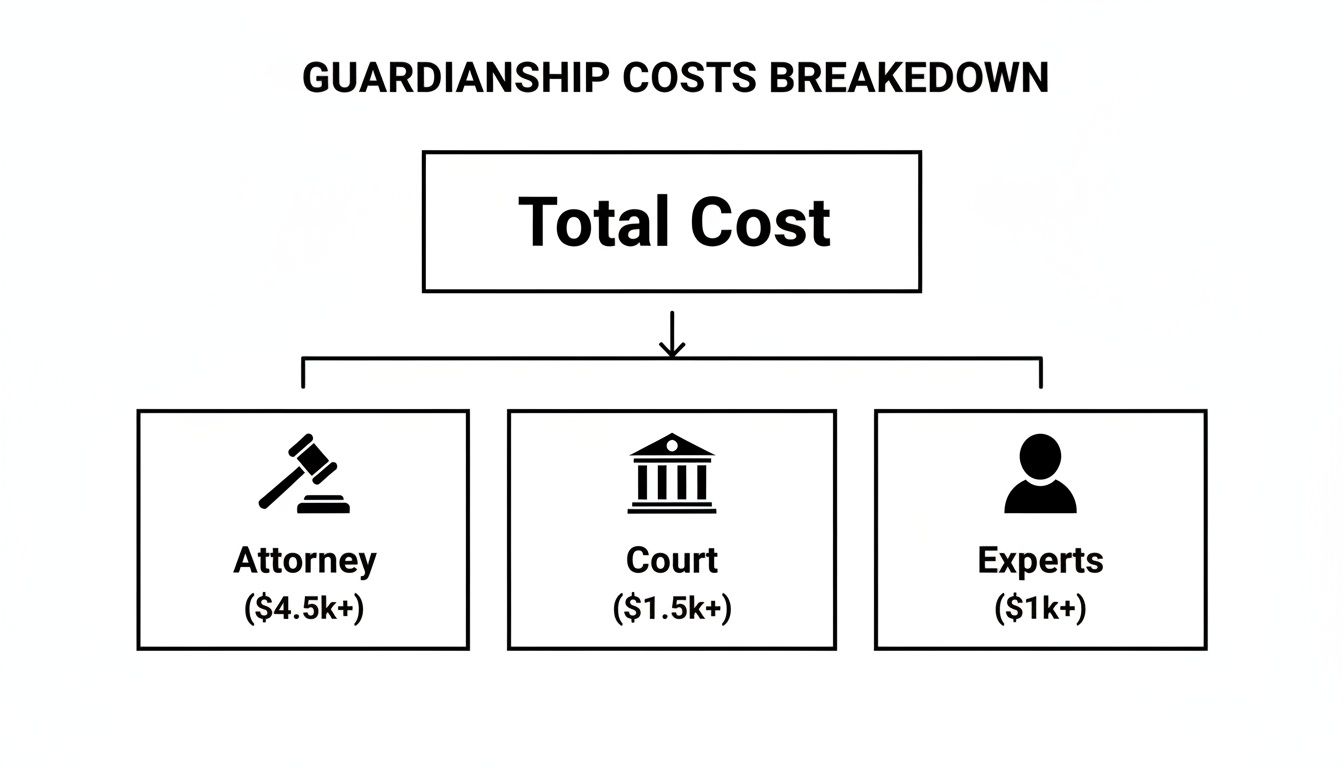
As you can see, the legal fees for both your attorney and the court-appointed attorney make up the lion's share of the cost, with court fees and expert evaluations following behind.
Physician's Evaluation and Guardian's Bond
There are two last, but crucial, expenses to plan for: the doctor's evaluation and the guardian's bond. The Texas Estates Code requires a doctor to complete a form called a "Physician's Certificate of Medical Examination." This is the official medical evidence showing that your loved one is incapacitated. This report typically costs between $500 and $1,500.
Once the judge appoints you as guardian of the estate, you will almost always need to purchase a guardian's bond. Think of it as an insurance policy that protects the ward’s money and property from mismanagement. The cost is an annual premium based on the value of the estate's liquid assets. To get a better feel for how these work, you can read our guide on what guardianship bonds are and when they are required.
Understanding all these moving parts takes the surprise out of the equation and lets your family plan for this journey with confidence and clarity.
Why Family Disputes Dramatically Increase Costs
The costs for a straightforward, uncontested guardianship are fairly predictable. But that predictability vanishes the moment a family disagreement enters the picture. If you want to know the single biggest factor that can make guardianship costs skyrocket, it's this: family conflict.
A guardianship becomes contested when someone objects. This could be another family member, or even the person you’re trying to help. Objections can be about anything—whether a guardian is needed at all, who that guardian should be, or how your loved one’s finances are being handled. What starts as a protective legal process can quickly devolve into an exhausting, emotionally draining, and expensive court battle.

The Financial Impact of a Contested Guardianship
In an uncontested case, the path is clear: your attorney files the application, you attend one hearing, and the judge makes a decision. But when a case is contested, the game changes completely. Suddenly, you're facing a whole new set of expensive legal hurdles.
These extra, costly steps often include:
- Discovery: This is the formal process of exchanging information. It involves attorneys drafting and reviewing written questions (interrogatories), demanding documents, and responding to formal requests. It is time-consuming and attorney-intensive.
- Depositions: Picture this: attorneys for each side questioning witnesses for hours, under oath, with a court reporter typing down every word. You’re paying for the attorneys' time, the court reporter's time, and sometimes even a videographer. It gets expensive, fast.
- Multiple Court Hearings: Instead of one final hearing, a contested case can get bogged down with several smaller hearings for temporary orders, arguments over discovery, and other disputes that crop up along the way.
- Expert Witnesses: You might need to hire your own medical or financial experts to challenge the other side's claims and testify in your favor. This alone can add thousands of dollars to the final bill.
This isn't just a hypothetical problem; it's a reality many Texas families face. A 2026 report from the Texas Office of Court Administration showed that of 6,800 guardianship filings, a stunning 1,200 were contested. The average cost for these disputed cases shot up to $18,500, which included about $10,000 in attorney fees and another $4,000 just for expert testimonies. You can read more about the rising financial stakes in these legal matters.
A contested guardianship doesn't just cost more money; it takes a significant emotional toll on the entire family. The conflict can damage relationships at a time when unity is needed most.
How a Simple Case Becomes a $20,000 Struggle: A Scenario
Let's walk through a hypothetical scenario to see just how quickly things can escalate. Imagine two siblings, Sarah and David, agree their mother, who has advancing dementia, needs a guardian. They decide Sarah should apply and set a budget of around $6,000 for a smooth, uncontested process in their Harris County Probate Court.
But then their estranged uncle learns of the plan. He objects, claiming their mother is perfectly fine and that Sarah is just after her money. He hires his own lawyer to fight the guardianship.
Just like that, the case is contested. Sarah’s attorney now has a mountain of extra work:
- Responding to the uncle's legal challenges.
- Engaging in discovery, which means demanding records and answering formal questions.
- Preparing Sarah and other family members for stressful depositions.
- Attending multiple court hearings to argue against motions filed by the uncle’s lawyer.
What was supposed to be a straightforward process has become a long, drawn-out legal war. The family's $6,000 budget is gone in a flash, and the total cost spirals past $20,000. The worst part? All these expenses are usually paid from their mother’s own estate, draining the very funds meant for her care.
This is exactly why having an experienced attorney on your side is so critical. A skilled guardianship lawyer can often anticipate these conflicts, negotiate with the other side, and find a path forward. Their expertise can be the difference between a minor disagreement and an all-out war that depletes your family’s finances and destroys relationships. While proactive estate planning is the best defense, solid legal guidance is essential once a conflict starts.
When you’re trying to protect someone you love, a family feud that drains their life savings is the last thing you need. If you even suspect there might be a disagreement, it is crucial to talk to an attorney right away. The team at The Law Office of Bryan Fagan is here to offer the compassionate, strategic guidance you need to get through these challenges. Schedule a free consultation with us to discuss your family's situation and build a plan to protect your loved one without the unnecessary cost and conflict.
The Hidden Costs and Ongoing Annual Expenses

Getting a judge to sign the final order feels like crossing the finish line, but when it comes to the cost of guardianship, it’s really just the beginning of your duties. Many families are caught off guard by the recurring, annual expenses needed to maintain a guardianship in Texas. These aren't one-time fees; they're ongoing financial obligations you need to plan for.
We know that taking on the role of guardian is a massive responsibility. Our job is to help you see around the corner, preparing you for the financial side of this long-term commitment so you can manage your loved one's estate confidently and without unwelcome surprises. These ongoing costs are required by Texas law to ensure the person under guardianship remains protected.
Annual Accountings and Reports
One of the most significant recurring costs is the preparation of the Annual Accounting. The Texas Estates Code requires a guardian of the estate to file a detailed financial report with the court every year. This isn't a simple summary of income and expenses; it's a comprehensive document that must track every penny with precision.
This accounting must meticulously detail:
- All income the ward's estate received, such as Social Security benefits, pensions, or investment returns.
- Every single expense paid out on the ward's behalf, from rent and medical bills to groceries and personal care items.
- A complete list of all assets and debts remaining at the end of the reporting year.
Because these reports must be perfectly accurate and follow strict legal formats, most guardians find it necessary to hire their attorney to prepare and file them. This legal help ensures the accounting gets approved without a hitch, avoiding expensive rejections or delays. The cost for preparing an annual accounting can easily range from $1,500 to $4,000 or more, depending on the complexity of the estate.
Guardian's Bond Premiums
Another cost that shows up every year is the premium for the guardian's bond. As we’ve discussed, this bond is like an insurance policy that protects the ward's assets from mismanagement. It's not a one-time payment. You must pay a premium annually to keep the bond active for as long as the guardianship is in place.
The premium is calculated based on the total value of the ward's liquid assets—think cash in bank accounts and investments (but not real estate). For most families, this yearly premium falls somewhere between $250 and $1,500. For larger estates, this cost can be higher.
Compensation for the Guardian
Being a guardian is a demanding job that takes a lot of time and effort. Recognizing this, Texas law allows guardians to be paid for their service. A guardian can ask the court for "reasonable compensation" to be paid from the ward's estate for carrying out their duties.
Under Texas Estates Code § 1155.002, the court can authorize compensation for a guardian. The amount must be reasonable and is decided by looking at the guardian's duties and the size and nature of the estate.
While many family members choose to forgo payment, it’s an important option to be aware of, especially if managing the guardianship affects your own ability to earn an income. This compensation is another ongoing expense that needs to be factored into the estate's annual budget.
State data highlights just how significant these ongoing costs can be. A 2026 analysis reported that guardians of the estate in Texas faced average annual accounting fees of $3,500. That same year, over 28,000 active guardianships reported combined administrative costs of $112 million, which averages out to about $4,000 per case. These numbers underscore the importance of getting professional guidance. You can find more on these market trends and cost analyses here.
These recurring expenses are a fundamental part of the guardianship process. For more information on your yearly obligations, check out our guide on annual guardianship reports and how to ensure compliance. At The Law Office of Bryan Fagan, we help families plan for these long-term costs and manage them as efficiently as possible.
When you’re looking at the potential cost of guardianship, the numbers can feel overwhelming. But you are not powerless. There are several effective strategies your family can use to manage, and even reduce, these expenses. A proactive approach can make all the difference, ensuring your loved one is protected without creating an unnecessary financial crisis.
We understand that you want to find the most compassionate and cost-effective path forward. By exploring your options and preparing carefully, you can sidestep common and costly mistakes, keeping the focus right where it should be—on the well-being of the person you love.
Strategic Ways to Manage and Reduce Guardianship Costs
Plan Ahead With Alternatives to Guardianship
The single most effective way to manage potential guardianship costs is to avoid needing one in the first place. This is where proactive Estate Planning becomes so incredibly valuable for Texas families.
Putting the right legal documents in place while your loved one still has the capacity to make their own decisions provides a much less restrictive and far less expensive solution.
These key documents often serve as powerful alternatives to guardianship:
- Durable Power of Attorney: This document lets your loved one appoint a trusted person—an "agent"—to handle their financial matters if they become incapacitated. It can completely prevent the need for a more complex and costly guardianship of the estate.
- Medical Power of Attorney: Similarly, this document allows a designated agent to make healthcare decisions. This can help you avoid a guardianship of the person.
- Living Will (Directive to Physicians): This document clearly spells out a person’s preferences for end-of-life care, giving clear instructions to family and medical teams.
These tools can achieve the same protective goals as a guardianship but with a fraction of the expense, time, and emotional toll. Talking about these options with an attorney before a crisis hits is the most powerful move you can make to manage future costs.
Choose a Law Firm With Transparent Billing
When guardianship is the only path forward, your choice of attorney is absolutely critical. You need a law firm that not only has deep experience in Texas guardianship law but is also committed to transparent and fair billing practices.
An attorney who regularly handles cases in your local probate court, whether it's in Harris County or Travis County, will already know the judges and their specific rules. That local knowledge helps the entire process run more smoothly, which saves time and money.
Before you hire anyone, ask them directly about their fee structure. A reputable firm will be upfront about their costs, telling you whether they charge a flat fee for straightforward, uncontested cases or bill by the hour. They should provide a clear estimate of what to expect, helping you budget effectively and avoid surprise bills.
By preparing a complete and accurate guardianship application right from the start, you can prevent costly delays. Missing information or procedural errors can lead to court rejections, requiring your attorney to spend more time—and your family to spend more money—fixing those mistakes.
Manage the Estate’s Finances Wisely
Once a guardianship is established, smart financial management is key to controlling ongoing costs. As the guardian of the estate, you have a fiduciary duty—a high legal and ethical obligation—to manage the ward's assets responsibly.
This means you must keep meticulous records for the required annual accounting and make sound financial decisions to preserve the estate. For example, implementing effective Cash Flow Management Strategies can be a game-changer.
By carefully budgeting and tracking all income and expenses, you ensure the estate’s funds are used efficiently for the ward’s care. This not only simplifies the annual accounting process but also reduces the legal fees needed to prepare those court-mandated reports.
At The Law Office of Bryan Fagan, we guide families through every option. Schedule a free consultation with us today, and let our compassionate team help you find the most protective and cost-effective solution for your family.
Navigating Guardianship Costs With Confidence
We know that walking through the financial side of guardianship can feel overwhelming. But gaining a firm grasp on the potential costs is your first, most powerful step toward taking control of the situation with clarity and care.
As we've seen, the final answer to "how much does guardianship cost?" can change dramatically. Family disputes can escalate quickly, turning a manageable process into an expensive, emotionally draining ordeal. At the end of the day, remember the goal: to protect someone you love. Here at The Law Office of Bryan Fagan, we firmly believe you shouldn’t have to walk this path alone.
Your Path Forward: Practical Steps to Take
Taking a few purposeful steps now can make all the difference.
Gather Key Documents: Start by pulling together essential paperwork. This includes medical records that clearly document your loved one's condition and any financial statements that paint a full picture of their estate. Having this ready from the start helps streamline the legal process.
Talk With Family: We cannot stress this enough. Open, honest communication with other family members can help everyone get on the same page. This is the best way to avoid the painful and costly conflicts that so often arise in these cases. A united front is always your strongest asset.
Schedule a Consultation: This is your most critical step. You need to speak with an experienced guardianship attorney who understands the nuances of Texas law and can offer compassionate advice tailored specifically to your family's situation.
Understanding your legal options is the best way to protect your loved one and your family's resources. An initial consultation can provide the clarity and direction needed to make informed decisions.
The journey through Texas guardianship law, as governed by the Texas Estates Code, is complex and requires careful, experienced guidance. We invite you to contact The Law Office of Bryan Fagan for a complimentary consultation. Let our compassionate team provide the personalized support your family needs to move forward with confidence and peace of mind. We're here to help you protect what matters most.
Frequently Asked Questions About Guardianship Costs
After walking through the numbers, it's natural to still have questions. Every family's situation is unique, and when you're planning for a loved one's future, the details matter.
Let's tackle a few of the most common questions we hear from Texas families trying to navigate the financial side of guardianship.
Can I Get a Guardianship in Texas Without a Lawyer?
While you technically can file for guardianship on your own, it is almost always a bad idea that ends up costing you more in the long run. The Texas Estates Code is loaded with strict, complex legal requirements.
A simple mistake on a form or a missed deadline can get your case dismissed by the judge. If that happens, you're forced to start all over again—and pay all the fees a second time.
On top of that, the court is legally required to appoint an attorney, called an Attorney Ad Litem, to represent your loved one's interests. This means a lawyer is going to be involved no matter what. Hiring your own experienced attorney ensures the process is handled correctly from day one, protecting you from expensive errors and emotional stress.
Who Actually Pays for the Guardianship Costs?
This is a critical question we hear all the time. Typically, all reasonable and necessary costs of the guardianship case are paid directly from your loved one's (the proposed ward's) estate. This pool of money covers your attorney's fees, the court-appointed ad litem attorney, court filing fees, and the doctor's evaluation.
However, there's a big "what if." If the court denies the guardianship application, or if the proposed ward has no assets to begin with, the person who filed the application is usually held responsible for all the costs. It's essential to have a frank discussion about this possibility with your attorney right from the start.
Is an Emergency Guardianship Cheaper Than a Permanent One?
Initially, yes. A temporary or emergency guardianship is designed as a rapid, short-term fix for an urgent crisis. The upfront cost is lower because the process is more limited, often falling in the $2,500 to $5,000 range.
But it’s crucial to understand that a temporary guardianship usually only lasts for 60 days. If the need for oversight is long-term, you must then file a completely separate application for a permanent guardianship, which comes with its own full set of costs. Think of the emergency fees as an additional expense, not a substitute for the cost of a permanent guardianship.
Texas Estates Code § 1251.051 lays out the strict requirements for a temporary guardianship, highlighting that it is an extraordinary remedy for situations where there is "imminent danger" to the proposed ward's health or estate.
Does My Location in Texas Affect the Cost?
Absolutely. Your location can have a noticeable impact on how much guardianship costs. Court filing fees can vary from one county to the next.
More importantly, attorney fees and the rates for court-appointed lawyers are often higher in major metro areas like Houston (Harris County) or Dallas compared to smaller, rural counties. An attorney who is familiar with your local probate court can give you a much more accurate and realistic cost estimate based on their direct experience with that court's specific procedures and fee structures.
Understanding the costs is a vital step in protecting your loved one. At The Law Office of Bryan Fagan, PLLC, our compassionate attorneys are here to provide the clarity and guidance your family deserves. Schedule a free, no-obligation consultation with us to discuss your specific situation and learn how we can help you navigate this process with confidence. Visit us at https://texasguardianshiplawyer.net to get started.