Skip to content
Deciding to pursue guardianship for a parent is one of the toughest, most emotionally charged choices a family ever has to make. We understand the weight of this decision and are here to guide you with clarity and care. Here in Texas, the process involves proving to a probate court that your parent is legally incapacitated, meaning they can no longer manage their own health, safety, or financial affairs. It's a protective legal step, taken as a last resort, to ensure they get the care they need when they can no longer provide it for themselves.
Knowing When Guardianship Is the Right Choice

Watching a parent's health decline is a deeply personal and difficult journey. It's common for adult children to feel torn, wondering when—or even if—they should step in. We want you to remember that guardianship isn't about taking control. It’s about providing a crucial safety net when your parent’s ability to make safe and sound decisions has faded, a reality that many Texas families face with empathy and concern.
Understanding Incapacity in Texas
Under the Texas Estates Code (Title 3, Subtitle G), "incapacity" is a legal determination, not just a medical diagnosis. A judge in a Texas probate court, such as the Harris County Probate Court, must find that your parent, because of a physical or mental condition, is substantially unable to provide their own food, clothing, or shelter, care for their physical health, or manage their finances.
Consider a hypothetical scenario that simplifies this legal issue: a mother with a recent dementia diagnosis has started missing utility payments, and shut-off notices are piling up. She's also forgetting to take her heart medication and has missed several important doctor's appointments. These are clear, tangible signs she may no longer have the capacity to handle her daily life safely.
Another common example is a father with a severe physical disability who can't perform daily tasks or coordinate his medical care anymore, leaving him vulnerable to neglect. In these kinds of scenarios, guardianship becomes a vital protective measure.
It can be difficult to pinpoint when the line is crossed. The table below outlines some common warning signs that might suggest a parent is struggling to care for themselves.
Signs Your Parent May Need a Guardian
A summary of common indicators suggesting a parent might be incapacitated and require guardianship for their protection.
| Area of Concern | Examples of Warning Signs |
|---|---|
| Financial Management | Unpaid bills, unusual or large withdrawals, falling for scams, giving away significant amounts of money. |
| Personal Care & Hygiene | Neglecting personal grooming, wearing inappropriate clothing for the weather, unexplained weight loss or gain. |
| Health & Medical Care | Forgetting to take medications, missing doctor's appointments, inability to follow medical instructions. |
| Home Environment | Hoarding, unsanitary living conditions, expired food in the refrigerator, neglecting home repairs. |
| Cognitive & Behavioral | Increased confusion or memory loss, getting lost in familiar places, personality changes, paranoia or delusions. |
Seeing one or two of these signs might not be cause for alarm, but a consistent pattern can indicate a serious problem that requires intervention.
Is Guardianship the Only Option? Alternatives to Guardianship
It’s crucial to understand that guardianship significantly limits a person's rights. For that very reason, Texas courts require it to be a last resort, only after less restrictive alternatives have been ruled out.
For instance, if your parent planned ahead and created a solid Durable Power of Attorney or Medical Power of Attorney while they still had capacity, a guardianship might not be necessary at all. These documents allow them to appoint a trusted agent to make decisions without any court involvement. Other alternatives include living trusts or supported decision-making agreements.
Guardianship is a legal tool of last resort, designed to protect the most vulnerable. It should only be pursued when no other viable option exists to ensure a parent's safety and well-being.
The use of guardianship varies dramatically across the country. In some states, only 5.5% of at-risk individuals are under guardianship, while in others, that figure is as high as 89.0%. This wide range reflects different legal standards and the availability of alternatives, which is why exploring every other option first is so important. You can explore national guardianship data in this detailed report to see these trends for yourself.
If you believe your parent is in immediate danger or is simply unable to manage their affairs, and no other plans are in place, it's probably time to discuss your options with a professional. Contact The Law Office of Bryan Fagan for a free consultation to understand how we can help protect your loved one.
Preparing for the Guardianship Process
Long before you find yourself in a Texas courtroom, the real work of a guardianship case gets done. Getting your ducks in a row isn't just about strengthening your legal position; it's about honoring your parent's dignity and trying to keep the emotional toll on your family to a minimum. When you take these practical steps, you're showing the court that you’re acting responsibly and have thought through every possible angle.
Think of this as building your case from the ground up with solid evidence, clear communication, and careful consideration. It means that when you do file the petition, you’re coming from a place of confidence, making it undeniable that your parent's best interests are your only priority.
Gather Essential Medical Documentation
In Texas, the entire guardianship case hinges on proving incapacity. To do that, you need undeniable medical evidence. The single most important piece of paper you'll need is the Certificate of Medical Examination (CME).
This isn't just any old doctor's note. The CME is a specific legal form that has to be filled out by a licensed Texas physician. Crucially, the doctor must have examined your parent within the last 120 days before you file the guardianship application. On that form, the doctor will give a detailed rundown of your parent's physical and mental state, spelling out exactly why they are considered incapacitated and can't manage their own affairs.
To back up the CME, you'll also want to pull together:
- Medical Records: Get your hands on relevant diagnoses, treatment plans, and notes from any specialists, like a neurologist if your parent is dealing with dementia or Alzheimer's.
- Medication Lists: A complete list of all prescriptions can paint a clear picture of how complex your parent's healthcare needs really are.
- Statements from Caregivers: If your parent has in-home help or is in a facility, getting written observations from their professional caregivers provides a powerful, firsthand account of their day-to-day struggles.
Have the Difficult Conversations
Let’s be honest: talking about guardianship with your parent and siblings is incredibly tough. These conversations are often heavy with grief, fear, and sometimes, flat-out disagreement. But tackling them head-on with empathy and honesty can save you from some really painful family fights later.
If your parent can still participate in the conversation, try to frame it around their safety and well-being, not about what they're losing. Use "I" statements to show you're coming from a place of concern. For example, say, "I'm worried about you being here alone," instead of, "You can't take care of yourself anymore."
When it comes to your siblings, set aside a specific time to talk without your parent there. The idea is to get on the same page and present a united front.
- Share the medical evidence you've gathered.
- Talk openly about who is in the best position to be the guardian. Consider their location, how available they are, and their financial stability.
- Make sure you listen to everyone's concerns and let them know their feelings are valid.
If siblings can't agree, the court might have no choice but to appoint a neutral, third-party guardian—which is rarely what any family wants. Your best bet to avoid that is open communication.
Under the Texas Estates Code, a judge must consider all less restrictive alternatives before granting a guardianship. Failing to do so can result in the denial of your application.
Explore Less Restrictive Alternatives First
Texas law is crystal clear: guardianship is the last resort. Before a judge in a Harris County Probate Court will even look at your application, you have to prove you've already explored—and ruled out—options that are less restrictive. This is all about protecting your parent’s autonomy and making sure their rights aren’t taken away more than is absolutely necessary.
So, before you file anything, you need to find out if your parent has existing Estate Planning documents in place, such as:
- Durable Power of Attorney: This document lets a person your parent already chose (the "agent") handle their financial matters.
- Medical Power of Attorney: This names an agent to make healthcare decisions for them when they can't.
- Living Trusts: A trust can be used to manage financial assets, often eliminating the need for a guardian of the estate.
If these documents exist and are still working as intended, a guardianship might not even be necessary. If they don’t exist, you'll need to be ready to explain to the court precisely why these alternatives won't be enough to keep your parent safe. For personalized guidance through this critical stage, schedule a free consultation with our team.
Navigating the Texas Court System
Stepping into a Texas courtroom can feel like the most intimidating part of this whole journey. It’s only natural to feel overwhelmed by the legal side of things.
But understanding the road ahead makes all the difference. It turns a daunting legal challenge into a series of clear, manageable stages. This is where all your preparation really pays off, and where the court officially steps in to protect your parent.
The entire process kicks off when you file an Application for Appointment of Permanent Guardian. This is the formal legal document you'll submit to the appropriate court in the county where your parent lives—whether that's a Harris County Probate Court or one in Dallas County, getting the venue right is a critical first step. This application tells the judge exactly who you are, who your parent is, and why a guardianship is truly necessary for their safety and well-being.
Once that application is on file, the court sets several things in motion, all designed to protect your parent's rights.
The Court's Independent Review
A Texas judge isn't just going to take your word for it that a guardianship is needed. Their first and most important duty is to the proposed ward—your parent. To make sure they're doing right by them, the court launches its own independent review.
First up, the judge will appoint an attorney ad litem. Think of this person as an independent lawyer whose only job is to represent your parent's best interests. They will meet with your parent, explain what’s happening in a way they can understand, and then advocate for their wishes in court. If your parent wants to fight the guardianship, the attorney ad litem is the one who will lead that charge on their behalf.
At the same time, the court brings in a court investigator. This person is basically the eyes and ears of the judge. They conduct a thorough investigation, which usually includes:
- Visiting your parent at home or in their care facility.
- Interviewing you, your parent, and other family members or caregivers.
- Reviewing the doctor's letter and other medical evidence you provided.
- Assessing whether you are a suitable person to serve as guardian.
The investigator then files a detailed report with their findings and recommendations. This gives the judge an unbiased, real-world picture of the entire situation, ensuring every decision is made with your parent’s welfare as the absolute top priority.
This visual shows the key preliminary steps for how to gain guardianship of a parent, from gathering documents to evaluating alternatives.
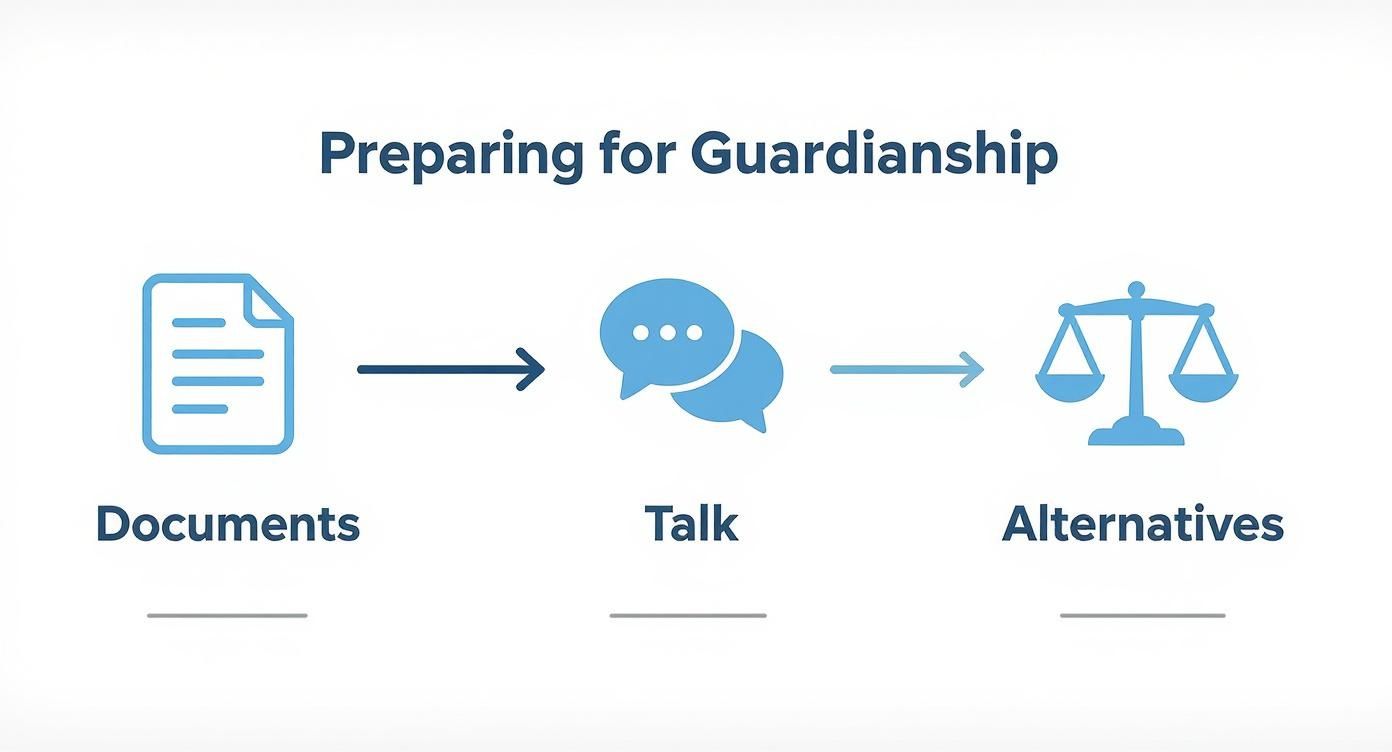
This process ensures every action is thoughtful and justified before ever stepping into a courtroom.
What Happens at the Guardianship Hearing
Once all the preliminary work is done, the court will schedule a formal hearing. This is your chance to present your case directly to the judge. The thought of a hearing is enough to make anyone nervous, but being prepared makes all the difference. We have a detailed guide that explains what to expect at a Texas guardianship hearing.
During the hearing, your attorney will present evidence to meet the legal requirements for guardianship under the Texas Estates Code. It really boils down to proving two critical things:
- Incapacity: You must provide clear and convincing evidence that your parent is legally incapacitated and can't manage their own affairs. The Certificate of Medical Examination you got earlier is the cornerstone of this argument.
- Suitability: You have to show the court that you are qualified and are the best person to serve as their guardian.
The judge will almost certainly ask you questions directly. They'll want to know about your relationship with your parent, your understanding of a guardian's duties, and what your plans are for their care. Just be honest and keep the focus on your parent’s needs. Your parent has the right to be at the hearing and may even be required to attend, unless their doctor specifically states it would be harmful to their health.
To help you get a sense of what's involved from start to finish, here's a table outlining the major legal milestones in a typical case.
Key Stages of a Texas Guardianship Case
| Stage | What Happens | Key Document/Action |
|---|---|---|
| Application Filing | You formally petition the court to establish a guardianship. | Application for Appointment of Permanent Guardian |
| Court Appointments | The judge appoints an attorney ad litem and a court investigator. | Order Appointing Attorney Ad Litem/Investigator |
| Investigation Period | The ad litem and investigator meet with all parties and review evidence. | Investigator's Report, Ad Litem's Report |
| Formal Hearing | You and your attorney present your case and evidence to the judge. | Testimony, Certificate of Medical Examination |
| Judge's Ruling | The judge makes a final decision on incapacity and your appointment. | Order Appointing Guardian |
| Qualification | You take an oath and post a bond to officially begin your duties. | Oath of Guardian, Surety Bond |
This structured process ensures that every step is handled with care and legal precision, all for the protection of your loved one.
A judge’s final decision rests on "clear and convincing evidence." This is a high legal standard, meaning the evidence must show that it is substantially more likely than not that the facts you allege are true.
After hearing all the testimony and reviewing the evidence, the judge will make a ruling. If they agree a guardianship is necessary and you are a suitable choice, they will sign an order appointing you as guardian. This order is the legal document that gives you the authority to start making decisions for your parent.
Before you can officially act, though, you'll have to take an oath and may need to post a bond—which is basically an insurance policy that protects your parent’s assets.
Your Duties and Responsibilities as Guardian

Once the judge appoints you as your parent's guardian, the real work begins. This isn't just a title; it's a profound commitment that comes with serious legal weight and what's known as a fiduciary duty. In simple terms, this means you are legally required to act only in your parent's best interest, putting their needs before anyone else's—including your own.
The court order you receive will be your roadmap, clearly spelling out the scope of your authority. In Texas, these responsibilities are usually split into two distinct roles. You might be appointed to one, or you might be appointed to both.
Guardian of the Person vs. Guardian of the Estate
It’s absolutely critical to understand the difference between these two roles. Confusing them can lead to serious legal trouble, as each comes with its own set of rules under the Texas Estates Code.
A Guardian of the Person is what most people picture when they think of a guardian. You're in charge of your parent's physical and emotional well-being.
Your duties could involve:
- Deciding where your parent lives, whether it's staying at home with help, moving to an assisted living facility, or transitioning to a nursing home.
- Giving consent for medical treatments, surgeries, and different therapies on their behalf.
- Working closely with doctors, nurses, and caregivers to make sure their care plan is being followed.
- Ensuring their day-to-day needs—like food, clothing, and personal safety—are consistently met.
A Guardian of the Estate, on the other hand, is the financial manager for your parent. This role demands meticulous attention to detail and flawless record-keeping.
As Guardian of the Estate, you will:
- Take control of their financial world, including bank accounts, investments, and other assets.
- Handle all their bills and expenses, from the mortgage and medical costs to everyday spending.
- Collect any income they're entitled to, like Social Security benefits or pension payments.
- You might also find yourself responsible for things like managing personal family contracts that your parent is a party to.
These aren't just suggestions from the court; they are legal mandates. Mixing your personal money with your parent's funds or making a decision that falls outside your court-ordered authority can land you in hot water.
The Fiduciary Standard in Practice
Let's walk through a hypothetical scenario. Say you’ve been appointed as both Guardian of the Person and Estate for your mother, who has advanced Alzheimer's. You notice her bank account is running low, but she desperately needs a new wheelchair. You can't just loan her the money from your own account to speed things up.
The proper way to handle this is to use her funds to buy the wheelchair and document the purchase perfectly. If there isn't enough money in her account, you might need to go back to court and ask for permission to sell one of her assets, like an old car, to generate the cash. Every single financial move has to be transparent and completely justifiable.
Texas Estates Code §1151.051 puts it plainly: a guardian must manage the ward's estate as a "prudent person" would manage their own property. This fiduciary duty is the absolute cornerstone of guardianship law, designed to protect the ward from mismanagement or exploitation.
Mandatory Reporting to the Court: Guardianship Compliance
Your job doesn't stop once you're appointed. The court stays involved, keeping a close watch to make sure you're doing everything by the book. This oversight is managed through mandatory annual reporting.
First, within 60 days of your appointment, you must file a detailed inventory of every single one of your parent's assets with the court. After that, you'll have ongoing reporting duties.
- Annual Report on the Well-Being of the Ward: This is your update to the judge on your parent's physical and mental health, their living situation, and how they're doing overall.
- Annual Accounting: For a Guardian of the Estate, this is a comprehensive financial report. It has to account for every dollar that came in and every dollar that went out of your parent's accounts over the last year.
Missing deadlines or submitting sloppy, inaccurate reports can lead the court to remove you as guardian. You can get a much deeper look into this topic by reading our guide on understanding Texas guardianship annual accounting obligations.
Being a guardian is a demanding role, but you don't have to figure it all out on your own. For clear guidance on your duties, help with court filings, or any other questions about how to gain guardianship of a parent, schedule a free consultation with The Law Office of Bryan Fagan.
When Emergencies and Family Disputes Arise
Even with the most thoughtful planning, a sudden crisis can turn your world upside down. Your parent might have a stroke, leaving them unable to consent to life-saving treatment. Or maybe a rapid cognitive decline puts them in immediate danger. When you simply can’t wait weeks for a standard guardianship hearing, Texas law offers a way to act fast.
This is where a Temporary Guardianship becomes an indispensable tool. Under the Texas Estates Code, this is an emergency court order designed for situations where there's clear and convincing evidence that a person or their estate needs immediate protection from imminent harm.
Think about this scenario: Your father, who lives alone in San Antonio, has a sudden medical crisis. He's found disoriented and can't communicate. The hospital needs consent for an urgent procedure, but he never signed a Medical Power of Attorney. Filing for a temporary guardianship lets a judge grant you decision-making power—often in just a few days—so he gets the care he needs right away.
When You Have to Act Immediately: Emergency Guardianship
A temporary guardianship isn't granted just because it's convenient; a judge in a place like the Harris County Probate Court will only approve one if you can prove a true emergency exists.
These orders are short-term by design, typically lasting no more than 60 days. They act as a critical bridge, keeping your parent safe while you move forward with the full application for a permanent guardianship. It's a way to ensure your loved one is protected during a crisis without skipping the detailed review required for a long-term appointment.
Navigating Disagreements with Siblings: Guardianship Disputes
One of the most difficult parts of this journey is when the people who should be your allies—your siblings—don’t see things the same way. Disagreements can bring the process to a grinding halt, drive up legal costs, and create family rifts that last a lifetime. One sibling may see guardianship as absolutely necessary, while another feels it’s a drastic overreach.
When these disputes land in court, the judge has one priority: your parent's best interests. They will listen to every side and weigh all the evidence presented.
The court's primary duty is to the proposed ward, not to the family's disagreements. A judge will always prioritize the safety and well-being of the parent above all else.
To handle these conflicts as constructively as possible, try to:
- Share Information Openly: Give your siblings copies of the doctor's letters and any other evidence you have. Sometimes, just seeing the facts in black and white can clear up misunderstandings.
- Consider Mediation: A neutral mediator can help you have a productive conversation outside the high-stress environment of a courtroom, which can save everyone time, money, and heartache.
- Focus on the Common Goal: Gently remind everyone involved that the objective isn't to "win" but to make sure your parent is safe, healthy, and cared for.
If you simply can't find common ground, the court will make the final call. In some highly contentious cases, a judge might even appoint a neutral, professional guardian to sidestep the family conflict entirely. While that's rarely the outcome anyone wants, it shows how seriously the court takes its duty to protect your parent.
Facing an urgent medical situation or a family dispute adds a heavy layer of stress to an already emotional process. If you need to pursue an emergency guardianship or are struggling with disagreements, please reach out. Schedule a free consultation with The Law Office of Bryan Fagan for compassionate, clear-headed guidance.
Common Questions About Texas Guardianship
When you’re considering how to get guardianship of a parent, a lot of questions come up. It's a heavy topic, and the legal side of it can feel overwhelming. It’s completely normal to have concerns about the cost, the specific legal hoops you have to jump through, and what life looks like after a judge makes a decision. Let's walk through some of the most common questions we hear from families in Texas.
How Much Does Guardianship Cost in Texas?
The honest answer is: it varies. The total cost to establish a guardianship for a parent can range pretty widely based on the complexity of your family's situation.
You'll have some standard expenses right out of the gate. These include court filing fees, the fee for the doctor who fills out the Certificate of Medical Examination, and the fees for the court-appointed attorney (known as an attorney ad litem) who will represent your parent's interests. On top of that, you'll have your own attorney's fees.
If everyone is on the same page and the case is straightforward—what we call "uncontested"—the total cost might land in the range of a few thousand dollars. However, if other family members disagree about whether a guardianship is needed or who should be the guardian, it becomes contested. At that point, you're looking at litigation, and the costs can climb significantly higher.
What Are the Alternatives to Guardianship?
This is a critical question because Texas law is very clear: guardianship should be a last resort. The courts want to protect your parent's independence as much as humanly possible, so you must consider less restrictive options first.
Here are the most common alternatives we see:
- Durable Power of Attorney: This is a document where your parent, while they still have capacity, names an agent to handle their financial affairs.
- Medical Power of Attorney: Similar to the above, but this appoints an agent specifically for healthcare decisions.
- Living Trusts: A trust can be set up to manage financial assets, completely bypassing the need for court supervision.
- Supported Decision-Making Agreements: This is a fantastic option for parents who can still make their own choices but just need a trusted advisor to help them understand the issues and communicate their decisions.
Having a solid Estate Planning portfolio in place before it's needed is always the best path to avoiding the courtroom.
A key takeaway: Guardianship should always be the final option. The Texas Estates Code is explicit: if a less restrictive alternative can do the job and adequately protect your parent, the court cannot grant a guardianship.
Can a Guardianship Be Terminated or Changed?
Yes, a guardianship isn't necessarily a life sentence. This is known as Guardianship Termination. If your parent's health improves to the point where they can manage their own affairs again, either you or your parent can petition the court to terminate the guardianship. This will require new medical evidence showing their capacity has been restored.
Life changes, too. If the person appointed as guardian can no longer handle the responsibilities, or if someone else becomes a better fit for the role, the court can be asked to appoint a successor guardian. In every decision, the court’s one and only focus will be the best interest of your parent, who is referred to as the “ward.”
Navigating the world of Texas guardianship demands a careful blend of legal knowledge and genuine compassion. Whether you're just starting to weigh your options or you know it's time to act, The Law Office of Bryan Fagan, PLLC is here to offer the straightforward guidance your family deserves.
Reach out today to schedule a free, no-pressure consultation. We can talk through your specific situation and help you understand the best way to protect the person you love.
Schedule Your Free Consultation:https://texasguardianshiplawyer.net