Skip to content
Tackling your future can feel like a monumental task, but putting a Texas estate planning strategy in place is genuinely one of the most powerful and caring things you can do for your family. Think of it as a roadmap—one that makes sure your wishes are honored, your assets are protected, and your loved ones are looked after, no matter what happens. This isn't just for the wealthy; it's for every Texan who wants a say in their own legacy.
Why Every Texas Family Needs a Plan
Let's be honest: thinking about estate planning can be tough. It brings up difficult emotions, which is why so many families kick this can down the road. We understand that these conversations are challenging. The problem is, ignoring it doesn't make the issues go away. It just hands all the decision-making power over to a probate court.
Without your instructions, a judge will be forced to follow Texas law to decide who gets your property and who raises your minor children. Those decisions might be a world away from what you actually wanted.
A solid estate plan brings clarity and peace of mind when life gets chaotic. It lets you:
- Choose Your Beneficiaries: You get to decide who receives your assets and on what terms, which can prevent a world of potential family conflict.
- Appoint Your Decision-Makers: You can name trusted people to manage your finances (Durable Power of Attorney) and make healthcare choices (Medical Power of Attorney) if you ever become unable to do so yourself.
- Steer Clear of Guardianship: Being proactive is the single best way to avoid a court-supervised guardianship. As outlined in the Texas Estates Code, Title 3, Subtitle G, these proceedings are often costly, public, and incredibly stressful for loved ones.
- Protect Your Kids: You can name a guardian for your minor children directly in your will, ensuring they are raised by someone you know and trust.
The High Cost of Doing Nothing
The hard truth is that most adults don't have even the most basic estate planning documents ready. National surveys show that only about 31% of Americans have a will, leaving countless families vulnerable when the unexpected strikes.
For a state like Texas, with its large and aging population, this gap is a critical issue. Without a will or powers of attorney, families facing a sudden illness or loss are often thrown into public, lengthy, and expensive probate or guardianship proceedings in courts like the Harris County Probate Court. You can dig into the numbers in this study on national estate planning preparedness.
Creating a Texas estate plan is an act of love. It’s about taking responsibility today to shield your family from uncertainty, conflict, and unnecessary legal headaches tomorrow. It gives them a clear path forward, guided by your voice.
By putting a clear estate plan in place, you replace the cold, impersonal process of court intervention with your own thoughtful instructions. At The Law Office of Bryan Fagan, we know these decisions carry a lot of emotional weight. We’re here to offer compassionate, straightforward guidance to help you build a plan that truly secures your family’s future. For personalized advice, schedule a free consultation with our experienced team today.
The Core Documents in a Texas Estate Plan
Putting together a Texas estate plan is a lot like building a protective shelter for your family's future. Each document is a critical piece of the structure, designed to support your loved ones and make sure your wishes are carried out exactly as you intend. Without these tools in place, your family could be left dealing with the court system, adding a layer of financial and emotional stress during an already painful time.
A solid estate plan delivers control, protection, and most importantly, peace of mind.
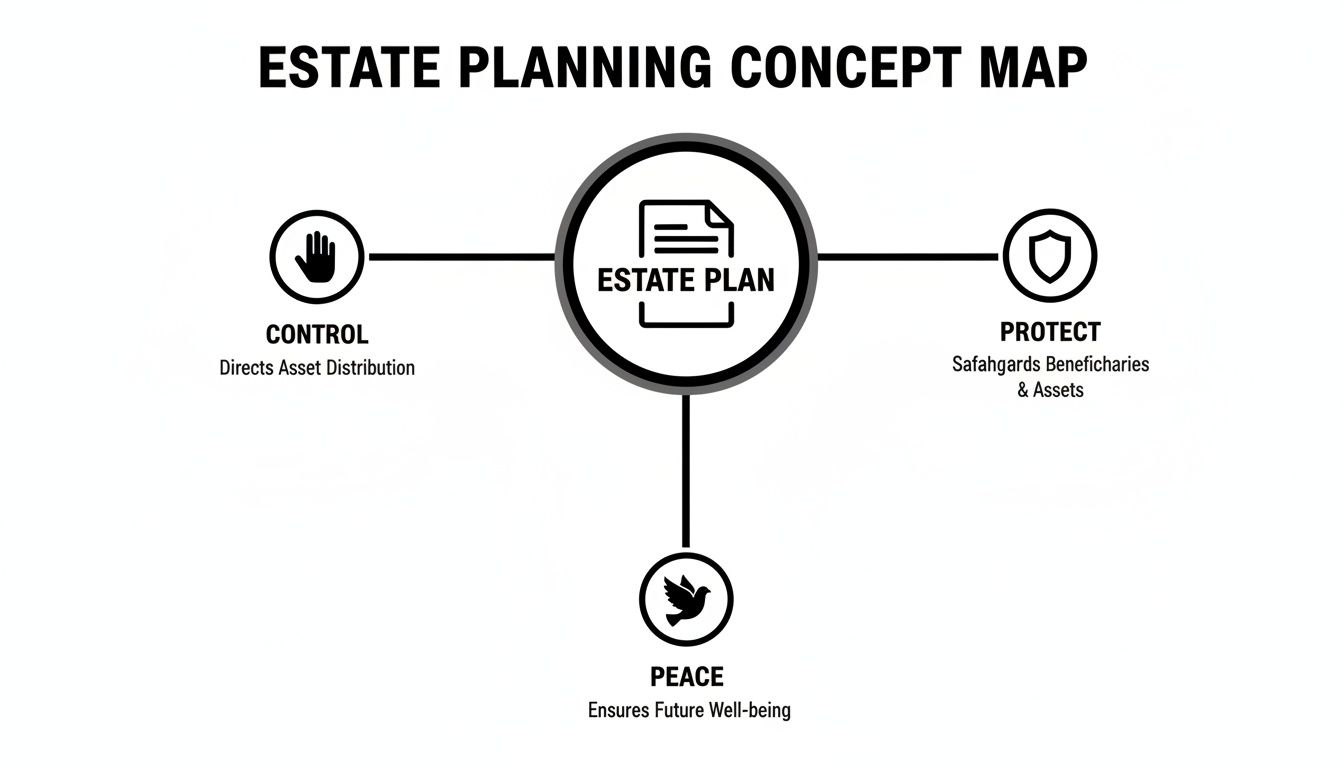
This map shows how a proper plan puts you in the driver's seat of your legacy, shields your assets for your beneficiaries, and brings a sense of calm to everyone involved. Let's break down the specific documents that make this happen.
To help you see how these documents fit together, here’s a quick overview of what each one does.
Key Texas Estate Planning Documents at a Glance
| Document | What It Does | Primary Benefit |
|---|---|---|
| Last Will and Testament | Names an executor, specifies how property is distributed, and nominates guardians for minor children. | Ensures your assets go to the right people and your children are cared for by someone you trust. |
| Durable Power of Attorney | Appoints a trusted agent to manage your financial and legal affairs if you become incapacitated. | Avoids a costly and public court-ordered guardianship for your finances. |
| Medical Power of Attorney | Appoints a trusted agent to make healthcare decisions for you if you cannot communicate them yourself. | Ensures your medical care aligns with your values and wishes. |
| Advance Directive (Living Will) | Outlines your specific wishes for end-of-life medical treatments. | Lifts the burden of difficult decisions from your family during a crisis. |
| Revocable Living Trust | Creates a private legal entity to hold and manage your assets, both during your life and after. | Allows your estate to avoid the time, cost, and publicity of the probate court process. |
Each document plays a unique role, and a comprehensive plan typically includes several of them working in concert. Now, let’s take a closer look at each one.
The Last Will and Testament: Your Personal Instruction Manual
A Last Will and Testament is the foundational document of almost every Texas estate plan. Think of it as your personal instruction manual for what should happen after you’re gone. Its main job is to clearly state who gets your property, from your home in Fort Bend County to your treasured family heirlooms.
But a will does more than just hand out assets. It's also the official place to name a guardian for your minor children—an incredibly important decision. By legally documenting your choice, you ensure the person you trust most is appointed to raise your kids, preventing a potential court battle over their custody.
Under the Texas Estates Code, Title 2, Subtitle F, a valid will has to be in writing, signed by you, and witnessed by two credible people in your presence. While a will does have to go through the court process called probate, having one makes that process far smoother and less expensive for your family.
The Durable Power of Attorney: Your Financial Co-Pilot
Life is full of surprises, and planning for incapacity is just as crucial as planning for what happens after you die. A Durable Power of Attorney is a legal tool that lets you appoint a trusted person—your "agent"—to handle your financial affairs if you ever become unable to do so yourself. This is a common alternative to guardianship.
This person becomes your financial co-pilot, stepping in to manage tasks like:
- Paying your mortgage and utility bills
- Managing your bank and investment accounts
- Filing your income tax returns
- Handling real estate transactions
- Running your small business
Without this document, your family would likely have to go to court to establish a guardianship to get the authority to manage your finances. That process can be slow, public, and expensive—adding a ton of stress when your family can least afford it. A Durable Power of Attorney keeps these matters private and in your family’s control.
Medical Power of Attorney and Advance Directives: Your Healthcare Advocate
Just as you need someone to handle your finances, you also need someone to make medical decisions if you can't communicate them yourself. A Medical Power of Attorney lets you name a healthcare agent—your trusted advocate—to speak with doctors and make treatment choices based on what you would have wanted.
This document goes hand-in-hand with an Advance Directive to Physicians, which many people call a Living Will. This directive is where you specifically spell out your preferences for end-of-life care, such as your wishes regarding life-sustaining treatments.
By completing these two documents, you lift an enormous weight off your family's shoulders. They won't be left guessing what you would have wanted in a crisis; they will have your written instructions to guide them with confidence.
The Revocable Living Trust: The Privacy Protector
While a will is essential, some families also add a Revocable Living Trust to their plan for extra benefits. You can think of a trust as a private container you create to hold your assets. You transfer ownership of your property—like your house, bank accounts, or investments—into the trust. You typically act as the trustee, so you maintain full control over everything during your lifetime.
The single biggest advantage of a trust is its ability to avoid probate. Because the trust owns the assets (not you personally), they can be passed to your beneficiaries privately and quickly, without the delay and expense of court supervision. A trust also provides a seamless transition of asset management if you become incapacitated, another powerful alternative to guardianship.
You can learn more about the different types of Texas estate planning documents and how they fit together to create a complete plan.
Together, these core documents form the bedrock of a strong Texas estate plan. Each serves a distinct purpose, working together to protect you and the people you love most.
Planning for Incapacity to Avoid Guardianship
It's a question every family hopes they never have to face: What do we do if Mom or Dad can no longer make their own decisions, and there's no plan? This is the tough reality where a court-supervised guardianship becomes the only option, a path our firm helps Texas families navigate every single day. When an adult becomes incapacitated without legal documents that name a decision-maker, the courts are forced to step in to protect them.

This entire process is laid out in the Texas Estates Code, specifically Title 3, Subtitle G, which defines the legal hoops you have to jump through to declare someone incapacitated and appoint a guardian. A judge, often in a specialized court like the Harris County Probate Court or Dallas County Probate Court, has to weigh the evidence before appointing someone to manage that person's financial and personal life. While this is a critical safeguard, it can be incredibly draining on a family, both emotionally and financially.
The Emotional and Financial Toll of Court Intervention
Picture this: a family's mother is showing the advanced signs of Alzheimer's. She can no longer keep up with her bills, manage her own medications, or tell doctors what she wants for her healthcare. Because she never signed a Power of Attorney, her kids have no legal authority. They can't access her bank accounts to pay for her care, and they can't speak to her doctors about treatment plans.
To step in and help, they have to start a guardianship proceeding. This isn't a simple process. It means they'll need to:
- Hire an attorney just to file the detailed application with the court.
- Pay for a doctor's examination and an official Letter of Incapacity.
- Wait for a court-appointed attorney to investigate everything and represent their mother.
- Attend a formal court hearing where a judge makes the final decision.
The whole ordeal is public, can drag on for months, and often racks up thousands of dollars in legal and court fees. It adds a tremendous amount of stress at a time that's already heartbreaking. The court's involvement, while designed to protect, often feels deeply intrusive to families who just want to care for their loved one.
The Compassionate Alternative: Proactive Planning
The best way—truly, the most compassionate way—to sidestep this entire scenario is by planning ahead as part of a complete Texas estate planning strategy. By creating the right legal documents before a crisis hits, you give the people you trust the power to step in smoothly. This keeps intensely private decisions within the family and far away from a public courtroom.
The key is to legally authorize someone to act for you if you can't. In Texas, we do this mainly with two powerful documents we've already touched on: a Durable Power of Attorney for your finances and a Medical Power of Attorney for your healthcare.
A well-drafted Power of Attorney is your private alternative to a public guardianship. It is your voice, legally documented, ensuring the person you choose can manage your affairs without the cost, delay, and emotional pain of court proceedings.
Empowering Your Chosen Representatives
When you put these tools in place, you're essentially writing the rulebook for your own care. You get to name a financial agent who can immediately step in to pay your mortgage and manage your investments. You also choose a healthcare agent who can get your medical records and make treatment decisions that align with your personal values.
This kind of foresight prevents agonizing delays and crippling family arguments. Your loved ones won't be left scrambling to get a judge's permission to pay for a nursing home or approve a necessary medical procedure. Instead, they can focus 100% on your well-being, guided by the clear authority you gave them. Planning for incapacity is one of the greatest gifts you can give your family.
You can dive deeper into how these documents protect your family in our guide on planning for incapacity with powers of attorney and advanced directives in Texas. To get personalized help creating a plan designed to keep your family out of court, schedule a consultation with our team. We're here to help you secure your future with clarity and care.
Navigating the Texas Probate Process
The word "probate" often sounds more intimidating than it needs to be. Many people picture drawn-out court battles and confusing legal paperwork. In reality, probate is simply the court-supervised process for confirming a will is valid, settling any outstanding debts, and officially passing assets on to the people named as beneficiaries. For most Texas families, it’s a standard—and manageable—part of settling a loved one's estate.
A well-thought-out will can make this process surprisingly smooth. Think about it this way: if a father in Travis County passes away with a clear, properly executed will, he’s left behind a roadmap. His will names his daughter as the executor and spells out exactly how to divide his property. Thanks to his planning, probate becomes more of an administrative task than a family feud. The court's job is just to give the will its official stamp of approval and grant the daughter the legal power she needs to follow her father's wishes.

Probate vs Non-Probate Assets
A crucial part of effective Texas estate planning is knowing that not everything you own has to go through the probate court. Some assets can be transferred directly to your loved ones, bypassing the court system entirely. Understanding this difference is key to building a smart plan that saves your family time, money, and hassle.
Here’s how these two types of assets are handled after someone passes away:
- Probate Assets: These are assets owned solely in the deceased's name with no beneficiary named. Think of a house titled only to one person, a car, personal belongings, or a bank account without a co-owner or a "payable-on-death" instruction. A will tells everyone where these assets should go, but it takes a probate court to make it official.
- Non-Probate Assets: These assets transfer automatically because of a contract you set up. Common examples are life insurance policies, 401(k) or IRA accounts where you've named beneficiaries, and bank accounts marked as "Payable on Death" (POD). This money goes straight to the person you designated, often with little more than a death certificate and a claim form.
The biggest advantage of non-probate assets is speed. A beneficiary can often access funds from a life insurance policy or an IRA within weeks, while probate can easily take several months, if not longer, to finalize.
The Critical Role of Beneficiary Designations
Forgetting to update beneficiary designations is one of the most common—and disruptive—estate planning mistakes. Let's say you named your ex-spouse on your 401(k) years ago and never got around to changing it after the divorce. That money will legally go to them, no matter what your will says. It's a hard rule: a beneficiary designation form almost always overrides a will.
It's absolutely essential to review these forms every few years, and especially after big life events like a marriage, divorce, or the birth of a child. This simple check-up ensures your assets end up exactly where you intend them to. For many, navigating the probate process also involves dealing with real estate, and knowing the steps for things like selling a house during probate can be a huge help.
Using a Trust to Avoid Probate Entirely
For families who want to maximize privacy and efficiency, a Revocable Living Trust is a powerful tool for avoiding probate completely. When you create a trust, you transfer your assets into it. You don't lose any control—you can still buy, sell, and manage everything just as before—but legally, the trust owns the assets, not you.
When you pass away, the person you appointed as the "successor trustee" steps in and distributes the assets according to the rules you laid out in the trust. This all happens outside of court supervision. It keeps your family's financial affairs private, avoids court costs, and dramatically speeds up the timeline for beneficiaries to receive their inheritance. You can learn more about the details of probating wills in Texas and see how it stacks up against using a trust.
For personalized guidance on structuring your estate to minimize or avoid probate, please contact The Law Office of Bryan Fagan to schedule a free consultation.
Advanced Strategies for High-Net-Worth Texans
When a family’s legacy involves more than just a home and a savings account—think thriving businesses, sprawling real estate, or valuable oil and gas interests—a standard Texas estate planning approach just won't cut it. For high-net-worth individuals and families, the conversation shifts from simple asset distribution to strategic wealth preservation.
The goal is no longer just about passing things on. It's about protecting what you've built for generations, ensuring a smooth business succession, and shielding your heirs from hefty tax bills. This often means rolling out the big guns: sophisticated legal tools designed for serious asset protection and tax efficiency.
Understanding the Federal Estate Tax Landscape
One of the biggest drivers behind these advanced strategies is tax law. The good news? Texas is one of the few states with no state estate or inheritance tax. That means the primary concern for wealthier families is the federal estate tax.
Think of the federal estate tax as a tax on the transfer of your assets after you pass away, but it only kicks in for estates that exceed a very high threshold set by the government.
Right now, that exemption amount is historically generous. For high-net-worth Texans, this makes advanced planning a game of strategy, focused on minimizing the tax bite. Thoughtful estate tax planning strategies can be the difference between preserving your legacy and writing a huge check to the IRS.
The federal rules heavily influence how we plan here in Texas. For example, the federal unified credit currently stands at around $13.61 million per individual. This number is a huge deal, but it’s set to be cut roughly in half after December 31, 2025.
For now, a married Texas couple can shelter over $27 million from federal estate taxes. This reality shapes every conversation, especially for those with mineral rights, royalties, or real estate in multiple states—all common assets for successful Texans. You can dive deeper into these top Texas estate planning topics to see how the landscape is shifting.
Powerful Tools for Asset Protection and Legacy Preservation
To tackle these unique challenges, we often turn to specialized trusts and business structures. These tools aren't just about saving on taxes; they’re about maintaining control, protecting assets from creditors or lawsuits, and making sure your vision for the future becomes a reality.
Here are a few of the go-to strategies for high-net-worth families:
- Irrevocable Life Insurance Trusts (ILITs): An ILIT is a trust you create specifically to own your life insurance policy. By moving the policy out of your name, the death benefit is generally excluded from your taxable estate. This provides your heirs with tax-free cash to cover any estate taxes or other expenses without having to sell off other assets.
- Family Limited Partnerships (FLPs): Think of an FLP as a family-owned company used to hold assets like a business or real estate. It allows you to gift ownership shares to your kids or grandkids over time, often at a discounted value, while you stay in the driver's seat as the general partner.
- Charitable Trusts: For families with a philanthropic heart, tools like charitable remainder trusts (CRTs) or charitable lead trusts (CLTs) can be a win-win. They let you support causes you're passionate about, create an income stream for yourself or your family, and get significant tax deductions all at the same time.
These advanced strategies are about more than just numbers on a spreadsheet. They are about ensuring that the business you built continues to thrive, your family is secure, and your charitable vision is realized for generations.
Crafting a sophisticated plan requires a deep understanding of both Texas law and the ever-changing federal tax code. The compassionate and experienced attorneys at The Law Office of Bryan Fagan can guide you through these complex decisions with clarity and care. To discuss how these strategies might fit your family’s unique circumstances, schedule a free consultation today.
How to Start Your Texas Estate Plan
Getting started is often the most difficult part of any important task, and putting together a Texas estate plan is no exception. But here's the good news: you don't need to have every single detail mapped out before you talk to a professional. The most critical step is simply making the decision to begin. It's an act of profound care for your family's future.
Taking a little time to organize your thoughts and information beforehand can make your first meeting with an attorney incredibly productive and far less stressful. This prep work helps you clarify your own goals and gives your legal guide a clear snapshot of your life right from the start.
Your Pre-Consultation Checklist
Before you sit down with an attorney, it helps to gather a few key pieces of information. Think of it as collecting the puzzle pieces that will eventually form your complete estate plan. Having these details handy will save time and help you feel more confident and in control of the conversation.
Here's a simple checklist to get you on your way:
- A Snapshot of Your Assets: Make a straightforward list of what you own. This includes things like your home in Harris County, bank accounts, retirement funds (think 401(k)s and IRAs), investments, life insurance policies, and any other significant personal property. Don't worry about exact numbers down to the penny; a general overview is perfect.
- Key People and Contact Information: Jot down the full names and contact details for everyone you plan to name in your documents. This list should include your children, potential guardians for them, and anyone you're considering for important jobs like your executor or agents for your powers of attorney.
- Initial Thoughts on Key Roles: Give some thought to who you trust to handle these critical responsibilities. Who is the best person to serve as the executor of your will? Who do you want making financial or medical decisions for you if you can't? Write down your initial picks for these jobs.
Remember, estate planning isn't just a legal task; it's a profound expression of love and responsibility. It’s about making sure the people you care about are protected from confusion, conflict, and unnecessary legal headaches during what will already be a difficult time.
Doing this bit of homework will empower you to have a focused, effective conversation with your attorney, ensuring your time together is well spent.
At The Law Office of Bryan Fagan, we understand the emotional weight of these decisions. Our compassionate attorneys are here to guide families in Houston, Dallas, Austin, and San Antonio through every step, helping turn your wishes into a solid legal reality. We make the process clear and manageable, providing clarity and care when you need it most.
Ready to protect what matters most? Schedule a free, no-obligation consultation with our experienced team today to begin building the plan your family deserves.
Frequently Asked Questions About Texas Estate Planning
Stepping into the world of Texas estate planning naturally brings up a lot of questions. We get it. To help you find some clarity, we’ve put together a list of the questions our attorneys hear most often from families just like yours. Here are some straightforward answers to help you move forward.
How Much Does Estate Planning Cost in Texas?
The honest answer is, it depends. The cost to create an estate plan in Texas really hinges on your family’s specific needs and how complex your finances are. A simple will for a straightforward situation might only be a few hundred dollars.
On the other hand, a more comprehensive plan involving tools like a revocable living trust could run several thousand dollars. Many firms, ours included, offer flat-fee packages. This way, you know the exact cost from the very beginning—no surprises.
Think of it as an investment. Planning ahead is almost always far less expensive than the court costs, legal fees, and sheer stress of a public probate or guardianship battle that can happen when there’s no plan at all.
What Happens if I Die Without a Will in Texas?
If you pass away without a will, the law calls this dying "intestate." When that happens, you no longer have a say in who gets your property. Instead, the State of Texas makes all the decisions for you.
The state follows a rigid formula laid out in the Texas Estates Code, which divides everything based strictly on your family tree. This can lead to results you would have never wanted. For instance, your spouse could be forced to split property with children from a prior marriage. A will is your one sure way to make sure your assets go to the people you choose, exactly how you want.
How Often Should I Review My Estate Plan?
Life doesn’t stand still, and neither should your estate plan. It’s a good rule of thumb to pull out your documents and review them every three to five years, or anytime a major life event happens.
Certain events should always prompt a review of your plan:
- Getting married or divorced
- The birth or adoption of a child or grandchild
- The death of anyone named in your plan (like a beneficiary or executor)
- A major change in your financial picture (coming into money or selling a large asset)
- Moving to another state
Keeping your plan current ensures it reflects what you want today, not what you wanted five years ago. It’s the best way to prevent confusion and family disagreements down the road.
Do I Need a Trust if I Already Have a Will?
This is a fantastic question. While a will is an essential foundation for any Texas estate planning strategy, a trust offers some powerful advantages that a will simply can’t. The biggest benefit of a Revocable Living Trust is its ability to completely bypass the probate process. This keeps your family’s affairs private and allows your assets to be distributed efficiently, without the delays and costs of court involvement.
A trust also provides a clear plan for managing your finances if you become incapacitated, which can prevent the need for a court to step in and appoint a guardian. It gives you far more control over how and when your heirs receive their inheritance, which can protect them from creditors or their own financial inexperience.
An experienced estate planning attorney can sit down with you, talk through your goals, and help you decide if a trust makes sense for your family.
At The Law Office of Bryan Fagan, PLLC, we believe every Texas family deserves the peace of mind that a solid estate plan provides. If you have more questions or you feel ready to get started, our team is here to offer the clear, compassionate guidance you need.