Skip to content
A state of Texas last will and testament form is more than just a legal document. It’s a profound act of care for your family. It is your final voice, providing clear instructions on how your property should be handled and, most importantly, who will care for your minor children if you are no longer able to. While basic templates exist, creating a will is a deeply personal process, one that offers your loved ones clarity and peace during an incredibly difficult time.
Why Every Texan Needs a Will
It’s a common misconception that wills are only for the wealthy. This couldn’t be further from the truth. A Last Will and Testament is the foundation of any solid Estate Planning strategy, putting you—not a court—in control of your legacy.
If you pass away without a will, a situation known as dying intestate, Texas law takes over. A judge, perhaps in a Harris County Probate Court, will be legally required to follow the inflexible formulas in the Texas Estates Code to divide your assets. This process can feel impersonal and often doesn’t align with what you would have wanted, sometimes leading to painful family disputes.
Key Takeaway: A will is your voice after you are gone. It ensures the people you choose inherit your property and that a guardian you trust is appointed to care for your children.
Making Sense of the Legal Jargon
The language in a will can seem formal and intimidating, but the core concepts are straightforward. Understanding the key roles can empower you and demystify the entire process.
To help clear things up, here’s a quick-reference table that breaks down the essential people and concepts you’ll encounter when creating your Texas will.
Key Roles in Your Texas Will Explained
| Term | Simple Definition | Example Scenario |
|---|---|---|
| Testator | The person creating the will. This is you. | Maria, a mother of two in Austin, is the testator creating her will to protect her family. |
| Executor | The trusted person or institution you appoint to carry out the will’s instructions. | Maria names her responsible older brother, David, as her executor. He will pay her final bills and distribute her assets. |
| Beneficiary | The people, charities, or organizations who will inherit your property. | Maria names her two children as the primary beneficiaries to receive her estate. |
| Guardian | The person you name to care for your minor children if you pass away. | Since her kids are young, Maria chooses her sister, Elena, who shares her parenting values, to be their guardian. |
| Probate | The legal process of validating a will in court and executing its terms. | After Maria’s passing, David will initiate the probate process to legally manage and distribute her estate. |
As you can see, each role works together to form a clear, actionable plan. Getting these details right drastically reduces the chance of family arguments and legal headaches down the road. The official process of validating the will is known as Probate.
More Than Just Passing Down Property
A well-crafted will is so much more than a list of who gets what. It’s a comprehensive roadmap that lifts a massive emotional and administrative weight off your family’s shoulders. While asset distribution is key, it’s also smart to understand the implications of life insurance without a will as you build your complete estate plan.
Navigating the nuances of Texas law can feel overwhelming, but you don’t have to do it alone. The attorneys at The Law Office of Bryan Fagan are here to guide your family with clarity and care. Schedule a free consultation today to discuss your family’s future and build a plan that brings you true peace of mind.
Meeting Texas Legal Requirements for a Valid Will
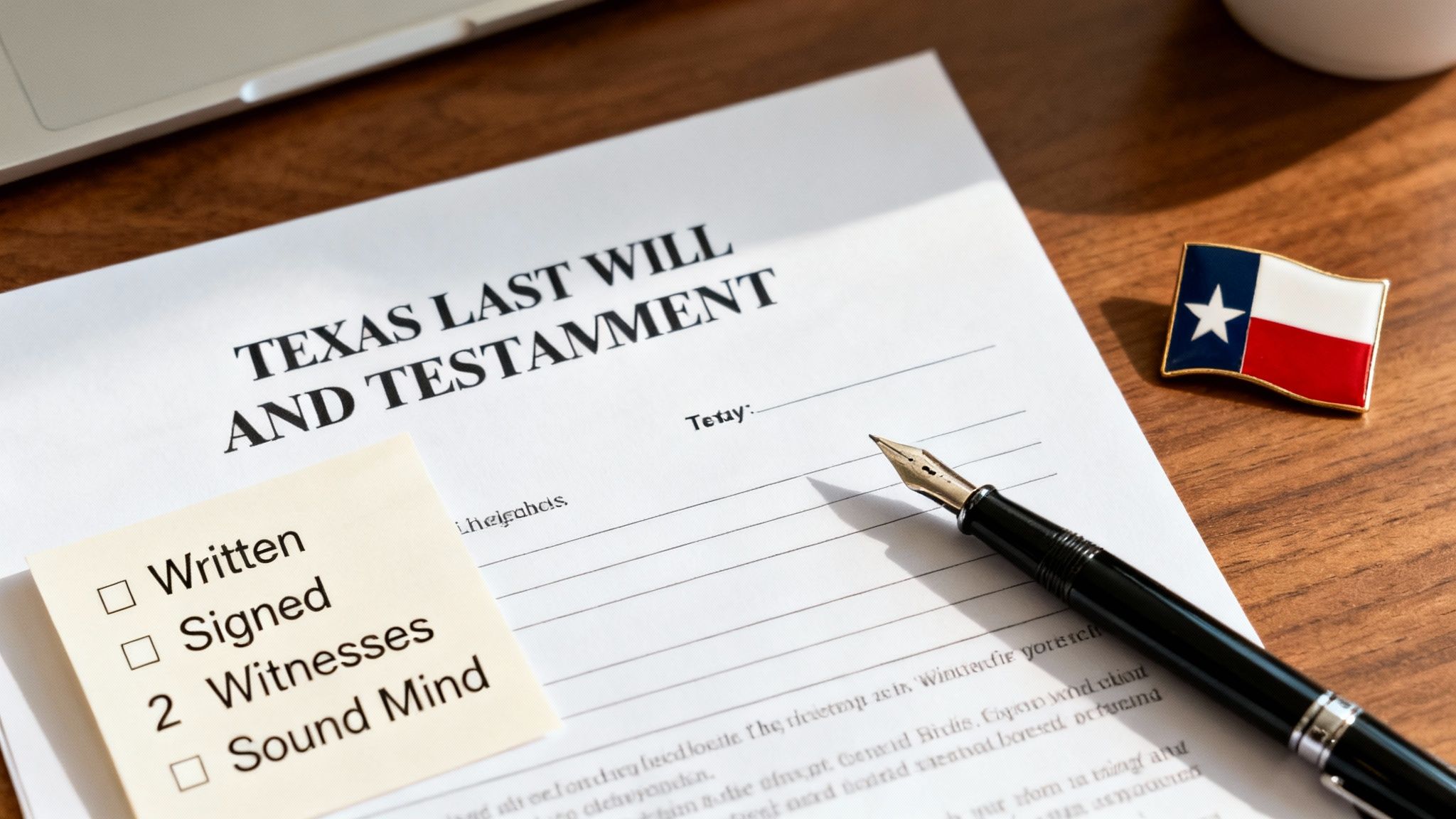
Creating a will is an empowering step, but for your wishes to be honored, the document must be legally sound. In Texas, a last will and testament is a formal legal instrument that must follow strict rules outlined in the Texas Estates Code.
These formalities exist for a good reason: they protect your true intentions from fraud, challenges, or misinterpretation during the often-emotional probate process. Following these rules ensures that a probate judge can look at your will with confidence and affirm that it genuinely reflects your final wishes. A mistake could result in the will being invalidated, leaving your family in the difficult position of having the state decide how to distribute your assets.
Who Can Actually Make a Will in Texas?
Before you begin, you must meet the state’s basic criteria. The person making the will (the testator) must meet specific age and mental state requirements.
Under Texas Estates Code § 251.001, you must be:
- At least 18 years old; or
- Currently married or have been lawfully married before; or
- A member of the United States armed forces.
The next requirement—your mental state—is where many legal challenges arise.
The “Sound Mind” Requirement: Testamentary Capacity
Beyond age, you must have testamentary capacity—a legal term meaning you are of “sound mind” at the moment you sign the will. This doesn’t mean you need to be in perfect health or have a flawless memory.
In plain English, being of “sound mind” means you understand four key things:
- The Act: You know you are signing a document that will distribute your property after you die.
- Your Property: You have a general understanding of what you own (your house, bank accounts, car, etc.).
- Your Beneficiaries: You know who your close family members are (the natural objects of your bounty, like a spouse or children).
- The Effect: You understand how signing the will distributes your property to the specific people you’ve named.
This standard is critical. If someone can later prove you lacked this mental clarity when you signed, a judge could invalidate the entire will. This is why it is so important to create your will while you are healthy and thinking clearly, long before capacity could become an issue.
The Three Pillars of a Valid Will: Written, Signed, and Witnessed
The most common and legally secure type of will in Texas is a formal, or “attested,” will. For this document to hold up in court, it must meet three core conditions.
The will must be:
- In writing. A verbal promise or a video message is not legally binding.
- Signed by you (the testator). Alternatively, another person may sign on your behalf, but they must do so in your presence and under your direction.
- Attested by two credible witnesses. This is the most technical—and crucial—part of the process.
These witnesses must be at least 14 years old and, most importantly, they must sign the will in your presence. Texas courts are very strict about this “in your presence” requirement. A small procedural error here can have devastating consequences.
This tiny error can undo years of careful planning and throw a family into a costly, heartbreaking legal battle. A will isn’t just a standalone document; it’s a key piece of a much larger puzzle that should include a guide to essential estate planning documents that all work together to protect your family.
These strict rules are precisely why professional guidance is so valuable. At The Law Office of Bryan Fagan, we can oversee the signing ceremony to ensure every detail is handled correctly, safeguarding your will from future challenges.
Crafting the Core Sections of Your Texas Will
Now that you understand the legal requirements, we can focus on the heart of your will—the instructions that will guide your family and protect your legacy. Crafting a state of Texas last will and testament form is about making a series of clear, thoughtful decisions. Each clause is a building block designed to prevent confusion and ensure your wishes are honored.
Let’s walk through this with a hypothetical example. Imagine the Smith family from Montgomery County. John and Sarah have two young children, a house, and some savings. Their primary goal is to ensure their children are cared for by the right person and their assets are managed responsibly. Their story illustrates the essential sections every Texas will needs.
Appointing a Capable Independent Executor
One of the most critical decisions you’ll make is naming an executor. This is the person or institution you trust to manage your estate, pay final debts, and distribute your property according to your will.
In Texas, you can appoint an independent executor, an option we almost always recommend. An independent executor can handle most estate duties without needing constant court supervision, which makes the Probate process faster, less expensive, and far less stressful for your family.
John and Sarah name Sarah’s brother, Mark, as their independent executor because he is organized and trustworthy. But they also take two crucial extra steps:
- Always name a backup: What if Mark is unable to serve? The Smiths wisely name John’s sister, Emily, as the successor independent executor. This simple step is a vital safety net.
- Discuss the role beforehand: Before finalizing the will, they talk with Mark to explain the responsibilities and ensure he is comfortable taking on the role.
Naming a Guardian for Your Minor Children
For parents, this is the most important decision. A will is the only legal document where you can nominate a guardian—the person you entrust to raise your children if both parents pass away.
After careful thought, John and Sarah choose Sarah’s cousin, Jessica, who shares their values and has children of a similar age.
In your will, you should clearly name a guardian of the person (who raises the children) and, if necessary, a guardian of the estate (who manages their inheritance). They can be the same person, but sometimes separating the roles is a wise choice.
Just as with the executor, they also name an alternate guardian. Without this designation, a court would be forced to make this deeply personal decision, and the outcome may not be what John and Sarah would have wanted. This decision is at the core of the Guardianship process and is a primary reason families should never delay creating a will.
Designating Specific Bequests and the Residuary Estate
Once you’ve appointed the key people, the next step is deciding who gets what. Your will can make specific bequests, which are gifts of particular items to specific people.
For instance, the Smiths decide on a few specific gifts:
- John’s vintage guitar collection will go to his nephew.
- Sarah’s grandmother’s wedding ring will go to their daughter.
But what about everything else—the house, bank accounts, and investments? This is known as the residuary estate. A residuary clause is essential; it’s a catch-all that ensures every remaining asset is distributed. The Smiths’ residuary clause states that after all debts and specific gifts are handled, everything else will be divided equally between their two children.
Protecting an Inheritance with a Testamentary Trust
Since their children are young, John and Sarah worry about them inheriting a large sum of money at age 18. Their will includes a provision to create a testamentary trust, which only comes into existence after their passing.
They appoint Mark (their executor) as the trustee to manage the funds for the children’s health and education. The trust specifies that the inheritance will be distributed in stages: one-third at age 25, another third at 30, and the final portion at 35. This structure protects the inheritance from youthful mismanagement while providing for the children as they mature.
Drafting these core sections requires careful thought about your family, your assets, and your goals. The Law Office of Bryan Fagan can help you translate your wishes into a clear, legally sound will that protects what matters most. Schedule a free consultation to discuss your unique situation and build a plan with confidence.
Executing Your Will: The Signing Ceremony Checklist
Signing your will is a formal legal ceremony. If not done correctly, your entire will could be invalidated, unraveling all your careful planning. This is the moment your wishes become legally binding, so it must be handled with precision to avoid future challenges. A small error can create an opening for a will contest, leading to the family stress and legal expense you sought to prevent.
This chart breaks down the core decisions that lead up to this crucial moment.
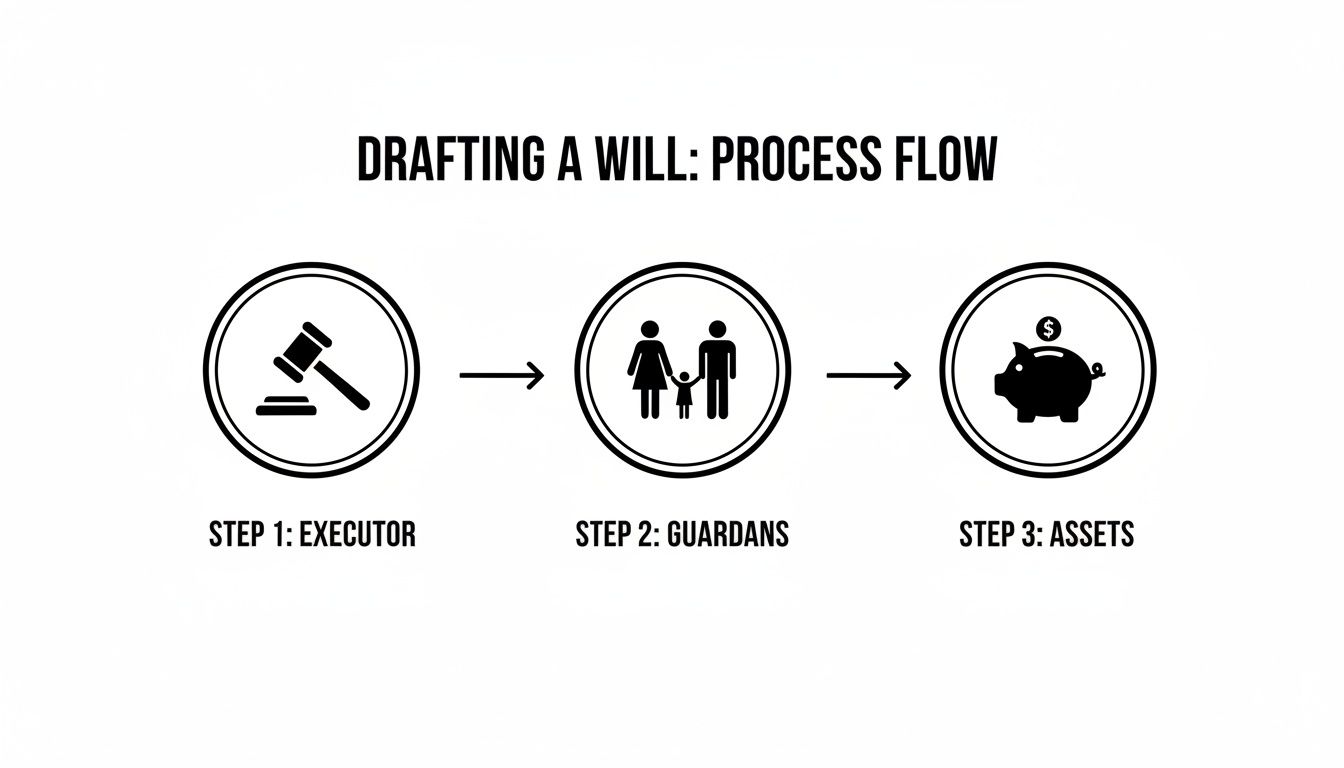
From choosing your executor to protecting your children and assets, the signing ceremony is what makes it all official.
Assembling the Right Team
The validity of your will’s execution depends on who is present. The Texas Estates Code is clear about who needs to be there.
Your signing ceremony team must include:
- The Testator: That’s you, the person creating the will.
- Two Credible Witnesses: These individuals must be at least 14 years old and cannot inherit anything from your will. Choosing neutral, disinterested people is essential.
- A Notary Public: While not required for the will itself to be valid, a notary is necessary for the self-proving affidavit, a document that makes the probate process much smoother.
It is just as important to consider who should not be present. We advise clients to never have beneficiaries in the room during the signing. Their presence, however well-intentioned, could create an appearance of undue influence—a common claim in Fort Bend and Harris County probate courts that you were pressured into making the will.
The Order of Operations: A Step-by-Step Guide
The signing ceremony must follow a specific sequence. Everyone involved must remain in the same room from start to finish to meet the “in your presence” requirement.
Here is the proper order of events:
- Your Declaration: You, the testator, must clearly state to your witnesses that the document you are about to sign is your Last Will and Testament.
- Your Signature: You then sign the will in full view of both witnesses.
- The Witnesses’ Signatures: Immediately after you sign, each witness signs the will in your presence, confirming they saw you sign and believed you were of sound mind.
- Signing the Self-Proving Affidavit: Once the will is signed, you and the witnesses will then sign this separate statement in front of the notary. The notary then signs and stamps the affidavit.
Key Tip from Our Attorneys: Don’t initial the bottom of each page. While common with other legal documents, it isn’t required for a Texas will and can sometimes create unnecessary legal confusion. Follow the formal signature process exactly as described.
This carefully orchestrated ceremony is your best shield against future challenges. It is also vital that you understand the legal responsibilities of the person you’ve named; you can read more about the duties of a will executor in our detailed guide.
Getting the execution right transforms your state of Texas last will and testament form from a simple draft into a powerful legal instrument. If you have any questions or want the assurance that your will signing is done perfectly, The Law Office of Bryan Fagan is here to guide you.
After the Signing: Safekeeping and Updating Your Will
Once your will is signed and notarized, you have achieved a major milestone, but the process isn’t quite finished. Protecting and maintaining this vital document is just as crucial. A will is not a static file to be forgotten but a living document that should adapt to your life’s changes.
After the signing, the immediate question is, “Where should I keep this?” The original signed document is essential; a copy will not be accepted by the court during probate.
There are a few solid options for safekeeping:
- A Fireproof Safe at Home: This offers convenient access for your executor without bureaucratic delays.
- A Safe Deposit Box at a Bank: This provides high-level security, but accessing it after death can be complicated and may require a court order, causing delays.
- With Your Attorney: Our firm can store the original document for you, ensuring it is kept in a secure, professional environment and can be easily located by your executor.
No matter where you store it, make sure your executor knows exactly where to find the original will. Providing them with a copy and clear instructions can save your loved ones immense stress.
When Life Changes, Your Will Should Too
Your will is a snapshot of your life at a specific moment. As your family, finances, and relationships evolve, your will must evolve with them. An outdated will can cause unintended and heartbreaking consequences, creating the very family disputes you worked so hard to avoid.
Certain life events should always trigger an immediate review of your will to ensure it still reflects your wishes.
When to Review Your Texas Will: A Life Events Checklist
Here’s a quick guide to the major life changes that signal it’s time to review your will.
| Life Event | Why An Update Is Needed | Risk of Not Updating |
|---|---|---|
| Marriage or Divorce | Texas law has specific provisions for spouses. A divorce, for example, automatically nullifies any provisions in your will that name your ex-spouse as a beneficiary or executor. | An old will could fail to provide for your new spouse as required by law or create ambiguity after a divorce. |
| Birth or Adoption of a Child | You’ll need to name a guardian for your new child and include them as a beneficiary in your estate plan. | Without an update, your new child might be unintentionally disinherited, forcing a court to intervene to provide for them. |
| Significant Financial Changes | A large inheritance, a major business success, or a significant loss can dramatically alter the structure of your estate. | Your distribution plan may no longer be feasible or fair. A specific cash gift might now represent a much larger or smaller portion of your total estate than you intended. |
| Death of a Key Person | If an executor, guardian, or major beneficiary passes away, you must appoint a successor. | The court may have to appoint a replacement you would not have chosen, leading to delays and potential conflicts during probate. |
Consider this common scenario: a man creates a will leaving everything to his wife. Years later, they divorce, and he remarries but never updates his will. After he passes away, the old will causes confusion. While Texas law would void his ex-wife’s inheritance, the ambiguity could ignite a painful legal battle between his new wife and his children. A simple update would have prevented this entirely.
For more information on how a will is handled after a loved one’s passing, you can find a helpful overview in our guide on the process of probate and wills in Texas.
Your will is the cornerstone of your legacy. Keeping it safe and current is a final act of care for your family. If you’ve experienced a major life change or have questions about your existing will, schedule a free consultation with The Law Office of Bryan Fagan. We are here to provide the compassionate, professional guidance your family deserves.
Common Questions About Texas Wills
When you start planning your will, many questions can arise. It’s completely normal. Below, we’ve answered some of the most frequent questions we hear from Texas families to provide you with clear, straightforward information.
Can I Write My Own Will in Texas Without a Lawyer?
Technically, yes. Texas law recognizes “holographic” wills (wills written entirely in your own handwriting), and you can find a basic state of texas last will and testament form online. However, these DIY routes come with significant risks.
A simple mistake—an unclear phrase, a missing signature, or failure to follow strict legal formalities—can cause a court to invalidate your will. If that happens, it’s as if you died without one. A judge, not you, will then distribute your property based on rigid state formulas. Working with an experienced attorney is the surest way to ensure your will is legally sound and effectively carries out your wishes.
What Is a Self-Proving Affidavit and Do I Need One?
A self-proving affidavit is a separate statement that you and your witnesses sign in front of a notary public. While it’s not required to make a will valid in Texas, we highly recommend it.
This simple document dramatically speeds up the Probate process. Without it, the court may need to track down your original witnesses—who could be anywhere years later—to testify. That search can cause significant delays and extra costs for your family during an already difficult time.
It’s a small, inexpensive step that acts as an insurance policy for a smoother probate process.
What Happens If I Own Property in Another State?
Owning real estate outside of Texas adds another layer to your planning. Even with a valid Texas will, your family may have to open a second probate case in the state where that property is located. This is called ancillary probate.
While your Texas will directs who inherits the property, the other state’s court must officially approve the transfer. Ancillary probate can be slow and expensive. For clients with property in multiple states, we often explore more advanced Estate Planning tools, like a living trust, which can bypass this issue entirely.
How Do I Change or Revoke My Will?
As your life changes, your will should be able to adapt. In Texas, you have two primary options for updating your will.
- For minor changes, you can create a codicil, which is a legal amendment to your existing will. It must be signed with the same formalities as the original will, including two credible witnesses.
- For major updates, the cleanest and safest approach is to create an entirely new will. The new document must include clear language stating that you are revoking all previous wills and codicils.
Physically destroying a will can also revoke it, but proving your intent to do so can be difficult. The most reliable method is always to execute a new, professionally drafted legal document, which leaves no doubt about your final wishes.
Navigating the details of a Texas will can feel overwhelming, but you don’t have to figure it all out on your own. The attorneys at the Law Office of Bryan Fagan, PLLC are here to offer the clear guidance and compassionate support your family deserves. Schedule a free consultation with us to talk about your goals and build a plan that protects what matters most.