Skip to content
When a Texas court entrusts you with the profound responsibility of guardianship, you are stepping in to make crucial life decisions for a loved one. But how do you prove you have that authority? It's not just a single piece of paper. Proof of guardianship is a set of official, court-issued documents that validate your legal power to act on their behalf.
Understanding what these documents are and how they work is the first practical step in fulfilling your duties with confidence and avoiding frustrating roadblocks. We know this journey can be emotionally challenging, and our goal is to provide clear, compassionate guidance for Texas families.
What Is Proof of Guardianship and Why It Matters
After a Texas court, like a Harris County Probate Court, officially appoints you as a guardian, you are entrusted with making critical decisions for someone who can no longer make them independently. In legal terms, this person is called the "ward."
But how do you actually use that authority when speaking to a doctor, a banker, or a school administrator? This is where proof of guardianship comes in. These official documents are your key to acting effectively for your ward. They are the legal instruments that turn a judge's ruling into real-world power.
Without them, you are a concerned family member trying to help. With them, you are a legal fiduciary empowered by the court to protect your loved one’s well-being.
The Foundation of Your Authority
The guardianship establishment process, governed by Title 3, Subtitle G of the Texas Estates Code, is specifically designed to protect vulnerable individuals. Your role as guardian is a serious commitment, and the court ensures your authority is clearly defined and documented. This formal process eliminates confusion and gives institutions the confidence they need to follow your directions.
The need for clear, credible proof is growing. For instance, the number of children in the U.S. foster care system placed with relatives has risen significantly, as shown in recent studies. With guardianship now a common path for providing stable homes, having reliable documents is more important than ever for ensuring family stability and access to necessary services.
The Two Most Important Documents
While you'll encounter several documents, two are absolutely central to proving your role as a guardian:
- The Order Appointing Guardian: This is the court's final judgment. Think of it as the comprehensive legal order that officially names you as the guardian and spells out the specific scope of your powers and duties.
- Letters of Guardianship: This is your day-to-day proof. It's a concise, one-page certificate issued by the court clerk that you will present most often to banks, doctors, and schools. It serves as your official ID for your guardianship role.
Understanding how to obtain, use, and maintain these documents is fundamental to fulfilling your responsibilities. At The Law Office of Bryan Fagan, we know this can feel overwhelming. Our mission is to turn legal complexity into clear, actionable steps. If you are starting this journey, schedule a free consultation with us for personalized guidance.
The Core Documents That Prove Your Authority
When a Texas probate court names you as a guardian, you’ve been given the legal power to act. But that authority isn't just an abstract concept; it’s proven through specific, official documents. Think of this paperwork as the keys to your new role—each one unlocks a different door, allowing you to act on behalf of your loved one, whom the court now calls the "ward."
Getting a handle on these core documents is non-negotiable. They are what you will show to banks, doctors, school administrators, and anyone else who needs to verify your decisions. Knowing which piece of paper to use in a given situation will save you a world of headaches and prevent frustrating delays when your ward needs you most.
The Foundation: The Order Appointing Guardian
The first and most fundamental document is the Order Appointing Guardian. This is the formal, signed judgment from the judge who heard your case. It is the bedrock legal decree that officially establishes the guardianship.
This order is usually several pages long and packed with details, including:
- The court’s official finding that the ward is incapacitated.
- Your name, confirming you as the appointed guardian.
- The specific powers the court has granted you.
- Any limitations or restrictions placed on your authority.
While the Order is the ultimate source of your power, you won’t carry this bulky document around. It is filed in the official court records, like those at the Tarrant County Probate Court, serving as the primary legal foundation for everything you do.
Your Everyday Proof: Letters of Guardianship
The document you'll rely on day-to-day is the Letters of Guardianship. The best way to think of this is as your official, state-issued ID for being a guardian. It's a concise, one-page certificate issued by the county clerk only after you’ve taken your oath and filed any required bond.
According to Section 1106.002 of the Texas Estates Code, the Letters of Guardianship are considered conclusive evidence of your authority. This means institutions are legally required to accept it as valid proof of your role.
This powerful document boils down all the essential information from the lengthy court order into a simple, portable format. It clearly states your name, the ward's name, when you were appointed, and confirms you are fully qualified to act. For a deeper look at what these letters contain and why they're so vital, you can explore what Letters of Guardianship are in our detailed guide. This is what you’ll show the pharmacist to pick up a prescription or a banker to access an account.
Quick Verification with a Certificate of Guardianship
Sometimes, a third party just needs a quick confirmation that a guardianship is active. In these cases, the court clerk can issue a Certificate of Guardianship. This is an even more streamlined document that simply states a guardianship is in effect and you are the appointed guardian. It's often used for quick administrative tasks where the full details of your powers aren't necessary.
To give you a clearer picture, here's a quick breakdown of these key documents.
Key Guardianship Documents and Their Uses
| Document Type | What It Is | Common Use Cases |
|---|---|---|
| Order Appointing Guardian | The detailed, multi-page court judgment that legally creates the guardianship. | Serves as the foundational legal record; rarely shown to third parties. |
| Letters of Guardianship | A one-page certificate from the clerk serving as your official ID and primary proof of authority. | Proving your authority to banks, medical providers, schools, and other institutions. |
| Certificate of Guardianship | A simple statement from the clerk confirming an active guardianship exists. | Quick, simple verification for administrative tasks where detailed powers are not required. |
While these three documents are the cornerstones of Texas guardianship, it's worth noting that practices can vary. Across the United States, proof of guardianship must establish who the guardian is, what they can do, and the legal basis for their appointment. You can learn more about national standards for caregiver documentation in recent publications.
Learning to navigate these documents can feel like learning a new language, but each one has a distinct and logical purpose. Understanding their roles empowers you to manage your responsibilities confidently and efficiently. If you ever find yourself uncertain about which document to use or facing pushback from an institution, don't struggle alone. Our team at The Law Office of Bryan Fagan is here to bring clarity to your situation. Schedule a free consultation to get the straightforward guidance you deserve.
How to Obtain and Maintain Your Guardianship Documents
So, the judge has signed the Order Appointing Guardian. You’ve made it through the hardest part of the court process. But your work isn’t quite done yet.
Think of the judge's order as the official "go-ahead." The next step is to get the documents that prove your authority to the rest of the world—banks, doctors, schools, you name it. This crucial document is your Letters of Guardianship.
Getting Your Certified Copies Step by Step
Now, you can’t just run a copy of the Letters on your home printer. That won’t work. Institutions need to see a certified copy, which is an official duplicate stamped and signed by the county clerk's office. This certification is the seal of approval, verifying that your document is the real deal and is on file with the court. It’s what gives the paper its legal power.
Getting these copies is usually a straightforward process. You'll need to contact the clerk of the probate court that handled your guardianship case. Here’s a simple game plan:
- Find the Right Court: Identify the county clerk’s office where the guardianship order was issued. If your case was in Dallas County, for example, you'll be dealing with the Dallas County Clerk.
- Make the Request: Ask specifically for certified copies of your "Letters of Guardianship." Being precise matters.
- Pay the Fee: There will be a small fee for each certified copy, which varies from county to county.
Pro Tip: We always tell our clients to get at least five to ten certified copies right off the bat. You’ll be surprised how many places need one, from banks and doctors to Social Security and schools. Many will want to keep a copy for their own records, so having extras will save you a ton of time and hassle.
This whole flow, from the judge’s order to having the proof you need in hand, can be visualized pretty simply.
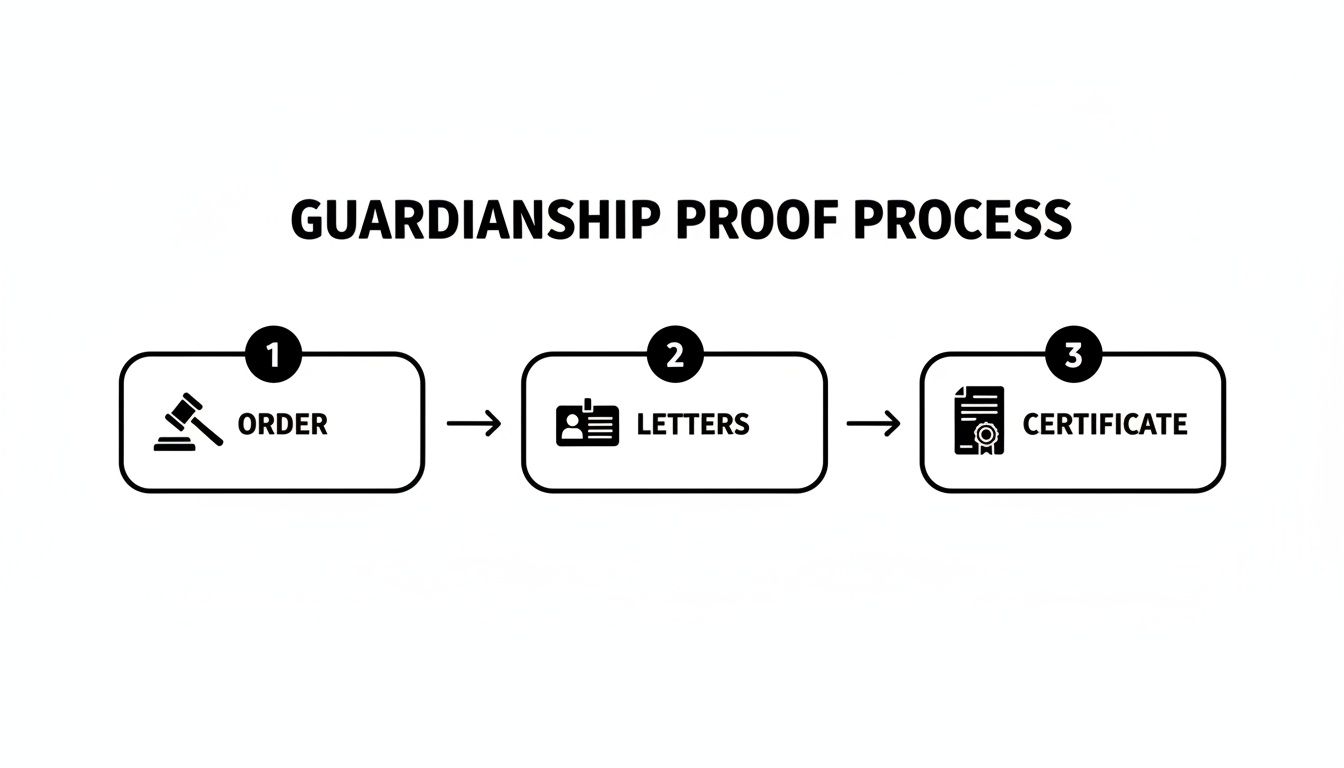
The court's Order is the starting point, which then allows the clerk to issue the Letters. Those Letters are what you'll use day-to-day to manage the ward's affairs.
Keeping Your Guardianship Authority Current
Getting your initial documents is a huge milestone, but it’s not a one-and-done deal. Your authority as a guardian has an expiration date.
In Texas, your Letters of Guardianship are typically only valid for 16 months from the date they’re issued. Why? This timeline is tied directly to your legal duty to file an Annual Report with the court. This report is your way of updating the judge on the ward's well-being and accounting for how you’ve managed their affairs over the last year.
Once the court reviews and approves your Annual Report, the clerk can issue fresh, renewed Letters of Guardianship for the next year. Missing this deadline is a big deal. If you let it slide, your legal authority expires, and you could find yourself powerless to make a critical decision for your ward when it matters most.
This annual compliance cycle might feel like a bit of a grind, but it’s an important safeguard Texas law puts in place to protect the ward. For families just starting this journey, understanding the full scope of these duties is key. If you're still in the early phases, you can get a more detailed walkthrough by reading our guide on how to get guardianship in Texas.
Navigating Real-World Scenarios with Your Documents

Holding your certified Letters of Guardianship is a huge step, but it’s really just the starting line. The true test begins when you have to step out into the world and use that authority. Whether you’re at a bank in Bexar County or a hospital in Houston, you are now your loved one's official advocate, and those documents are your most critical tool.
It can feel a little intimidating presenting these legal papers for the first time, especially if you run into staff who aren’t familiar with guardianship. This section is all about building your confidence, giving you practical tips and even a few scripts to handle common situations with both compassion and firmness.
At The Bank: Adding Yourself to an Account
Managing the ward’s finances is often one of the first things on a new guardian's to-do list. This means a trip to their bank to get yourself added to their accounts as the legal guardian.
What to bring with you:
- Your photo ID (like a driver's license)
- Your certified Letters of Guardianship (make sure they are current!)
- The ward’s account numbers or debit card
When you sit down with a banker, get straight to the point. Say clearly, "I am the court-appointed guardian for [Ward's Name], and I need to be added to their accounts." Then, present your certified Letters. The bank will absolutely need to make a copy for their files, which is exactly why having several certified copies is so crucial.
In a Medical Setting: Authorizing Care
Your role is just as critical in a medical setting. When it’s time to authorize a procedure, access medical records, or discuss treatment plans, you'll again need to show your certified Letters of Guardianship.
Explain your role simply: "I am the legal guardian for [Ward's Name], and I'm here to consent to this procedure on their behalf."
This authority extends beyond just doctor's appointments. For instance, if your ward is a minor with specific educational needs, your Letters are what give you the legal power to engage in special education advocacy. You'll need them to attend IEP meetings and make binding decisions for their schooling.
Handling Pushback and Common Roadblocks
It happens more often than you'd think: you present your Letters, and an employee confuses them with a Power of Attorney (POA). They might say something like, "Sorry, we need a Power of Attorney for this." This is a key moment where you'll need to educate and advocate.
Stay calm but be firm. Here’s a script you can use:
"I understand the confusion, but this is a court-ordered Guardianship, which is legally different from a Power of Attorney. Under the Texas Estates Code, these Letters of Guardianship are conclusive proof of my authority to act. Could you please check with a manager or your legal department to verify this?"
This approach does a few things: it's polite, it's informative, and it directs them to someone higher up who can confirm your legal standing. Don't ever hesitate to ask for a supervisor. The problem is almost always a lack of training, not an intentional refusal to help.
Guardianship vs. Power of Attorney
Understanding the difference yourself is the best way to explain it to others. The core distinction comes down to who holds the power and how that power is granted. Think of a POA as something someone chooses to give, while guardianship is something a court imposes for protection.
Here's a quick breakdown that can serve as a mental cheat sheet.
Guardianship vs Power of Attorney
| Feature | Guardianship | Power of Attorney (POA) |
|---|---|---|
| Origin | Created by a court order after a judge determines a person is incapacitated. | Created by an individual (the "principal") while they still have capacity to do so. |
| Authority | The court grants authority to the guardian. | The principal grants authority to their chosen "agent." |
| Oversight | The guardian is supervised by and must report all actions back to the court. | Generally operates with no court oversight unless someone challenges the agent's actions. |
| When It Ends | Ends when the ward dies, regains capacity, or the court issues a new order. | Automatically ends if the principal revokes it, becomes incapacitated (unless it's a "durable" POA), or dies. |
A POA is a private choice made by someone with full mental capacity. A guardianship, on the other hand, is a public, court-ordered protection for someone who has already lost that capacity.
Navigating these real-world scenarios is a fundamental part of your duty as a guardian. With a little preparation and the right documents in hand, you can handle any conversation with confidence. But if you ever face persistent refusal from an institution, don't try to fight the battle alone. We can step in and make sure your legal authority is respected.
Proving Authority in Emergency and Temporary Cases
Not all guardianships are meant to last forever. Sometimes, a crisis erupts that demands immediate intervention to protect someone you love. In these high-stakes moments, a Texas court can establish a Temporary Guardianship to provide a swift, short-term shield.
This process is built for emergencies—situations where waiting for a full, permanent guardianship hearing could lead to serious, irreversible harm. The proof of guardianship you get in these cases is unique because it comes with a built-in, and very strict, deadline.
Understanding the Time-Sensitive Nature of Temporary Orders
Under the Texas Estates Code, a temporary guardianship is exactly what it sounds like: brief. The court order and the matching Letters of Temporary Guardianship are typically only valid for a maximum of 60 days. This short window is designed to stop an immediate crisis in its tracks while giving everyone time to figure out if a permanent solution is needed.
Of course, this time limit creates its own set of challenges. While you have the full legal authority of a guardian during this period, you have to move fast. The clock is always ticking.
The primary goal of a temporary order is to stabilize a crisis. It empowers you to make critical decisions about medical care or living arrangements right away, preventing immediate harm to the proposed ward.
In critical moments, such as those requiring urgent care services, knowing how to quickly prove your temporary authority is everything. The documents you receive will look very similar to permanent ones but will clearly state the expiration date of your appointment.
Overcoming Practical Challenges with Expiring Authority
One of the biggest hurdles temporary guardians face is getting institutions to act on an order that has a fast-approaching expiration date. A bank, hospital, or care facility might hesitate, worried that your authority will expire before a procedure is finished or a transaction clears.
This is where clear communication and confident advocacy become your best friends.
Steps for Using Temporary Authority:
- Act Immediately: Don’t wait. The moment you have your certified Letters of Temporary Guardianship in hand, start tackling the most critical issues.
- Clearly State Your Role: When you approach an institution, lead with confidence. "I am the court-appointed Temporary Guardian for [Ward's Name]. This order is active until [Expiration Date]."
- Highlight the Expiration Date: Point to the date on the document yourself. This shows you understand the time limit and are acting responsibly within that framework.
- Explain the Urgency: Briefly explain why immediate action is so critical to protect the ward. Adding that context can help motivate staff to move quickly.
- Escalate if Necessary: If a front-line employee is unsure or hesitant, politely ask to speak with a manager or someone in their legal department. They are far more likely to understand the legal weight of a court order, even a temporary one.
Navigating this stressful time requires a clear head and a firm grasp of your limited authority. Feeling pressured or uncertain is completely normal. Remember, the whole point of an emergency order is to give you a legal shield during a vulnerable time, and knowing how to use it is your most powerful tool.
When families are facing an immediate crisis, it's vital to understand every option available. To learn more about how this specific legal tool works, we encourage you to read our detailed guide on obtaining an emergency guardianship.
If you're in a crisis and need to protect a loved one right now, you don’t have to figure it all out alone. Schedule a free consultation with The Law Office of Bryan Fagan, and let us guide you through the process with the clarity and care your family deserves.
When to Call a Guardianship Attorney for Help
While this guide is designed to empower you with knowledge, some situations are too complex or high-stakes to handle alone. Recognizing when to seek professional legal help is a sign of a diligent guardian committed to protecting their ward's best interests.
Think of it this way: when a serious legal or financial issue arises that could harm your ward, calling an experienced guardianship attorney is the most responsible step you can take.
Key Moments to Seek Legal Counsel
It's definitely time to bring in a professional if you find yourself in any of these tight spots:
- An institution refuses to honor your documents. If a bank, doctor's office, or care facility is rejecting your valid, certified Letters of Guardianship, an attorney can step in to enforce your legal authority. A letter from a law firm often gets a much faster response than another phone call from you.
- Family members dispute your decisions (Guardianship Disputes). Disagreements over medical care, finances, or living arrangements can escalate quickly. An attorney can help mediate these disputes, protect you from legal challenges, and ensure every action you take is legally sound and defensible in court.
- You need to modify or terminate the guardianship. Life changes. As your ward's situation evolves, you might need to ask the court to change your powers or even end the guardianship altogether. This isn't an informal request; it requires filing the right motions and following a specific court process.
- You are unsure about alternatives to guardianship. Before pursuing guardianship, it's wise to explore less restrictive options like supported decision-making agreements or powers of attorney. An attorney can help you determine if these alternatives are a better fit for your family’s situation.
Reaching out for legal support is not a sign of failure; it’s a proactive step to ensure you are fulfilling your duties correctly and protecting both your ward and yourself from legal complications.
At The Law Office of Bryan Fagan, we provide the clarity and support Texas families need to manage these challenges. We understand the emotional weight of these situations and are here to offer steady, experienced guidance. If you are facing a difficult situation, schedule a free consultation to discuss your specific needs with our compassionate team.
Frequently Asked Questions About Proof of Guardianship
Taking on the role of a guardian comes with a lot of responsibility, and it's completely normal for practical questions to pop up along the way. Families often find themselves wrestling with the details of their legal documents and how to use them in the real world. Here are some straightforward answers to the questions we hear most often from Texas families about proving their guardianship authority.
How Long Are Letters of Guardianship Valid in Texas?
In Texas, your Letters of Guardianship are typically valid for 16 months from the day they’re issued. That 16-month clock isn't random—it's tied directly to your legal duty as a guardian to file an Annual Report with the court.
This report is your way of updating the judge on the ward's well-being and showing how you've managed their finances. Once the court reviews and approves your annual filing, it can issue new or renewed Letters. It's absolutely critical to stay on top of these reporting deadlines so your legal authority to act for your loved one never lapses.
Can I Just Use a Photocopy of My Guardianship Order?
Almost never. Banks, doctors, schools, and pretty much any other official entity will require a "certified copy" of your Order Appointing Guardian or, more commonly, your Letters of Guardianship. A simple copy you run off on your home printer just won’t cut it.
A certified copy is the real deal. It has an official stamp and a signature from the county clerk in the courthouse where the guardianship was granted, like the Montgomery County Clerk's office. This certification is the court's way of officially verifying that the document is a true and correct copy of what's on file. It’s what gives the paper its legal power, and it's why institutions are so insistent on seeing it.
What if a Bank or Hospital Refuses to Accept My Documents?
First, take a deep breath and stay calm, but be firm. It’s very possible the person you’re dealing with simply hasn’t been trained on what guardianship papers look like or what they mean. Politely ask to speak with their manager, a supervisor, or someone in the legal or compliance department.
If the institution still digs in its heels and refuses to recognize your valid, certified documents, it's time to call a guardianship attorney. When an organization puts up a legal wall, that’s a clear signal you need professional backup to enforce the court’s order and protect your ward’s rights.
An attorney can step in on your behalf, often starting with a formal letter or a phone call, to compel the institution to follow the law as laid out in the Texas Estates Code.
Do I Need New Letters of Guardianship for Different Tasks?
Nope. Your single, valid Letters of Guardianship document gives you all the authority for every power listed within it. You don't need one letter for the bank and a different one for the doctor.
What you will need, however, are multiple certified copies of that same document. Many places will want to keep a copy for their own records. To save yourself from making endless trips back to the courthouse, it’s always a smart move to get several certified copies from the county clerk right when you’re first appointed.
Dealing with these situations can be frustrating, but you don't have to figure it all out on your own. If you're hitting roadblocks or just have questions about your role as a guardian, the experienced team at The Law Office of Bryan Fagan, PLLC is here to help. Schedule a free, no-obligation consultation to get the clear guidance and compassionate support your family deserves.