Skip to content
When a loved one passes away, the legal process of settling their estate is known as probate. For families in Texas, probating a will is the formal step where a court validates the document, officially appoints an executor to manage the estate, and oversees the process of paying debts and distributing assets to the rightful heirs. We understand this journey often begins during a time of grief, and our goal is to provide clear, compassionate guidance to help your family navigate it with confidence.
Your First Steps After a Loved One's Passing
The days following the loss of a family member are emotionally challenging, and the thought of legal paperwork can feel overwhelming. At its heart, probating a will is about honoring your loved one’s final wishes. The process starts with a few manageable steps that can bring a sense of clarity during a difficult time.
Let's walk through what needs to happen first. Imagine a family in Harris County whose father recently passed away. His will names his oldest daughter, Sarah, as the executor. Her initial actions will lay the groundwork for a smooth and respectful probate process.
Securing the Essential Documents
Before any court filings can begin, Sarah must locate two critical documents: the original will and an official death certificate. A photocopy of the will is not sufficient; the probate court, such as the Harris County Probate Court, requires the original, signed document. This is often found in a safe deposit box, a home safe, or with the attorney who drafted it.
Simultaneously, she will need to order several certified copies of her father's death certificate from the Texas Bureau of Vital Statistics. These are essential not only for the court but also for managing practical matters like closing bank accounts, transferring titles, and claiming life insurance benefits.
Understanding the Path Ahead
With the will and death certificate in hand, the next step is to determine the most appropriate legal path. Not every will follows the same probate process. The Texas Estates Code offers several options for administering an estate, each suited to different family and financial circumstances.
Here are the primary routes you might consider:
- Independent Administration: This is the most common and efficient method in Texas. If the will allows for it, this process gives the executor the freedom to manage the estate with minimal court supervision, which saves significant time and money.
- Dependent Administration: This path involves much more court oversight. The executor must seek a judge's approval for nearly every action, from selling property to paying debts. While slower and more expensive, this level of supervision can be beneficial in cases with complex assets or disputes among beneficiaries.
- Muniment of Title: This is a simplified probate process used when the deceased has no outstanding debts (other than a mortgage secured by real estate). It primarily serves to transfer the title of assets directly to the beneficiaries named in the will, avoiding a full administration.
A key part of this initial stage is identifying which assets must go through probate. Some assets, like life insurance policies or accounts with designated beneficiaries, pass outside of the will. Our guide on probate and non-probate assets can help you distinguish between them.
Tackling these first steps can feel like a lot, but you don't have to navigate it on your own. The Law Office of Bryan Fagan is here to guide your family with compassion and expertise. Schedule a free consultation with us today, and we can talk through your specific situation and give you personalized advice on what to do next.
Understanding Texas Probate Timelines and Deadlines
When you're grieving a loss, legal deadlines are the last thing on your mind. However, when it comes to probating a will in Texas, timing is critical. Understanding the key deadlines from the outset can prevent significant stress and ensure your loved one's wishes are honored as intended.
The most crucial deadline is the statute of limitations for filing a will for probate. Under the Texas Estates Code, Section 256.003, you have four years from the date of the person's death to submit their will to the court. This is not a suggestion—it is a firm rule with serious consequences.
If you miss this four-year window, the will is generally considered invalid for probate. In the eyes of the court, it is as if your loved one died without a will (intestate). Their property would then be divided according to Texas's rigid intestate succession laws, which might be the complete opposite of what they wanted.
The Four-Year Rule and Its Exceptions
While the four-year deadline is strict, the law allows for a very narrow exception. It is possible to probate a will after four years, but only if the person filing can prove to the court they were not "in default" for the delay. This is an extremely difficult standard to meet.
For example, imagine a scenario where a disgruntled family member intentionally hid the will, and it was only discovered six years after the death. A court in Tarrant County might agree to hear the case, but it would involve a stressful and expensive legal battle. It is always best to act promptly and avoid this complication entirely.
Key Takeaway: The four-year deadline to probate a will in Texas is one of the most unforgiving parts of the process. Acting within this timeframe is crucial to protect the will's validity and stop the state from deciding how to distribute the assets.
The first few steps after a loved one's passing are critical for getting the ball rolling.
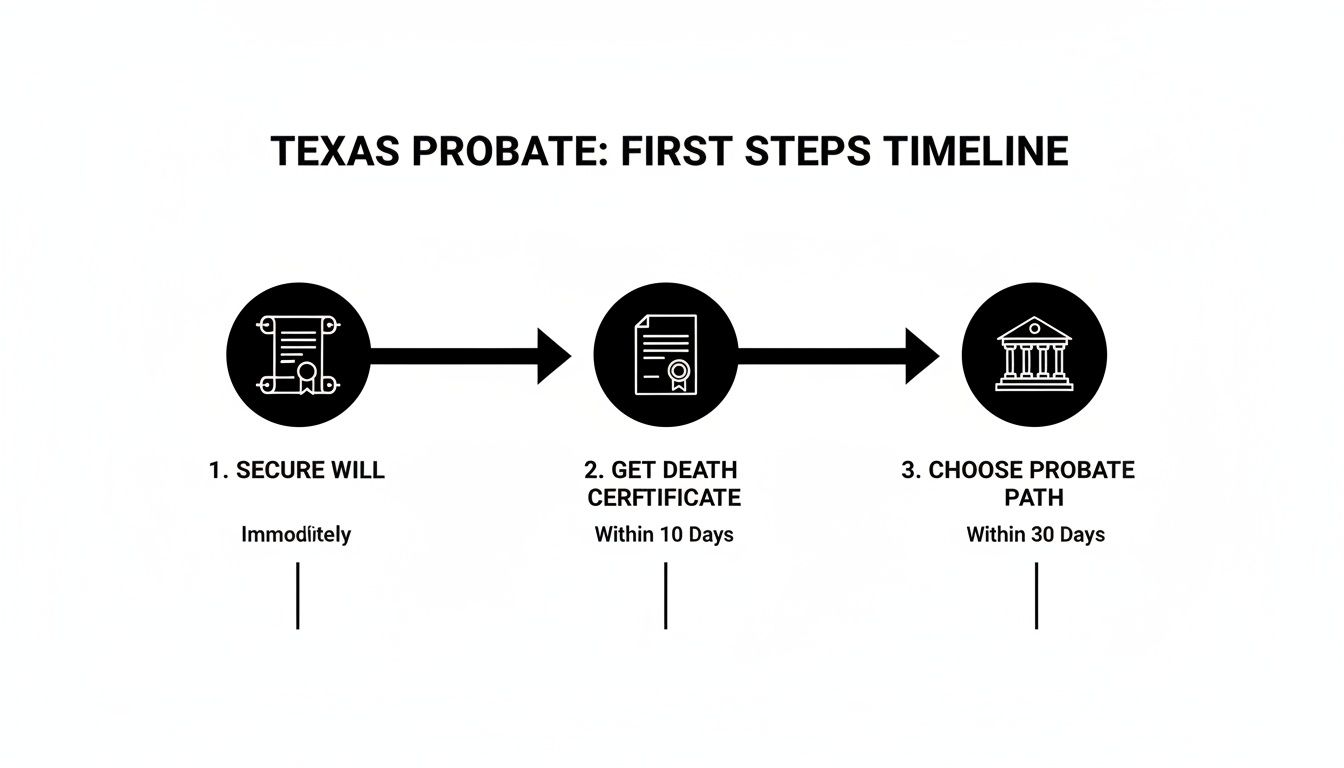
This graphic really drives home the point: getting your hands on the will and the death certificate are the immediate priorities. Those two documents are what allow you and your attorney to decide on the right probate path forward.
Comparing Timelines for Texas Probate Processes
Once the application is filed, the overall timeline can vary significantly depending on the estate's complexity and the type of probate administration used. A vast majority of Texas estates—around 80%—utilize independent administration. This path is generally faster and more affordable because it allows the executor to handle most tasks without seeking court permission for each step.
Conversely, dependent administration is a much more court-supervised process, which naturally extends the timeline. If you want to dig deeper, you can explore the details of Texas probate laws.
To give you a better sense of what to expect, here’s a breakdown of how the timelines typically stack up for different probate processes.
| Probate Type | Typical Timeline | Best For |
|---|---|---|
| Independent Administration | 6 to 12 months | Estates where the will allows it and there are no major disputes among beneficiaries. |
| Dependent Administration | 1 to 2+ years | Complex estates, situations with significant debt, or when family members are in disagreement. |
| Muniment of Title | 2 to 4 months | Simple estates with no debts other than a mortgage, where the main goal is just to transfer property title. |
Regardless of the route you take, the basic stages are the same: filing the application, waiting for a court hearing, notifying creditors, and finally, distributing the assets. Each one of these steps has its own timing, and things like busy court dockets in counties like Bexar or Dallas can cause delays.
Trying to manage these deadlines and legal hoops on your own can feel overwhelming. You don't have to face it alone. The Law Office of Bryan Fagan is here to offer the clear, compassionate guidance your family needs during this difficult time. Schedule a free consultation with us to discuss your family's situation and map out a clear path forward.
The Executor's Role and Responsibilities
Being named the executor of a will is a profound expression of trust. It signifies that your loved one believed you were the most capable person to carry out their final wishes. However, this honor comes with significant legal duties that can feel daunting, especially while you are grieving. This role is not just a title; it is a hands-on job with specific responsibilities outlined in the Texas Estates Code.
Think of yourself as the temporary manager of your loved one's estate. Your primary duty is to gather their assets, settle any legitimate debts, and distribute the remaining property to the beneficiaries named in the will. It is a process that requires organization, clear communication, and a steady hand. Let's walk through what that actually looks like.

Taking the First Legal Steps
Your first official action as the named executor is to file an "Application to Probate Will and for Issuance of Letters Testamentary" with the appropriate court. This is typically in the county where the deceased person had their permanent residence. For example, if they lived in Harris County, you would file with the Harris County Probate Court. This application initiates the legal process.
Shortly after filing, the court will set a hearing date. At this hearing, a judge will officially appoint you as the executor and grant you Letters Testamentary. This document is your proof of authority—it is the official court order that gives you the legal power to act on behalf of the estate. Without it, you cannot access bank accounts, communicate with financial institutions, or manage any of the estate's affairs.
Gathering and Managing Estate Assets
With your Letters Testamentary in hand, the real work begins. The next major phase involves locating, securing, and valuing all of the estate's assets. This is often the most labor-intensive part of the job and requires careful attention to detail.
Here’s a breakdown of what this stage involves:
- Creating an Inventory: You have 90 days from your appointment to file a detailed "Inventory, Appraisement, and List of Claims" with the court. This is a comprehensive list of all estate property—such as the house, cars, bank accounts, stocks, and furniture—and its fair market value on the date of death.
- Opening an Estate Bank Account: It is absolutely essential to open a new bank account specifically for the estate. You must never mix your personal funds with the estate's money. All income and expenses must flow through this dedicated account.
- Securing Property: This involves taking physical control of assets. You may need to change the locks on the deceased's home, ensure valuable items like jewelry or art are stored safely, and secure any vehicles.
Part of an executor's job often involves the practical, and sometimes difficult, task of cleaning out a person's home. If you're facing a house full of belongings, finding a great junk removal company can be an invaluable resource to help manage the physical side of settling an estate.
Notifying and Paying Creditors
A significant part of probating a will in Texas is ensuring the deceased's final bills are paid. You are legally required to notify potential creditors. The standard method is to publish a formal notice in a local newspaper. For any creditors you already know about—such as a mortgage company or credit card issuer—you must notify them directly.
Once notified, creditors have a specific period to make a formal claim against the estate. Your duty is to review each claim, determine its legitimacy, and pay valid claims from the estate's bank account. Following the rules in the Texas Estates Code is crucial; if you pay the wrong person or ignore a valid debt, you could become personally responsible.
Executor's Tip: From day one, keep a meticulous record of every penny that moves in or out of the estate account. Document everything—every phone call, every decision, every receipt. This level of detail will be your best defense if a beneficiary or the court ever questions your actions.
Communicating with Beneficiaries and Distributing the Estate
Once you have gathered all the assets and paid all valid debts, you are finally ready to distribute what remains to the beneficiaries according to the will's instructions. Keeping the beneficiaries informed throughout this process is essential. Clear, consistent communication can prevent frustration and potential disputes down the road.
Your final major act is to formally close the estate. Depending on the type of probate, this may require filing a final accounting with the court. Taking on the role of an executor is a complicated job, but you don't have to figure it all out on your own. For a deeper dive into your specific obligations, you can learn more about the duties of a will executor in our detailed guide.
Trying to manage all these responsibilities while you're grieving is a heavy burden. The Law Office of Bryan Fagan is here to offer compassionate, expert guidance to executors across Texas. Schedule a free consultation with us, and let us help you fulfill your duties correctly while protecting both the estate and yourself.
Breaking Down the Costs of Texas Probate
One of the first questions we hear from families is, "How much is this going to cost?" It's a completely understandable concern, and the fear of unknown legal fees can add significant stress to an already difficult time.
The good news is that probating a will in Texas does not have to be prohibitively expensive. The final cost depends heavily on the complexity of the estate. A straightforward, uncontested probate will always cost less than one entangled in family disputes or involving complex assets. It's helpful to think of the cost not as a single fee, but as a collection of specific expenses required to move the process forward.
Let's look at what your family can realistically expect to pay.

Core Probate Expenses
Regardless of the estate's size, some baseline costs are nearly unavoidable. These are the standard fees required to initiate and complete the process, though the exact amounts can vary slightly by county.
- Court Filing Fees: This is the fee paid to the county clerk to officially open the probate case. In major counties like Harris or Dallas, this typically ranges from $300 to $500.
- Attorney's Fees: This is usually the largest single expense. For simple, uncontested cases, many probate attorneys (including our firm) work on a flat-fee basis, providing families with certainty and peace of mind. For more complex or contested matters, an hourly rate is more common.
- Executor Compensation: The Texas Estates Code allows the executor to receive a commission, typically calculated as 5% of the money that flows in and out of the estate. In practice, when a family member serves as executor, they often waive this fee to maximize the inheritance for the beneficiaries.
Additional Potential Costs
Beyond the core expenses, other costs may arise depending on the estate's assets and circumstances. These are variable costs that not every case will incur.
For instance, if the will must be formally proven in court, you may have to pay citation fees for posting legal notices. If real estate or valuable artwork is involved, professional appraisals will likely be needed to determine an accurate market value for the inventory. For very small estates, however, you might avoid many of these costs. You can learn more about the specific requirements for a small estate affidavit in Texas in our detailed guide.
A Note on Bonds: In some cases, especially in a more supervised dependent administration, the court will require the executor to post a probate bond. This acts as an insurance policy to protect the estate from mismanagement. The cost is based on the estate's value and can be a significant additional expense.
Estimated Probate Costs in Texas
To help you budget, here’s a table that provides a general idea of the costs involved. Please keep in mind these are just estimates; every family's situation is unique.
| Expense Type | Simple Estate (Estimate) | Complex or Contested Estate (Estimate) |
|---|---|---|
| Attorney's Fees | $2,500 – $5,000 | $7,500 – $20,000+ |
| Court & Filing Fees | $400 – $600 | $600 – $1,500+ |
| Appraisal Fees | $0 – $1,000 | $1,000 – $5,000+ |
| Probate Bond | Typically waived | $500 – $2,500+ |
As you can see, the single biggest factor that drives up costs is conflict. When heirs disagree, someone contests the will, or the executor’s actions are challenged, legal fees can escalate quickly. This is precisely why having an experienced probate lawyer on your side from day one is so critical—it helps keep the process smooth, efficient, and on track.
Trying to figure out the financial side of probate can feel overwhelming, but you don't have to guess. At the Law Office of Bryan Fagan, we offer a complimentary consultation to walk your family through the potential costs and map out a clear path forward. Contact us today to get the clarity and guidance you need.
How to Handle Probate Disputes and Complications
Ideally, probating a will is a straightforward process of honoring a loved one’s wishes. But in reality, the intersection of grief, family dynamics, and finances can create a rocky path forward.
While most probates proceed smoothly, it is wise to be aware of the complications that can arise. Understanding potential challenges is the first step in addressing them effectively, which can help minimize the emotional and financial strain on your family.
Understanding Will Contests
The most significant complication is a will contest. This is not a simple disagreement but a formal lawsuit filed in court alleging that the will itself is invalid. A will contest can bring the entire probate process to a halt.
In Texas, a will can be contested for several specific reasons, and the challenger must provide solid evidence to support their claim. The most common grounds include:
- Lack of Testamentary Capacity: The person challenging the will must prove that at the time of signing, the deceased lacked the mental clarity to understand they were making a will, the nature of their property, or who their family members were.
- Undue Influence: This claim alleges that someone used manipulation, coercion, or intense pressure to force the person to change their will. A classic example is a caregiver isolating an elderly person and threatening to withhold care unless named the sole beneficiary.
- Improper Execution: Texas law has strict requirements for how a will must be signed and witnessed. A challenge might argue that it was not signed in the presence of two credible witnesses or that the signatures are forgeries.
A will contest is an incredibly painful and expensive ordeal for any family. It drags private relationships and personal history into a public courtroom, often causing rifts that last long after the legal battle is over.
Navigating Other Common Hurdles
Beyond a formal will contest, other issues can cause delays and create friction. It is the executor's responsibility to handle these matters carefully to prevent them from escalating. This is where having an experienced attorney is absolutely essential.
One common hurdle is dealing with creditor claims. The executor must notify potential creditors and pay valid debts. Disputes can easily arise over the legitimacy of a claim, especially with informal "loans" between family members. Mishandling these claims could result in personal liability for the executor.
Another challenge is locating unknown or missing heirs. If the will is unclear or an heir cannot be found, the executor must demonstrate to the court that they made a diligent effort to find them. This may involve hiring investigators and will almost certainly delay the distribution of assets, causing frustration for the known beneficiaries.
Finally, simple disagreements among beneficiaries can stall the process. For example, one sibling may want to sell the family home in Montgomery County immediately, while another wishes to keep it for sentimental reasons. These disputes are not formal will contests but can require negotiation—and sometimes court intervention—to resolve.
The Importance of Experienced Legal Counsel
When disputes arise, the situation can quickly become overwhelming for an executor who is also juggling legal duties, family dynamics, and their own grief. This is precisely when an experienced probate attorney becomes invaluable.
A good lawyer does more than just file paperwork. They act as a neutral guide, a mediator, and a strong advocate for the estate. An attorney can help negotiate agreements between beneficiaries, formally respond to creditor claims, and vigorously defend the will if it's contested. Their guidance ensures every action you take complies with the Texas Estates Code, protecting you from personal liability and keeping the process moving as efficiently as possible.
Dealing with probate complications is stressful, but you don't have to face it alone. The Law Office of Bryan Fagan provides the compassionate, professional guidance your family needs to resolve disputes and find a path forward. Schedule a free consultation with us today to discuss your situation with clarity and care.
How Recent Law Changes Affect Your Family's Estate
The laws surrounding probate in Texas are not static. They evolve to address new challenges and improve the process for modern families. Staying informed about these updates is crucial because they can have a direct impact on how smoothly your loved one's estate is settled.
These changes are not just minor adjustments to legal jargon in the Texas Estates Code. Lawmakers often make practical updates to increase efficiency, enhance security, and reduce the potential for costly delays. For families navigating probate, this means a more secure and predictable journey.
Securing the Original Will for the Future
One of the most significant recent updates addresses a common probate headache: what happens to the original will after the court process concludes? For years, this was a gray area that could create major issues later on, especially when selling property.
A key update to Texas probate law, effective as of September 1, 2025, changes how wills are handled. It now requires county clerks to retain custody of original wills or qualifying paper copies within the probate files, with clear rules for their removal and return.
This change solves the "where's the will?" problem that could arise years later, providing significant relief for title companies and banks needing to verify the chain of title for real estate. It is especially beneficial in muniment of title cases, which are often used for property transfers and can now be completed more quickly. If you want to dive into the specifics, you can discover more insights about recent Texas probate changes.
What This Means for Your Family
So, what does this legal shift actually mean for you? It's all about providing long-term security and peace of mind.
Let's say your family probates a will in Austin to transfer ownership of the family home. Five years from now, you decide to sell it. The title company will absolutely need to see the original probated will to confirm the transfer was legitimate.
- Before the change: The original will might have been returned to the executor. It could have been lost, damaged, or stored in a box no one can find, causing massive delays and stress during the sale.
- After the change: The original will (or a secure copy) is safely on file with the Travis County Clerk. The title company can easily verify it, allowing your home sale to proceed without a hitch.
This legislative update is a perfect example of how the law adapts to protect families. By ensuring the original will is securely maintained, Texas lawmakers have removed a significant barrier that often complicated real estate transactions for heirs.
Understanding these legal shifts is a core part of our commitment at The Law Office of Bryan Fagan. We stay on top of every single change to the Texas Estates Code to make sure we're providing the most current and effective guidance possible. This up-to-the-minute legal knowledge is a key part of our estate planning services, designed to protect your family’s legacy.
If you have questions about how this or any other law might affect your family’s situation, you don’t have to figure it out alone. Schedule a free, no-obligation consultation with our team. We’re here to provide the clarity and compassionate support you deserve.
Answering Your Texas Probate Questions
When a loved one passes away, the last thing you want to deal with is a confusing legal process. But probate often brings up a lot of questions, filled with legal terms and procedures most families have never seen before. To help bring some clarity during a difficult time, we've put together answers to some of the most common questions we hear from families just like yours.
What Happens If My Loved One Died Without a Will in Texas?
When someone dies without a valid will, Texas law says they died “intestate.” This is a critical distinction. It means the Texas Estates Code takes over, using a strict, unbending formula to divide their property among legal heirs—typically a spouse, children, or other relatives.
The process to sort this out is called an heirship proceeding, and it's almost always more complicated, expensive, and drawn-out than probating a will. The biggest issue, though, is that the court's decision is based on legal hierarchy, not your loved one's actual wishes. Without a will, their personal desires have no legal standing.
Do All Assets Have to Go Through Probate?
No, and this is a point of relief for many families. A surprising amount of a person's assets can pass directly to their beneficiaries without ever needing to go before a probate judge. We call these non-probate assets.
Common examples include:
- Life insurance policies where a specific person is named as the beneficiary.
- Retirement accounts like 401(k)s and IRAs.
- Bank accounts that are set up as "payable-on-death" (POD).
- Property held inside a living trust.
These assets are transferred contractually to the people named, which can dramatically simplify the estate settlement process. That's why reviewing these beneficiary designations is a vital part of both probate and estate planning—you have to make sure they still reflect what you want.
Can I Handle Probate Myself Without an Attorney?
While it might be technically possible in the absolute simplest scenarios, like a straightforward muniment of title with zero debt or complications, it is strongly discouraged for most people. The Texas probate system isn't forgiving; it's a maze of strict legal deadlines, precise procedural rules, and complex paperwork that has to be filed perfectly.
A single misstep—like missing a creditor notice deadline or incorrectly filling out the inventory of the estate—can trigger costly delays, create personal financial liability for the executor, and even ignite ugly family disputes. An experienced probate attorney acts as your guide, ensuring the process is handled correctly from the very beginning.
Hiring a lawyer isn't just about avoiding paperwork errors. It's about protecting the estate, honoring your loved one’s legacy, and giving your family the peace of mind to grieve without added legal stress.
Navigating probate can feel like a heavy burden, but you don't have to carry it alone. At the Law Office of Bryan Fagan, PLLC, our compassionate attorneys are here to guide your family with clarity and care. For personalized advice on your specific situation, schedule a free consultation with our team today. We're here to help.
Learn more by visiting us at https://texasguardianshiplawyer.net.