Skip to content
Deciding to pursue guardianship is one of the most significant and loving choices a family can make for a vulnerable loved one. This isn't just about paperwork; it's a legal process where a Texas court determines that an individual, known as the "proposed ward," is legally incapacitated and needs someone else to make critical life decisions for them. We understand this journey is filled with emotional and financial challenges, and our goal is to provide clarity and care every step of the way.
Is Guardianship the Right Path for Your Loved One?

Making the decision to seek guardianship is never easy. It’s an emotionally heavy choice, often coming after months or even years of watching a loved one's ability to care for themselves slowly slip away. This is a step born from love and a deep-seated responsibility to protect someone who can no longer protect themselves.
At its core, guardianship is about stepping in when someone you care about simply can't manage their own affairs anymore. The need can spring from many different situations, each bringing its own unique heartaches and challenges.
Understanding When Guardianship Is Necessary
The Texas Estates Code (specifically Title 3, Subtitle G) is clear on this. A person is considered legally "incapacitated" if, because of a physical or mental condition, they are unable to provide their own food, clothing, or shelter, care for their physical health, or manage their financial affairs. This isn't about a single bad decision; it's about a consistent, demonstrated inability to make safe choices.
Consider these common, real-world scenarios that Texas families face:
- Advancing Dementia: An elderly parent with Alzheimer's in Harris County starts forgetting to take vital medication, wanders away from home, or becomes an easy target for financial scammers.
- Severe Disability: An adult child with a significant intellectual disability who cannot comprehend the legal or medical documents required for informed consent.
- Sudden Medical Crisis: A spouse suffers a traumatic brain injury in an accident and is left unable to communicate their wishes or manage household finances.
In these tough situations, guardianship provides the legal authority needed to ensure bills get paid, medical treatments are approved, and daily life is managed safely. It is a court-supervised process designed from the ground up to protect our most vulnerable.
The Human Side of a Legal Decision
While the legal standards are straightforward, the emotional journey is anything but. Families in Harris County, Fort Bend County, and all across Texas grapple with this choice, often feeling a confusing mix of guilt and resolve. It is so important to remember that even exploring guardianship is an act of profound care.
You are not taking away your loved one's freedom. You are creating a legal shield to protect them when their own judgment is impaired. The legal process itself acknowledges how serious this step is.
Before you commit to this path, it's also critical to see if less restrictive options might work. Sometimes, documents like a Power of Attorney or a trust are already in place and can do the job. In fact, Texas courts require you to consider these alternatives to guardianship before moving forward.
At The Law Office of Bryan Fagan, we understand the weight of this decision. Our mission is to guide you with both legal clarity and human compassion, making sure you feel supported as you do what's best for your loved one.
If you are facing this difficult choice, please know you're not alone. For personalized guidance on your family’s unique situation, we invite you to schedule a free consultation with our compassionate team.
Laying the Groundwork Before You File
Before you ever set foot in a Texas courthouse, the steps you take can make or break your guardianship case. This isn't just about filling out forms; it's about building a solid, compassionate, and compelling argument. The groundwork you lay now can significantly smooth out the entire process later on.
Imagine a family in Houston. Their father, a retired teacher, is struggling with advanced dementia. His children have noticed he’s forgetting to pay bills and has fallen for a few phone scams. They've lovingly decided that guardianship is the only way to truly protect him. Before they head to the Harris County Probate Court, there are critical things they must do.
Lock Down the Medical Evidence
The single most important piece of your application is the Physician's Certificate of Medical Examination (PCME). This isn't a simple doctor's note; it's a specific, sworn legal document that provides the medical backbone for your case. As required by the Texas Estates Code, this certificate must be recent—dated within 120 days of when you file your application.
The PCME must be completed by a Texas-licensed physician who has examined your loved one. It must clearly outline:
- The specific nature and severity of the proposed ward’s incapacity.
- Their exact physical and mental conditions.
- Whether they are physically able to appear in court.
- An opinion on whether they can still make responsible decisions for themselves.
For our hypothetical family, this means getting their father an appointment with his geriatrician. They’ll need to clearly explain their concerns so the doctor can perform a thorough evaluation of their dad's cognitive state, which will then be officially documented in the PCME.
Make Sure the Right Person Is Nominated
Not just anyone can step in as a guardian in Texas. The court’s number one priority is the well-being of the proposed ward. As you prepare your application, you must be certain the person you're putting forward is qualified to serve.
Generally, someone is disqualified if they:
- Have a conflict of interest (like owing the proposed ward money).
- Lack the experience or education to responsibly manage the ward’s finances.
- Have a criminal record or a history of misconduct.
The Texas Estates Code sets out a priority list for appointments, usually starting with a spouse and then moving to the next of kin. But the court always has the final say, and the decision will always come down to who is best suited to act in the ward's best interests.
As his children, the siblings are high on that priority list. Since they are responsible adults with no conflicts of interest, they are strong candidates to serve as co-guardians.
Address the Alternatives and Family Situation First
A Texas court won't grant a guardianship unless it's truly the last resort. You are required to show the judge that no less restrictive options will work. This means you must have already considered things like a Durable Power of Attorney, a Medical Power of Attorney, or a supported decision-making agreement and found them insufficient.
This is also the time to have frank conversations with family. Nothing complicates a guardianship case more than family disputes. Getting everyone on the same page can prevent costly and stressful conflict down the road.
Our family learns their father never signed a power of attorney. They also sit down with their aunt and uncle, explain their dad's deteriorating condition, and walk them through why guardianship is the necessary next step. By doing this, they build family unity before a single form is filed.
Taking these steps ahead of time builds a rock-solid foundation for your application. If you need help gathering documents or navigating tough family dynamics, we're here to help. Schedule a free consultation to talk about your family's situation and get fully prepared for what's ahead.
Filing the Texas Guardianship Application
Once you've done the initial legwork, you’re ready to step into the formal legal process. This means completing and filing the official Application for Appointment of Permanent Guardian with the proper Texas probate court. Think of this document as the core of your case—it’s where you lay out all the facts for why your loved one needs the protection of a guardianship.
The application can look intimidating, but its purpose is simple: to paint a clear, honest picture for the judge. You'll be providing detailed information about the person needing help (the "proposed ward"), yourself as the applicant, and why guardianship is the only workable solution.
Navigating the Key Parts of the Application
The application, which is guided by the Texas Estates Code, Title 3, Subtitle G, asks for very specific information. Getting this right is crucial, as any mistakes can cause delays.
Here’s what you’ll need to provide:
- Information on the Proposed Ward: Their name, address, and a clear description of the physical or mental conditions causing their incapacity.
- Details of the Proposed Guardian: Your information, your relationship to the ward, and confirmation that you are legally qualified to serve.
- Statement of Assets: A general list of the proposed ward’s property and its likely value. This helps the court decide if a guardianship of the estate is needed.
- Justification for Guardianship: Here, you'll explain why less restrictive options, like a power of attorney, aren't enough to protect your loved one.
Essentially, the application is your chance to tell your family's story to the court in a structured, official way.
This infographic breaks down the key steps that get you ready for the filing stage.
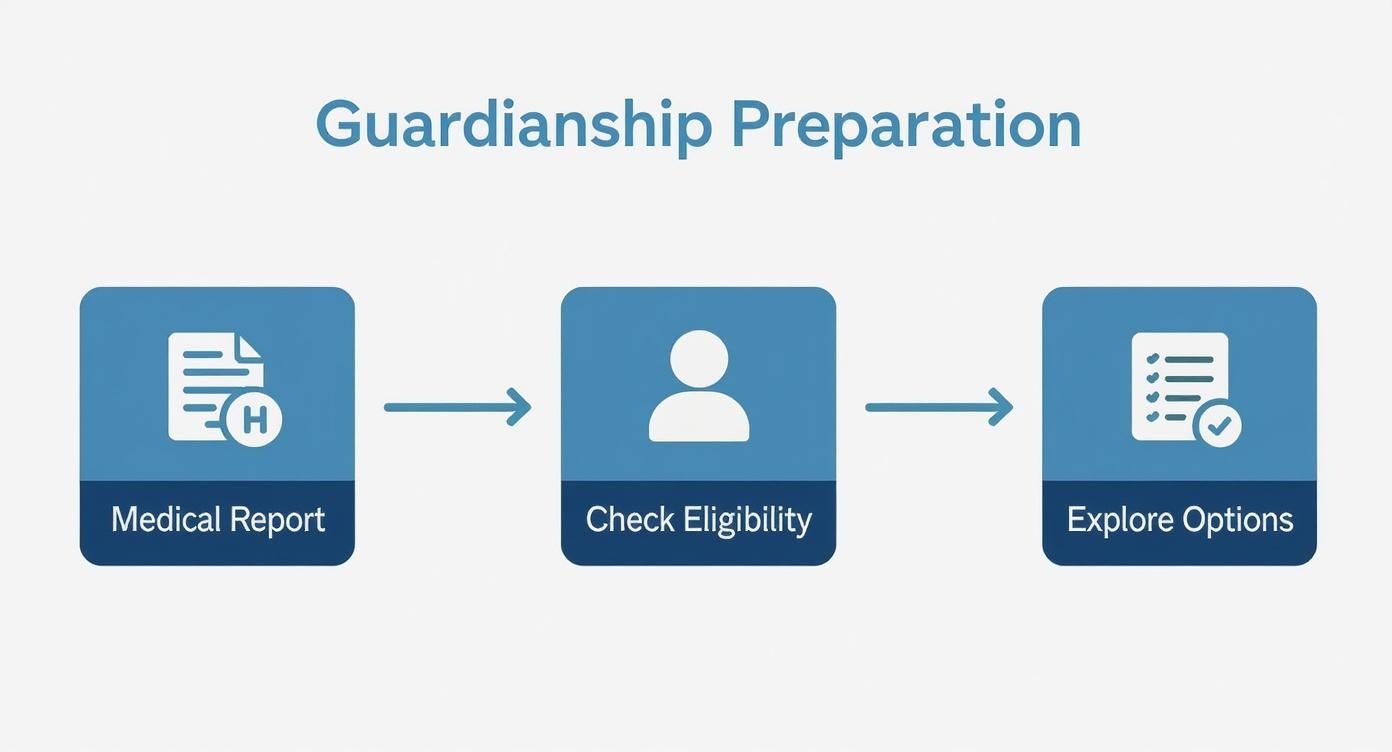
As you can see, getting that medical report and confirming your own eligibility are foundational tasks that directly feed into how you'll complete and file the official application.
The Critical Steps After Filing
Once your application is submitted to the correct court—whether it’s the Tarrant County Probate Court or the Bexar County Probate Court—a series of legal steps kicks into gear.
First, you’ll pay the court's filing fees. These costs differ from county to county, so it's a good idea to check with the local court clerk's office.
Next, the proposed ward must be officially notified that a guardianship case has been started. This is done by having a sheriff or a private process server "serve" them with a legal notice, known as a citation, along with a copy of your application. This is a non-negotiable right that ensures the person at the center of the case knows what is happening.
The Texas Estates Code is built to protect the rights of the proposed ward at every single stage. Even if they can't fully grasp the legal proceedings, the law ensures they are treated with dignity and given every chance to have their voice heard.
This filing also triggers a crucial safeguard: the judge will appoint an attorney ad litem. This is an independent lawyer whose sole job is to represent the proposed ward. They will meet with your loved one, review the application and doctor’s letter, and give their own unbiased report back to the court.
To get a better handle on this role and other procedural steps, you can learn more about the complexities of guardianship petitions and legal procedures.
To give you a clearer picture of the journey, here's a breakdown of the main stages you'll go through.
Key Stages of the Texas Guardianship Application
This table summarizes the critical milestones in the guardianship process, from filing the application to the court's final decision.
| Stage | Primary Action Required | Key Document or Participant |
|---|---|---|
| Initial Filing | Submit the Application for Guardianship and pay fees. | Application for Appointment of Permanent Guardian |
| Service of Process | Formally notify the proposed ward of the lawsuit. | Citation and Copy of Application |
| Attorney Ad Litem Appt. | The court appoints an independent attorney for the ward. | Attorney ad Litem |
| Investigation | The attorney ad litem investigates the facts of the case. | Ad Litem's Report to the Court |
| Court Hearing | Present evidence and testimony before a judge. | Applicant, Ward, Witnesses, Attorneys |
| Court's Decision | The judge issues an order granting or denying guardianship. | Order Appointing Guardian |
Working through these filing requirements can be complicated. Having an experienced attorney guide you through the paperwork can lift a huge weight off your shoulders and ensure everything is handled correctly.
The Law Office of Bryan Fagan is here to make this process as clear and straightforward as possible. If you’re ready to file or have questions about what comes next, schedule a free consultation with our team today.
What to Expect at Your Guardianship Hearing
After weeks or months of paperwork and preparation, the guardianship hearing is the moment it all comes together. This is the formal court proceeding where a judge will hear the evidence and make a final decision. It's normal to feel anxious, but knowing what to expect can calm your nerves and help you present your case with confidence.
The entire point of the hearing is for the judge to determine two things based on clear and convincing evidence: first, that your loved one is legally incapacitated, and second, that appointing you as their guardian is in their best interest. This is the high legal standard set by the Texas Estates Code, designed to protect the very person you’re trying to help.
The Key Players in the Courtroom
When you walk into the courtroom, whether it's a Dallas County Probate Court or one in another Texas county, you won't be alone. A few key people will be present, each with a specific job.
- The Applicant (You): You’ll need to be there and be ready to answer questions under oath.
- The Proposed Ward: The law requires your loved one to be at the hearing unless the court agrees it would be harmful or medically impossible, a fact that should be noted in the Physician's Certificate.
- Your Attorney: Your lawyer is there to present the case, question witnesses, and make the necessary legal arguments.
- The Attorney Ad Litem: This is the independent attorney appointed for your loved one. They will share their investigation's findings and advocate for what they believe is best for the proposed ward.
Presenting Your Testimony Clearly and Compassionately
Your testimony is your chance to talk directly to the judge. This isn't the time for complex legal arguments; that's your attorney's job. Your role is to give a clear, honest, and heartfelt explanation of why this guardianship is necessary.
The judge needs to hear specific, real-world examples. Instead of just saying, "My mother can't handle her finances," try to be more descriptive. For instance, "Last month, my mother paid the same utility bill three times and then gave a large sum of money to a phone scammer she couldn't remember speaking with." Concrete details paint a much clearer picture.
The most compelling testimony comes from a place of genuine care. Keep the focus on your loved one’s safety and well-being. Explain how guardianship will provide the protection they need to live with dignity.
This testimony is particularly crucial when determining the scope of guardianship. The use of full versus partial guardianship varies dramatically across the country. In fact, data shows that the percentage of individuals under some form of guardianship ranges from just 5.5% in some states to a staggering 89.0% in others. You can learn more about these national trends in this brief on guardianship for individuals with disabilities.
How the Judge Makes the Final Decision
At the end of the day, the judge's decision is based on hard evidence. They will carefully weigh several key pieces of information to make their ruling.
The primary evidence usually includes:
- The Physician’s Certificate: This medical report is often the most influential document.
- The Attorney Ad Litem's Report: Judges place great trust in the ad litem’s independent investigation and recommendation.
- Your Testimony: Your firsthand account helps the judge understand the day-to-day realities.
If the judge finds the evidence is clear and convincing, they will sign an order appointing you as guardian. This order is the official legal document that gives you the authority to make decisions. Knowing how the hearing is structured is a huge advantage, and you can get even more pointers from our detailed guide on how to prepare for a guardianship hearing in Texas.
Feeling ready for your day in court is one of the most important parts of this process. If you have a hearing coming up, schedule a free consultation with The Law Office of Bryan Fagan. We will stand by your side and help you advocate for your family member.
Your Responsibilities After Becoming a Guardian

The judge's order appointing you as guardian is a huge milestone, but it's the starting line, not the finish. That legal document, officially called the Letters of Guardianship, gives you the authority to make decisions. But with that authority comes serious, ongoing responsibilities. You've officially become a fiduciary—someone the court has entrusted to act solely in the best interests of your loved one, now known as the "ward."
This new role is defined by both immediate tasks and long-term duties, all laid out in the Texas Estates Code. Grasping these obligations from day one is critical to fulfilling your role effectively, staying in good standing with the court, and giving your family member the best possible care.
Fulfilling Your Immediate Duties
In the first few weeks after your appointment, the court requires several key actions. Think of these as foundational steps; they aren't optional.
Your very first task is to take a formal Oath of Guardian. This is a sworn statement you file with the court, promising to faithfully perform all your duties. It’s a formal acknowledgment of the commitment you’re making under the court's supervision.
Next is posting a guardian's bond. This is an insurance policy that protects the ward's assets from any potential mismanagement. A judge sets the bond amount based on the value of the ward's liquid assets. It’s a standard requirement in most guardianships involving an estate.
Managing the Ward's Assets and Well-Being
Once you've officially qualified, your ongoing duties kick in. One of your most significant initial projects is to track down and secure all of the ward's property. This process demands meticulous records and total transparency.
Within 30 days of your appointment, you must file a sworn document called an Inventory, Appraisement, and List of Claims. This detailed report gives the court a complete financial snapshot of the ward's estate. It needs to include:
- Real Property: A legal description of any land or homes the ward owns.
- Personal Property: A comprehensive list of everything else, from bank accounts and investments to vehicles and personal belongings.
- Claims: A list of any money owed to the ward or by the ward.
This inventory establishes the financial baseline. From this point on, every penny that comes into or goes out of the ward’s estate has to be carefully tracked.
Under Texas law, a guardian is held to a high standard of care. This means you must manage the ward's property as a prudent person would manage their own, avoiding risky investments and prioritizing the ward's needs above all else.
Maintaining Compliance Through Annual Reporting
Guardianship isn't a one-and-done deal. The court stays involved, supervising your actions through mandatory annual reports to ensure you are always acting in the ward's best interest.
Every year, you'll be required to file specific reports. The two most common are:
- Annual Report on the Condition and Well-Being of the Ward: This report updates the court on the ward's living situation, health status, and any significant changes.
- Annual Account: If you're the guardian of the estate, this is your detailed financial report card. It must list all income received and every expense paid on behalf of the ward, backed up with receipts.
Failing to file these reports on time can have serious consequences, including being removed as guardian. While these requirements can feel like a lot of work, they exist to protect your loved one and create a clear record of your diligent care.
Navigating these post-appointment duties is where you put the court's trust into action. If you have questions about filing an inventory, securing a bond, or preparing your annual account, The Law Office of Bryan Fagan is here to provide clarity and support. Schedule a free consultation to ensure you are fully prepared for your duties as a guardian.
Common Questions About Texas Guardianship
Navigating guardianship brings up many questions. It's completely normal. Families often have the same practical concerns about cost, timeline, and what happens when family members disagree. Let's address some of the most common questions we hear from Texas families.
How Much Does Guardianship Cost?
This is usually the first question on everyone's mind. The honest answer is: it depends. The total cost of a guardianship can vary significantly based on its complexity.
Key factors that shape the final cost include:
- Attorney's Fees: This is typically the largest expense.
- Court Filing Fees: These vary by county, so it’s smart to check with your local probate court, like the Travis County Probate Court.
- Attorney Ad Litem Fees: The court appoints an independent attorney to represent the proposed ward, and their fees must be paid.
- Bond Premiums: If a bond is required to protect the ward's assets, you'll have an annual premium to pay.
An uncontested case, where everyone agrees, will always be more affordable. When family members dispute the guardianship, the process can become longer and much more expensive.
How Long Does the Process Usually Take?
Every case is unique, but a straightforward, uncontested guardianship in Texas generally takes between two and four months from filing the application to the judge signing the final order.
This timeline allows for serving the proposed ward with notice, the attorney ad litem conducting their investigation, and getting the final hearing scheduled on a busy court docket. If a case is contested or involves complex finances, you can expect the process to take longer. For urgent situations, Texas law also provides for emergency or temporary guardianship, which can be established much more quickly to address immediate threats to a person's health or safety.
It’s interesting to see that efficiency is a worldwide concern. During the European migrant crisis, for example, the strain on their systems pushed the European Commission to propose appointing guardians for unaccompanied minors within just five working days. You can read more about these international guardianship system developments to see how others are tackling it.
What If a Family Member Disagrees?
Guardianship disputes can be the most emotionally draining part of the process. If a family member objects to your application, they have the legal right to contest it in court. This can turn a clear path into a difficult legal battle.
A family member might contest the guardianship for various reasons. Perhaps they don't believe the person is truly incapacitated, or they think someone else should be the guardian. When this happens, the case moves to a contested hearing where both sides present evidence and testimony.
In a contested guardianship, the court has one single focus: the proposed ward. A judge will hear all sides and look at all the evidence to figure out what is genuinely in that person's best interest—not what any one family member wants.
These are just a handful of the questions that come up, but understanding these practical issues can help you set realistic expectations for the road ahead.
Navigating the complexities of a guardianship application requires a steady, experienced hand. At The Law Office of Bryan Fagan, PLLC, we provide the compassionate guidance and legal clarity Texas families need to protect their loved ones. If you have more questions or are ready to take the next step, schedule a free, no-obligation consultation with our team today at https://texasguardianshiplawyer.net.