Skip to content
When you agree to be a guardian for a loved one, you’re stepping into a role of immense trust and responsibility. We know this journey is often born from love and necessity, but this commitment isn't just a personal promise; it comes with a serious legal duty to be transparent. In Texas, the annual accounting for a guardianship is your formal report to the court, proving you are managing the ward's finances honorably and in their best interests.
This isn’t just a suggestion. It’s a mandate under the Texas Estates Code, and understanding this responsibility is the first step in fulfilling your role with confidence and care.
The Guardian's Duty to Report

Becoming a guardian in Texas means you’ve accepted a fiduciary duty—the highest standard of care recognized by law. This means you are legally bound to act solely for the benefit of the person you are protecting, known as the ward. The annual accounting is the primary tool the court uses to verify you are upholding that sacred trust.
It’s best to think of this report not as a burden, but as your shield. A meticulously prepared accounting protects your loved one from financial mistakes or harm, and it protects you from potential legal challenges or false accusations. It’s the official record of your diligent stewardship, demonstrating your commitment to their well-being.
Why This Report Is So Critical
Probate courts, whether in Harris County, Dallas County, or anywhere else in Texas, take this reporting duty extremely seriously. The annual accounting serves several vital purposes for families like yours:
- Ensures Transparency: It creates a complete and honest picture of the ward’s financial life over the past year.
- Prevents Mismanagement: Regular court review helps catch and deter potential errors, neglect, or even abuse.
- Upholds Accountability: It holds you, the guardian, accountable for every single financial decision you make.
- Confirms Your Diligence: A well-prepared report proves your commitment to the ward’s well-being and your respect for the court.
This entire requirement is laid out in Title 3, Subtitle G of the Texas Estates Code, which details the powers and duties of guardians. Failing to file—or filing a sloppy, inaccurate report—can lead to severe consequences, including court sanctions, removal as guardian, and even personal financial liability.
A Mandate, Not a Suggestion
Unfortunately, compliance is a major issue across the state. One recent review of 7,590 guardianship cases found that a shocking 34% were out of compliance with court requirements. The same report revealed that 40% of the cases reviewed were missing their required annual accounts.
This data, which you can read about in the official report on Texas guardianship compliance, highlights why courts are so strict. This report is a fundamental safeguard for some of the state’s most vulnerable residents.
By fulfilling this obligation with care and precision, you transform a complex legal task into a clear demonstration of your dedication. It is your opportunity to formally show the court and your family that you are honoring the trust placed in you.
We understand that navigating these legal duties can feel overwhelming, especially when you’re already focused on the day-to-day work of caregiving. If you have questions about your responsibilities or need help preparing your first annual accounting for a guardianship in Texas, our team is here to help. Schedule a free consultation with The Law Office of Bryan Fagan to get personalized guidance and clarity.
Organizing Your Financial Records Like a Pro
Success with your annual accounting doesn't start the week it's due. It’s a year-long process of careful organization. If you want to avoid a frantic scramble, you must build a system for meticulous record-keeping from day one.
This isn't about tossing receipts into a shoebox and hoping for the best. It's about transforming what feels like a dreaded chore into a smooth, routine part of your guardianship duties. By tracking every dollar in and every dollar out, you're not just being organized—you're proving your commitment as a fiduciary.
Setting Up Your System
Think of yourself as the financial manager for your loved one’s estate. Your first move should be to create a dedicated space—physical or digital—for every single financial document. Many families find that digital folders on a computer are the easiest to manage.
For example, if you're the guardian for your father, you might create a main folder named "Dad's 2026 Guardianship." Inside, you'd create sub-folders for everything:
- Income: Social Security statements, pension stubs, any other deposits.
- Bank Statements: One for each month, for every single guardianship account.
- Medical Bills: Invoices from doctors, pharmacy receipts, and anything related to medical equipment.
- Housing & Utilities: Copies of rent checks or mortgage statements, plus all utility bills.
- Personal Needs: Receipts for groceries, clothing, toiletries, and other daily expenses.
This simple habit of filing things away immediately will save you from trying to figure out what a crumpled, faded receipt from 11 months ago was for.
The Monthly Reconciliation Habit
A system is useless if you don't use it. The absolute key to avoiding a year-end panic attack is to reconcile the ward's accounts every single month.
This sounds more intimidating than it is. A simple spreadsheet is your best friend here. Create columns for the date, a description of the transaction, the amount, and a category (e.g., "Medical," "Food," "Utilities"). Once a month, sit down with the bank statement and your spreadsheet and check off every transaction. This one-hour task will save you dozens of hours of stress later.
Think of this monthly check-in as your early warning system. It helps you catch bank errors, spot surprise expenses, and make sure you’re staying on budget long before the court is looking over your shoulder.
Sometimes, you'll need more than just a receipt. If you have to sell some of the ward's personal property to cover expenses, for example, using a formal Bill of Sale Template is crucial. It creates a clean, official record for the court and leaves no room for questions.
The Non-Negotiable: A Dedicated Bank Account
Here is one rule you can never, ever bend: your loved one's money must be kept completely separate from your own. Commingling funds is a cardinal sin in guardianship. Even "small" mistakes, like paying for the ward's prescription with your personal debit card and planning to "pay it back later," can create a nightmare paper trail and cause a judge to question your integrity.
All of the ward’s income must go into the guardianship account. Every single expense must be paid from it. For a detailed guide on setting these accounts up correctly, be sure to read our article on essential Texas guardianship bank account rules you must know.
This discipline is the bedrock of a clean and defensible annual accounting in a Texas guardianship. It's the clearest and most powerful way to demonstrate to a judge in Harris County, or any other Texas probate court, that you are handling your duties with the utmost professionalism and care.
How to Prepare the Formal Annual Account
After a year of diligent record-keeping, it’s time to assemble your notes, receipts, and statements into the formal document the court requires. This is where all your hard work pays off, translating your efforts into a clear financial story for the judge.
Preparing the annual accounting for a guardianship in Texas isn't about navigating complex legal loopholes. It's about providing structured, transparent reporting. The Texas Estates Code simply demands an honest, clear summary of your financial stewardship over the past year.
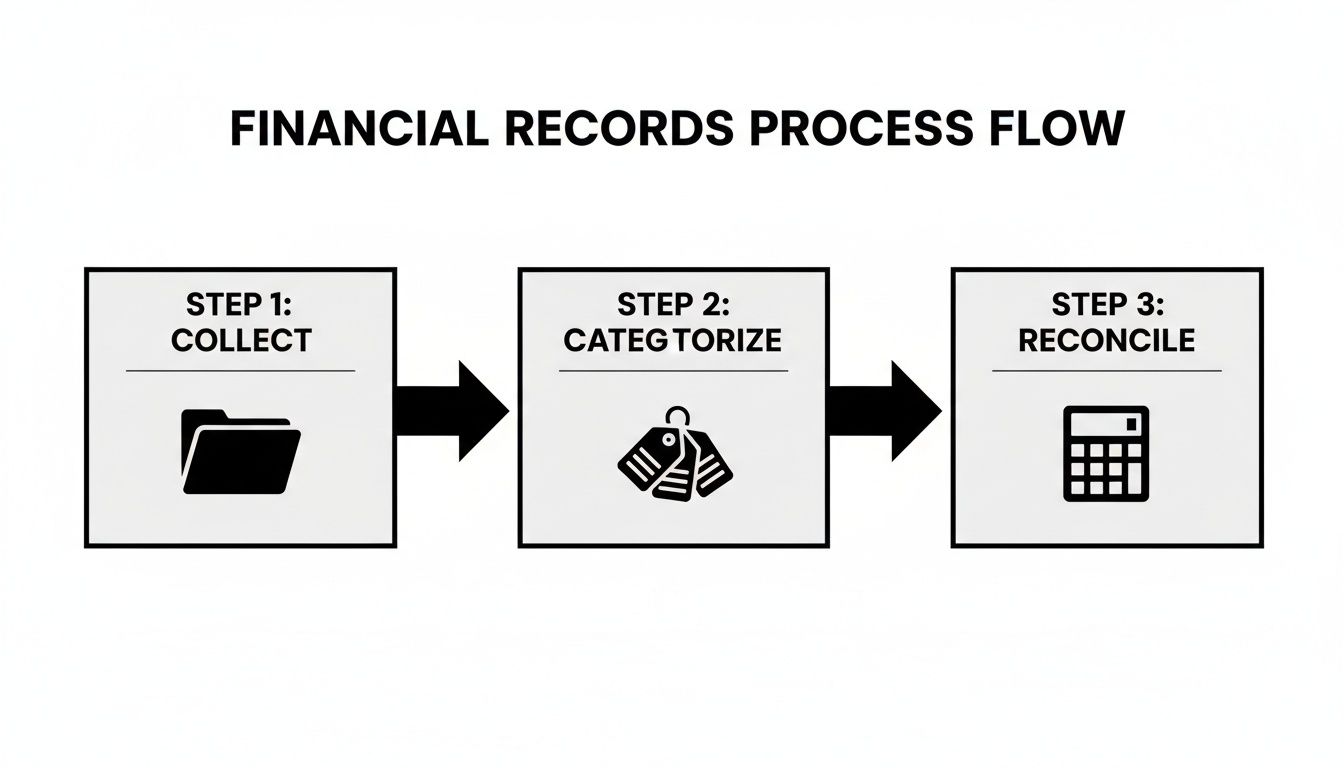
The entire process hinges on a simple, repeatable system you should be using all year long: collect, categorize, and reconcile. This foundational approach ensures no transaction gets missed and makes putting together the final report infinitely smoother.
Breaking Down the Annual Account
Think of the formal annual account as telling a financial story with a distinct beginning, middle, and end. The court wants to see what the ward owned at the start of the year, all the money that came in, every dollar that went out, and what was left when the year was over.
Your report will be broken down into these core sections:
- Property on Hand: A detailed list of every asset belonging to the ward at the start of the accounting period. This number must match the ending balance from last year's account or your initial inventory.
- Income and Receipts: A complete record of all money and property received. This includes everything from Social Security benefits and pension payments to trust distributions or rental income.
- Expenditures and Disbursements: A categorized list of every payment made from the ward’s estate. Each expense needs to be documented and justified as being for the ward's benefit.
- Property on Hand (at End of Period): The final list of assets and the closing cash balance in the guardianship account.
To help you organize your documents, we've put together a checklist that outlines the key components required under the Texas Estates Code.
Annual Account Components Checklist
| Component (As per Texas Estates Code) | What It Includes | Required Documentation Example |
|---|---|---|
| Beginning Balance/Property on Hand | Assets (cash, real estate, investments) held at the start of the accounting period. | Prior Year's Approved Account or Initial Inventory |
| Receipts/Income | All money received by the estate during the period. | Bank statements, Social Security award letters, checks |
| Disbursements/Expenditures | All payments made from the estate, categorized by purpose (e.g., housing, medical, personal care). | Canceled checks, invoices, receipts, credit card statements |
| Administration Costs | Payments for bond premiums, court costs, and attorney fees. | Invoices, court receipts, bond premium statements |
| Changes in Property | Any assets sold, purchased, or otherwise changed during the period. | Sales contracts, purchase agreements, deeds |
| Ending Balance/Property on Hand | All assets remaining in the estate at the end of the accounting period. | End-of-period bank statements, brokerage statements |
This checklist serves as your guide to ensure you've gathered all the necessary pieces before you start compiling the final report for the court.
A Practical Scenario Documenting Expenses
Let’s put this into a real-world context. Imagine you’re the guardian for your adult sister in Harris County. Her income comes from a small trust and Social Security disability payments, and it's your job to show how you used those funds for her care.
In the expenditures section of your account, a single line item like "Caregiving – $20,000" won't cut it. The court needs precision. Instead, you'd break it down like this:
- Caregiver Services: "Payments to HomeWell Care Services for 20 hours/week of in-home support as pre-approved by the court. Total: $15,600." You would have the corresponding invoices or payment confirmations ready to attach.
- Therapies: "Co-pays for weekly physical therapy sessions at Memorial Hermann. Total: $1,200." You'd back this up with receipts for each co-pay.
- Daily Living: "Reimbursements for groceries, toiletries, and household supplies purchased for the ward's use. Total: $3,200." You would have all the categorized receipts for these purchases.
This level of detail leaves no room for questions. It shows the court exactly how every dollar was spent to support your sister.
Key Takeaway: The purpose of the annual account is to create an undeniable record of responsible management. Every number you report should be backed by a piece of paper—a bank statement, a receipt, or an invoice.
While the court often provides specific forms, it can be helpful to remember that this report is a type of financial statement. You can review some general financial statement example templates to better understand the standard structure of these documents.
By detailing every transaction, you aren't just filling out a form. You are building a powerful case that demonstrates your commitment as a guardian and validates the trust the court placed in you. This document is the ultimate proof of your dedication and care.
Avoiding Common and Costly Accounting Mistakes
Even the most dedicated guardians can get tripped up when handling a loved one's finances. Preparing an annual accounting in a Texas guardianship can feel like a high-stakes test, but knowing where the common landmines are can help you sidestep them entirely. A simple error isn’t just a paperwork hassle; it can raise serious red flags with the court, creating stress for you and your family.
In our practice, we’ve seen countless good people make honest mistakes that snowball into significant legal consequences. By understanding these frequent slip-ups, you can protect the ward and solidify your own standing as a trustworthy guardian.
Commingling Funds: An Innocent but Serious Error
One of the most common—and most serious—mistakes we see is commingling funds. This is just a legal term for mixing the ward’s money with your own, even for a moment. It almost always starts with something that seems completely harmless and convenient.
For example, David is the guardian for his father, who's in a Dallas County care facility. While out running errands, David uses his dad's guardianship debit card to fill up his own gas tank, fully intending to transfer the money back from his personal account that night. That single, innocent-seeming swipe is a major breach of his duty. The court has no way to verify why the transaction happened or if the money was truly paid back, which immediately creates the appearance that something is wrong.
The Proactive Solution: Never, ever use the ward’s funds for your personal expenses, or vice versa. Every single transaction for the ward must come from the designated guardianship bank account. This creates a clean, undeniable paper trail that makes your annual accounting a breeze.
Neglecting to Get Court Pre-Approval
Another major pitfall is failing to get the court’s permission before making large or unusual expenditures. As a guardian, you don’t have a blank check. Certain expenses require a judge’s sign-off before you spend a single dollar of your loved one's money.
Let's look at a real-world scenario. Maria, guardian for her brother in Travis County, sees that his house desperately needs a new roof. She gets a fair quote for $15,000 and pays the contractor from the guardianship account. The expense was absolutely necessary, but Maria didn’t get a court order authorizing this major capital improvement first. When she files her annual account, the judge is likely to question the unapproved expense and could even refuse to ratify it, leaving Maria personally on the hook for the $15,000.
Common expenses that almost always require pre-approval include:
- Selling real estate or other significant assets.
- Making large purchases or investments.
- Paying for elective medical procedures.
- Entering into contracts on the ward’s behalf.
Remember, the specific local rules can vary. What flies in a Harris County Probate Court might require an extra step in Bexar County. When in doubt, the safest move is always to ask the court or your attorney first.
Losing Track of Small Cash Transactions
While big-ticket items get all the attention, it’s the small, day-to-day cash spending that often unravels an annual accounting. It's incredibly easy to lose track of minor cash expenses for groceries, toiletries, or a haircut when you’re pulling from cash withdrawn from the guardianship account.
A guardian might withdraw $200 for the week’s needs but then misplace the individual receipts. On the report, they'll be tempted to just write "$200 – Cash for miscellaneous." To a judge, this is a huge red flag because it lacks the specific itemization the law requires. Every dollar must be accounted for. For more on this and other critical issues, you can read our detailed guide on common Texas guardianship accounting errors to avoid.
The solution is to treat cash with the same discipline as a debit card. Keep a small notebook or use a phone app to immediately log every single cash purchase, and diligently save every receipt, no matter how small. These simple habits are the bedrock of a successful and stress-free annual accounting in a Texas guardianship.
Filing Your Report with the Court
You’ve done the hard work of gathering every receipt, reconciling every bank statement, and putting your annual accounting together. Now it’s time to take it across the finish line by filing it with the court.
This isn't just a matter of dropping off a stack of papers. Filing is a formal process designed to create a transparent, official record of your actions as guardian.

Before you can file, you must attach a sworn affidavit. This is your personal declaration—made under penalty of perjury—that everything in the accounting is true and correct to the best of your ability. That signature turns your financial summary into a legally binding document.
Notifying Interested Parties
A huge piece of the filing puzzle is making sure all "interested parties" get a copy. The Texas Estates Code mandates this step to give everyone with a legal stake in the ward's well-being a chance to review your work.
So, who exactly gets a copy? It’s a specific list:
- The ward, if they are 12 years of age or older.
- The ward’s spouse, parents, and any children.
- Any person or organization that has filed a request for special notice in the case.
- Anyone else the judge has specifically ordered you to notify.
You’ll need to send a copy of the filed accounting to each of these individuals, and the law is specific about how you do it. The standard method is certified mail with a return receipt requested. That little green card you get back in the mail is your golden ticket—it’s the proof you show the court that you followed the rules.
For a deeper dive into these notice obligations, you can learn more about annual reporting requirements for guardians in our detailed guide.
The Filing and Approval Process
Once your affidavit is signed and you have your list of people to notify, you’re ready to file. Most Texas probate courts, especially in larger counties like Harris or Dallas, have moved to mandatory electronic filing (e-filing). You'll use the state’s online system to upload your complete annual accounting, the affidavit, and all your supporting schedules. This is also when you'll pay the required filing fee.
After your report is officially filed, the court’s review process kicks in. A judge or their staff will comb through your documents, checking for mathematical accuracy, proper documentation, and full compliance with the law. They are making sure every expense was appropriate and all the estate’s income has been properly accounted for.
At the same time, the interested parties you notified have a period to review the accounting and file any objections if they find issues.
Key Takeaway: Your ultimate goal is to receive an "Order Approving Annual Account." This court order is the judge’s official stamp of approval on your work. It confirms you’ve met your fiduciary duties for the year and formally closes the books on that accounting period. Think of this order as your legal shield, proving you managed the estate with care and integrity.
If you are facing the final steps of your annual accounting guardianship in Texas and feel uncertain, you don't have to navigate it alone. Schedule a free consultation with The Law Office of Bryan Fagan for personalized guidance.
When You Need a Guardianship Lawyer on Your Side
Taking on the role of a guardian is a monumental act of love and service, but you’re not expected to be a legal or financial expert. In fact, some of the most diligent guardians we’ve worked with are the ones who know exactly when to raise their hand and ask for help.
While preparing the annual accounting for a guardianship in Texas can be straightforward, some situations can spiral quickly. What seems like a simple duty can turn into a complex legal headache if you're not careful. Calling an attorney isn't a sign of failure—it's a smart, proactive step that shows the court you are serious about your role and are protecting both the ward and yourself.
When Legal Guidance Becomes Essential
So, when is it time to pick up the phone? Certain red flags should immediately tell you it’s time to consult an attorney. If any of these scenarios sound familiar, getting professional advice is the wisest move you can make for your family.
- Complex Estates: Is the estate you’re managing more than just a simple bank account? If you're dealing with business assets, multiple real estate holdings, or complicated investment portfolios, you're in territory that requires specialized knowledge to account for everything properly.
- Family Disputes: Things can get ugly fast when family is involved. Have relatives started questioning your decisions, demanding information, or even threatening to take you to court? A lawyer can step in to manage these communications and defend you against false claims.
- Simply Feeling Overwhelmed: Let's be honest—sometimes the sheer volume of paperwork, looming deadlines, and the dense language of the Texas Estates Code is just too much. We hear this from families all the time. If you feel like you’re drowning, an attorney can bring clarity and much-needed peace of mind.
We understand the immense weight on your shoulders. At The Law Office of Bryan Fagan, we see our role as your expert partner, providing the support you need to fulfill your duties perfectly. A consultation isn't an admission of defeat; it’s an investment in doing the job right.
An experienced guardianship lawyer can be your lifeline. They can review your accounting before it's filed to catch any errors, help you navigate disagreements with family members, or represent you if a formal challenge is ever brought before the court. Their guidance ensures you stay in full compliance, which protects the ward’s assets and your own legal standing.
You don't have to go through this alone. If you're struggling with your annual accounting guardianship Texas duties or facing challenges you never saw coming, our team is here to help. Schedule a free consultation today to get personalized guidance from attorneys who genuinely care.
Frequently Asked Questions About Guardianship Accounting
As a guardian, you're bound to have questions about the annual accounting. It's a complex and critical duty, and it’s natural to worry about getting it right. We've compiled answers to some of the most common questions we hear from families just like yours, based on our years of experience helping clients in Texas probate courts.
What Happens If I Miss the Filing Deadline?
Missing the filing deadline for your annual accounting in a Texas guardianship is a serious matter that the court will not ignore. You could quickly find yourself receiving a court order to appear and explain why the report is late.
This isn't a situation any guardian wants to be in. Failing to file on time can lead to fines, your removal as guardian, or even being held personally liable for any financial harm to the ward's estate. If you see a delay coming, the best thing you can do is proactively request an extension from the court before the deadline hits. If you've already missed it, it's crucial to contact a guardianship attorney right away to help you get back in compliance and show the court you are taking your responsibilities seriously.
Does an Annual Accounting Need to Be Filed If the Ward Has Little Money?
Yes, without a doubt. The legal duty to file an accounting is mandatory under the Texas Estates Code (Title 3, Subtitle G), no matter how large or small the estate is. The core purpose of the accounting is to provide complete transparency to the court.
Think of it this way: even if your loved one’s only income is a monthly Social Security check that you use for their groceries and rent, the accounting is your formal record showing the judge exactly how those funds were managed for their direct benefit. A report for a smaller estate will be simpler, of course, but it is never optional. It's a fundamental responsibility for every single guardian of the estate.
Can I Pay Myself for My Time and Effort As Guardian?
While you may be entitled to fair compensation for your services, you absolutely cannot just write yourself a check from the guardianship account. This is a common and critical misunderstanding that can get even the most well-intentioned guardians into serious trouble.
To get paid, you must first do the work and then formally request compensation as part of your annual accounting. You’ll need to provide a detailed breakdown of the services you provided. A judge will personally review your request to determine if the amount is reasonable. Only after the judge signs a court order approving the payment can you take that specific amount from the ward’s funds. Paying yourself without a court order is a major breach of your fiduciary duty and carries severe penalties.
At The Law Office of Bryan Fagan, PLLC, we know that these questions are often just the tip of the iceberg. We are committed to guiding Texas families through the complexities of guardianship with clarity and care. If you're feeling overwhelmed or just need clear, personalized guidance on your annual accounting, our experienced attorneys are here to help. Schedule a free consultation today, and let us give you the support you need to protect your loved one and yourself.