Skip to content
Navigating Texas property tax law can feel overwhelming, especially when you are also focused on caring for your family. The homestead exemption in Texas isn’t just a piece of legal jargon; it’s a powerful tool designed to lower your property tax bill and protect your family’s most important asset. Think of it as a state-guaranteed discount on the taxable value of your primary home, offering real, tangible savings for you and your loved ones every year.
Getting to Know the Homestead Exemption and Its Perks

If you own a home in Texas, you know that property taxes are a significant part of your annual budget. We understand that for many families, especially those facing the financial challenges of caregiving or managing an estate, every dollar counts. The homestead exemption is designed to lighten that load by carving out a portion of your home’s value and making it off-limits to taxation.
This crucial protection isn’t automatic—you have to apply for it. Once your application is approved, the exemption applies specifically to the home you own and live in as your main residence. It’s a foundational benefit that every homeowner in Texas should take advantage of to safeguard their family’s financial future.
How This Exemption Puts Real Money Back in Your Pocket
Let’s break down how this works with a practical, real-world example. Imagine your family home in Harris County is appraised at $350,000. Without any exemptions, your school district taxes are calculated based on that full value. We know this can be a daunting figure.
But here’s where the relief comes in. Thanks to a huge legislative push, Texas recently increased the mandatory school district exemption from $40,000 to a massive $100,000. This means your home is now taxed by the school district as if it were worth only $250,000 ($350,000 – $100,000). That difference leads to significant savings, year after year. You can read more about this historic property tax cut package to see its full impact.
This isn’t just a small tax break. It’s a fundamental protection designed to make homeownership more affordable and to shield your family’s most important financial and emotional investment.
Different Flavors of Homestead Exemptions
The good news doesn’t stop with the general exemption. Texas law offers several other types of homestead exemptions to provide even more relief based on your personal circumstances. Understanding which ones you or your loved ones qualify for is key to maximizing your savings and preserving family assets.
To help you see what’s available, here’s a clear summary of the main homestead exemptions you might be eligible for in Texas.
Key Homestead Exemptions in Texas at a Glance
| Type of Exemption | Mandatory Exemption Amount | Who Qualifies |
|---|---|---|
| General Residence | $100,000 for school district taxes. | Any Texas homeowner for their principal residence. |
| Over-65 | An additional $10,000 for school district taxes. | Homeowners who are 65 years of age or older. |
| Disability | An additional $10,000 for school district taxes. | Homeowners who meet specific disability criteria. |
| Disabled Veteran | From $5,000 up to 100% of the home's value. | Veterans with a service-connected disability rating. |
Each of these exemptions can be layered on top of one another, providing substantial relief for those who qualify. It’s absolutely worth investigating which ones apply to your situation with care and attention.
These protections are especially vital in complex family situations. For instance, in a Guardianship, it is the guardian's duty under the Texas Estates Code to secure these exemptions to preserve the ward's assets. Similarly, in Estate Planning, the homestead is a protected asset that carries benefits through the Probate process. If you need help applying these rules to your family's needs with clarity and compassion, we invite you to schedule a free consultation.
Determining Your Eligibility for a Homestead Exemption
Before you can tap into the powerful property tax savings offered by a homestead exemption in Texas, you need to make sure you meet the eligibility criteria. While legal rules can sometimes feel tangled and confusing, our goal is to demystify them. The requirements here are refreshingly straightforward, and understanding them is the first practical step toward protecting your family’s finances.
At its heart, eligibility boils down to two simple facts: you must own your home, and it must be your principal residence as of January 1 of the tax year. That means it’s the primary place you live—not a vacation home or a rental property. To tie it all together, your Texas driver’s license or state-issued ID must also list this address, creating a clear link between you and the property.
Defining Your Principal Residence
That term, "principal residence," is absolutely crucial. If you are fortunate enough to own more than one home, you can only claim the homestead exemption on one of them—the one you truly consider your home base. This is the address where you’re registered to vote, where your important mail arrives, and where you return after being away.
Let's walk through a common scenario we see with families and caregivers. Imagine Sarah lives in Houston but also owns a small house in San Antonio where her aging mother lives. Sarah spends a good deal of time in San Antonio helping her mom, but she always returns to her Houston home where her husband and kids live.
- Which home qualifies? Sarah’s Houston home is her principal residence. It’s the central hub of her family life, even though she dedicates significant time to caring for her mother elsewhere.
- Why not the San Antonio home? Even though Sarah owns it, it isn't her primary home. She cannot claim a homestead exemption on it.
This distinction is non-negotiable. The state requires a clear, singular home base for the exemption to apply, ensuring the tax relief goes to homeowners for the property they genuinely live in.
Ownership Rules for Individuals and Families
Ownership is the other key piece of the puzzle. Generally, the name on the property's title deed is what determines who can apply. This holds true for individuals, married couples, and even people who have inherited a property.
If you’re a single homeowner and the property is your principal residence, the process is clean and direct. For married couples, the home is usually considered community property, and either spouse can file for the exemption as long as it's their shared primary home. The rules are set up with empathy to protect the family unit.
But what about inherited property? If you inherit a home and make it your principal residence, you absolutely can and should apply for the homestead exemption. This is a critical move for families navigating the difficult period after losing a loved one, as it helps preserve a valuable family asset. If you find yourself in this situation, understanding how to change a deed on a house is a vital first step.
The law is designed to be inclusive, recognizing different forms of ownership as long as the core requirement is met: the owner lives in the home as their primary residence on January 1.
That January 1st date is a hard deadline. Your eligibility is locked in based on your living situation on that specific day. Even if you buy and move into your new home on January 2nd, you'll have to wait until the following year to qualify and apply for the exemption. Planning your move around this date can make a real difference in how quickly you start seeing those tax savings. If you have questions about how these rules apply to you, our team is here to provide clarity in a free consultation.
A Step-by-Step Guide to the Application Process
Applying for your homestead exemption in Texas might seem like another piece of complicated legal paperwork, but it's actually one of the most effective steps you can take to protect your family's home and lower your property tax bill. Let's walk through exactly how to get it done right, so you can feel empowered and in control.
The path to property tax relief starts with a single form and a clear deadline. Texas has a long history of helping homeowners, a commitment that has evolved over decades. You can explore the history of this Texas tax relief and see how it has grown from a modest exemption to the significant protection it is today.
Locating and Completing the Correct Form
First things first, you need the official application: the Residence Homestead Exemption Application (Form 50-114).
The easiest way to find it is by going directly to your local county appraisal district’s website. Whether you’re dealing with a massive entity like the Harris County Appraisal District (HCAD) or a smaller rural office, the process is very similar. Just search for your county's appraisal district, find their "Forms" page, and download the application. Many districts now offer online filing, which is usually the quickest and simplest way to submit.
When you fill out the form, you’ll need some basic information ready:
- Your full name (and any other owners' names)
- The property's physical address (it must be your main home)
- When you bought the property and when you moved in
- Which exemptions you’re claiming (like the general residence, over-65, or disability exemption)
This graphic breaks down the key criteria your appraisal district looks at for the general homestead exemption.
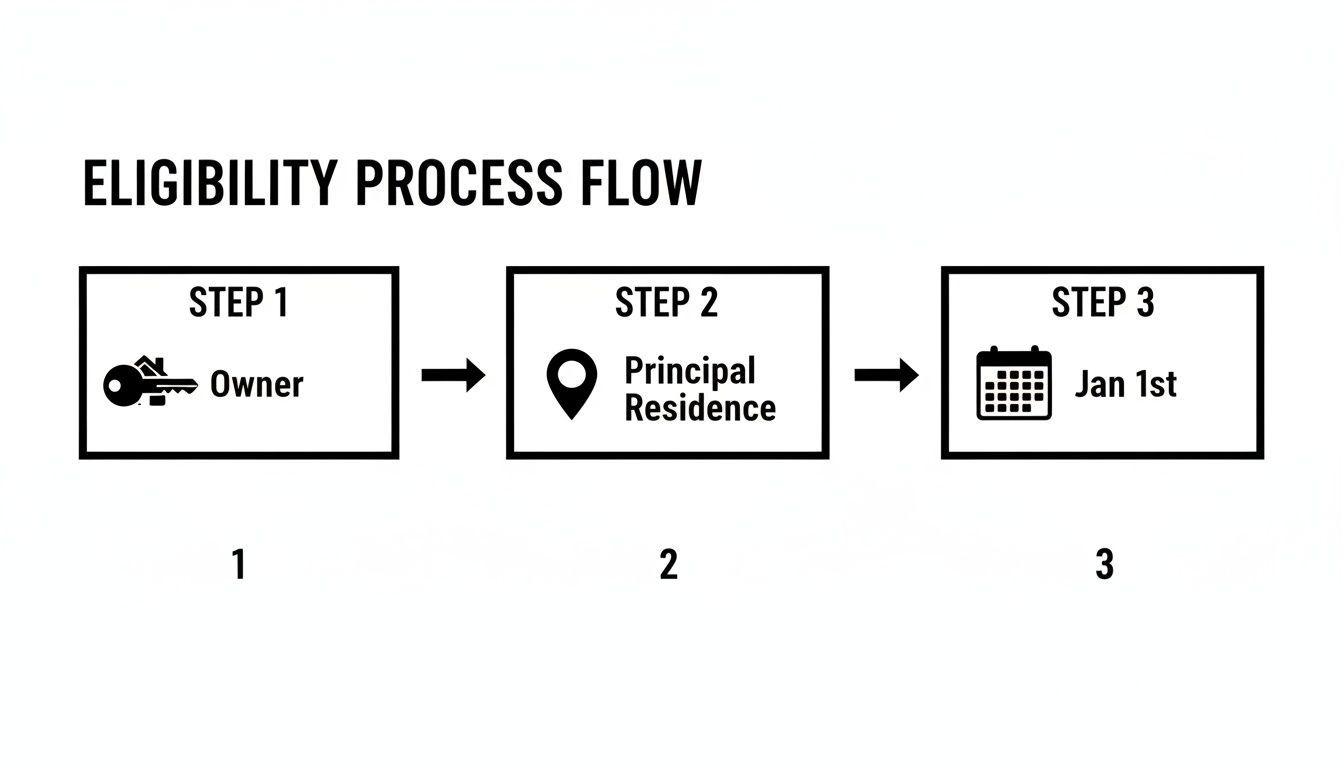
As you can see, the core requirements are simple: you must own the home, live in it as your principal residence, and have moved in by January 1st of the tax year.
Gathering Your Required Documentation
To verify your claim and prevent fraud, the appraisal district requires a copy of your valid Texas driver’s license or a state-issued personal ID card. This is non-negotiable.
Crucial Detail: The address on your driver’s license or state ID must match the address of the homestead you are claiming. If it doesn’t, your application will almost certainly be denied.
If your ID has an old address, you need to get it updated with the Texas Department of Public Safety before you file your application. This single detail is the most common reason we see applications get delayed or rejected, so we encourage you to double-check it with care.
Filing by the Deadline
Timing is everything. The filing window for a homestead exemption opens on January 1 and closes on April 30 of the tax year.
Getting your application in during this period ensures the exemption applies to that year's property taxes. For instance, to get the exemption for the 2024 tax year, your completed application must be in the hands of your county appraisal district by April 30, 2024. Don't wait until the last day—filing early gives you a buffer to fix any unexpected issues.
After You Apply: What to Expect
Once submitted, your application goes into a queue for review by the appraisal district. This can take several weeks, especially as the April 30 deadline approaches. Most counties, like the Fort Bend County Appraisal District, will mail a confirmation letter or send an email once your exemption is approved.
You can also check the status yourself. Just head back to your appraisal district’s website and use their property search tool. When you pull up your property's details, you should see the approved exemptions listed. Seeing that "HS" (Homestead) code active on your account is a great feeling—it means your financial protections are officially in place.
We know that navigating these steps can feel like a lot, especially if you're also managing complex family matters like Guardianship or Estate Planning. If you need guidance, our team is here to help. Schedule a free consultation to ensure all your family’s assets, including the homestead, are properly protected.
Additional Exemptions for Seniors and Disabled Texans
Beyond the general homestead exemption in Texas, the law provides even deeper property tax relief for some of our most cherished community members—seniors and individuals with disabilities. These additional benefits are a compassionate recognition of the financial pressures that can come with fixed incomes and medical needs. They are designed to give your family stability and peace of mind when it’s needed most.
For homeowners who are 65 or older or who meet specific disability qualifications, an extra $10,000 exemption can be claimed for school district property taxes. This is a huge benefit because it stacks right on top of the standard $100,000 general residence exemption. This means a qualifying senior or disabled homeowner automatically shaves at least $110,000 off their home's taxable value for school taxes.
The Powerful School Tax Ceiling
This is where the real protection kicks in. Perhaps the most significant benefit offered to seniors and disabled homeowners is the tax ceiling, often called a "tax freeze." This isn't just a one-time discount; it’s a permanent shield against rising property taxes.
Once you qualify for the over-65 or disability exemption, the amount you pay in school district property taxes gets locked in. Even if your home's appraised value shoots up or the school tax rate increases, your portion of the school tax bill will not exceed the amount from your first year of qualification. This freeze provides incredible predictability and security, protecting you from being priced out of your own home.
Let's look at a compassionate, real-world example.
Scenario: An adult child in Austin helps his elderly mother apply for the over-65 exemption. In her first year of eligibility, her school property taxes are calculated to be $2,500. The very next year, property values in her neighborhood soar, and the school district raises its tax rate. While her neighbors see their school tax bills jump, her bill remains capped at $2,500. This freeze offers invaluable financial stability on a fixed income.
Enhanced Exemptions for Disabled Veterans
Texas also extends profound gratitude and support to disabled veterans through a separate, substantial homestead exemption. This benefit is tiered based on the veteran's service-connected disability rating from the U.S. Department of Veterans Affairs (VA). The higher the disability rating, the greater the property tax relief.
Crucially, this exemption applies to the total appraised value of the veteran's homestead, providing relief from all local property taxes—including county, city, and special district taxes. This goes far beyond the school-tax-only benefits of the general and over-65 exemptions. Planning for a loved one's future is essential, and understanding these benefits is key. For those looking after individuals with disabilities, exploring options like a Special Needs Trust in Texas can provide additional layers of financial protection.
Here is a breakdown of the exemption amounts available to disabled veterans in Texas.
Disabled Veteran Homestead Exemption Tiers
| VA Disability Rating | Exemption Amount from Taxable Value |
|---|---|
| 10% to 29% | $5,000 |
| 30% to 49% | $7,500 |
| 50% to 69% | $10,000 |
| 70% to 99% | $12,000 |
| 100% or Unemployable | 100% Exemption (Total property tax exemption) |
As you can see, a veteran with a 100% disability rating or who is deemed individually unemployable by the VA is entitled to a 100% property tax exemption on their homestead. This means they pay zero property taxes on their primary residence—a financial lifeline for these heroes and their families. Surviving spouses of veterans who qualified for this 100% exemption may also be eligible to continue receiving it.
Navigating these additional exemptions can feel overwhelming, but securing them is a critical step in protecting the financial well-being of your loved ones. If you are helping an elderly parent, a person with a disability, or a veteran, our team is here to provide clarity. Schedule a free consultation to discuss your family’s specific needs and ensure you are leveraging every protection available under Texas law.
How Homestead Exemptions Impact Guardianship and Estates

The homestead exemption in Texas is much more than a way to lower your property tax bill. It’s a powerful legal shield, and its true importance often comes into focus when a family is navigating the emotional and financial challenges of a guardianship or settling a loved one’s estate.
In these sensitive situations, the family home is usually the most significant asset—not just financially, but emotionally. Understanding how the exemption protects this cornerstone of your family’s life is essential to managing your responsibilities and preserving that legacy with care.
When a court, such as a Harris County Probate Court, appoints a guardian for someone who can no longer care for themselves (the “ward”), that guardian takes on a profound legal and ethical duty to manage the ward’s property. This isn’t just about paying bills on time; it’s about being proactive to protect the ward’s assets from being needlessly drained. The homestead exemption is one of the most effective tools for that job.
A Guardian’s Duty to Protect the Homestead
Under the Texas Estates Code, Title 3, Subtitle G, a guardian of an estate must use the same diligence and care that any prudent person would in managing their own financial affairs. A huge part of that duty is making sure the ward gets every single tax benefit they are entitled to.
This means if the ward owns a home but never filed for their homestead exemption, the guardian has a clear obligation to file it for them immediately. This is a practical, immediate step a guardian can take to fulfill their duties.
Consider an adult son in Fort Bend County who is appointed guardian for his mother, who is living with dementia. He quickly realizes she never applied for her over-65 exemption or the property tax ceiling that comes with it. By filing that paperwork, he can instantly lower her property tax bill and, critically, freeze her school taxes from increasing any further. This single action can save the estate thousands of dollars every year—money that can then be used for her direct care. This is a key part of the guardianship establishment process.
This responsibility covers every available exemption, including those for disability or veteran status. A guardian who fails to secure these benefits could be seen as breaching their fiduciary duty, making this one of the first and most critical tasks in any guardianship.
Homestead Protections in Probate and Estate Administration
The protective power of the homestead exemption doesn’t disappear when a person passes away. In fact, it becomes one of the central pillars of the probate process in Texas, offering incredibly strong protection against creditors, which can be a source of great relief for grieving families.
When an estate is opened, creditors can file claims to be paid from the deceased person’s assets. However, the Texas Constitution shields the homestead from being forcibly sold to satisfy most debts. With very few exceptions (like the mortgage on the home itself or property taxes), unsecured creditors—think credit card companies or medical providers—cannot force the sale of the family home to pay off their bills. This is a critical protection during potential guardianship disputes or estate challenges.
This protection is one of the strongest in the entire country. It’s specifically designed to prevent a surviving spouse or minor children from losing their home after a family tragedy, ensuring the homestead can pass to the heirs free and clear from the claims of most creditors.
This powerful shield is backed up by other property tax rules. For instance, Texas homesteads have a 10% annual cap on how much their assessed value can increase for tax purposes. In a guardianship or estate context, this cap prevents sudden, shocking tax hikes, which is vital for keeping the estate’s finances stable.
Integrating Exemptions with Comprehensive Estate Planning
The homestead exemption isn’t just a standalone benefit; it’s a key piece of a well-designed estate plan. When we work with families, our goal is to weave these protections together with other legal tools that preserve assets and provide for the people you love.
For example, a solid plan can ensure the homestead passes smoothly to the right heirs while keeping its protected status intact. Tools like a Lady Bird Deed can be incredibly useful for transferring a home outside of the probate process while still preserving its homestead protections, offering an alternative to traditional guardianship or probate transfers. We dive deeper into how this works in our guide to the Lady Bird Deed in Texas.
Whether you are a court-appointed guardian, the executor of an estate, or a family member planning ahead, the homestead exemption is a critical piece of the puzzle. It offers financial relief, powerful creditor protection, and priceless peace of mind during some of life’s most difficult chapters.
Still Have Questions? Let’s Clear Things Up
When you start digging into the Texas homestead exemption, it’s natural for questions to pop up. Every family’s situation is a little different, and applying these rules to your specific circumstances can feel tricky. To empower you with understanding and direction, we’ve put together answers in plain English to some of the most common questions we hear from Texas homeowners.
Can I Claim a Homestead Exemption on More Than One Property?
No, and Texas law is very strict about this. You can only claim a homestead exemption on your principal residence. Think of it as your home base—the one place you own and live in as your main home.
To make sure this rule is followed, the state requires the address on your Texas driver’s license or state ID card to match the property address you’re claiming. Trying to claim an exemption on a vacation home, a rental property, or any other house you own will not be approved.
What Happens If I Miss the April 30 Filing Deadline?
While it’s always best to file on time, please don’t panic if the April 30 deadline slips by. Texas law gives homeowners a generous safety net. You can file a late application for up to two years after the date your property taxes for that year would have become delinquent.
For example, let’s say you forgot to file for your 2023 homestead exemption. Those taxes typically become delinquent on February 1, 2024. This means you have until February 1, 2026, to submit a late application and still get the tax savings you were entitled to for that 2023 tax year. The appraisal district will simply issue a refund or a credit for what you overpaid.
This two-year lookback period is a lifesaver, ensuring a simple oversight doesn’t cost your family thousands in tax relief. It reflects the state’s commitment to making homeownership more affordable.
This is especially helpful in a Guardianship situation. Imagine a newly appointed guardian discovering that their loved one never applied. This window allows the guardian to go back, correct the oversight, and reclaim significant funds for the ward’s estate, which is a practical step they can take after a guardianship hearing.
Do I Need to Reapply for My Homestead Exemption Every Year?
Good news—in most cases, you don’t. Once your general residence homestead exemption is approved, it automatically renews every year. As long as you continue to own the home and live in it as your main residence, you’re all set.
You do have a responsibility to notify the appraisal district if things change. If you sell the home or it’s no longer your principal residence, you need to let them know. This is an important part of guardianship compliance.
The other time you’ll need to file again is if you qualify for an additional exemption. For instance, if you turn 65 or become eligible for a disability exemption, you’ll need to submit a new application to claim those extra tax breaks and lock in that valuable school tax ceiling.
Does the Homestead Exemption Affect My Ability to Sell My Home?
Not in the slightest. The homestead exemption is purely a tax benefit for you as the owner-occupant. It has absolutely no negative impact on your ability to sell your property and doesn’t create a lien or any other roadblock that would complicate a sale.
When you sell your home, the property tax benefits you received for that year are usually prorated between you and the buyer at closing. The new owner will then need to apply for their own homestead exemption for the next tax year, assuming they meet all the requirements.
Can I Lose My Homestead Exemption?
Yes, it is possible to lose your exemption, but only if you no longer meet the basic requirements. The most common reasons an exemption gets removed are pretty straightforward:
- Selling the Property: You must own the home to qualify.
- Changing Your Principal Residence: If you move and the property is no longer your main home, you’ll lose the exemption on that property.
- Death of the Owner: The exemption doesn’t automatically pass to heirs unless they also own the property and make it their primary home. This may lead to guardianship termination.
It’s also crucial to be truthful on your application. If an appraisal district finds out an exemption was granted based on false information, they can remove it and may seek back taxes, penalties, and interest. This is one more reason why it’s so important to make sure all your information, especially your ID address, is accurate from the start.
The homestead exemption is a cornerstone of property ownership in Texas, designed to provide stability and serious financial relief. Understanding these details helps ensure you can take full advantage of the protections it offers, especially when navigating complex life events like Estate Planning or the Probate process.
At The Law Office of Bryan Fagan, PLLC, we understand that legal questions often arise during life’s most challenging moments. If you need personalized guidance on how the homestead exemption intersects with guardianship, estate planning, or probate, our compassionate team is here to help. We are dedicated to guiding Texas families with clarity and care. Schedule a free, no-obligation consultation with us today to get the support and direction your family deserves.