Skip to content
A parent falls twice in one month. One sister says he can still live at home with help. A brother says he needs a facility now. Another relative starts asking about bank accounts, medication lists, and whether someone should file for guardianship in probate court.
That's how many guardianship disputes begin in Texas. Not with bad intentions, but with fear, urgency, and very different ideas about what protection should look like.
When families search for answers about What to Do When Family Members Disagree About Guardianship, they usually need two things at once. They need a legal roadmap, and they need a way to stop the conflict from getting worse. Both matter. If you move too slowly, your loved one may stay unprotected. If you move too aggressively, the family conflict can harden into a court fight that becomes harder to resolve.
The Emotional Crossroads of Guardianship Disagreements
A guardianship dispute often starts in a living room, hospital room, or rehab facility. Someone notices unpaid bills. Someone else worries about wandering, missed medication, or unsafe driving. Then the conversation shifts from concern to control. Who gets to decide? Who should step in? Is guardianship even necessary?
One common Texas scenario looks like this. An aging mother in Harris County has memory loss and needs help with daily tasks. One adult child wants in-home care because it feels more personal and less disruptive. Another believes a nursing facility is safer. A third says the underlying issue is money, not care, and accuses siblings of trying to control the estate. Everyone says they're acting out of love. They may all mean it.

Why this conflict is so common
These cases are not rare. State courts handle approximately 290,000 guardianship cases annually, and disputes often escalate when multiple family members file competing petitions because each believes they're best suited to serve, which can prolong the process and increase costs, as noted in this discussion of annual guardianship caseloads and competing petitions.
That number matters because it tells families something important. You are not the only family facing this. Probate judges in places like Harris County Probate Court and courts across Texas see these conflicts regularly. There is a process for sorting them out.
Guardianship fights usually aren't about one argument. They're about years of family history colliding with one urgent decision.
What makes these cases harder than ordinary disagreements
Guardianship disputes hit several pressure points at once:
- Health decisions become immediate: Families may disagree about doctors, medications, rehab, or long-term placement.
- Money enters the picture quickly: If someone can't manage finances, questions about accounts, bills, and property move to the front.
- Autonomy is at stake: Guardianship can remove important rights, so courts treat it seriously.
- Old family roles reappear: The sibling who always handled everything may assume control. The sibling who lives out of town may feel shut out.
The emotional strain is real, but the path forward doesn't have to be chaotic. Texas law gives families a framework. The key is to stop treating the disagreement as a personality contest and start treating it as a decision about evidence, legal priority, and the proposed ward's actual needs.
Your First Moves De-escalate and Document Everything
Before anyone races to the courthouse, slow the conflict down. Early mistakes can damage both the family relationship and the legal case. The first job is to reduce heat. The second is to build a clean factual record.
Start with a controlled family meeting
If communication is still possible, hold one focused conversation. Keep it short. Pick one person to moderate. Don't turn it into a trial about old grievances.
National data shows that 81.3% of guardians are family members, which helps explain why sibling tensions, stepfamily friction, and competing care philosophies often drive these disputes, as discussed in this overview of family-led guardianship disagreements.
That reality means you need structure. Without it, the meeting becomes a replay of family history.
A few ground rules work better than broad demands for everyone to “be reasonable”:
- Speak from observation, not accusation. “Dad forgot to turn off the stove” is useful. “You never cared about Dad” is not.
- Name the shared goal first. The question is what protects your loved one with the least loss of dignity.
- Keep money and care issues separate when possible. Blending them too early usually creates suspicion.
- Write down action items before the call ends. Decide who gathers records, schedules appointments, and updates others.
For families trying to keep conflict from becoming personal, this short piece on redefining the bigger person can be helpful. In guardianship disputes, being the bigger person doesn't mean giving in. It means staying focused on the vulnerable person instead of escalating every slight.
Build a timeline, not a narrative
Documentation should be factual and boring. That's a good thing. Judges, attorneys ad litem, and physicians need specifics.
Use a notebook, shared document, or folder with dated entries. Record facts such as:
- Safety problems: falls, wandering, leaving appliances on, missed medication
- Financial issues: unpaid bills, unusual withdrawals, confusion about routine expenses
- Daily functioning: hygiene problems, missed meals, inability to keep appointments
- Communication changes: repeated confusion, paranoia, inability to track conversations
- Caregiver observations: what nurses, aides, or doctors said, without embellishment
Practical rule: Write what happened, when it happened, who saw it, and what was done next.
Avoid editorial comments. “Mom stated she believed her deceased sister visited that morning” is stronger than “Mom is completely losing touch with reality.”
If a sibling is obstructing access to information, appointments, or the proposed ward, review this resource on what to do if a sibling is blocking a guardianship case in Texas. Blocking behavior can affect both strategy and timing.
What usually does not work
Some responses make a hard situation worse:
| Approach | What happens |
|---|---|
| Group text arguments | People perform for the thread instead of solving the problem |
| Surprise legal threats | Relatives become defensive and stop sharing information |
| Secret doctor visits without context | Other family members challenge credibility later |
| Mixing estate fights with care decisions | The dispute spreads into every issue at once |
The best first moves are calm, documented, and deliberate. That gives you options later, whether the family chooses mediation, an alternative to guardianship, or court.
How Texas Courts Decide Who Becomes Guardian
When agreement breaks down, a Texas probate court decides. Families often assume the judge will choose the person who seems most involved, most financially secure, or most forceful. That isn't how it works.
Texas courts look at the best interest of the proposed ward, but they also apply statutory rules that many families miss. In contested cases, that oversight can be costly.
The overlooked rule in Texas Estates Code Section 1104
Texas law does not start from a blank slate. Texas Estates Code § 1104 establishes a clear priority list for guardian appointments, beginning with a person designated by the ward, then the ward's spouse, and then other relatives. Roughly 65% of contested guardianships in Texas follow this priority list unless there is clear and convincing evidence of unfitness, as explained in this discussion of Texas guardianship priority under Section 1104.
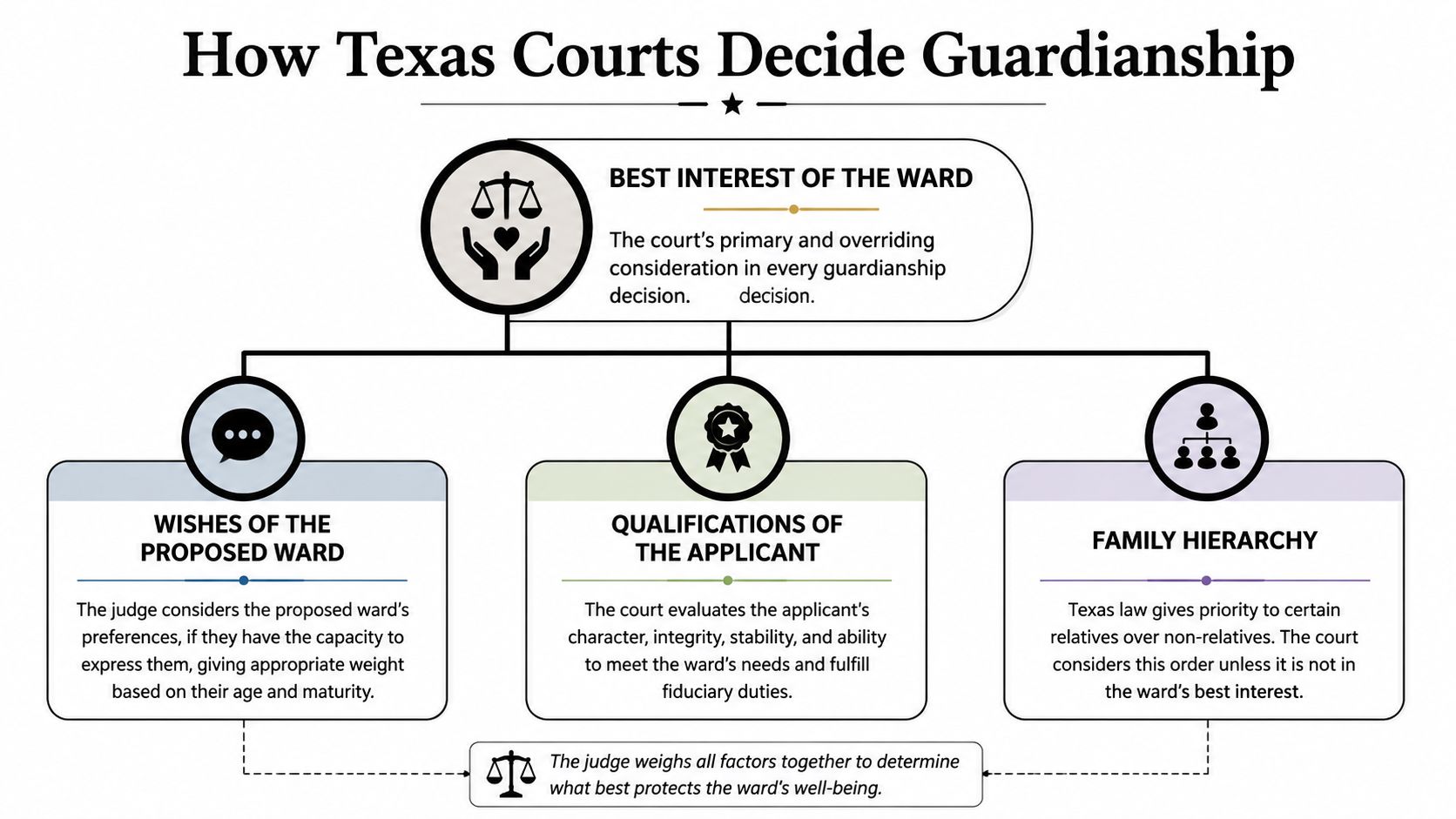
This is the unique strategic point many families don't know. The court may not choose the sibling everyone expected if another relative has a stronger legal priority under the Estates Code and no proven disqualification.
A simple way to think about court decision-making
A judge in a county probate court, including courts in Harris County, is often weighing three separate questions at once:
- Is guardianship necessary at all
- If so, what type of guardianship is needed
- Who is legally and practically suited to serve
Those questions overlap, but they are not the same. A person can prove that a loved one needs help and still lose the appointment fight. Another person can have higher statutory priority and still be passed over if the evidence shows unfitness.
Here is the practical hierarchy Texas families should keep in mind:
| Court concern | What the judge is looking for |
|---|---|
| Necessity | Whether a less restrictive option can protect the person |
| Capacity | Whether the proposed ward lacks ability in areas that require protection |
| Priority | Whether one applicant has statutory preference under Section 1104 |
| Suitability | Whether the applicant can carry out fiduciary duties responsibly |
What can override family preference
Family consensus matters, but it doesn't control the outcome. The court may reject a popular family choice if the evidence raises concern about that person's ability to serve.
Common suitability issues include:
- Financial red flags
- Poor judgment in medical or housing decisions
- A history of conflict that interferes with caregiving
- Failure to follow court orders or fiduciary duties
- Credible allegations of exploitation or self-dealing
A person with lower family support but stronger legal priority and cleaner evidence may still prevail.
If you're preparing for a contested hearing, the legal standard matters as much as the family story. This explanation of the burden of proof in Texas guardianship cases is worth reviewing before anyone assumes the “better sibling” automatically wins.
The strongest guardianship case is usually not the loudest one. It is the one that fits the statute and is supported by reliable evidence.
That's why early legal analysis matters. Families often spend weeks arguing about fairness when the court will be applying a priority structure that was already set by law.
Proving Incapacity and Suitability to Serve
A contested guardianship turns on evidence. Feelings matter to the family. Proof matters to the court.
Under Texas Estates Code Title 3, Subtitle G, the court needs competent evidence about the proposed ward's condition and the applicant's ability to serve. If the evidence is thin, inconsistent, or rushed, the case weakens fast.
What the medical proof needs to do
In practical terms, the medical evidence should answer a narrow question. Can this person manage personal, medical, or financial affairs without court intervention, and if not, in what areas?
That means families should gather records with discipline. Don't send the doctor into an evaluation with a vague statement like “we think Mom has dementia.” Provide a timeline of functional problems, medication issues, hospitalizations, unsafe events, and any prior planning documents such as powers of attorney.
Good evidence usually has these traits:
- Current observations: stale records rarely answer present capacity questions
- Functional detail: not just diagnosis, but how the condition affects decisions
- Consistency: the doctor's findings should line up with real-world events
- Clarity about scope: whether help is needed with the person, the estate, or both
Telehealth evaluations can help, but they can also be attacked
Texas now allows telehealth capacity evaluations under Texas Estates Code § 1101.103. That can be useful when one child lives in Dallas, another lives out of state, and the parent is in Houston or San Antonio. But convenience does not guarantee acceptance.
Since 2025, Texas has allowed these telehealth evaluations. Harris County Probate Courts rejected 22% of such evaluations in early 2026 due to concerns including video quality and “insufficient rapport.”
That tells families something important. Remote evaluations may open the door, but they also create new attack points.
If telehealth is part of the plan, focus on credibility:
- Use a stable, private setting: background noise and poor connection make the evaluation look weak
- Make sure the physician has enough interaction time: a short, choppy visit invites criticism
- Organize records in advance: the doctor should review context, not guess from snippets
- Expect scrutiny if another family member contests the exam: the other side may ask for an in-person reevaluation
Suitability is proven through conduct
The court isn't only evaluating the proposed ward. It is also evaluating you.
Bring records that show reliability. That may include caregiving logs, bill payment history, communication with providers, or evidence that you've acted in the person's interest rather than your own. If there has been conflict, address it directly. Judges are less concerned with who is hurt and more concerned with who can function as a fiduciary.
If your evidence depends on “everyone knows I'm the responsible one,” you are not ready for a hearing.
In many cases, the best move is to strengthen the medical record before filing or before responding to a competing application. A rushed petition built on weak proof often creates a longer fight, not a faster resolution.
Initiating or Contesting Guardianship in Court
Once voluntary agreement has failed, the dispute moves into a formal process. Texas probate procedure can feel intimidating, but it's more manageable when you break it into stages.
Families usually enter court in one of two ways. They either initiate a guardianship by filing an application, or they contest a petition someone else already filed.

If you are starting the case
A typical Texas guardianship case begins with an application in the proper court. The filing must identify the proposed ward, explain why guardianship is needed, and specify whether the request concerns the person, the estate, or both.
The court then requires notice, and the proposed ward is entitled to procedural protections. In many cases, the court appoints an attorney ad litem to represent the proposed ward's interests. That role matters. The ad litem is not there to make the family happy. The ad litem investigates and helps the court assess whether guardianship is necessary and whether the requested scope is appropriate.
You should also expect the court to examine whether less restrictive alternatives are available. Under Texas law, guardianship is not supposed to be the first answer when a workable alternative can protect the person.
If you are contesting the case
Contesting a guardianship does not always mean arguing that your loved one has full capacity. Sometimes the contest is narrower. You may agree that help is needed but object to the person seeking appointment. Or you may argue the requested powers are too broad.
A contest often focuses on one or more of these issues:
- No guardianship is necessary
- A less restrictive option is available
- The proposed guardian is not suitable
- The scope should be limited
- The medical evidence is weak or outdated
Effective documentation and thorough preparation are essential in these situations. Contests are won on focused objections, not broad emotional complaints.
Temporary or emergency guardianship
Some situations cannot wait for a standard timeline. If a vulnerable adult faces immediate danger, a party may ask for temporary or emergency guardianship. In plain terms, this request tells the court that delay itself creates serious risk.
Examples can include urgent medical neglect, immediate financial exposure, or unsafe living conditions that require quick intervention. Courts still require proof. Emergency requests are not a shortcut around weak evidence or family impatience.
Temporary guardianship is for urgent protection, not tactical advantage in a sibling dispute.
What happens after appointment
Families sometimes think the fight ends once the judge signs the order. It doesn't. A guardian takes on ongoing duties under court supervision. Those duties may include reporting, accountings, fiduciary compliance, and following limits in the court's order.
Guardianship can also change over time. If the ward's condition improves, if a guardian fails to comply, or if circumstances shift, a party may seek modification or termination. That's why it helps to think beyond the hearing itself. A successful case is not just about obtaining appointment. It is about handling the role lawfully afterward.
If your family also needs related guidance, it can help to review broader information on Texas guardianship matters, Texas probate issues, and estate planning concerns because these topics often overlap in real cases.
Finding Resolution Through Mediation and Alternatives
Court is sometimes necessary. It is not always the smartest first destination.
In many disputed guardianship matters, mediation gives families a better chance to protect the proposed ward without deepening the damage between relatives. It also creates space to discuss alternatives that a court will want addressed anyway.

Why mediation works better than many families expect
Mediation is a structured negotiation led by a neutral third party. It is not therapy, and it is not a courtroom rehearsal. Done well, it helps the family identify actual sticking points, test options, and draft an agreement the court can accept.
Mediation offers a 70-85% resolution rate in family guardianship disputes and often takes only 1-3 sessions, making it more efficient than adversarial litigation, according to this overview of guardianship mediation outcomes and process.
That efficiency matters because delay hurts everyone. The proposed ward stays in uncertainty. Bills still need to be paid. Medical decisions still need to be made. The family keeps spending energy on the fight instead of the care plan.
A productive mediation often addresses issues the courtroom handles poorly, such as:
- Who manages day-to-day care communication
- Whether one person handles medical decisions and another helps with finances
- How often family updates are shared
- Which less restrictive tools should be tried before a full guardianship order
Alternatives that may solve the problem without full guardianship
Texas courts must consider whether a less restrictive alternative can protect the person. That requirement changes strategy. Families who ignore alternatives often make their own case harder.
Useful alternatives can include:
| Option | When it may help |
|---|---|
| Durable power of attorney | When the person still has enough capacity to sign planning documents |
| Medical power of attorney | When health decision-making needs a named agent |
| Supported decision-making | When the person can participate with help rather than lose rights entirely |
| Trust or other financial management tools | When asset handling is the main concern |
One alternative many families overlook is supported decision-making in Texas. In the right case, it can preserve dignity and autonomy while still creating needed structure.
The Law Office of Bryan Fagan, PLLC can assist with evaluating whether a disputed matter calls for a guardianship application, a contest, mediation, or a less restrictive approach under the Texas Estates Code.
What a strong mediation preparation looks like
Families get more out of mediation when they arrive with substance, not speeches.
Bring:
- A short timeline of the care issues
- Medical records or evaluation summaries
- A draft proposal for decision-making roles
- A list of documents already in place
- A realistic view of the statutory priority issue if appointment is disputed
For a quick overview of how these decisions can affect families, this video may help frame the discussion before mediation or a hearing:
Some families do not need a winner. They need a workable structure with clear roles, reliable communication, and court approval where required.
Mediation does not fit every case. If there is active exploitation, severe obstruction, or immediate danger, court intervention may be necessary right away. But in many Texas disputes, mediation is what turns a family impasse into a care plan.
If your family is facing a guardianship dispute in Texas, personalized guidance can make the next step clearer. The Law Office of Bryan Fagan, PLLC helps families with guardianship applications, contests, temporary guardianship requests, compliance issues, and alternatives to guardianship across Houston, Dallas, Austin, San Antonio, and statewide through virtual consultations. Schedule a free consultation to discuss your loved one's situation and the strongest path forward under Texas law.