Skip to content
Planning for the future can feel overwhelming, but a Lady Bird Deed in Texas, also known as an enhanced life estate deed, is a simple yet powerful tool to protect your family's home. It allows you to pass your property directly to your loved ones when you die, completely avoiding the stress and high costs of the probate process. Imagine having a remote control for your home; you keep full control to sell it, mortgage it, or change your mind at any time. This flexibility provides incredible peace of mind for Texas families.
At The Law Office of Bryan Fagan, we understand the emotional and financial challenges families face when planning for the future or dealing with the loss of a loved one. Our mission is to guide you with clarity and care, demystifying complex legal tools like the Lady Bird Deed.
What Is a Texas Lady Bird Deed and How Does It Work?

A Texas Lady Bird Deed is a compassionate and practical way to ensure your home goes directly to the people you choose (your beneficiaries) the moment you pass away, without court interference.
Think of it like setting a destination in your GPS. You name who will inherit the home right in the deed itself, but you remain in the driver's seat. You have the complete authority to change your mind or take a different route. This "enhancement" over a traditional life estate gives you total control. You will never need your beneficiary's permission to sell the property, take out a mortgage, or decide to leave it to someone else.
This level of control is a key reason why the Lady Bird Deed is a preferred tool in Estate Planning for Texas families. It combines the certainty of an inheritance with the flexibility needed to adapt to life's changing circumstances.
Understanding the Automatic Transfer
The main purpose of a Lady Bird Deed is to keep your property out of probate court. Probate is a public, expensive, and often slow legal process. In major Texas counties like Harris County or Dallas County, probate can drag on for months—or even years—adding stress and financial strain to grieving families.
When you have a properly executed Lady Bird Deed, the ownership transfer happens automatically upon your death. Your beneficiary simply needs to file your death certificate with the county clerk. That's it. The title is cleared, and the property is theirs. No court hearings, no lengthy legal battles, and no unnecessary delays.
A Common Misconception About Its Name
Interestingly, the deed's popular name comes from a myth. Many believe President Lyndon B. Johnson used this deed to transfer property to his wife, Claudia "Lady Bird" Johnson. The truth is, the term was created by a Florida attorney in 1982—nearly a decade after LBJ's death. The attorney used the Johnson family names as characters in his legal examples. Historical research confirms the Johnsons never actually used one, but the catchy name stuck.
At The Law Office of Bryan Fagan, we see firsthand the emotional and financial challenges families face. A Lady Bird Deed can be a compassionate solution, creating a clear path for your property while protecting your family from the burdens of Probate. It's a key part of a thoughtful estate plan, especially when considering alternatives to Guardianship. For personalized guidance on how this tool can benefit your family, schedule a free consultation with our experienced attorneys today.
Key Benefits for Texas Families
When you're planning for the future, you want certainty, control, and peace of mind. For Texas families, a Lady Bird Deed delivers on all three. It’s a powerful tool that provides real-world advantages where it matters most: avoiding probate, keeping you in control, and safeguarding eligibility for crucial government benefits.
For most people, the thought of probate court is enough to cause a headache. One of the biggest draws of a lady bird deed in Texas is its ability to sidestep this often drawn-out and expensive legal process. It's one of several smart strategies to avoid probate court that can make things much smoother for your family.
Avoid the Stress and Cost of Probate
The greatest benefit for many is simple: a Lady Bird Deed keeps your home out of probate court. Probate is the formal court process for validating a will and distributing assets, and it can become a heavy burden for a family that is already grieving.
In busy Texas counties like the Harris County Probate Court, the process can easily last six months to over a year. During that time, attorney's fees and court costs can pile up, often reaching thousands of dollars. A Lady Bird Deed cuts through all of that. When you pass away, the property automatically transfers to your named beneficiaries. All they need to do is file a simple affidavit and a death certificate with the county clerk. This straightforward step saves your family from months of waiting and a significant financial drain.
Maintain Complete Control and Flexibility
Another huge advantage is the incredible flexibility a Lady Bird Deed provides. Unlike some estate planning tools that lock you into decisions, this deed keeps you firmly in control of your property for your entire life.
This “enhanced” feature is what makes it so special. It means you keep the right to:
- Sell the Property: You can sell your home at any time without needing permission from your beneficiaries.
- Mortgage or Refinance: Need to tap into your home's equity? You’re free to take out a new mortgage.
- Change Your Mind: If your circumstances change, you can easily change beneficiaries or cancel the deed altogether.
Here’s a practical scenario: Imagine a mother in Austin signs a Lady Bird Deed naming her two children as beneficiaries. A few years later, she faces unexpected medical bills and needs to sell her home. Because she used a Lady Bird Deed, she can sell her home and use the proceeds without consulting her children or facing legal hurdles. Her home remains her asset to use as she sees fit.
Protect Eligibility for Government Benefits
For families worried about the staggering cost of long-term care, a Lady Bird Deed is an essential part of Medicaid planning. When you apply for Medicaid to help cover nursing home expenses, the government looks at your assets to determine eligibility.
A Lady Bird Deed helps in two critical ways. First, signing the deed isn't considered a gift, which means it doesn’t trigger a Medicaid penalty period for transferring assets. Second, and most importantly, it shields the home from the Medicaid Estate Recovery Program (MERP). MERP allows the state to seek reimbursement from the estate of a person who received Medicaid benefits. Because a property passed through a Lady Bird Deed is a non-probate assets—meaning it's not part of the legal estate—it is generally protected from being claimed by MERP. This ensures your home can be passed down to your loved ones as intended.
Comparing Your Estate Planning Options
Choosing the right estate planning tool can feel like navigating a maze of confusing legal terms. To provide clarity, it helps to see a straightforward comparison of a Lady Bird Deed against other common options in Texas.
Understanding what each tool does—and doesn’t do—is the first step toward making a compassionate decision for your family’s future. Families from San Antonio to Houston are often trying to balance three main goals: avoiding probate, keeping control over their property, and planning for potential long-term care needs. Let’s break down how a Lady Bird Deed stacks up.
This flowchart helps visualize the core advantages, showing how the deed offers a clear path to avoiding probate while letting you keep total control.
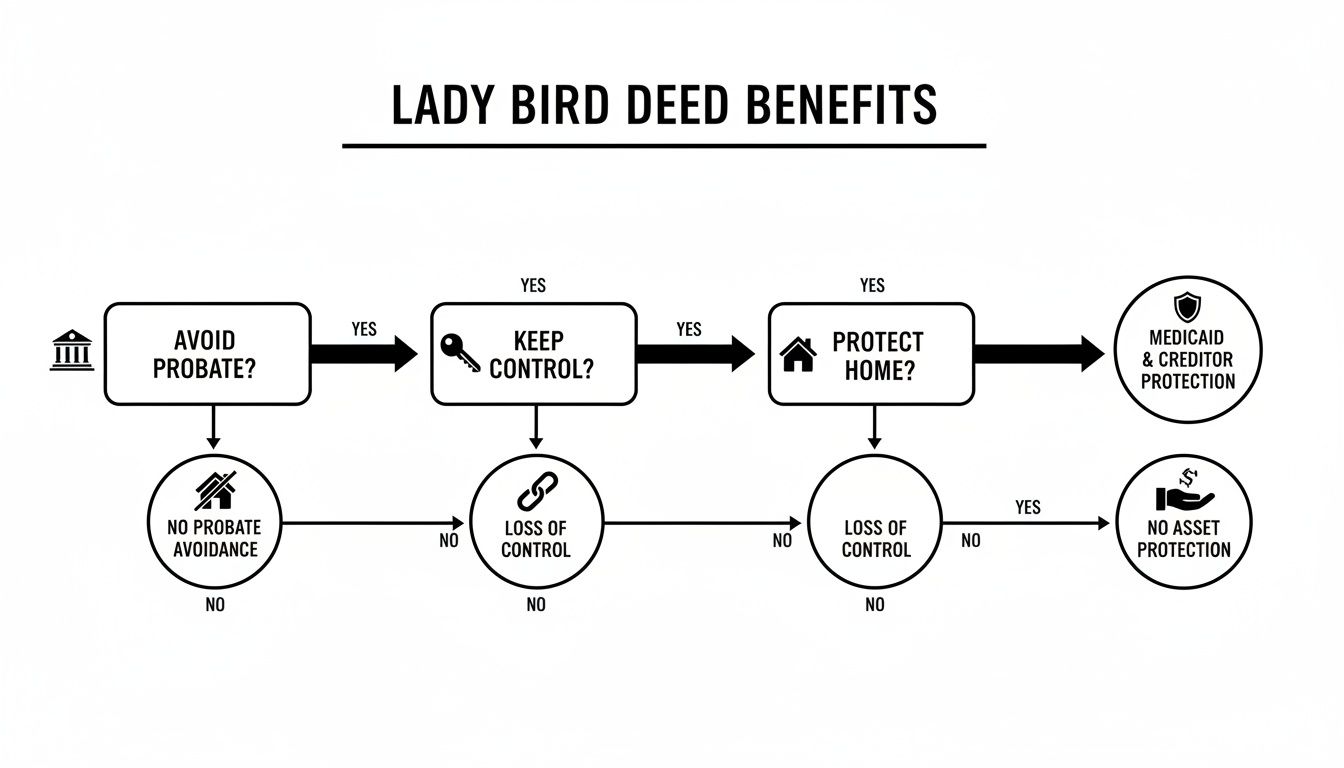
As you can see, the deed is designed to give you a direct route to securing your home for your heirs without tying your own hands.
Lady Bird Deed vs. Transfer on Death Deed (TODD)
A Transfer on Death Deed (TODD) is another popular way to bypass probate in Texas. It’s governed by the Texas Estates Code and lets you name a beneficiary to receive your property when you pass away. However, key differences often make a Lady Bird Deed the more flexible and protective choice.
- Total Flexibility: With a Lady Bird Deed, you can sell or mortgage your property without your beneficiary's permission. A TODD can create issues here, as some title companies are hesitant to insure a property for up to two years after the owner’s death due to potential creditor claims.
- Warranty of Title: You can include warranties of title in a Lady Bird Deed, giving your beneficiaries extra protection. This is not an option with a TODD.
- Power of Attorney: If you become incapacitated, an agent under a durable power of attorney can sign a Lady Bird Deed for you. This is a significant benefit that is generally not allowed for a TODD.
Lady Bird Deed vs. Traditional Life Estate
A traditional life estate also lets you live on your property for life before it passes to your beneficiary (the "remainderman"). But here’s the major drawback: you give up control.
Once you create a traditional life estate, you can't sell the property, take out a mortgage, or change the beneficiary without their signed consent. This rigidity can become a huge problem if your financial needs or relationships change.
A Lady Bird Deed fixes this problem by being "enhanced." That enhancement is the crucial power you retain to do whatever you want with your property, giving you a level of freedom a traditional life estate just can't match.
Lady Bird Deed vs. Revocable Living Trust
A revocable living trust is a powerful estate planning tool that can hold many assets, not just your home. It’s excellent for avoiding probate, but it’s also much more complex and expensive to set up and manage than a Lady Bird Deed.
For families whose main goal is to transfer their home to their loved ones efficiently and affordably, a Lady Bird Deed is a far more direct and cost-effective solution.
To give you a clearer snapshot, here’s how these common estate planning tools compare.
Texas Estate Planning Tools At a Glance
| Feature | Lady Bird Deed | Transfer on Death Deed (TODD) | Living Trust |
|---|---|---|---|
| Probate Avoidance | Yes | Yes | Yes |
| Retain Control (Sell/Mortgage) | Yes, full control | Yes, but potential title issues | Yes, as trustee |
| Medicaid Protection (MERP) | Yes, protects the home | No, subject to MERP claim | Yes, if structured properly |
| Cost to Create | Low | Low | High |
| Complexity | Low | Low | High |
| Use with Power of Attorney | Yes | No | Yes |
| Gift Tax Consequences | No | No | No |
This table simplifies the major differences, but your personal circumstances will determine which tool is the best fit. It's also critical to consider how you own your property. For married couples, understanding Texas community property laws is essential for a smooth transfer of assets.
Navigating Medicaid and Tax Implications

When planning for the future, two major financial worries often arise for Texas families: the high cost of long-term care and the taxes that can diminish an inheritance. A Lady Bird Deed in Texas addresses both, serving as a powerful tool for Medicaid planning and tax savings. It's a sensible way to protect your home while ensuring your loved ones aren't left with unexpected financial burdens.
Understanding how this specific deed interacts with government programs and tax laws is not just about passing on a house; it's about protecting your family's financial future.
Protecting Your Home from Medicaid
The idea of paying for a nursing home can be overwhelming. While Medicaid can be a lifeline, qualifying means having assets below a very low threshold. This is where a Lady Bird Deed shows its true value.
When you sign a Lady Bird Deed, the future transfer of your home isn't considered a "gift." This is a critical distinction, as giving away assets can trigger a Medicaid penalty period, delaying your eligibility. Because you keep full control over the property, it’s still your asset and generally isn't counted against Medicaid's strict asset limits.
The most significant benefit is how a Lady Bird Deed helps shield your home from the Medicaid Estate Recovery Program (MERP). MERP is the state's way of getting reimbursed for benefits by making a claim against the deceased person's probate estate. Since property passed with a Lady Bird Deed avoids probate, it's not part of your legal estate. This means MERP typically can't touch it, and your home stays safely with your family.
This is a key reason Lady Bird Deeds are so valuable in Texas. They often help families qualify for long-term care by excluding the home from asset limits. With Medicaid's strict asset thresholds—like $2,000 for an individual in 2025—the fact that your home isn't counted against that cap is a game-changer.
Securing Major Tax Advantages
Beyond Medicaid, a Lady Bird Deed offers significant tax advantages that can save your family a lot of money.
- No Gift Tax: Creating the deed doesn't trigger gift taxes. Because the transfer isn't complete until you pass away, you don’t need to file a federal gift tax return.
- Stepped-Up Basis: This is a huge tax benefit. When your beneficiaries inherit the property, its value for tax purposes is "stepped up" to its market value on the date of your death.
- Homestead Exemption: You don't lose your property tax breaks. As long as you live in the home, you continue to receive all your benefits, including the valuable Texas homestead exemption.
What Is a Stepped-Up Basis and Why Does It Matter?
Let's break down "stepped-up basis" with a simple example. Say you bought your home in a Dallas suburb for $50,000 decades ago. Today, it’s worth $400,000.
If you gave the house to your children while you were alive, they would inherit your original $50,000 cost basis. If they sold it for $400,000, they would face a taxable capital gain of $350,000.
But with a Lady Bird Deed, your children inherit the home with a new, "stepped-up" basis of $400,000. If they sell it for that price, their taxable gain is zero. This simple move could save them tens of thousands of dollars in taxes.
Planning for long-term care is legally and emotionally complex. For a deeper look, read our guide on protecting assets from nursing home costs.
How to Create and Record a Lady Bird Deed

While a Lady Bird Deed in Texas is a direct and powerful tool, creating one requires precise legal knowledge. Trying to draft one yourself can lead to costly mistakes that invalidate the document—creating the very probate issue you were trying to avoid. Following a structured process is key to protecting your family's inheritance.
Step 1: Consult an Experienced Attorney
Your first and most critical step is to consult with an experienced Texas estate planning attorney. An attorney can review your unique financial and family situation and confirm if a Lady Bird Deed is the best tool for you. They will discuss your goals, analyze potential complexities (like blended families or beneficiaries with special needs), and ensure the deed aligns with your overall estate plan.
Step 2: Gather the Necessary Information
Once you and your attorney decide to proceed, you will need to gather key information to ensure the deed is drafted accurately:
- The Property's Legal Description: This is the official description found on your current deed, often including lot and block numbers.
- Full Legal Names of Beneficiaries: Provide the complete, correct legal names for everyone you want to inherit the property.
- Your Current Deed: A copy of your existing deed helps your attorney verify ownership and the legal description quickly.
Step 3: Draft and Sign the Deed
Your attorney will draft the Lady Bird Deed with specific legal language to create the "enhanced life estate"—the part that gives you the power to sell or mortgage the property without your beneficiaries' permission.
Crucial Language: The deed must explicitly state that you, the grantor, reserve the right to "sell, convey, mortgage, lease, and otherwise dispose of the property… without the joinder or consent of the remainder beneficiaries." This clause is the heart of a Lady Bird Deed.
After the deed is drafted, you must sign it in front of a notary public. Do not sign it beforehand. Texas law requires the notary to witness your signature for the document to be valid.
Step 4: Record the Deed with the County Clerk
The final step is to file—or "record"—the signed and notarized Lady Bird Deed with the county clerk's office in the county where your property is located. For example, if you live in Houston, you'd file it with the Harris County Clerk. Recording the deed makes it an official part of the public record and legally effective. Once recorded, your property is set to bypass probate and transfer automatically to your chosen beneficiaries.
When Do You Need an Estate Planning Attorney?
While a Texas Lady Bird Deed is a wonderfully direct path for straightforward estates, some family situations really call for the strategic eye of an experienced attorney. Going the DIY route can backfire with unintended consequences, especially when life gets a little complicated.
Professional legal guidance is absolutely non-negotiable in certain scenarios. Take blended families, for instance—careful planning is a must to ensure stepchildren are included or excluded exactly as you wish, heading off painful disputes down the road. Naming multiple beneficiaries might also seem simple, but without crystal-clear instructions, it can easily lead to arguments over how to manage or sell the property.
Situations where a loved one might need a guardian, or a beneficiary has special needs, also demand expert advice. A Lady Bird Deed has to be correctly woven into other legal tools, like a Special Needs Trust, to avoid accidentally kicking someone off their essential government benefits.
An attorney makes sure the deed aligns with your bigger picture under the Texas Estates Code, preventing conflicts and protecting your legacy. It's a proactive step that brings clarity and peace of mind to everyone involved.
At The Law Office of Bryan Fagan, we get these sensitive dynamics. Schedule a free consultation with our compassionate team to talk through your family's unique needs and make sure your estate plan is solid, secure, and built with care.
Common Questions About Lady Bird Deeds Answered
To help pull all these concepts together, let's walk through some of the most common questions Texas families have about Lady Bird Deeds. Think of this as a quick-reference guide to reinforce what we've covered and give you the confidence to figure out your next steps.
Can I Name More Than One Person to Inherit the Property?
Yes, you absolutely can. When you name multiple beneficiaries, the critical detail is deciding how they will own the property together.
You have two main options. The first is "joint tenants with right of survivorship," which means if one beneficiary passes away, their share automatically transfers to the surviving beneficiary, keeping the property out of probate.
The second option is "tenants in common." In this setup, each person owns a distinct, separate share. If one of them dies, their share goes to their own heirs through their will or estate plan. An experienced attorney can talk you through which choice makes the most sense for your family.
What Happens if My Beneficiary Dies Before I Do?
This is an excellent and incredibly important question to ask. What happens next really hinges on how carefully the Lady Bird Deed was written in the first place.
A well-drafted deed will always include an alternate or "contingent" beneficiary. This is your backup plan. It ensures that if your primary choice passes away before you do, the property automatically goes to your second choice, still neatly avoiding the probate process.
If you don't name a contingent beneficiary, the property will most likely have to go through probate when you pass away. This defeats one of the biggest advantages of using a Lady Bird Deed, which is why getting the language right with professional legal help is so crucial.
Does a Lady Bird Deed Protect My House From All Creditors?
A Lady Bird Deed in Texas provides powerful protection, but it isn't an impenetrable fortress against every type of creditor.
During Your Lifetime: Since you still own the property outright, it remains subject to your own debts, such as a mortgage.
After Your Death: This is where the deed truly shines. It’s fantastic at protecting the home from the Medicaid Estate Recovery Program (MERP) and most general, unsecured creditors. Why? Because the property transfers outside of your probate estate, putting it beyond their reach.
The key exception is any creditor who already has a lien on the property. Think mortgage lenders or the IRS—those debts are tied directly to the real estate itself and will still need to be settled.
How Do I Change or Cancel the Deed Later On?
Changing or even completely revoking a Lady Bird Deed is remarkably straightforward, which is one of its most attractive features. You retained full control, so you don't need your beneficiary's permission—or even for them to know about it—to make a change.
All you have to do is execute and file a new deed. For instance, you could file a new Lady Bird Deed naming a different person, which automatically cancels out the old one. Or, you could file a simple deed that transfers the property from yourself back to yourself, with no beneficiaries named at all, effectively wiping the slate clean.
Making decisions about your home and your legacy requires both legal precision and personal care. At The Law Office of Bryan Fagan, PLLC, our compassionate attorneys are here to provide the clarity you need to protect what matters most. Schedule a free, no-obligation consultation with us to discuss whether a Lady Bird Deed is the right fit for your estate plan. Visit our website to get started.