Skip to content
The first thing to understand about a power of attorney (POA) is that your parent must willingly grant you this authority. This isn't something you can initiate on your own; it's a legal document they must sign while they are still mentally competent. It requires their full consent and understanding.
If your parent is already incapacitated and can no longer make decisions for themselves, a POA is off the table. In that scenario, you would likely need to pursue a court-ordered Guardianship instead.
Starting the Power of Attorney Conversation

It’s a tough, emotional moment when you realize a parent might need help managing their personal, financial, or medical affairs. Many adult children in Texas start by asking how to get power of attorney over a parent, but it’s helpful to reframe that thought. A POA isn't something you "take over" from someone; it’s a gift of trust they give to you.
The entire process hinges on one critical element: your parent's mental capacity. Under Texas law, they must be able to understand the nature and consequences of the document they are signing. This means they need to grasp what a POA is, what powers they are granting, and who they are granting them to.
Shifting from Takeover to Teamwork
Approaching this conversation requires a lot of sensitivity and care. Rather than framing it as a loss of their independence, present it as a collaborative plan to protect their future and ensure their wishes are followed.
Think of it as setting up a plan for the "what ifs," much like buying car insurance. You're simply putting a plan in place to prevent chaos down the road, making sure their affairs are handled by someone they trust—and avoiding the need for a court to step in later.
A Power of Attorney allows your parent to choose who makes decisions for them. A guardianship is what happens when a court has to choose because the parent can no longer make that decision for themselves.
Power of Attorney Versus Guardianship
It's absolutely essential for Texas families to understand the difference between a Power of Attorney and a Guardianship. These are two very different legal paths with completely different starting points and outcomes. A POA is a proactive step taken by choice, while a guardianship is a reactive, court-imposed measure and a key alternative to consider.
We have extensive resources to help families understand the more intensive legal process of Guardianship, but a quick comparison can highlight the key distinctions.
Power of Attorney vs Guardianship at a Glance
This table breaks down the fundamental differences between these two legal tools, showing why planning ahead with a POA is almost always the preferred route.
| Feature | Power of Attorney (POA) | Guardianship |
|---|---|---|
| Initiation | Voluntarily created by a mentally competent person (the "principal"). | Court-ordered process initiated when a person is already incapacitated. |
| Authority | The principal chooses their "agent" and defines the exact scope of their powers. | A judge appoints a "guardian" after a formal hearing in a probate court, such as the Harris County Probate Court. |
| Timing | Must be established before incapacity occurs. | Established after a person is legally declared incapacitated by the court. |
| Oversight | Less court supervision; it’s managed privately between the principal and the agent. | Requires ongoing court supervision, including annual reports and accountings under the Texas Estates Code, Title 3, Subtitle G. |
As you can see, the processes are worlds apart. Starting this discussion early, while your parent is still fully capable, is the kindest and most effective way to protect them. It honors their autonomy and sets a supportive, collaborative tone for whatever comes next.
If you need help starting this conversation or just want to understand your family's options, The Law Office of Bryan Fagan offers a free consultation to provide clear, personalized guidance.
Choosing the Right Type of POA for Your Family
Not all Power of Attorney documents are created equal. In Texas, these vital legal instruments are designed for specific purposes, and picking the right one is the first real step toward protecting your parent. This isn't just about filling out a form; it's about crafting a solution that fits your family's actual needs.
Think of it like having different tools for different jobs. The POA that manages your parent's finances is completely separate from the one that handles their healthcare decisions, and you need to understand which one to use and when.
Distinguishing Medical and Financial POAs
For most families in Texas, it boils down to two essential documents: the Medical Power of Attorney and the Durable Power of Attorney. They cover different ground but are equally important parts of a solid plan.
Medical Power of Attorney (MPOA): This lets your parent name a trusted agent to make healthcare decisions if they become unable to speak for themselves. This covers everything from treatments and surgeries to medications and critical end-of-life care.
Durable Power of Attorney (DPOA): This document is all about the money and property. It grants an agent the authority to manage your parent’s financial life—paying bills, handling bank accounts, filing taxes, and even dealing with real estate. You'll often hear this referred to as a What Is Power of Attorney for Property, which is exactly what it sounds like.
To get a clearer picture of how these work together (and why you need both), you can read our detailed breakdown of a Durable vs. Medical Power of Attorney. The key takeaway is they are not interchangeable, and having both is the best way to ensure complete protection.
The Critical Importance of "Durability"
You’re going to hear the word "durable" a lot, and for good reason. A Durable Power of Attorney is specifically designed to stay in effect even if your parent becomes incapacitated. This is, without a doubt, the most crucial feature of any POA created for elder care.
A standard, non-durable POA becomes void the moment your parent loses mental capacity. That completely defeats the purpose of planning for a future illness or accident. The document becomes useless right when you need it most.
In Texas, ensuring your parent's financial POA is "durable" is non-negotiable. It's the legal language that bridges the gap between their current capacity and a future where they may need you to step in.
Tailoring Powers to Your Parent's Needs
A well-drafted POA is not a one-size-fits-all document. It can be incredibly broad, giving an agent sweeping powers, or it can be narrowly focused on just a few specific tasks. This flexibility allows your parent to customize the document to their comfort level.
Here are a few real-world examples of how this plays out:
The Broad Approach: An elderly father in Dallas is worried about his declining memory. He signs a broad Durable Power of Attorney, effective immediately, giving his daughter authority to manage all his finances. This lets her seamlessly start paying his bills and managing his investments without any hiccups.
The Limited Approach: A mother in Austin is still active but plans to travel for several months. She signs a limited POA that only gives her son the power to sell her house while she’s away. The document clearly states his authority ends the day she gets back.
The "Springing" Approach: A "springing" durable power of attorney only kicks in after a specific event, usually when a doctor certifies that your parent is incapacitated. While this gives some parents peace of mind, it can create serious delays. Banks and hospitals may demand extensive proof of incapacity before they’ll honor the document, leaving you stuck in limbo.
The best path forward is to discuss these options with your parent and an experienced attorney. The goal is to create a document that honors their wishes, meets their practical needs, and actually works when you need it to.
Talking with Your Parent About Their Legal Capacity
This is often one of the hardest conversations to have. Discussing your parent's ability to make their own decisions feels like you’re questioning their independence. But framing it differently helps. This isn’t about taking anything away; it's about putting a legal shield in place to protect their wishes before it’s too late.
The entire foundation of a Power of Attorney is built on one simple fact: your parent must have the mental capacity to understand and sign the document.
Legally speaking, Texas law defines an "incapacitated person" as someone who can't provide for their own food, clothing, or shelter, or manage their own health and financial affairs. For a POA to be valid, your parent needs to be the opposite of that. They must be competent enough to know exactly what they're signing.
This legal standard is the bright line that separates a voluntary POA from a court-ordered guardianship.
What “Legal Capacity” Really Means in Texas
Let's be clear: legal capacity isn’t about being as sharp as a tack or remembering every single detail from last week. We all have moments of forgetfulness. Misplacing the car keys or struggling to recall a neighbor's name doesn't mean someone has lost their legal capacity. That’s just normal life.
The real test is whether they can understand the basics of what they're doing. To sign a valid POA in Texas, your parent just needs to grasp these three things:
- The Document’s Purpose: Do they get that they’re signing a legal paper that lets someone else (the agent) act for them?
- What It Does: Do they understand the kinds of decisions their agent will be able to make, like paying their bills or talking to their doctors?
- Who They're Choosing: Do they recognize the person they are appointing and trust that individual to handle these important jobs?
Think of it this way: A mom in Fort Bend County might forget what she ate for breakfast, but she can clearly tell you, "I want my son to handle my banking if I can't do it anymore." She understands the concept and has made a clear choice. That's a strong indicator she has the capacity to sign a Durable Power of Attorney.
When Capacity Isn't So Clear-Cut
The toughest situations pop up when a parent's capacity seems to be on the decline or when family members just don't see eye to eye. It's a classic scenario: one sibling sees their parent's forgetfulness as a major red flag, while another thinks they’re doing just fine. This is where guardianship disputes can ignite, sometimes leading to ugly legal battles down the road.
When you're facing this kind of uncertainty, getting a written assessment from a physician is one of the smartest moves you can make. It gives you a professional, unbiased opinion that can bring clarity to the family and serve as rock-solid evidence if the POA is ever challenged in a Texas court.
This document, often called a "letter of capacity" or "certificate of medical examination," confirms that on a specific day, a doctor evaluated your parent and found them cognitively able to execute legal documents. This simple piece of paper can save a world of heartache and legal bills later on.
A Real-World Scenario in Harris County
Let's look at a common family dynamic in Houston. The oldest daughter lives with her dad and helps him every day. She knows he has his good days and his bad days, but she feels he's still in the driver's seat. Her younger brother, however, lives out of state. During his visits, he's alarmed by his dad repeating the same stories and is convinced he’s no longer competent to make decisions.
Instead of letting it turn into a fight, they agree to take their father to see his long-time family doctor. The doctor runs a cognitive assessment and concludes that while their dad shows signs of mild cognitive impairment, he absolutely understands what a Power of Attorney is and is firm in his choice to appoint his daughter as his agent. He then provides a signed letter stating his professional opinion.
That single document solves several problems at once:
- It ends the family argument with an expert's impartial evaluation.
- It creates powerful evidence of their father's capacity at the moment he signed.
- It protects the POA from a future challenge that he was coerced or didn't know what he was doing.
These conversations are never easy. They require a lot of patience and empathy. If you're facing this difficult step and need some guidance on assessing capacity or figuring out your next move, the experienced attorneys at The Law Office of Bryan Fagan are here to help. Schedule a free consultation to get the clarity and direction your family deserves.
How to Draft and Execute the POA Document in Texas
Once your parent agrees that a Power of Attorney is the right move, the next step is getting that agreement down on paper in a legally binding way. This part is crucial. It’s not just about filling out a form; it’s about creating a document that banks, doctors, and other institutions will actually accept and act on. The technical details of how you draft and sign the document are just as important as the decision to create it in the first place.
It's tempting to grab a generic, one-size-fits-all form from the internet. They seem quick, easy, and cheap. But in our experience, these templates often cause more headaches than they solve. They frequently miss key Texas-specific language or are so vague that banks or hospitals reject them right when you need them most.
An ambiguous document can turn into a real nightmare. For example, if the language about when the POA kicks in is unclear, you could find yourself in a drawn-out battle trying to prove your parent's incapacity just to pay their bills. This is a common pitfall that a good attorney will help you sidestep entirely.
Getting the Language Right
A well-drafted POA is all about precision. It needs to clearly spell out the agent's powers and state exactly when those powers become active. Here in Texas, a Durable Power of Attorney is automatically effective the moment it's signed, unless the document specifically says otherwise.
If your parent would rather have a "springing" POA—one that only activates if they become incapacitated—the document must detail precisely how incapacity is determined. This could mean requiring a written confirmation from one or two physicians. Without that level of clarity, the document is left open to interpretation, which can lead to challenges down the road.
This chart breaks down the basic steps for thinking through a loved one's mental state before any legal documents are signed.
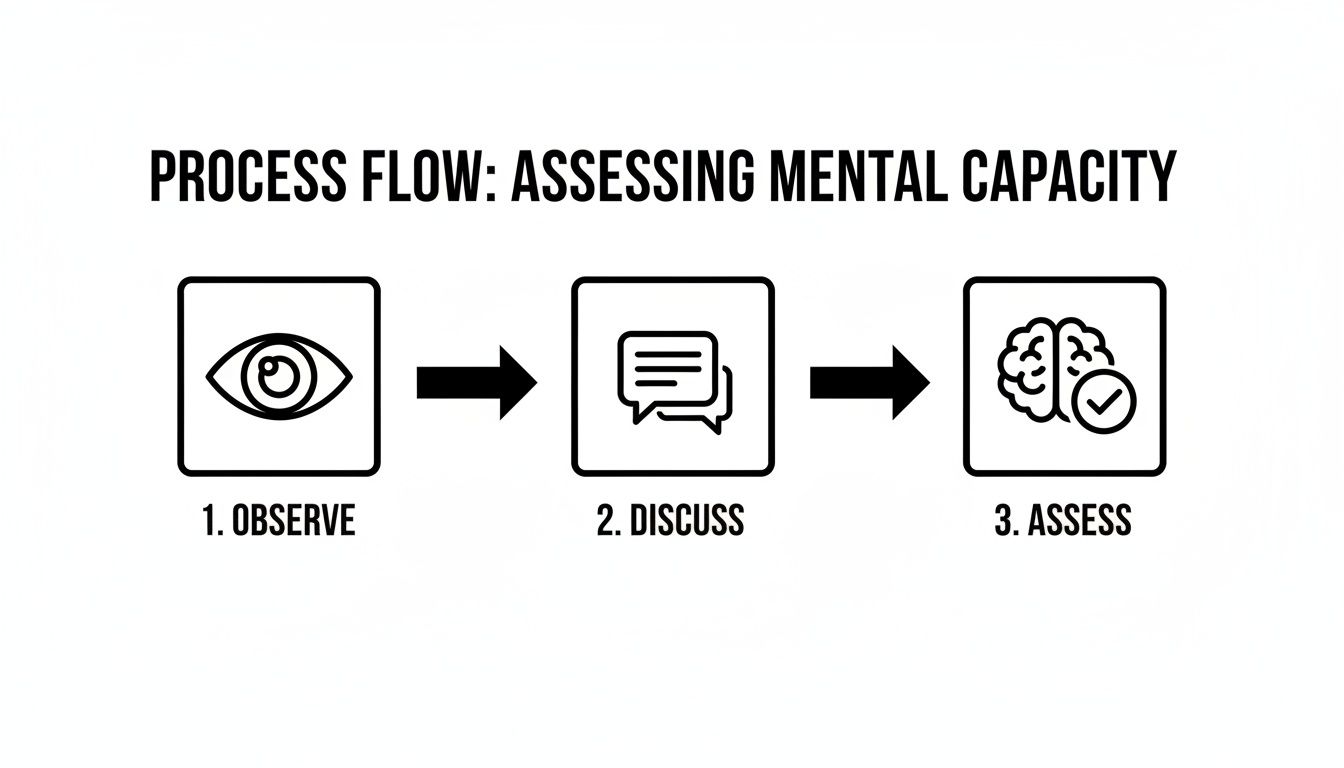
As you can see, determining capacity isn't a snap judgment. It involves careful observation, open conversation, and, when needed, getting a professional assessment to ensure every decision is made with a clear mind.
The Formalities of Signing in Texas
Texas law is very particular about how a POA must be executed to be considered valid. Just getting a signature isn't enough. The process is designed to make sure the person signing (the principal) is doing it willingly and with a full understanding of what the document means.
Under the Texas Estates Code, a Durable Power of Attorney must be:
- In writing.
- Signed by the principal.
- Acknowledged by the principal in front of a notary public.
This means you, your parent, and a notary all need to be present for the signing. Think of it this way: you and your mother meet a mobile notary at her home in Bexar County. The notary verifies her ID, confirms she understands the document she's about to sign, and then officially notarizes her signature. That simple act is what makes the document legally powerful.
A common mistake families make is failing to follow the signing formalities to the letter. A missing notary stamp can render the entire document invalid, forcing families into the very guardianship process they were trying to avoid.
The Importance of Open Discussion and Professional Guidance
Even with a perfectly drafted document, honest communication is everything. The need for these documents is growing—and a proactive approach can make all the difference. Yet, many families still find it hard to have these crucial conversations, which is where professional guidance can be invaluable.
Working with an attorney ensures all the technical boxes are checked and that the powers you grant are tailored to your parent's specific needs and financial situation. They can also help mediate tricky family dynamics to ensure the final document truly reflects what your parent wants.
If you need help creating a valid and effective document, you can find a comprehensive Power of Attorney form for Texas and other guidance on our site. For personalized assistance, contact The Law Office of Bryan Fagan for a free consultation to make sure your family is protected.
When Guardianship Is the Necessary Path Forward
Sometimes, despite our best hopes, the window of opportunity for a Power of Attorney just isn’t there anymore. It’s a heartbreaking reality when you realize your parent can no longer understand a legal document, making it impossible for them to sign a POA. When that happens, Texas law provides a different, more protective path: guardianship.
Guardianship isn’t something you “get over” a parent, just as a POA isn’t. Instead, it’s a court-supervised legal process designed to protect someone who has become incapacitated and simply can't care for themselves anymore. It’s a major step, and one the courts don't take lightly. But often, it's the only way to ensure a vulnerable parent is safe from harm or exploitation. This includes situations requiring an emergency or temporary guardianship for immediate protection.
The Shift From Private Agreement to Public Process
A Power of Attorney is a private document between your parent (the principal) and you (the agent). Guardianship, on the other hand, is a public, court-supervised process governed by Title 3, Subtitle G of the Texas Estates Code. This shift is necessary because your parent has lost the legal capacity to choose their own decision-maker.
The court must now step in to appoint someone to act in their best interest. This all starts by filing a formal application in the proper probate court, whether that’s the Harris County Probate Court or the courts in Fort Bend or Montgomery County.
Understanding the Texas Guardianship Process
Initiating a guardianship proceeding moves the decision-making out of the family living room and into a formal courtroom. A judge will ultimately make the final determination based on clear evidence.
The guardianship establishment process generally unfolds like this:
- Filing an Application: As the applicant, you’ll file a detailed application with the probate court. This document lays out why a guardianship is needed and provides information about your parent (the proposed ward), their condition, and their finances.
- Obtaining a Physician's Certificate: The court requires fresh medical evidence of incapacity. You’ll need a physician to evaluate your parent and complete a standard form called a "Certificate of Medical Examination." This is a critical piece of evidence that gives the court a professional opinion on your parent’s mental and physical state.
- Appointment of an Attorney Ad Litem: Because guardianship removes a person's fundamental rights, the court appoints an independent attorney, called an attorney ad litem, to represent your parent. This attorney meets with your parent, explains what's happening, and advocates for their wishes in court.
- The Court Hearing: A formal hearing is set where the judge reviews all the evidence, including the physician’s report and the ad litem’s findings. You’ll likely have to testify about why you believe your parent needs a guardian. The judge must find by "clear and convincing evidence" that your parent is incapacitated before appointing a guardian.
Guardianship is a measure of last resort. It's the legal system's way of creating a safety net when a person can no longer protect themselves and no less restrictive alternatives, like a valid Power of Attorney, are in place.
The Emotional and Financial Realities
Let’s be honest: pursuing guardianship is an emotionally draining and often expensive journey. It can feel like you’re taking legal action against your own parent, even when your only intention is to protect them. The process can create incredible stress on family relationships, all while you're already coping with a parent’s declining health.
The financial costs are also significant. You’re looking at court fees, your own attorney's fees, and the fees for the court-appointed attorney ad litem. But for many families, these costs are a necessary investment to make sure a loved one's bills are paid, their medical needs are met, and they are safe from financial predators. Once a guardianship is established, the guardian has ongoing rights and duties, including annual reporting, which can lead to guardianship termination or compliance issues if not handled correctly.
It is vital to grasp the profound differences between these legal tools. You can explore a detailed comparison in our article on Guardianship vs. Power of Attorney.
If you believe guardianship is the necessary path for your parent, please don’t try to navigate this complex and emotional process alone. The Law Office of Bryan Fagan is here to provide the compassionate and authoritative guidance your family deserves. Schedule a free consultation with our experienced attorneys today to discuss your specific situation with clarity and care.
Common Questions About POA and Guardianship in Texas
Even after you get a handle on the basics, navigating the legal side of caring for a parent will bring up a lot of real-world questions. Families run into practical issues all the time that aren't spelled out in the legal statutes. Here are some clear, direct answers to the concerns we hear most often from Texas families.
Can an Agent Change My Parent's Will?
Absolutely not. It's a hard "no." An agent operating under a Power of Attorney has a fiduciary duty, which is a legal obligation to act only in your parent's best interest.
Trying to change a will, trust, or any other part of an Estate Planning strategy for their own benefit isn't just a breach of that duty—it's illegal. A POA is strictly for managing financial and medical decisions while your parent is alive. It gives the agent zero power to change what happens after they pass away.
How Much Does Guardianship Typically Cost in Texas?
This is a big one. Because guardianship is a full-blown court process, the financial and emotional costs can add up quickly. Families should brace for several different expenses:
- Court Filing Fees: These are the initial fees just to get the case started, and they vary from county to county.
- Your Attorney's Fees: The cost for your own legal counsel to represent you and navigate the system.
- Attorney Ad Litem Fees: The court will appoint an independent lawyer to represent your parent's interests. The estate is almost always on the hook for their fees.
- Bonding Costs: Most guardians have to buy a bond, which acts like an insurance policy to protect your parent's assets from mismanagement.
All told, these costs can easily soar into the thousands of dollars. This is why getting a POA set up ahead of time is a much more affordable and private alternative.
Key Takeaway: The whole point of a Power of Attorney is to avoid the public, expensive, and emotionally draining process of guardianship. It keeps your parent in the driver's seat by letting them choose their decision-maker in advance.
What if a Bank or Hospital Won't Accept the POA?
This is a frustratingly common roadblock. Sometimes, institutions get overly cautious and will push back on a perfectly valid POA.
If this happens, the first move is to have your attorney get in touch with the institution’s legal department. Often, a formal letter from a lawyer that explains the agent's authority under the Texas Estates Code is all it takes to clear things up.
To be truly prepared, you need to understand the difference between power of attorney and guardianship. A POA is a choice made before someone is incapacitated. Guardianship is a solution the court imposes after they are.
Can My Parent Revoke a Power of Attorney?
Yes, they can—with one major condition. Your parent must still have the mental capacity to fully understand what they are doing.
The revocation has to be done in writing. That written notice then needs to be delivered to the agent and to any bank, hospital, or other institution that has a copy of the original POA. If your parent's capacity is already in doubt, trying to revoke the document can get very messy and might even require a judge to step in. It really highlights how critical it is to choose a completely trustworthy agent from day one.
Trying to figure all this out can feel like you're lost in a maze, but you don’t have to do it alone. The compassionate team at The Law Office of Bryan Fagan, PLLC is here to give your family the clarity and guidance you need. Schedule a free, no-obligation consultation with us to talk through your parent's situation and find the right path forward. Contact us today to protect your loved one's future.