Skip to content
It's one of the hardest realizations a family can face: the moment you understand a parent might no longer be able to care for themselves safely. Pursuing legal guardianship is a profound step, one born out of love and a deep desire to protect a parent who has become incapacitated and vulnerable. We understand this isn't a decision made lightly; it involves a formal court process where a judge grants you the legal authority to make critical decisions on their behalf, a journey that can feel both emotionally and financially challenging.
Knowing When Guardianship Is the Right Choice for Your Parent
Deciding to seek guardianship is emotionally taxing. It's an act of protection, but the path to getting there can feel overwhelming. The first step is truly understanding when this powerful legal tool is not just an option, but an absolute necessity for your parent's well-being.
This conversation goes beyond simple forgetfulness or needing a hand with groceries. The discussion shifts to the legal standard of "incapacity," a specific term defined in the Texas Estates Code.

Recognizing the Signs of Legal Incapacity
Guardianship becomes necessary when a parent is legally unable to manage their own affairs due to a physical or mental condition. This isn't about occasional memory lapses. It’s about a consistent, documented inability to make rational decisions that ensure their own safety and well-being.
Consider a hypothetical scenario we often see in Texas courts: An elderly mother with progressing Alzheimer's is living alone in Harris County. She's started giving large sums of money to phone scammers, forgets to take her vital heart medication, and can no longer comprehend the medical consent forms her doctor asks her to sign.
This isn't just needing help; this is legal incapacity. Her inability to protect her finances and her own health puts her in immediate danger.
Under Title 3, Subtitle G of the Texas Estates Code, the grounds for guardianship center on proving with clear evidence that a person lacks the capacity to:
- Provide their own food, clothing, or shelter.
- Care for their own physical health.
- Manage their financial affairs.
A Texas court will only grant a guardianship if there is clear and convincing evidence of incapacity. It must also be the least restrictive option available to protect the person, who is referred to as the "proposed ward."
Understanding the Two Core Types of Guardianship
When you begin to learn how to obtain guardianship of a parent, it’s critical to know that it's not an all-or-nothing arrangement. A Texas court has the flexibility to tailor the guardianship to your parent’s specific needs, typically by appointing one of two main types:
- Guardianship of the Person: This grants you authority over personal and healthcare decisions. As guardian of the person, you decide where your parent lives, arrange for their medical care, and make sure their daily needs are met.
- Guardianship of the Estate: This gives you authority over all financial matters. This guardian is responsible for managing income, paying bills, protecting assets from scams, and preventing financial exploitation.
Sometimes, one person fills both roles. In other situations, particularly with complex family dynamics, a court might appoint two different people. For instance, a sibling who is a nurse could be appointed guardian of the person, while another sibling who is an accountant could be guardian of the estate.
The path to guardianship inevitably involves navigating tricky situations, which is why understanding complex family dynamics and roles can be so helpful. It’s also important to remember that guardianship is truly a last resort. Before starting this process, it's wise to explore other legal tools by learning more about the differences between guardianship vs. a power of attorney.
Navigating the Different Types of Texas Guardianship
When you start looking into how to get guardianship of a parent, the legal system can feel overwhelmingly complex. But understanding the different options available in Texas is the first major step toward finding clarity and making the right decision for your family. The law recognizes that a parent might need help in some areas of their life but remain perfectly capable in others.
For that very reason, Texas law doesn’t use a one-size-fits-all approach to guardianship. A court will tailor the guardianship to fit your parent's precise needs, a core principle found in the Texas Estates Code. The ultimate goal is always to impose the least restrictive alternative necessary to keep them safe and well.
Guardian of the Person
A Guardian of the Person is appointed by the court to handle decisions about your parent's personal care and well-being. This is the role most people picture when they hear the word "guardian."
This responsibility is focused squarely on your parent’s physical and emotional health. If you were appointed as the Guardian of the Person, your duties would include things like:
- Deciding where your parent will live—whether that's at home with support, in an assisted living facility, or another suitable place.
- Giving consent for medical treatments, surgeries, and routine healthcare on their behalf.
- Making sure their daily needs for food, clothing, and shelter are consistently met.
- Overseeing their overall physical safety and personal care.
This role is about protecting your parent’s health and ensuring they can live with dignity in a safe environment. The guardian must file an annual report with the court on the parent's condition and well-being.
Guardian of the Estate
On the flip side, a Guardian of the Estate is responsible only for managing your parent's financial life. This type of guardianship becomes necessary when a parent can no longer handle their finances, leaving them vulnerable to exploitation, scams, or simple mismanagement that could wipe out their life savings.
The duties of a Guardian of the Estate are strictly financial and involve tasks like:
- Paying bills and managing their bank accounts.
- Collecting any income they receive from Social Security, pensions, or investments.
- Filing tax returns on their behalf.
- Protecting their property and assets from being lost or stolen.
A Guardian of the Estate has a fiduciary duty to act in the parent's best financial interest and must file an annual accounting of all financial transactions with the court. For a more detailed look, our comprehensive guide to the different types of guardianship in Texas breaks down these roles even further.
To help you see the difference clearly, here’s a quick breakdown of their core responsibilities.
Guardian of the Person vs Guardian of the Estate Key Responsibilities
| Area of Responsibility | Guardian of the Person | Guardian of the Estate |
|---|---|---|
| Primary Focus | Personal well-being, health, and safety | Financial affairs, assets, and property |
| Healthcare | Consents to medical treatments and chooses doctors | Arranges payment for medical bills from the estate's funds |
| Living Situation | Decides where the person will live (home, facility, etc.) | Pays for housing, rent, or facility fees |
| Daily Needs | Ensures proper nutrition, clothing, and personal care | Manages the budget for food, clothing, and other necessities |
| Financial Tasks | Does not manage finances | Pays bills, manages bank accounts, files taxes, invests funds |
| Court Reporting | Files an annual report on the person's condition and well-being | Files an annual accounting of all financial transactions |
This table shows how the roles can be completely separate, yet work together to provide total support for your loved one.
Think about a family with two siblings. One is a nurse who lives nearby and is perfectly suited to manage their mother's daily care. The other is an accountant who lives out of state but is a whiz with finances. A Harris County Probate Court could appoint the nurse as Guardian of the Person and the accountant as Guardian of the Estate, using each of their strengths to provide complete protection.
Full vs. Limited Guardianship
Texas courts are dedicated to preserving as much of a person's independence as possible. Because of this, a judge will always consider if a limited guardianship is a better fit before granting a full guardianship.
A full guardianship is only granted when someone is found to be totally incapacitated, with no ability to make any decisions for themselves. It’s a last resort.
A limited guardianship, on the other hand, gives the guardian only the specific powers that the parent can no longer handle on their own. For instance, a judge might grant a guardian the power to make medical decisions but allow the parent to continue managing their own small bank account for personal spending. This approach honors your parent's autonomy while still providing critical support exactly where it's needed.
During the guardianship hearing, the judge will look at all the evidence to figure out the precise level of support your parent requires. Understanding these distinctions is crucial for building a case that truly serves your parent's best interests. For personalized guidance on what type of guardianship may be right for your family’s situation, please schedule a free consultation with our experienced attorneys.
Your Practical Roadmap to Filing for Guardianship
Once your family decides that guardianship is the necessary path forward, the legal process begins. This can feel intimidating, but let's break down the practical steps into a clear, manageable roadmap.
The entire process kicks off with obtaining a physician's certificate. Think of this as the medical cornerstone of your case—the official document that shows the court why your parent needs help. From there, you'll prepare and file an "Application to Appoint a Guardian" with the probate court in your parent's county of residence, whether that's in Harris County, Travis County, or elsewhere in Texas.
The Physician's Certificate: The Most Critical Piece of Evidence
Before a judge will consider a guardianship application, you must provide medical proof of incapacity. This comes in the form of a signed letter or certificate from a doctor who has examined your parent within the last 120 days.
This isn't just a simple doctor's note. The Texas Estates Code is very specific about what this document needs to include:
- The nature and severity of your parent's condition.
- A clear description of their current mental and physical state.
- An assessment of their ability to make decisions about their own health, finances, and general well-being.
- A professional opinion on whether they are able to attend the court hearing.
This medical evidence is non-negotiable. It provides the court with an unbiased, professional opinion that validates the need for a guardian and forms the foundation of your entire case.
Filing the Application and Providing Notice
With the physician's certificate secured, your next move is filing the official "Application for Appointment of Guardian." This legal document is submitted to the statutory probate court in the county where your parent lives.
The application is your formal request to the court, asking it to establish a guardianship and appoint you (or someone else) as the guardian. Once it's filed, a critical phase begins: providing legal notice to your parent and other close relatives. This isn't just a courtesy call; it's a formal legal requirement. A court official, like a process server or constable, will personally deliver a copy of the filing to your parent, making sure they are officially informed of the proceedings.
This visualization illustrates the distinct responsibilities overseen by a Guardian of the Person versus a Guardian of the Estate.
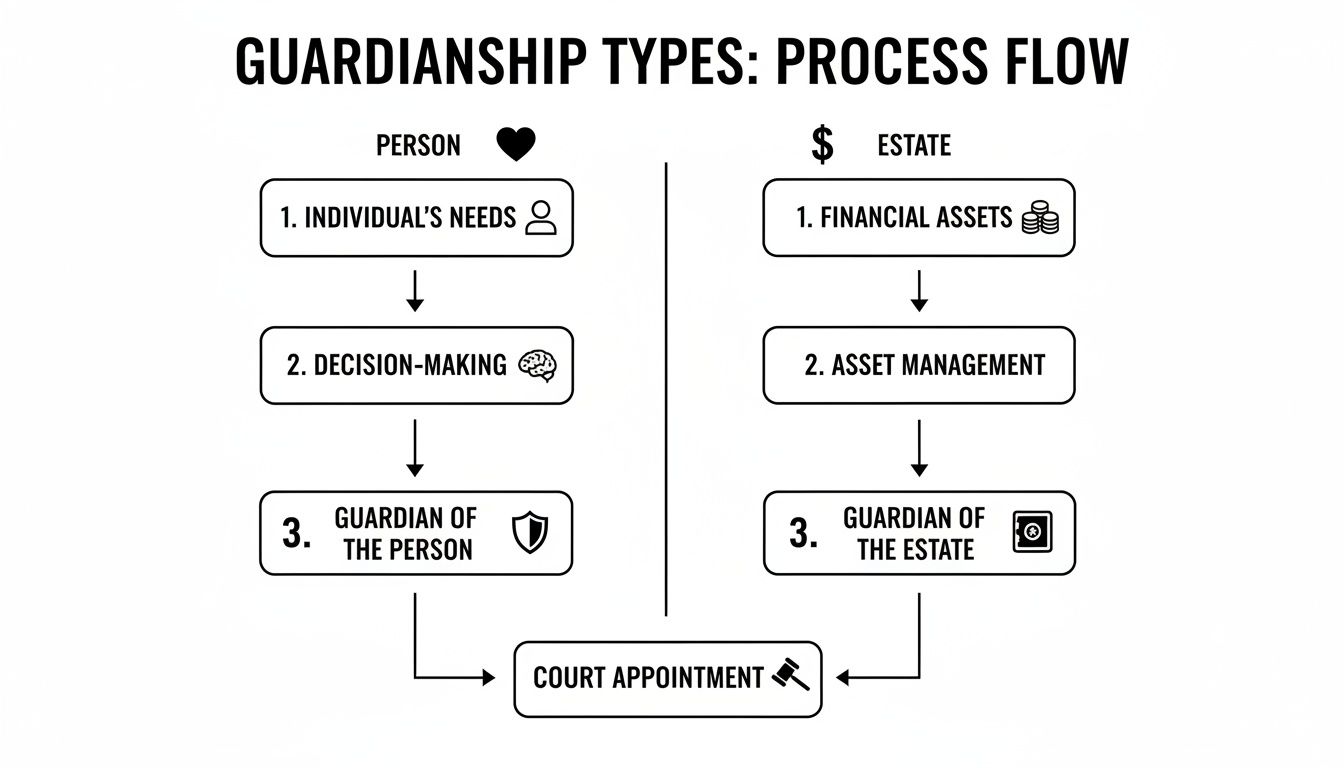
This distinction is crucial because the court can appoint one person for both roles or split the duties between two people to best serve the parent's needs.
The Role of the Attorney Ad Litem
After you file, the judge will appoint an independent attorney known as an attorney ad litem. This is one of the most important safeguards in the entire Texas guardianship system.
The attorney ad litem’s only client is your parent (the proposed ward). Their job is to meet with your parent, explain the guardianship process in terms they can understand, and advocate fiercely for their wishes and best interests before the court.
This attorney acts as your parent's independent voice. They'll investigate the situation, interview family members and caregivers, and then file a report with the court. This report recommends whether a guardianship is truly necessary and if you are the right person for the job, ensuring the judge has a complete and impartial picture before making a final decision.
The guardianship system is vast, yet often under-documented. Research shows the U.S. adult guardianship system manages approximately 1.3 million adults and $50 billion in assets, and many experts believe those figures are actually much higher. A key finding is that only 17 states actively document the preferences and goals of adults under guardianship, which highlights a major gap in person-centered care. You can read the full research about these guardianship findings to get a better sense of the national context.
Getting these initial steps right is essential. A simple error in the application or an issue with the legal notice can cause significant delays and frustration. If you're considering this path, we invite you to schedule a free consultation with our team to ensure your application is prepared with the care and precision your family deserves.
Preparing For Your Day In Court: The Guardianship Hearing
The guardianship hearing can feel like the most intimidating part of this whole journey. Walking into a courtroom can be unnerving, but knowing what to expect can turn that anxiety into confidence.
This hearing is your opportunity to clearly and compassionately explain to the judge why your parent needs this protection and why you are the right person to provide it. This isn't just a formality; it's a formal proceeding where a judge reviews all the evidence. Your attorney will present key documents, like the physician's certificate, but your own testimony often carries the most weight. You'll be asked to speak about your parent's condition and the specific struggles that led you to seek guardianship.

What To Expect During The Hearing
A judge in a Harris County Probate Court has one primary goal: to act in the best interest of your parent, the proposed ward. To do that, they must be absolutely certain that guardianship is the last resort and the least restrictive way to keep your parent safe.
The judge will ask questions to get a complete picture of the situation. These are not trick questions; they are designed to gather the facts. You can expect to be asked things like:
- Why do you believe your parent is incapacitated? Be ready with specific, real-world examples.
- What less restrictive alternatives, like a power of attorney, have you explored?
- Why are you the most suitable person to serve as guardian?
- Do you understand the significant responsibilities and legal duties you would be taking on?
The attorney ad litem—the independent lawyer appointed by the court for your parent—will also be there to share their findings and advocate for your parent's wishes. Your parent has a right to be at the hearing, and if they are able, their presence can be very important.
Presenting a Clear and Convincing Case
Your testimony should be honest, direct, and focused on your parent’s needs. This isn't about proving you're perfect; it's about showing you are capable, caring, and committed to their well-being.
Speak from the heart about your relationship and your genuine desire to protect them. Be prepared to explain your plan for managing their care, where they will live, and how you will handle their finances responsibly if you’re also seeking to be guardian of the estate.
The court's decision hinges on clear and convincing evidence. This is a high legal standard. It means the judge must be firmly convinced that your parent is incapacitated and that you are qualified to serve. Your calm, sincere testimony is a vital part of meeting that standard.
For a deeper dive into what to expect and how to present yourself effectively, you might find our guide on how to prepare for a guardianship hearing in Texas especially helpful.
After The Judge's Approval, The Work Begins
The moment a judge approves the guardianship brings immense relief, but it also marks the official start of your court-supervised responsibilities. This is not a one-time event; it is the beginning of a new legal relationship with ongoing compliance requirements.
Immediately after your appointment, you must complete several crucial steps to legally qualify as guardian, as required by the Texas Estates Code:
- Take an Oath of Guardianship: You will swear an oath before the court, promising to faithfully perform all the duties of a guardian.
- Post a Bond: If you are appointed Guardian of the Estate, the court will almost always require you to post a bond. This is an insurance policy that protects your parent's assets from any potential mismanagement. The judge sets the bond amount based on the value of the estate.
- File an Inventory, Appraisement, and Claim: Within 90 days of qualifying, you must file a detailed report with the court listing all of your parent's assets and any claims against their estate.
Failing to complete these steps can result in your removal as guardian. This underscores how seriously the court takes this role and its ongoing supervision. Navigating these post-hearing duties is just as important as the hearing itself, and our firm is here to guide you through every compliance requirement to ensure you fulfill your duties correctly and compassionately.
Are There Alternatives to Guardianship in Texas?
When we talk about guardianship, we're talking about a legal process that removes some of a person's fundamental rights. Because of that, Texas law is clear: it should always be the last resort. Before any judge, whether in Bexar County Probate Court or elsewhere, will grant a guardianship, they must be completely convinced there isn't a less restrictive option that can protect your parent.
This is why having proactive, though sometimes difficult, conversations about Estate Planning is so important. By putting the right legal tools in place while your parent is still fully capable, families can often avoid the courtroom altogether.
Empowering Your Parent with Powers of Attorney
Two of the most powerful alternatives are the Durable Power of Attorney and the Medical Power of Attorney. These legal documents are straightforward: they let your parent choose a trusted person—an "agent"—to make critical decisions for them if they become unable to do so.
- Durable Power of Attorney (Financial): This document gives an agent the authority to handle your parent's financial life, from paying bills and managing bank accounts to handling property matters. It's a vital tool for keeping their affairs in order and preventing financial exploitation.
- Medical Power of Attorney (Healthcare): This lets an agent make healthcare decisions when your parent can't. The agent can speak with doctors, consent to treatments, and access medical records, all based on the wishes your parent previously expressed.
The key is that these documents must be signed while your parent still has full mental capacity. Many of the core ideas, like setting up trusts and making designations to keep family matters private and out of the courts, are also central to good strategies to avoid probate court.
A Real-World Example of Proactive Planning
Let’s picture a common scenario. Years ago, a father worked with an attorney to create both a Durable and a Medical Power of Attorney, naming his daughter as his agent. Fast forward to today, and a sudden stroke has left him unable to speak or manage his finances.
Because he planned ahead, his daughter can step in immediately. She can use the Durable Power of Attorney to pay his mortgage and medical bills directly from his bank account. With the Medical Power of Attorney, she can approve the rehabilitation plan his doctors recommend. The family completely avoids the cost, delay, and public nature of a guardianship hearing, and her father’s wishes are followed by the person he trusted most.
Supported Decision-Making Agreements
A newer and even less restrictive option in Texas is the supported decision-making agreement. This is a fantastic tool for adults who can still make their own decisions but need help gathering information, understanding their options, or communicating their choices.
With this agreement, your parent can name a trusted supporter who is authorized to:
- Help them collect and understand information.
- Talk through their different options.
- Communicate their final decision to others, like doctors or bankers.
The crucial difference here is that the supporter does not make the decision for the parent. This arrangement preserves your parent's autonomy and legal rights while giving them a structured support system.
It's also worth noting that cultural factors and access to legal resources can shape how families approach these situations. For instance, one study found that Hispanic families were far more likely to have a family member serve as guardian (91.1%) compared to White families (11.2%). These kinds of statistics show that every family's journey is different. You can discover more insights about these guardianship statistics to see the bigger picture.
Exploring these alternatives isn't just a legal tactic; it's a compassionate approach that honors your parent's dignity and independence. If you're unsure which path is right for your family, schedule a free consultation with our team. We can walk you through every option available to protect your loved one.
Answering Your Texas Guardianship Questions
When you're facing a situation as personal and weighty as guardianship, you're bound to have questions. The path to becoming a guardian for your parent is filled with practical concerns about time, money, and family dynamics. Here, we'll tackle some of the most common questions we hear from Texas families, giving you clear answers to help you understand what this process truly involves.
How Long Does the Texas Guardianship Process Typically Take?
This is one of the first things everyone wants to know, and the honest answer is: it varies. The timeline depends on the court's calendar and the unique details of your case. In an uncontested guardianship in a court like the Bexar County Probate Court, you might see a resolution in 30 to 90 days.
However, complications can arise. If other family members contest the guardianship, if your parent's estate is complex, or if the court's docket is backed up, the process can easily stretch to six months or even longer. The two most important things you can do to keep things moving are submitting the physician's certificate promptly and ensuring all legal notices are served correctly. For truly urgent situations where a parent is in immediate danger, it's often possible to establish an emergency or temporary guardianship in just a few days to provide immediate protection.
What Are the Estimated Costs of a Guardianship Proceeding?
The financial side of guardianship is a serious and valid concern for any family. You should be prepared for several different expenses that can add up.
You're generally looking at costs that include:
- Court filing fees to get the case started.
- The physician's examination fee for the required medical report.
- Your own attorney's fees for preparing and managing the case.
- Fees for the court-appointed attorney ad litem who represents your parent's interests.
If the court requires you to post a bond to protect the estate's assets, there will also be an annual premium for that bond. A straightforward, uncontested guardianship can cost several thousand dollars. If the case is contested and turns into a full-blown legal battle, those costs can rise dramatically. It's vital to have a frank conversation about all potential expenses with your attorney right from the start.
What Happens if Another Family Member Objects?
An objection from a sibling or another relative immediately changes the case into a contested guardianship, which is essentially a lawsuit. This is a common form of guardianship dispute. The person objecting might argue that a guardianship isn't necessary, or they might put themselves forward as a better choice for guardian.
This kicks off a much more formal legal fight, often involving discovery (gathering evidence), depositions (sworn testimony outside of court), and potentially a trial where a judge will hear from both sides before making a final decision.
A contested case underscores the absolute necessity of having an experienced guardianship attorney on your side. Their role becomes critical in protecting your parent's best interests while navigating the complexities of family conflict within a courtroom setting.
Can I Be Paid for Serving as My Parent's Guardian?
Yes, Texas law allows a guardian to be reasonably compensated for their services. Under the Texas Estates Code (Title 3, Subtitle G), this is particularly common for a Guardian of the Estate who is managing significant financial duties.
However, payment is not automatic. You must file a formal application with the court detailing the work you’ve done. A judge will review your request and decide on a fee they consider reasonable based on the size of the estate, its complexity, and the specific tasks you performed. This process ensures transparency and protects your parent's assets while properly recognizing the significant responsibilities you've shouldered.
Navigating these questions is the first step toward making an informed decision for your family. At The Law Office of Bryan Fagan, PLLC, we are here to provide the clarity and compassionate guidance you need. If you are considering guardianship for a parent, schedule a free, no-obligation consultation with our experienced Texas attorneys today.