Skip to content
Deciding to pursue legal guardianship for a child is a significant step, one that almost always comes from a place of deep concern and love during a difficult family crisis. We understand that you're here because a child you care about needs a stable, safe home, and you're considering being the one to provide it.
In Texas, becoming a minor's legal guardian means proving to a court that their parents are unable to care for them and that appointing you is in the child's best interest. This isn't just about filling out forms; it's a formal legal process that gives you the authority to make critical decisions for a child, ensuring their well-being when they need it most. At The Law Office of Bryan Fagan, our mission is to guide Texas families like yours through guardianship law with clarity and care.
When Is Guardianship the Right Path for a Minor in Texas?
Let's be honest: if you're looking into guardianship, you're likely facing a tough, emotional situation. The road ahead can feel overwhelming. But it's important to remember that this legal process exists for a reason—to protect a child’s future when informal family arrangements just aren't enough.
You might be a grandparent, aunt, uncle, or a close family friend watching a child deal with instability that's no fault of their own. Your willingness to step in legally is a powerful testament to your commitment, and we recognize the emotional and financial challenges this journey entails.
Common Scenarios Requiring Guardianship
In our experience, guardianship becomes a necessary option when a child's parents simply cannot be there for them. The Texas Estates Code, specifically Title 3, Subtitle G, provides the legal framework to create a safe harbor for these children.
A few situations we see time and again include:
- Parental Incapacity: A parent is battling a severe illness, a mental health crisis, or a disability that makes it impossible for them to provide adequate care.
- Abandonment or Incarceration: A parent has disappeared from the child's life or is incarcerated for an extended period, leaving a void that needs to be filled with a stable, loving presence.
- Death of Parents: Tragically, when both parents pass away without naming a guardian in their will, the court must step in to appoint someone to raise the child.
- Managing a Child's Finances: If a minor inherits money or receives a large settlement (like from a personal injury lawsuit), a guardian of the estate is needed to protect and manage those funds until they turn 18.
It's a common myth that a simple notarized letter from a parent gives you full legal authority. In reality, documents like a Power of Attorney for a Minor Child are temporary and can be revoked at any time. Only a court-ordered guardianship provides the solid legal standing you need to enroll a child in school, consent to medical treatment, and make critical life decisions.
The Two Key Types of Minor Guardianship
Texas law wisely recognizes that a child's needs fall into two main categories: their personal well-being and their financial security. The court can appoint guardians to handle one or both of these roles, and understanding the distinction is a key part of the process.
Many people get guardianship and custody confused. While they both involve caring for a child, they happen in different courts and carry different legal weight. We break it all down in our guide on Guardianship vs. Custody in Texas.
To help clarify the two main guardianship roles, let’s look at them side-by-side.
Guardianship of the Person vs. Guardianship of the Estate for a Minor
| Aspect | Guardianship of the Person | Guardianship of the Estate |
|---|---|---|
| Primary Focus | The child's daily life, care, and well-being. | The child's money, property, and financial assets. |
| Key Responsibilities | Deciding where the child lives, goes to school, and their religious upbringing. Making day-to-day parenting decisions. | Managing inheritances, lawsuit settlements, and investments. Paying the child's expenses from their funds and protecting assets. |
| Decision-Making Authority | Consenting to medical, dental, and psychological care. | Filing inventories and accountings with the court. Protecting and growing the child’s assets as required by law. |
| Common Scenario | A grandparent taking over care when a parent is incarcerated or incapacitated. | A child receives a large life insurance payout after a parent's death, and a guardian is needed to manage it. |
In many cases, the court will appoint one person to serve as both guardian of the person and the estate. However, it’s not unusual to see two different people appointed if that’s what best serves the child’s interests. The ultimate goal is always to build a protective and stable environment for the child.
This path to permanency is so important. Consider this: in FY 2024, only 11% of children leaving foster care were placed in a guardianship. That number highlights just how crucial this option can be for kids who might otherwise age out of the system with no family support at all. You can dig deeper into the latest foster care and adoption statistics to see the full picture.
Making the choice to pursue guardianship is a profound act of love. If you believe this is the right step for a child in your life, you don't have to figure it out alone. Schedule a free consultation with The Law Office of Bryan Fagan today, and let's talk through your family’s situation with the clarity and compassion you deserve.
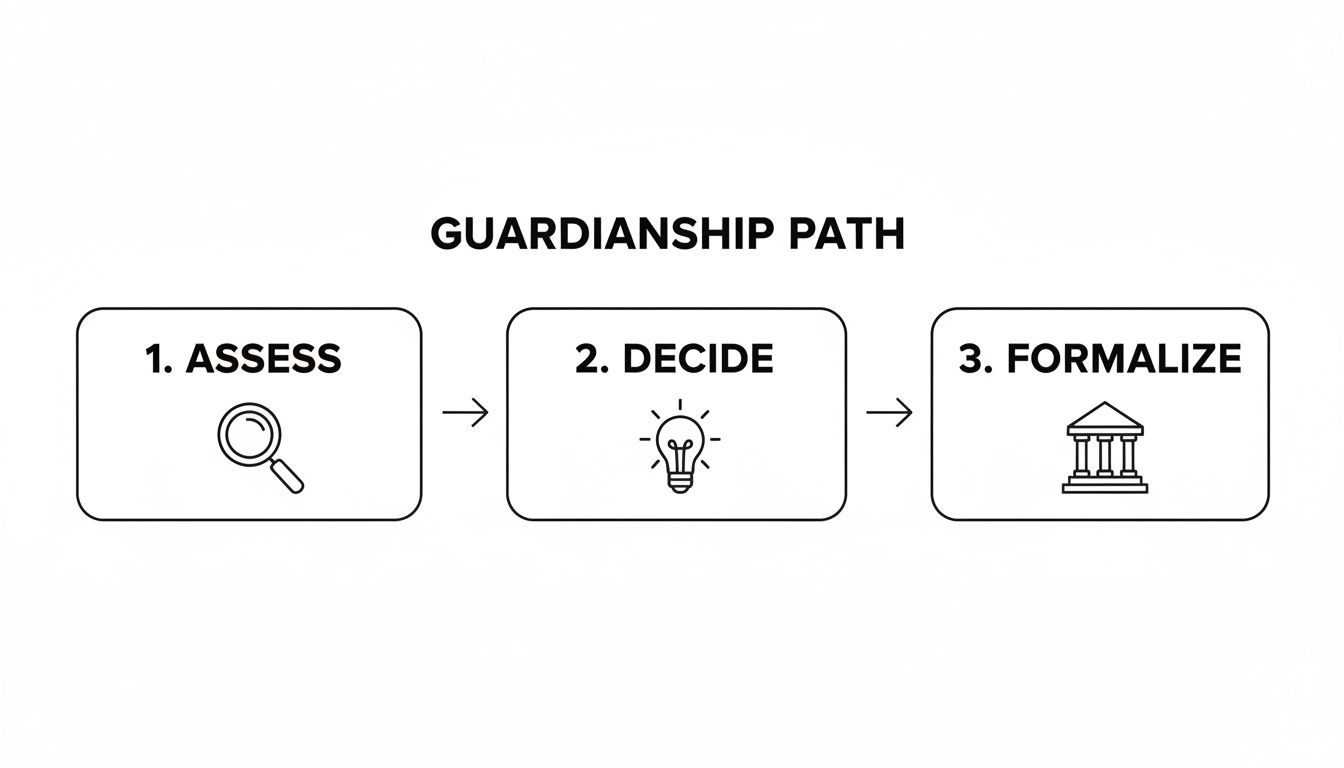
Your Roadmap to Filing for Guardianship in Texas
Stepping into the Texas court system can feel daunting, but when a child's well-being is on the line, a clear path forward is essential. Pursuing guardianship is a formal legal process where every step is designed to protect the child. This is where your good intentions become legally recognized action.
The whole process kicks off when you file an Application for Appointment of Permanent Guardian. This document is the cornerstone of your entire case. Getting it right from the start is critical to avoid frustrating delays and to show the court you are prepared for this immense responsibility.
The Initial Application and Filing
Think of the application as your formal introduction to the court. It must paint a complete, honest picture of why this guardianship is necessary for the child.
You’ll have to pull together specific details, including:
- The Minor’s Information: Full name, date of birth, and where they are currently living.
- Your Information: Your name, address, and your relationship to the child. You'll also need to explain why you are qualified to serve in this role.
- Parental Information: The names and last known addresses of the child’s living parents. If a parent has passed away, you must state that.
- The Reason for Guardianship: This is the "why." You must clearly explain why the child needs a guardian, detailing the parents' inability to provide care due to issues like illness, incarceration, substance abuse, or abandonment.
Precision matters immensely. A simple mistake, like an old address for a parent, can grind the whole process to a halt. Courts in major counties like Harris County Probate Court are incredibly strict about ensuring everyone is properly notified according to the Texas Estates Code.
We guide clients through these forms every day, but you can also find helpful examples in our guide to essential sample guardianship application templates.
Issuing Notice and Appointing an Ad Litem
Once you file the application, the court doesn’t just take your word for it. The next phase is about formal notification. This legal notice, known as a citation, must be issued by the court clerk and properly delivered ("served") to all interested parties.
This includes the child's parents, anyone who currently has legal custody (a managing conservator), and even the child themselves if they are 12 years of age or older. This step is non-negotiable; it guarantees that everyone with a legal stake in the child's future has a chance to be heard in court.
A critical, and often surprising, part of the process is the appointment of an attorney ad litem. This is an independent lawyer appointed by the judge, and their only client is the child. Their sole job is to investigate and recommend what is in the child's best interest.
The ad litem acts as the court's eyes and ears. They will interview you, the child, the parents, and other relevant people. They'll review school records, medical files, and then write a formal report for the judge with their recommendation. Being completely transparent and cooperative with the ad litem is one of the most important things you can do.
Understanding the Timeline
"How long will this take?" It's the first question nearly every family asks. While no two cases are the same, you should prepare for a process that takes several months, not weeks.
Here’s a practical breakdown of what to expect in a straightforward case:
- Filing and Citation (2–4 weeks): After filing, the court clerk issues citations. Service can take time, especially if a parent's location is unknown or they are avoiding being served.
- Ad Litem Investigation (4–8 weeks): The ad litem needs time to do their job thoroughly. This involves scheduling interviews, possibly a home visit, and gathering documents before they can finalize their report for the judge.
- Court Hearing (scheduled 1–3 months out): Once the ad litem's report is in and everyone has been served, the court will set a hearing date. Busy probate courts, particularly in the Dallas-Fort Worth metroplex, are often booked several months in advance.
All told, a non-contested guardianship often takes between 3 and 6 months from filing to a final order. If a parent or another relative decides to contest the guardianship, that timeline can stretch out significantly longer.
The path to guardianship is a marathon, not a sprint. Knowing the practical steps you need to take can make all the difference.
Building Your Case for the Guardianship Hearing
When you walk into that courtroom, you have one primary job: to convince the judge that granting you guardianship is in the best interest of the child. This is the single most important standard in all of Texas family law. It’s not about what the parents want, or even what you want. It’s all about securing a safe, stable, and healthy future for the minor.
The hearing is your chance to tell a clear, compelling story backed by hard evidence. Your goal is two-fold: show the court why the biological parents are currently unable to provide adequate care, and then demonstrate why you are the most qualified person to step into that role. This means getting organized and preparing to paint a full picture for the judge.

Gathering Your Evidence
Strong evidence is the absolute backbone of a guardianship case. Simply telling the judge a parent is unfit or unstable isn’t enough; you have to show them.
We always advise our clients to gather documentation that speaks for itself. The more objective the evidence, the better. Examples include:
- Physician's Letters: A letter from a doctor can be powerful. It might detail a parent's serious medical condition or a mental health diagnosis that directly impacts their ability to care for a child.
- School Records: Report cards, attendance sheets, and disciplinary reports can reveal a pattern of neglect or instability. Is the child consistently late, absent, or struggling academically under the parents' care?
- Testimony from Professionals: Teachers, counselors, or therapists often have a unique window into a child's world. They can speak to the child’s emotional state or developmental struggles and explain how a stable environment would make a difference.
- Legal Documents: This is crucial. Collect official records of a parent’s incarceration, a documented criminal history, or court filings that show a history of substance abuse.
For example, if a parent is incarcerated, you wouldn't just state that fact. You’d provide the court with the official sentencing records. Then, you'd build your case around the child's need for consistency during that long-term absence, showing how you can provide a stable home, keep them in their school, and offer the emotional support they need.
Proving You Are the Right Person
Next, the court will turn its attention to you. Be prepared for a close look at your own fitness to serve as a guardian. This part of the process can feel very personal, and that’s because it is.
You will have to undergo a criminal background check. The judge will also want to know about your own stability—your health, your living situation, and whether you are financially able to take on the responsibility of raising a child.
Be ready to talk about your motivations and your long-term plan for the child's care. The court is looking for someone who is not just willing, but genuinely capable and prepared for this immense responsibility.
The Texas Estates Code requires the court to choose the "least restrictive alternative" needed to protect the child. This means you must prove that an informal family arrangement won't work. You have to show why only a formal, court-ordered guardianship can give you the legal authority to make critical decisions about the child's medical care, education, and overall safety.
Addressing Unique Family Circumstances
Guardianship cases often come from incredibly complex family situations. We see this frequently when children arrive from out of state or even from another country to live with relatives. These kids are especially vulnerable without a legal guardian who can enroll them in school, consent to medical treatment, or simply advocate for them.
This issue is particularly pressing for children seeking asylum. For instance, a recent study on child asylum seekers found that guardianship was critically low—only 31% had a legal guardian during forensic evaluations, which exposed them to significant risks. You can read the full study on the vulnerability of children without legal guardians to understand the scope of the problem.
This data underscores how urgent establishing guardianship can be for providing immediate protection. In these types of cases, your petition must clearly lay out the child's vulnerable status and your ability to provide a true safe haven. The evidence you present to a Harris County Probate Court, for example, has to be tailored to these specific and compelling facts.
Ultimately, building a strong case is about so much more than just winning a legal argument. It's about laying a secure foundation for a child's entire future.
If you're preparing for a guardianship hearing, you don't have to figure all this out on your own. Schedule a free consultation with The Law Office of Bryan Fagan. We're here to help you present the strongest case possible with the compassion and experience your family deserves.
Handling Urgent Situations with Emergency Guardianship
Sometimes, you just can't wait. When a child is in immediate trouble, the standard guardianship process is simply too slow. Thankfully, Texas law provides a fast track for these crises: temporary and emergency guardianships. These are not permanent solutions, but they are absolutely critical legal tools to stabilize a dangerous situation and protect a child from harm.
It's vital to know which one fits your circumstances. A temporary guardianship is for situations with a substantial, immediate need. An emergency guardianship, however, is reserved for the most extreme situations where a child is in imminent danger.
When to Seek a Temporary Guardianship
A temporary guardianship, as laid out in the Texas Estates Code, can last for up to 60 days. It’s designed to give a caregiver the legal authority they need while the underlying crisis is being addressed. To obtain one, you must present substantial evidence to the court that a child's welfare requires the immediate appointment of a guardian.
Hypothetical Scenario: A single mother is in a serious car accident, leaving her hospitalized and unable to communicate for weeks. Her sister steps in to care for the kids, but without legal authority, she can't enroll them in a new school or consent to routine medical care. A temporary guardianship solves this, granting her the power to handle these crucial tasks while the mother recovers.
Understanding the High Stakes of Emergency Guardianship
Emergency guardianship is an even more rapid process, built for the most dire circumstances where there is a risk of imminent harm. We use it when a child faces imminent danger of physical harm or their financial assets are about to be stolen or lost. The process is incredibly fast, with a hearing often happening just days after filing the application.
Hypothetical Scenario: A child’s parents are suddenly arrested for drug manufacturing in their home. The child is left alone and needs urgent medical consent for an injury sustained during the chaos. This is precisely the kind of crisis an emergency filing is designed to fix. It allows a relative to get immediate legal control to ensure the child is safe and receives necessary care.
Because these guardianships grant immense power on an expedited basis, the burden of proof is very high. You must present clear and convincing evidence to a judge that the danger to the child is immediate and severe. This isn't for potential future problems—it's for present, active crises.
The extreme risks some children face are truly staggering. The National Center for Missing & Exploited Children (NCMEC) handles millions of reports of child exploitation, with a large number coming from the U.S. These statistics underscore the severe dangers that can make emergency guardianship a child's only lifeline after a traumatic event. You can explore the NCMEC's findings to understand the global implications for child safety.
These urgent legal actions are complex and move at a blistering pace. Our team has extensive experience navigating these high-stakes situations, and you can learn more about emergency guardianship in our detailed guide.
In a crisis, time is your most precious and limited resource. The emotional and financial toll can be overwhelming, but you don't have to face it alone. If a child's safety is at immediate risk, contact The Law Office of Bryan Fagan for a free, urgent consultation to get the guidance you need right away.
Life as a Guardian: Your Ongoing Duties and Responsibilities
The moment the judge signs the order appointing you as guardian is incredible. It’s a huge wave of relief. The legal fight is over, and now you can finally start building a new chapter with the child. But while the stress of the court case is behind you, your work isn’t done—it’s just shifting to a new phase of responsibility.
Your role now transitions from an applicant to a court-supervised protector. This isn’t meant to be a burden. Think of these ongoing duties as a supportive framework, one designed to help you protect the child and ensure every decision is transparent and in their best interest. This is where your new role truly begins.

Your First Steps as an Appointed Guardian
Immediately after the hearing, you have a few critical tasks to complete to "qualify" as a guardian in the eyes of the law. You must complete these practical steps before you can officially act on the child's behalf.
- Take the Oath of Guardian. This is a sworn statement where you promise to faithfully perform all the duties your new role requires.
- Post a Bond. If you’re appointed as guardian of the estate, the court will almost always require you to post a fiduciary bond. This is essentially an insurance policy that protects the child's assets from any mismanagement. The judge sets the amount based on the value of the child’s estate.
- File an Inventory. A guardian of the estate has 90 days from qualifying to file a detailed "Inventory, Appraisement, and List of Claims." This document catalogs every single asset the child owns and its current market value.
Once you’ve taken the oath and posted any required bond, the court clerk issues your "Letters of Guardianship." This one-page document is your golden ticket—it's the official proof of authority you'll need to enroll the child in school, consent to medical treatment, or open and manage their bank accounts.
The Annual Reporting Cycle and Compliance
Your legal duties don't end after those first few months. The Texas Estates Code requires every guardian to check in with the court annually. This process, known as guardianship compliance, ensures the child (or "ward," in legal terms) is safe and that their assets, if any, are being managed correctly. This yearly check-in is the core of the court's supervision.
As a guardian, you’re also responsible for the child's emotional well-being, which is a key part of their overall development. If you need some guidance, you can find effective strategies for prioritizing children's mental health in this helpful guide.
Keeping meticulous records isn't just good advice; it's a legal requirement. Every dollar spent from the child's estate and every major decision made about their care must be documented. This diligence protects you from future disputes and demonstrates your commitment to the court.
Each year, you’ll be responsible for a couple of key reports:
- Annual Report on the Condition and Well-being of the Ward: This report updates the court on the child’s living situation, health, education, and general progress. It basically answers the court's main question: "How is the child doing?"
- Annual Account: For guardians of the estate, this is a detailed financial report. It must show every penny that came into and went out of the child’s estate over the past year, backed up with bank statements and receipts.
For example, imagine you are the guardian for a child who received an injury settlement. In your Annual Account, you would need to show the court every expenditure—whether for physical therapy, school tuition, or daily living expenses—and prove that each expense was for the child's direct benefit. Probate courts, especially in counties like Harris County, are extremely strict about these financial accountings.
These ongoing responsibilities can feel overwhelming at first, but they don't have to be. With good organization and a clear understanding of what the court expects, you can handle these duties with confidence. Your commitment as a guardian is an incredible act of love, and these legal guardrails are there to help you protect the child’s future.
Common Questions About Minor Guardianship in Texas
Going through a guardianship case brings up many questions. It’s only natural. The legal process can feel overwhelming, and with a child’s well-being on the line, the emotional stakes couldn't be higher. We’ve seen countless families in your shoes, so we've put together some of the most common questions we hear, with clear, plain-English answers to help you see the path forward.
How Much Does It Cost to Get Guardianship of a Minor in Texas?
The cost to secure guardianship for a child in Texas can vary depending on the complexity of the situation. If it's an uncontested case—meaning all parties agree that the guardianship is necessary and that you are the right person for the job—the costs are much more predictable.
You’re generally looking at a few standard expenses:
- Court Filing Fees: This is the baseline cost to file your application with the probate court, like the Bexar County Probate Court.
- Citation Fees: A fee paid to the court clerk to have all necessary parties formally and legally notified about the case.
- Attorney Ad Litem Fee: This is a mandatory cost in every minor guardianship. The court appoints an independent attorney to represent the child's best interests, and their fee is part of the court costs.
A guardianship dispute or contested case will be more complex. If a family member opposes the guardianship, it means more hearings, more legal strategy, and more time in court, which increases legal fees. We are committed to transparency about costs, which is why we offer a free consultation at The Law Office of Bryan Fagan to discuss your specific case and provide a realistic financial picture.
Does Guardianship Terminate the Parents' Rights?
This is a huge point of confusion for many families, so let's be clear: guardianship does not terminate parental rights. What it does is suspend them. The court is essentially pressing pause on the parents' legal authority and giving you, the guardian, the power to make decisions for the child.
The biological parents are still the child's legal parents. In many cases, the court might even order specific rights to remain in place, like the right to visitation. Guardianship is designed as a protective shield for the child, not a permanent severing of the parent-child bond like you see in an adoption.
Because it doesn't permanently terminate parental rights, guardianship can be a flexible solution. If the parents' circumstances dramatically improve and they can prove to the court they can once again provide a safe and stable home, the guardianship can be modified or even terminated. This makes it a powerful, but less permanent, alternative to adoption.
What Happens If Someone Contests the Guardianship?
When a parent or another family member files a formal opposition to your guardianship application, the case becomes a contested legal matter or a guardianship dispute. This isn't just a disagreement; it's a formal legal battle. The court will schedule a hearing where both sides present their evidence and make their case.
The judge will hear testimony, review documents, and give significant weight to the recommendation from the attorney ad litem—the lawyer representing the child. In the end, every decision comes down to one guiding principle: what is in the best interest of the child?
A contested guardianship is almost always more expensive, more stressful, and takes much longer to resolve. The legal fight gets more intense, and having an experienced guardianship attorney becomes absolutely critical. Your lawyer will be your advocate, helping you build a strong case that puts the child's safety and well-being first while expertly navigating the complex probate court system.
Are There Alternatives to a Full Guardianship?
Yes, absolutely. Texas law requires courts to consider if there's a "least restrictive alternative" that can protect the child without taking the step of a full guardianship.
Depending on your family’s unique situation, you might consider these alternatives to guardianship:
- Parental Child Safety Placement: This is a formal agreement, often involving Child Protective Services (CPS), that lets a relative care for a child temporarily. The major downside is that it doesn't give you the full legal authority needed for major medical or educational decisions.
- Suit Affecting the Parent-Child Relationship (SAPCR): This is a completely different type of lawsuit filed in family court, not probate court. It's used to determine custody, visitation, and child support, and might be the right fit if the main issue is a custody dispute between two fit parents or between a parent and another adult.
Figuring out the right path—be it guardianship, a SAPCR, or another solution—depends entirely on the child's needs and the specifics of your family's situation. An experienced attorney can explain the pros and cons of each path, including related areas like Probate and Estate Planning, and help you decide on the best legal solution.
Navigating the complexities of minor guardianship requires compassionate, knowledgeable guidance. The Law Office of Bryan Fagan, PLLC is dedicated to helping Texas families protect the children they love. Schedule a free, no-obligation consultation with us today for personalized guidance on your specific situation. Contact us now to get the support you need.