Skip to content
When a loved one can no longer make safe decisions for themselves, Texas law offers a solution called legal guardianship for adults. This is a court-supervised process where a judge appoints a responsible person (the guardian) to make critical decisions for an incapacitated adult (the Ward). We understand that considering guardianship is an emotional journey, and this guide is designed to provide Texas families with the clarity and care they need.
What Legal Guardianship for Adults Really Means in Texas

Watching someone you care about struggle with their health, safety, or finances is an incredibly painful experience. When a person is legally determined to be "incapacitated" and can't manage their own affairs, a Texas guardianship provides a formal legal tool to step in and help. We know this decision is filled with emotional and financial challenges.
Because guardianship involves removing some of an individual's fundamental rights, Texas courts, such as the Harris County Probate Courts, treat it as a last resort. The decision to pursue it is never made lightly. But when it's genuinely necessary, it becomes a vital safety net.
A Protective Tool, Not a Punishment
It's helpful to think of guardianship not as taking away freedom, but as creating a legal support system for your loved one. The entire process is built around one core principle: acting in the Ward’s best interest. It’s about ensuring their needs are met and protecting them from harm, neglect, and financial exploitation.
A Texas court will tailor the guardianship to fit the person's exact needs. The goal is to grant only the specific powers required for protection, following the "least restrictive alternative" principle found in Title 3, Subtitle G of the Texas Estates Code.
The Two Main Types of Guardianship
Texas law recognizes that an adult might need help in one area of their life but not another. Because of this, the court can establish two distinct types of guardianship to address specific needs.
This table breaks down the differences between a Guardian of the Person and a Guardian of the Estate.
Guardianship of the Person vs. Guardianship of the Estate
| Aspect of Guardianship | Guardianship of the Person | Guardianship of the Estate |
|---|---|---|
| Primary Focus | Personal well-being, health, and daily life decisions. | Financial matters, property, and assets. |
| Key Responsibilities | Deciding where the Ward lives, consenting to medical care, and overseeing social needs. | Paying bills, managing bank accounts, protecting property, and filing taxes. |
| Typical Powers | Making healthcare decisions and choosing living arrangements (e.g., home vs. facility). | Accessing financial accounts, selling property (with court approval), and managing investments. |
| Goal | To ensure the Ward's physical and emotional health and safety. | To preserve and manage the Ward's assets and prevent financial exploitation. |
A judge can appoint one person to handle both roles or split the duties between two people. For example, a close family member might be a perfect Guardian of the Person, while a CPA or financial professional could be named Guardian of the Estate.
To dig deeper into the specific powers involved, you can learn more about what a court-appointed guardian does and how they operate under the court's strict supervision. Understanding this framework is the first step toward making a compassionate and informed decision for your family.
Recognizing When Guardianship Might Be Necessary
Realizing that a loved one might need a guardian is one of the toughest moments a family can face. It’s about identifying specific, repeated patterns that show they are no longer safe on their own. Spotting these signs is the first, most crucial step toward protecting them.
The entire legal process in Texas hinges on one word: “incapacity.” This isn’t about a single bad decision or a moment of forgetfulness. The Texas Estates Code defines it as a situation where an adult, due to a physical or mental condition, is substantially unable to provide for their own food, clothing, or shelter, care for their physical health, or manage their own finances.
From Normal Aging to Clear Incapacity
It’s easy to confuse the normal bumps and bruises of aging with true incapacity. A parent who occasionally misplaces their keys is one thing. A parent who repeatedly leaves the stove on, gets lost driving to the grocery store, or falls victim to scams is another matter entirely. The difference is the risk of substantial harm.
Here are a few real-world situations where guardianship might become necessary:
- Financial Exploitation: A family learns their elderly father, who has early-stage dementia, is making large, uncharacteristic cash withdrawals. He can’t explain where the thousands of dollars are going but mentions a new “friend” who has been helping him out. He is clearly unable to protect himself from being taken advantage of.
- Medical Non-Compliance: An adult with a traumatic brain injury consistently refuses to take medication essential for their health, resulting in repeated hospitalizations. They simply cannot understand the severe consequences of their choices.
- Neglecting Basic Needs: A woman with advanced Alzheimer’s is discovered living in an unsanitary home, unable to keep up with personal hygiene or ensure she has enough food to eat. She has lost the ability to care for herself.
These scenarios are becoming more common as our population ages. With more people facing conditions like dementia, the need for protective measures like guardianship is only going to increase.
The Cornerstone of a Guardianship Case
Your concerns, no matter how valid, aren’t enough to convince a Texas judge. The court’s decision must be built on a foundation of objective, medical evidence. This is why the Certificate of Medical Examination (CME) is arguably the single most important document in the entire guardianship process.
A guardianship case cannot even begin without it. Under Texas Estates Code §1101.103, an application for guardianship must be supported by a written letter or certificate from a physician. This report must be dated within 120 days of filing and give the court a detailed look at the proposed ward’s medical condition.
This isn’t just a doctor’s note. The CME is a formal report that must detail the nature, degree, and severity of the person’s incapacity. Crucially, it must state whether the doctor believes the person can make responsible decisions about their personal and financial well-being. A vague or incomplete CME can bring your case to a screeching halt, causing major delays or even an outright dismissal.
Guardianship Is Always a Last Resort
Because guardianship involves taking away a person's fundamental rights, Texas law is clear: it should only be used when there are no other options. The court will require you to show that less restrictive alternatives won’t work. Before heading to court, you must consider if tools like a Power of Attorney or a Supported Decision-Making Agreement could meet your loved one’s needs instead. If you want to understand the specifics of what the court looks for, you should learn more about proving incapacity in Texas courts.
If you’re seeing these warning signs and believe your loved one is in real danger, it may be time to get professional guidance. It’s vital to assess your family’s situation with a clear understanding of the legal road ahead.
Navigating the Texas Guardianship Court Process
Embarking on the court process for a legal guardianship for adults can feel overwhelming. We understand the emotional weight you're carrying, and our goal is to light the path ahead. This section breaks down the Texas guardianship court process into clear, manageable steps so you know exactly what to expect.
Successfully moving through the Texas courts requires a sharp focus on deadlines and schedules. Understanding concepts like legal docketing helps illustrate how legal professionals track these critical dates, preventing simple oversights that could delay your case.
The First Step: Filing the Application
The formal process officially kicks off when an interested person—often a concerned family member—files an Application for Appointment of Permanent Guardian. This application is submitted to the appropriate Texas court, which is usually a statutory probate court like the Harris County Probate Court or the Dallas County Probate Courts.
This isn't just another form. It's a sworn statement that lays the entire foundation for your case.
The application must provide detailed information, including:
- The name, age, and address of the person seeking guardianship (the applicant).
- The name, age, and address of the person alleged to need help (the proposed Ward).
- The specific reasons why a guardianship is necessary.
- The type of guardianship requested (of the person, of the estate, or both).
- The applicant's relationship to the proposed Ward.
As we covered earlier, this application must be filed with a Certificate of Medical Examination (CME) from a physician. This report must be recent, dated within the last 120 days, as required by the Texas Estates Code. It's the cornerstone of the medical evidence needed to prove incapacity.
This simple graphic shows the flow from first noticing a problem to taking legal action.
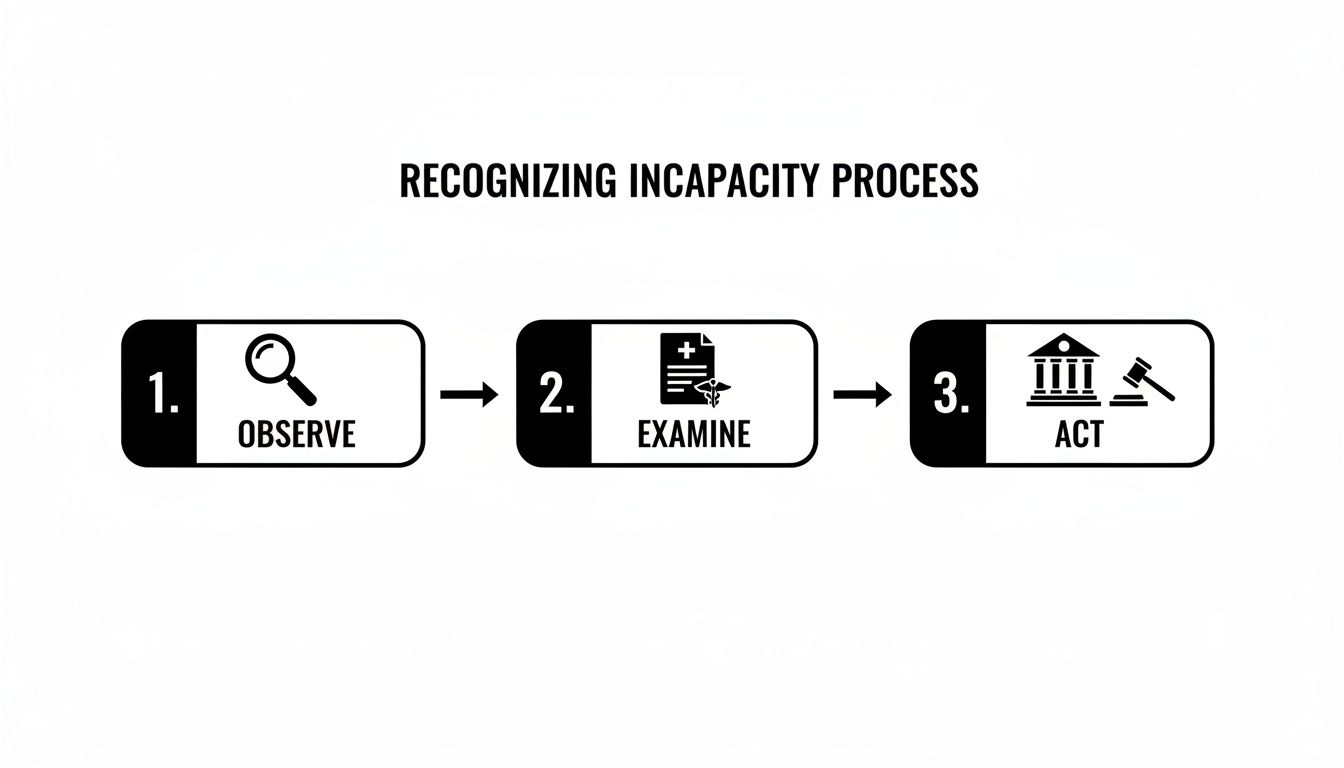
It highlights that seeking guardianship is a deliberate, thoughtful process. It starts with careful observation, moves to a formal medical examination, and only then proceeds to legal action.
Appointment of the Attorney Ad Litem
As soon as the application is filed, the judge will appoint an attorney ad litem. This is a crucial safeguard in Texas law. The ad litem is an independent attorney whose only job is to represent the proposed Ward's best interests and protect their rights.
This attorney will meet with your loved one in person to explain what's happening and what their rights are. They also interview you, review the medical evidence, and investigate the situation before filing a report with the court that summarizes their findings and makes a recommendation.
A Practical Example: Imagine the Martinez family in Houston is seeking guardianship for their father, who has advanced Parkinson's disease. After they file their application, the Harris County judge appoints an attorney ad litem. This attorney visits Mr. Martinez at home, speaks with his adult children, and reviews his medical records. He then tells the court whether he believes a guardianship is appropriate and truly in Mr. Martinez's best interest.
The Court Hearing
Every guardianship case in Texas requires a court hearing. As the applicant, you must attend and be ready to present your case to the judge. This is your chance to explain why your loved one needs this protection.
The standard of proof is high. You must prove by "clear and convincing evidence" that the proposed Ward is incapacitated and that appointing a guardian is in their best interest. This is a much higher legal bar than the "preponderance of the evidence" standard used in many other civil cases.
During the hearing, your attorney will guide you through your testimony and may call other witnesses. The judge will carefully consider all the evidence, including the CME and the report from the attorney ad litem. If the judge agrees that all legal requirements have been met, they will sign an order appointing the guardian and issue Letters of Guardianship—the official document granting you the legal authority to act.
When an Emergency Arises: Temporary Guardianship
Sometimes, a crisis won't wait. A loved one might be facing immediate physical harm or falling victim to severe financial exploitation, and the standard process is just too slow.
In these urgent moments, the Texas Estates Code allows for an Emergency or Temporary Guardianship. This is a much faster process designed to put protections in place within a matter of days. A temporary guardianship typically lasts for 60 days, giving you the authority to handle the immediate crisis while you work toward a more permanent solution.
The guardianship process is detailed for a reason—it’s designed to protect everyone involved, especially the person who may need help. If you have questions about getting started, our compassionate team at the Law Office of Bryan Fagan is here to help. Schedule a free consultation for personalized guidance.
Exploring Alternatives That Preserve Independence
When a loved one’s ability to make decisions is in question, many families assume guardianship is the only path forward. But in Texas, guardianship is a last resort—and for good reason. It’s a profound legal step that removes an individual's basic civil rights.
Because the stakes are so high, Texas law requires courts to consider every less restrictive alternative first. Planning ahead is one of the most powerful things you can do. By putting the right legal tools in place before a crisis hits, your loved one maintains control, choosing who they trust to act on their behalf. This preserves their dignity and avoids a stressful, public court process.
Let's look at the most common and effective alternatives to guardianship.
Durable Power of Attorney for Financial Matters
A Durable Power of Attorney is a cornerstone of any solid plan. This legal document lets your loved one appoint a trusted person (known as an “agent”) to manage their financial and property affairs. The word “durable” is key—it means the document stays in effect even if they later become incapacitated.
Without one, your family would have no legal authority to access their bank accounts to pay bills, file taxes, or manage investments. You’d likely be forced to seek guardianship just to handle routine financial tasks.
A properly drafted Durable Power of Attorney allows the agent to:
- Pay monthly bills and manage daily expenses.
- File tax returns on your behalf.
- Manage real estate and other property.
- Oversee investment or retirement accounts.
It’s a private, efficient way to manage finances without court intervention and an essential part of any comprehensive Estate Planning.
Medical Power of Attorney for Healthcare Choices
While the Durable Power of Attorney covers finances, the Medical Power of Attorney is all about healthcare. This document allows your loved one to name an agent who can make medical decisions for them if they become unable to communicate their own wishes.
This is invaluable during a medical emergency. Instead of doctors and family members being left in limbo, the chosen agent can speak with the medical team and make critical choices that honor the person’s values.
Imagine your mother has a sudden stroke and is unconscious. Without a Medical Power of Attorney, doctors might have to wait for a court to appoint a guardian before proceeding with non-emergency care. With one, the agent she appointed can immediately step in to approve the doctor's recommended treatment plan.
Directive to Physicians and Family or Surrogates (Living Will)
A Directive to Physicians, often called a "Living Will," serves a very different but equally important purpose. It doesn't appoint an agent. Instead, it’s a direct, written instruction from your loved one to their doctors.
It clearly states what kind of life-sustaining treatment they would or would not want if they are diagnosed with a terminal or irreversible condition. This document speaks for them when they can no longer speak for themselves. It lifts the gut-wrenching burden from family members of having to guess at such personal and profound end-of-life choices.
Supported Decision-Making Agreements
A more recent and collaborative alternative is the Supported Decision-Making Agreement. This tool is perfect for adults who can still make their own choices but might need some help understanding their options, processing information, and communicating their decisions. It’s an excellent fit for many individuals with intellectual or developmental disabilities.
Through this formal agreement, the individual chooses trusted advisors—or "supporters"—to help them think through important issues. Crucially, the final decision-making power always remains with the individual. This approach is all about empowerment and self-determination. You can discover more about how supported decision-making works to see if it’s the right option for your family.
These alternatives offer a way to protect the people you care about while honoring their independence. If you're feeling overwhelmed and unsure which path is right for your family, scheduling a consultation with our team can provide the clarity and personalized guidance you need.
Understanding a Guardian’s Rights and Responsibilities

Becoming a guardian is more than a legal title. It’s a profound commitment and one of the most serious responsibilities you can take on. When a court appoints you, you are stepping into a position of immense trust, legally required to act only in the best interests of the person you are protecting—the “Ward.”
This isn't just a moral suggestion; it's a fiduciary duty, which is the highest standard of care recognized under Texas law.
In simple terms, you must manage the Ward's life and affairs with the same level of care you’d give your own, but every single decision must be for their benefit alone. Your own needs or convenience can't enter the picture.
Guardian of the Person vs. Guardian of the Estate
Your specific duties will hinge on whether the court named you Guardian of the Person, Guardian of the Estate, or both. These are two very different roles, each with its own set of responsibilities.
Guardian of the Person: This role is all about the Ward’s personal and medical well-being. You’ll be in charge of deciding where they live, making sure their environment is safe, arranging for daily care, and consenting to medical treatments on their behalf.
Guardian of the Estate: This role is purely financial. You’ll be tasked with managing the Ward's money and property. This means finding and securing all their assets, paying their bills, handling bank accounts, managing investments, filing taxes, and protecting their property from being lost or sold improperly.
For instance, a Guardian of the Person would be the one arranging for an in-home health aide and taking a loved one to their doctor’s appointments. The Guardian of the Estate would be responsible for selling the Ward’s rental property (with court approval) to generate the funds to pay for that care.
The Fiduciary Standard in Action
Being a guardian doesn't give you absolute power. Far from it. You operate under the strict supervision of the probate court, which serves as a critical safety net for the Ward.
To make sure you uphold this high standard of care, Texas law lays out several steps you must take to officially step into the role.
According to Title 3, Subtitle G of the Texas Estates Code, every guardian must formally qualify before they can act. This involves taking a sworn oath, posting a bond to protect the Ward’s assets against mismanagement, and filing official paperwork with the court.
These aren't just administrative hoops; they are fundamental safeguards. The court needs to be certain that you understand the seriousness of your duties and are financially accountable for every action you take. This is why having skilled legal counsel for your Probate and guardianship matters is so important.
Court Oversight and Mandatory Reporting
Once you are qualified, you are subject to the court's continuous oversight. This process creates transparency and holds you accountable for the decisions you make on behalf of the Ward. Your key reporting duties will include:
Inventory, Appraisement, and Claim for Allowance: Within 30 days of your appointment, you must file a complete and detailed inventory of all the Ward’s property with the court.
Annual Accountings: Every year, a Guardian of the Estate must file a detailed financial report, or "accounting," that shows every dollar that came in and every dollar that went out.
Annual Reports: A Guardian of the Person must also file a yearly report on the Ward’s physical and mental condition, living situation, and general well-being.
The reality is that most guardians—81.3 percent, according to one national study—are family members. They have a deep, personal reason for wanting to help but often lack formal training in these complex legal and financial duties. You can explore national best practices from organizations like the National Guardianship Association in their informative brief on guardianship trends.
Guidance from an experienced attorney is crucial to navigate these requirements, meet every deadline, and fulfill your responsibilities correctly. The Law Office of Bryan Fagan can provide the clarity and support you need.
Answering Your Questions About Adult Guardianship

When you're thinking about legal guardianship for an adult, it's normal for a flood of practical questions to surface. The path can seem complex, but you deserve clear answers to move forward with confidence. Here, we'll tackle some of the most pressing concerns we hear from Texas families just like yours.
We've designed these answers to be straightforward, helping you feel more prepared for what's next.
How Much Does Legal Guardianship for Adults Cost in Texas?
The total cost to establish a guardianship in Texas depends entirely on the complexity of the case. It’s helpful to think of it as an investment in your loved one’s safety and stability.
Several key factors will shape the final expense:
- Court Filing Fees: Every county, from Bexar to Travis, has its own fees for filing the initial application and subsequent documents.
- Attorney Ad Litem Fees: The court is required to appoint an independent attorney to represent your loved one's interests. This attorney's fees are a standard part of the process.
- Your Own Attorney's Fees: This cost reflects the amount of legal work your specific case demands.
An uncontested guardianship, where everyone is on the same page, might cost a few thousand dollars. However, if the situation becomes contested or involves complicated family dynamics, the costs can rise significantly. We always provide a transparent breakdown of expected costs during our free consultations.
Can Someone Contest a Guardianship?
Yes, absolutely. Any "interested person" has the legal right to contest a guardianship proceeding in Texas. This is one of the most common reasons the process can become more stressful and expensive.
A contest can arise for a few different reasons. For example, another family member might disagree that a guardianship is necessary at all. Or, they might agree a guardian is needed but challenge your fitness to serve, putting forward another name instead.
When a guardianship is contested, it becomes an adversarial trial where both sides must present evidence, call witnesses, and argue their case.
If you suspect a disagreement among family members, it is critical to partner with an experienced guardianship lawyer from day one. We can help you build a powerful case with clear and convincing evidence, showing the court exactly why your loved one needs this protection.
What if a Guardian Mismanages Their Duties?
Texas courts take the role of a guardian incredibly seriously. Strong oversight is built into the system to protect the Ward, and a guardian is held to a very high fiduciary standard. Failing to meet these duties comes with severe consequences.
If a guardian is misusing funds, neglecting the Ward’s needs, or simply failing to file their required annual reports with the court, any concerned person can act. They have the right to file a motion with the court demanding the guardian’s removal.
The court will investigate these claims thoroughly. If misconduct is proven, the judge has the power to:
- Immediately remove the guardian from their position.
- Appoint a new, qualified guardian to take over.
- Hold the former guardian financially liable for any misused assets or harm caused to the Ward’s estate.
Our firm is equipped to represent clients on both sides of these serious disputes, whether you are trying to remove a negligent guardian or defending yourself against false accusations.
How Does a Guardianship End in Texas?
A guardianship isn’t always permanent. The Texas Estates Code is designed so that a guardianship lasts only as long as it is legally required to protect the Ward.
The guardianship officially terminates under a few specific circumstances:
- The Ward's Capacity is Restored: If the Ward recovers from their condition and is no longer incapacitated, the guardianship can be ended.
- The Ward Passes Away: The guardianship automatically ends upon the Ward’s death.
- The Ward's Estate is Exhausted: In a guardianship of the estate, if all assets have been properly spent on the Ward's care, the guardianship may be closed.
To formally end the guardianship, a final motion must be filed with the court, providing proof that it’s no longer necessary. After the judge signs the termination order, the guardian must file a final accounting and distribute any remaining property as required by law. Our firm handles all aspects of Estate Planning and can guide you through this final step.
Navigating the complexities of legal guardianship for adults requires a steady, experienced hand. At The Law Office of Bryan Fagan, PLLC, we are committed to providing the compassionate and knowledgeable guidance your family deserves. If you have more questions or are ready to discuss your specific situation, we invite you to schedule a free, no-obligation consultation with our team. Let us help you protect the ones you love.