Skip to content
In Texas, a standard uncontested guardianship usually costs between $3,000 and $10,000. In simpler first-year cases with minimal assets and no litigation, families often see totals closer to $3,000 to $5,000, while contested cases can climb much higher.
When a parent's dementia is getting worse, a disabled child is turning 18, or a loved one can no longer manage money or medical decisions safely, you're probably also asking a second question right behind the first: who is going to pay for all of this? That's the part many families don't get clear answers on until they're already deep in the probate process.
Texas guardianship is a court-supervised proceeding under the Texas Estates Code, especially Title 3, Subtitle G. That means there are required steps, required professionals, and court oversight designed to protect the proposed ward. Those protections matter. They also cost money. The good news is that once you understand where the expenses come from, you can plan better, avoid preventable delays, and decide whether guardianship is the right tool.
The Primary Cost Components of Texas Guardianship
A family often walks into my office expecting one bill to start the case. What they face is a stack of separate charges, each tied to a different part of the court's review. That distinction matters, especially if the proposed ward has little money or no accessible funds yet.
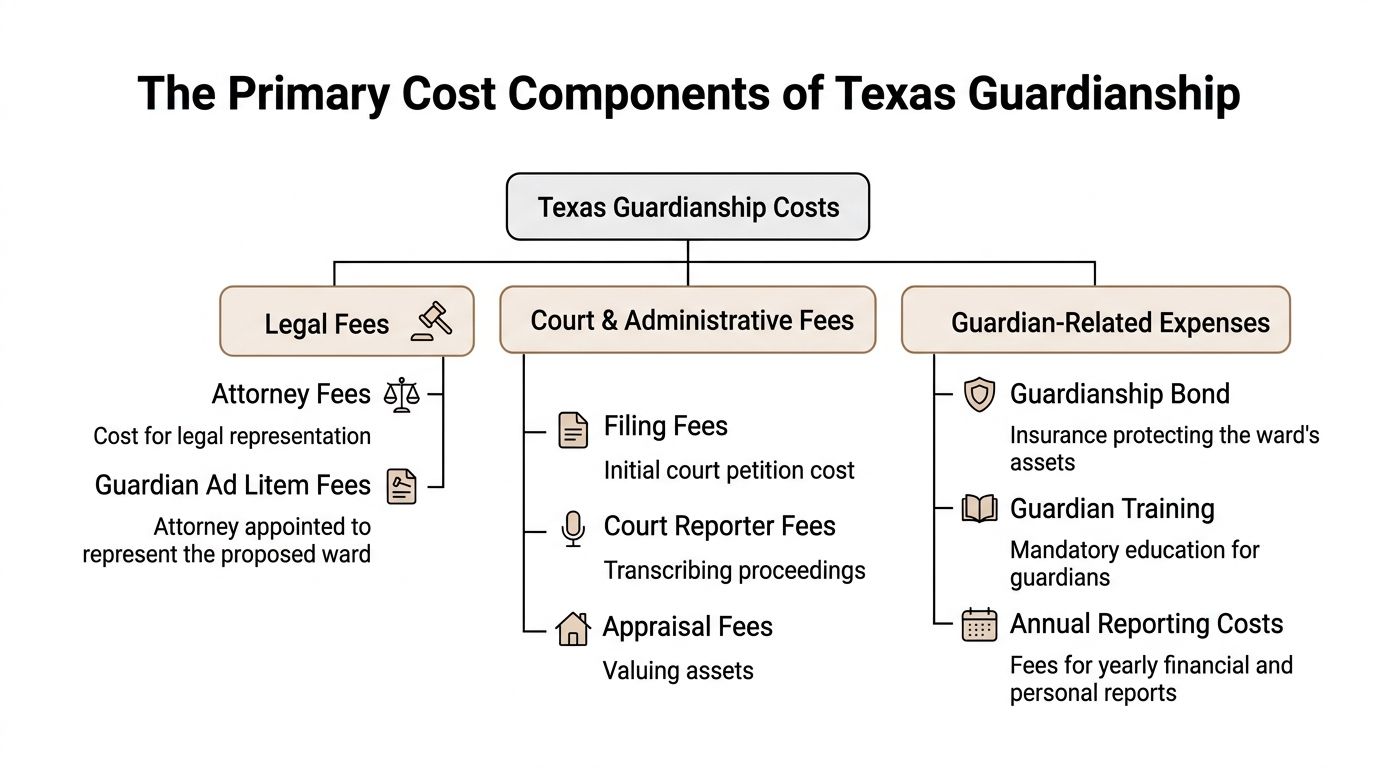
Texas guardianship costs usually fall into three buckets: court costs, professional fees, and property-related expenses if the guardian will handle money. Some are paid up front. Some are set by the court after appointments are made. Some do not appear until late in the case, which is why families feel blindsided if nobody explains the full picture early.
The costs that appear in many cases
In many Texas guardianship matters, families should plan for these categories:
- Attorney fees: Preparing the application, gathering records, handling service, preparing for the hearing, and dealing with court requirements usually makes legal fees the largest private expense.
- Court filing fees: These are paid to open the guardianship in the proper court and issue required notices.
- Medical evidence: The court needs current proof of incapacity. That may mean a physician's examination and a written certificate that meets Texas requirements.
- Attorney ad litem fees: The judge appoints an attorney to represent the proposed ward's interests. Families are often surprised by this charge because it is separate from the applicant's lawyer.
- Guardian ad litem or court investigator fees: Some courts appoint another neutral professional to investigate the facts and report back to the judge.
These are not extras the court adds for convenience. They exist because a guardianship can limit a person's legal rights, so the court builds in independent review.
Costs families miss when they build a budget
The missed items are usually the painful ones.
If the guardianship includes the estate, the court may require a bond before letters of guardianship are issued. That means a premium must be paid, and the amount usually tracks the size and character of the assets being protected. If property management may be part of your case, read about the Texas guardianship bond requirement for estate cases early, not after the judge signs the order.
There can also be charges for certified copies, service of process, background checks in some situations, and obtaining medical records. None of these items is usually the largest expense alone. Together, they can change a family's budget by hundreds or thousands of dollars.
What if the proposed ward has no money
This is the scenario many articles skip.
If the proposed ward has no available funds, the applicant often pays costs up front and later asks whether reimbursement from the ward's estate is allowed. Whether that happens depends on the facts, the court, and whether assets exist to reimburse anyone. If the person owns a home but has no liquid cash, the case can still be expensive because the bills come due before the property can be sold or before anyone gets authority to act.
That is why cost planning at the beginning matters. Families should ask, before filing, who can cover the first round of expenses, whether any assets are reachable quickly, and whether a less restrictive option could solve the immediate problem at lower cost.
A practical way to look at the total
A straightforward case can still involve several payees. One check may go to the clerk, another to the physician, another to your lawyer, and later another to a court-appointed attorney or investigator. If the case includes property, bond expense may follow. If the proposed ward has no checking account access or no liquid assets, timing becomes as important as total cost.
I tell families to build two budgets, not one. First, estimate what the full case may cost. Second, estimate what must be paid before the hearing.
If you're trying to understand the filing path itself, How to Get Guardianship in Texas: The Process gives a step-by-step look at the court process for establishing a guardianship.
For families comparing court-supervised expenses across states, this guide to managing probate property costs in Arizona is a helpful contrast. The procedures are different, but the budgeting lesson is similar: court oversight creates layers of cost, and families do better when they identify those layers before filing.
How Case Complexity and Location Affect Your Final Cost
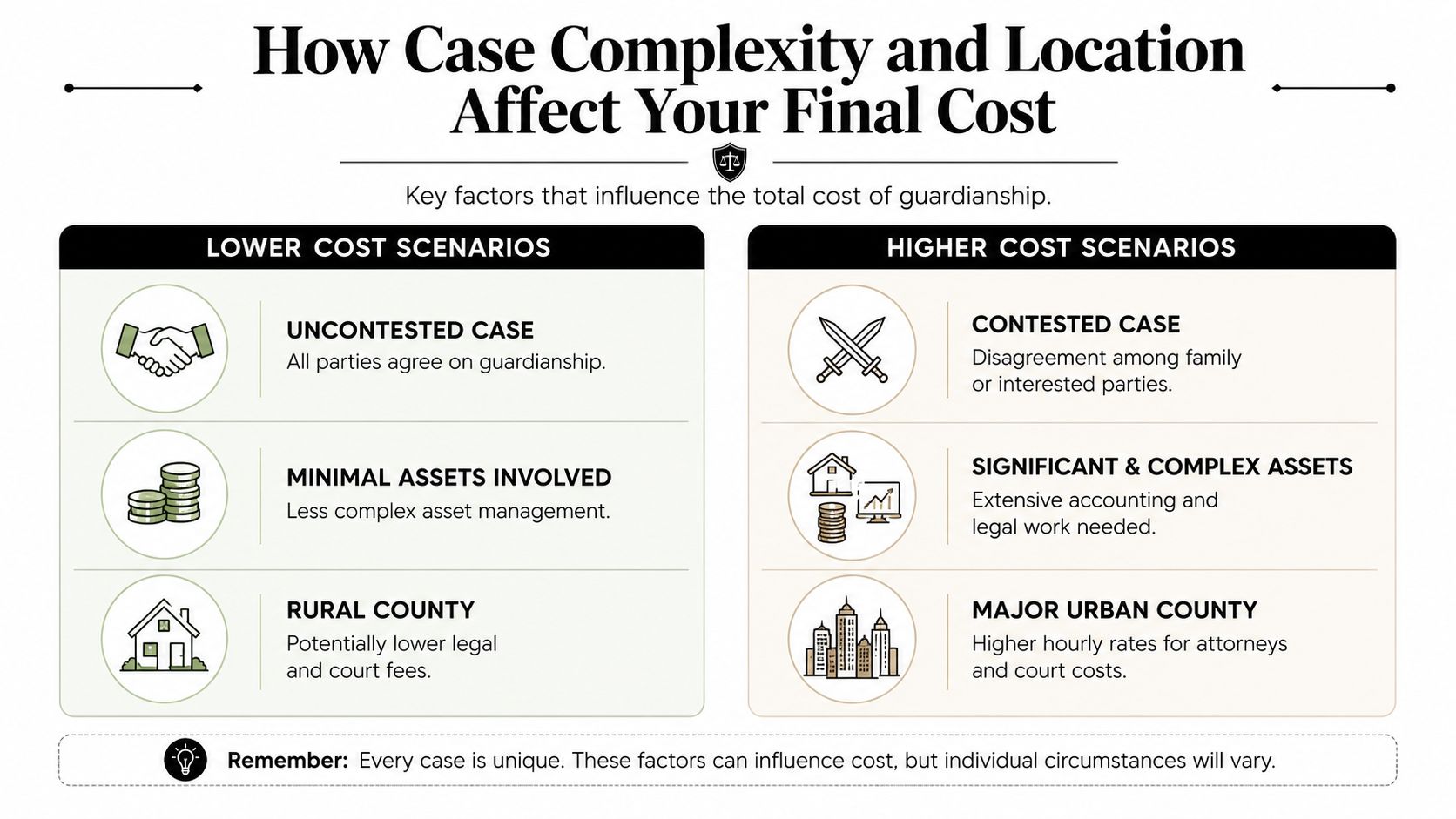
A daughter in Dallas and a son in a rural county can both be trying to protect a parent with the same diagnosis, and still face very different guardianship bills. The reason usually is not the diagnosis itself. It is whether anyone objects, how fast the court needs to act, and whether the case requires extra professionals to step in.
Uncontested versus contested cases
The biggest cost swing usually comes from conflict.
In a cooperative case, the family agrees guardianship is needed, agrees on who should serve, and provides the medical proof the court expects. Those cases are still work, but the fees stay more predictable because the lawyer is preparing one path to a hearing instead of responding to objections, setting extra hearings, and gathering rebuttal evidence.
A contested case costs more because each disagreement creates another layer of work. One sibling may claim the proposed guardian is unfit. The proposed ward may object. A dispute over who controls the home, bank accounts, or medical decisions can pull the case into discovery, witness preparation, and expert testimony. That is where fees rise fast.
I tell families to ask a blunt question before filing: is anyone likely to fight this? If the answer is yes, budget for a contested matter from the start, even if you hope the case settles.
Temporary or emergency guardianship can also increase the final bill. The court may hear the case quickly, but speed creates pressure. Medical records have to be gathered fast, witnesses may need to be prepared on short notice, and your lawyer may need to clear a schedule to get the application ready immediately. Fast relief can be necessary. It is rarely the cheaper route.
Later in the process, many families find this overview helpful before a hearing:
Location affects more than the filing fee
County filing fees differ, but the clerk's fee is only part of the story.
Local court practices can change how much attorney time a case requires. Some courts expect tighter documentation on the front end. Some require appearances that are brief but still billable. In larger counties, families may also see higher hourly rates for attorneys, ad litems, investigators, or physicians willing to complete the required capacity paperwork.
Scheduling matters too. If a court has a crowded docket, delays can increase the amount of follow-up work needed before the hearing. If a county has fewer professionals available, the family may spend more time locating a qualified doctor or arranging service. Those are not always large line items by themselves, but they add up.
The "what if" problems that change the budget
Some of the hardest cost issues do not show up on a basic fee chart.
If the proposed ward has no available cash, someone usually has to advance the early expenses. That may mean a child pays filing fees, the doctor's evaluation, and part of the attorney's retainer before the court can do anything. Reimbursement may be possible later if the court approves it and assets become available, but families should not assume immediate repayment.
If there are assets but they are frozen, inaccessible, or tied up in real property, timing becomes the primary problem. A person may own a house and still have no practical way to fund the first stage of the case. In that situation, ask the attorney which costs must be paid first, which can wait for court approval, and whether a narrower filing or temporary relief would solve the immediate safety issue with less upfront spending.
If the only reason the family is considering guardianship is to sign paperwork, pay bills, or make one category of decisions, it is worth pausing to ask whether a less restrictive option could avoid a full court case. Families also save money later when they understand the annual accounting requirements for a Texas guardianship before they choose a guardianship of the estate.
Cost-saving steps that actually help
Families usually reduce avoidable expense by handling the practical problems before filing:
- Confirm the correct county and court before paperwork is prepared.
- Gather medical records and physician information early, so the application is supported the first time.
- Identify likely objections from siblings, spouses, or adult children and address them before the hearing is set.
- Separate urgent safety problems from long-term family disagreements. The first issue may need court action. The second often needs a plan, not a courtroom fight.
- Ask who will front the initial costs if the proposed ward cannot access funds yet.
That last point gets missed often. A family can be fully justified in seeking guardianship and still get stuck because no one planned for the first dollars out the door.
Understanding the Ongoing Costs of a Guardianship
A family gets through the hearing, the judge signs the order, and everyone feels some relief. Then the first renewal notice, annual report deadline, or bond invoice arrives. That is the point when many families realize the filing cost was only the front end of the commitment.
Bond costs for guardians of the estate
A guardianship of the estate usually brings a continuing bond requirement. The court sets the bond amount to protect the ward's property if money is mishandled, and the premium is usually paid again each year, not once at appointment.
That recurring charge matters most in cases where the ward has assets on paper but little cash available. For example, a ward may own a house yet have no ready funds to pay bond premiums, court costs, tax prep, or help with the annual accounting. In that situation, the guardian may need to advance costs personally and then seek reimbursement if the court approves it. Families should ask that question early, before accepting appointment.
Annual reporting and accounting
Texas guardianships stay under court supervision. A guardian of the person may have to file an annual report about the ward's condition, living arrangements, and care. A guardian of the estate has stricter financial reporting duties and must be prepared to show where money came in, where it went, and why each transaction served the ward's best interest.
The cost here is not just the filing fee. It is the time and recordkeeping behind the filing.
Guardians who keep clean records from the start usually spend less later. Guardians who mix receipts together, miss bank statements, or wait until the deadline often end up paying an attorney or accountant to reconstruct the year. Families who want a clearer picture of those court expectations should review the annual accounting requirements in a Texas guardianship before the first reporting deadline arrives.
The expenses families do not plan for
The ongoing costs that cause the most stress are often the ones no one mentioned at the kitchen table. Certified copies of orders, updated letters of guardianship, attorney time for court questions, bookkeeping help, tax return preparation, bond renewals, and occasional hearings over sales of property or disputed spending can all add to the total.
If the ward has no assets, the pressure is sharper. Someone may need to front routine expenses while waiting for authority to access funds, or while there are no funds at all. In those cases, the practical question is simple. Who is paying month to month to keep the guardianship compliant?
Rights, duties, and termination issues
A guardian also takes on daily financial discipline. Funds must stay separate. Court limits must be followed. Records need to be accurate enough that a stranger could understand them a year later. Sloppy administration creates legal risk and often raises the cost of fixing the problem.
Guardianship can be modified or ended if circumstances change, but until the court signs a new order, the reporting and compliance duties continue. That is why families should treat ongoing cost as part of the original decision, not as an afterthought once the case is won.
Practical Strategies to Manage and Reduce Guardianship Expenses
A common scenario looks like this. An adult child knows a parent is no longer safe managing money or medical decisions, but there is no savings account to draw from, no trust, and no clear way to pay court costs up front. That is the point where cost planning matters as much as the legal filing.

Start by confirming guardianship is really the right tool
The cheapest guardianship is the one you do not have to file.
Texas courts expect families to consider less restrictive options first, and for good reason. Guardianship removes rights and brings court supervision with it. In some cases, a better path is already available through:
- Durable power of attorney: Useful if the person still had capacity when signing it and the document is broad enough for the current problem.
- Medical power of attorney: Often enough for treatment decisions without opening a full guardianship case.
- Supported decision-making agreement: Sometimes workable for adults who need help understanding choices but can still participate.
- Limited guardianship: A narrower request can reduce both conflict and expense if only certain decisions need court oversight.
These options fail in predictable situations. Capacity may already be gone. A bank may reject an old power of attorney. Siblings may be fighting. If that is your family's reality, filing for guardianship may still be the right call. The point is to test the alternatives before spending money on a process the court may view as broader than necessary.
The hardest cost problem is the ward with no assets
Families are often surprised by this issue because many articles assume the proposed ward can pay from an estate. Sometimes there is no estate to use.
If the proposed ward has little or no money, the person filing may need to pay initial costs personally while the case is pending. That includes filing fees, service costs, medical evidence, and court-appointed professional fees. In practice, this financial burden often causes families to struggle. They are trying to protect a vulnerable person and also asking, very plainly, who is writing the checks this month.
That question should be answered early, not after the application is filed.
What to do when money is tight
Cost control in a guardianship case usually comes from better planning, a narrower request, and fewer avoidable disputes.
Ask about a fee waiver before filing
Some applicants may qualify to reduce or defer certain court costs. This depends on the county and the facts, so ask at the start.Bring organized records to the first meeting
Gather IDs, addresses, family contact information, medical records, insurance information, prior planning documents, and a simple asset list. Lawyer time spent chasing missing basics increases the bill fast.Define the actual problem the court needs to solve
If the urgent issue is access to medical decision-making or stopping financial exploitation, say that clearly. A focused case is often less expensive than a broad application that invites objections.Look hard at whether limited guardianship will work
Families sometimes ask for full authority out of fear. The court may not think full authority is justified. A narrower request can reduce attorney time, resistance from relatives, and later compliance issues.Screen for conflict before papers are filed
One angry sibling can change the budget more than any filing fee. If a dispute is likely, address it early with clear facts and documents instead of hoping it stays quiet.Ask whether any step can be handled in phases
Some lawyers can separate the initial appointment work from later help with inventories, reports, or accountings. That lets families budget in stages instead of paying for every service at once.Use the consultation to compare legal tools, not just prices
A lower quote is not always the lower total cost if the strategy is too broad or likely to be contested. Families often get better value by reviewing questions to ask an estate planning attorney before choosing a guardianship strategy and using those questions in the first meeting.
A practical warning about trying to save money the wrong way
Do not cut corners on medical evidence, notice requirements, or financial records.
Those shortcuts often create delay, extra hearings, amended filings, or court concerns about whether the guardian is prepared to serve. I have seen families spend more fixing a rushed filing than they would have spent doing the initial work carefully.
A factual consultation with a firm such as Law Office of Bryan Fagan, PLLC can help a family sort out whether a full guardianship, a limited guardianship, an emergency filing, or a different protective arrangement makes financial sense. That early case screening is often where the greatest savings happen.
Key Questions to Ask a Guardianship Attorney About Fees
A consultation shouldn't feel like a vague conversation about "average cost." It should give you a roadmap.
Questions that get real answers
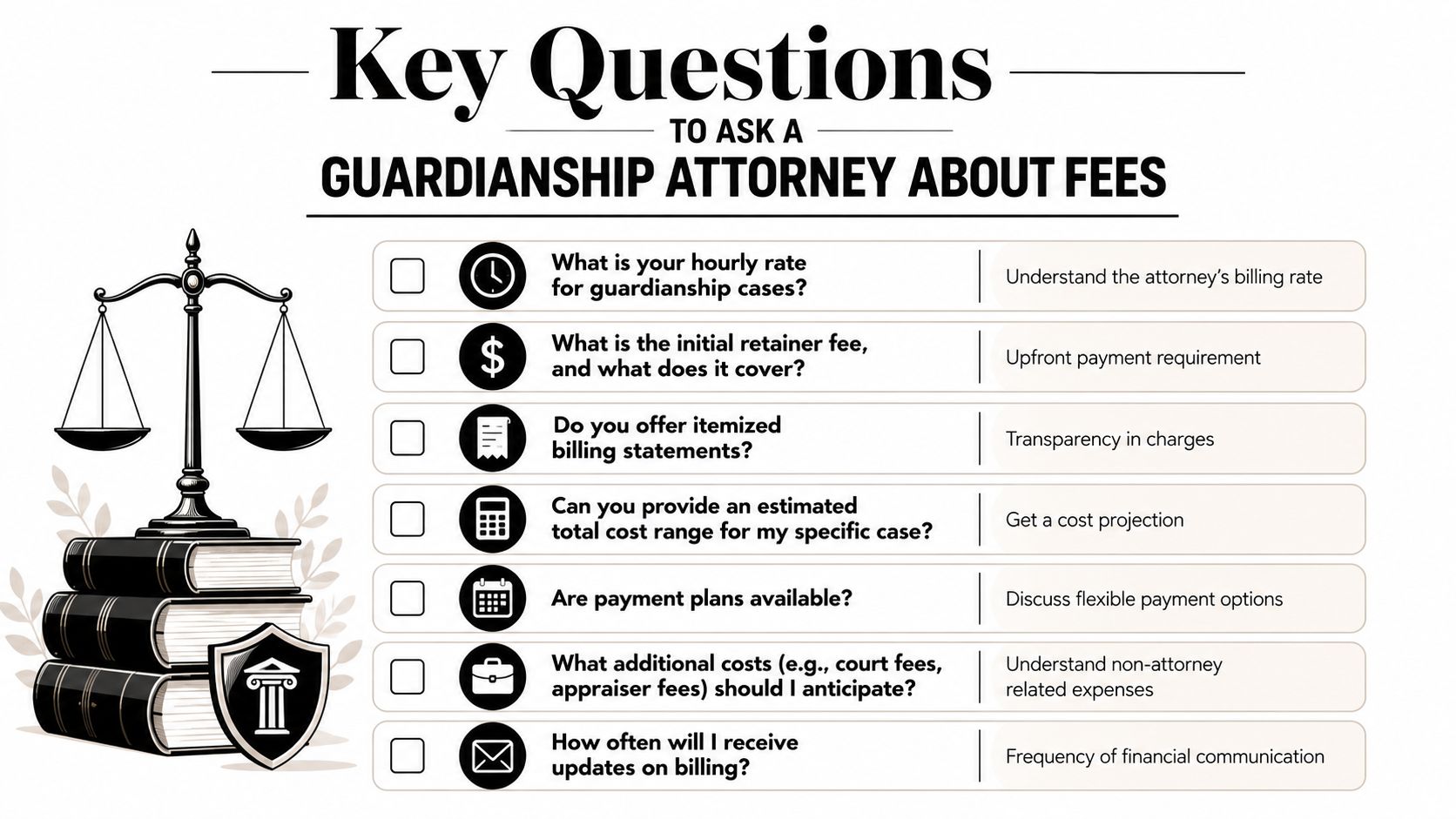
Bring a written list and ask direct questions like these:
- How do you charge for guardianship cases? Ask whether the case is billed hourly, by flat fee, or by phase.
- What does your estimate include? Some estimates cover only attorney work and not court-appointed professionals.
- What facts in my family could make this cost go up? This is often the most useful question in the room.
- Who pays the ad litem fees? You need to understand whether those costs are expected up front.
- What will I have to pay after the hearing? Many families forget to ask about annual compliance costs.
- How do you handle emergency or temporary guardianship filings? Fast action may change the fee structure.
- If someone contests the case, what happens to the estimate? You want this answer before conflict starts.
- Will you help with post-appointment duties? Some lawyers handle appointment only, while others also help with reports, accountings, and later modifications or termination.
Documents to bring
A consultation is far more productive when you arrive with a short file, not just a story.
| Bring this | Why it helps |
|---|---|
| Medical records or diagnosis summaries | Shows whether incapacity evidence is likely sufficient |
| Existing powers of attorney or directives | Helps determine whether guardianship is avoidable |
| Names of close relatives | Notice requirements matter early |
| Basic asset information | Helps assess whether estate issues and bond concerns exist |
This related checklist on questions to ask an estate planning attorney is also useful because many guardianship cost issues overlap with incapacity planning.
A good attorney won't promise a perfect number on day one. But a prepared consultation should still give you a realistic range, likely cost drivers, and a plan for keeping the case under control.
Frequently Asked Questions About Texas Guardianship Costs
Who usually pays for a Texas guardianship case
A common problem comes up fast. An adult child needs to file because a parent can no longer manage medication, money, or safe housing, but the parent has almost no cash available to cover the filing.
In Texas, the answer is often practical before it is legal. Families frequently pay costs up front so the case can get filed and heard on time. If the proposed ward has assets and the court approves payment from those assets, some expenses may later be reimbursed or paid through the estate. If the proposed ward has little or nothing, the applicant may end up paying a large share personally.
That is why the first budget question should be simple. Who can write the checks in the next 30 to 60 days?
Can I file without a lawyer to save money
You can try, but the key question is whether self-filing will lower the total cost.
Guardianship cases involve more than forms. The court will expect proper pleadings, medical evidence, service, notice to relatives, and compliance with Texas Estates Code procedures under Title 3, Subtitle G. If the paperwork is incomplete or notice is handled incorrectly, the case can stall. A delayed case often means another filing expense, more missed work, and more stress for the family.
For some families, the least expensive path is not doing everything alone. It is paying for limited legal help at the points where mistakes are expensive.
Are temporary or emergency guardianships more expensive
Often, yes.
The extra cost usually comes from speed. A lawyer may need to gather records quickly, prepare emergency papers on short notice, contact the court immediately, and get witnesses or providers lined up for a fast hearing. Courts do not charge more because a family is under pressure. The added expense usually comes from the amount of work that has to be done in a very short time.
If an emergency is developing, ask for two numbers. Ask what it will cost to seek immediate relief, and what it will cost to carry the case through a full guardianship if the court requires a second phase.
Can a guardian be paid
Sometimes, but families should not assume guardianship creates a paycheck.
Texas law limits compensation, especially for a guardian of the person. In plain terms, the court controls what compensation is allowed, and family members usually cannot just pay themselves for all the time they spend helping. That matters in real life because many relatives expect the role to at least offset lost time from work. In many cases, it does not.
Guardianship is usually a duty first, not an income source.
Are a guardian's personal expenses reimbursable
They often can be, if the expense was reasonable, related to the ward, and properly documented.
Mileage, supplies, care-related purchases, and similar out-of-pocket costs may be recoverable in the right case, but sloppy records create problems quickly. Keep receipts. Keep a simple log. Keep the ward's funds separate from personal money at all times. If reimbursement will matter to your household budget, ask the attorney and the court process questions early rather than assuming those expenses will be paid back later.
What if my parent already signed powers of attorney
A signed durable power of attorney or medical power of attorney may solve the problem without a guardianship. Sometimes it does not.
The document may be too narrow. A bank may reject it. Other family members may accuse the agent of abuse. The parent may have signed it when capacity was already questionable. In those situations, a family can spend money preparing for guardianship while also examining whether the existing documents still work.
That review is worth doing before filing. If a valid alternative exists, avoiding guardianship can save substantial court costs and ongoing reporting expense.
What if the proposed ward has no assets at all
This is one of the hardest situations, and many articles skip it.
If there are no meaningful assets, no available credit, and no one in the family can comfortably advance fees, the cost issue becomes a case-planning issue. Ask whether a full guardianship is necessary or whether a narrower step could solve the immediate problem. For example, the family may need a benefits representative, a medical decision solution, or help accessing a facility placement process instead of a full guardianship over person and estate.
Ask the attorney to separate required costs from optional work. Ask what can wait. Ask whether filing only for guardianship of the person makes more sense than asking for authority over the estate too. Narrower requests can reduce both start-up costs and future compliance costs.
Does guardianship always last forever
No.
Some guardianships remain in place for years, but they can be modified or terminated if the ward improves, if a less restrictive option becomes workable, or if the court decides the scope should be reduced. That matters for cost planning because the cheapest long-term choice is sometimes a limited guardianship that fits the actual problem, not the broadest order possible.
Families often save money by asking for only the authority they need. Courts tend to view that approach more favorably too.
Your Next Step Toward Peace of Mind
The answer to how much does guardianship cost in Texas is never just one number. It's a mix of filing fees, medical proof, court-appointed professionals, attorney time, and, in many cases, ongoing reporting and bond costs. The legal system builds those layers in to protect vulnerable people.
That doesn't make the process easy for families. It does make planning essential.
If you're considering guardianship for a parent, adult child, spouse, or another loved one, gather the basics now. Collect medical records, prior planning documents, names of close relatives, and a rough picture of assets and income. Ask whether a limited guardianship, temporary guardianship, or an alternative to guardianship might work better. If a dispute is brewing, don't wait for it to explode at the hearing.
Compassion matters here. So does candor. Families deserve a clear explanation of what the court requires, what it will likely cost, and what can be done to protect both the loved one and the family's finances.
The most useful first step is personal advice based on your county, your family dynamics, and your loved one's condition. A free consultation can help you understand whether you're facing a straightforward filing, an emergency matter, a contested case, or a situation where a less restrictive alternative may be enough.
If you need practical guidance on Texas guardianship, probate, or estate planning issues, schedule a free consultation with Law Office of Bryan Fagan, PLLC. We can help you understand the likely costs, the court process in counties such as Harris County, and the options available for protecting your loved one with clarity and care.