Skip to content
A lot of families reach this point privately.
A daughter notices her father is paying the same bill twice and forgetting medical appointments. A parent of an adult child with disabilities realizes school services have ended, but the need for support hasn't. A sibling learns a vulnerable brother has been targeted by someone trying to access his money. The question arrives with a mix of love, fear, and guilt: do we need guardianship?
In Texas, guardianship can protect a disabled adult, but it also places legal limits on that person's rights. That's why courts treat it seriously. Families often come in thinking the hearing is the hard part. In practice, the hardest part is usually deciding whether guardianship is necessary, preparing the right proof, and understanding the long-term duties that start after the judge signs the order.
When seeking guidance on guardianship of a disabled adult in Texas, a practical approach is most helpful. You need to know what the court wants, what can delay a case, when emergency action may be possible, what alternatives must be considered first, and what life as a guardian looks like after appointment. In counties such as Harris County, Dallas County, Bexar County, and Travis County, those details matter.
Navigating a Difficult Crossroads
The family usually sees the problem before the court ever does.
A mother may still recognize her children but no longer understand banking, medications, or contracts. An adult son with a developmental disability may do well with routine but struggle to consent to treatment or protect himself from exploitation. In both situations, loved ones are trying to balance two values that can feel like they're pulling in opposite directions: safety and independence.
That tension is normal. It's also why Texas guardianship law is built to slow families down just enough to ask the right questions.
What families are often feeling
Those considering guardianship aren't trying to control a loved one. They're trying to stop a crisis from getting worse. They're worried about missed care, unsafe housing, unpaid bills, scams, or a vulnerable adult signing documents they don't understand.
Guardianship isn't a punishment. It's a legal tool the court may use when support alone isn't enough to keep someone safe.
Families also worry about conflict. One sibling may think guardianship is overdue. Another may think it goes too far. A proposed ward may oppose it entirely. Those disagreements don't always mean someone is acting badly. Sometimes they mean the family is facing a hard legal and moral decision with incomplete information.
A simple example
Take a hypothetical Harris County family. Their adult daughter has significant cognitive limitations and can't manage medical decisions on her own. For years, her parents handled everything informally. Then a hospital asks for legal authority. A bank refuses to discuss her account. A landlord wants a signature she can't meaningfully provide. What worked at home stops working in the outside world.
That's where guardianship law enters the picture. It creates court-supervised authority, but only if the evidence supports it and only to the extent the person needs protection.
What Is Guardianship of a Disabled Adult in Texas
Under Texas Estates Code Title 3, Subtitle G, guardianship is a court process used to appoint someone to act for an adult who can't adequately care for themselves or manage their affairs. The adult under guardianship is commonly called the ward. The person asking to be appointed is the proposed guardian.
Texas courts focus on function, not labels alone. A diagnosis matters, but the court wants to know what the person can and can't do in daily life.
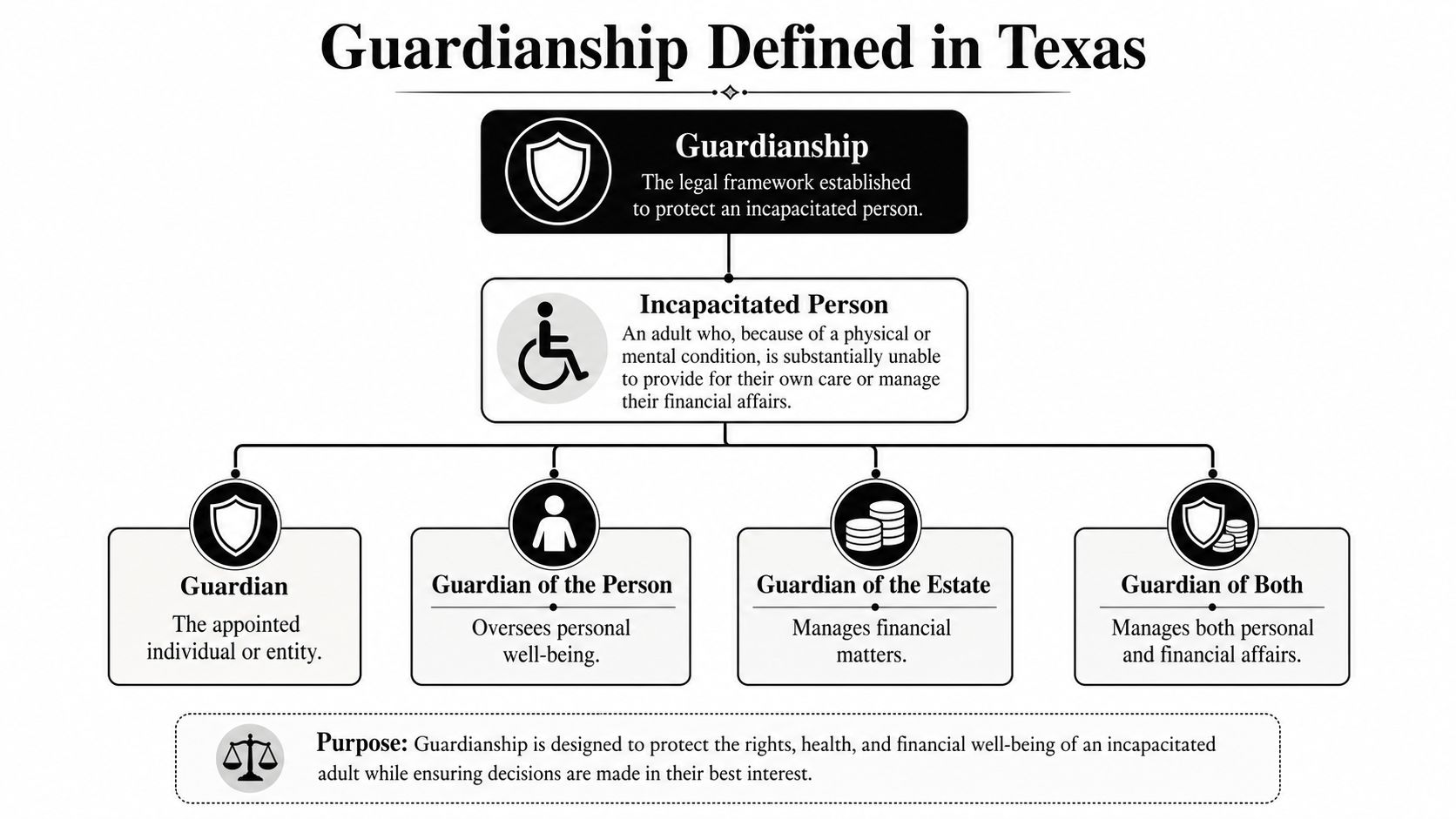
The two main forms of guardianship
Think of guardianship as legal authority that can come in different keys.
| Type | What it generally covers | Common example |
|---|---|---|
| Guardian of the Person | Personal care, medical decisions, and living arrangements | Choosing care providers or approving treatment |
| Guardian of the Estate | Money, property, and financial management | Handling accounts, bills, or property issues |
| Guardian of Both | Both personal and financial authority | A case involving broad support needs |
If you want a deeper overview of how a court establishes this authority, Guardianship of an Incapacitated Adult in Texas describes how a court establishes guardianship for an adult who cannot manage their affairs.
What the court requires
Texas doesn't grant guardianship just because a family is worried. The law requires proof. According to the Texas Health and Human Services adult guardianship guide, the application must include a written opinion from a licensed physician or psychologist certifying that the proposed ward lacks capacity to make decisions under Texas Estates Code § 1101.103(b)(6). That opinion must also address whether supports and services would help the person live in the least restrictive environment and which guardian powers should be limited if those supports are in place.
That requirement tells you a lot about how Texas views these cases. Courts aren't just asking, “Does this person have a disability?” They're asking, “What decisions can this person still make, what support might help, and what powers are essential?”
Who the court prefers to appoint
Texas courts generally prefer a close relative such as a spouse, parent, or adult child if that person is suitable. But preference isn't automatic entitlement. The applicant still has to show that less restrictive alternatives were tried and failed, or that they're inadequate to protect the proposed ward from abuse, neglect, or financial exploitation.
That's why some families are surprised when a judge doesn't readily accept a caring relative's word. Good intentions matter, but legal authority requires evidence.
The Texas Guardianship Court Process Step by Step
Most guardianship cases follow a steady sequence. Families who understand that sequence usually make better decisions and avoid preventable delays in probate court.

Filing in the right court
The case starts with an application filed in the proper court, often a probate court. In places like Harris County Probate Court or Dallas County probate court, filing errors can slow a case before it really begins. The application has to identify the proposed ward, explain why guardianship is needed, and specify whether the request is for the person, the estate, or both.
Families looking for a practical filing overview often start with this guide on how to file for guardianship in Texas.
The medical evidence that can make or break the case
The medical certificate isn't a side issue. It's central.
According to this Texas guardianship filing overview, the proposed ward must have a Physician's Certificate of Medical Examination obtained within 120 days of filing, and the certificate must describe the nature, degree, and severity of incapacity in enough detail to satisfy the court's clear and convincing evidence standard. If that certificate falls outside the 120-day window, the application is invalid and the family may have to start over.
Practical rule: Don't schedule the filing first and chase the medical certificate later. Coordinate both together so the certificate is current when the case is filed.
What the Johnson family might experience
Consider a hypothetical example. The Johnson family seeks guardianship for their mother, who has advanced memory loss and can no longer handle medication or finances. They file the application in the county probate court. The court then appoints an attorney ad litem to represent their mother's interests.
The attorney ad litem is not there to help the applicant. The attorney's job is to investigate, meet with the proposed ward, and help the court understand that person's rights, wishes, and circumstances. Families sometimes feel anxious about this, but it's an important safeguard.
A hearing follows. The judge reviews the application, medical evidence, and reports from the professionals involved. If the judge grants the guardianship, the work still isn't finished.
Here's a general video overview many families find useful before the first hearing:
What happens after the judge signs
After appointment, the guardian must complete post-order tasks before receiving legal proof of authority. Families often assume the signed order is enough. It usually isn't enough for banks, hospitals, and other institutions. They will typically want to see Letters of Guardianship once issued by the clerk.
That gap between courtroom success and practical authority is where many first-time guardians get confused.
When Immediate Action Is Needed Emergency Guardianship
Some cases can't wait for the normal pace of probate court.
A disabled adult may be in the hospital with no one able to authorize urgent care decisions. A caregiver may be diverting funds. A vulnerable adult may be in immediate physical danger or at risk of losing access to basic needs. In those situations, families often ask about temporary or emergency guardianship.
What makes a case an emergency
Emergency guardianship isn't a faster version of ordinary guardianship. It's a separate remedy for urgent danger. The court usually wants to see a present risk of serious harm to the person or the estate, not just concern that something could go wrong later.
Examples that may justify fast action include:
- Medical crisis where no valid decision-maker is available and treatment decisions can't wait.
- Active financial exploitation such as ongoing withdrawals, coercion, or unauthorized transfers.
- Unsafe living conditions where the adult faces immediate danger and no less restrictive measure can protect them quickly enough.
A family dispute by itself usually won't qualify. Neither will general frustration with an adult who makes poor but legally independent choices.
Why emergency relief is limited
Temporary guardianship is narrow for a reason. Courts use it as a short-term protective tool while the underlying facts are sorted out. Judges often limit the powers granted to what the crisis requires.
That means a family might get authority to address immediate medical placement or stop financial harm, but not broad permanent control over every aspect of the person's life. For many families, that feels frustrating. From the court's perspective, it protects the proposed ward from unnecessary loss of rights.
If you're facing a genuine crisis, this step-by-step guide on how to get emergency guardianship fast in Texas is one practical starting point.
In urgent cases, the strongest emergency filings tie the danger to a specific need for immediate court action. Judges respond to concrete facts, not broad fears.
Exploring Less Restrictive Alternatives to Guardianship
Texas law treats guardianship as a last resort. That's not a slogan. It's built into the process.
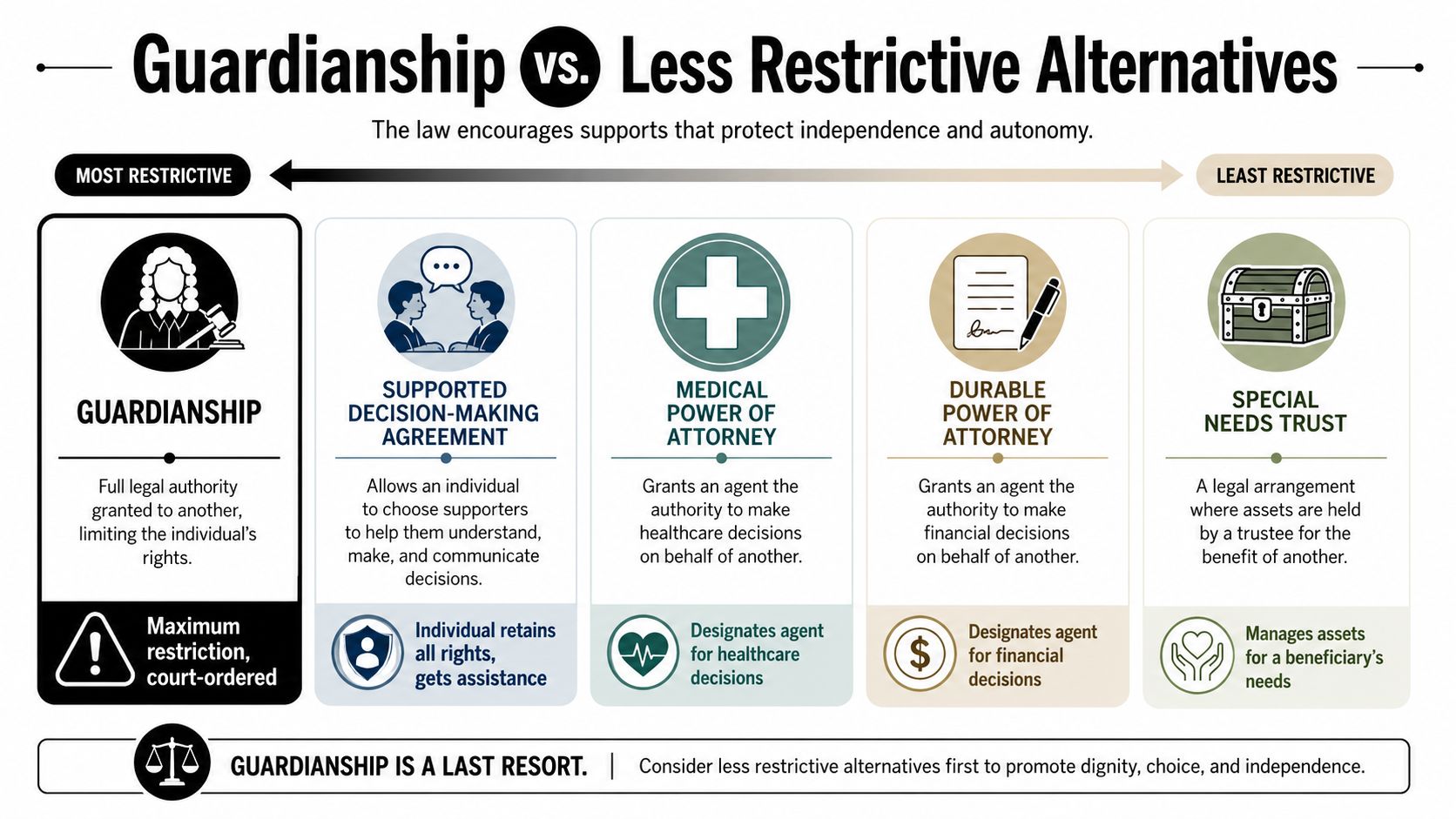
According to the Texas Governor's Committee on People with Disabilities guardianship resource, Texas Estates Code § 1054.151 requires a less restrictive alternative inquiry. A court investigator must consider whether supported decision-making, joint-decision agreements, or representative payee arrangements can meet the person's needs before a guardian is appointed. That inquiry can delay approval by 30 to 60 days depending on county resources. If a workable alternative exists, the guardianship application is denied.
Comparing the main options
Not every disabled adult needs a guardian. Some need support, not substitution.
| Option | Best fit | Limitation |
|---|---|---|
| Guardianship | The person cannot safely manage key decisions even with support | Most restrictive |
| Supported Decision-Making | The person can decide with help understanding choices | Requires meaningful ability to participate |
| Medical Power of Attorney | The person can sign before incapacity becomes too severe | Depends on capacity to execute |
| Durable Power of Attorney | Financial help is needed without court supervision | Same capacity concern |
| Special Needs Trust | Asset management is needed for long-term support | Doesn't replace personal decision-making |
| Direct Services | Daily support can solve practical problems without court orders | May not address legal authority gaps |
What works and what often doesn't
Supported decision-making works well when the adult understands choices with assistance and can communicate a preference. It doesn't work well when the person can't grasp the decision even after support is provided.
A power of attorney can be an excellent tool, but only if the person still has the capacity to sign it. Families often wait too long. By the time they ask about documents, the person may no longer be legally able to execute them.
Direct services also matter more than families expect. Case management, benefits help, residential support, and community-based programs can sometimes solve the practical problem that prompted the guardianship discussion in the first place. Social connection matters too. For adults seeking safe community and relationships, some families explore resources such as dating sites for disabled people to support independence and reduce isolation outside the legal system.
The best guardianship case is often the one you don't have to file because a less restrictive plan actually protects the person.
Life as a Guardian Fiduciary Duties and Annual Reporting
Winning the hearing is not the end of the job. It's the beginning of supervision.
Many online guides spend almost all their time on filing and almost none on compliance. That leaves families exposed. A Texas guardian is a fiduciary, which means the guardian must act in the ward's best interest, keep the ward's property separate, avoid self-dealing, and follow court rules closely.

The immediate duties after appointment
According to the Texas Law Help guardianship guidance, many resources overlook the post-appointment burden of rigorous financial accountability. That includes the 20-day deadline to sign an oath and post a bond, the 16-month expiration of Letters of Guardianship, and the demanding standards for annual reports and accountings required under the Texas Estates Code.
Those dates matter because missing them can create real legal problems.
Here's the short version of what a newly appointed guardian should focus on:
- Complete the oath promptly so the appointment can move forward without unnecessary delay.
- Post the bond when required if the guardianship includes estate authority.
- Finish required training before expecting full practical authority to function smoothly.
- Obtain and track Letters of Guardianship because institutions often ask for current letters, not just the order.
- Calendar renewal and reporting deadlines immediately, not months later.
The record-keeping standard families underestimate
The court expects more than rough notes and a shoebox of receipts.
If you manage the ward's money, treat every transaction as something a court auditor could review later. Keep bank records, invoices, receipts, benefit notices, care expenses, and explanations for major spending decisions. Don't mix ward funds with personal funds. Don't borrow from the ward. Don't make casual reimbursements without documentation.
For guardians dealing with estate reporting, this guide on annual accounting in Texas guardianship cases can help frame what the court expects.
Good guardianship practice is part caregiving and part disciplined paperwork. If either side is ignored, the guardian can end up in trouble.
Where disputes often begin
Guardianship disputes don't always start with bad intent. A daughter pays a facility bill from the wrong account. A brother sells property before getting court approval. A guardian forgets a reporting deadline because daily care consumed all available time.
Those mistakes can still trigger objections, audits, or removal efforts. In contested matters, courts look closely at documentation, compliance history, and whether the guardian respected the ward's rights.
For some families, working with counsel on the compliance side, not just the initial application, is the difference between a stable guardianship and repeated court problems. The Law Office of Bryan Fagan, PLLC handles guardianship applications, disputes, and ongoing compliance issues as one option for families who need that kind of support.
Common Questions and Your Next Steps
Families usually ask four questions first. How much will this cost? How long will it take? What if someone contests it? How does it end?
What does guardianship cost in Texas
Guardianship is often more expensive than families expect. According to this Texas guardianship cost breakdown, total initial expenses for a typical case average approximately $10,850. That same source states that filing fees usually range from $250 to $400, attorney fees for a standard case often range from $3,000 to $5,000, attorney ad litem fees typically range from $1,000 to $2,500, and medical or psychological evaluation fees commonly range from $500 to $2,000.
That doesn't mean every case costs the same. A straightforward uncontested case differs from a disputed one. But it does mean families should budget for more than just the filing fee.
How long does the process take
The honest answer is that it depends on the county, the medical evidence, the court investigator's schedule, and whether anyone objects. In a probate court with a crowded docket, delays can come from something as simple as an outdated medical exam, incomplete pleadings, or unresolved questions about alternatives.
If the case is contested, the timeline usually stretches. If the proposed ward's wishes differ from the applicant's plan, the attorney ad litem's position can heavily shape the path forward. In counties with active probate dockets, families should prepare for a process that requires patience.
Can someone contest a guardianship
Yes. A proposed ward can object. So can relatives or other interested persons. Disputes commonly involve whether the person is incapacitated, whether guardianship is necessary at all, who should serve, or whether the proposed guardian is suitable.
In real life, these disputes are often about trust. One sibling believes another is too controlling. A parent and adult child disagree about placement. A professional caregiver raises concerns about how family members handle money. Courts sort those disputes by evidence, not family rank.
Can a guardianship end
Yes. Guardianship can be modified or terminated if it's no longer needed, if a less restrictive arrangement becomes appropriate, or if the guardian fails to perform the role properly. Some wards improve. Some arrangements become overbroad for the person's actual needs. Some guardians cannot continue.
Families should also think about related planning issues. Guardianship cases often overlap with probate matters and estate planning decisions, especially when the disabled adult has assets, receives benefits, or may need a trust-based plan instead of broad court supervision.
One final point matters more than any checklist. Guardianship law is deeply personal. The right answer for your family depends on capacity, risk, family dynamics, available supports, and what level of court involvement is truly necessary. A guide can clarify the road. It can't make the judgment call for you.
If you're weighing guardianship of a disabled adult in Texas, schedule a free consultation with Law Office of Bryan Fagan, PLLC. A lawyer can help you evaluate alternatives, prepare the right medical and court filings, respond to disputes, and build a plan that protects your loved one while respecting their dignity.