Skip to content
A lot of families land here in the middle of a hard week. A parent has died. A grandparent is suddenly caring for a child. An insurance check, inheritance, or settlement is about to be paid to a minor. Everyone agrees the child needs protection, but nobody is sure what the court requires or how fast things need to move.
That's where guardianship of a minor in Texas becomes more than a legal term. It becomes the tool that gives an adult the legal authority to care for a child, manage the child's property, or both, under court supervision. The process can feel intimidating, especially in counties like Harris County, Dallas County, or Bexar County where probate court procedures are formal and closely monitored. Still, families who understand the steps early usually make better decisions and avoid costly delays.
Understanding When a Minor Needs a Guardian in Texas
A common situation looks like this. A child has been living with an aunt because a parent is hospitalized and unable to make decisions. Or both parents have died, and a grandparent is handling school pickups, doctor visits, and daily care without any legal authority. In another family, the child is physically safe, but a lawsuit settlement or inheritance is being held for the child, and someone must be appointed to manage those funds.
That is when guardianship may be necessary. In Texas, guardianship is a court-created relationship that gives a responsible adult authority over a minor's person, estate, or both. A guardian of the person handles care decisions such as residence, education, and medical treatment. A guardian of the estate handles money or property that belongs to the child.
Guardianship is not the same as custody
Families often use the words interchangeably, but the law doesn't. Custody disputes usually arise between parents in family court. Guardianship is handled through probate court and is used when a child needs a legally appointed decision-maker because a parent cannot serve, or because the child owns property that requires court-supervised management.
Texas law also treats some family situations with nuance. If substance use is affecting a parent's ability to care for a child, the legal issue may overlap with treatment and recovery planning. Families trying to understand that side of the crisis may find this discussion of parental addiction guidance from Children Psych helpful while they sort through immediate caregiving concerns.
Guardianship should solve a real legal problem. It is not just a way to formalize who is helping.
Situations that often lead to a filing
Some cases are emotionally obvious. Others are financially driven.
- Parental loss or incapacity: A child may need a legal caregiver if no parent can safely exercise authority.
- Money belonging to the child: Texas law requires estate guardianship for minors who receive settlement funds, inheritance, or life insurance proceeds that need court oversight, as explained in this discussion of the role of the Texas Department of Family and Protective Services in guardianship.
- Family instability: Sometimes the child is already being cared for by a relative, but schools, doctors, and financial institutions need court-issued authority before they'll accept that person's decisions.
The key question is practical. Who can legally act for the child today, and does that authority need to be backed by a court order? If the answer is no one, or not for the issue in front of you, a guardianship case may be the right next step.
Determining Eligibility and Less Restrictive Alternatives
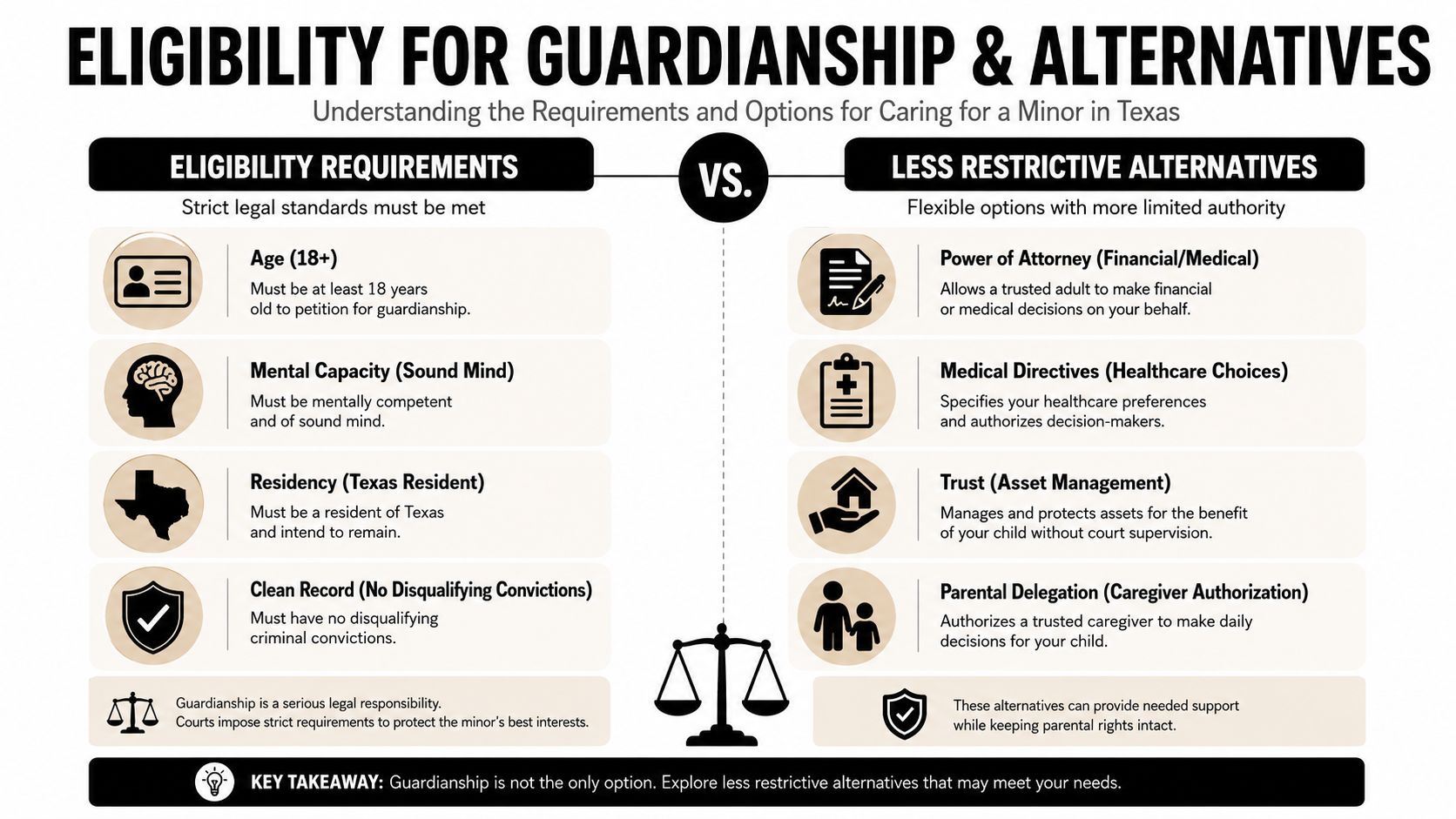
A grandmother may already be taking the child to school, handling doctor visits, and keeping daily life stable. Then the family learns that practical caregiving is not the same as legal authority. Before a Texas court appoints a guardian, it will look closely at two things. Is the proposed guardian qualified, and is guardianship necessary?
Who can qualify
Texas courts expect the proposed guardian to be an adult who can responsibly handle the job. That usually means someone at least 18, capable of managing the child's needs, and free from problems that would make the appointment unsafe or inappropriate. A history of child abuse, neglect, or certain criminal issues can stop a case before it gets very far.
The court also looks beyond bare eligibility. In practice, judges want to know whether this person is organized, honest about the family situation, and able to follow court rules after appointment. I often tell families that being a loving relative is important, but it is only part of the test. The court is appointing someone to take on legal duties, paperwork, reporting obligations, and, in some cases, financial accountability.
One rule catches families by surprise. If one parent has died, the surviving parent usually has priority under Texas law. Texas Estates Code Section 1104.051 states that the surviving parent is the natural guardian of the child's person and is entitled to appointment as guardian of the child's estate unless the court finds another arrangement is in the child's best interest, as stated in Texas Estates Code Section 1104.051.
That priority does not make the issue automatic. It does mean other relatives need evidence, not just concern or frustration, if they want the court to choose someone else.
The less restrictive alternatives problem
Many otherwise decent cases often stall at this stage. Texas courts do not grant guardianship because it would make family logistics easier. The court expects families to show why a narrower solution will not solve the problem in front of them.
Sometimes a less restrictive option works well enough. Sometimes it fails in practice.
Examples can include:
- A caregiver authorization or parental delegation: This may help with school or medical issues for a limited period, but it can fall apart if a parent withdraws consent or a provider refuses to rely on it.
- A trust for asset management: If the child has money, a trust may handle those funds without putting the family through a full guardianship of the estate.
- A power of attorney where legally available: A parent may be able to delegate some authority, but only if the parent is available, cooperative, and legally capable of doing so. That is why Guardianship vs. Power of Attorney in Texas often becomes part of the early case analysis.
Families should also review less restrictive alternatives to guardianship in Texas before filing. Courts expect that analysis, and a judge may ask about it directly at the hearing.
Practical rule: If your application cannot explain why simpler options failed, are unavailable, or would leave the child unprotected, the case is much more likely to be delayed or challenged.
Questions to ask before you file
A short self-check often saves time, money, and avoidable conflict.
| Question | Why it matters |
|---|---|
| Is the child safe right now? | Immediate danger may call for temporary relief instead of waiting on a standard timeline. |
| Does the child need care authority, financial management, or both? | The court analyzes guardianship of the person and guardianship of the estate separately. |
| Is there a surviving parent with legal priority? | Statutory preference can shape the whole case from the start. |
| Have you documented why simpler options will not work? | Specific facts usually matter more than broad statements about family stress. |
The strongest filings usually come from families who have already done the hard thinking. They can tell the court, with specifics, why this child needs legal protection, why this person should serve, and why a smaller step will not get the job done.
Navigating the Texas Guardianship Application Process
A grandmother walks into my office with a stack of school papers, a hospital discharge note, and a simple question: “What do I file first so my grandson is protected?” That is the point where Texas guardianship becomes real for a family. The court process is manageable, but small mistakes at the start can cost time, money, and sometimes credibility with the judge.
Filing in the right probate court
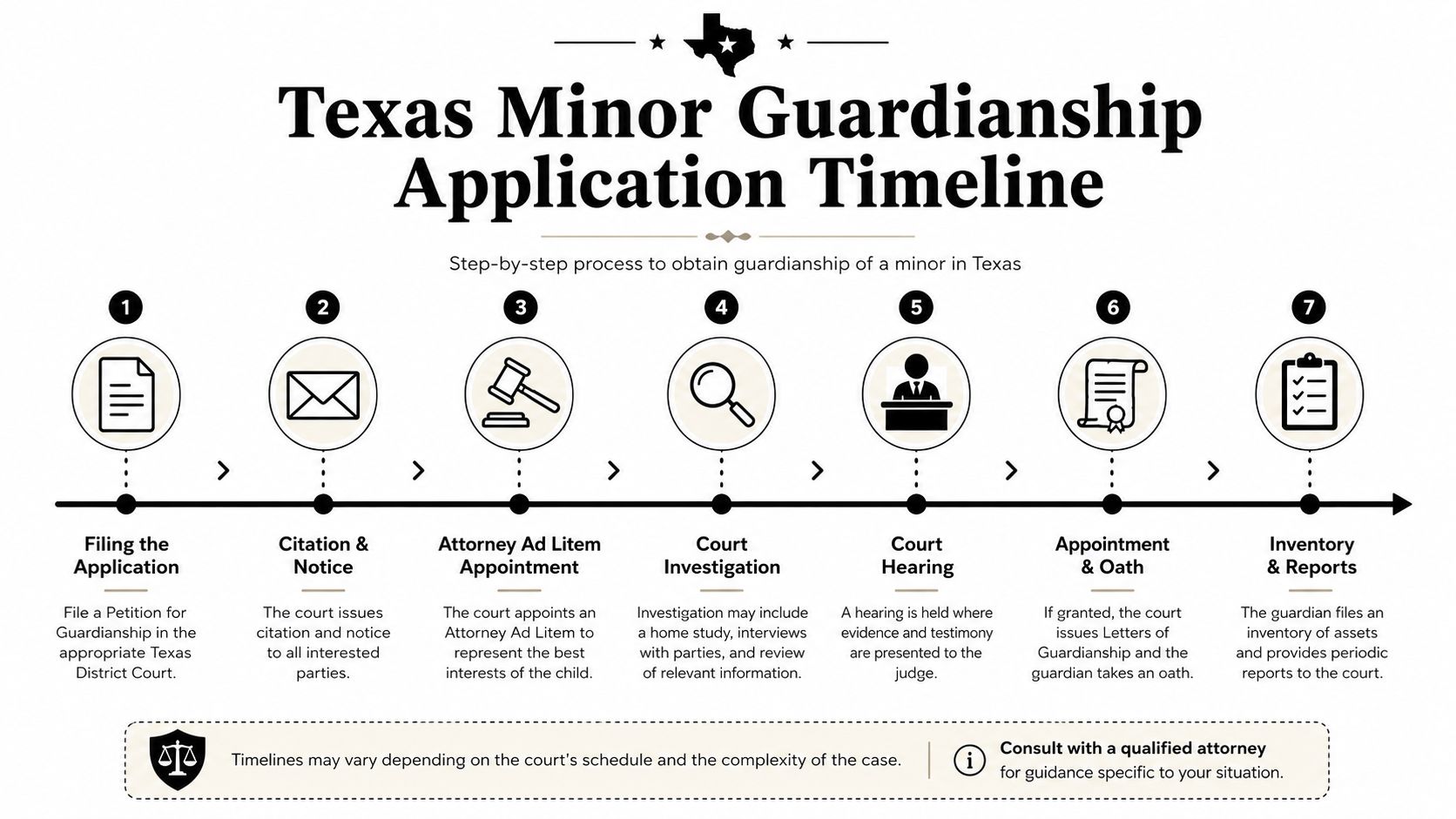
The case starts with an Application for Appointment of Permanent Guardian filed in the correct Texas court. That usually means the probate court or county court with guardianship jurisdiction in the county where the child lives or owns property. Filing in the wrong county creates avoidable delay, and families often do not realize the problem until time has already been lost.
The application must do more than ask for help. It needs to identify the child, explain why guardianship is needed now, state whether you are seeking guardianship of the person, the estate, or both, and show why the proposed guardian is qualified. Families who want a more detailed look at that first filing can review this guide on filing a guardianship petition in Texas.
What happens after filing
After the application is filed, the court begins its review. Notices must go out. Interested parties may have a chance to object. The court will appoint an Attorney Ad Litem for the child, and a hearing will be set.
Even in a family that agrees on the result, the process usually takes longer than people expect. Courts move on their own schedule, ad litems need time to investigate, and missing paperwork can reset the calendar fast. The families who avoid expensive delays are usually the ones who treat the case like an evidence file from day one, not a conversation they plan to finish at the hearing.
The Attorney Ad Litem's role
The Attorney Ad Litem represents the child's interests, not the applicant's and not the rest of the family's. That distinction matters.
In practice, the ad litem may interview the child if age-appropriate, speak with relatives, review school or medical information, examine the proposed living arrangement, and report concerns to the court. If the child is at least 12, the court may also consider the child's preference about who should serve, but the judge still decides what appointment is in the child's best interest.
Families often make the same mistake here. They treat the ad litem like an obstacle and become defensive. A better approach is simple: answer directly, provide documents quickly, and do not try to smooth over family conflict that the court is likely to learn about anyway.
Here is a plain-language overview if you want to hear the process discussed in video form.
How to prepare for the hearing
By the hearing date, the judge will want specifics. General statements like “I love this child” or “I have always helped out” are not enough by themselves. The court is deciding legal authority, so the record needs to show why the child needs protection and why this proposed guardian can carry the responsibility.
Bring organized proof, not a loose stack of papers:
- Identity and relationship records: Birth certificates, death certificates if relevant, and records showing how you are related to the child.
- Financial records for estate cases: Settlement documents, inheritance paperwork, benefit statements, or insurance information.
- Care plan details: Where the child will live, where the child goes to school, who provides medical care, and how day-to-day needs will be handled.
- Problem-specific evidence: Police reports, medical records, CPS paperwork, or other documents that explain why guardianship became necessary.
- Alternative analysis: A clear, fact-based explanation of why less restrictive options will not protect the child.
In court, organized facts carry more weight than sincere promises.
What works and what does not
Strong guardianship cases are usually candid about hard facts. If a parent is absent, say how long. If there has been addiction, incarceration, financial mismanagement, or family conflict, address it carefully and truthfully. Judges see these situations every week. What raises concern is not the existence of family problems. It is an applicant who appears to be hiding them.
Practical preparation also means thinking beyond the hearing. If the case involves a child's money, a bond may be required. If relatives are likely to contest the application, expect the timeline and legal fees to increase. If the matter overlaps with probate, trust administration, or asset management, families sometimes coordinate with probate counsel, estate-planning counsel, or a firm such as Law Office of Bryan Fagan, PLLC. The goal is to present a record the court can trust and a plan that is practical for the child once the order is signed.
When Urgent Action Is Needed Emergency and Temporary Guardianship
At 9:00 p.m., a grandmother gets a call that the child's mother has been taken to the hospital and may be there for weeks. The child is safe for the night, but the next morning brings harder questions. Who can consent to treatment if the child gets sick? Who can deal with school paperwork? If the child has money in his name, who keeps it from being mishandled while the adults sort out the crisis?
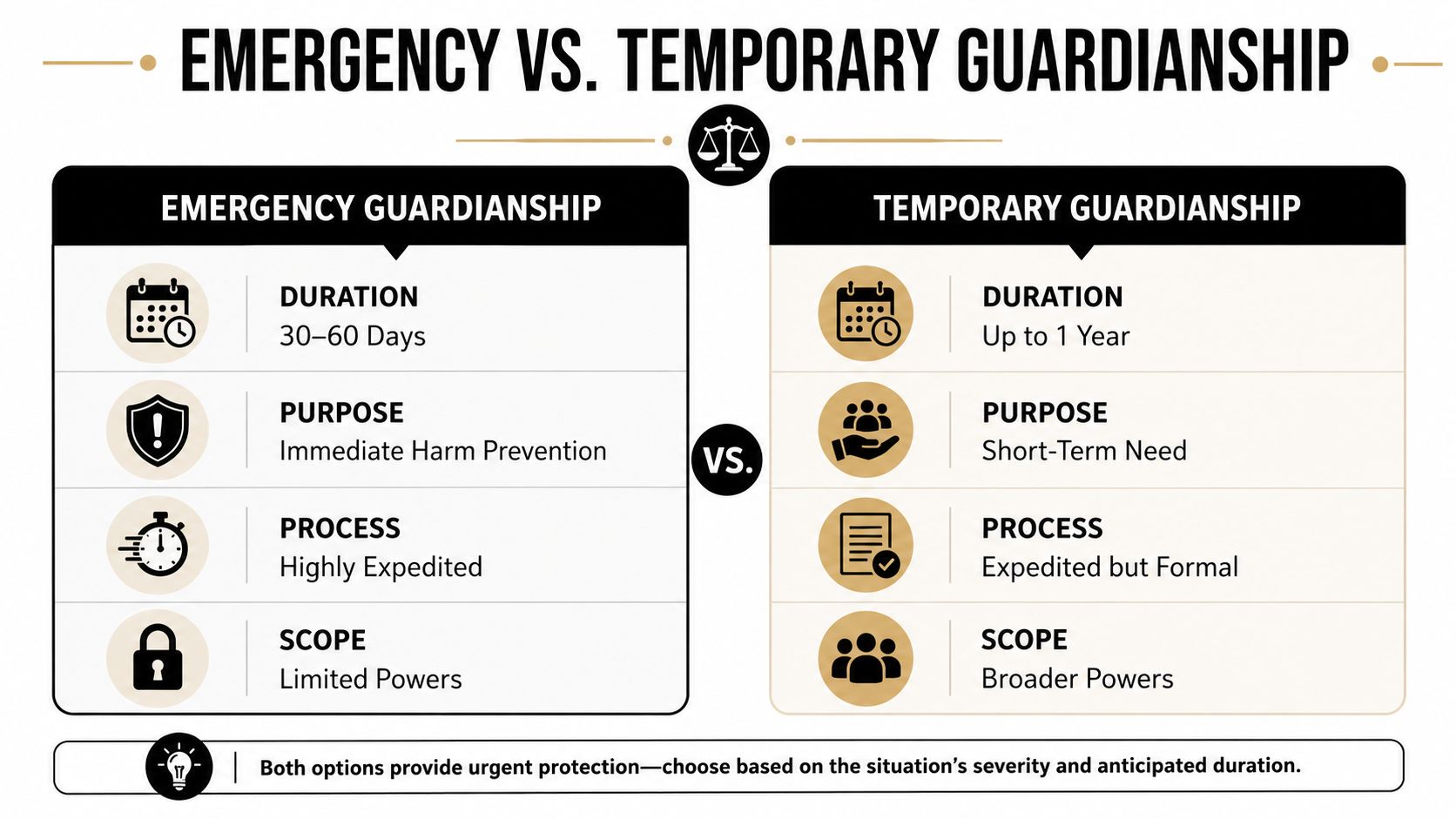
Texas courts can act quickly, but only when the facts justify quick action. A temporary guardianship is for immediate danger to the child or the child's property. It is not a faster version of the ordinary case, and families lose time when they file an emergency request based on stress, family conflict, or general instability without proof of urgent risk.
The legal standard is imminent danger
Under Texas Estates Code Section 1251.003, the application for a temporary guardian must be sworn and must set out specific facts showing why immediate court action is needed. Judges look closely at this part. Broad statements like “the child is not safe” or “the parent cannot handle things right now” usually are not enough by themselves. The application needs dates, events, and a clear explanation of what could happen before a regular hearing can be held.
That is where families often make an expensive mistake. They focus on why the proposed guardian is a good person and give too little attention to the short-term danger that justifies emergency relief. In a temporary case, the urgent problem is the center of the hearing.
Temporary and permanent cases do different jobs
Temporary guardianship is meant to stabilize a crisis. Permanent guardianship addresses a longer-term need for legal authority and court supervision.
| Issue | Temporary guardianship | Permanent guardianship |
|---|---|---|
| Reason for filing | Immediate danger to the child or property | Ongoing need for legal authority |
| Proof needed | Specific urgent facts in a sworn application | Broader showing of necessity and suitability |
| Court pace | Fast, crisis-driven | Formal review with investigation |
| Main goal | Protect the child until the court can fully review the case | Put a lasting legal arrangement in place |
Texas law generally limits a temporary guardianship to a short period. Families should treat that time as a narrow window to protect the child and prepare the underlying case correctly.
What judges usually want to see in an urgent case
In practice, emergency requests are stronger when the risk can be tied to an immediate decision that no one currently has authority to make. Medical consent, school enrollment, securing settlement funds, preventing a withdrawal from the child's account, or removing a child from a dangerous living arrangement are common examples.
I also tell families to be realistic about scope. If the true emergency is access to the child's funds, the request should say that plainly. If the problem is the child's placement and medical care, the pleading should match that problem. Asking for broader powers than the facts support can hurt credibility.
If you ask for emergency authority, show the emergency in concrete terms.
A common real-world example
A child has been living with his mother. She suffers a sudden medical crisis and cannot communicate. The aunt steps in immediately, but by the end of the week the school needs enrollment documents, a doctor's office needs consent for treatment, and a claims check from a prior settlement is sitting in the child's name. That set of facts may support temporary relief because waiting through the standard schedule could leave the child without authorized care and leave property exposed.
The practical trade-off is simple. Filing too slowly can leave the child unprotected. Filing too aggressively, without the facts to support imminent danger, can lead to denial and force the family to start over with a more measured application. The best emergency filings do both jobs at once. They address the immediate risk and lay the groundwork for the longer case the court will expect after the crisis passes.
Your Duties and Responsibilities as a Guardian
The order signed by the judge is the beginning of the work, not the end of the case. Families are often relieved when the appointment goes through, then surprised by how quickly the practical responsibilities start. The court now expects follow-through, documentation, and careful judgment.
Guardian of the person and guardian of the estate
Texas courts treat these as separate jobs because they involve different risks.
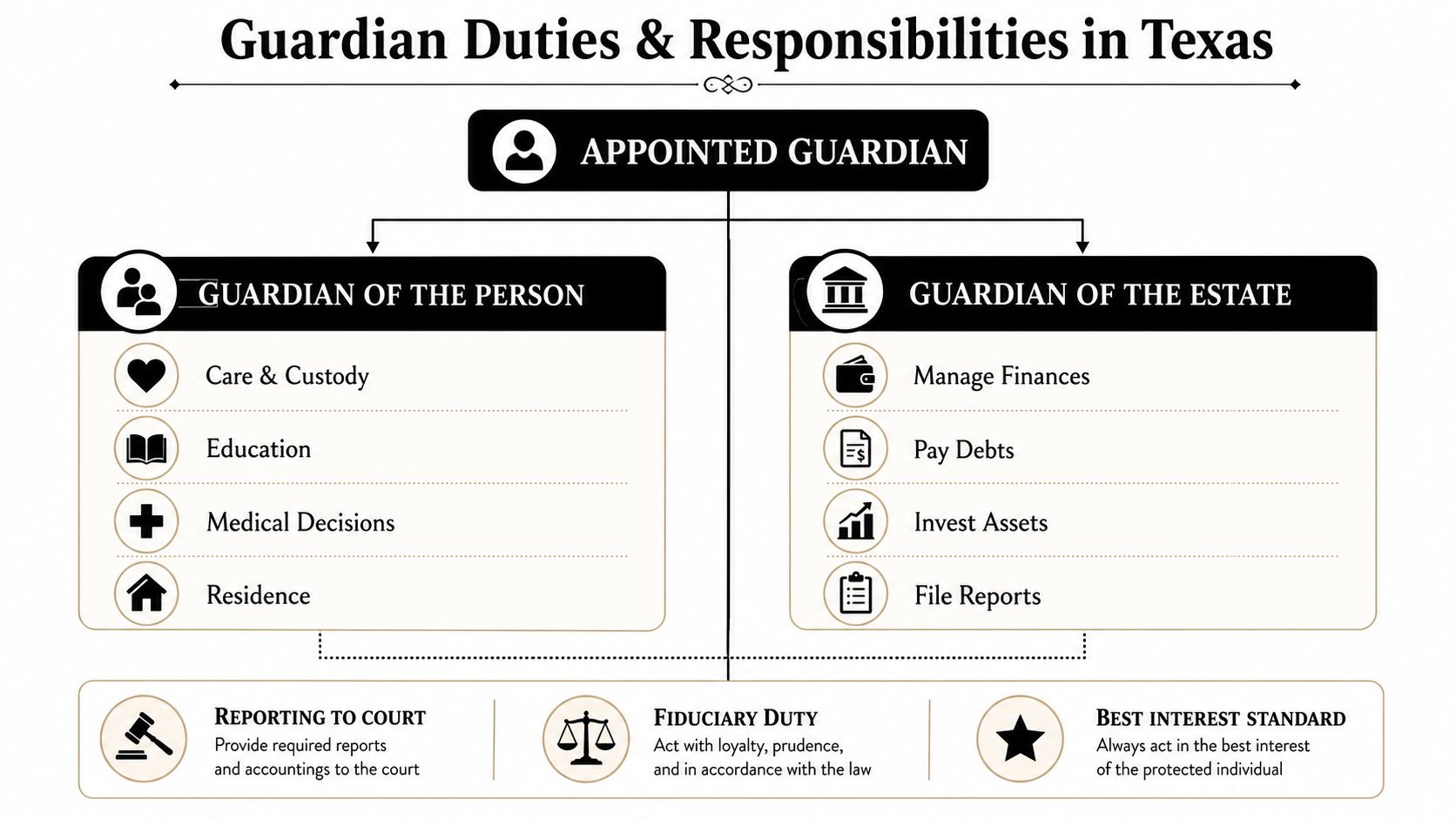
A guardian of the person makes decisions about the child's care and daily life. That usually includes where the child lives, school matters, medical consent, supervision, and basic support. A guardian of the estate handles money or property that belongs to the child. If there is an inheritance, lawsuit recovery, insurance payment, or other asset in the minor's name, estate duties come with a higher recordkeeping burden and closer court oversight.
That distinction matters in real life. A loving relative may be fully capable of caring for a child day to day, but less prepared to manage restricted funds, court approvals, accountings, and investment limits. Families make expensive mistakes when they assume good caregiving automatically translates into good estate management.
The first deadlines after appointment
The first set of deadlines arrives fast. After appointment, the guardian usually must qualify by filing the required oath and, if ordered, posting bond before Letters of Guardianship are issued. Those Letters are the document banks, schools, doctors, and other institutions will ask to see.
If that qualification step is delayed, authority can stall at the exact moment the family expects things to get easier.
Letters of Guardianship also do not stay valid forever. Courts require updated filings to keep them current, and expired Letters create avoidable problems. I have seen families turned away by financial institutions and medical providers because they assumed the original paperwork was enough. It was not.
What the court expects from you day to day
A guardian is a fiduciary. In practical terms, that means every decision must be made for the child's benefit, not the convenience of the adults involved.
For a guardian of the person, that usually means:
- keeping the child in a safe and stable living arrangement
- making sure the child gets medical care, education, and daily support
- informing the court about major changes that affect the child
- following any limits written into the appointment order
For a guardian of the estate, the habits matter even more:
- keep the child's money in separate accounts
- never use the child's funds as a family back-up account
- save receipts, statements, and court orders
- get court approval before taking action that requires it
- track every deadline for reports or accountings
These are the cases where small shortcuts become big problems. A guardian who reimburses herself informally, transfers money between accounts without a paper trail, or relies on memory instead of records can create a mess that is hard to fix later, even when the spending was well intended.
If the case involves inherited assets, settlement planning, or longer-term family planning, families often need parallel help with estate planning matters or related probate concerns. Guardianship solves legal authority over the child or the child's property. It does not replace the rest of the family's planning.
Reporting, oversight, and practical boundaries
Court supervision continues after appointment. Guardians are commonly required to file reports about the child's condition, the child's living situation, or the status of estate assets, depending on the type of guardianship.
The safest approach is disciplined and boring. Keep a folder, digital or paper, for every bank statement, school record, medical bill, and court filing. Write down why money was spent. Keep copies of anything submitted to the court. If another family member later challenges your decisions, good records usually matter more than good intentions.
Boundaries matter too. Guardianship gives authority over the child's needs and, in some cases, the child's property. It does not give open-ended permission to act outside the order, ignore court restrictions, or treat the child's funds as part of the household budget.
Special transition issues near age 18
A minor guardianship does not automatically roll into adult guardianship. If the young person may need continued legal protection after turning 18 because of incapacity, the family has to prepare for a separate process.
Texas law allows that adult guardianship application to be filed in advance within a limited window before the child's eighteenth birthday, but the adult case does not take effect until adulthood begins. That timing can be easy to miss. Families who wait too long sometimes end up with a gap in authority over medical, financial, or placement decisions at the very point when continuity matters most.
This is one of those avoidable mistakes that costs time, money, and stability. The legal deadline matters, but so does the family's practical planning.
Common Pitfalls and How Guardianship Ends
Most bad outcomes in minor guardianship cases are not caused by a terrible family. They are caused by missing steps, weak documentation, and avoidable assumptions about what the court will overlook.
The most common mistake is failing to prove that less restrictive alternatives were considered. Verified Texas guidance states that applications filed without legal representation and missing this or other procedural requirements have a success rate below 50%, compared with over 85% for fully compliant applications, according to this discussion of Texas child guardianship filings.
That same guidance is a warning for families who try to rush through the paperwork because everyone agrees on the result. Agreement helps, but compliance wins cases.
Mistakes that cause delay or denial
Several problems show up again and again:
- Weak alternative analysis: The court wants specifics, not a conclusion.
- Missed bond and qualification deadlines: Authority can collapse if post-appointment steps are ignored.
- Poor financial boundaries: Using the child's funds casually or without records creates fiduciary trouble fast.
- Incomplete notice or hearing preparation: Even good caregivers can lose credibility if they arrive without organized proof.
A practical mindset helps here. Think like a court file, not like a family conversation. If a fact matters, document it.
Courts usually forgive emotion. They rarely forgive incomplete compliance.
How a minor guardianship ends
Texas law is clear on the natural endpoint. Guardianship of a minor generally ends when the child turns 18, unless the court orders earlier termination because of emancipation, marriage, or changed circumstances, as explained in this overview of guardianship of a minor in Texas.
Estate issues can make the ending feel less simple. Verified background on underserved questions in Texas guardianship notes confusion often arises when a child nears adulthood while funds are still under structured management or trust administration, and that many cases involve injury settlements requiring estate oversight, as discussed in this legal Q and A about guardianship transitions. The guardianship may end, but separate trust administration may continue if a valid structure is in place.
When to seek help with modification or termination
Not every case ends only because the child becomes an adult. Circumstances change. A parent may recover. A temporary arrangement may no longer fit. Financial supervision may need adjustment. Those are moments to get legal advice before acting, especially in courts with busy dockets like Harris County Probate Court.
Families usually don't need perfection. They need a clear plan, honest filings, and disciplined follow-through.
If your family is facing a guardianship question involving a child, inherited funds, an injury settlement, or an urgent caregiving crisis, Law Office of Bryan Fagan, PLLC can help you evaluate the options and prepare for the next step. A free consultation can give you clear guidance on whether guardianship is necessary, what type of filing fits your situation, and how to avoid the mistakes that often delay relief for Texas families.