Skip to content
You may be in that uneasy stretch of time where something feels off, but no one in the family wants to say it out loud yet. A parent forgets to pay the electric bill. A neighbor mentions they seemed confused. You notice unopened mail stacked on the kitchen counter, or a sudden change in how they handle money, medication, or basic daily tasks.
Most families don't start by searching for an attorney. They start by worrying. They try to help informally, hope things improve, and wonder whether stepping in will protect their loved one or take away too much independence. That tension is real, and it's one of the hardest parts of elder care in Texas.
An elder law attorney in Texas helps families sort through those moments with a legal plan that fits the actual problem. Sometimes the right answer is guardianship. Sometimes it isn't. Sometimes the biggest issue isn't getting appointed by a court. It's what comes after, especially when a guardian has to keep up with court rules, annual reports, and financial accountability for years.
Families in Houston, Dallas, Austin, San Antonio, and smaller Texas communities run into these issues every day. If you're dealing with possible incapacity, long-term care planning, a guardianship dispute, or questions from out of state, the law can feel cold and technical at the exact moment your family needs clarity most. It doesn't have to stay that way.
Navigating a Loved One's Changing Needs
A daughter in Harris County notices her father has started missing doctor visits. Her brother in another state thinks she's overreacting. Their father insists he's fine, but his checkbook doesn't match the bank statement, and a new "friend" seems unusually interested in his finances. No single event proves incapacity. Taken together, the situation tells a different story.
That's how these cases usually unfold. Families rarely walk into probate court after one dramatic incident. More often, they arrive after months of small warning signs, difficult conversations, and growing fear that waiting longer could lead to a medical crisis, financial loss, or family conflict.
Why families feel stuck
The emotional problem comes first. People don't want to embarrass a parent or strip away control. Adult children may disagree about whether help is needed, who should step in, or whether the parent can still sign legal documents.
The legal problem follows close behind. If your loved one can no longer safely make decisions, someone may need authority to act. That might involve health care, housing, banking, benefits, or protection from exploitation. Texas law gives families tools for each of those problems, but the right tool depends on timing and capacity.
A good legal plan protects safety without taking more authority than the situation requires.
A practical starting point
Before anyone files anything, families should slow down and gather facts:
- Watch for patterns: A single forgotten appointment may not mean much. Repeated missed medications, unpaid bills, or unsafe driving usually deserve closer attention.
- Document concerns: Keep notes about incidents, dates, hospital visits, and financial problems. Clear facts help doctors and courts.
- Check existing documents: A durable power of attorney, medical power of attorney, trust, or prior designation may already solve part of the problem.
- Expect mixed emotions: Guilt, denial, resentment, and fear are common. Those feelings don't mean you're making the wrong decision.
An experienced Texas lawyer's job isn't just to file papers. It's to help your family decide whether guardianship is necessary, whether an alternative will work, and what responsibilities you'll be taking on if the court appoints you.
What a Texas Elder Law Attorney Actually Does
People often hear "elder law" and think only of wills or nursing homes. In practice, the work is broader and far more hands-on. A Texas elder law attorney usually helps in four connected areas.
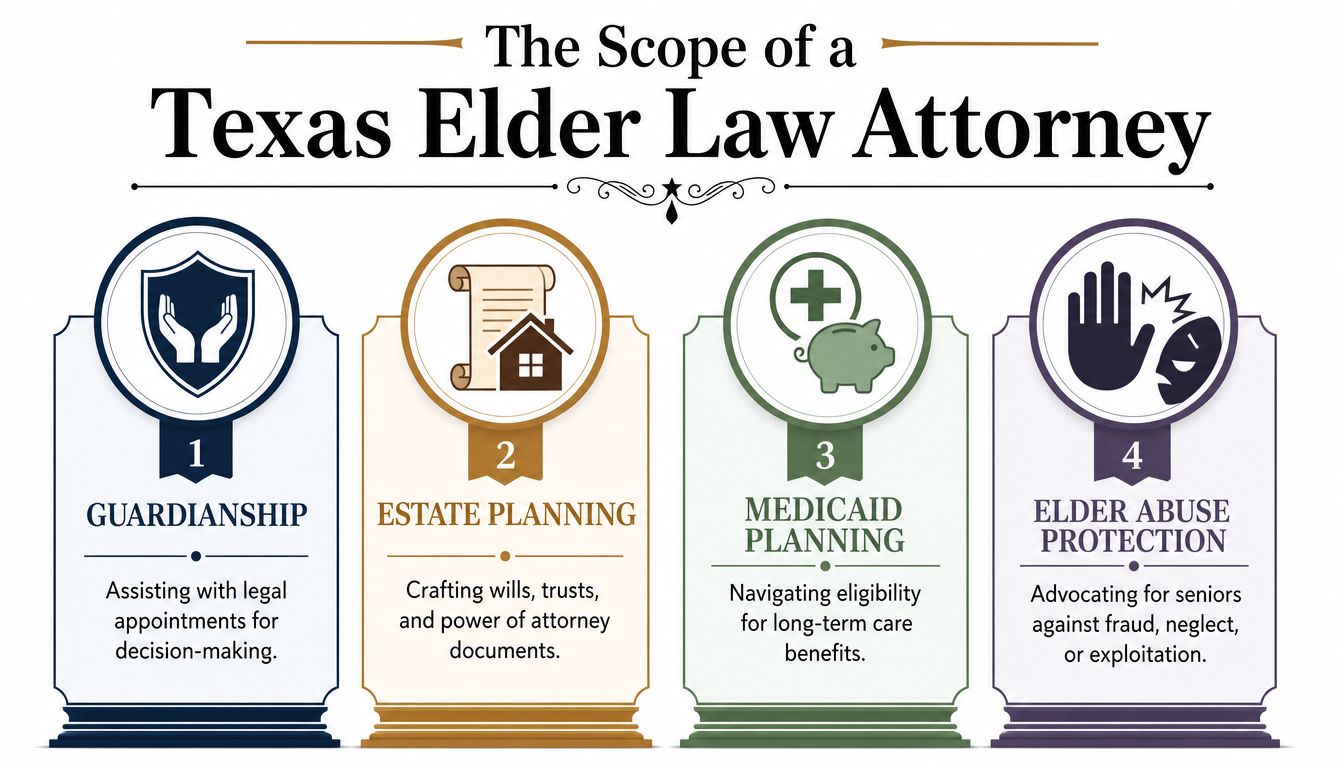
Guardianship and incapacity planning
Guardianship is the court process used when an adult can't manage personal or financial affairs safely and no less restrictive option will work. That can involve a guardian of the person, a guardian of the estate, or both. If you want a clearer explanation of the two roles, Guardian of the Person vs. Guardian of the Estate outlines what each controls.
The details matter as the attorney coordinates medical evidence, prepares the court application, helps the family understand what the proposed ward may object to, and addresses county-specific court practices in places like Harris County Probate Court or Bexar County Probate Court.
Estate planning and probate
Sometimes the best elder law work happens before a crisis. Wills, trusts, medical directives, and powers of attorney can preserve a person's choices and reduce the chance that the family will later need court supervision.
If death has already occurred, probate issues often overlap with elder law concerns. A family may need to sort out disputed assets, prior powers of attorney, or questions about whether someone mishandled funds before death. Related planning tools often connect with Probate matters and Estate Planning options.
Medicaid and long-term care planning
Long-term care decisions don't wait for perfect timing. Families often need to figure out how care will be paid for while trying to preserve stability for a spouse or disabled child. That's where a lawyer's role becomes strategic. The work can include document review, timing decisions, and planning around eligibility issues. For a deeper look at that part of the practice, this page on Texas Medicaid elder law guidance is useful.
Protection from exploitation and neglect
An elder law attorney also steps in when the issue isn't just decline. It's misconduct. That can mean financial abuse by a caregiver, misuse of an existing power of attorney, pressure from a relative, or neglect in a care setting.
Texas families often want to know how to tell whether a lawyer really focuses on this field. One practical marker is certification and professional involvement. Certified Elder Law Attorneys in Texas must meet rigorous standards from the National Elder Law Foundation, with substantial involvement in elder law and competency in subjects such as Medicaid planning, guardianship petitions, and nursing home disputes. Membership in the National Academy of Elder Law Attorneys is another key benchmark for specialized focus, as described by this overview of elder law attorney qualifications.
Signs Your Family Should Speak with an Attorney
Some families wait too long because they think they need certainty before making a call. They don't. You don't need a final diagnosis, a complete family agreement, or a crisis severe enough for the emergency room. You need enough concern to ask informed questions.

Red flags that usually justify legal advice
- A recent cognitive decline: Dementia, confusion, memory loss, or a doctor raising concerns about capacity.
- Financial irregularities: Unpaid bills, unusual gifts, new joint accounts, missing checks, or someone else suddenly controlling access.
- Unsafe living conditions: Missed medication, falls, wandering, self-neglect, or repeated hospital visits.
- Family conflict: Siblings disagree about care, one relative isolates the parent, or nobody knows who has legal authority.
- Long-term care pressure: A hospital discharge, nursing home placement issue, or urgent need to review care payment options.
- Existing document problems: A power of attorney exists, but the named agent can't serve, won't serve, or may be abusing authority.
Why speed matters
Delay can make every option harder. A person who still has legal capacity today may be able to sign planning documents that avoid a future guardianship case. If that window closes, the family may have no choice but to go to court.
The urgency is even clearer when abuse is part of the picture. Texas reported 52,506 cases of abuse involving individuals over 60 in 2020, a stark reminder that legal intervention often involves protection from exploitation, neglect, and capacity-related risk, as noted in this discussion of Texas nursing home abuse and elder harm.
When money starts disappearing or a vulnerable adult becomes isolated, families shouldn't treat it as a private misunderstanding. They should treat it as a legal problem that may require immediate action.
A common example
A son in Fort Bend County learns his mother has been giving large checks to someone helping around the house. She insists the person is "taking care of things." The son doesn't know whether she still understands the transactions, whether a power of attorney exists, or whether anyone can freeze the damage.
That family needs legal advice right away. Not because guardianship is always the answer, but because the cost of waiting can be permanent.
Navigating the Texas Guardianship Process Step by Step
Texas guardianship is a court-supervised process under the Texas Estates Code, and families usually feel better once they can see the sequence clearly. The process is formal for a reason. A guardianship can take away important rights, so the court requires proof, notice, and oversight.

Step one through step three
Step 1 is evaluating capacity. In a typical case, the family first needs a physician's certificate of incapacity or similar medical support showing why the proposed ward cannot manage certain decisions.
Step 2 is filing the application. The case is filed in the appropriate court, often a probate court such as Harris County Probate Court, Dallas County Probate Court, or the county court with probate jurisdiction where the person lives.
Step 3 is giving the court the full picture. Texas law does not allow families to skip over alternatives. Under Texas Estates Code §1101.052, the application must include a declaration stating whether alternatives to guardianship and available supports were considered and whether those alternatives are feasible.
Practical rule: If the family hasn't seriously reviewed powers of attorney, supported decision-making, or narrower forms of help, the court may view the filing as incomplete in substance even if the paperwork is technically filed.
A helpful overview for many families is this explanation of the Texas guardianship process and least restrictive alternatives, which notes that the process typically takes 60 to 90 days and usually involves a physician's certificate, a formal application, and a hearing.
For readers who prefer a video walkthrough, this overview may help:
The hearing and what the judge decides
At the hearing, the court looks at two separate questions. First, is the person incapacitated to the degree claimed? Second, if so, what is the least restrictive alternative that will still protect them?
That phrase matters. Courts don't appoint a full guardian just because doing so would be convenient for the family. Judges must consider whether a limited guardianship, supported decision-making arrangement, or existing power of attorney could solve the problem with less loss of autonomy.
For emergency situations, the rules are tighter. Under Texas Estates Code §1251.003, a sworn application for temporary guardianship must state the alleged imminent danger, the type of appointment requested, and the specific protection needed. Courts expect facts, not general worry.
What happens after appointment
Many articles stop here. Families shouldn't. Appointment is the beginning of a long-term fiduciary job.
Within 20 days of appointment, the guardian must sign a sworn oath and post bond if required. Only after the bond is posted does the clerk issue Letters of Guardianship, which are the official proof of authority. Those letters expire after 16 months unless renewed with the required annual report, as explained by Texas Law Help's guardianship guide.
After that, the court continues watching. Guardians may need to file annual reports, annual accountings, and other updates depending on whether they serve over the person, the estate, or both. That ongoing duty is where many well-meaning families get overwhelmed, especially if they didn't realize they were taking on a continuing court relationship rather than a one-time hearing.
Exploring Alternatives to Guardianship in Texas
Texas law pushes families to consider less restrictive options first, and that's more than good policy. It's a legal requirement. Texas Estates Code §1101.052 requires each guardianship application to state whether alternatives and available supports were considered and why they are not feasible, as shown in the text of Texas Estates Code section 1101.052.
For many families, the right question isn't "How do we get guardianship?" It's "Can we solve this without asking a court to remove rights?"
Guardianship alternatives compared
| Tool | Primary Purpose | Court Involvement | Best For |
|---|---|---|---|
| Statutory Durable Power of Attorney | Lets a trusted person handle financial matters | None if properly signed | A person who still has capacity and wants to choose an agent |
| Medical Power of Attorney | Names someone to make health care decisions when needed | None if properly signed | Health care decision-making during incapacity |
| Supported Decision-Making Agreement | Helps an adult receive support while keeping decision-making rights | None | Adults who can make decisions with assistance |
| Revocable Living Trust | Allows management of trust assets by a trustee or successor trustee | None for ordinary administration | Families focused on asset management and continuity |
| Limited Guardianship | Gives the guardian only specific powers approved by the court | Yes | Situations where some court protection is necessary, but full guardianship is too broad |
What works and what doesn't
A durable power of attorney can be very effective when the person still understands what they're signing and trusts the chosen agent. It often works well for paying bills, handling property, and dealing with banks. It doesn't work well when the document is signed too late, drafted too narrowly, or challenged by suspicious relatives or institutions.
A medical power of attorney can prevent chaos during hospitalization. It does not solve every financial issue. Families sometimes assume one document covers everything, then discover no one can access accounts or manage real estate.
A revocable trust can create smoother management of certain assets, but only if the assets were transferred into the trust. Signing the trust and never funding it is a common mistake.
For families comparing these options more closely, this guide on whether you really need guardianship in Texas and five alternatives to consider offers a useful starting point.
The best planning tool is the one your loved one signs while they still have capacity, and the family understands how to use before an emergency hits.
How to Prepare for Your First Consultation
The first meeting with an elder law attorney feels easier when you arrive with a short file and a short list of questions. You don't need perfect records. You do need enough information to let the lawyer spot urgent issues, missing documents, and possible paths forward.
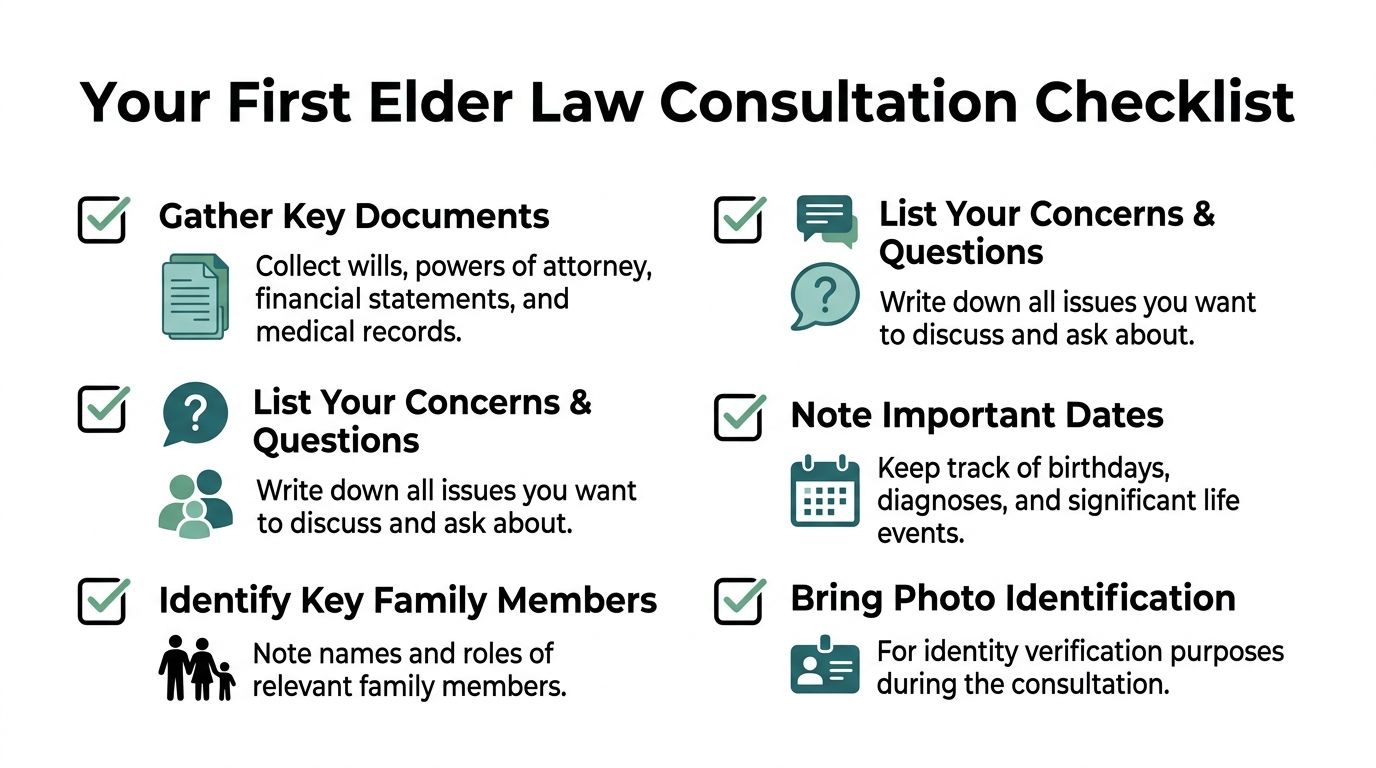
Documents to gather
Bring what you have. If something is missing, say so. That happens all the time.
- Medical records and diagnoses: Especially anything related to memory loss, incapacity, hospitalization, or a physician's concerns.
- Estate planning documents: Wills, trusts, powers of attorney, directives, beneficiary forms, or prior guardian designations.
- Basic financial records: Recent bank statements, lists of assets, unpaid bills, property records, and information about income sources.
- Court papers if a case already exists: Prior probate filings, guardianship orders, or notices from the court.
- Identification and contact information: Names of key relatives, caregivers, doctors, and anyone currently helping with care or finances.
Questions worth asking
The consultation should help you judge fit as much as legal strategy.
- County experience: Ask whether the lawyer regularly handles matters in your county, such as Harris County, Travis County, or Bexar County.
- Guardianship scope: Ask whether your case may involve the person, the estate, or both.
- Contested issues: Ask how the lawyer handles disputes when siblings disagree or the proposed ward objects.
- Post-appointment compliance: Ask who helps with annual reports, accountings, and other ongoing duties after appointment.
- Communication: Ask who will handle the case day to day and how updates are shared.
If you're comparing options, the guide to finding a good elder law attorney in Texas can help you organize those questions.
One practical note about cost and complexity
Texas elder law is specialized work. As one market reference point, the average annual salary for an Elder Law Attorney in Texas was $100,768 as of July 2026, with many earning between $74,500 and $121,100 and top earners reaching $144,872, according to ZipRecruiter's Texas elder law attorney salary data. Families don't need that figure to hire a lawyer, but it reflects how technical this field has become.
The Law Office of Bryan Fagan, PLLC handles guardianship, probate, and estate planning matters across Texas, including cases involving incapacity, emergency guardianship requests, and ongoing court compliance.
Your Texas Elder Law Questions Answered
What if my parent objects to the guardianship
That doesn't end the case. It changes how the case must be prepared. If a parent objects, the court will look closely at capacity evidence, the scope of powers requested, and whether a less restrictive option would protect them. Objections also tend to bring family conflict into the open, so clear records and careful medical support matter.
Can an emergency guardian be appointed quickly
Sometimes, yes. But Texas courts don't grant emergency relief based on general concern alone. The application must show immediate danger to the person or property, and the facts have to be specific and sworn.
Can I serve if I live outside Texas
Possibly, but out-of-state families face extra practical hurdles. A 2025 study found that 32% of elder law inquiries in Texas came from out-of-state caregivers, while many online guides still fail to explain that Texas law may require an in-state agent and that virtual hearing practices vary by county, according to this discussion of out-of-state caregiver issues in Texas elder law. A daughter in Colorado may be the best person to help her mother in Houston, but the court will still want to know how duties will be handled on the ground in Texas.
What happens after a guardian is appointed
The guardian's job continues for as long as the court order remains in place, unless the guardianship is modified or terminated. Duties may include making decisions, keeping records, filing required reports, and staying within the authority granted by the court. If the guardian falls behind, the court can demand corrections and, in serious cases, consider removal.
Can guardianship ever end
Yes. If the ward regains capacity, if a less restrictive arrangement becomes workable, or if the current order no longer fits the person's needs, the court can review termination or modification. Families should not assume the original order is permanent just because it was entered.
If your family is facing questions about incapacity, guardianship, probate, or planning for an aging loved one, a personalized legal strategy matters. The Law Office of Bryan Fagan, PLLC helps Texas families understand their options, prepare for hearings, handle disputes, and stay compliant after appointment. Schedule a free consultation to talk through your situation with a Texas team that works in guardianship, estate planning, and probate law.