Skip to content
Your mother's hospital doctor is asking who can consent to treatment. Your brother thinks he should take over her bank account. Your mother insists she's fine, even though unpaid bills are piling up and she's wandered from home twice.
Families usually reach this point slowly, then all at once.
No one starts this process because they want control. Many start because they're scared, tired, and trying to protect someone they love. If that's where you are, you're not alone. The hard part is that the legal answer isn't always “file for guardianship now.” Sometimes guardianship is necessary. Sometimes it's too much. Sometimes the better answer is a narrower tool that preserves more independence.
A lot of confusion starts when a hospital, bank, or care facility says you don't have authority to act. If that has happened in your family, this guide on what to do when a hospital says you have no authority to make decisions can help you understand why informal family roles often aren't enough.
The Moment You Realize Something Has to Change
Maria in Harris County had been helping her father for months. At first, it was little things. She organized his medications, drove him to appointments, and reminded him to pay his utilities. Then the problems got harder to explain away. He gave the same charity his credit card information more than once. He forgot where he lived on a bad day. He became angry when anyone mentioned help.
Her family asked the same question many Texas families ask. Do we need a guardianship attorney, or is there another way to solve this?
That question matters because guardianship is powerful. It can protect a vulnerable person from neglect, confusion, or financial harm. But it can also take away decision-making authority that person used to have. For some families, that tradeoff is necessary. For others, it's premature.
What families often feel at this stage
- Worried about safety: A loved one may be making choices that put their health, housing, or money at risk.
- Unsure who has authority: Adult children often assume they can step in automatically, but Texas law usually requires legal authority.
- Divided as a family: One relative may want immediate court action while another says the person just needs more support.
- Overwhelmed by timing: Crises rarely happen on a convenient schedule.
Families usually don't need more pressure. They need a clear way to tell the difference between an urgent legal problem and a planning problem.
That's the goal here. If you're trying to understand when you need a guardianship attorney and when you don't, start with one simple idea. The right answer depends on the person's present ability, the documents already in place, and whether anyone is likely to disagree.
What Texas Guardianship Legally Means
In Texas, guardianship is a court process under Texas Estates Code Title 3, Subtitle G. A judge can give one adult legal authority to make certain decisions for another adult who can no longer make or communicate those decisions safely. The person asking for protection is called the proposed ward. The person the court appoints is the guardian.
That sounds simple. In practice, it is a serious transfer of rights.
Texas courts usually divide guardianship into two lanes. One lane covers personal and medical decisions. The other covers money and property. Some families need only one lane. Some need both.
Guardianship of the person
A guardian of the person makes decisions about daily life and care, but only to the extent the court allows. That can include where the person lives, arranging services, and consenting to certain medical treatment.
This kind of guardianship often arises when a parent with dementia cannot live safely without supervision, or when an adult child with a disability needs continued decision-making support after age eighteen. The court's order matters here. It should spell out what the guardian can decide and what rights the person keeps.
Guardianship of the estate
A guardian of the estate handles financial matters. That may include collecting income, paying bills, protecting property, and filing reports with the court.
Families often focus on this part when money is going missing, bills are piling up, or someone is being pressured to sign documents they do not understand. In those situations, signs of exploitation can change a planning problem into a court problem. If that concern is on your radar, review these warning signs of exploitation in Texas guardianship cases.
If you want a broad overview of representation in these cases, Texas Guardianship Lawyer explains guardianship of the person and estate under the Estates Code.
Why Texas courts treat guardianship as a last resort
Guardianship protects people, but it can also remove major legal rights. Depending on the order, a person may lose authority over where to live, how to manage money, whether to consent to treatment, and other personal decisions. That is why Texas courts are supposed to use guardianship only when less restrictive options will not solve the problem.
The proof standard is also high. Guardianship generally requires clear and convincing evidence, a stricter standard than the one used in many ordinary civil disputes, as explained in the U.S. Department of Justice guardianship guidance.
A helpful way to view this is to compare guardianship to handing someone the keys to another person's life. Courts do not hand over those keys just because a family is worried or frustrated. They are supposed to ask a narrower question. What decisions can this person still make safely, and what authority is needed to protect them?
Texas law looks for the least restrictive fit
Texas law does not assume every struggling adult needs full guardianship. The court should tailor any order to the person's actual limits. That is why limited guardianship matters. If a loved one can still choose where to live but cannot manage investments or resist financial pressure, the legal answer may be narrower than many families expect.
This is also where the attorney question becomes clearer. If valid planning documents already exist and still work, guardianship may be unnecessary. If capacity is fading, documents are missing, assets are at risk, or the court may need to divide rights carefully, legal help becomes much more important.
The goal is not to get the most control possible. The goal is to protect your loved one without taking more independence than the law requires.
Red Flags That Signal You Need an Attorney Now
You may reach a point where concern turns into urgency. Your father is missing bill payments, a new friend is asking questions about his bank account, and your sister insists everything is fine. In that kind of moment, the question is not just whether guardianship might help. The real question is whether the warning signs are serious enough that a Texas guardianship lawyer should be involved right away.
Some problems can still be handled with planning documents and family cooperation. Others mean you need legal guidance now because the court may have to step in, rights may be limited, or harm may be happening in real time.
The proposed ward objects
If your loved one says no, the case changes immediately. What might have started as a family effort to get help can turn into a contested court matter involving medical evidence, witness testimony, and strict proof requirements under Texas law.
Texas courts do not grant guardianship just because relatives are worried. The court must find that the person is incapacitated and that guardianship is necessary, and the process includes protections for the proposed ward under the Texas Estates Code: Texas Estates Code, Guardianship Proceedings.
In plain terms, an objection means you are no longer filling out forms. You are preparing for a hearing where the judge may hear very different versions of the same story.
Family members are fighting
A disagreement between relatives is one of the clearest signs that handling this alone can go badly. One child may believe Mom cannot safely live alone. Another may believe the issue is untreated depression, poor support at home, or conflict over money.
Courts tend to look closely at cases where the family cannot agree on basic facts. Who should serve. Whether the person truly lacks capacity. Whether someone has already been using the person's funds inappropriately. Those disputes can slow the case, increase suspicion, and make even honest mistakes look damaging.
A contested guardianship often feels less like signing paperwork and more like trying to referee a game where everyone has a different rulebook.
Watch for these dispute patterns
- Conflicting accounts of capacity: One relative says the person can still make decisions. Another says they cannot manage daily safety or finances.
- Arguments about who should serve: Two family members both want control, or no one trusts the other to act fairly.
- Concerns about past money handling: Missing funds, unusual withdrawals, or informal caregiving arrangements can become part of the court's review.
- Long-standing family conflict: Old resentments often surface fast when medical care, housing, and property are on the table.
There are signs of exploitation or misuse of funds
Financial abuse changes the timeline. If someone is isolating your loved one, pressuring them to sign papers, taking them to the bank, using their debit card, or suddenly appearing in legal and financial decisions, waiting can make recovery much harder.
In these cases, a lawyer can help you act before more property disappears and before bad documents are signed. If this concern sounds familiar, review these red flags in Texas guardianship cases involving exploitation.
This kind of case often needs more than family concern. It may require records, emergency requests, and a clear explanation to the court of why immediate protection is needed.
There is no valid planning document to rely on
Sometimes the red flag is not conflict. It is a legal vacuum.
If there is no durable power of attorney, no medical power of attorney, no supported decision-making arrangement, and no other workable authority, family members may find that banks, doctors, and care facilities will not accept their instructions. At that point, good intentions do not create legal authority. An attorney can help you determine whether guardianship is needed or whether a narrower Texas option is still available before capacity is lost completely.
The case involves an urgent medical or safety problem
Texas law allows temporary guardianship in limited emergency situations, but emergency cases still require careful proof and quick action. If your loved one is being discharged from a hospital with no safe plan, wandering, refusing needed care because of serious cognitive impairment, or being moved by others without lawful authority, delay can put their health or finances at risk.
This is one of the clearest situations where legal help is necessary. Deadlines are short, the facts must be organized quickly, and the court will still want to know why a less restrictive option will not solve the immediate problem.
The guardianship will involve money, reporting, or possible accusations
Serving as guardian can place you under court supervision, especially if money or property is involved. You may need to manage accounts, keep records, request approval for certain actions, and answer questions later about how every dollar was handled.
That responsibility works like serving as a trustee for someone who may no longer be able to check your work. Even honest family members can get into trouble if they mix funds, skip records, or make decisions that seem reasonable at home but do not satisfy court rules.
If several of these red flags are present at the same time, contested family conflict, missing documents, suspected exploitation, or immediate safety concerns, talking with a Texas guardianship attorney early can prevent a bad situation from becoming a legal crisis.
When Alternatives to Guardianship Are the Right Choice
Your mother is forgetting bills, but she still knows what she wants. Your adult son with a disability can make choices if someone slows things down and explains them. Your father is in the hospital, and the problem is that no one can speak with doctors because the paperwork was never signed. In each of those situations, a guardianship case may be more than the family needs.
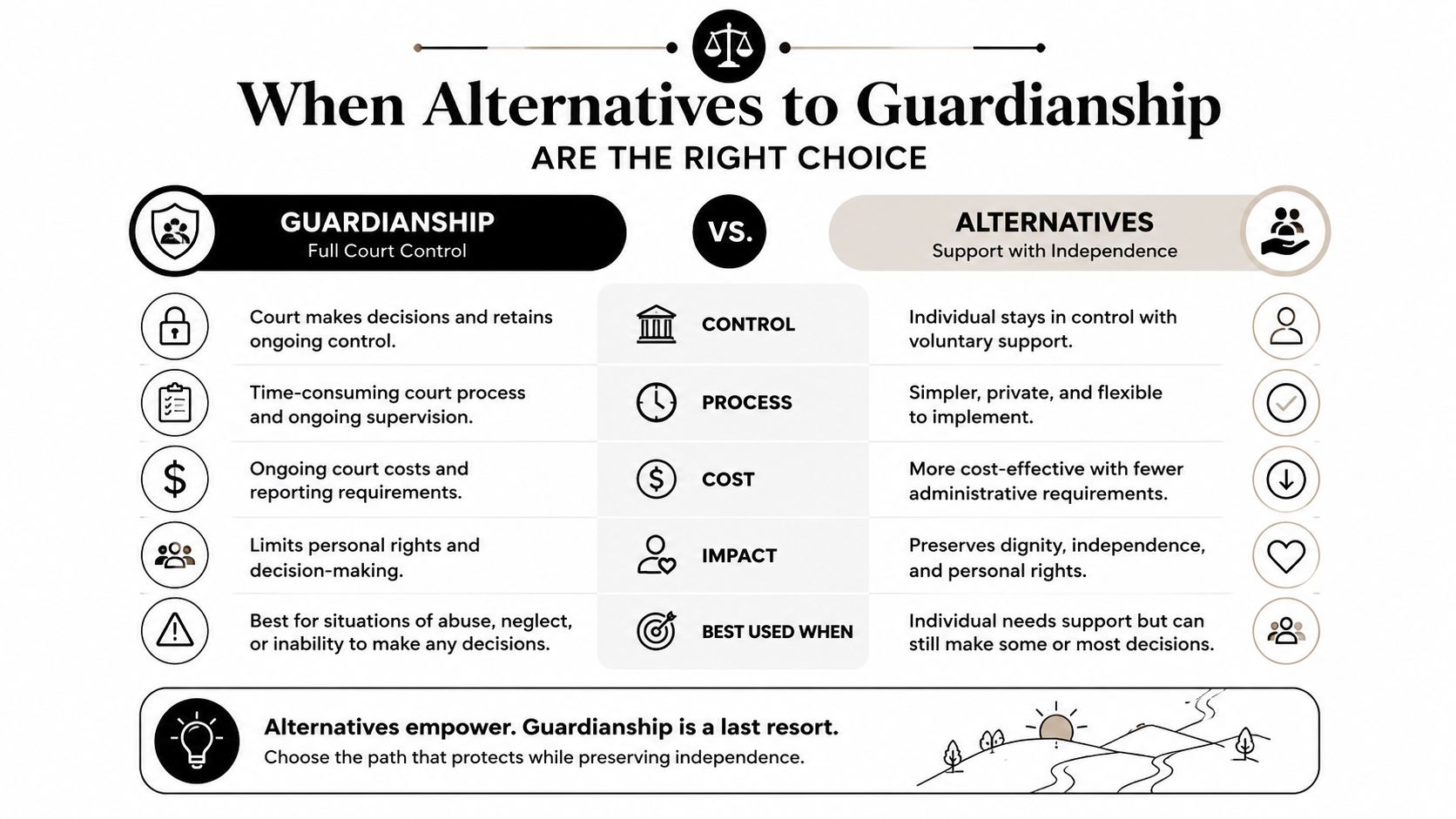
Texas courts are supposed to favor the least restrictive option that still protects the person. Put simply, the law asks a practical question first. Can this problem be solved with a targeted tool instead of handing decision-making power to a court-appointed guardian?
That matters because guardianship removes rights. A good alternative keeps as many rights in the person's hands as possible while still covering the practical problem in front of you.
Common alternatives Texas families should review first
A useful way to sort this out is to identify the exact task that is breaking down. Is someone unable to pay bills, sign medical forms, understand choices without help, or manage property already held in trust? Different problems call for different tools.
Durable Power of Attorney
A Durable Power of Attorney lets a chosen agent handle financial matters. If it was signed while the person had capacity and the language is broad enough, it may cover banking, paying bills, dealing with property, and other daily financial tasks.
This often works well when the person trusted someone in advance and the banks or other institutions will accept the document.
Medical Power of Attorney
A Medical Power of Attorney allows an agent to make health care decisions if the principal cannot make those decisions for themselves. For many families, this is the missing piece during a hospital stay, rehab admission, or discharge planning meeting.
If the problem is medical consent only, filing for guardianship may be unnecessary.
Supported Decision-Making Agreement
A Supported Decision-Making Agreement can be a strong fit for some adults with disabilities who can decide, but need help understanding information, weighing options, or communicating a choice. The person keeps decision-making authority. The supporter helps them process information, much like a good interpreter helps someone understand a complicated conversation without taking over the conversation.
That distinction is important. Needing help is not the same as being unable to decide.
Estate planning tools
Trusts and related planning documents can also reduce the need for guardianship of the estate. If assets are already structured so a trustee or other fiduciary can manage them, the family may not need a court to appoint someone just to handle money.
For a closer look at less restrictive options that may work instead of guardianship, review how these tools compare in real Texas situations.
Guardianship vs. Alternatives in Texas
| Feature | Guardianship | Durable Power of Attorney | Supported Decision-Making |
|---|---|---|---|
| Court involvement | Court case under Texas Estates Code Title 3, Subtitle G | Private document | Private agreement |
| Loss of rights | Can remove significant decision-making rights | Usually preserves rights while allowing an agent to act | Preserves the person's authority |
| Ongoing reporting | Ongoing court duties may apply | No annual court reporting in the ordinary sense | No court reporting in the ordinary sense |
| Best fit | When no lesser option works and protection is necessary | When the person signed a valid document that covers the issue | When the person can decide with support |
| Flexibility | Limited by court order and supervision | Depends on how the document was drafted | Depends on the person's ability and support system |
Washington Law Help also explains why courts look at alternatives before imposing guardianship in its discussion of adult guardianship, conservatorship, and other protective arrangements.
The best legal tool is usually the one that solves the problem while taking away the fewest rights.
Signs an alternative may still work
You may be looking at an alternative, rather than a guardianship filing, if:
- Valid documents already exist: A signed power of attorney, medical power of attorney, trust, or similar document covers the current problem.
- The person can still participate in decisions: They need explanation, reminders, or support, but they can still express a choice.
- The problem is limited: The issue is narrow, such as speaking with doctors, accessing an account, or handling one category of decisions.
- There is no active dispute or exploitation concern: Institutions are cooperating, and no one is accusing the proposed helper of misuse.
Families still benefit from an attorney review here, especially in Texas, because a document can exist on paper and still fail in practice. It may be too old, too narrow, signed incorrectly, or rejected by a bank or hospital. A short legal review can tell you whether the alternative will work before you spend time and money on a guardianship case.
Navigating the Texas Guardianship Process Step by Step
The process often feels overwhelming at first. Families are usually dealing with a health crisis, a safety concern, or a sudden breakdown in decision-making at the same time they are trying to understand court rules. It helps to treat guardianship like a series of checkpoints. At each checkpoint, the judge is asking one basic question: what level of legal authority is needed to protect this person without taking away more rights than necessary?

Step one through step three
Meet with counsel and gather facts
The first job is to define the core problem. Is your loved one unable to consent to medical treatment? Are bills going unpaid? Is someone taking advantage of them financially? The answer matters because Texas courts do not grant guardianship in the abstract. They want to know what decisions need to be covered and why.Review alternatives before filing
Before a case is filed, a careful lawyer will test whether a less restrictive option can still solve the problem. That might include a power of attorney, medical power of attorney, trust arrangement, representative payee, or supported decision-making agreement. If those tools are still workable, guardianship may be too much. If they are missing, rejected, outdated, or no longer reliable, that becomes part of the case.Prepare the application and supporting records
The paperwork needs to fit the facts closely. In many adult cases, medical evidence is central. The court will also want a current physician's certificate that addresses capacity. In Texas, the judicial branch provides probate guardianship forms and instructions that show how these cases are structured, including the physician's certificate and annual reporting forms: Texas Judicial Branch guardianship forms.
What happens after filing
Once the application is filed in the correct court, often a probate court, the case begins to move on two tracks at the same time. One track is about protection. The other is about due process.
That second track surprises families.
The proposed ward has rights, and the court takes those rights seriously. A judge may appoint an attorney ad litem to represent the proposed ward's interests. That lawyer does not represent the family member who filed the case. The ad litem meets with the proposed ward, reviews the circumstances, and gives the court an independent view of the person's wishes, condition, and legal rights.
This step matters because guardianship can remove a person's ability to make some decisions for themselves. Texas courts are careful about that, as they should be.
The hearing
At the hearing, the judge decides three core issues. Is guardianship necessary? If so, what type of guardianship is appropriate? And who should serve?
If no one disagrees, the hearing may be straightforward. If relatives are fighting, if someone questions the medical evidence, or if there are concerns about money, the hearing can become much more demanding. That is one of the Texas red flags that usually calls for an attorney, because the court will be weighing evidence, credibility, and whether the proposed guardian is suitable.
Judges usually want practical answers, not broad labels:
- What decisions can the person still make safely?
- What decisions are they unable to manage?
- What less restrictive options were considered, and why did they fail?
- Why is this particular guardian the right choice?
A diagnosis alone is not enough. The court is looking at day-to-day function. In other words, the question is not just whether a person has dementia, mental illness, or a disability. The question is what that condition prevents them from doing safely and consistently.
After appointment, the work continues
Being appointed guardian is a court-supervised job. It comes with continuing duties, deadlines, and limits. In Texas, the guardian may need to qualify by taking an oath and, in some cases, posting a bond. After appointment, the guardian must keep up with reporting requirements and follow the court's order closely.
Letters of Guardianship in Texas do not stay effective forever without upkeep. They must be renewed through ongoing compliance with court requirements. The Texas Estates Code addresses issuance and renewal of letters through the state legislature's online statutes: Texas Estates Code, Chapter 1106.
That is where many families run into trouble. Winning the hearing is only one part of the responsibility.
Ongoing responsibilities may include
- Following the court order: The guardian must act within the authority the judge granted.
- Keeping detailed records: This is especially important if the guardian handles money or property.
- Filing required reports on time: Delays can create court problems and interrupt authority.
- Putting the ward's interests first: A guardian is expected to act as a fiduciary, which means loyalty and care come first.
For some families, the case becomes manageable once the court order is in place. For others, especially where there is conflict, property, or close court supervision, legal help remains useful well after the hearing.
Guardianship Decisions in Real-World Scenarios
A daughter notices her mother has started leaving the stove on. Her brother insists she is "mostly fine." The bank calls about unusual withdrawals. No one agrees on what to do next.
That is how many Texas guardianship cases begin. Not with a legal theory, but with a family trying to decide whether they need court authority or whether a less restrictive option can still work.

The easiest way to sort this out is to look for Texas-specific red flags. Some facts point toward an attorney and a court case. Other facts suggest the person may still be able to use signed planning documents instead.
Scenario one, contested guardianship between siblings
Elaine lives in Houston. Her brother lives out of state. Their mother has memory loss, but on some days she sounds sharp and says no one should interfere. Elaine believes her mother needs help with daily safety because she is refusing care and wandering. Her brother believes Elaine is overstating the problem so she can gain control.
This usually calls for legal help right away. In Texas, a disputed guardianship is not just paperwork. It becomes a case about proof. The court may need medical evidence, testimony about the mother's day-to-day functioning, and a clear explanation of why guardianship is the least restrictive choice.
Family conflict is one of the clearest warning signs. If one sibling plans to object, accuse another family member of bad motives, or ask to serve as guardian instead, an attorney is often necessary to prepare the case correctly.
Scenario two, sudden incapacity plus financial risk
David's father suffers a severe stroke. He cannot communicate clearly, and a new acquaintance has been using his debit card. No valid power of attorney is in place. The family needs someone with legal authority to protect him, stop the misuse, and make immediate decisions.
Here, the red flags stack up fast. Sudden incapacity. Possible exploitation. No existing planning documents.
That combination often means a lawyer is needed without delay. A Texas court may need to step in because no one else has legal authority to act, and waiting can lead to more financial loss or unsafe care decisions.
Scenario three, guardianship avoided through prior planning
Sandra's parents signed estate planning documents years earlier while they still understood what they were signing. Later, her father began struggling with bills and medical conversations. Sandra was able to step in under those documents and help handle the practical problems.
This is often the better path if it is still available. A power of attorney works like a permission slip created in advance. Guardianship is a court order created after capacity has been lost. If the older documents are valid, broad enough, and accepted by the bank or medical providers, the family may not need a guardianship case at all.
The key question is whether the person still had capacity when the documents were signed and whether those documents cover the decisions that now need to be made.
Scenario four, the hard middle ground
Some families fall between the two obvious examples. A parent may still understand simple choices but cannot manage complex finances. Or an adult child with a disability may be able to make personal decisions, yet need help with benefits or contracts.
These are the cases where families can make mistakes by rushing to court or by waiting too long. Texas courts are supposed to consider less restrictive alternatives before imposing guardianship. That is why careful legal advice matters in close cases. The goal is not to take rights away faster. The goal is to match the legal tool to the actual problem.
The Law Office of Bryan Fagan, PLLC handles guardianship, estate planning, and probate matters related to these decisions across Texas.
Your Next Steps and Questions for Your Attorney
A lot of families reach this point after one hard moment. A bank account has unexplained withdrawals. A parent refuses needed medical care but cannot explain the choice. Two siblings disagree about what is safe. That is usually the sign to stop guessing and get a legal opinion based on the facts in front of you.
Start by sorting the problem into one of two buckets. The first is urgent risk, such as exploitation, unsafe living conditions, or a loved one who is likely to resist help in a way that could turn the case into a dispute. The second is uncertainty, where you are not sure whether existing documents still solve the problem. In Texas, that distinction matters. Some situations call for a guardianship attorney right away. Others may still be handled with planning documents that were signed while your loved one had capacity.
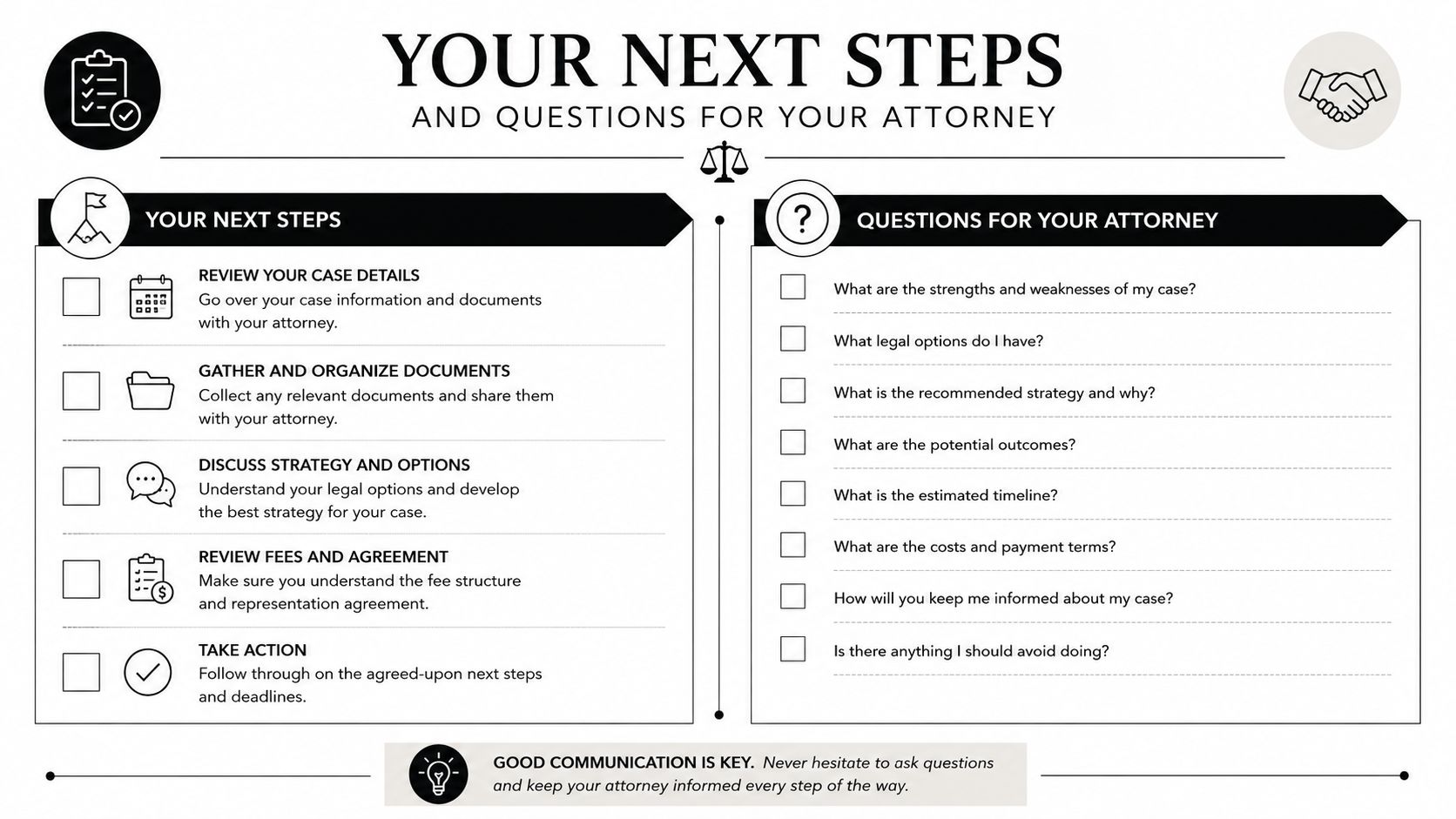
A practical checklist before the consultation
- Collect existing documents: Bring any power of attorney, medical directive, trust papers, court orders, and recent medical information.
- Write down specific examples: Note missed medications, unsafe driving, unpaid bills, wandering, or suspicious financial activity.
- List the decision-makers: Identify close relatives, caregivers, and anyone likely to support or oppose court action.
- Know the county involved: Probate practice can feel different depending on where the case is filed, including courts serving Harris County and nearby counties.
Questions worth asking the attorney
Good questions help your lawyer spot the difference between a case that needs court involvement and one that may still be solved with a less restrictive tool. A guardianship case works like asking the court to hand someone a set of legal keys. Before that happens, you want to know exactly which doors need to be opened and whether another key already exists.
- Do the facts point to guardianship, or is there a less restrictive option?
- Would this likely be contested?
- What type of guardianship fits this situation under Texas Estates Code Title 3, Subtitle G?
- Will the court likely require ongoing reporting, bond, or accountings in this case?
- What should our family do before filing anything?
- If guardianship is granted, what are the guardian's day-to-day duties?
- Can this guardianship later be limited, modified, or ended if circumstances change?
That last question matters because capacity is not always static. A person may improve after treatment, decline over time, or need help in only one area rather than every area of life. Ask the attorney what evidence a court would need to narrow the guardianship later or end it altogether, and what warning signs would suggest that a temporary fix will not be enough.
The right legal step protects your loved one while preserving as much independence as possible.
If you're facing questions about a parent, adult child, or other vulnerable loved one, Law Office of Bryan Fagan, PLLC can help you evaluate whether guardianship is necessary, whether a less restrictive alternative may work, and what Texas court process may apply in your county. A free consultation can give you a clearer path forward and help you make decisions with confidence and care.